What Future Mortgage Advisers Should Be Aware Of

Professional mortgage adviser working in a modern office, representing the skills, professionalism and adaptability needed for a successful long-term mortgage advice career.

People often ask whether becoming a mortgage adviser is a future-proof career. The honest answer is that no career can be guaranteed to remain unchanged. However, mortgage advice continues to play an important role because buying a home is one of the biggest financial decisions most people make. While regulations, technology and customer expectations evolve, the need for knowledgeable, professional advisers remains.

If you are considering mortgage advice as a long-term career, it helps to understand what the role involves beyond passing your CeMAP exams. Success is built on professionalism, continuous learning, adaptability and a genuine commitment to helping clients make informed decisions.

This article explores what future mortgage advisers should know before entering the profession and how to prepare for a rewarding career with realistic expectations.

Professional mortgage adviser working in a modern office, representing the skills, professionalism and adaptability needed for a successful long-term mortgage advice career.

Is Mortgage Advice a Future-Proof Career?

Mortgage advice cannot be described as completely future-proof because every profession changes over time. However, it remains a well-established career that continues to adapt alongside the housing market, financial regulation and consumer needs.

A mortgage adviser helps clients understand their borrowing options, recommends suitable mortgage products and explains the long-term financial commitments involved. This responsibility means the profession is shaped by trust, knowledge and regulation rather than short-term trends.

People will continue to buy homes, remortgage, invest in property and seek guidance during major life changes. Although the way advisers work may evolve, the need for qualified professionals who can explain complex financial information clearly remains important.

For anyone considering CeMAP, it is better to think about building a career that can adapt over time rather than expecting the profession to remain exactly as it is today.

Mortgage Advice Is a Profession Built on Responsibility

Many people are attracted to mortgage advice because they enjoy working with people or have an interest in property. While these are useful qualities, the role carries significant responsibility.

Every recommendation can have a lasting financial impact on a client’s life. Buying a home is often the largest financial commitment someone will ever make, making careful assessment and clear communication essential.

Professional mortgage advisers are expected to:

  • Understand each client’s individual circumstances.
  • Recommend suitable mortgage solutions.
  • Explain costs, risks and commitments clearly.
  • Maintain accurate records.
  • Act within regulatory requirements.
  • Continue developing their professional knowledge.

This responsibility is one reason why advisers must achieve an appropriate qualification before providing regulated mortgage advice.

A successful adviser combines technical knowledge with integrity, patience and strong communication skills.

Why Professionalism Matters Throughout Your Career

Professionalism is not simply about dressing smartly or working in an office. It is demonstrated through every interaction with clients.

Clients often seek reassurance during stressful periods. First-time buyers may feel overwhelmed, while home movers or remortgage clients may be dealing with changing financial circumstances.

Professional advisers build confidence by:

  • Listening carefully before making recommendations.
  • Explaining technical language in plain English.
  • Responding honestly when they do not immediately know an answer.
  • Treating every client fairly and respectfully.
  • Maintaining confidentiality.
  • Following established processes consistently.

These habits help build trust, which is one of the most valuable assets any adviser can develop.

New Blog What future mortgage advisers should be aware of ROLE You are offering forward-looking but cautious guidance. OBJECTIVE Highlight considerations for people entering the profession. AUDIENCE People planning long-term careers. CONSTRAINTS • No forecasts • No fear-based language CONTENT REQUIREMENTS • Discuss responsibility and professionalism • Discuss adaptability • Discuss learning mindset • Emphasise informed commitment SEO & AI OPTIMISATION • Answer “Is mortgage advice a future-proof career?” LENGTH 1,200–1,400 words What Future Mortgage Advisers Should Be Aware Of People often ask whether becoming a mortgage adviser is a future-proof career. The honest answer is that no career can be guaranteed to remain unchanged. However, mortgage advice continues to play an important role because buying a home is one of the biggest financial decisions most people make. While regulations, technology and customer expectations evolve, the need for knowledgeable, professional advisers remains. If you are considering mortgage advice as a long-term career, it helps to understand what the role involves beyond passing your CeMAP exams. Success is built on professionalism, continuous learning, adaptability and a genuine commitment to helping clients make informed decisions. This article explores what future mortgage advisers should know before entering the profession and how to prepare for a rewarding career with realistic expectations. Is Mortgage Advice a Future-Proof Career? Mortgage advice cannot be described as completely future-proof because every profession changes over time. However, it remains a well-established career that continues to adapt alongside the housing market, financial regulation and consumer needs. A mortgage adviser helps clients understand their borrowing options, recommends suitable mortgage products and explains the long-term financial commitments involved. This responsibility means the profession is shaped by trust, knowledge and regulation rather than short-term trends. People will continue to buy homes, remortgage, invest in property and seek guidance during major life changes. Although the way advisers work may evolve, the need for qualified professionals who can explain complex financial information clearly remains important. For anyone considering CeMAP, it is better to think about building a career that can adapt over time rather than expecting the profession to remain exactly as it is today. Mortgage Advice Is a Profession Built on Responsibility Many people are attracted to mortgage advice because they enjoy working with people or have an interest in property. While these are useful qualities, the role carries significant responsibility. Every recommendation can have a lasting financial impact on a client's life. Buying a home is often the largest financial commitment someone will ever make, making careful assessment and clear communication essential. Professional mortgage advisers are expected to: Understand each client's individual circumstances. Recommend suitable mortgage solutions. Explain costs, risks and commitments clearly. Maintain accurate records. Act within regulatory requirements. Continue developing their professional knowledge. This responsibility is one reason why advisers must achieve an appropriate qualification before providing regulated mortgage advice. A successful adviser combines technical knowledge with integrity, patience and strong communication skills. Why Professionalism Matters Throughout Your Career Professionalism is not simply about dressing smartly or working in an office. It is demonstrated through every interaction with clients. Clients often seek reassurance during stressful periods. First-time buyers may feel overwhelmed, while home movers or remortgage clients may be dealing with changing financial circumstances. Professional advisers build confidence by: Listening carefully before making recommendations. Explaining technical language in plain English. Responding honestly when they do not immediately know an answer. Treating every client fairly and respectfully. Maintaining confidentiality. Following established processes consistently. These habits help build trust, which is one of the most valuable assets any adviser can develop. Why Adaptability Is an Essential Skill One of the biggest misconceptions about mortgage advice is that once you qualify, the learning stops. In reality, the industry changes continuously through developments in regulation, lender criteria, technology and customer expectations. Adaptability means being willing to adjust your knowledge and working practices throughout your career. Examples include: Changes in Mortgage Products Lenders regularly introduce new products, withdraw existing ones or amend lending criteria. Advisers need to stay informed so they can provide suitable recommendations. Technology Continues to Improve Many administrative tasks are now supported by digital systems that help advisers compare products, process applications and communicate with clients more efficiently. Technology supports advisers but does not replace the need for professional judgement, empathy and personalised advice. Client Expectations Continue to Evolve Modern clients often research mortgages before speaking to an adviser. They may arrive with information gathered online but still need help understanding how it applies to their own circumstances. An adviser's role increasingly involves helping clients interpret information rather than simply providing it. Why a Learning Mindset Matters More Than Knowing Everything One of the most valuable qualities for any future mortgage adviser is a willingness to keep learning. No adviser knows every lender policy, every mortgage product or every possible client scenario. Even experienced professionals encounter situations they have not seen before. The difference is that experienced advisers know how to research, verify information and seek guidance when required. Developing a learning mindset means: Asking questions. Reviewing new guidance. Reflecting on previous cases. Learning from colleagues. Keeping professional knowledge up to date. Remaining curious throughout your career. This approach builds confidence gradually rather than expecting immediate expertise. CeMAP Is the Start of Your Professional Development The London Institute of Banking & Finance CeMAP qualification provides the educational foundation required for individuals who want to give regulated mortgage advice in the UK. It covers mortgage regulation, products, law and the advice process, helping learners meet the education requirements set by the Financial Conduct Authority for mortgage advisers. Passing CeMAP is a significant achievement, but it should be viewed as the beginning rather than the end of your development. Your knowledge continues to grow through: Practical experience. Working alongside experienced advisers. Continuing Professional Development (CPD). Learning about different client situations. Keeping up with industry changes. Many new advisers discover that their confidence grows considerably during their first few years in the profession. Building Strong Communication Skills Is Just as Important as Technical Knowledge Technical knowledge allows advisers to understand mortgage products, but communication helps clients understand them too. Clients may have little experience of mortgages and financial terminology. Explaining complex information clearly is one of the most valuable skills an adviser can develop. Effective communication includes: Using plain English. Avoiding unnecessary jargon. Confirming client understanding. Listening carefully before offering solutions. Explaining both benefits and potential risks. Being approachable often helps clients feel comfortable asking questions they may otherwise avoid. The Best Advisers Continue Improving One characteristic shared by many successful advisers is a commitment to continuous improvement. Rather than assuming qualification means they have finished learning, they regularly reflect on how they can become more effective. This might include improving: Time management. Client communication. Technical knowledge. Organisation. Research skills. Confidence during appointments. Small improvements made consistently over time often have a greater impact than trying to change everything at once. Why Informed Commitment Matters Before You Start Before committing to any new career, it is worth taking time to understand what daily life actually involves. Mortgage advice can be rewarding for people who enjoy helping others, solving problems and continuing to learn. At the same time, it requires professionalism, attention to detail and a willingness to take responsibility. Being informed means understanding both the opportunities and the responsibilities before beginning your qualification. Questions worth asking yourself include: Do I enjoy working directly with people? Am I comfortable explaining financial information? Can I continue learning throughout my career? Do I enjoy solving problems? Am I prepared to work carefully and accurately? There are no perfect answers, but thinking about these questions helps ensure you are making a considered decision. What Should Future Mortgage Advisers Focus on Before Qualifying? While studying CeMAP, many learners naturally focus on passing the exams. Although this is important, developing broader professional habits at the same time can make the transition into the workplace much smoother. Useful areas to develop include: Good study discipline. Organisation. Clear written communication. Confidence speaking with others. Basic understanding of the housing market. Professional conduct. These skills complement your technical knowledge and prepare you for working with real clients. So, Is Mortgage Advice a Good Long-Term Career Choice? Mortgage advice continues to offer opportunities for people who enjoy helping clients make informed financial decisions. Although no profession is immune to change, advisers who remain professional, adaptable and committed to learning are well placed to build lasting careers. Rather than looking for a career that never changes, it is more realistic to choose one where ongoing development is part of the profession. Mortgage advice fits that description well. If you are prepared to invest in your education, embrace continuous learning and approach the role with professionalism, CeMAP can provide the starting point for a career that develops alongside you. The qualification opens the door, but your long-term success will be shaped by your willingness to keep learning, adapt to change and put clients' interests at the centre of every recommendation. Please create SEO for WordPress backend for this post Edit Please create SEO for this image Following your SEO framework for AI and search optimisation Image Title What Future Mortgage Advisers Should Be Aware Of | CeMAP Career Guide Alt Text Professional mortgage adviser working in a modern office, representing the skills, professionalism and adaptability needed for a successful long-term mortgage advice career. Caption Building a successful mortgage advice career requires professionalism, continuous learning and adaptability alongside gaining your CeMAP qualification. Description A professional featured image for a blog exploring what future mortgage advisers should be aware of before entering the profession. The image highlights key themes including responsibility, professionalism, adaptability and continuous learning, helping answer the common question, "Is mortgage advice a future-proof career?" Ideal for articles about CeMAP, mortgage adviser careers and the UK mortgage industry. Focus Keyword Future mortgage advisers Secondary Keywords Is mortgage advice a future-proof career Mortgage adviser career CeMAP career Becoming a mortgage adviser Mortgage adviser skills Professional mortgage adviser Mortgage advice profession CeMAP qualification This is optimised consistently with your previous blog image SEO and reinforces the primary search intent without keyword stuffing. Please create a side image for section - Why Professionalism Matters Throughout Your Career This is a side image just to give a little visual to text not to repeat its content Edit Please create SEO for this image Following your SEO framework for image optimisation and AI search Image Title Professional Mortgage Adviser Meeting with Client | Mortgage Advice Career Alt Text Professional mortgage adviser meeting with a client in a modern office, demonstrating trust, clear communication and professionalism throughout the advice process.

Why Adaptability Is an Essential Skill

One of the biggest misconceptions about mortgage advice is that once you qualify, the learning stops.

In reality, the industry changes continuously through developments in regulation, lender criteria, technology and customer expectations.

Adaptability means being willing to adjust your knowledge and working practices throughout your career.

Examples include:

Changes in Mortgage Products

Lenders regularly introduce new products, withdraw existing ones or amend lending criteria. Advisers need to stay informed so they can provide suitable recommendations.

Technology Continues to Improve

Many administrative tasks are now supported by digital systems that help advisers compare products, process applications and communicate with clients more efficiently.

Technology supports advisers but does not replace the need for professional judgement, empathy and personalised advice.

Client Expectations Continue to Evolve

Modern clients often research mortgages before speaking to an adviser. They may arrive with information gathered online but still need help understanding how it applies to their own circumstances.

An adviser’s role increasingly involves helping clients interpret information rather than simply providing it.

Why a Learning Mindset Matters More Than Knowing Everything

One of the most valuable qualities for any future mortgage adviser is a willingness to keep learning.

No adviser knows every lender policy, every mortgage product or every possible client scenario. Even experienced professionals encounter situations they have not seen before.

The difference is that experienced advisers know how to research, verify information and seek guidance when required.

Developing a learning mindset means:

  • Asking questions.
  • Reviewing new guidance.
  • Reflecting on previous cases.
  • Learning from colleagues.
  • Keeping professional knowledge up to date.
  • Remaining curious throughout your career.

This approach builds confidence gradually rather than expecting immediate expertise.

CeMAP Is the Start of Your Professional Development

The London Institute of Banking & Finance CeMAP qualification provides the educational foundation required for individuals who want to give regulated mortgage advice in the UK. It covers mortgage regulation, products, law and the advice process, helping learners meet the education requirements set by the Financial Conduct Authority for mortgage advisers.

Passing CeMAP is a significant achievement, but it should be viewed as the beginning rather than the end of your development.

Your knowledge continues to grow through:

  • Practical experience.
  • Working alongside experienced advisers.
  • Continuing Professional Development (CPD).
  • Learning about different client situations.
  • Keeping up with industry changes.

Many new advisers discover that their confidence grows considerably during their first few years in the profession.

CeMAP learner studying at a desk with books and a laptop, representing the start of professional development towards a career as a mortgage adviser.

Building Strong Communication Skills Is Just as Important as Technical Knowledge

Technical knowledge allows advisers to understand mortgage products, but communication helps clients understand them too.

Clients may have little experience of mortgages and financial terminology. Explaining complex information clearly is one of the most valuable skills an adviser can develop.

Effective communication includes:

  • Using plain English.
  • Avoiding unnecessary jargon.
  • Confirming client understanding.
  • Listening carefully before offering solutions.
  • Explaining both benefits and potential risks.

Being approachable often helps clients feel comfortable asking questions they may otherwise avoid.

The Best Advisers Continue Improving

One characteristic shared by many successful advisers is a commitment to continuous improvement.

Rather than assuming qualification means they have finished learning, they regularly reflect on how they can become more effective.

This might include improving:

  • Time management.
  • Client communication.
  • Technical knowledge.
  • Organisation.
  • Research skills.
  • Confidence during appointments.

Small improvements made consistently over time often have a greater impact than trying to change everything at once.

Why Informed Commitment Matters Before You Start

Before committing to any new career, it is worth taking time to understand what daily life actually involves.

Mortgage advice can be rewarding for people who enjoy helping others, solving problems and continuing to learn. At the same time, it requires professionalism, attention to detail and a willingness to take responsibility.

Being informed means understanding both the opportunities and the responsibilities before beginning your qualification.

Questions worth asking yourself include:

  • Do I enjoy working directly with people?
  • Am I comfortable explaining financial information?
  • Can I continue learning throughout my career?
  • Do I enjoy solving problems?
  • Am I prepared to work carefully and accurately?

There are no perfect answers, but thinking about these questions helps ensure you are making a considered decision.

What Should Future Mortgage Advisers Focus on Before Qualifying?

While studying CeMAP, many learners naturally focus on passing the exams. Although this is important, developing broader professional habits at the same time can make the transition into the workplace much smoother.

Useful areas to develop include:

  • Good study discipline.
  • Organisation.
  • Clear written communication.
  • Confidence speaking with others.
  • Basic understanding of the housing market.
  • Professional conduct.

These skills complement your technical knowledge and prepare you for working with real clients.

Organised study desk with a laptop, notebooks, books and study materials representing preparation for the CeMAP qualification and a future mortgage adviser career.

So, Is Mortgage Advice a Good Long-Term Career Choice?

Mortgage advice continues to offer opportunities for people who enjoy helping clients make informed financial decisions. Although no profession is immune to change, advisers who remain professional, adaptable and committed to learning are well placed to build lasting careers.

Rather than looking for a career that never changes, it is more realistic to choose one where ongoing development is part of the profession. Mortgage advice fits that description well.

If you are prepared to invest in your education, embrace continuous learning and approach the role with professionalism, CeMAP can provide the starting point for a career that develops alongside you.

The qualification opens the door, but your long-term success will be shaped by your willingness to keep learning, adapt to change and put clients’ interests at the centre of every recommendation.

Looking for training support?

We offer CeMAP training for learners working towards a career in mortgage advice. Our courses follow the London Institute of Banking & Finance syllabus and are designed to support understanding of mortgage regulation and advice requirements.

Explore our accredited CeMAP training courses

> Futuretrend Financial Training 

What Most People Misunderstand About CeMAP Exams

Student studying for CeMAP exams while separating common myths from the facts about the qualification.

Many people considering CeMAP hear stories about the exams being incredibly difficult, full of trick questions, or impossible to pass without years of financial experience. In reality, most of these beliefs come from misunderstandings rather than the qualification itself. Knowing what to expect can help you prepare more effectively and approach the exams with confidence.

Student studying for CeMAP exams while separating common myths from the facts about the qualification.

Are CeMAP Exams as Hard as People Say?

The short answer is no, not for most learners.

CeMAP exams are challenging because they assess your understanding of mortgage advice, regulation and financial products. They are designed to ensure future mortgage advisers have the knowledge needed to work in a regulated profession. However, they are not intended to catch people out or require advanced mathematical ability.

Many learners pass by studying consistently, using quality learning materials and taking time to understand the topics rather than trying to memorise facts.

The difficulty often comes from the amount of information to learn rather than the complexity of the individual questions.

What Is CeMAP Actually Testing?

The Certificate in Mortgage Advice and Practice (CeMAP) is awarded by the London Institute of Banking & Finance (LIBF) and meets the educational requirements set by the Financial Conduct Authority (FCA) for individuals who want to provide regulated mortgage advice.

Rather than testing whether someone already knows the mortgage industry, the qualification assesses whether they have learned the knowledge needed to advise customers responsibly.

The exams cover areas such as:

  • UK financial regulation
  • Mortgage products
  • Lending principles
  • Property ownership
  • Customer circumstances
  • Ethical and professional responsibilities

The aim is to confirm understanding, not previous experience.

Student studying CeMAP with notes showing the key knowledge areas covered in the qualification.

Misunderstanding 1: You Need a Financial Background

This is one of the most common myths.

Many people believe only bankers, accountants or experienced financial professionals can pass CeMAP. In reality, learners come from a wide variety of backgrounds.

Successful students include people who have previously worked in:

  • Retail
  • Hospitality
  • Customer service
  • Estate agency
  • Administration
  • Education
  • Armed forces
  • Self-employment

The qualification starts with the fundamentals before building towards more specialised mortgage knowledge.

Having experience in finance may make some topics feel more familiar, but it is not a requirement for success.

Misunderstanding 2: The Exams Are Designed to Trick You

Some learners worry that CeMAP exams are full of misleading questions designed to make people fail.

In reality, the exams are written to assess whether you understand the subject matter. Questions often present realistic situations where you need to apply your knowledge rather than simply remember a definition.

This sometimes creates the impression that questions are trying to catch you out.

More often, the challenge is reading carefully and understanding exactly what the question is asking.

Taking time to practise multiple-choice questions and learning how questions are structured can make a significant difference.

Misunderstanding 3: You Have to Memorise Everything

Another common concern is that success depends entirely on memorising hundreds of pages of information.

While some factual knowledge is important, CeMAP places considerable emphasis on understanding principles.

For example, knowing why regulation exists, how different mortgage products work or why affordability assessments matter will often help you answer several different questions.

Learners who focus only on memorising individual facts can sometimes struggle when questions are presented in a different way.

Understanding the subject is usually more valuable than learning isolated facts by heart.

Misunderstanding 4: If You Fail Once, You'll Probably Never Pass

Failing an exam can feel disappointing, but it does not mean someone is unsuited to becoming a mortgage adviser.

Many successful advisers have needed more than one attempt at part of their qualification.

Sometimes learners discover they underestimated the amount of preparation required. Others simply experience exam nerves or identify areas where they need more revision.

A previous unsuccessful attempt often helps learners understand how the exam works, making their future preparation more focused.

One result does not define your ability.

Misunderstanding 5: You Need to Be Brilliant at Maths

People are often surprised to learn that CeMAP is not a maths qualification.

You should be comfortable with basic numerical concepts, percentages and interpreting financial information, but the qualification does not involve advanced mathematical calculations.

The emphasis is on understanding mortgage principles and applying financial knowledge appropriately.

For many learners, reading comprehension and understanding regulation are more significant challenges than mathematics.

Misunderstanding 6: Studying Longer Always Means Better Results

It can be tempting to think that spending hours reading every evening is the best way to prepare.

In practice, quality often matters more than quantity.

Many learners benefit from:

  • Studying in shorter, focused sessions
  • Regular revision rather than cramming
  • Practising sample questions
  • Reviewing weaker topics
  • Using a mixture of books, videos and tutor support

Learning effectively is usually more valuable than simply studying for longer.

Misunderstanding 7: Everyone Finds the Same Parts Difficult

There is no single section that every learner struggles with.

Some people find regulation straightforward but need more time with mortgage products.

Others quickly understand lending principles but take longer to remember legal terminology.

Your previous experience, study style and confidence all influence which topics feel easier or harder.

Comparing yourself with other learners is rarely helpful because everyone’s strengths are different.

Why Do So Many Stories Make CeMAP Sound Difficult?

People naturally tend to share challenging experiences more often than straightforward ones.

Someone who found the exams stressful is more likely to talk about it than someone who quietly revised, passed and moved on.

Online discussions can also unintentionally exaggerate the difficulty. One learner’s experience may be influenced by limited preparation, outdated study materials or personal circumstances.

That does not mean the exams are easy, but it does mean individual stories do not always represent what most learners experience.

Looking for balanced, reliable information can help you build realistic expectations.

CeMAP learner studying while considering common myths and real expectations about the difficulty of CeMAP exams.

What Helps Learners Feel More Confident?

Confidence usually grows from preparation rather than luck.

Many successful learners:

  • Follow a structured study plan
  • Break large topics into manageable sections
  • Use accredited learning resources designed for CeMAP
  • Complete practice questions regularly
  • Revise consistently instead of relying on last-minute study
  • Ask questions whenever something is unclear

Using learning materials from an accredited LIBF Learning Support Provider can also help ensure your resources are aligned with the current CeMAP syllabus and learning outcomes.

Good preparation makes the exams feel far more manageable.

Should You Be Worried About Exam Nerves?

Feeling nervous before an exam is completely normal.

Even well-prepared learners often feel anxious because they care about doing well.

Simple preparation strategies can help reduce unnecessary stress, including:

  • Getting enough rest before the exam
  • Arriving with plenty of time
  • Reading each question carefully
  • Avoiding rushing through the paper
  • Focusing on one question at a time

Confidence usually comes from knowing you have prepared properly rather than trying to eliminate every feeling of nervousness.

Is CeMAP More About Understanding Than Memory?

Yes.

Although some factual recall is required, CeMAP is largely about demonstrating that you understand how mortgage advice works within the UK’s regulated environment.

Understanding relationships between topics often makes revision easier.

For example, when you understand why affordability assessments, customer protection and regulation all work together, individual facts become easier to remember because they fit into a wider picture.

This deeper understanding is also much more useful once you begin working as a mortgage adviser.

Final Thoughts

Most misunderstandings about CeMAP exams come from second-hand stories rather than the qualification itself.

The exams are designed to assess knowledge and understanding, not to discourage people from entering the profession. They require commitment, consistent study and good preparation, but they do not require years of financial experience or exceptional academic ability.

Approaching CeMAP with realistic expectations is often one of the biggest advantages a learner can have. Instead of worrying about the myths, focus on building your understanding step by step, using reliable study materials and giving yourself enough time to prepare.

For many people, CeMAP is challenging but entirely achievable with the right approach.

Looking for training support?

We offer CeMAP training for learners working towards a career in mortgage advice. Our courses follow the London Institute of Banking & Finance syllabus and are designed to support understanding of mortgage regulation and advice requirements.

Explore our accredited CeMAP training courses

> Futuretrend Financial Training 

How Mortgage Regulation Affects Advisers in Practice

how-mortgage-regulation-affects-advisers-in-practice

Mortgage advice is a regulated profession in the UK. Regulation influences almost every part of a mortgage adviser’s role, from the information they gather and the recommendations they make to the records they keep and the training they complete.

For people considering a career in mortgage advice, regulation can sometimes sound complicated or restrictive. In reality, regulation exists to help ensure consumers receive suitable advice, understand the products they are choosing, and are treated fairly throughout the mortgage process.

Understanding how regulation affects mortgage advisers in practice provides a clearer picture of what the role actually involves day to day.

how-mortgage-regulation-affects-advisers-in-practice

What Is Mortgage Regulation?

Mortgage regulation is the framework of rules and standards that govern how mortgage advice is provided in the UK.

The main regulator is the Financial Conduct Authority (FCA). The FCA sets standards that firms and advisers must follow when advising customers about mortgages and related products.

The purpose of regulation is to create a fair, transparent, and trustworthy mortgage market. It aims to reduce the risk of unsuitable advice, improve consumer understanding, and ensure firms act responsibly.

Mortgage advisers do not simply recommend products based on personal opinion. They work within a regulated environment designed to put customer interests at the centre of the advice process.

Why Does Mortgage Regulation Exist?

Mortgage regulation exists primarily to protect consumers.

For many people, a mortgage is the largest financial commitment they will ever make. Choosing the wrong mortgage could have long-term financial consequences.

Regulation helps ensure that:

  • Customers receive clear information
  • Advice is based on individual circumstances
  • Risks are explained appropriately
  • Products are recommended for suitable reasons
  • Firms maintain professional standards
  • Complaints can be investigated fairly

Without regulation, consumers would have fewer protections and less confidence in the advice they receive.

The regulatory system helps create consistency across the industry while promoting trust between advisers and clients.

How Does Regulation Affect Mortgage Advisers Day to Day?

Regulation affects almost every stage of a mortgage adviser’s work.

Many people imagine advisers spend most of their time comparing mortgage rates. While product knowledge is important, a significant part of the role involves following processes designed to ensure recommendations are appropriate and properly documented.

Day-to-day responsibilities often include:

  • Gathering detailed client information
  • Understanding customer needs and objectives
  • Assessing affordability
  • Explaining options clearly
  • Documenting recommendations
  • Maintaining records
  • Completing ongoing training
  • Following firm procedures

Regulation shapes how these activities are carried out and helps ensure consistency across the advice process.

Mortgage adviser reviewing client information and affordability documents as part of the regulated mortgage advice process.

Why Do Advisers Need to Gather So Much Information?

One of the most visible effects of regulation is the amount of information advisers must collect from clients.

Before recommending a mortgage, advisers need to understand a customer’s circumstances thoroughly.

This may include:

  • Income and employment details
  • Existing financial commitments
  • Credit history information
  • Future plans and objectives
  • Deposit availability
  • Property details

Some clients are surprised by the number of questions involved. However, these questions are designed to help advisers understand the client’s situation and recommend products that fit their needs.

Without this information, it would be difficult to assess whether a mortgage is suitable.

Gathering detailed information is therefore a core part of regulated mortgage advice rather than an administrative exercise.

How Does Regulation Influence Mortgage Recommendations?

Regulation requires advisers to have clear reasons for the recommendations they make.

A mortgage recommendation should be based on the customer’s circumstances rather than personal preference or convenience.

When assessing options, advisers may consider factors such as:

  • Affordability
  • Interest rate structure
  • Product flexibility
  • Fees and charges
  • Mortgage term
  • Customer objectives

The goal is to identify products that meet the client’s needs while ensuring they understand how the mortgage works.

Regulation encourages advisers to focus on suitability rather than simply finding the lowest interest rate available.

A mortgage with a lower rate is not always the most appropriate solution if other features better match the client’s circumstances.

Why Is Record Keeping So Important?

Record keeping is a major part of working in a regulated profession.

Mortgage advisers are expected to maintain accurate records of:

  • Customer discussions
  • Information gathered
  • Recommendations provided
  • Supporting evidence
  • Key decisions made during the advice process

Good record keeping helps demonstrate why a recommendation was made and what information was considered at the time.

It also helps protect both customers and advisers if questions arise later about the advice provided.

Many people outside the industry underestimate how much documentation forms part of the adviser role.

While clients often see the meetings and recommendations, there is usually significant work taking place behind the scenes.

Mortgage adviser organising client records and documentation as part of the regulated mortgage advice process.

How Does Regulation Support Consumer Protection?

Consumer protection sits at the heart of mortgage regulation.

The regulatory framework aims to ensure customers are treated fairly throughout the mortgage process.

This includes helping consumers:

  • Understand products clearly
  • Make informed decisions
  • Receive appropriate recommendations
  • Access complaint procedures if needed
  • Understand costs and commitments

Mortgage advisers play an important role in delivering these protections.

Rather than simply arranging mortgages, advisers help customers understand important information and make decisions based on their circumstances.

This consumer-focused approach is one reason mortgage advice remains a regulated activity.

Does Regulation Affect How Advisers Communicate With Clients?

Yes. Regulation influences how advisers communicate with customers.

Information should be presented clearly and fairly. Advisers must avoid creating misunderstandings or giving incomplete explanations.

In practice, this means advisers often spend time discussing:

  • Product features
  • Risks and limitations
  • Costs and fees
  • Repayment obligations
  • Potential future changes

Good communication is an essential skill for mortgage advisers.

Regulation supports transparency by encouraging advisers to ensure customers understand the information they are receiving before making decisions.

What Ongoing Responsibilities Do Mortgage Advisers Have?

Regulation does not end once an adviser becomes qualified.

Mortgage advisers are expected to maintain professional standards throughout their careers.

Ongoing responsibilities may include:

  • Continuing professional development (CPD)
  • Keeping up with regulatory changes
  • Maintaining product knowledge
  • Following firm compliance procedures
  • Completing internal training
  • Demonstrating competence in their role

The mortgage market changes over time, and advisers are expected to keep their knowledge current.

This commitment to ongoing learning helps ensure consumers continue to receive informed and accurate advice.

Mortgage adviser completing professional development and regulatory training as part of ongoing industry responsibilities.

Does Regulation Make Mortgage Advice More Difficult?

Regulation can make the advice process more detailed, but its purpose is not to make life difficult for advisers or customers.

The additional processes are designed to support good decision-making and consumer protection.

Many advisers view regulation as a framework that helps maintain professional standards across the industry.

While compliance responsibilities form part of the role, they also contribute to the trust that consumers place in regulated mortgage advice.

For people considering a career in the sector, understanding and following regulatory requirements becomes a normal part of everyday working life.

How Does Regulation Affect Mortgage Advisers?

Mortgage regulation affects mortgage advisers by shaping how they gather information, assess customer needs, make recommendations, communicate with clients, maintain records, and develop their professional knowledge.

The regulatory framework exists to protect consumers and promote fair outcomes. Rather than being separate from the adviser role, regulation is woven into the daily activities that advisers carry out.

For aspiring advisers studying towards qualifications such as CeMAP, understanding regulation is an important part of understanding the profession itself. Mortgage advice is not simply about finding products. It is about helping customers make informed decisions within a structured and regulated environment that prioritises consumer protection, suitability, and professional responsibility.

Final Thoughts

Mortgage regulation is often viewed as a set of rules advisers must follow, but in practice it shapes how professional mortgage advice is delivered every day.

From gathering client information and assessing affordability to explaining recommendations and maintaining records, regulation influences the entire advice process. Its purpose is to help ensure consumers receive suitable advice, understand their options, and are treated fairly throughout their mortgage journey.

For those considering a career as a mortgage adviser, understanding regulation is an important part of understanding the profession itself. Successful advisers do more than compare mortgage products. They combine technical knowledge, communication skills, and professional responsibility to help clients make informed decisions within a regulated framework.

While regulation creates additional responsibilities, it also helps build trust in the advice process, benefiting both advisers and the customers they serve.

This works well because it summarises the key themes of consumer protection, professionalism, trust, and day-to-day impact without repeating the article word for word, while also giving AI Overviews and search engines a strong concluding summary.

Looking for training support?

We offer CeMAP training for learners working towards a career in mortgage advice. Our courses follow the London Institute of Banking & Finance syllabus and are designed to support understanding of mortgage regulation and advice requirements.

Explore our accredited CeMAP training courses

> Futuretrend Financial Training 

What skills do mortgage advisers need?

Mortgage adviser explaining options to clients showing communication, organisation, empathy and professionalism skills

Choosing a career in mortgage advice is not just about passing exams or gaining a qualification. It is about how you work with people, how you handle responsibility, and how you make decisions that affect real financial outcomes.

A mortgage adviser is someone who helps clients understand their borrowing options and make informed choices. In the UK, this typically involves meeting the qualification requirements set by the Financial Conduct Authority, often through qualifications like CeMAP awarded by the London Institute of Banking & Finance.

But qualifications alone do not define whether someone will feel comfortable or effective in the role. The day-to-day work relies heavily on practical skills and personal traits that develop over time.

This article looks at the key skills and traits that support success in mortgage advice, with a focus on development rather than natural ability.

Mortgage adviser explaining options to clients showing communication, organisation, empathy and professionalism skills

Do you need strong communication skills to be a mortgage adviser?

Yes. Communication is one of the most important skills in mortgage advice, but it is not about being a confident speaker or a “natural salesperson”.

It is about clarity.

Mortgage advisers deal with complex information, including interest rates, lending criteria, affordability assessments, and legal processes. Clients often come in with limited understanding or with assumptions that are not quite right. Your role is to explain things in a way that makes sense to them.

What good communication looks like in practice

Clear communication in this role usually means:

  • Explaining financial concepts in plain language
  • Checking understanding rather than assuming it
  • Listening carefully before offering solutions
  • Adjusting how you explain things depending on the client

For example, one client may want a detailed breakdown of options, while another may feel overwhelmed and prefer a simple comparison.

Listening matters as much as explaining

A common misconception is that communication is mostly about talking. In reality, listening is often more important.

Clients may not always explain their situation clearly at first. They might leave out key details or focus on the wrong concerns. Being able to pick up on what is not being said, and ask the right follow-up questions, is a skill that improves with experience.

This is especially important when discussing sensitive topics such as income, debt, or financial difficulties.

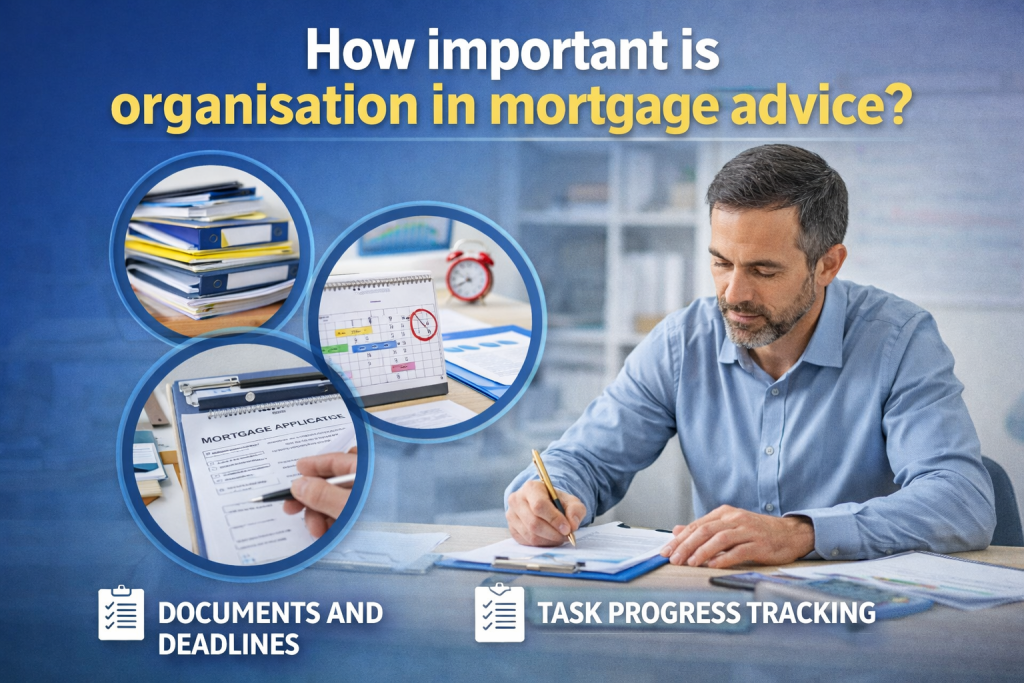
How important is organisation in mortgage advice?

Organisation is essential because mortgage advice involves managing multiple moving parts at once.

You are not just having conversations. You are also:

  • Handling documents and evidence
  • Tracking application progress
  • Meeting lender requirements
  • Managing deadlines and client expectations

Without a structured approach, it becomes easy to miss details or create delays.

Mortgage adviser organising documents and tracking tasks showing importance of organisation in mortgage advice

Why organisation affects client experience

From a client’s perspective, the mortgage process can already feel stressful. Delays, missing paperwork, or unclear updates can make that worse.

An organised adviser helps by:

  • Keeping processes moving smoothly
  • Providing timely updates
  • Reducing uncertainty

This does not mean you need to be naturally “ultra-organised”. Many advisers develop systems over time, using checklists, workflows, and CRM tools to stay on track.

Small habits make a big difference

Organisation in this role often comes down to consistent habits, such as:

  • Recording information accurately after meetings
  • Following up when you say you will
  • Keeping clear notes on each case

These are learnable behaviours rather than fixed traits.

What kind of judgement do mortgage advisers need?

Mortgage advisers regularly make judgement calls, even within structured rules and regulations.

This includes:

  • Assessing which mortgage products may suit a client’s situation
  • Deciding how to present options clearly
  • Identifying potential risks or complications

While lenders provide criteria, real client situations are not always straightforward.

Judgement is about applying knowledge, not guessing

Good judgement does not mean relying on instinct alone. It comes from:

  • Understanding how different lenders operate
  • Recognising patterns in client situations
  • Knowing when something needs further clarification

Over time, advisers build a sense of what is likely to work and what may cause issues later in the process.

Knowing when to slow down

An important part of judgement is recognising when not to rush.

If something does not seem clear or complete, taking time to check details can prevent larger problems later. This might mean going back to the client for more information or double-checking lender criteria.

Why does empathy matter in mortgage advice?

Empathy plays a central role because mortgages are not just financial transactions. They are tied to major life events.

Clients may be:

  • Buying their first home
  • Moving due to family changes
  • Dealing with financial pressure
  • Unsure about long-term commitments

Understanding how someone feels about their situation helps you communicate more effectively and provide appropriate support.

Mortgage adviser showing empathy to clients discussing financial situation and mortgage decisions

Empathy is about awareness, not emotion

You do not need to be overly emotional to be empathetic. It is more about recognising:

  • When a client feels uncertain or anxious
  • When they need reassurance or clarity
  • When to slow down and explain things more carefully

A calm and respectful approach often matters more than trying to be overly reassuring.

Building trust through understanding

Clients are more likely to trust advice when they feel understood. This trust is important because they are relying on you to guide them through decisions that may affect them for years.

Empathy supports that trust, but it develops naturally through experience and exposure to different client situations.

What does professionalism mean in this role?

Professionalism in mortgage advice is about consistency, responsibility, and clear boundaries.

It includes:

  • Being accurate and careful with information
  • Following regulatory requirements
  • Communicating clearly and honestly
  • Managing expectations appropriately

Why professionalism is critical

Mortgage advisers operate within a regulated environment. The standards set by the Financial Conduct Authority are there to protect clients.

This means professionalism is not optional. It is part of the role.

For example, this includes:

  • Avoiding misleading statements
  • Ensuring advice is suitable for the client
  • Keeping records of recommendations

Professional behaviour builds long-term credibility

Clients may not always understand the technical side of what you do, but they do notice how you behave.

Reliability, honesty, and clarity contribute to a professional reputation over time.

Can these skills be developed, or do you need them already?

These skills can be developed. They are not fixed traits that you either have or do not have.

This is an important point, especially for people considering whether mortgage advice is the right fit.

Development happens through experience

Most advisers improve their skills through:

  • Training and structured learning
  • Practical experience with real clients
  • Feedback from managers or mentors

For example:

  • Communication improves through repeated client conversations
  • Organisation improves through building systems and routines
  • Judgement improves through exposure to different cases

Confidence often follows competence

Many people assume they need confidence before starting. In reality, confidence tends to grow as skills improve.

Early on, it is normal to feel unsure or cautious. Over time, as processes become familiar, confidence develops naturally.

What skills do mortgage advisers need overall?

Mortgage advisers need a combination of communication, organisation, judgement, empathy, and professionalism.

No single skill defines success. Instead, it is how these areas work together.

In simple terms:

  • Communication helps clients understand
  • Organisation keeps the process on track
  • Judgement supports decision-making
  • Empathy builds trust
  • Professionalism ensures standards are met

These are practical, developable skills rather than fixed personality traits.

Mortgage adviser with icons showing communication, organisation, empathy, judgement and professionalism skills

Final thoughts

Mortgage advice is a people-focused role built on clear thinking and responsible communication.

It does not require a specific personality type or a perfect starting point. What matters more is a willingness to learn, adapt, and improve over time.

If you are assessing whether the role suits you, it is worth focusing less on whether you already have these skills and more on whether you are open to developing them.

That mindset tends to matter far more in the long run.

Looking for training support?

We offer CeMAP training for learners working towards a career in mortgage advice. Our courses follow the London Institute of Banking & Finance syllabus and are designed to support understanding of mortgage regulation and advice requirements.

Explore our accredited CeMAP training courses

> Futuretrend Financial Training