
Five things every CeMAP learner should know before starting

CeMAP learner studying with notebook and laptop showing five key things to know before starting CeMAP qualification

Starting CeMAP can feel like a big step, especially if you are new to financial services. Most learners focus on how to revise or which course to choose, but there are a few basics that matter just as much and are often missed at the start.

This guide answers a simple but important question: what should you know before starting CeMAP? Getting these foundations right can make your study smoother, more manageable, and far less frustrating.

CeMAP learner studying with notebook and laptop showing five key things to know before starting CeMAP qualification

What is CeMAP and why does it matter?

CeMAP is the industry standard qualification for mortgage advisers in the UK. It is awarded by the London Institute of Banking & Finance and meets the Financial Conduct Authority education requirements for giving mortgage advice.

It matters because without it, you cannot legally advise on mortgages in the UK. It is not just a course. It is the starting point for a regulated career.

That context is important. You are not just studying to pass exams. You are learning knowledge that underpins real financial decisions for clients.

1. CeMAP is manageable, but it is not “easy”

A lot of learners ask whether CeMAP is difficult. The honest answer is that it is very manageable with the right approach, but it is not something you can rush through without effort.

Why this matters

Some learners start thinking it will be straightforward because it is an entry-level qualification. Others go the opposite way and assume it will be overwhelming.

Both views can cause problems:

  • Underestimating it leads to poor preparation
  • Overestimating it leads to unnecessary stress

The reality sits in the middle. The content is clear and structured, but there is quite a lot of it.
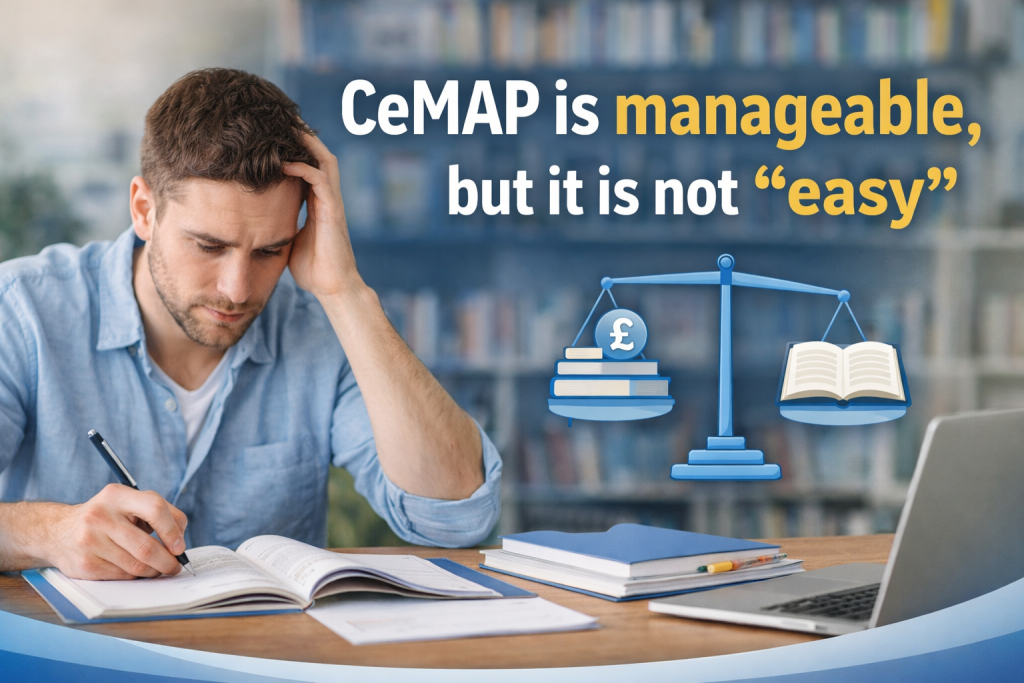
CeMAP learner studying with books and laptop showing that CeMAP is manageable but not easy

What to expect

CeMAP is split into three modules:

  • CeMAP 1 focuses on regulation and core financial services knowledge
  • CeMAP 2 covers mortgage products and processes
  • CeMAP 3 applies your knowledge through case studies

Each builds on the last. If you take shortcuts early on, it tends to catch up with you later, especially in CeMAP 3.

A steady, consistent approach works far better than trying to cram.

2. How you study matters as much as what you study

There is no single “best” way to study CeMAP. Some learners prefer structured lessons, others prefer self-paced learning.

Why this matters

Many learners struggle not because the content is too hard, but because their study method does not suit them.

For example:

  • Reading alone may not work if you need explanation
  • Videos alone may not stick without practice questions
  • Intensive courses may feel too fast if you need time to absorb topics

CeMAP learner studying with notes and laptop showing that how you study matters as much as what you study

Practical advice

Before you start, think about:

  • How you usually learn best
  • How much time you can realistically commit each week
  • Whether you need structure, flexibility, or a mix of both


Many learners benefit from combining resources. For example:

  • Study materials that break down the syllabus
  • Videos explaining each topic
  • Practice questions to check understanding
  • Mock exams to get used to the format

The key point is this: your study method should support your learning, not work against it.

3. Time management is one of the biggest challenges

One of the most common issues learners face is not difficulty with the content, but difficulty staying consistent.

Why this matters

CeMAP is often studied alongside:

  • Full-time work
  • Family commitments
  • Other responsibilities

Without a plan, it is easy to fall behind or lose momentum.

CeMAP learner struggling with time management while studying with notes, laptop and deadlines

What works in practice

You do not need a perfect timetable. You need a realistic one.

A simple approach:

  • Break the syllabus into smaller sections
  • Set weekly goals rather than vague intentions
  • Build in time for revision and practice exams


It is also worth accepting that some weeks will not go to plan. That is normal. The important thing is to get back on track rather than stopping altogether.

Consistency over time matters far more than short bursts of heavy studying.

4. Passing the exam is not just about memorising facts

It is easy to assume that CeMAP is mainly about remembering information. In reality, understanding is just as important.

Why this matters

The exams, particularly later modules, test how well you can apply knowledge, not just recall it.

For example:

  • Understanding why a regulation exists
  • Knowing how a mortgage product fits a situation
  • Interpreting information in a case study

CeMAP learner studying showing that passing exams requires understanding and not just memorising facts

Common mistake

A common mistake is relying too heavily on reading or passive learning without testing yourself.

This often leads to a situation where:

  • The content feels familiar
  • But confidence drops in the exam

Better approach

Use a mix of:

  • Topic-based questions after each section
  • Regular recap of key areas
  • Full mock exams to simulate the real experience

Practising exam-style questions is one of the most effective ways to build confidence and identify gaps.

5. Support and structure can make a big difference

Not all learners need the same level of support, but having access to guidance can make the process smoother.

Why this matters

Studying alone can work well for some people, but others benefit from:

  • Being able to ask questions
  • Having topics explained in different ways
  • Staying accountable to a study plan

Without support, it is easier to feel stuck or lose direction.

CeMAP learner studying with tutor support showing how structure and guidance improve learning

What to look for

Effective support does not have to be complicated. It can include:

  • Clear study materials that simplify the syllabus
  • Access to tutors or learning support teams
  • Structured learning paths
  • Practice resources aligned with the exam format

Some learners prefer virtual classrooms for structure, while others prefer flexible home study with support available when needed.

There is no right or wrong choice. It depends on what helps you stay consistent and confident.

How do these five points fit together?

Each of these insights connects to the same idea:

Success in CeMAP is less about ability and more about preparation and approach.

If you:

  • Understand what the qualification involves
  • Choose a study method that suits you
  • Manage your time realistically
  • Focus on understanding, not just memorising
  • Use support where needed

You give yourself a much stronger starting point.

What should you know before starting CeMAP?

Before you begin, you should know that:

  • CeMAP is a structured but manageable qualification
  • Your study approach will shape your experience
  • Time management is key to staying on track
  • Exams test understanding as well as knowledge
  • The right level of support can make a real difference

These are not complicated ideas, but they are often overlooked. Getting them right early can save time, reduce stress, and improve your chances of progressing smoothly through the qualification.

Final thoughts

Starting CeMAP is a practical step towards a regulated career, not just an academic exercise. That is why it is worth approaching it with a clear plan rather than rushing in.

You do not need to have everything figured out from day one. Most learners adjust their approach as they go. What matters is starting with a realistic view of what is involved and giving yourself the structure to succeed.

If you go in with the right expectations and a steady approach, CeMAP becomes far more straightforward than many people expect.

Looking for training support?

We offer CeMAP training for learners working towards a career in mortgage advice. Our courses follow the London Institute of Banking & Finance syllabus and are designed to support understanding of mortgage regulation and advice requirements.

Explore our accredited CeMAP training courses

> Futuretrend Financial Training 
What Are Common CeMAP Myths? Clearing Up the Misunderstandings

Common CeMAP myths explained with study manual, magnifying glass over the word myths, calculator and mortgage notes on desk

If you have spent any time on forums or social media groups, you will have seen strong opinions about CeMAP. Some are helpful. Others are not.

CeMAP is often discussed in half-truths. People repeat what they have heard rather than what they have checked. Over time, those ideas start to sound like facts.

This article answers the question clearly: what are common CeMAP myths? It explains where they come from and replaces them with accurate information, so you can make decisions based on facts rather than hearsay.

Common CeMAP myths explained with study manual, magnifying glass over the word myths, calculator and mortgage notes on desk

What Is CeMAP?

CeMAP stands for the Certificate in Mortgage Advice and Practice. It is awarded by the London Institute of Banking & Finance and is the industry standard qualification for mortgage advisers in the UK.

CeMAP meets the Financial Conduct Authority’s education requirements for giving regulated mortgage advice. The Financial Conduct Authority sets the regulatory standards for advisers, while the qualification itself is delivered and examined through the awarding body.

CeMAP is a qualification. It is not a licence, not employment, and not authorisation on its own.

Understanding that distinction clears up many of the myths straight away.

Myth 1:

CeMAP Is Extremely Difficult and Most People Fail

This is one of the most common statements you will see online.

Why this myth persists

People who struggle are more likely to post about it than people who quietly pass. Forums often amplify negative experiences. It can also feel reassuring to blame the exam rather than preparation.

The accurate picture

CeMAP is a professional qualification. It requires study, understanding and exam technique. But it is designed for new entrants to the industry, not academic specialists.

The exams test knowledge of:

  • The UK mortgage market
  • Regulation and ethics
  • Mortgage products and repayment methods
  • The advice process

Learners who prepare properly, use structured materials and take practice questions generally perform well. There is no evidence that “most people fail”. Outcomes depend largely on preparation and exam readiness.

CeMAP is demanding, but it is not designed to catch people out.

Myth 2:

You Need a Finance Degree to Pass CeMAP

This idea can put people off before they even begin.

Why this myth persists

Mortgage advice involves regulation, law and financial calculations. That can sound technical, so some assume you need a university background in finance or economics.

The accurate picture

CeMAP does not require a degree. Many successful advisers come from retail, estate agency, customer service, administration or completely unrelated sectors.

The qualification starts with core principles. It explains:

  • How the UK financial system works
  • Basic regulatory structures
  • Mortgage types and features
  • Affordability and suitability principles

It builds knowledge step by step. What matters more than academic background is consistency and attention to detail.

Myth 3:

CeMAP Is Only for Bank Employees

Some learners believe CeMAP is relevant only if you already work in a bank.

Why this myth persists

Historically, high street banks were the most visible employers of mortgage advisers. That perception still lingers.

The accurate picture

CeMAP is required for anyone who wants to give regulated mortgage advice in the UK, whether they work:

  • For a bank
  • For a building society
  • For a mortgage brokerage
  • As an appointed representative under a network

It is not tied to a specific employer. It is the recognised qualification across the industry.

Myth 4:

Passing CeMAP Automatically Makes You a Mortgage Adviser

This misunderstanding can cause real confusion.

Why this myth persists

People often equate qualifications with licences. In some professions, passing an exam does lead directly to practising.

The accurate picture

CeMAP meets the education requirement for giving mortgage advice. It does not provide regulatory authorisation.

To advise clients, you must also:

  • Be authorised by the Financial Conduct Authority, or
  • Work under a firm that is authorised

Firms will also usually require supervised experience and internal training before allowing advisers to give advice independently.

CeMAP is a key step. It is not the final step.

Myth 5:

CeMAP Guarantees You a Job

This belief can lead to disappointment.

Why this myth persists

Training providers and recruiters sometimes highlight industry demand for advisers. Over time, this can be misinterpreted as a promise of employment.

The accurate picture

CeMAP is a recognised entry requirement for mortgage adviser roles. It improves your eligibility. It does not guarantee a job.

Employment depends on:

  • Interview performance
  • Communication skills
  • Commercial awareness
  • Cultural fit with a firm
  • Local job availability

Many learners do find roles after qualifying. But recruitment decisions are made by employers, not by the qualification provider.

Myth 6:

You Must Complete CeMAP in a Few Weeks or It Looks Bad

Online discussions often create pressure around timelines.

Why this myth persists

Some learners complete CeMAP quickly and share their results. Others feel behind and assume they are failing.

The accurate picture

There is no fixed “correct” pace.

CeMAP is typically completed over several months by learners studying alongside work. Others may take longer if balancing family or career commitments.

What matters is understanding the material, not racing through it. Employers are generally more interested in competence than speed.

Myth 7:

CeMAP Is Outdated and Doesn’t Reflect Real Advice

You may see comments suggesting that CeMAP is too theoretical.

Why this myth persists

New advisers sometimes find that real client conversations feel different from textbook scenarios. That contrast can be interpreted as a flaw in the qualification.

The accurate picture

CeMAP focuses on regulation, structure and product knowledge. It ensures advisers understand:

  • The legal framework
  • Consumer protection rules
  • Affordability and suitability principles
  • Ethical responsibilities

Practical confidence develops with experience. The qualification provides the foundation required by the regulator. Workplace training builds on that foundation.

Myth 8:

You Only Need to Revise the Practice Questions

This is a risky approach.

Why this myth persists

Practice questions are useful. Some learners believe memorising them is enough to pass.

The accurate picture

Practice questions help you understand exam style and timing. They do not replace understanding.

CeMAP exams assess applied knowledge. Questions are often scenario-based. Memorising sample answers without grasping underlying principles can lead to confusion if wording changes.

Effective preparation includes:

  • Reading and understanding core materials
  • Revising key definitions and rules
  • Completing varied practice questions
  • Reviewing weaker areas

Understanding always outperforms memorisation.

Myth 9:

If You Fail Once, You’re Not Suited to the Industry

This can feel personal, but it should not be.

Why this myth persists

Exams can feel like judgement. Failing may seem like proof of ability rather than a snapshot of performance on one day.

The accurate picture

Many capable advisers have failed one CeMAP unit at some point. Reasons vary:

  • Nerves
  • Poor time management
  • Underestimating certain topics
  • Life circumstances

A resit is an opportunity to strengthen weak areas. It is not a verdict on long-term suitability.

Resilience and willingness to improve are valuable traits in financial services.

Why Do CeMAP Myths Spread So Easily?

Understanding this helps you filter what you read.

1. Online forums favour extremes

People rarely post “It was fine”. They post strong opinions. That skews perception.

2. Personal experience becomes general advice

One person’s difficulty becomes “everyone struggles”.

3. Confusion between qualification and career

CeMAP is often discussed alongside job searching, income expectations and self-employment. These are separate issues, but they become blurred.

4. Outdated information lingers

Regulation and qualification structures evolve. Old comments remain searchable long after they are relevant.

What Should You Believe About CeMAP?

A balanced view looks like this:

  • CeMAP is a recognised, regulated qualification.
  • It meets the education standards for mortgage advice in the UK.
  • It requires structured study and exam preparation.
  • It does not guarantee employment or authorisation.
  • It is achievable for learners from varied backgrounds.

If you focus on preparation rather than opinion, the process becomes far more manageable.

Final Thoughts: Replace Noise with Facts

When asking “What are common CeMAP myths?”, the answer is not that people are wrong on purpose. Most misinformation spreads through assumption and repetition.

The safest approach is to rely on:

  • Official guidance from the awarding body
  • Clear regulatory information
  • Structured learning materials

Treat online commentary as personal opinion, not evidence.

CeMAP is neither impossibly difficult nor effortlessly simple. It is a professional qualification designed to prepare advisers to work within a regulated environment.

If you approach it with realistic expectations and steady preparation, you are far more likely to form your own view based on experience rather than myth.

Looking for training support?

We offer CeMAP training for learners working towards a career in mortgage advice. Our courses follow the London Institute of Banking & Finance syllabus and are designed to support understanding of mortgage regulation and advice requirements.

Explore our accredited CeMAP training courses

> Futuretrend Financial Training