What Makes a CeMAP Course Actually Effective (Beyond Content)?

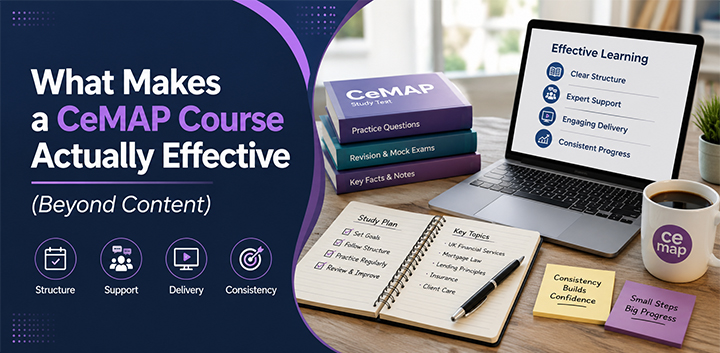
Student studying CeMAP with organised study materials, laptop and notebook, illustrating how structure, support, delivery and consistency contribute to an effective CeMAP course.

When people compare CeMAP courses, it’s easy to focus on what seems most obvious. How many modules are included? How thick is the study manual? Are there mock exams? Is there video content?

While all of these things have value, they don’t necessarily determine whether a course will help you learn effectively.

A good CeMAP course is not simply one with the most content. It’s one that helps learners understand, retain and apply the material consistently over time. The way information is organised, delivered and supported often has a far greater impact than the quantity of resources available.

If you’re comparing providers, looking beyond the course materials themselves can help you choose a learning experience that genuinely suits the way you study.

Student studying CeMAP with organised study materials, laptop and notebook, illustrating how structure, support, delivery and consistency contribute to an effective CeMAP course.

What Makes a Good CeMAP Course?

A good CeMAP course combines accurate learning materials with clear structure, effective delivery, ongoing support and a study approach that encourages consistent progress. Success comes from how well learners engage with the material, not simply how much content is provided.

The most effective courses recognise that learning is a process rather than a collection of documents.

Why Isn't More Content Always Better?

One of the biggest misconceptions is that more resources automatically create a better course.

It’s understandable why this belief exists. If one provider offers hundreds of pages of notes, dozens of videos and countless downloadable documents, it can appear to offer greater value.

In reality, too much information can sometimes make studying harder.

When learners are faced with large volumes of material without clear guidance, they may struggle to identify what matters most. Instead of building understanding step by step, they spend valuable study time deciding where to start.

Effective learning is about selecting the right information at the right time.

A well-designed CeMAP course focuses attention on the syllabus, explains concepts clearly and builds knowledge gradually rather than overwhelming learners with every possible resource.

Why Does Course Structure Matter?

Structure is often the hidden factor that separates effective learning from frustrating learning.

A structured course guides learners through topics in a logical sequence. Each lesson builds naturally on previous knowledge, making new concepts easier to understand.

Without structure, learners may:

  • Jump between unrelated topics
  • Miss important foundation knowledge
  • Spend too much time revising weaker areas while neglecting others
  • Feel overwhelmed despite studying regularly

Good course design removes unnecessary decision-making.

Instead of asking, “What should I study next?”, learners always know the next step.

This creates momentum, which is one of the biggest contributors to consistent progress.

Organised CeMAP study workspace with structured learning materials, progress blocks and study planning representing the importance of course structure for effective learning.

How Does Good Delivery Improve Learning?

The same information can be taught in very different ways.

Delivery refers to how course content is presented, explained and reinforced.

Some learners absorb information best through reading.

Others benefit from hearing explanations during tutor-led sessions.

Some prefer diagrams, worked examples or practical scenarios that demonstrate how concepts apply in real situations.

An effective CeMAP course recognises that simply providing information isn’t enough.

Good delivery focuses on making difficult concepts easier to understand.

Examples include:

  • Breaking complex topics into smaller sections
  • Explaining technical language in plain English
  • Using realistic mortgage scenarios
  • Revisiting important concepts throughout the course
  • Allowing time for questions and clarification

Learning becomes much easier when explanations reduce confusion rather than increase it.

Why Is Support So Important During a CeMAP Course?

Support is often overlooked when comparing courses, yet it can make a significant difference.

Even motivated learners occasionally reach topics that don’t immediately make sense.

Without support, small misunderstandings can become larger problems as new topics build on earlier knowledge.

Support may include:

  • Tutor guidance
  • Question and answer sessions
  • Feedback on practice questions
  • Clarification of difficult concepts
  • Study advice when learners lose momentum

Importantly, support isn’t about giving learners the answers.

It’s about helping them understand why an answer is correct so they can apply the same thinking elsewhere.

Knowing that help is available can also reduce anxiety, making learners more willing to tackle difficult areas instead of avoiding them.

What's the Difference Between Content and Learning?

This is perhaps the most important distinction to understand.

Content is the information.

Learning is what happens after someone engages with that information.

Two learners can read exactly the same chapter yet leave with very different levels of understanding.

Learning involves:

  • Understanding concepts
  • Remembering information
  • Applying knowledge to exam questions
  • Identifying mistakes
  • Improving over time

Simply reading study notes repeatedly does not guarantee learning.

Effective courses encourage active participation rather than passive reading.

That might involve practice questions, discussions, revision activities or opportunities to test understanding throughout the course.

The goal isn’t simply to complete the materials.

The goal is to build lasting understanding.
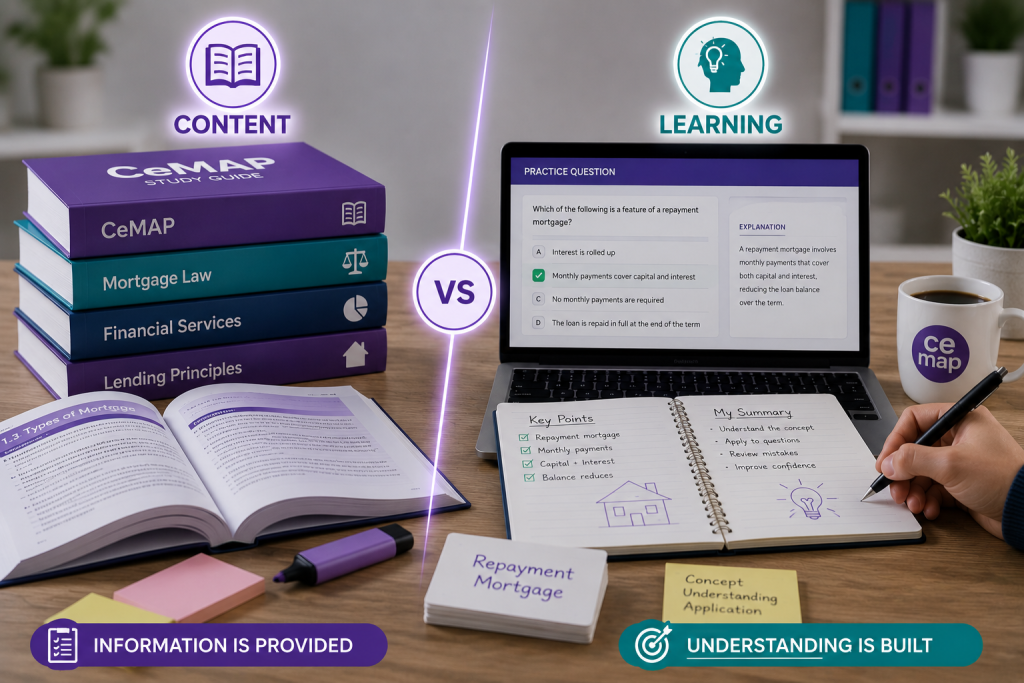
CeMAP study workspace comparing study materials with active learning methods, showing the difference between reading content and building understanding through practice and revision.

Why Does Consistency Matter More Than Intensity?

Many learners begin their CeMAP studies with enthusiasm.

They spend entire weekends studying, cover several chapters and make rapid early progress.

Then work becomes busy, motivation drops or life gets in the way.

Large gaps between study sessions often make revision harder because previously learned information begins to fade.

Consistent study generally produces better long-term understanding than occasional intensive sessions.

Effective CeMAP courses encourage steady progress by presenting manageable learning goals rather than expecting learners to absorb everything quickly.

Small, regular study sessions often make it easier to:

  • Retain information
  • Build confidence
  • Identify weak areas early
  • Reduce exam stress
  • Maintain motivation over several months

Learning is usually more sustainable when it becomes part of a routine.

How Does Active Learning Improve a CeMAP Course?

One feature common to effective CeMAP learning programmes is active engagement.

Active learning means learners regularly test their understanding instead of simply consuming information.

Examples include:

  • Answering practice questions
  • Explaining concepts in their own words
  • Completing mock exams
  • Reviewing incorrect answers
  • Revisiting difficult topics until they become familiar

These activities strengthen recall and highlight areas that still need attention.

By contrast, passive activities such as repeatedly reading notes can create the impression of progress without revealing knowledge gaps.

A good course encourages learners to interact with the material rather than simply read it.

Should Flexibility Be Part of an Effective CeMAP Course?

Flexibility matters because learners have different responsibilities outside their studies.

Some study around full-time employment.

Others balance family commitments or changing work patterns.

An effective course allows learners to build study around their lives while still maintaining enough structure to encourage progress.

Flexibility should not mean complete absence of guidance.

Instead, it should give learners options while still providing a clear pathway through the syllabus.

Finding the right balance between freedom and direction often leads to a more positive learning experience.

What Questions Should You Ask Before Choosing a CeMAP Course?

Rather than comparing only price or the amount of content included, consider asking questions such as:

  • Is the course structured logically?
  • How is difficult content explained?
  • What learner support is available?
  • Are there opportunities to ask questions?
  • Does the course encourage regular practice?
  • Is there guidance on revision?
  • Does the learning style suit the way I prefer to study?

These questions often reveal more about the overall learning experience than a list of downloadable resources.
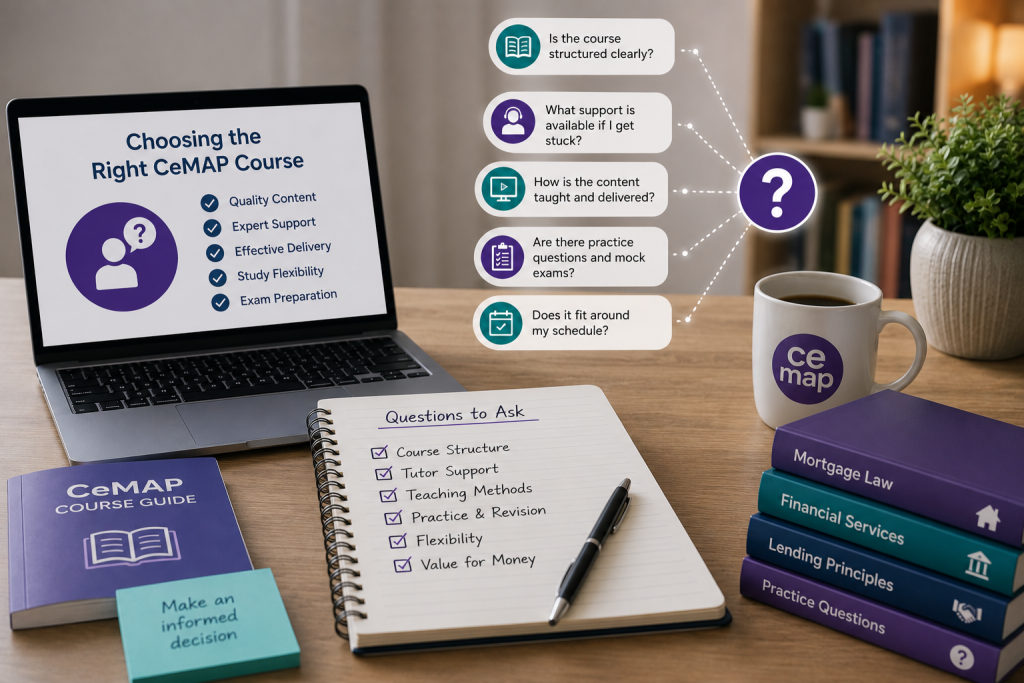
Student comparing CeMAP courses using a checklist, laptop and study materials to evaluate course structure, tutor support, teaching methods and learning resources.

Can the Best Course Guarantee Success?

No.

No CeMAP course can guarantee exam success because learning ultimately depends on how learners engage with the material.

The most effective courses provide the tools, guidance and support needed to build understanding, but learners still need to study consistently, practise regularly and develop confidence over time.

Choosing a course that matches your preferred learning style can make studying more productive, but personal commitment remains an essential part of success.

Final Thoughts

When people ask, What makes a good CeMAP course?, they’re often expecting the answer to be about books, videos or revision notes.

In reality, those are only part of the picture.

A genuinely effective CeMAP course combines well-organised content with thoughtful structure, clear delivery, meaningful support and opportunities for active learning. It helps learners understand the syllabus rather than simply work through it.

Ultimately, learning is not measured by how much content you receive but by how confidently you can apply what you’ve learned in the exam and beyond.

When comparing CeMAP courses, looking beyond the materials themselves can help you choose a learning experience that supports steady, confident progress rather than simply providing more information.

Looking for training support?

We offer CeMAP training for learners working towards a career in mortgage advice. Our courses follow the London Institute of Banking & Finance syllabus and are designed to support understanding of mortgage regulation and advice requirements.

Explore our accredited CeMAP training courses

> Futuretrend Financial Training 
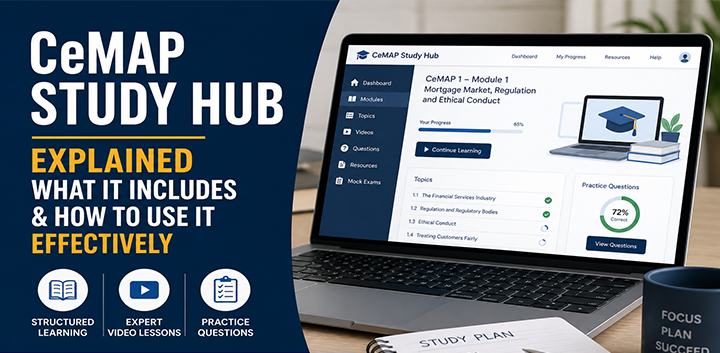
What the CeMAP Study Hub actually includes (and how to use it properly)

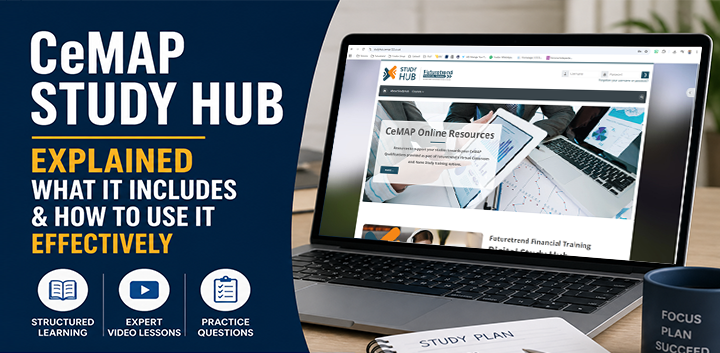
CeMAP Study Hub online learning platform showing structured modules, video lessons and practice questions

What is a CeMAP Study Hub?

A CeMAP Study Hub is an online learning platform designed to organise and deliver structured study for the CeMAP qualification.

It brings together learning materials, topics, and practice tools in one place, arranged in a logical order so learners can progress step by step rather than trying to piece everything together themselves.

Most Study Hubs are built around the official syllabus set by the London Institute of Banking & Finance, which means the content follows the same structure as the actual exams.

In simple terms, a Study Hub is not just a collection of resources. It is a guided framework that shows you:

  • What to study
  • In what order
  • How to check your understanding
  • When you are ready to move on
CeMAP Study Hub online learning platform displayed on laptop with study notes and workspace

What does a CeMAP Study Hub typically include?

A good Study Hub is made up of several core elements. These work together to support both learning and revision.

Structured topic content

At the heart of any Study Hub are the syllabus topics.

Each CeMAP module is broken down into smaller sections, covering areas such as:

  • Regulation
  • Mortgage law
  • Products and processes
  • Ethics and conduct

These are not random chunks of content. They follow the same order you would see in the official syllabus, which helps avoid gaps in knowledge.

Video lessons

Most Study Hubs include video presentation lessons or walkthroughs.

These are used to:

  • Explain complex topics in plain language
  • Add context to written material
  • Highlight key points that often come up in exams

Video content can be especially useful for topics that feel dry or technical when read on their own.

Revision resources

Alongside learning content, most Study Hubs include supporting materials such as:

  • Summary notes
  • Key fact sheets
  • Revision guides
  • Audio guides
  • Exam tips

These are designed to help with revision rather than first-time learning.

Practice questions

CeMAP Practice questions are a key part of structured learning.

They allow you to:

  • Check your understanding as you go
  • Get used to the way exam questions are written
  • Identify weak areas early

Some platforms include topic-based questions, while others also provide mock exams that reflect the real assessment format.

Progress tracking

Many platforms include a way to track your progress through the course.

This might show:

  • Which topics you have completed
  • Your scores on practice questions
  • Areas that need more attention

While not essential, this can help keep your study organised and consistent.

How is a Study Hub structured?

One of the main strengths of a CeMAP Study Hub is how clearly everything is organised.

Most platforms follow a simple hierarchy:

Module → Topic → Resource

This structure is what makes the platform effective.

Module level

CeMAP is split into separate modules (for example, CeMAP 1, 2, and 3).

Each module covers a broad area of knowledge and is assessed separately.

CeMAP Study Hub structure shown on laptop with module topic and resource layout

Topic level

Within each module, the content is broken down into smaller topics.

For example:

  • A module might include regulation
  • Regulation might be split into specific rules, bodies, and principles

This makes large sections of content easier to manage.

Resource level

Within each topic, you will find the actual learning materials:

  • Videos
  • Written explanations
  • Audio explanation
  • Practice questions
  • Downloads

This is where the learning happens day to day.

How should you use a Study Hub effectively?

Knowing what is inside a Study Hub is one thing. Using it properly is what actually makes a difference.

Here is a simple way to approach it.

1. Follow the structure from start to finish

The biggest advantage of a Study Hub is the order it provides.

It is tempting to jump straight into areas that feel easier or more interesting, but this often leads to gaps later on.

Working through topics in sequence helps build understanding step by step.

2. Engage actively with each topic

Passive learning does not work well for CeMAP.

Instead of just watching videos or reading notes:

  • Pause and think about what you have learned
  • Make short notes in your own words
  • Try to explain the topic out loud

This helps move information from short-term to long-term memory.

3. Use practice questions early and often

Do not wait until the end to start testing yourself.

After each topic:

  • Complete the related questions
  • Review both correct and incorrect answers
  • Go back to the content if something is unclear

This approach reinforces learning and highlights problems early.

4. Revisit weak areas

A Study Hub makes it easy to go back to specific topics.

If you struggle with something:

  • Rewatch the video
  • Reread the notes
  • Attempt the questions again

Progress is not about getting everything right first time. It is about improving understanding over time.

5. Use revision resources closer to the exam

Summary materials are useful, but they are not a replacement for learning.

Use them:

  • After completing the full module
  • When preparing for mock exams
  • In the final stages before the real exam

They are best used for reinforcement, not first exposure.

Common mistakes when using online learning platforms

Even with a well-structured Study Hub, it is easy to fall into habits that slow progress.

Jumping between topics

Skipping around the platform might feel productive, but it often leads to:

  • Missing key foundations
  • Confusion between related topics
  • Weaker overall understanding

Structure only works if you follow it.

Passive consumption

Watching videos without thinking or taking notes can give a false sense of progress.

It may feel like you understand the material, but this often disappears when you try to answer questions.

Avoiding difficult areas

Everyone has topics they find harder.

Avoiding them does not make them go away. In fact, these are often the areas that matter most for exam performance.

Leaving practice too late

Some learners focus only on learning content and delay testing themselves.

This can lead to:

  • Poor exam technique
  • Lack of familiarity with question style
  • Surprises in the actual exam

Practice is part of learning, not something separate from it.

How structure improves understanding

A structured platform is not just about organisation. It directly affects how well you learn.

It builds knowledge in layers

Each topic builds on the previous one.

For example:

  • Understanding regulation helps make sense of mortgage advice rules
  • Knowing products helps with case study questions

Without this order, learning can feel disconnected.

It reduces overwhelm

CeMAP covers a wide range of content.

Breaking it into smaller, manageable sections makes it easier to:

  • Stay focused
  • Track progress
  • Maintain motivation
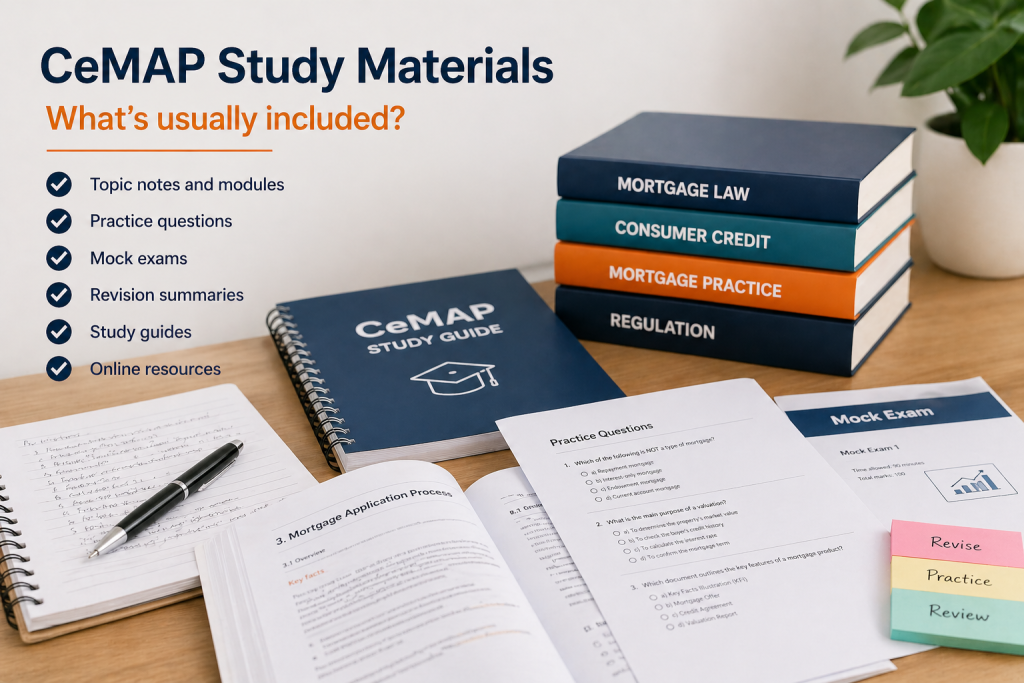
CeMAP study materials including notes practice questions mock exams and study guides

It supports consistent study

A clear structure removes the need to decide what to study next.

This helps build a routine, which is often more important than study intensity.

It mirrors the exam structure

Because Study Hubs are based on the official syllabus, they align closely with how exams are written.

This means:

  • You are less likely to encounter unfamiliar topics
  • Your preparation is more targeted
  • Your confidence improves over time

How to use online learning platforms effectively

Using a Study Hub well comes down to a few simple principles:

  • Follow the intended order
  • Stay actively engaged
  • Test yourself regularly
  • Review and revisit weak areas
  • Use summaries for revision, not learning

These apply to most online learning platforms, not just CeMAP.

The platform provides the structure, but the results depend on how you use it.

Final thoughts

A CeMAP Study Hub is best understood as a structured guide rather than just a collection of materials.

It brings together:

  • Clear topic organisation
  • Multiple ways to learn
  • Opportunities to test understanding

When used properly, it helps turn a large and sometimes complex syllabus into something manageable and logical.

It does not replace effort or guarantee outcomes, but it does remove a lot of the uncertainty around what to study and how to approach it.

That clarity is often what learners need most.

Looking for training support?

We offer CeMAP training for learners working towards a career in mortgage advice. Our courses follow the London Institute of Banking & Finance syllabus and are designed to support understanding of mortgage regulation and advice requirements.

Explore our accredited CeMAP training courses

> Futuretrend Financial Training