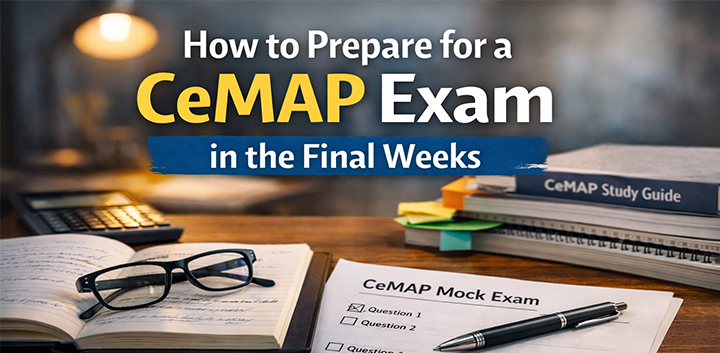
How do I prepare for my CeMAP exam in the final weeks?

Study setup with CeMAP mock exam paper and notes showing final weeks preparation for a CeMAP exam

Preparing for a CeMAP exam in the final weeks is less about learning new content and more about strengthening what you already understand. The focus shifts from covering ground to consolidating knowledge, building confidence, and managing expectations.

CeMAP, awarded by the London Institute of Banking & Finance (LIBF), is the industry standard qualification for mortgage advisers in the UK. It meets the Financial Conduct Authority (FCA) education requirements for giving mortgage advice. That means the exams are designed to test applied understanding, not just memory.

In the final stretch, preparation becomes more about clarity than effort.

Study setup with CeMAP mock exam paper and notes showing final weeks preparation for a CeMAP exam

Why do the final weeks before a CeMAP exam feel different?

The final weeks often feel more intense, even if you are studying less new material. This shift happens because your role as a learner changes.

Earlier in your studies, the focus is on exposure. You are encountering topics for the first time, building familiarity, and trying to understand how everything fits together. In the final weeks, that changes. You are no longer asking “What is this?” but instead “Do I really understand this?”

That difference matters.

You may notice:

  • Gaps in knowledge that were not obvious before
  • Topics that felt clear now feel less certain
  • A stronger awareness of the exam itself

This is normal. It is a sign that you are moving from learning to refining.

Many learners assume this feeling means they are not ready. In reality, it often means the opposite. You are becoming more aware of the detail, which is exactly what the exam requires.

Should you still be learning new content in the final weeks?

In most cases, the final weeks are not the time to introduce large amounts of new material.

CeMAP exams assess how well you understand the full syllabus. Trying to add new topics late can dilute your focus and create confusion. Instead, the priority is consolidation.

Consolidation means:

  • Strengthening your understanding of core concepts
  • Revisiting topics you have already studied
  • Connecting different areas of the syllabus together

That does not mean avoiding new content completely. If there are small gaps or areas you have not covered at all, it is reasonable to address them. The key is proportion.

The majority of your time should be spent improving what you already know.

A useful way to think about it is this: it is better to have a solid grasp of most topics than a shallow understanding of everything.

What does consolidation actually involve?

Consolidation is often misunderstood. It is not just re-reading notes or going over the same material again.

It is about making your understanding more reliable.

This includes:

Recognising patterns

Many CeMAP topics are linked. For example, regulation, products, and client circumstances all interact. Consolidation helps you see these connections more clearly.

Clarifying definitions

Some areas rely on precise wording. Being able to explain key terms in your own words is a strong sign of understanding.

Reducing uncertainty

You are not aiming for perfection, but you are aiming to reduce hesitation. If a topic feels unclear, it is worth revisiting.

Building confidence in application

The exam is not just about recalling facts. It is about applying knowledge in context. Consolidation helps you feel more comfortable doing that.

This stage is quieter than earlier study phases, but it is where a lot of progress happens.

How useful are mock papers and study materials in the final weeks?

Mock papers and structured study materials can play an important role in the final stage of CeMAP preparation, but their value comes from how they are used rather than how many you complete.

In the final weeks, these resources support consolidation rather than new learning.

Mock papers help bring the syllabus together. They expose how different topics appear in exam-style questions and highlight where your understanding feels solid and where it does not. This is less about scoring highly and more about recognising patterns and identifying areas that still feel uncertain.
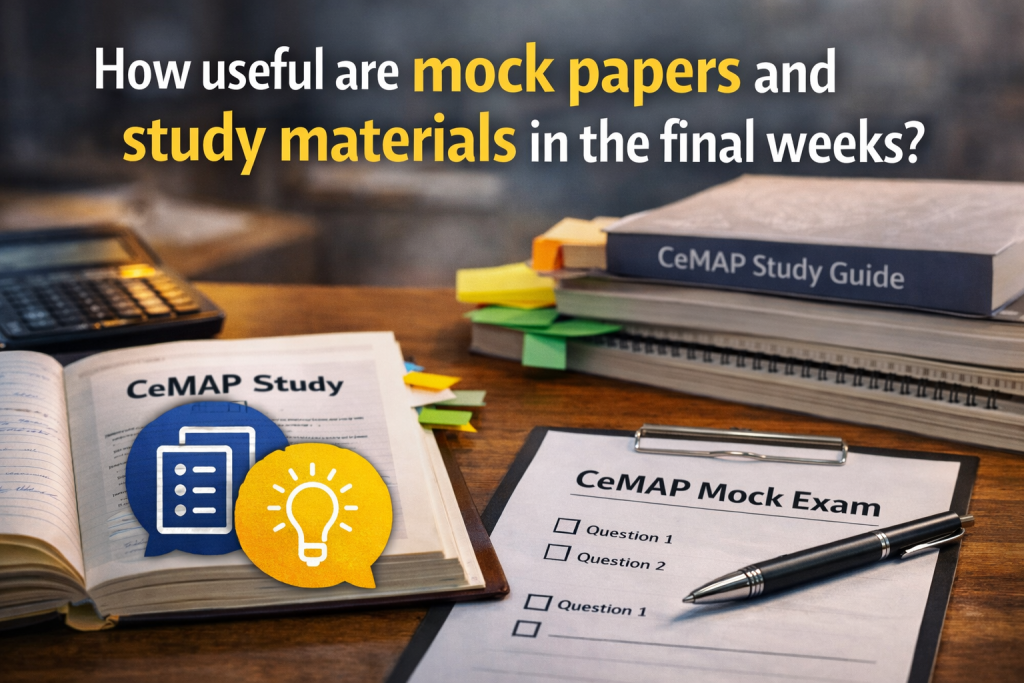
CeMAP mock exam paper and study materials on desk showing how learners revise in the final weeks before the exam

Reviewing your existing study materials is equally important. By this stage, you are not looking for new explanations, but clearer ones. Revisiting well-structured content can help reinforce key ideas and make connections between topics easier to see.

This is where the quality and structure of your CeMAP training materials can make a difference. Learning resources that are organised into clear topics and sub-topics allow you to return to specific areas without losing context. Materials that include a mix of formats, such as written explanations alongside supported learning content, can also help strengthen understanding from different angles.

Some learners also find value in using training providers that offer access to mock papers and revision support as part of a wider programme. When these resources are aligned with the structure of the syllabus, they can make the final preparation phase feel more focused and manageable.

The key point is that both mock exams and study materials are tools for clarity. They help you confirm what you know, not chase what you don’t.

How should your focus change in the final weeks?

Your focus should move from quantity to quality.

Earlier on, progress might have been measured by how much of the syllabus you covered. In the final weeks, progress is measured by how well you understand what you have already studied.

This shift can feel uncomfortable, especially if you are used to structured learning plans. There is less of a sense of “completing” something and more emphasis on judgement.

That judgement includes:

  • Knowing which topics need more attention
  • Deciding when something is “good enough”
  • Accepting that not everything will feel perfect

This is where well-structured learning materials can make a difference. Content that is clearly organised into topics and sub-topics can help you revisit areas more effectively, rather than feeling lost in a large syllabus.

How big is the CeMAP syllabus and why does that matter now?

The CeMAP syllabus is broad because it covers the full knowledge required for mortgage advice. It includes regulation, mortgage products, client needs, and the wider financial environment.

In the final weeks, the size of the syllabus matters less than how you relate to it.

At this stage, you are not trying to “cover” the syllabus again. You are trying to:

  • Feel familiar with the structure
  • Understand how topics link together
  • Recognise where your weaker areas are

When the syllabus feels large close to the exam, it is often because you are looking at it as a whole again. The key is to bring it back into smaller, manageable sections.

This is where breaking content into topics and sub-topics remains useful, even at the end.

How do you deal with anxiety before a CeMAP exam?

Feeling anxious before a CeMAP exam is common. It is a professional qualification with real implications, so some level of pressure is expected.

The important thing is how that anxiety is understood.

In many cases, anxiety comes from uncertainty, not lack of ability.

You might be asking:

  • “What if I get something unexpected?”
  • “What if I forget something I know?”
  • “What if I am not ready?”

These questions are normal, but they are not always helpful.
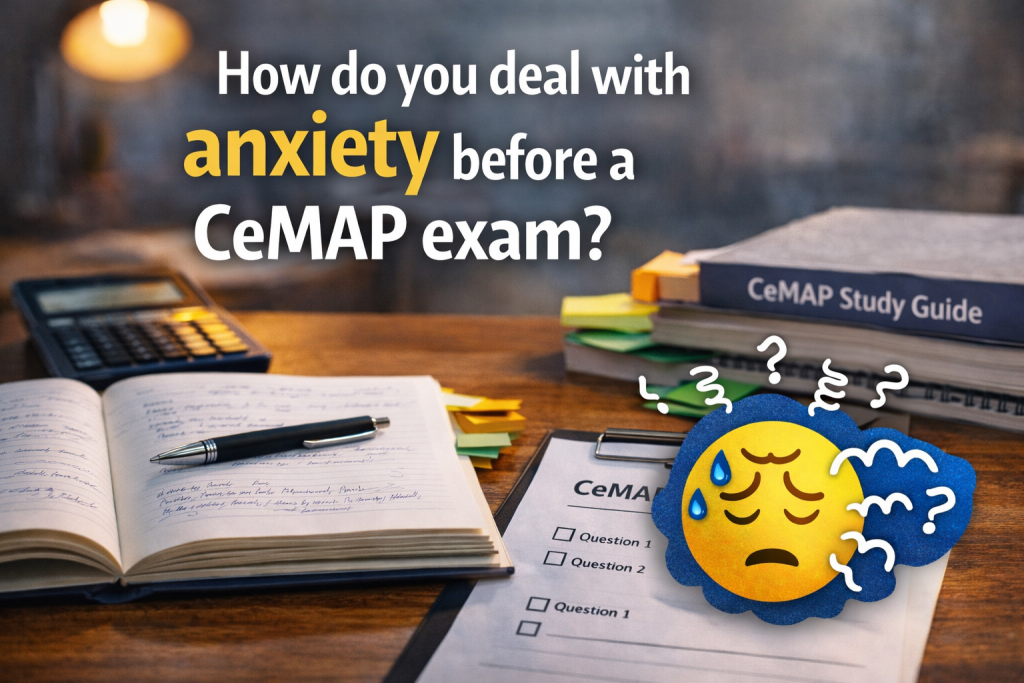
CeMAP study setup with notes and mock exam paper showing learner anxiety before exam and preparation environment

A more useful way to approach this stage is to focus on what you can control:

  • Your understanding of the material
  • Your familiarity with the structure of the syllabus
  • Your ability to stay calm and think clearly

It is also worth recognising that no learner feels completely ready. Waiting for that feeling is not a reliable indicator.

Confidence tends to build through engagement with the material, not by avoiding uncertainty.

What expectations should you have going into the exam?

A realistic expectation is that you will not know everything perfectly.

CeMAP exams are designed to test overall understanding, not flawless recall. You are expected to make informed decisions based on your knowledge, not to remember every detail without hesitation.

In practical terms, this means:

  • You may encounter questions that feel unfamiliar
  • You may need to think through answers rather than recognise them instantly
  • You may not feel confident about every response

That does not mean you are underprepared.

It means you are engaging with the exam at the right level.

Setting balanced expectations helps reduce unnecessary pressure. The goal is not perfection. It is competence.

How important is mindset in the final weeks?

Mindset plays a larger role than many learners expect.

By this stage, most of the learning has already happened. What changes now is how you approach what you know.

A steady, realistic mindset can help you:

  • Stay focused on consolidation rather than panic
  • Avoid overloading yourself with new material
  • Maintain a clearer sense of progress

On the other hand, a reactive mindset can lead to:

  • Jumping between topics without depth
  • Doubting areas you already understand
  • Increasing stress without improving performance

This is why the final weeks are often described as a transition. You are moving from learning to trusting your preparation.

Can training structure affect final exam preparation?

The structure of your training can have a noticeable impact in the final weeks.

If your learning materials are clearly organised, it becomes easier to:

  • Revisit specific topics quickly
  • Identify weaker areas
  • Reinforce understanding without starting from scratch

For example, CeMAP training that breaks the syllabus into clear topics and sub-topics allows you to focus your attention more precisely. This can make consolidation more efficient and less overwhelming.

Well-developed training programmes also tend to present information in multiple formats, which can help reinforce understanding in different ways.

This does not change the content of the syllabus, but it can influence how manageable it feels at this stage.

What skills are you really using in the final preparation phase?

In the final weeks, preparation is less about effort and more about judgement.

You are using skills such as:

  • Awareness – recognising what you understand and what you do not
  • Organisation – focusing your time where it matters most
  • Resilience – staying steady even when confidence dips
  • Clarity – being able to explain concepts simply

These are the same types of skills that support success in mortgage advice itself. The ability to process information, stay calm, and make informed decisions is central to both the exam and the role.

What does effective final preparation for a CeMAP exam look like overall?

Effective preparation in the final weeks is focused, calm, and realistic.

It involves:

  • Consolidating existing knowledge rather than chasing new topics
  • Strengthening understanding across the full syllabus
  • Managing expectations about what “ready” feels like
  • Maintaining a steady mindset approaching the exam

The question “How do I prepare for my CeMAP exam?” does not have a single method or formula. Instead, it comes down to using this phase in the right way.

The final weeks are not about doing more. They are about making what you already know more reliable.

When that happens, the exam becomes less about pressure and more about demonstrating understanding.

Looking for training support?

We offer CeMAP training for learners working towards a career in mortgage advice. Our courses follow the London Institute of Banking & Finance syllabus and are designed to support understanding of mortgage regulation and advice requirements.

Explore our accredited CeMAP training courses

> Futuretrend Financial Training 

What Learners Usually Find Hardest in CeMAP 1 – And Why

What is the hardest part of CeMAP 1 featured image showing regulation, ethics and compliance study themes.

Many new learners ask the same question before they begin: what is the hardest part of CeMAP 1?

The honest answer is that most people find the regulatory and legal content the most challenging. Not because it is impossible to understand, but because it feels unfamiliar, detailed and less practical than expected.

CeMAP 1 is very different from what many people imagine. It is not about mortgage calculations or sales techniques. It focuses on regulation, ethics and the legal framework that underpins financial services in the UK.

Understanding why this feels difficult can remove a lot of unnecessary anxiety.

What is the hardest part of CeMAP 1 featured image showing regulation, ethics and compliance study themes.

What Does CeMAP 1 Actually Test?

CeMAP 1 is formally known as Financial Services Regulation and Ethics (FSRE). It is the first module of the CeMAP qualification and is awarded by the London Institute of Banking & Finance.

CeMAP is the industry standard qualification for mortgage advisers in the UK. It meets the education requirements set by the Financial Conduct Authority for giving regulated mortgage advice.

CeMAP 1 focuses on:

  • The structure of financial services regulation in the UK
  • The role and powers of the Financial Conduct Authority
  • Ethical standards and professional conduct
  • Consumer protection
  • Complaints and compensation processes
  • Financial crime and anti-money laundering principles

It tests understanding of how the regulatory system works and how advisers are expected to behave within it.

It does not test how to sell mortgages. It tests whether someone understands the rules that govern the industry.

What Is the Hardest Part of CeMAP 1?

For most learners, the hardest part of CeMAP 1 is grasping the regulatory framework and remembering who is responsible for what.

This includes:

  • Understanding how regulation developed
  • Knowing the roles of different bodies
  • Distinguishing between rules, principles and guidance
  • Interpreting ethical scenarios

The difficulty usually comes from three factors:

  1. The volume of terminology
  2. The abstract nature of regulation
  3. The level of detail required

It is not usually mathematical complexity or technical mortgage knowledge that causes difficulty. It is the legal and compliance language.

Why Does Regulation-Based Learning Feel So Difficult?

Is It Because the Content Is Too Complicated?

Not necessarily. The content is logical, but it uses precise language.

Regulation is written to remove ambiguity. That means terms have specific meanings. Words such as “authorised”, “regulated activity”, and “consumer duty” are not general phrases. They carry defined legal meaning.

For learners who are new to financial services, this can feel heavy at first.

Is It Because There Is So Much to Remember?

Partly, yes.

CeMAP 1 contains structured knowledge that builds on itself. For example:

  • Understanding the regulator
  • Understanding authorised firms
  • Understanding approved persons
  • Understanding conduct standards

Each concept links to another. If the foundation feels unclear, later sections feel harder.

That can create the impression that the whole module is difficult, when in reality it is about becoming familiar with a new framework.

Regulation-based learning concept showing rules, guidance and authorised firm terminology in CeMAP 1 study material.

Which Areas Do Learners Most Commonly Struggle With?

Understanding the Role of the Financial Conduct Authority

Many learners initially confuse what the Financial Conduct Authority actually does.

The Financial Conduct Authority is the UK regulator responsible for overseeing financial services firms and ensuring markets function well. It sets rules, supervises firms and has enforcement powers.

Learners sometimes mix up supervision, rule-making and enforcement functions. They may also struggle to understand how the FCA’s objectives influence its approach.

Because these concepts are theoretical rather than practical, they can feel less tangible.

The Principles and Rules Framework

CeMAP 1 explains how regulation operates at different levels:

  • High-level principles
  • Detailed rules
  • Guidance

Understanding the difference between these levels can be challenging.

Principles are broad standards of behaviour. Rules are specific requirements. Guidance explains how rules may be applied.

Learners often find it harder to interpret principles because they are not checklist items. They require judgement and understanding.

Ethics and Professional Conduct

Ethics is another area that learners underestimate.

Ethics in CeMAP 1 refers to professional behaviour standards expected within regulated financial services. It includes integrity, treating customers fairly and managing conflicts of interest.

The difficulty is not the idea of being ethical. The difficulty lies in applying ethical principles to scenarios.

Questions may describe situations where more than one answer seems reasonable. That can create doubt.

Complaints and Compensation Structures

The structure of complaints handling and compensation arrangements can feel procedural.

Understanding the difference between:

  • A firm’s internal complaints process
  • The escalation route
  • The role of ombudsman services
  • Compensation schemes

requires careful reading.

Learners sometimes struggle because they try to memorise processes without fully understanding why those processes exist.

Financial Crime and Anti-Money Laundering

Financial crime topics are often detailed and rule-based.

This includes:

  • The purpose of anti-money laundering controls
  • Suspicious activity reporting
  • The responsibilities of regulated firms

The terminology can feel technical, particularly for learners without prior exposure to compliance roles.

Why Do Learners Often Expect CeMAP 1 to Be Easier?

A common misconception is that CeMAP 1 will be the “basic” module because it is first.

In reality, it lays the regulatory foundation for the rest of the qualification.

Some learners assume:

  • It will focus mainly on mortgages
  • It will be practical and scenario-based
  • It will involve simple definitions

Instead, it focuses on structure, governance and professional standards.

When expectations do not match reality, the module can feel harder than it truly is.

Is CeMAP 1 Harder Than the Other Modules?

It depends on the individual.

Some learners with legal, compliance or financial services backgrounds find CeMAP 1 straightforward.

Others who are more comfortable with practical product knowledge may find later modules more natural.

CeMAP 1 feels harder to many people because it is abstract. Later modules feel more concrete, particularly when discussing mortgage products and case-based scenarios.

Difficulty is often about familiarity rather than ability.

Does Struggling With CeMAP 1 Mean You Are Not Suited to the Industry?

No

Many capable mortgage advisers found CeMAP 1 challenging at the beginning.

Regulatory learning is a skill in itself. It requires:

  • Attention to detail
  • Comfort with structured rules
  • Careful reading

These are not innate talents. They develop with exposure.

Struggling at first does not indicate a lack of potential. It often reflects encountering a new type of subject matter.

Learner studying CeMAP 1 looking concerned, with question about suitability for the mortgage industry.

Why Standards Still Matter

While it is important to normalise difficulty, it is equally important not to minimise standards.

CeMAP 1 exists because mortgage advice is regulated.

Advisers handle large financial commitments for clients. Regulation protects consumers and ensures consistent professional conduct.

Understanding regulation is not optional. It is central to the role.

The purpose of CeMAP 1 is not to make the qualification harder. It is to ensure that anyone progressing understands the framework they will operate within.

How Should Learners View CeMAP 1?

A helpful perspective is to see CeMAP 1 as learning the rules of the road before driving.

It may not feel as exciting as discussing mortgage products. It may involve more reading than expected.

However, once the structure becomes familiar, the content becomes more logical.

Many learners report that:

  • The first exposure feels dense
  • The second reading feels clearer
  • The overall system starts to connect

The perceived difficulty often reduces as understanding grows.

Final Perspective: What Is Really the Hardest Part of CeMAP 1?

The hardest part of CeMAP 1 for most learners is adjusting to regulatory thinking.

It requires:

  • Learning precise terminology
  • Understanding a formal framework
  • Applying ethical principles

It is not about intelligence. It is about familiarity and mindset.

CeMAP 1 sets the professional foundation for mortgage advice in the UK. It introduces the regulatory environment that advisers must work within.

If it feels challenging, that is normal. It reflects the seriousness of the industry rather than a personal limitation.

With time and structured learning, what first feels abstract usually becomes clear and manageable.

The key point is perspective. Difficulty at the start is common. It does not predict the outcome.

Looking for training support?

We offer CeMAP training for learners working towards a career in mortgage advice. Our courses follow the London Institute of Banking & Finance syllabus and are designed to support understanding of mortgage regulation and advice requirements.

Explore our accredited CeMAP training courses

> Futuretrend Financial Training 
CeMAP Success in a Changing Syllabus: How We Support Learners Every Step of the Way

CeMAP Success in a Changing Syllabus

With the new LIBF CeMAP syllabus launching in September 2025, learners face an exciting but challenging transition. Whether you’re completing the current structure or starting fresh with the new modules, one thing is certain: the right support makes all the difference.

At CeMAP123, we’ve been helping aspiring mortgage advisers succeed for over 16 years. Thousands of learners have trusted us to not only pass their CeMAP exams but also build rewarding careers in financial services.

Here’s how we support you at every stage of your CeMAP journey — from first study session through to your first role as a qualified adviser.

CeMAP Success in a Changing Syllabus

Support During Your CeMAP Studies

The CeMAP Study Hub

Our Study Hub is at the heart of learner support. Designed to suit all learning styles, it provides:

  • Tutor-led topic videos to break down complex areas.
  • Made Easy Revision Notes in both digital and optional hard copy.
  • Audio books and podcasts for learning on the go.
  • Key Point Tutorials, FAQs and Glossary for quick reference.
  • Topic Reviews and Quizzes to check your progress.

At the end of each unit, you’ll find Unit Reviews with exam preparation, guidance on specimen papers, and practice under exam-style conditions. For CeMAP 1 and 3, we also include special guidance on case studies — a key exam area many learners struggle with.

CeMAP study hub learning support

👉 Learners can choose digital-only access or upgrade to Home Study Packages with printed revision guides and specimen papers.

Live Virtual Classroom

For those who thrive in an interactive setting, we run Live Virtual Classrooms via Zoom. These are:

  • Fully interactive (ask questions live by mic or chat).
  • Delivered by experienced mortgage advisers and accredited tutors.
  • Recorded and available for 3 months via the Study Hub.

This means you get the structure of classroom teaching with the flexibility of online learning.

Tailored Tutor Support

We know learners need reassurance and quick answers. That’s why we provide:

  • A Learner Forum in the Study Hub where tutors and L&D Managers respond directly to questions.
  • Email training support and guidance from our team education experts.
  • Guidance on how to read exam questions, approach case studies, and use official LIBF Specimen Papers to maximise your readiness.

Life After CeMAP – Career Support

Passing your CeMAP exam is only the beginning. We continue to support learners with:

  • Career guidance – CV writing, interview preparation, and job-hunting strategies.

  • Introductions to mortgage networks and independent broker firms – through our trusted partnerships, learners can access consultancy and advice, with no obligation.

  • Industry insights – understanding different career paths, from working in established brokerages to setting up your own practice.
Life After CeMAP – Career Support

💡 One of our past learners recently became a finalist in the British Mortgage Awards 2025 (Buy-to-Let category).

👉 Others have gone on to launch their own successful firms and even hired some of our new CeMAP graduates into their teams.

Why Choose CeMAP123 Over LIBF’s Standard Resources?

LIBF provides the syllabus, reading material, and an exam attempt. While valuable, it’s a one-size-fits-all approach.

At Futuretrend Financial Training, we go further by offering:

  • A wide range of learning formats (video, audio, notes, podcasts, quizzes).

  • Tutor-led guidance for every unit and topic.

  • Ongoing support and interaction through forums and classrooms.

  • Resources that save learners money — for example, our packages include LIBF specimen papers (normally purchased separately).

  • Over 25 years of training experience in training services and 16 years in financial training in which time we became one of the first LIBF Accredited Learning and Support providers in CeMAP.


Simply put: we don’t just give you the content. We guide you, test you, and support you until you’re ready to succeed.

Frequently Asked Questions About CeMAP Support

What kind of study support does Futuretrend Financial Training provide for CeMAP learners?

At www.CeMAP123.co.uk, we provide structured, tutor-led support that goes beyond LIBF’s core syllabus. Our Study Hub includes revision notes, tutor videos, podcasts, quizzes, and specimen exam practice to match different learning styles. Learners also get access to live virtual classrooms every 6 weeks, and our dedicated tutor forum where qualified advisers answer questions. This blend of resources and human support has helped thousands of learners pass CeMAP over the last 16 years.

Can I choose between online CeMAP study or printed learning materials?

Yes. All learners get access to our digital Study Hub, but you can also choose a Home Study Package that includes printed revision guides and specimen papers. These hard copy materials are popular with learners who prefer to highlight, annotate, and revise offline. Both formats are fully aligned with LIBF’s syllabus, but the hard copy gives extra flexibility for learners who want to reduce screen time.

What is included in my LIBF CeMAP registration, and how is CeMAP123 different?

When you register with LIBF, you receive access to the syllabus, digital reading materials, and one exam attempt. However, LIBF’s resources are limited to self-study. At CeMAP123, we provide enhanced training: tutor-led videos, structured revision guides, interactive quizzes, live classes, and guidance on specimen papers. Because we are an accredited LIBF Learning Support Provider, learners can trust that our resources meet LIBF standards while providing much more support.

Do you provide help after I complete my CeMAP exams?

Yes — our support doesn’t end when you pass. We provide career guidance, including CV advice, interview preparation, and introductions to mortgage networks and broker firms through our partnerships. Many of our learners have gone on to secure roles quickly, with some even launching their own businesses. In fact, some of our graduates have been shortlisted for national awards such as the British Mortgage Awards 2025. This ongoing support ensures learners are not only exam-ready but also career-ready for a bright future.

Is CeMAP123 a trusted provider of CeMAP support?

Yes. We have over 25 years of experience in  education towards careers and have been supporting learners through CeMAP for over 16 years. As an LIBF-accredited training provider, we follow their standards while adding extra resources that make studying easier and more effective. Thousands of learners have trained with us, many of whom are now established mortgage advisers, brokers, or business owners — proof that our support delivers long-term results.

Do CeMAP123 resources include practice exams and exam-style preparation?

Yes. Our Study Hub includes access to official LIBF specimen papers, with tutor guidance on how to approach the questions. Learners also practise under timed conditions and receive feedback on their answers, which builds exam confidence. For CeMAP 1 and 3, we also include special sessions on how to analyse case studies, since this is a key skill for success.

Conclusion

The CeMAP syllabus may be changing in 2025, but one thing hasn’t changed: learners succeed when they’re supported. At Futuretrend Financial Training, we’re proud to guide students from their very first study session to launching successful mortgage advice careers.

👉 Whether you’re completing CeMAP under the current structure or starting fresh with the new syllabus, our Study Hub, Live Virtual Classrooms, and career support network will help you achieve your goals.

Ready for additional training support?

Book our CeMAP Home Study course or visit our website for full training resources:
https://cemap123.co.uk/home-study-training/

Explore our accredited CeMAP training courses

Images Designed by AI