Studying CeMAP on a budget without damaging your chances

Studying CeMAP on a budget with books, calculator and savings jar showing cost planning for exam preparation

Can you study CeMAP cheaply?

Yes, you can study CeMAP on a budget. But “cheap” and “effective” are not the same thing.

CeMAP is the industry standard qualification for mortgage advisers in the UK. It is awarded by the London Institute of Banking & Finance and meets the Financial Conduct Authority’s education requirements for giving mortgage advice.

You can reduce costs by choosing self-study options, spreading payments, and avoiding unnecessary extras. However, cutting too far can leave you without the structure, support, or resources needed to pass your exams.

A low-cost route works best when it is planned carefully. The aim is not to spend as little as possible, but to spend in a way that supports your chances of passing.

Studying CeMAP on a budget with books, calculator and savings jar showing cost planning for exam preparation

What are the main costs when studying CeMAP?

The main costs come down to how you prepare rather than the qualification itself.

Most learners will need to budget for:

  • Study materials (books, online content, question banks)
  • Exam fees
  • Tuition or support (if included)
  • Access to materials over time

Exam fees are fixed, so your decisions sit around study resources and support.

A simple way to think about it:

  • Exams are unavoidable
  • Materials are essential
  • Support is optional but often useful

If you remove something to reduce cost, you should be clear about what impact that has on your learning.

Where can you realistically save money?

You can reduce costs without harming your chances, but it needs to be done carefully.

Self-study instead of classroom learning

Self-study is usually the most affordable route. You avoid the cost of in-person training while still covering the same syllabus.

This works well if you:

  • Are comfortable studying independently
  • Can stay organised without external pressure
  • Prefer working at your own pace
Ways to save money when studying CeMAP including self study, flexible payments and choosing the right support level

Flexible payment options

Some providers offer instalment plans. This does not reduce the total cost, but it can make it easier to manage.

Choosing the right level of support

Not everyone needs full tutor support. Some learners only need:

  • Structured materials
  • Practice questions
  • Clear exam guidance

Paying for support you will not use adds unnecessary cost. But removing support entirely can slow you down.

The right balance depends on how you learn.

Where do learners make false savings?

This is where budget decisions can backfire.

Trying to spend as little as possible often leads to choices that cost more later.

Choosing the cheapest option without checking quality

Low-cost materials can lack:

  • Clear explanations
  • A mix of learning formats (for example, text only with no variation)
  • Up-to-date content
  • Exam-style practice questions

If the material is difficult to follow, you may end up replacing it.

Common mistakes when trying to save money studying CeMAP including cheap materials limited access and lack of support

Limited access to resources

Some options restrict how long you can access materials.

If your access ends before you are ready, you may need to pay again.

Life can easily disrupt study plans, so access time matters more than many expect. Many learners take several months to complete CeMAP when studying alongside other commitments.

No structured learning plan

Without structure, learners often:

  • Jump between topics
  • Miss key areas
  • Delay revision

This increases the risk of failing exams, which adds cost.

No support when you get stuck

Even confident learners come across difficult topics.

Without any support, progress can slow or stop completely.

Saving money upfront can lead to longer study time and extra exam fees.

Why does cheaper not always mean better value?

Lower cost does not always mean better value.

Value comes from how well the materials and support help you pass.

A cheaper option may lack:

  • Clear guidance
  • Practice materials
  • Ongoing access

This can make studying harder and slower.

A slightly higher-cost option that includes structure and better resources can reduce:

  • Study time
  • Stress
  • Risk of resits

In that sense, it can be better value overall.

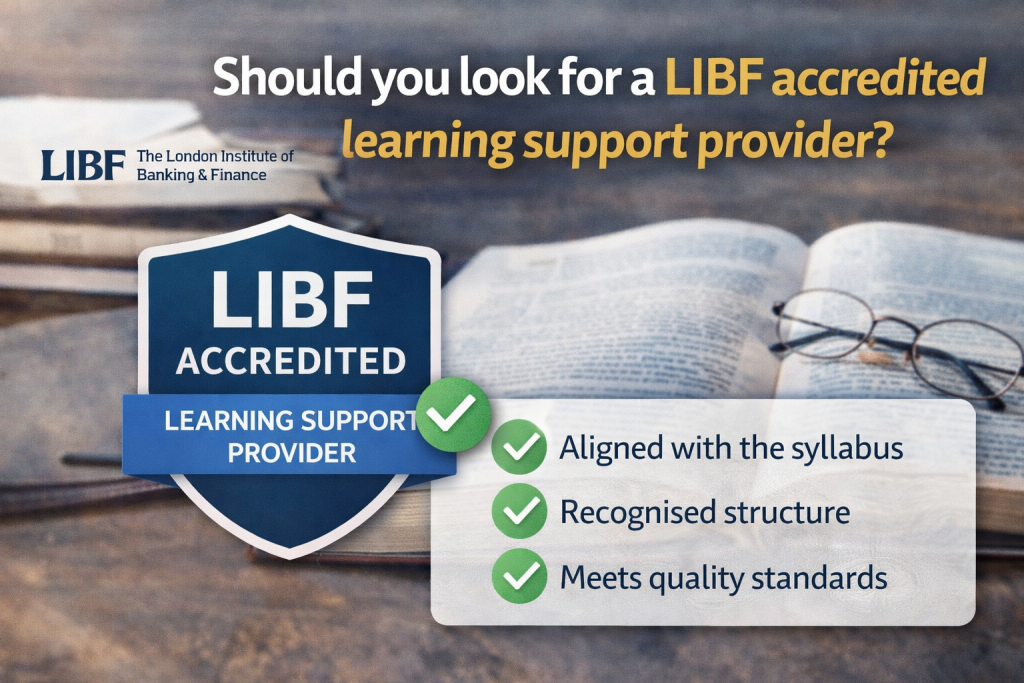
Should you look for a LIBF accredited learning support provider?

Yes, this can be a useful way to assess quality.

An Accredited CeMAP Learning Support Provider by The London Institute of Banking & Finance has had its learning support reviewed against specific standards.

This does not guarantee success, but it suggests:

  • Materials are aligned to the syllabus
  • The structure supports learning
  • The provider meets recognised standards

Be careful with wording.

Some providers may say they offer “CeMAP training” or describe themselves as “qualified”, but that is not the same as being LIBF accredited.

If accreditation matters to you, check:

  • The exact wording used
  • Whether official accreditation is clearly stated

This helps reduce the risk of choosing poor-quality resources.

LIBF accredited CeMAP learning support provider badge with study materials showing recognised quality and structured learning support

How do you choose resources that match your learning style?

Your budget should not ignore how you learn best.

Ask yourself:

  • Do I prefer reading, watching, or practising questions?
  • Do I need structure or can I organise my own study?
  • How much support will I realistically use?

For example:

  • Visual learners may benefit from video-based content
  • Independent learners may prefer written materials and question banks
  • Some learners need tutor access to stay on track

Choosing a cheaper option that does not suit your learning style often leads to delays.

A better approach is to balance affordability with usability.

How long should you have access to your materials?

Access duration should match your realistic study timeline.

If you are studying alongside work or other commitments, you may need longer than expected.

Short access periods can create pressure and lead to rushed exam attempts.

When comparing options, check:

  • How long materials are available
  • Whether extensions are possible
  • What happens if your timeline changes

Paying slightly more for longer access can prevent having to repurchase materials.

How can you plan your CeMAP study budget realistically?

A simple plan can help you stay in control of costs.

Step 1: Set a total budget

Decide what you can afford without creating pressure.

Step 2: Prioritise essentials

Focus on:

  • Reliable study materials
  • Exam fees
  • Access duration

Step 3: Add support where needed

Only include support you will actually use.

Step 4: Allow for flexibility

Leave room for:

  • Extra time
  • Possible resits
  • Additional resources if needed

This reduces the risk of unexpected costs.

Planning a CeMAP study budget with materials fees timeline and calculator showing realistic cost planning

Are there balanced options for studying on a budget?

Some providers offer home study options designed to balance cost and support.

Structured home study packages with instalment options can make learning more accessible without requiring a large upfront payment.

Futuretrend’s CeMAP home study options are one example where learners can spread costs while still having structured materials.

The key point is the approach rather than the provider:

  • Structured learning
  • Manageable payments
  • Sufficient access time

These features support learners without removing important elements.

What is the biggest mistake when studying CeMAP on a budget?

The biggest mistake is focusing only on price.

When cost becomes the main decision factor, learners often:

  • Choose unsuitable materials
  • Underestimate study time
  • Lack support when needed

This can lead to delays, resits, and higher overall costs.

A better question to ask is:

What gives me the best chance of passing efficiently?

Final thoughts: balancing cost and your chances of success

Studying CeMAP on a budget is entirely possible.

Many learners take this route successfully, but it works best when decisions are balanced.

Keep in mind:

  • Lower-cost options can work if they are structured
  • Accreditation can help indicate quality
  • Access time matters
  • Your learning style should guide your choice

Avoid decisions that seem cheaper now but create problems later.

A steady, well-planned approach is often the most cost-effective in the long run.

Looking for training support?

We offer CeMAP training for learners working towards a career in mortgage advice. Our courses follow the London Institute of Banking & Finance syllabus and are designed to support understanding of mortgage regulation and advice requirements.

Explore our accredited CeMAP training courses

> Futuretrend Financial Training 

What good CeMAP study support actually looks like

CeMAP study support image showing tutor support structured learning and exam feedback

When people ask What support do you get with CeMAP?”, they are usually trying to work out one thing: will they be left to figure it all out alone, or guided properly through it?

Study support is not just about having materials. It is about how you are helped to understand, apply, and stay on track while working towards a regulated qualification.

This matters because CeMAP is not simply about memorising facts. It is about understanding how mortgage advice works in practice, within rules set by the Financial Conduct Authority (FCA). The way support is delivered can shape how confident and prepared you feel when you move into the role.

CeMAP study support image showing tutor support structured learning and exam feedback

What does “study support” mean for CeMAP?

Study support refers to the guidance, structure, and feedback available to help you progress through the CeMAP qualification.

In practical terms, it usually includes:

  • Access to tutors or subject specialists
  • Structured learning materials and study plans
  • Feedback on practice questions or assessments
  • Help with understanding difficult topics
  • Support with exam preparation

Good support makes the learning process clearer and more manageable. It reduces the risk of getting stuck or misunderstanding key concepts.

Poor or limited support can leave learners unsure whether they are on the right track, especially if they are new to financial services.

What support do you get with CeMAP?

The support you receive with CeMAP depends on how you choose to study, but effective support usually includes three core elements: access to tutors, structured learning, and meaningful feedback.

Each of these plays a different role in helping you progress.

How important is tutor access?

Tutor access is one of the most important parts of CeMAP study support.

A tutor is not there just to answer questions. They help you:

  • Break down complex topics
  • Explain how rules apply in real scenarios
  • Clarify areas where textbooks feel unclear
  • Keep your understanding aligned with exam expectations

For example, topics such as regulation, affordability, and mortgage products can seem straightforward at first, but often involve nuance. A tutor can explain not just what the rule is, but why it matters and how it is applied.

Good tutor support usually means:

  • You can ask questions when needed
  • Responses are clear and relevant
  • Explanations are practical, not just theoretical

Without this, learners often rely on guesswork or spend too long trying to interpret material on their own.

What does structured learning actually look like?

Structure is what turns a large amount of content into something manageable.

CeMAP covers multiple modules, each with its own topics, terminology, and regulatory context. Without structure, it is easy to feel overwhelmed.

Effective structured support usually includes:

  • A clear study plan or pathway
  • Content broken into manageable sections
  • Suggested timelines (without rigid deadlines)
  • Logical progression from basic to more complex topics

Structure helps you answer key questions while studying:

  • What should I focus on today?
  • What comes next?
  • Am I covering everything I need?
CeMAP structured learning plan with study schedule checklist and organised modules

It also reduces the risk of skipping important areas or spending too long on less relevant details.

Importantly, structure should guide you, not pressure you. Everyone learns at a different pace, and good support allows flexibility while still providing direction.

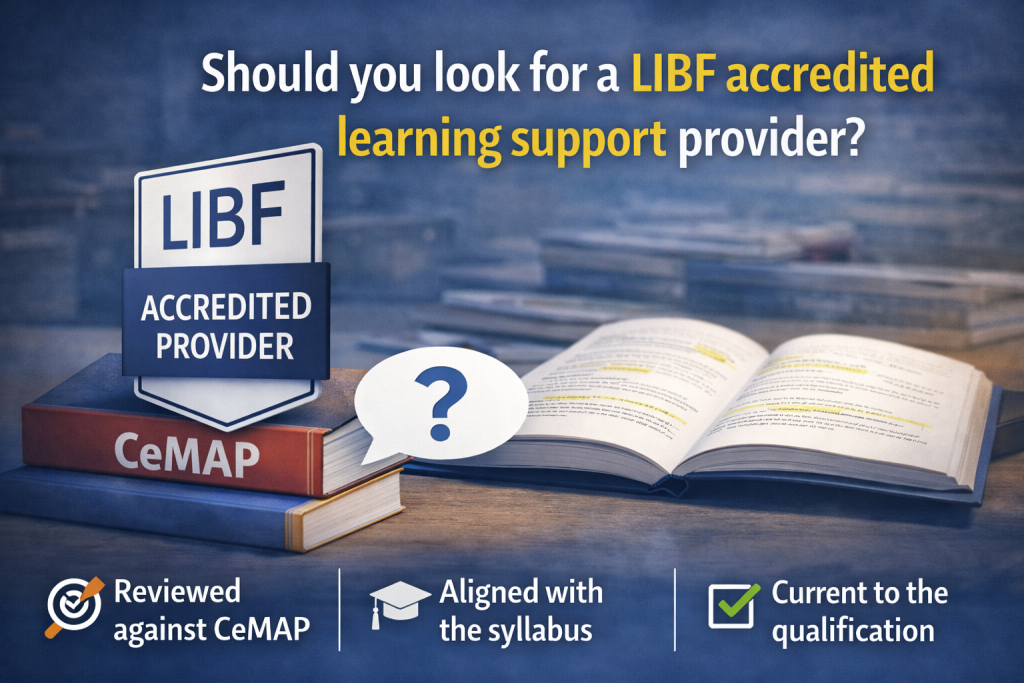
Should you look for a LIBF accredited learning support provider?

Looking for a London Institute of Banking & Finance (LIBF) accredited learning support provider can be one way to assess the quality of study resources.

CeMAP is awarded by LIBF, so accredited providers have had their learning materials reviewed against the qualification standards. This can give learners confidence that the content is aligned with the syllabus.

In practical terms, this may mean:

  • Study materials follow the correct CeMAP structure
  • Key topics are covered in line with exam requirements
  • Content reflects current standards set by LIBF
LIBF accredited CeMAP learning support provider with study materials and syllabus alignment

However, accreditation relates to the quality and relevance of the learning materials, not the level of personal support you will receive.

It does not guarantee:

  • Faster completion
  • Better exam results
  • A specific level of tutor access or feedback

This is why it should be seen as one indicator of effective study support, rather than the only factor.


A balanced approach is to look for:

  • Accredited learning materials
  • Clear structure and guidance
  • Access to tutors when needed
  • Opportunities for feedback and exam practice


Together, these give a more complete picture of what your study experience is likely to be.

How does feedback improve your learning?

Feedback is where learning becomes active rather than passive.

Reading materials alone can give a false sense of understanding. You only really test your knowledge when you apply it.

Good CeMAP support includes:

  • Practice questions
  • Mock exams
  • Explanations of correct and incorrect answers


The key part is not just whether an answer is right or wrong, but why.

Effective feedback helps you:

  • Spot gaps in your knowledge
  • Understand how questions are structured
  • Improve exam technique
  • Build confidence over time


For example, if you misunderstand a question about mortgage regulation, feedback should explain both the rule and the reasoning behind the correct answer.

Without this, learners may repeat the same mistakes without realising it.

How does study support affect the overall experience?

Study support has a direct impact on how manageable and realistic the qualification feels.

With strong support:

  • Learning feels guided rather than overwhelming
  • You are less likely to feel stuck
  • Progress feels steady and measurable
  • Confidence builds gradually


With limited support:

  • It can feel unclear whether you are doing things correctly
  • Small misunderstandings can build into bigger problems
  • Motivation may drop if progress feels uncertain


The difference is not just about passing exams. It is about understanding the material well enough to apply it later in a real role.

This is important because CeMAP is designed to meet the FCA’s education requirements for mortgage advisers. The goal is not just to pass, but to develop a working understanding of how advice and regulation fit together.

What role does flexibility play in good support?

Flexibility is often overlooked, but it is a key part of effective support.

Many people studying CeMAP are:

  • Changing careers
  • Working full-time
  • Managing other commitments


Good support allows you to:

  • Study at times that suit you
  • Move at your own pace
  • Revisit topics when needed


At the same time, flexibility should still be balanced with structure. Too much freedom without guidance can lead to delays or loss of focus.

The best support sits somewhere in the middle. It gives you control over your schedule, while still helping you stay on track.

How does support help with exam preparation?

Exam preparation is where support becomes especially valuable.

CeMAP exams are not just about recalling information. They test how well you understand concepts and apply them in realistic scenarios.

Good support in this stage includes:

  • Practice exams that reflect real exam style
  • Guidance on how questions are worded
  • Help with time management during exams
  • Techniques for handling more difficult questions

This helps reduce uncertainty.

CeMAP exam preparation support with mock exam results feedback and study materials

Rather than going into the exam unsure of what to expect, you have already worked through similar formats and understand how to approach them.

That familiarity can make a noticeable difference in how confident you feel on the day.

What does poor or limited support look like?

Understanding what good support looks like is easier when you recognise the signs of limited support.

This might include:

  • No access to tutors or delayed responses
  • Large amounts of content with little structure
  • Practice questions without clear explanations
  • No guidance on exam technique

In these situations, learners often spend more time trying to organise their learning than actually learning.

It does not mean progress is impossible, but it can make the process slower and more frustrating.

Why does study support matter beyond the exams?

CeMAP is the starting point for becoming a mortgage adviser, not the end point.

The way you learn during this stage can affect how prepared you feel when you begin working in the role.

Strong support helps you:

  • Understand real-world application, not just theory
  • Build confidence in explaining concepts
  • Develop habits that carry into professional learning

For example, understanding why certain rules exist makes it easier to apply them when dealing with clients later on.

This is particularly important in a regulated environment, where decisions must be both accurate and justifiable.

Do all learners need the same level of support?

No, and this is where personal preference comes in.

Some learners prefer:

  • More independence
  • Learning at their own pace with minimal input

Others benefit from:

  • Regular guidance
  • Clear checkpoints
  • Ongoing reassurance that they are progressing correctly

Neither approach is right or wrong.

The key is understanding what helps you stay consistent and confident.

If you are new to financial services, more structured support and tutor access often make the learning curve smoother.

If you already have some background knowledge, you may rely less on support but still benefit from feedback and exam preparation.

How can you tell if support is actually effective?

Effective support is usually noticeable in how you feel while studying.

Signs that support is working well include:

  • You understand topics rather than just memorising them
  • You know what to study next
  • You can identify and correct mistakes
  • You feel gradually more confident over time

If you find yourself:

  • Re-reading the same material without clarity
  • Unsure whether you are progressing correctly
  • Avoiding certain topics because they feel confusing

It may be a sign that support is not meeting your needs.

A clear way to think about CeMAP study support

CeMAP study support is best understood as a combination of guidance, structure, and feedback that helps you move from confusion to clarity.

It is not about being constantly assisted. It is about having the right help available at the right time.

At its best, support allows you to:

  • Understand what you are learning
  • Apply that knowledge in context
  • Prepare realistically for exams
  • Build confidence step by step

Final thoughts

When asking What support do you get with CeMAP?”, the more useful question is often:

“What kind of support will help me learn effectively?”

The answer will vary depending on your experience, your schedule, and how you prefer to learn.

What remains consistent is this: good support is practical, structured, and responsive. It helps you understand the material, not just get through it.

And that understanding is what carries forward when you move from studying into real mortgage advice.

Looking for training support?

We offer CeMAP training for learners working towards a career in mortgage advice. Our courses follow the London Institute of Banking & Finance syllabus and are designed to support understanding of mortgage regulation and advice requirements.

Explore our accredited CeMAP training courses

> Futuretrend Financial Training 

LIBF Accredited CeMAP: Why It Matters for Your Study Success

Blog-LIBF Accredited Learning

If you’re considering CeMAP training, you’ve likely come across the phrase LIBF accredited. But what does it actually mean – and why should it matter to you?

CeMAP (Certificate in Mortgage Advice and Practice) is awarded by the London Institute of Banking & Finance (LIBF). The LIBF is the official body that oversees the qualification. When a training provider is LIBF-accredited, it means they’ve met certain quality standards set by the awarding body itself.

In this article, we’ll explain what LIBF accreditation involves, how it affects your learning, and why choosing an accredited provider like Futuretrend can improve your chances of success.

Blog-LIBF Accredited Learning

What Is LIBF Accreditation?

What does ‘LIBF-accredited’ mean?

LIBF accreditation is a formal recognition that a training provider meets the standards required to deliver CeMAP study support in line with the qualification’s aims. It shows that the provider offers up-to-date materials, qualified tutors, and appropriate support for learners preparing for CeMAP.

To be accredited, providers must submit their content, learning structure, and tutor qualifications to LIBF for review. It’s not a one-off tick-box – accredited status is monitored and reviewed regularly.

How does a provider get accredited?

Accreditation involves a detailed application process. LIBF looks at:

  • The structure and content of the course
  • Tutor qualifications and experience
  • Support offered to learners
  • Quality assurance processes

Once approved, the provider must maintain these standards to keep their accreditation. Any changes in delivery or tutors must be reported to LIBF.

View our LIBF Accreditation

Why LIBF Accreditation Matters for CeMAP Students

Confidence in your study materials

Accredited providers follow the official CeMAP syllabus. This ensures that your course content matches what you’ll be tested on in the real exams.

This reduces the risk of outdated material or incorrect exam preparation. You can focus on studying with confidence, knowing your materials are up to standard.

Structured, quality learning experience

An LIBF-accredited provider offers a clear and supportive study path. You’ll get:

  • A well-structured study plan
  • Learning outcomes clearly mapped to the exam units
  • Resources designed to help you stay on track

You’re not just handed a set of notes and left to it. Accredited training providers are expected to help you stay focused and supported.

Recognition and trust in the industry

Training with an accredited provider shows that you’ve taken a professional route to gaining your CeMAP. Many employers trust and recognise names like Futuretrend because of our long-term accreditation and proven success.

See our CeMAP course overview

Tutor Tip: 

LIBF accreditation isn’t just a nice extra, it’s your quality check. It shows the provider is up-to-date, approved, and working to the same standards LIBF uses to assess the exams.

How Futuretrend Supports Your LIBF-Accredited CeMAP Journey

25 years of training experience

Futuretrend has been delivering mortgage training since the late 90s. Over the years, we’ve helped thousands of students prepare for CeMAP, from absolute beginners to advisers looking to refresh or resit.

Read our student success stories

Tailored support and resources

Our courses are designed for flexibility. Whether you’re studying alongside work or full time, we offer:

  • Tutor Q&A support
  • Mock exams
  • Made Easy Revision Guides
  • Regular updates and syllabus changes

We know the CeMAP structure well and build our courses to guide you through every unit.

Flexibility without cutting corners

Online learning doesn’t have to mean second-rate training. With an accredited structure, you get all the benefits of convenience while still working within a recognised framework.

Frequently Asked Questions

What is the difference between LIBF-accredited and non-accredited CeMAP training?

Accredited providers are formally recognised by LIBF and follow strict content and delivery standards. Non-accredited courses may not be updated or structured correctly, and there’s no quality assurance process.

Do I need an accredited provider to sit the CeMAP exam?

No, you can register and take the exam on your own. But working with an accredited provider gives you the structured learning and support that can make a big difference, especially if you’re new to the subject.

How can I check if a provider is accredited by LIBF?

You can check the LIBF website or ask the provider directly. Accredited providers should be happy to show their status and tell you what it means. Futuretrend’s status is detailed here.

Next Steps

If you’re aiming to qualify as a mortgage adviser, your choice of training provider matters. Going with an LIBF-accredited CeMAP provider gives you structure, confidence, and trusted support.

It doesn’t guarantee you’ll pass, but it does mean you’re learning in a way that’s been checked and approved by the awarding body itself.

Ready for more exam-style examples?

Book our CeMAP Home Study course or visit our website for full training resources:
https://cemap123.co.uk/home-study-training/

Explore our accredited CeMAP training courses