
What Most People Misunderstand About CeMAP Exams

Student studying for CeMAP exams while separating common myths from the facts about the qualification.

Many people considering CeMAP hear stories about the exams being incredibly difficult, full of trick questions, or impossible to pass without years of financial experience. In reality, most of these beliefs come from misunderstandings rather than the qualification itself. Knowing what to expect can help you prepare more effectively and approach the exams with confidence.

Student studying for CeMAP exams while separating common myths from the facts about the qualification.

Are CeMAP Exams as Hard as People Say?

The short answer is no, not for most learners.

CeMAP exams are challenging because they assess your understanding of mortgage advice, regulation and financial products. They are designed to ensure future mortgage advisers have the knowledge needed to work in a regulated profession. However, they are not intended to catch people out or require advanced mathematical ability.

Many learners pass by studying consistently, using quality learning materials and taking time to understand the topics rather than trying to memorise facts.

The difficulty often comes from the amount of information to learn rather than the complexity of the individual questions.

What Is CeMAP Actually Testing?

The Certificate in Mortgage Advice and Practice (CeMAP) is awarded by the London Institute of Banking & Finance (LIBF) and meets the educational requirements set by the Financial Conduct Authority (FCA) for individuals who want to provide regulated mortgage advice.

Rather than testing whether someone already knows the mortgage industry, the qualification assesses whether they have learned the knowledge needed to advise customers responsibly.

The exams cover areas such as:

  • UK financial regulation
  • Mortgage products
  • Lending principles
  • Property ownership
  • Customer circumstances
  • Ethical and professional responsibilities

The aim is to confirm understanding, not previous experience.

Student studying CeMAP with notes showing the key knowledge areas covered in the qualification.

Misunderstanding 1: You Need a Financial Background

This is one of the most common myths.

Many people believe only bankers, accountants or experienced financial professionals can pass CeMAP. In reality, learners come from a wide variety of backgrounds.

Successful students include people who have previously worked in:

  • Retail
  • Hospitality
  • Customer service
  • Estate agency
  • Administration
  • Education
  • Armed forces
  • Self-employment

The qualification starts with the fundamentals before building towards more specialised mortgage knowledge.

Having experience in finance may make some topics feel more familiar, but it is not a requirement for success.

Misunderstanding 2: The Exams Are Designed to Trick You

Some learners worry that CeMAP exams are full of misleading questions designed to make people fail.

In reality, the exams are written to assess whether you understand the subject matter. Questions often present realistic situations where you need to apply your knowledge rather than simply remember a definition.

This sometimes creates the impression that questions are trying to catch you out.

More often, the challenge is reading carefully and understanding exactly what the question is asking.

Taking time to practise multiple-choice questions and learning how questions are structured can make a significant difference.

Misunderstanding 3: You Have to Memorise Everything

Another common concern is that success depends entirely on memorising hundreds of pages of information.

While some factual knowledge is important, CeMAP places considerable emphasis on understanding principles.

For example, knowing why regulation exists, how different mortgage products work or why affordability assessments matter will often help you answer several different questions.

Learners who focus only on memorising individual facts can sometimes struggle when questions are presented in a different way.

Understanding the subject is usually more valuable than learning isolated facts by heart.

Misunderstanding 4: If You Fail Once, You'll Probably Never Pass

Failing an exam can feel disappointing, but it does not mean someone is unsuited to becoming a mortgage adviser.

Many successful advisers have needed more than one attempt at part of their qualification.

Sometimes learners discover they underestimated the amount of preparation required. Others simply experience exam nerves or identify areas where they need more revision.

A previous unsuccessful attempt often helps learners understand how the exam works, making their future preparation more focused.

One result does not define your ability.

Misunderstanding 5: You Need to Be Brilliant at Maths

People are often surprised to learn that CeMAP is not a maths qualification.

You should be comfortable with basic numerical concepts, percentages and interpreting financial information, but the qualification does not involve advanced mathematical calculations.

The emphasis is on understanding mortgage principles and applying financial knowledge appropriately.

For many learners, reading comprehension and understanding regulation are more significant challenges than mathematics.

Misunderstanding 6: Studying Longer Always Means Better Results

It can be tempting to think that spending hours reading every evening is the best way to prepare.

In practice, quality often matters more than quantity.

Many learners benefit from:

  • Studying in shorter, focused sessions
  • Regular revision rather than cramming
  • Practising sample questions
  • Reviewing weaker topics
  • Using a mixture of books, videos and tutor support

Learning effectively is usually more valuable than simply studying for longer.

Misunderstanding 7: Everyone Finds the Same Parts Difficult

There is no single section that every learner struggles with.

Some people find regulation straightforward but need more time with mortgage products.

Others quickly understand lending principles but take longer to remember legal terminology.

Your previous experience, study style and confidence all influence which topics feel easier or harder.

Comparing yourself with other learners is rarely helpful because everyone’s strengths are different.

Why Do So Many Stories Make CeMAP Sound Difficult?

People naturally tend to share challenging experiences more often than straightforward ones.

Someone who found the exams stressful is more likely to talk about it than someone who quietly revised, passed and moved on.

Online discussions can also unintentionally exaggerate the difficulty. One learner’s experience may be influenced by limited preparation, outdated study materials or personal circumstances.

That does not mean the exams are easy, but it does mean individual stories do not always represent what most learners experience.

Looking for balanced, reliable information can help you build realistic expectations.

CeMAP learner studying while considering common myths and real expectations about the difficulty of CeMAP exams.

What Helps Learners Feel More Confident?

Confidence usually grows from preparation rather than luck.

Many successful learners:

  • Follow a structured study plan
  • Break large topics into manageable sections
  • Use accredited learning resources designed for CeMAP
  • Complete practice questions regularly
  • Revise consistently instead of relying on last-minute study
  • Ask questions whenever something is unclear

Using learning materials from an accredited LIBF Learning Support Provider can also help ensure your resources are aligned with the current CeMAP syllabus and learning outcomes.

Good preparation makes the exams feel far more manageable.

Should You Be Worried About Exam Nerves?

Feeling nervous before an exam is completely normal.

Even well-prepared learners often feel anxious because they care about doing well.

Simple preparation strategies can help reduce unnecessary stress, including:

  • Getting enough rest before the exam
  • Arriving with plenty of time
  • Reading each question carefully
  • Avoiding rushing through the paper
  • Focusing on one question at a time

Confidence usually comes from knowing you have prepared properly rather than trying to eliminate every feeling of nervousness.

Is CeMAP More About Understanding Than Memory?

Yes.

Although some factual recall is required, CeMAP is largely about demonstrating that you understand how mortgage advice works within the UK’s regulated environment.

Understanding relationships between topics often makes revision easier.

For example, when you understand why affordability assessments, customer protection and regulation all work together, individual facts become easier to remember because they fit into a wider picture.

This deeper understanding is also much more useful once you begin working as a mortgage adviser.

Final Thoughts

Most misunderstandings about CeMAP exams come from second-hand stories rather than the qualification itself.

The exams are designed to assess knowledge and understanding, not to discourage people from entering the profession. They require commitment, consistent study and good preparation, but they do not require years of financial experience or exceptional academic ability.

Approaching CeMAP with realistic expectations is often one of the biggest advantages a learner can have. Instead of worrying about the myths, focus on building your understanding step by step, using reliable study materials and giving yourself enough time to prepare.

For many people, CeMAP is challenging but entirely achievable with the right approach.

Looking for training support?

We offer CeMAP training for learners working towards a career in mortgage advice. Our courses follow the London Institute of Banking & Finance syllabus and are designed to support understanding of mortgage regulation and advice requirements.

Explore our accredited CeMAP training courses

> Futuretrend Financial Training 
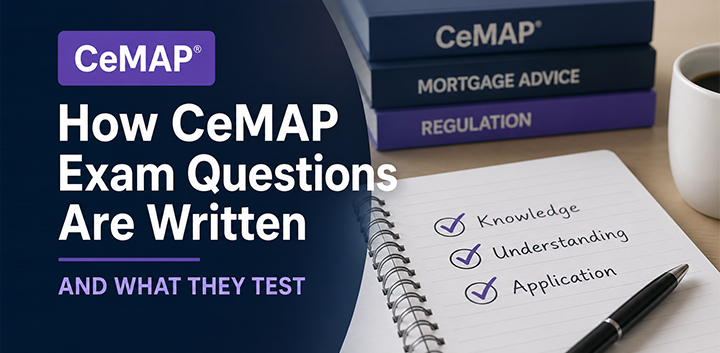
How CeMAP exam questions are written and what they test

CeMAP exam questions explained showing knowledge understanding and application checklist on study notebook

Understanding how exam questions are designed can make a big difference to how you interpret them. Many learners feel confident with the content but become unsure when faced with the wording of the exam itself. That usually comes down to not fully understanding what the questions are actually trying to assess.

This guide explains how CeMAP exam questions are structured, what they are designed to test, and why they are written the way they are.

CeMAP exam questions explained showing knowledge understanding and application checklist on study notebook

What do CeMAP exam questions test?

CeMAP exam questions are designed to assess whether you can apply knowledge in a realistic context, not just recall facts.

They test:

  • Your understanding of key concepts
  • Your ability to interpret information
  • Your judgement in applying rules and principles
  • Your awareness of how knowledge fits into real situations

The exams are not trying to catch you out. They are designed to reflect the kind of thinking required in a real mortgage advice role.

That means simply memorising facts is not enough on its own.

Why are CeMAP exams structured this way?

CeMAP is awarded by the London Institute of Banking & Finance and is aligned with the expectations of the Financial Conduct Authority.

The purpose of the qualification is to ensure that individuals advising on mortgages have the knowledge and understanding required to do so responsibly.

Because of this, exam questions are written to reflect real-world decision making, not just textbook learning.

A definition-style explanation makes this clearer:

CeMAP exam questions are structured to assess applied knowledge, meaning they test how well a learner can use information in context, rather than simply recall isolated facts.

This is why the wording can sometimes feel more complex than expected.

Do CeMAP questions test knowledge or understanding?

They test both, but the emphasis is on understanding.

Knowledge still matters

You need a solid grasp of:

  • Regulations
  • Mortgage products
  • Processes
  • Terminology

Without that foundation, you will struggle to interpret questions properly.

But understanding is what is really assessed

Understanding means:

  • Recognising what information is relevant
  • Interpreting what a question is asking
  • Applying knowledge to a scenario

Two learners might know the same facts, but the one who understands how to use them will perform better.

This is where many learners get caught out. They revise thoroughly but focus mainly on remembering content, rather than thinking about how it might be used.

Why do some CeMAP questions feel confusing?

This is one of the most common concerns.

The confusion usually comes from how questions are phrased, not from the difficulty of the content itself.

Questions are designed to require interpretation

Rather than asking for a direct definition, questions often:

  • Present information in a slightly indirect way
  • Require you to identify what is important
  • Expect you to connect different parts of the syllabus

This can feel unfamiliar if you are used to more straightforward testing styles.

Language is precise, not tricky

It is easy to assume questions are designed to mislead. In reality, they are carefully written to be precise.

Small differences in wording can change the meaning of a question. That is deliberate, because in real financial advice, details matter.

Context is often implied

You may not be given every piece of information explicitly. Instead, you are expected to:

  • Recognise what is being described
  • Understand the situation being presented
  • Apply the correct knowledge

This reflects real-world scenarios, where clients do not always present information in a perfectly structured way.

What is the purpose behind the way questions are written?

Every question has a purpose beyond simply checking memory.

To reflect real decision-making

Mortgage advisers do not work from memory alone. They:

  • Interpret client situations
  • Apply regulatory rules
  • Make informed judgements

Exam questions are written to reflect that process.

To test clarity of understanding

If you truly understand a topic, you should be able to recognise it even when it is presented differently.

This is why questions may:

  • Rephrase familiar ideas
  • Combine multiple concepts
  • Use slightly varied terminology

To ensure consistency and fairness

Exam design follows strict standards. Questions are reviewed to ensure they:

  • Accurately reflect the syllabus
  • Test appropriate levels of understanding
  • Avoid ambiguity where possible

While some questions may feel challenging, they are not random or subjective.

Common misconceptions about CeMAP exam questions

There are a few misunderstandings that tend to make the exams feel harder than they need to be.

“The questions are designed to trick you”

This is probably the biggest misconception.

Questions are not designed to trick you. They are designed to check whether you:

  • Understand the material
  • Can apply it correctly

If a question feels tricky, it is usually because it requires careful reading, not because it is misleading.

“If I memorise everything, I will pass easily”

Memorisation helps, but it is not enough on its own.

You might recognise the topic, but still struggle if you cannot:

  • Interpret the wording
  • Apply the knowledge in context

Understanding always matters more than volume of revision.

“The exam is harder than the syllabus”

The exam does not go beyond the syllabus.

However, it can feel harder because:

  • Questions are applied rather than direct
  • Topics are sometimes combined
  • Wording requires interpretation

The challenge is not new content. It is how the existing content is used.

Why understanding wording matters so much

One of the key skills being tested is your ability to read and interpret questions accurately.

In practice, this means:

  • Picking up on key terms
  • Not overlooking small details
  • Understanding what is actually being asked

This is important because in real mortgage advice:

  • Misunderstanding a client’s situation can lead to poor outcomes
  • Missing details can have regulatory implications
  • Clear communication is essential

The exam reflects these expectations.

How different topics are assessed within questions

Although all questions are based on the syllabus, they often draw on more than one area at once.

Topics are rarely isolated

Instead of testing one idea in complete isolation, questions may:

  • Combine regulation and product knowledge
  • Link processes with practical scenarios
  • Require you to think across topics

This reflects how knowledge is used in real situations.

Some areas test recognition

Certain parts of the syllabus are more knowledge-based.

These might involve:

  • Identifying definitions
  • Recognising key terms
  • Understanding core principles

Others test application

Other areas focus more on:

  • Interpreting situations
  • Applying rules correctly
  • Making informed judgements

Most exams include a mix of both.

Why applied questions are important for future advisers

It is worth remembering that CeMAP is not just an academic qualification.

It is designed to prepare people for working in financial services.

Applied questions matter because they:

  • Reflect real client interactions
  • Reinforce responsible decision-making
  • Build confidence in practical understanding

A learner who can apply knowledge is better prepared for the realities of the role.

How this affects the way you experience the exam

If you expect questions to be purely fact-based, the exam can feel more difficult than it actually is.

Once you understand what is being assessed, things usually start to make more sense.

You begin to see that:

  • Questions follow patterns
  • Wording has a clear purpose
  • The focus is on understanding, not memorisation

That shift in perspective often reduces confusion.

Why some learners find this adjustment challenging

The move from learning to application is not always easy.

Some reasons include:

  • Previous exams may have focused more on recall
  • The syllabus feels large, so learners prioritise memorising
  • Confidence can drop when questions are not straightforward

This is a normal part of the learning process.

Recognising that the exam is testing understanding rather than memory helps you adjust expectations.

What should you take away from this?

CeMAP exam questions are carefully designed to assess how well you understand and apply knowledge, not just how much you can remember.

They are:

  • Structured around real-world thinking
  • Written with precise language
  • Focused on interpretation and judgement

If the wording feels unfamiliar, that does not mean the exam is unfair. It usually means it is testing a deeper level of understanding.

Final thought

If you find CeMAP questions confusing at first, you are not alone. It is a common experience, especially for those new to this style of assessment.

The key is recognising that the exam is not about catching you out. It is about checking whether you can think like a mortgage adviser.

Once you understand that, the structure of the questions starts to feel far more logical.

Looking for training support?

We offer CeMAP training for learners working towards a career in mortgage advice. Our courses follow the London Institute of Banking & Finance syllabus and are designed to support understanding of mortgage regulation and advice requirements.

Explore our accredited CeMAP training courses

> Futuretrend Financial Training