How Should You Revise for CeMAP?

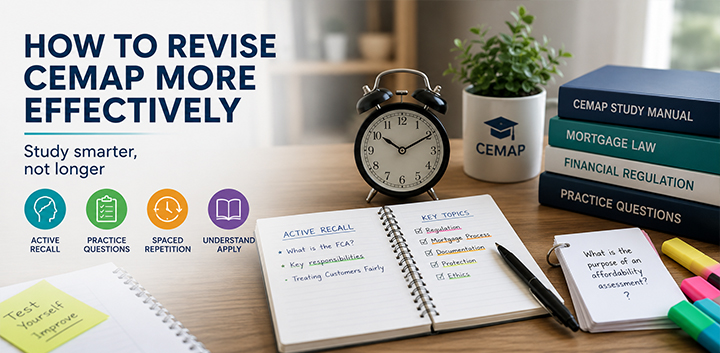
Student revising for CeMAP using active recall, practice questions and spaced repetition with organised study notes and learning resources.

Many learners believe that spending more hours revising automatically leads to better results. In reality, the quality of your CeMAP revision often matters far more than the quantity.

CeMAP covers a broad range of mortgage, financial and regulatory topics. Simply reading through the course materials repeatedly can create the feeling of progress without actually improving your ability to remember or apply what you’ve learned.

The most effective CeMAP revision focuses on actively retrieving information, identifying weak areas and regularly testing your understanding. These techniques help move knowledge from short-term memory into long-term memory, making it much easier to recall during the exam.

This guide explains how to revise CeMAP more effectively by replacing passive study habits with active learning techniques that help you make better use of your study time.

Student revising for CeMAP using active recall, practice questions and spaced repetition with organised study notes and learning resources.

What Makes CeMAP Revision Difficult?

CeMAP isn’t difficult because the concepts are impossible to understand. Many learners struggle because there is simply a large amount of information to absorb, much of it containing unfamiliar terminology and legislation.

The challenge comes from needing to understand topics rather than simply recognise them.

For example, you may recognise the correct answer when reading your notes, but struggle to recall it independently during the exam. This is a common sign that revision has become passive rather than active.

Recognising information is much easier than recalling it without prompts, yet the exam requires you to retrieve knowledge independently.

Understanding this difference is often the first step towards more effective revision.

What Is the Difference Between Passive and Active Revision?

Active revision requires your brain to work. Passive revision mainly involves consuming information.

Here’s how they compare:

Passive Revision

  • Reading notes repeatedly
  • Highlighting textbooks
  • Watching videos only
  • Re-reading chapters
  • Listening to lessons

Active Revision

  • Testing yourself without notes
  • Answering practice questions
  • Explaining concepts aloud
  • Writing answers from memory
  • Creating and answering flashcards

Passive revision feels comfortable because everything looks familiar.

Active revision often feels harder because you’re forcing your brain to retrieve information. That extra effort is exactly what strengthens memory and improves recall during exams.

Many learners mistake the discomfort of active revision for poor performance, when in fact it is one of the most effective ways to learn.

Why Is Active Recall So Effective?

Active recall means trying to remember information before looking at the answer.

Instead of reading a page five times, you close the book and ask yourself:

  • What were the key points?
  • Can I explain this topic?
  • Could I answer an exam question on it?

Every successful retrieval strengthens the memory.

If you cannot remember something, that’s useful information. It highlights exactly where further revision is needed.

For CeMAP, active recall can include:

  • Answering practice questions
  • Covering notes and explaining a topic aloud
  • Writing definitions from memory
  • Creating flashcards
  • Teaching someone else the concept

The goal is not perfection. The goal is identifying what you genuinely know versus what only feels familiar.

Student using flashcards and revision notes to practise active recall while studying for the CeMAP qualification.

How Important Are Practice Questions?

Practice questions are one of the most valuable revision tools available for CeMAP.

They help you:

  • apply knowledge rather than recognise it
  • identify knowledge gaps
  • become familiar with question wording
  • improve confidence under exam conditions
  • develop better recall.

Many learners wait until the end of their revision before attempting practice questions.

A more effective approach is to use them throughout your study.

After completing each topic, answer several questions before moving on. This reinforces learning immediately and prevents misconceptions from becoming established.

If you answer incorrectly, don’t simply memorise the right answer. Understand why your original answer was incorrect before moving forward.

How Can You Use Spaced Repetition?

One of the biggest mistakes learners make is revising a topic once and assuming they’ve learnt it permanently.

Memory naturally fades over time.

Spaced repetition works by reviewing topics at increasing intervals before they are forgotten.

A simple revision cycle might look like this:

  • Study the topic today.
  • Review it tomorrow.
  • Review again three days later.
  • Review a week later.
  • Review two weeks later.

Each review becomes quicker because the knowledge becomes more established.

Rather than cramming everything repeatedly, spaced repetition helps you retain information with less overall effort.

Should You Make Your Own Revision Notes?

Creating your own notes can be extremely useful if you’re processing the information rather than simply copying it.

Effective notes should:

  • summarise concepts in your own words
  • simplify complex topics
  • include key definitions
  • highlight important rules
  • contain examples where helpful.

Avoid rewriting entire textbooks.

If producing notes takes several hours without improving understanding, they may have become another passive activity.

Your notes should help you revise, not become the revision itself.

Are Flashcards Worth Using?

Flashcards work particularly well for CeMAP because many topics involve definitions, terminology, legislation and key facts.

A good flashcard asks a question on one side and provides the answer on the other.

For example:

Front

What does FCA stand for?

Back

Financial Conduct Authority.

Or:

Front

What is the purpose of affordability assessments?

Back

To determine whether a borrower is likely to be able to repay the mortgage without experiencing financial difficulty.

Flashcards are especially effective when combined with spaced repetition.

Digital apps can help organise review schedules, but traditional paper cards work equally well if used consistently.

Why Explaining a Topic Can Reveal Weaknesses

One of the simplest ways to check your understanding is to explain a topic as if you were teaching someone with no prior knowledge.

If you can explain:

  • what the concept is
  • why it matters
  • when it applies
  • how it affects mortgage advice,

then you probably understand it.

If you find yourself relying heavily on your notes or struggling to explain basic ideas, that’s a sign more revision is needed.

Many learners discover gaps they didn’t realise existed simply by talking through a topic aloud.

CeMAP learner explaining a mortgage advice topic using notes and a study board to identify knowledge gaps during revision

What Are the Most Common CeMAP Revision Mistakes?

Studying for long hours does not always produce better results.

Common mistakes include:

Re-reading Instead of Testing

Reading the same chapter repeatedly creates familiarity but not necessarily understanding.

Highlighting Everything

If every paragraph is highlighted, nothing stands out.

Highlighting should identify genuinely important information rather than replace revision.

Avoiding Difficult Topics

Most learners naturally revise topics they already enjoy.

Unfortunately, exams often expose the subjects you’ve been avoiding.

Spend extra time on weaker areas while continuing to review stronger ones.

Cramming Before the Exam

Trying to learn everything during the final few days places unnecessary pressure on short-term memory.

Steady revision over several weeks generally leads to better retention.

Never Reviewing Mistakes

Every incorrect practice question is an opportunity to improve.

Understanding why an answer was wrong is often more valuable than getting it right first time.

Which Study Aids Can Help You Revise More Effectively?

Different learners benefit from different combinations of study resources.

Useful revision aids include:

  • official CeMAP study manuals
  • topic summary sheets
  • practice question banks
  • flashcards
  • mind maps
  • revision planners
  • progress trackers
  • mock exams
  • short topic quizzes.

The best study aids encourage active participation rather than passive reading.

Choose resources that require you to think, answer questions and retrieve information from memory.

How Can You Structure a More Effective Revision Session?

Rather than studying for several uninterrupted hours, try dividing revision into focused sessions.

A typical session could look like this:

  • 10 minutes: Review previous material using flashcards.
  • 30 minutes: Study one new topic.
  • 20 minutes: Answer practice questions without notes.
  • 10 minutes: Review incorrect answers.
  • 5 minutes: Write a brief summary from memory.

This approach keeps your brain actively engaged throughout the session and provides regular feedback on your progress.

How Do You Know If Your Revision Is Working?

Effective revision isn’t measured by the number of hours you’ve studied.

Instead, ask yourself:

  • Can I explain this topic without my notes?
  • Can I answer practice questions consistently?
  • Am I remembering material from previous weeks?
  • Are my weaker topics improving?
  • Do I understand why answers are correct?

If the answer to these questions is increasingly “yes”, your revision strategy is working.

Progress is measured by understanding and recall, not simply time spent studying.

CeMAP learner reviewing study progress with revision notes, flashcards and a self-assessment checklist during exam preparation.

Final Thoughts

Revising more does not always mean revising better.

The most successful CeMAP learners usually focus on quality rather than quantity. They test themselves regularly, revisit topics over time, learn from mistakes and actively retrieve information instead of repeatedly reading it.

Active recall, practice questions, spaced repetition and structured revision sessions all help build long-term understanding that is far more useful during the exam than simple familiarity with the course material.

By making small changes to how you revise, you can often improve both your confidence and your ability to retain what you’ve learned without necessarily increasing the number of hours you spend studying.

Ultimately, effective CeMAP revision is about making every study session count.

Looking for training support?

We offer CeMAP training for learners working towards a career in mortgage advice. Our courses follow the London Institute of Banking & Finance syllabus and are designed to support understanding of mortgage regulation and advice requirements.

Explore our accredited CeMAP training courses

> Futuretrend Financial Training 
How to Deal with Information Overload in CeMAP

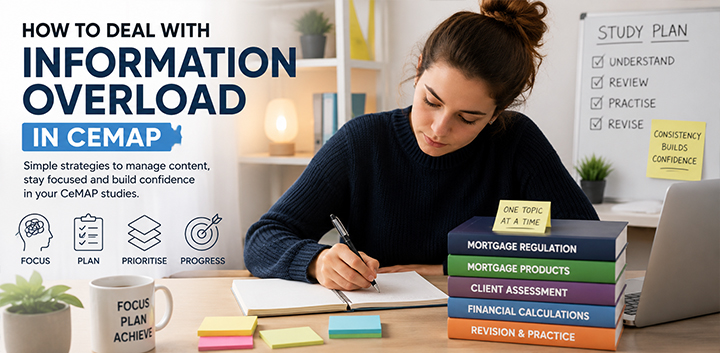
Student managing CeMAP information overload with organised study notes, revision books and a structured learning plan for the mortgage adviser qualification.

Starting the Certificate in Mortgage Advice and Practice (CeMAP) can feel like opening a textbook that never seems to end. Many learners begin with enthusiasm, only to find themselves overwhelmed by the sheer volume of information. From financial regulations and mortgage products to legal principles and industry terminology, there is a lot to absorb.

Information overload is one of the biggest reasons learners lose confidence early in their studies. Fortunately, it does not mean you’re incapable of passing CeMAP. It usually means you’re trying to learn too much at once.

Understanding why information overload happens, and having a simple way to manage it, can make studying feel far more achievable

Student managing CeMAP information overload with organised study notes, revision books and a structured learning plan for the mortgage adviser qualification.

Why Does CeMAP Feel Like Too Much Information?

Information overload happens when your brain receives more new information than it can comfortably organise and retain.

CeMAP introduces many concepts that are unfamiliar to people entering the mortgage industry. You’re not only learning facts but also understanding how different areas connect, including regulation, ethics, lending criteria, protection products and the wider financial services market.

Because everything feels new, it’s easy to think every sentence deserves equal attention. This often leads to reading pages repeatedly without remembering much afterwards.

The important thing to remember is that feeling overwhelmed is a normal part of learning something substantial. Your brain is building new knowledge rather than simply recalling familiar information.

What Makes CeMAP Content Feel So Overwhelming?

Several factors combine to create the feeling of overload.

Everything Appears Equally Important

When you’re new to CeMAP, it’s difficult to distinguish essential concepts from supporting detail. Without experience, every paragraph can seem equally critical.

Over time, patterns begin to emerge. Core principles are revisited throughout the qualification, while some supporting details simply provide context.

New Terminology Slows Learning

CeMAP introduces many financial and regulatory terms that most learners have never encountered before.

Every unfamiliar word requires extra mental effort to understand before you can even absorb the topic itself. Once this vocabulary becomes familiar, studying becomes much faster.

Trying to Learn Too Much in One Sitting

Many learners believe long study sessions produce better results. In reality, concentration naturally declines after extended periods.

Trying to complete multiple chapters in one evening often leaves you remembering very little by the end.

Shorter, focused sessions usually produce stronger understanding and better long-term memory.

How Do You Manage CeMAP Content Without Feeling Overwhelmed?

The simplest approach is to stop thinking about CeMAP as one large qualification.

Instead, think of it as hundreds of small learning tasks.

Rather than aiming to “study CeMAP tonight”, aim to understand one topic well.

For example:

  • Mortgage regulation
  • Types of repayment mortgages
  • Interest calculations
  • The house buying process

Completing one manageable topic provides a sense of progress without creating unnecessary pressure.

Small wins build confidence much more effectively than attempting huge amounts of reading.

CeMAP learner studying one topic at a time with organised notes and textbooks to manage information overload effectively.

Why Should You Break Topics Into Smaller Parts?

Breaking information into smaller sections reduces the amount your working memory has to process at once.

Instead of reading an entire chapter, divide it naturally into sections.

A simple approach might look like this:

  1. Read one small section.
  2. Summarise it in your own words.
  3. Test yourself without looking at your notes.
  4. Move on only when you understand the basic idea.

This keeps learning active rather than passive.

Understanding one topic thoroughly is more valuable than rushing through several chapters without retaining them.

How Do You Prioritise What to Learn?

Not every piece of information requires the same level of attention during your first study session.

A useful approach is to separate content into three categories.

Must Understand

These are the core principles that underpin multiple parts of CeMAP.

Examples include:

  • FCA regulation
  • Mortgage repayment methods
  • Types of mortgage products
  • Affordability principles
  • Consumer protection

These topics deserve your greatest attention because they appear repeatedly throughout your studies.

Useful Supporting Knowledge

Some sections provide context that helps explain the bigger picture.

These are still important but become easier once you understand the core concepts first.

Fine Detail

Certain facts, figures or definitions can be refined during later revision.

Trying to memorise every detail on your first reading often causes unnecessary stress.

Building understanding before memorisation usually produces better exam preparation.

A Simple Framework for Managing CeMAP Content

You do not need complicated revision systems or expensive productivity apps.

A straightforward four-step framework is often enough.

Step 1: Choose One Topic

Avoid opening multiple modules at once.

Decide exactly what you’re studying before you begin.

Step 2: Understand Before Memorising

Focus on answering one question:

“Do I understand why this works?”

If the answer is yes, remembering the details becomes much easier later.

Step 3: Review Soon Afterwards

A short review later that day or the following day helps reinforce what you’ve learned before it begins to fade.

Frequent reviews are usually more effective than one long revision session weeks later.

Step 4: Move On Gradually

Once you’re comfortable with one topic, begin the next.

This steady approach creates lasting knowledge without overwhelming yourself.

Should You Study Everything Perfectly the First Time?

No.

One of the biggest causes of information overload is believing every page must be fully understood immediately.

Learning rarely works like that.

Most successful CeMAP learners revisit topics several times.

Each review strengthens understanding because you’re connecting new knowledge with concepts you’ve already learned.

Progress is built through repetition rather than perfection.

How Can You Tell If You're Experiencing Information Overload?

Common signs include:

  • Reading the same paragraph repeatedly.
  • Forgetting what you read a few minutes earlier.
  • Feeling mentally exhausted after short study sessions.
  • Jumping between multiple topics without finishing any.
  • Feeling busy without making progress.

These signs usually indicate that it’s time to simplify your study approach rather than work harder.

CeMAP learner feeling overwhelmed while studying with books, notes and revision materials spread across a desk.

Should You Take Breaks When Studying CeMAP?

Yes.

Learning depends on giving your brain time to process information.

Short breaks between focused study sessions help maintain concentration and reduce mental fatigue.

Stepping away for ten minutes after completing a topic is often far more productive than forcing yourself to continue when your concentration has dropped.

Consistency over several weeks is much more valuable than one exhausting day of revision.

Does Information Overload Get Better?

Yes.

As your understanding grows, new topics begin connecting with previous ones instead of feeling completely unfamiliar.

Financial terminology becomes easier.

Regulatory concepts become more familiar.

Mortgage products begin to make logical sense.

Many learners find that the first few weeks are the hardest because almost everything is new. Once you’ve established a solid foundation, learning generally becomes more manageable.

Frequently Asked Questions

How do I manage CeMAP content?

The most effective way to manage CeMAP content is to break it into small, manageable topics, focus on understanding core CeMAP concepts before memorising details, review regularly and study consistently rather than trying to learn large amounts in one sitting.

How many CeMAP topics should I study each day?

There is no perfect number. Many learners make better progress by focusing on one or two topics thoroughly instead of rushing through several chapters.

Is it normal to forget what I’ve studied?

Yes. Forgetting some information is a normal part of learning. Regular review helps strengthen memory and improves long-term understanding.

Should I make detailed notes on everything?

Not necessarily. Notes should help clarify key ideas rather than copy entire textbooks. Simple summaries written in your own words are often more useful than lengthy notes.

Final Thoughts

Information overload is one of the most common challenges faced by CeMAP learners, particularly during the early stages of study. It happens because you’re absorbing a significant amount of new information in a relatively short period, not because you’re incapable of learning it.

The key is to simplify your approach. Break large topics into smaller sections, focus on understanding before memorising, prioritise the most important concepts and review your learning regularly. Small, consistent steps almost always lead to better results than trying to master everything at once.

Remember that CeMAP is designed to build your knowledge over time. As your understanding develops, subjects that once felt overwhelming gradually become familiar, helping you study with greater confidence and less stress.

Looking for training support?

We offer CeMAP training for learners working towards a career in mortgage advice. Our courses follow the London Institute of Banking & Finance syllabus and are designed to support understanding of mortgage regulation and advice requirements.

Explore our accredited CeMAP training courses

> Futuretrend Financial Training