Studying for CeMAP involves more than reading course material and remembering facts. At some point, most learners will come across something they do not fully understand, a question they cannot work out, or a topic that simply does not seem to make sense.
That does not necessarily mean they need someone teaching them every step of the way. It does, however, show why access to support can be an important part of CeMAP study.
Support is often undervalued because learners tend to think about it before they have started studying. At that stage, it is easy to imagine working through the material independently and looking things up when necessary.
The value of support often becomes clearer later, when a learner knows what they are struggling with but cannot work out why.
Do I Need Support for CeMAP?
You do not necessarily need regular tutor support to study CeMAP successfully. Some learners are comfortable studying independently and may require very little help.
However, having access to CeMAP support can be valuable when you encounter something you cannot resolve confidently on your own.
There is an important difference between needing constant assistance and knowing that help is available when required.
For many learners, support acts as a safety net. They can continue studying independently most of the time but have somewhere to turn when a particular concept, calculation or question causes difficulty.
This can prevent a relatively small misunderstanding from becoming a much bigger obstacle later in their studies.
What Happens When You Get Stuck While Studying CeMAP?
Getting stuck is a normal part of learning. The problem is not encountering something difficult. It is what happens next.
Imagine you are studying a mortgage-related concept and the explanation does not quite make sense. You read it again. You search online. You find another explanation, but it uses different terminology and now you are less certain than before.
You might eventually decide that you understand it well enough and move on.
That uncertainty can then reappear when you encounter the subject in a practice question. If you answer incorrectly, you may not know whether you misunderstood the topic, misread the question or applied the wrong rule.
A small gap in understanding has now affected another part of your study.
Having access to someone who can clarify the original point may allow you to resolve the problem much sooner.
Why Is Clarification So Important When Studying CeMAP?
Clarification helps turn partial understanding into something a learner can actually use.
CeMAP study involves learning terminology, principles, rules and how different concepts apply to mortgage advice. Simply recognising information on a page is not always the same as understanding it well enough to answer a question about it.
A learner might understand what a particular rule says but remain unsure about when it applies. Another learner may know the correct calculation but struggle to identify when a question is asking them to use it.
Good support is therefore not simply about being given an answer.
It can involve explaining the same concept in a different way, providing a practical example, identifying where the learner’s reasoning has gone wrong or helping them interpret what a question is actually testing.
Sometimes a five-minute explanation can resolve something that a learner has spent considerably longer trying to understand independently.
Can You Just Search Online When You Have a CeMAP Question?
Online research can certainly help, but it has limitations.
There is a huge amount of information about mortgages and financial services online. The difficulty for a learner is deciding whether the information they find is relevant to the CeMAP syllabus, current, accurate and explained at the appropriate level.
Search results can also lead learners much further into a subject than they need to go.
For example, you might search for clarification of a particular mortgage regulation and find detailed professional or regulatory material. The information may be accurate, but it could contain considerably more detail than you need for your current studies.
Effective CeMAP support can help distinguish between what you need to understand for your learning and additional information that may not help you at that stage.
That can make study more focused rather than simply giving you more material to read.
NOTE: All questions for exams come from the syllabus that is updated yearly. If changes come into play in the industry these do not mean they are in the sylabus.

How Can CeMAP Support Affect Your Confidence?
Support can improve confidence by helping learners establish whether their understanding is correct.
Confidence in CeMAP study should come from understanding rather than simply feeling comfortable with the material.
There are two common problems.
A learner may understand a topic correctly but keep second-guessing themselves because they have nobody to confirm their reasoning. Alternatively, they may feel confident about a topic while having misunderstood an important part of it.
Practice questions and mock exams can help expose these gaps, but support can help explain why the gap exists.
For example, repeatedly getting questions wrong on one subject can become frustrating. A learner may start thinking that they are simply “bad” at that topic.
A tutor or support adviser might instead identify one specific misunderstanding that is affecting several questions.
Once that point is clarified, the subject can suddenly become much easier to manage.
What Does Useful CeMAP Support Actually Look Like?
Useful support does not have to mean spending hours speaking to a tutor every week.
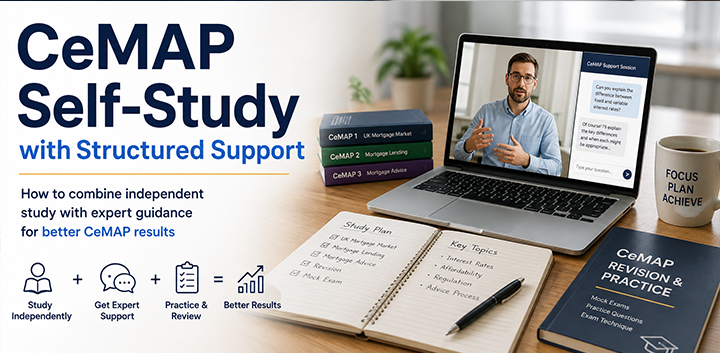
For many learners, the most useful model is independent CeMAP study with support available when needed.
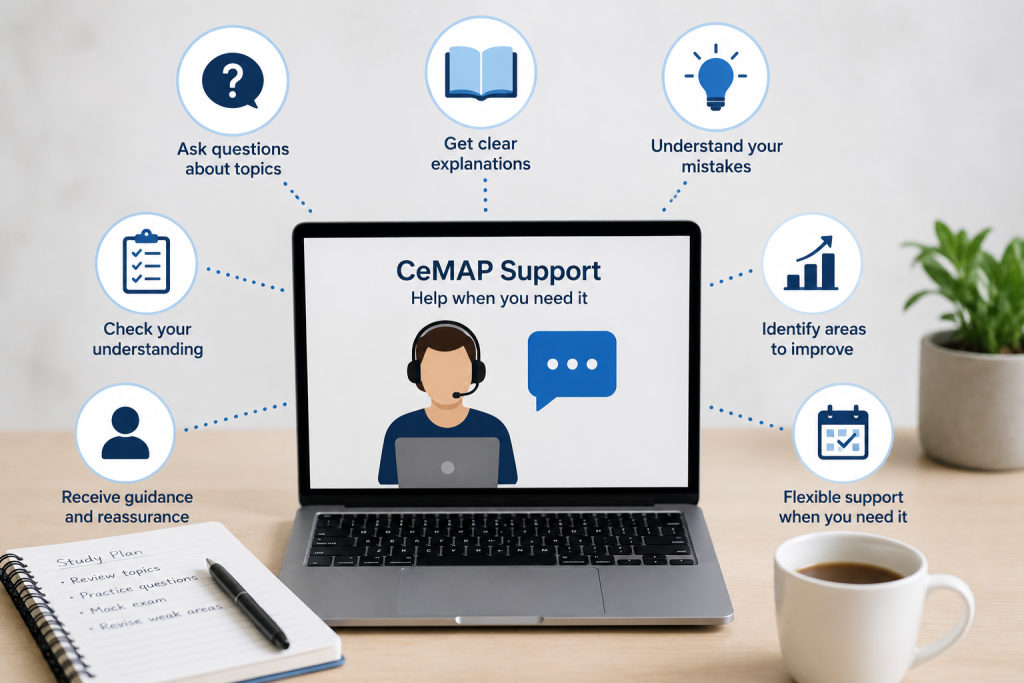
That support might include:
- asking questions about difficult concepts;
- checking your understanding of a topic;
- getting a different explanation when something is unclear;
- discussing why you answered a practice question incorrectly;
- getting guidance about areas that may need further revision; and
- talking through study difficulties before they begin affecting progress.
The important factor is accessibility.
If obtaining help is complicated or takes so long that you have already moved several topics ahead, its usefulness can be reduced.
Support works best when it helps remove obstacles while allowing the learner to remain responsible for their own study.
What Are Some Realistic Examples of When CeMAP Support Helps?
Consider a learner working through a section they initially find straightforward. They then complete practice questions and consistently score poorly.
Without support, they might simply reread the entire section.
With support, they could discuss the questions they are getting wrong and discover that they understand most of the topic but have confused two closely related concepts. They can then concentrate their revision on the actual problem.
Another learner may be doing well academically but struggling to interpret certain question wording. Their knowledge is not necessarily the issue. They need help understanding how to slow down, identify what is being asked and separate relevant information from distractions.
A third learner may have been away from formal education for many years. They understand the course material but are unsure how to organise their study or use practice results effectively.
These are different problems and they require different forms of support.
That is one reason access can matter more than the amount of support used.
Does Asking for Help Make CeMAP Study Less Independent?
No. Effective independent learning includes recognising when additional explanation would be useful.
Self-study does not have to mean studying entirely alone.
In fact, repeatedly spending hours trying to solve one problem can sometimes be less effective than asking a focused question, understanding the answer and continuing with your study.
The aim should not be to ask for help whenever something requires effort. Working through challenging material independently is an important part of learning.
The better approach is to recognise the difference between something that is difficult and something that you genuinely do not understand.
If another attempt, your study material and your notes resolve the issue, additional help may not be necessary.
If you remain confused, clarification can save time and prevent incorrect understanding from becoming established.
Can Support Help With CeMAP Practice Questions and Mock Exams?
Support can be particularly useful when reviewing practice questions and mock exam results.
A score tells you how many questions you answered correctly. It does not always tell you why you made the mistakes you did.
Two learners achieving the same score could have completely different problems.
One might have knowledge gaps in several topics. Another might know the material but rush through questions and miss important wording. Someone else may repeatedly change correct answers because they lack confidence.
Reviewing mistakes carefully helps turn question practice into learning.
Where a pattern is difficult to identify independently, support can help a learner understand whether they need more revision, a clearer explanation or simply a better approach to answering questions.

What Is the Long-Term Effect of Having Access to Support?
The longer-term benefit of support is not simply getting individual questions answered. It can help learners become better at identifying and resolving their own learning difficulties.
When someone explains why your reasoning was incorrect, you begin to recognise similar problems yourself.
When you learn how to review a mock exam properly, you can use the same approach on future attempts.
When a difficult concept is explained through a practical example, you may become better at connecting other parts of the syllabus to real mortgage situations.
Over time, the learner should ideally become less dependent on support rather than more dependent on it.
That is an important distinction.
Good support should help build independent understanding, not replace it.
Should Support Be a Factor When Choosing How to Study CeMAP?
Yes. Even if you expect to study mostly independently, it is worth considering what happens if you need help.
When comparing CeMAP study options, learners naturally look at course content, study materials, practice questions, mock exams, price and flexibility.
Access to support deserves to be considered alongside them.
Ask practical questions. Is there somewhere to ask questions? Who provides the answers? Can difficult concepts be explained rather than simply directing you back to the course material? Can you get help understanding mistakes in your practice work?
You may use that support frequently, occasionally or hardly at all.
The important point is that your need for support is difficult to predict before you begin studying.
Having access to it gives you another way to resolve problems when independent study alone is not providing the answer.
So, Do You Really Need Support for CeMAP?
Not every CeMAP learner needs regular support, and some people are perfectly comfortable completing most of their studies independently.
But there is a strong case for having access to support when you need clarification, become stuck or cannot understand why you are making mistakes.
The real value of support is not having someone constantly telling you what to do.
It is knowing that when you reach a genuine obstacle, you do not have to choose between guessing, spending hours searching for an explanation or simply moving on without fully understanding it.
For many learners, support may only play a small part in their overall CeMAP study.
But when it is needed, that small part can make a significant difference to how effectively they learn.
Looking for training support?
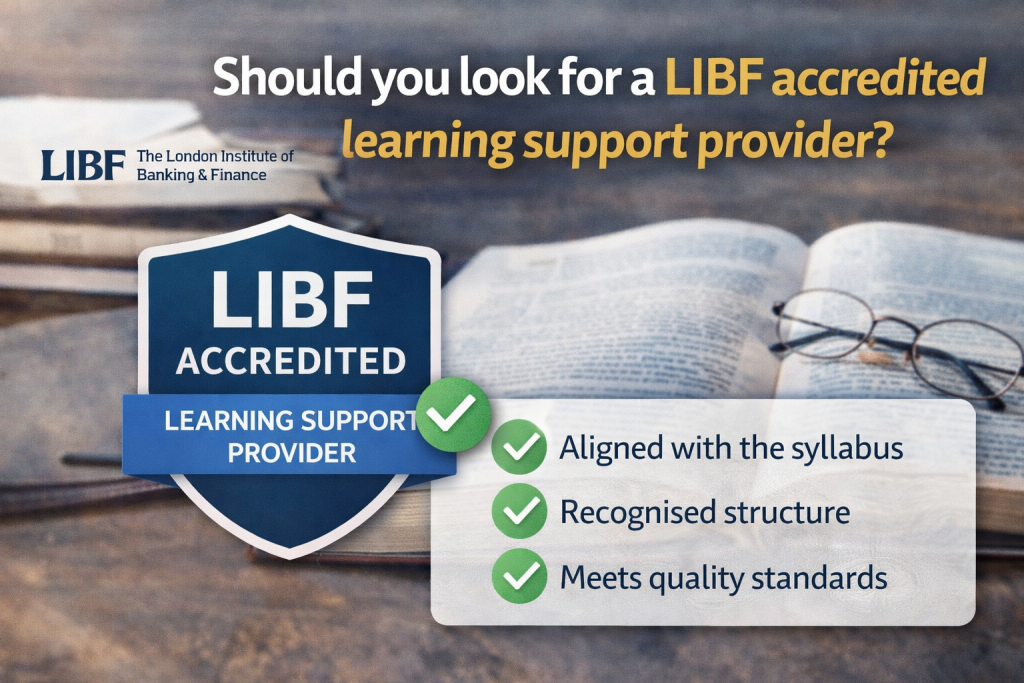
We offer CeMAP training for learners working towards a career in mortgage advice. Our courses follow the London Institute of Banking & Finance syllabus and are designed to support understanding of mortgage regulation and advice requirements.
Explore our accredited CeMAP training courses
> Futuretrend Financial Training