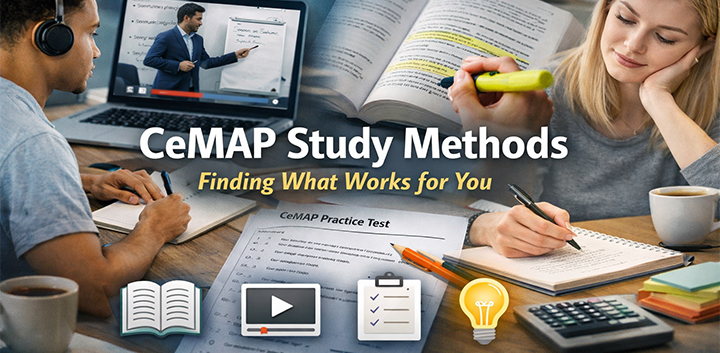
Different learning approaches and how they affect CeMAP study

CeMAP study methods showing different learning approaches including reading, video learning and practice questions

Why does CeMAP feel harder for some learners?

CeMAP can feel harder for some learners because the way it is studied does not match how the learner processes and retains information.

CeMAP is the industry standard qualification for mortgage advisers in the UK. It is awarded by the London Institute of Banking & Finance and meets the Financial Conduct Authority’s education requirements for giving mortgage advice. It is knowledge-heavy, exam-focused, and requires both understanding and recall.

CeMAP study methods showing different learning approaches including reading, video learning and practice questions

Some learners approach it by reading large amounts of material and hoping it sticks. Others rely on videos but do not test themselves. Some focus only on practice questions without fully understanding the content. None of these approaches are wrong in isolation, but each can become ineffective if used on its own.

What often feels like “difficulty” is actually a mismatch between method and outcome.

CeMAP is not designed to suit one type of learner. It requires a mix of understanding, application, and exam technique. If your current approach only covers one of these, progress can feel slow or frustrating.

Why does one-size-fits-all learning not work for CeMAP?

One-size-fits-all learning does not work because adult learners bring different habits, experiences, and expectations into their study.

Some learners are returning to study after years away from education. Others are used to structured environments with tutors and deadlines. Some prefer independent learning, while others need regular guidance to stay consistent.

CeMAP does not adapt itself to the learner. The learner has to adapt their approach to the structure of the qualification.

A fixed method, such as “just read the book” or “just watch videos”, assumes that all learners absorb and apply knowledge in the same way. In reality, most people need a combination of:

  • Exposure to new information
  • Time to process and understand it
  • Opportunities to apply it
  • Feedback on mistakes

If one of these steps is missing, gaps appear. Those gaps usually show up during practice questions or exams.

What study approaches do learners typically use?

Most CeMAP learners fall into a few broad study patterns. These are not strict categories, but they help explain why some methods feel more effective than others.

Reading-heavy approach

Some learners rely mainly on textbooks or written materials. This can work well for building a strong base of knowledge, especially for detailed topics.

However, reading alone often creates a false sense of understanding. It is easy to recognise information when you see it again, but harder to recall it in an exam.

Without active recall or testing, this approach can feel productive but lead to weak exam performance.

Video-led learning

Video content can make complex topics easier to understand, especially when concepts are explained step by step.

Many learners find this more engaging than reading. It can help with initial understanding, particularly for topics like regulation or mortgage products.

The limitation is that passive watching does not guarantee retention. If learners do not pause, reflect, or test themselves, much of the content is quickly forgotten.

Practice question focus

Some learners prefer to learn by doing. They use topic questions and specimen papers to guide their study.

This approach is useful for understanding how questions are structured and how knowledge is applied in exams.

However, relying only on questions can lead to shallow understanding. If a learner does not fully grasp why an answer is correct, they may struggle when questions are phrased differently.

Structured programme approach

A structured approach combines multiple elements:

  • Guided content
  • Regular checkpoints
  • Practice questions
  • Recaps and revision tools

This tends to support consistency and reduce gaps in knowledge.

It does not remove the need for effort, but it helps learners cover the full syllabus in a balanced way.

How does your approach affect your progress?

Your study approach directly affects how well you understand, retain, and apply information.

If your method focuses only on input, such as reading or watching, you may feel comfortable but struggle to recall information under pressure.

If your method focuses only on testing, you may improve exam technique but lack depth of understanding.

Progress in CeMAP usually comes from combining:

  • Learning new content
  • Revisiting it regularly
  • Testing your understanding
  • Identifying weak areas

When one of these is missing, progress becomes uneven. You may do well in some topics and struggle in others without a clear reason.

CeMAP structured learning plan with study schedule checklist and organised modules

What does effective CeMAP study actually involve?

Effective CeMAP study is not about finding the “best” method. It is about using a mix of approaches that support both understanding and exam performance.

Most learners benefit from a structure that includes:

Breaking down the syllabus

CeMAP covers a wide range of topics. Trying to study large sections at once can feel overwhelming.

Breaking content into smaller topics makes it easier to focus and track progress.

Active learning

Active learning means doing something with the information, not just consuming it.

This includes:

  • Answering topic questions
  • Writing short notes in your own words
  • Explaining concepts aloud

These actions strengthen understanding and memory.

Regular testing

Testing is not just about checking what you know. It helps reinforce learning.

Practice questions and specimen papers from the London Institute of Banking & Finance are particularly useful because they reflect the structure of the real exams.

Revisiting weak areas

It is normal to struggle with certain topics. Effective learners identify these early and revisit them.

Ignoring weaker areas often leads to repeated mistakes.

Why do some learners feel stuck even when they are studying regularly?

Feeling stuck is usually a sign that effort is not translating into effective learning.

This often happens when:

  • Study sessions are too passive
  • There is no clear structure or plan
  • Progress is not being measured
  • Weak areas are avoided rather than addressed

For example, a learner might spend hours reading but never test themselves. Another might complete questions but not review mistakes properly.

In both cases, time is being spent, but learning is limited.

CeMAP requires deliberate practice. This means focusing on areas that are difficult, not just repeating what feels comfortable.

CeMAP learner feeling stuck despite regular studying with notes, textbooks and practice questions

How can you identify what is not working?

study approach starts with honest reflection.

Ask yourself:

  • Can I explain key topics without looking at notes?
  • Do I understand why answers are correct, or am I guessing?
  • Am I improving in practice questions over time?
  • Do I avoid certain topics because they feel difficult?

If the answer to any of these is no, your approach may need adjusting.

This is not a sign of failure. It is part of the learning process.

CeMAP learner reviewing progress and identifying knowledge gaps using notes and practice results

How can you adapt your study approach effectively?

Adapting your approach does not mean starting again. Small changes can make a significant difference.

Combine different methods

If you mainly read, add practice questions.
If you rely on videos, add note-taking and recall.
If you focus on questions, revisit the theory behind them.

A balanced approach covers more of what CeMAP requires.

Use structured resources

Resources such as topic-based videos, breakdown guides, and recap materials can help organise your study.

Many learners benefit from having:

  • Clear explanations of each topic
  • Questions at the end of each section
  • Recaps to reinforce learning

This creates a more complete learning cycle.

Focus on understanding, not speed

Trying to move quickly through the syllabus can lead to gaps.

It is more effective to understand a topic properly before moving on, even if it takes longer.

Build exam familiarity

CeMAP exams are multiple choice, and CeMAP 3 includes case study elements.

Practising with official-style questions helps you understand how knowledge is tested, not just what you need to know.

Does changing your approach really make a difference?

Yes, but it is not immediate.

Changing how you study can feel uncomfortable at first. Active learning requires more effort than passive methods. Testing yourself can highlight gaps you did not notice before.

However, this is where real progress happens.

Over time, learners who adapt their approach tend to:

  • Retain information more effectively
  • Feel more confident in exams
  • Reduce repeated mistakes

The goal is not to make CeMAP easy. It is to make your effort more effective.

CeMAP learner improving results by changing study approach and reviewing progress notes

What if you are not sure which study approach suits you?

If you are unsure how you learn best, you are not alone. Many CeMAP learners only figure this out after trying a few different approaches.

Futuretrend’s Home Study option on the Study Hub was built with this in mind. Rather than assuming one way of learning works for everyone, it combines different methods to support a wider range of learners.

This includes:

  • Structured topic-by-topic learning to break down the syllabus
  • Video content to support understanding of key areas
  • Written materials that explain concepts clearly
  • Topic questions to test knowledge as you progress
  • Recaps and revision tools to reinforce learning
  • Access to official-style specimen papers to prepare for exam format

The aim is not to force a single way of studying, but to give you the tools to find what works for you and build a consistent approach around it.

If you are still unsure which study method suits you, it can help to talk it through. Futuretrend’s Learning and Development team can help you review your current approach and suggest a structure that better supports your progress.

Sometimes a short conversation is enough to identify what is missing and help you move forward with more confidence.

Final thoughts: focus on awareness, not labels

There is no single “type” of learner that succeeds in CeMAP.

What matters is understanding how you are currently studying and whether it is helping you make progress. If something is not working, it is usually a sign that your approach needs adjusting, not that you are unable to succeed.

CeMAP is designed to test understanding, not just effort. That is why some learners find it harder at first. Once your study method starts to match what the exams require, progress often becomes more consistent.

A balanced approach that includes learning, testing, and revisiting weaker areas will usually lead to better results over time.

The more aware you are of how you learn, the easier it becomes to improve your approach and move forward with confidence.

Looking for training support?

We offer CeMAP training for learners working towards a career in mortgage advice. Our courses follow the London Institute of Banking & Finance syllabus and are designed to support understanding of mortgage regulation and advice requirements.

Explore our accredited CeMAP training courses

> Futuretrend Financial Training 
Life Insurance CeMAP: A Guide to Mortgage Protection Basics

Life Insurance CeMAP: A Guide to Mortgage Protection Basics

Not sure which life insurance suits your client? You’re not alone. For CeMAP students, especially those working through Unit 2, understanding how protection products fit into the mortgage advice process is essential.

Life insurance is one of the most common protection policies you’ll encounter. It’s often used to help repay a mortgage if the borrower passes away before the loan is cleared. Choosing the right type of policy – and understanding its features – plays a key role in giving sound advice.

In this guide, we’ll explain the types of life insurance relevant to mortgage protection, outline key features advisers should know, and link it all back to your CeMAP learning. Whether you’re preparing for the exam or looking to build confidence in practical application, this guide will give you a solid base to work from.

Life Insurance CeMAP: A Guide to Mortgage Protection Basics

Types of Life Insurance

Term Life Insurance

This is the most common type of life cover used for mortgage protection. It runs for a set number of years – known as the policy term – and pays out a lump sum if the person insured dies within that time.

There are two main types:

  • Level term – the payout amount stays the same throughout the policy.

  • Decreasing term – the payout reduces over time, usually in line with a repayment mortgage.

Decreasing term assurance is usually recommended for capital and interest mortgages because the amount owed reduces over time too.

Whole of Life Insurance

This policy covers the person insured for their entire life, not just for a set number of years. It’s typically used for estate planning rather than mortgage protection, as the payout is guaranteed no matter when the policyholder dies – as long as premiums are paid.

While not common for covering a mortgage, it’s useful to know as it may come up in client discussions or exam scenarios.

Family Income Benefit

This type of life insurance pays a regular income rather than a lump sum. It’s less commonly used for mortgage protection but might be suitable if the goal is to replace lost earnings for the family.

Key Policy Features Advisers Need to Know

Sum Assured & Premium Types

The sum assured is the amount the policy will pay out. This must be carefully matched to the mortgage balance.

Premiums can be:

  • Guaranteed – fixed for the length of the policy.

  • Reviewable – may change based on insurer reviews, often after 5 or 10 years.

Some policies offer indexed cover, where both the sum assured and premium increase annually in line with inflation.

Common Exclusions

Most policies have standard exclusions. The most common include:

  • Suicide within the first 12 months
  • Death due to high-risk activities or undeclared medical conditions

Underwriting Basics

When applying for life insurance, clients answer questions about:

  • Health history
  • Occupation and lifestyle
  • Smoking status

Some may need to attend medicals or share GP records. If a client fails to disclose something relevant, the insurer might refuse a claim.

Policy Add-ons and Riders

Clients can choose to add extra cover to a policy. These include:

  • Waiver of premium – keeps the policy active if the client can’t work due to illness.

  • Critical illness cover – pays out if diagnosed with a serious illness like cancer or stroke.

  • Conversion options – allow a term policy to be changed to another type without fresh underwriting.

Pro Tip: 

Always check for policy exclusions. Insurers differ, and understanding these early can help prevent issues later.

Matching Cover to Mortgage Types

Capital & Interest vs Interest-Only Mortgages

With capital and interest mortgages, the balance reduces each month. A decreasing term policy is a natural fit, as it mirrors the mortgage reduction.

For interest-only mortgages, where the balance stays the same throughout the term, a level term policy is more appropriate.

Joint vs Single Life Cover

Life cover can be arranged for:

  • Single life – covers one person

  • Joint life (first death) – pays out on the first death only

In most mortgage cases, joint life cover is recommended for couples taking out a mortgage together. The payout clears the mortgage if either dies during the term.

How This Links Back to Your CeMAP Study

Life insurance is a key part of CeMAP Unit 2, where you’ll learn about protection needs and suitable products.

Here’s how this article supports your study:

  • Policy types – understand when level, decreasing or family income cover might be suitable.
  • Advice considerations – matching policies to client circumstances is exam-tested.
  • Exclusions and underwriting – a frequent topic in both multiple-choice questions and case studies.

Practical examples and comparisons – like those here – will help you remember how policies work and apply them to client scenarios.

Frequently Asked Questions

What is the best life insurance type for mortgage protection?

For most repayment mortgages, decreasing term life insurance is used. It reduces over time to match the mortgage balance. However, suitability depends on the mortgage type and client’s needs.

Do I need to understand underwriting for CeMAP exams?

Yes. While you don’t need to know medical details, you must understand how insurers assess risk, the role of disclosure, and common underwriting factors.

Can I give advice on life insurance once I’ve passed CeMAP?

You can give protection advice after qualifying, but you’re expected to know the products well and follow FCA guidelines. CeMAP includes enough coverage on protection to give this advice competently.

Conclusion

Understanding life insurance is essential for any mortgage adviser, and it forms a core part of your CeMAP training. You need to know how policies work, how to match them to mortgages, and what exclusions or features to look out for.

By linking your study to real examples and scenarios, this knowledge becomes easier to retain and apply. If you’re serious about becoming a capable mortgage adviser, make sure you’re comfortable with protection basics as well.

👉 Enrol in Futuretrend’s CeMAP study programme to get structured, supportive guidance through all areas of mortgage and protection advice.

Ready for more exam-style examples?

Book our CeMAP Home Study course or visit our website for full training resources:
https://cemap123.co.uk/home-study-training/

Images Designed by Freepik (www.freepik.com) and AI