One of the most common questions prospective mortgage advisers ask is: “How long does CeMAP take to study?”
The honest answer is that it varies from person to person.
Some learners complete the qualification within a few months, while others spread their studies over a year or more. Your available study time, previous experience, learning style, and the resources you use all play a part.
The Certificate in Mortgage Advice and Practice (CeMAP) is the industry-standard qualification for mortgage advisers in the UK. It is awarded by the London Institute of Banking & Finance (LIBF), now part of the Walbrook Institute London, and meets the FCA’s educational requirements for giving mortgage advice.
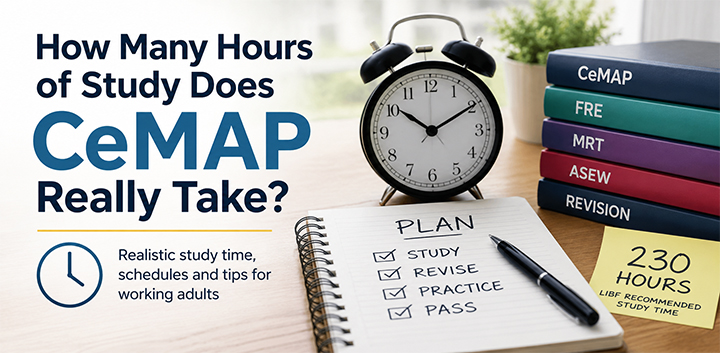
As a starting point, LIBF recommends around 230 hours of study across the full qualification. This provides a useful benchmark when planning your learning journey.
For most working adults, the challenge is not whether they can complete 230 hours. It is finding a realistic way to fit those hours around work, family life, and other commitments.
What Does the Recommended 230 Hours Include?
The recommended study time is based on working through the official syllabus, reading course materials, revising topics, and preparing for exams.
Since the September 2025 syllabus update, CeMAP is assessed across five units:
- FRE1
- FRE2
- MRT1
- MRT2
- ASEW
The 230-hour recommendation covers the full qualification rather than a specific unit.
A simple way to think about it is:
Unit | Typical Study Time |
FRE1 | 40-50 hours |
FRE2 | 40-50 hours |
MRT1 | 45-55 hours |
MRT2 | 45-55 hours |
ASEW | 30-40 hours |
Total | Approximately 230 hours |
These figures are not fixed requirements. Some learners need less time, while others benefit from additional revision and practice.
Why Do Some People Finish Faster Than Others?
No two CeMAP learners start from the same position.
Someone who has worked in banking, estate agency, lending, or financial services may already understand some of the terminology and concepts.
Others begin with no industry knowledge at all.
Several factors can affect how quickly you progress:
Previous Financial Services Experience
Learners with industry experience often recognise concepts such as regulation, mortgages, lending criteria, and client suitability.
This familiarity can reduce the time needed to understand new topics.
Study Consistency
A learner studying six hours every week usually progresses more effectively than someone studying twenty hours one weekend and then nothing for several weeks.
Consistency is often more important than intensity.
Learning Style
Some people absorb information quickly from reading.
Others learn more effectively through:
- Video lessons
- Audio learning
- Tutor explanations
- Practice questions
- Mock exams
Using resources that suit your learning style can improve understanding and reduce the amount of time spent repeatedly revisiting difficult topics.
Exam Confidence
Some learners feel ready to book exams as soon as they achieve strong scores in mock papers.
Others prefer additional revision to build confidence before sitting the assessment.
Both approaches are valid.
Can Additional Study Resources Reduce Study Time?
The official 230-hour recommendation is based largely on studying the syllabus content itself.
Many learners find that supplementary resources help them understand topics more quickly.
Examples include:
- Video tutorials
- Audio lessons
- Revision guides
- Topic-based practice questions
- Full mock examinations
- Tutor support

These resources do not remove the need to learn the syllabus. However, they can help explain complex topics in different ways, which often reduces the time spent struggling with difficult concepts.
For example, a learner who spends three hours reading a topic they do not fully understand may grasp it much faster after watching a clear explanation from an experienced tutor.
Many learners find that combining different learning formats improves both understanding and retention.
When choosing additional study resources, it is worth checking whether they come from an LIBF Accredited Learning Support Provider. Accreditation means the provider’s learning materials and support have been independently reviewed against the current CeMAP syllabus. While accreditation does not guarantee exam success, it can give learners confidence that the content is relevant, up to date, and designed to support their studies effectively.
Accredited providers often offer a combination of learning methods, including video lessons, audio resources, revision guides, topic-based practice questions, mock exams, and tutor support. Many learners find that using a variety of learning formats helps them understand and retain information more effectively than relying on a single study method.
Does Tutor-Led Training Speed Up Learning?
For some learners, yes.
A structured classroom or live online course can significantly reduce the amount of time spent working out what to study next.
Instead of navigating the syllabus alone, learners benefit from:
- A planned study structure
- Expert explanations
- Real-time questions and answers
- Guided exam preparation
- Accountability and momentum
This does not make CeMAP easier, and it does not guarantee exam success.
However, having an experienced tutor break down complex subjects can help learners understand material more efficiently.
Many intensive tutor-led programmes cover the syllabus over approximately ten days of guided learning. After completing the course, learners typically spend additional time revising and preparing for exams before booking their assessments.
At CeMAP123, many learners who complete the 10-day tutor-led programme choose to sit their exams within a couple of weeks after finishing the course, although individual timescales vary depending on confidence, availability, and preparation.
The key point is that structured learning often helps learners reach exam readiness faster than studying entirely independently.
How Many Hours a Week Should You Study?
The best study schedule is one you can maintain consistently.
Below are some realistic examples for working adults.
Option 1: Busy Professional
5 hours per week
- 1 hour Monday
- 1 hour Wednesday
- 3 hours Saturday
Approximate completion time:
- Around 46 weeks for 230 hours
Option 2: Typical Part-Time Learner
8 to 10 hours per week
- 1.5 hours Monday
- 1.5 hours Wednesday
- 2 hours Thursday
- 4 to 5 hours across the weekend
Approximate completion time:
- Around 5 to 7 months
This is one of the most common approaches used by working adults studying alongside full-time employment.
Option 3: Accelerated Study
15 to 20 hours per week
- Regular weekday sessions
- Longer weekend study blocks
Approximate completion time:
- Around 3 to 4 months
This approach is often used by learners who have more flexibility, are between jobs, or want to qualify quickly.
What Happens If You Miss Your Study Schedule?
Life happens.
Work becomes busy.
Children get ill.
Unexpected commitments arise.
Missing a few study sessions does not mean you have failed.
Many successful CeMAP learners adjust their timetable multiple times during their studies.
The important thing is returning to a regular routine as soon as possible rather than trying to make up every missed hour immediately.
Small, steady progress is usually more effective than attempting large catch-up sessions.
Is It Better to Study Little and Often?
For most learners, yes.
Research consistently shows that spaced learning improves retention compared with cramming.
Studying regularly helps:
- Build long-term memory
- Improve understanding
- Reduce overwhelm
- Increase confidence before exams
Even 30 to 60 minutes of focused study can be valuable when done consistently.
Many learners find that frequent shorter sessions fit more comfortably around work and family life than occasional marathon study days.
So, How Long Does CeMAP Really Take?
The official recommendation is approximately 230 hours of study across the full qualification. This is based on working through the syllabus, revision, and exam preparation independently.
In practice, the time taken to become CeMAP qualified varies considerably depending on the learning approach used.
For learners studying entirely on their own around full-time work and family commitments, completion often takes anywhere from six months to a year or longer. Others who can dedicate more regular study time may complete the qualification in three to six months.
However, structured learning can significantly reduce the overall timeframe.
Many learners choose tutor-led classroom training because it provides a clear study plan, expert explanations, guided revision, and the opportunity to ask questions as topics are covered. This can help learners understand the syllabus more efficiently than relying solely on reading course manuals.

For example, intensive tutor-led programmes such as a 10-day CeMAP classroom course cover the full syllabus in a structured format. Following the course, learners typically spend a short period revising, completing mock exams, and sitting their assessments.
As a result, many learners are able to complete all CeMAP examinations and become qualified within approximately four to eight weeks from the start of their training, although individual circumstances, exam availability, and study commitment will always affect the final timescale.
The key point is that there is no single answer to how long CeMAP takes. The qualification can be completed relatively quickly when supported by structured learning and focused revision, while learners studying independently may prefer a slower pace that fits around existing commitments.
What matters most is choosing a study approach that matches your learning style, available time, and personal circumstances. Consistent progress, good-quality study resources, and thorough exam preparation are far more important than trying to reach the finish line as quickly as possible.
Sources
Study time guidance and qualification structure are based on information published by LIBF/Walbrook Institute London and current CeMAP qualification resources.
Guidance from accredited CeMAP Learning Support Providers for the LIBF
This article follows the content standards set out in the project SEO guidance document.
Looking for training support?
We offer CeMAP training for learners working towards a career in mortgage advice. Our courses follow the London Institute of Banking & Finance syllabus and are designed to support understanding of mortgage regulation and advice requirements.
Explore our accredited CeMAP training courses
> Futuretrend Financial Training