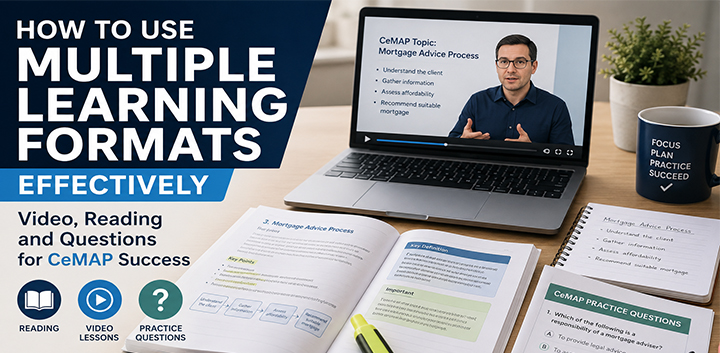
Many CeMAP learners ask the same question: what is the best way to study CeMAP topics?
The most effective approach is usually not relying on a single learning format. Reading, video learning and practice questions each support different parts of the learning process. When used together, they can help learners understand concepts, retain information and prepare for exam-style questions more effectively.
One common mistake is spending all study time watching videos or repeatedly reading notes without testing understanding. Learning becomes more effective when different formats are combined in a structured way.
This article explains how reading materials, video lessons and practice questions each contribute to CeMAP study and how to use them together as part of a practical study routine.
Why Is It Important to Use More Than One Learning Format?
Using multiple learning formats helps reinforce learning from different angles.
CeMAP covers a wide range of topics, including regulation, mortgage products, property law and financial services. Some concepts are easier to understand through explanation, while others require reading, repetition or practice to fully grasp.
Different learning formats support different stages of learning:
- Reading introduces information in detail.
- Video helps explain complex concepts.
- Practice questions test understanding and recall.
- Revision activities reinforce long-term retention.
Relying on only one format can create gaps in understanding. Combining several formats helps build a more complete picture of each topic.
What Does Reading Contribute to CeMAP Study?
Reading provides the foundation for learning CeMAP content.
Whether using official materials, revision guides or structured study resources, reading allows learners to work through topics at their own pace and absorb detailed information.
Reading is particularly useful for:
- Understanding regulations and rules
- Learning definitions and terminology
- Reviewing detailed syllabus content
- Building a broad understanding of a topic
The challenge is that reading alone can sometimes become passive. It is possible to read an entire chapter without fully understanding or remembering the information.
This is why reading works best when followed by another learning activity that reinforces understanding.
How Can You Get More From Reading?
How Can You Get More From Reading?
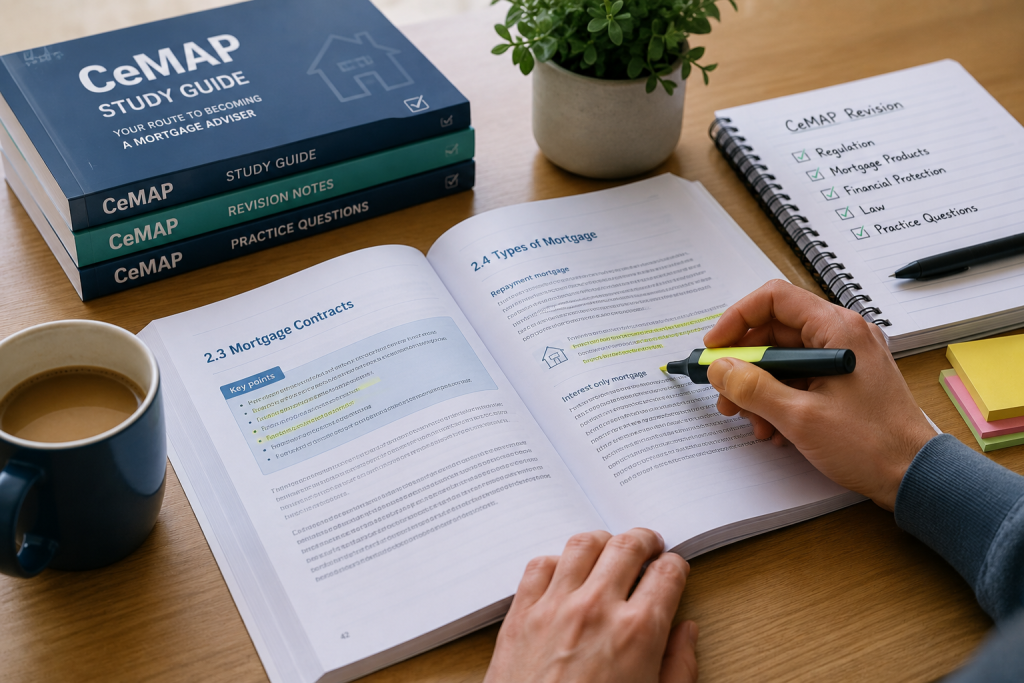
Instead of reading large sections without interaction, try:
- Taking brief notes
- Highlighting key concepts
- Summarising topics in your own words
- Creating simple revision prompts
The goal is not simply to finish a chapter but to understand what it is teaching.
How Do Video Lessons Support Learning?
Video learning can help make difficult topics easier to understand.
A good tutor-led explanation often breaks complex subjects into smaller, more manageable parts. This can be particularly useful when studying areas such as regulation, mortgage calculations or legal concepts.
Videos can help learners:
- Understand challenging topics more quickly
- Hear explanations in plain English
- See examples worked through step-by-step
- Maintain engagement during study sessions
Many learners find that watching a topic explained before reading the supporting material helps improve understanding.
However, videos should support learning rather than replace it.

Why Is Watching Videos Alone Not Enough?
Watching videos can create a false sense of progress.
A learner may understand a topic while watching an explanation but struggle to recall the information later without prompts.
This happens because recognition is different from recall.
Recognition occurs when information feels familiar. Recall occurs when you can retrieve information independently during an exam.
CeMAP examinations require recall, application and interpretation of knowledge. Simply recognising information from a video is unlikely to be enough on its own.
This is why practice and active engagement remain important.
Why Are Practice Questions So Important?
Practice questions help transform understanding into exam readiness.
The CeMAP qualification tests how well learners can apply knowledge, not simply whether they have seen the information before.
Practice questions help learners:
- Check understanding
- Identify knowledge gaps
- Improve recall
- Become familiar with exam wording
- Build confidence in applying concepts
When learners answer questions incorrectly, they often discover areas requiring further study. This makes question practice one of the most valuable learning tools available.
What Should You Do When You Get Questions Wrong?
Incorrect answers should be viewed as useful feedback rather than failure.
When reviewing mistakes:
- Read the explanation carefully
- Return to the relevant topic area
- Re-watch any supporting video if available
- Re-read the relevant study material
- Attempt similar questions later
This process helps strengthen understanding and reduce repeated mistakes.
What Is the Best Order to Use Reading, Video and Questions?
There is no single method that works for everyone, but a structured sequence often helps learners learn more efficiently.
A practical order is:
Step 1: Watch an Introduction to the Topic
Begin with a short video or tutor explanation.
This provides context and helps you understand what the topic is about before moving into detailed study.
Step 2: Read the Supporting Material
Once you understand the basics, read the relevant study guide or course material.
The video provides the overview while the reading adds depth and detail.
Step 3: Take Notes or Create Summaries
Capture the key points in a way that makes sense to you.
This encourages active learning and improves retention.
Step 4: Complete Practice Questions
Test your understanding while the material is still fresh.
Practice questions reveal what you have understood and what needs further work.
Step 5: Review Weak Areas
Use your results to identify topics requiring additional attention.
Return to the reading or video content where necessary before testing yourself again.
This cycle creates a structured approach that combines understanding, reinforcement and application.
What Are the Most Common Mistakes Learners Make?
Several study habits can limit progress even when learners are putting in significant effort.
Only Watching Videos
Videos are useful but should not be the entire study strategy.
Without reading and question practice, knowledge may remain superficial.
Only Reading Material
Reading is important but can become passive if learners never test understanding.
Questions help reveal whether information has actually been retained.
Leaving Questions Until the End
Some learners avoid questions until they have finished the entire syllabus.
Regular testing throughout the learning process is usually more effective because it highlights gaps earlier.
Jumping Between Topics
Constantly switching topics can make study feel busy without producing meaningful progress.
Working through topics in a structured sequence often improves retention.
Ignoring Mistakes
The most valuable questions are often the ones answered incorrectly.
Mistakes highlight where further learning is needed.
How Can a Structured Learning Platform Help?
A structured learning platform helps bring different learning formats together in one place.
Rather than searching for resources individually, learners can move through a planned sequence of study activities.
Many structured CeMAP learning programmes combine:
- Video tuition
- Study guides
- Knowledge checks
- Practice questions
- Topic tests
- Revision resources
This reduces the need to decide what to study next and helps learners follow a logical learning pathway.
For many learners, structure creates consistency and makes it easier to maintain progress over time.

What Is the Best Way to Study CeMAP Topics?
The best way to study CeMAP topics is usually to combine reading, video learning and practice questions rather than relying on a single method.
Reading provides detailed knowledge. Videos help explain complex concepts. Practice questions test understanding and prepare learners for the exam environment.
A structured approach that uses all three formats helps reinforce learning, identify weaknesses and improve knowledge retention.
While every learner studies differently, combining multiple learning formats generally creates a more effective and balanced study experience than focusing on only one resource type.
Final Thoughts
Effective CeMAP study is not about finding a perfect resource. It is about using the right combination of resources at the right time.
Reading, video lessons and practice questions each have their own role. Together they create a learning process that supports understanding, retention and exam preparation.
Learners who actively engage with all three formats often develop a stronger grasp of the syllabus and a clearer understanding of where further study is needed.
Rather than asking which format is best, a more useful question is how each format can support the others. When combined effectively, they create a practical and sustainable approach to CeMAP learning.
Looking for training support?
We offer CeMAP training for learners working towards a career in mortgage advice. Our courses follow the London Institute of Banking & Finance syllabus and are designed to support understanding of mortgage regulation and advice requirements.
Explore our accredited CeMAP training courses
> Futuretrend Financial Training