How to Get the Most Out of a CeMAP Virtual Classroom Course

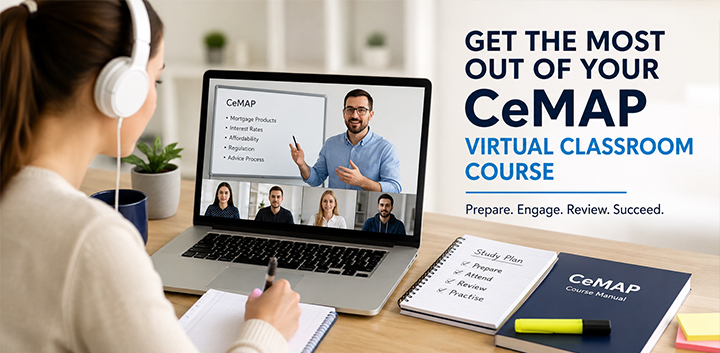
Student attending a live CeMAP virtual classroom course on a laptop while taking notes during online mortgage adviser training.

Virtual classroom learning has become one of the most popular ways to study for CeMAP. It offers the structure of live teaching while allowing learners to study from home or another convenient location. For many people, it provides a balance between the flexibility of online learning and the support of a traditional classroom.

However, simply attending the sessions is only part of the process. The learners who gain the most from a CeMAP virtual classroom course are usually those who prepare before each lesson, stay engaged during teaching and review what they have learned afterwards.

Whether you have already enrolled or are deciding if live online training is right for you, understanding how to use virtual classroom CeMAP training effectively can help you make the most of your investment of both time and effort. This approach aligns with best practices for educational, answer-led content and clear learner guidance.

Student attending a live CeMAP virtual classroom course on a laptop while taking notes during online mortgage adviser training.

What Is a CeMAP Virtual Classroom Course?

A CeMAP virtual classroom course is a live online training programme where an instructor teaches learners in real time using video conferencing software. Rather than watching pre-recorded videos whenever you choose, you join scheduled sessions alongside other learners.

The course typically follows a structured timetable, allowing tutors to explain key topics, answer questions and guide learners through the CeMAP syllabus.

Most virtual classroom providers also include supporting resources such as:

  • Digital course manuals
  • Practice questions
  • Revision materials
  • Mock exams
  • Tutor support between sessions

This combination of live teaching and independent study gives learners regular guidance while still allowing time to study between classes.

What Should You Expect from a CeMAP Virtual Classroom Session?

Knowing what happens during a session helps reduce uncertainty before your course begins.

Although every provider structures lessons slightly differently, most sessions follow a similar pattern.

A typical lesson may include:

  • A review of previous topics
  • Introduction of new learning outcomes
  • Tutor explanations using presentations or examples
  • Opportunities to ask questions
  • Worked examples and practice questions
  • Discussion of common exam misunderstandings
  • Guidance on what to study before the next lesson

Rather than expecting to memorise everything during the live session, think of each class as building your understanding of the subject. Your own revision afterwards is what helps turn that understanding into exam knowledge.

Learner attending a live CeMAP virtual classroom session on a laptop while taking notes during online mortgage adviser training.

How Should You Prepare Before Each Virtual Classroom Session?

Preparing before each lesson makes it much easier to follow the tutor and participate confidently.

Even spending 20 to 30 minutes beforehand can improve your understanding considerably.

Read Any Pre-Course Materials

Many training providers send course notes or reading materials before each lesson.

Having a basic awareness of the topic means you spend less time trying to understand unfamiliar terminology during the session and more time listening to the tutor’s explanations.

You do not need to master the content beforehand. Simply becoming familiar with the main concepts can make a noticeable difference.

Create a Suitable Study Environment

Virtual learning works best when you treat it like attending a physical classroom.

Choose somewhere:

  • Quiet
  • Comfortable
  • Well lit
  • Free from interruptions
  • With a reliable internet connection

If possible, avoid studying from places where you are likely to become distracted, such as the living room while others are watching television.

A dedicated workspace also helps you mentally switch into study mode.

Check Your Technology Beforehand

Technical problems can interrupt learning unnecessarily.

Before your first session, check:

  • Your internet connection
  • Camera
  • Microphone
  • Speakers or headset
  • Laptop charger
  • Login details

Joining five or ten minutes early gives you time to resolve any problems before teaching begins.

How Can You Stay Engaged During Virtual Classroom CeMAP Training?

One of the biggest advantages of live online learning is the ability to interact with experienced tutors.

Taking an active role usually leads to better understanding than simply watching passively.

Ask Questions When Something Is Unclear

Many learners worry about asking questions because they think everyone else understands the topic.

In reality, other learners often have the same question.

Good tutors expect questions throughout the course and can often explain concepts in several different ways.

If something does not make sense, asking immediately is usually better than hoping it becomes clearer later.

Take Your Own Notes

Even if comprehensive course manuals are provided, writing your own notes helps reinforce learning.

Rather than copying every word from the presentation, focus on:

  • Key definitions
  • Important rules
  • Areas you find difficult
  • Tutor explanations that helped something make sense

These personalised notes often become some of your most useful revision resources later.

Minimise Distractions

Studying from home brings temptations that would not exist in a classroom.

Try to avoid:

  • Checking emails
  • Looking at social media
  • Watching television
  • Using your phone unnecessarily
  • Working on unrelated tasks

Even brief interruptions can make it harder to follow detailed financial concepts.

Why Participation Matters More Than Attendance

Attending every session is important, but participation is what helps develop understanding.

Learners who contribute during discussions often remember information more effectively because they are actively processing what they hear.

Participation might include:

  • Answering tutor questions
  • Joining discussions
  • Completing exercises
  • Sharing your reasoning
  • Asking for clarification

You do not need to speak constantly. Simply engaging with the learning process keeps your attention focused.

CeMAP learner actively participating in a live virtual classroom by asking questions and engaging with the online tutor.

How Should You Review After Each Session?

One of the biggest mistakes learners make is assuming the live lesson is enough.

The most effective learning usually happens after the session ends.

Review Your Notes the Same Day

Revisiting your notes while the lesson is still fresh helps strengthen your memory.

Even a short review can identify areas that need further study before they become larger problems.

Review Your Notes the Same Day

Revisiting your notes while the lesson is still fresh helps strengthen your memory.

Even a short review can identify areas that need further study before they become larger problems.

Complete Practice Questions

CeMAP examinations test how well you understand the syllabus rather than whether you attended lessons.

Practice questions help you:

  • Apply your knowledge
  • Identify weak areas
  • Become familiar with exam wording
  • Build confidence gradually

If you answer questions incorrectly, use them as learning opportunities rather than signs of failure.

Organise Your Revision

After each lesson, organise your notes alongside your course materials.

Keeping everything clearly labelled makes later revision much easier.

Many learners use folders or digital note systems organised by CeMAP unit, allowing them to find information quickly when preparing for exams.

Should You Study Between Virtual Classroom Sessions?

Yes. Independent study is an important part of every CeMAP virtual classroom course.

Live sessions introduce and explain topics, but personal study helps reinforce and retain that knowledge.

Between lessons, you could:

  • Re-read course materials
  • Complete practice questions
  • Review tutor notes
  • Create revision summaries
  • Revise difficult topics
  • Test yourself using flashcards

Studying little and often is generally more effective than leaving everything until just before the exam.

What Are the Most Common Mistakes Learners Make?

Understanding common mistakes can help you avoid unnecessary difficulties during your course.

Expecting the Tutor to Do All the Learning

Tutors explain complex topics clearly, but learning still requires personal effort.

Virtual classroom training works best when learners actively revise outside scheduled sessions.

Falling Behind After Missing One Lesson

Life sometimes gets in the way, and missing a session does not automatically mean you cannot succeed.

The important thing is catching up promptly by reviewing recordings if available, reading the course materials and speaking with your tutor if necessary.

Leaving gaps for several weeks often makes later topics much harder to understand.

Ignoring Areas That Feel Difficult

It can be tempting to focus on subjects you already understand.

Instead, spend additional time on weaker topics while tutor support is still available.

Addressing small misunderstandings early is usually much easier than revisiting them shortly before the exam.

Not Using Available Support

Many virtual classroom providers offer additional support beyond the live lessons.

This may include tutor email access, revision sessions, discussion groups or extra learning resources.

Making use of these opportunities can help clarify difficult topics and maintain momentum throughout the course.

Is Virtual Classroom Learning Right for Everyone?

Not necessarily.

Some learners enjoy the flexibility and interaction of live online teaching, while others may prefer self-paced study or traditional classroom learning.

Virtual classroom courses often suit learners who:

  • Like structured study schedules
  • Benefit from live explanations
  • Want opportunities to ask questions
  • Appreciate regular accountability
  • Prefer learning from home

Those who need complete flexibility because of unpredictable work patterns may find on-demand online learning more suitable.

Choosing the right format depends on your learning style, availability and personal preferences rather than one method being better than another.
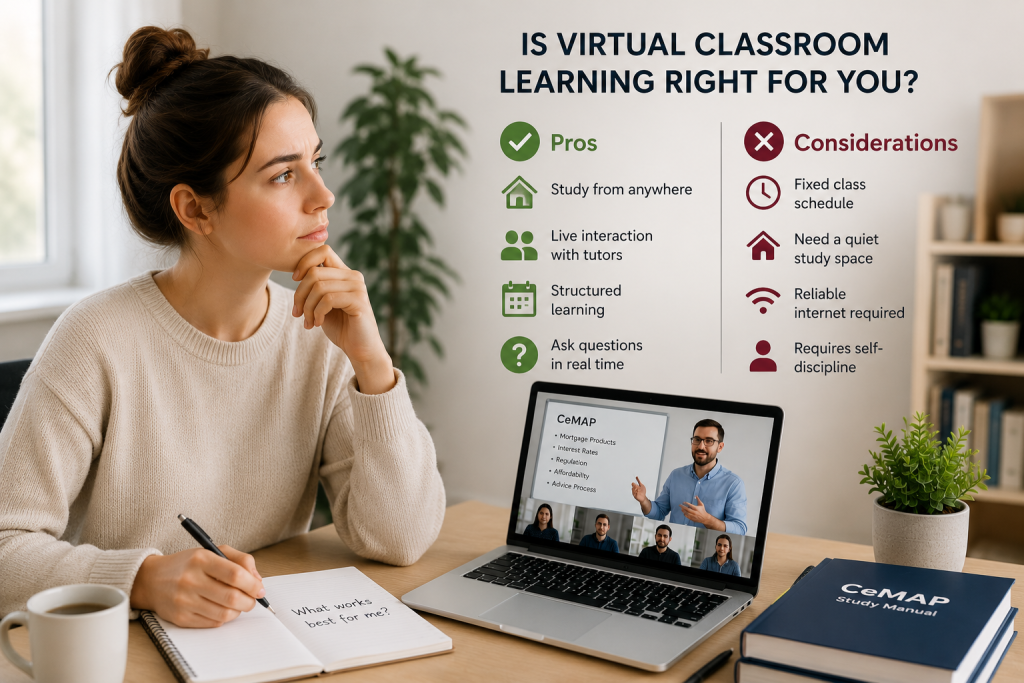
Prospective CeMAP learner considering whether a virtual classroom course suits their learning style and study needs.

How to Use Virtual Classroom CeMAP Training Successfully

Getting the most from a CeMAP virtual classroom course is about more than simply logging in each day. Preparing before lessons, engaging during teaching and reviewing afterwards all contribute to stronger understanding and greater confidence.

The live sessions provide valuable structure, guidance and opportunities to ask questions, but they work best when combined with regular independent study. Treat each lesson as part of an ongoing learning process rather than a standalone event.

With consistent preparation, active participation and steady revision, virtual classroom training can provide an effective route towards achieving your CeMAP qualification while giving you the support of experienced tutors and fellow learners throughout your studies.

Looking for training support?

We offer CeMAP training for learners working towards a career in mortgage advice. Our courses follow the London Institute of Banking & Finance syllabus and are designed to support understanding of mortgage regulation and advice requirements.

Explore our accredited CeMAP training courses

> Futuretrend Financial Training 
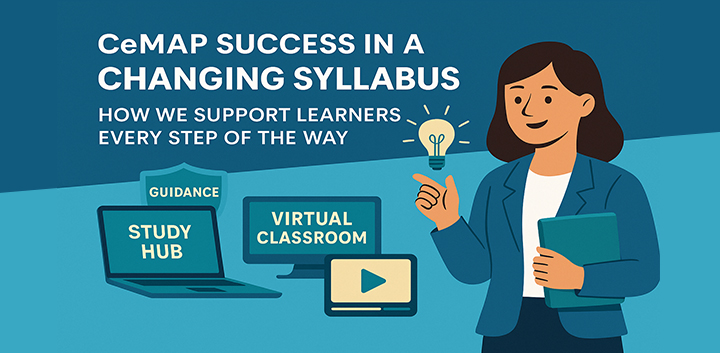
CeMAP Success in a Changing Syllabus: How We Support Learners Every Step of the Way

CeMAP Success in a Changing Syllabus

With the new LIBF CeMAP syllabus launching in September 2025, learners face an exciting but challenging transition. Whether you’re completing the current structure or starting fresh with the new modules, one thing is certain: the right support makes all the difference.

At CeMAP123, we’ve been helping aspiring mortgage advisers succeed for over 16 years. Thousands of learners have trusted us to not only pass their CeMAP exams but also build rewarding careers in financial services.

Here’s how we support you at every stage of your CeMAP journey — from first study session through to your first role as a qualified adviser.

CeMAP Success in a Changing Syllabus

Support During Your CeMAP Studies

The CeMAP Study Hub

Our Study Hub is at the heart of learner support. Designed to suit all learning styles, it provides:

  • Tutor-led topic videos to break down complex areas.
  • Made Easy Revision Notes in both digital and optional hard copy.
  • Audio books and podcasts for learning on the go.
  • Key Point Tutorials, FAQs and Glossary for quick reference.
  • Topic Reviews and Quizzes to check your progress.

At the end of each unit, you’ll find Unit Reviews with exam preparation, guidance on specimen papers, and practice under exam-style conditions. For CeMAP 1 and 3, we also include special guidance on case studies — a key exam area many learners struggle with.

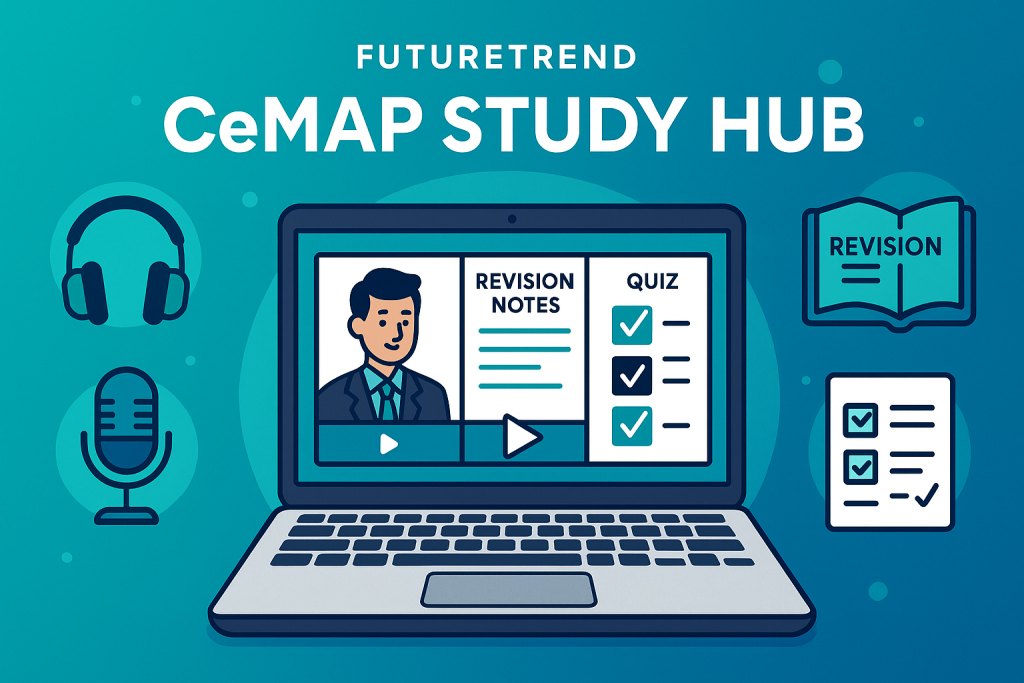
CeMAP study hub learning support

👉 Learners can choose digital-only access or upgrade to Home Study Packages with printed revision guides and specimen papers.

Live Virtual Classroom

For those who thrive in an interactive setting, we run Live Virtual Classrooms via Zoom. These are:

  • Fully interactive (ask questions live by mic or chat).
  • Delivered by experienced mortgage advisers and accredited tutors.
  • Recorded and available for 3 months via the Study Hub.

This means you get the structure of classroom teaching with the flexibility of online learning.

Tailored Tutor Support

We know learners need reassurance and quick answers. That’s why we provide:

  • A Learner Forum in the Study Hub where tutors and L&D Managers respond directly to questions.
  • Email training support and guidance from our team education experts.
  • Guidance on how to read exam questions, approach case studies, and use official LIBF Specimen Papers to maximise your readiness.

Life After CeMAP – Career Support

Passing your CeMAP exam is only the beginning. We continue to support learners with:

  • Career guidance – CV writing, interview preparation, and job-hunting strategies.

  • Introductions to mortgage networks and independent broker firms – through our trusted partnerships, learners can access consultancy and advice, with no obligation.

  • Industry insights – understanding different career paths, from working in established brokerages to setting up your own practice.
Life After CeMAP – Career Support

💡 One of our past learners recently became a finalist in the British Mortgage Awards 2025 (Buy-to-Let category).

👉 Others have gone on to launch their own successful firms and even hired some of our new CeMAP graduates into their teams.

Why Choose CeMAP123 Over LIBF’s Standard Resources?

LIBF provides the syllabus, reading material, and an exam attempt. While valuable, it’s a one-size-fits-all approach.

At Futuretrend Financial Training, we go further by offering:

  • A wide range of learning formats (video, audio, notes, podcasts, quizzes).

  • Tutor-led guidance for every unit and topic.

  • Ongoing support and interaction through forums and classrooms.

  • Resources that save learners money — for example, our packages include LIBF specimen papers (normally purchased separately).

  • Over 25 years of training experience in training services and 16 years in financial training in which time we became one of the first LIBF Accredited Learning and Support providers in CeMAP.


Simply put: we don’t just give you the content. We guide you, test you, and support you until you’re ready to succeed.

Frequently Asked Questions About CeMAP Support

What kind of study support does Futuretrend Financial Training provide for CeMAP learners?

At www.CeMAP123.co.uk, we provide structured, tutor-led support that goes beyond LIBF’s core syllabus. Our Study Hub includes revision notes, tutor videos, podcasts, quizzes, and specimen exam practice to match different learning styles. Learners also get access to live virtual classrooms every 6 weeks, and our dedicated tutor forum where qualified advisers answer questions. This blend of resources and human support has helped thousands of learners pass CeMAP over the last 16 years.

Can I choose between online CeMAP study or printed learning materials?

Yes. All learners get access to our digital Study Hub, but you can also choose a Home Study Package that includes printed revision guides and specimen papers. These hard copy materials are popular with learners who prefer to highlight, annotate, and revise offline. Both formats are fully aligned with LIBF’s syllabus, but the hard copy gives extra flexibility for learners who want to reduce screen time.

What is included in my LIBF CeMAP registration, and how is CeMAP123 different?

When you register with LIBF, you receive access to the syllabus, digital reading materials, and one exam attempt. However, LIBF’s resources are limited to self-study. At CeMAP123, we provide enhanced training: tutor-led videos, structured revision guides, interactive quizzes, live classes, and guidance on specimen papers. Because we are an accredited LIBF Learning Support Provider, learners can trust that our resources meet LIBF standards while providing much more support.

Do you provide help after I complete my CeMAP exams?

Yes — our support doesn’t end when you pass. We provide career guidance, including CV advice, interview preparation, and introductions to mortgage networks and broker firms through our partnerships. Many of our learners have gone on to secure roles quickly, with some even launching their own businesses. In fact, some of our graduates have been shortlisted for national awards such as the British Mortgage Awards 2025. This ongoing support ensures learners are not only exam-ready but also career-ready for a bright future.

Is CeMAP123 a trusted provider of CeMAP support?

Yes. We have over 25 years of experience in  education towards careers and have been supporting learners through CeMAP for over 16 years. As an LIBF-accredited training provider, we follow their standards while adding extra resources that make studying easier and more effective. Thousands of learners have trained with us, many of whom are now established mortgage advisers, brokers, or business owners — proof that our support delivers long-term results.

Do CeMAP123 resources include practice exams and exam-style preparation?

Yes. Our Study Hub includes access to official LIBF specimen papers, with tutor guidance on how to approach the questions. Learners also practise under timed conditions and receive feedback on their answers, which builds exam confidence. For CeMAP 1 and 3, we also include special sessions on how to analyse case studies, since this is a key skill for success.

Conclusion

The CeMAP syllabus may be changing in 2025, but one thing hasn’t changed: learners succeed when they’re supported. At Futuretrend Financial Training, we’re proud to guide students from their very first study session to launching successful mortgage advice careers.

👉 Whether you’re completing CeMAP under the current structure or starting fresh with the new syllabus, our Study Hub, Live Virtual Classrooms, and career support network will help you achieve your goals.

Ready for additional training support?

Book our CeMAP Home Study course or visit our website for full training resources:
https://cemap123.co.uk/home-study-training/

Explore our accredited CeMAP training courses

Images Designed by AI

What to Expect on the First Day of the CeMAP 1 Virtual Classroom Course

What to Expect on the First Day of the CeMAP 1 Virtual Classroom Course

The CeMAP 1 Live Virtual Classroom, led by Tutor Anthony, provides an engaging and structured learning experience designed to help learners navigate the complexities of the financial services landscape. Here’s a detailed breakdown of what you can expect on your first day.

Welcome and Orientation

The day begins with a warm welcome from Tutor Anthony, who introduces himself, the course, and the module structure for the week. He sets a professional yet approachable tone for the sessions. Following this, the Learning and Support Manager walks learners through the resources they would have received in advance, including hard-copy materials and access to the online portal. They explain how to navigate the portal to utilise additional online resources, including session recordings available at the end of each day.

Course Overview

Once everyone is settled, Anthony provides a comprehensive overview of the CeMAP structure. He explains how the modules are organized, the process for registering with the LIBF, and the exam options—either at a Pearson VUE Exam Centre or via an online exam with a remote moderator. Learners gain clarity on what to expect, helping them feel prepared and confident.

Diving into Module 1

The learning kicks off with Module 1, Topic 1, which is the first of 25 topics in the CeMAP 1 syllabus. The day’s four sessions are packed with foundational concepts, ensuring learners build a strong understanding of the essentials.

Throughout the day, Anthony integrates questions from official LIBF specimen papers, giving learners a chance to test their knowledge and practice exam-style questions. This interactive approach not only reinforces learning but also highlights areas where additional focus is needed.

Key Topics Covered

Here’s a closer look at the highlights from Day 1:

Money, Intermediation, and Banking Functions

Anthony discussed the functions of money, emphasizing its role as a medium of exchange, unit of account, and store of value. He explained that money must be portable, acceptable, divisible, sufficient in quantity, and not free from the effects of inflation. Anthony also introduced the concepts of intermediation and disintermediation, explaining how banks and building societies act as intermediaries between savers and borrowers, and how disintermediation allows companies to raise funds directly from the public. He further elaborated on the importance of maturity transformation, risk transformation, and geographic location in the banking sector. The discussion also touched on the role of banks in managing risk and the potential for default among borrowers.

Understanding Financial Institutions and Roles

Anthony discussed the importance of understanding the language and functions of various financial institutions, including banks, building societies, and credit unions. He emphasized the role of the Bank of England in managing the economy, setting interest rates, and issuing notes and coins. Anthony also explained the concept of demutualization, where a mutual organization like a building society becomes a bank or a public limited company (PLC). He highlighted the distinction between retail and wholesale banking, with retail banking serving individual customers and small businesses, while wholesale banking deals with larger transactions involving governments, corporations, and financial institutions. Anthony also touched on the role of the Debt Management Office (DMO) in issuing government bonds and gilts. He concluded the session by asking participants to recall the key points and prepare for a short break.

Economic Concepts and Their Implications

Anthony discusses economic concepts like inflation, GDP, and recession. He explains that the government aims for low and controlled inflation around 2% measured by the Consumer Price Index (CPI). A recession occurs when there is negative GDP growth for two consecutive quarters. Anthony clarifies the difference between recession, deflation (sustained price falls below 0%), and disinflation (falling but still positive inflation rate). The group practices identifying these concepts through example questions.

Bank of England’s Monetary Policy

Anthony discussed the impact of the Bank of England’s monetary policy on the economy, explaining that interest rates can be adjusted to stimulate demand and control inflation. He noted that during the Covid-19 pandemic, interest rates were lowered to encourage borrowing and spending, and that the Bank of England’s base rate has increased from 0.25% to 5.25% since August 2023. Anthony also explained the concept of fiscal policy, which involves using taxation and government spending to influence the economy. He mentioned that the UK government is currently in a deficit and will likely increase taxes to fund public services. The team also discussed the UK’s inflation target, which is set at 2% by the government.

Brexit’s Impact on UK Financial Services

Anthony discussed the impact of Brexit on the UK’s financial services and regulatory framework. He explained that the UK is no longer part of the EU, but still follows some of their rules and regulations. He mentioned the Financial Services Market Act 2023, which allows the government to repeal and replace laws, and the introduction of the Financial Conduct Authority (FCA) and the Prudential Regulation Authority (PRA) to regulate financial services. Anthony also touched on the concept of domicile and its relation to inheritance tax, explaining that an individual’s domicile determines which country’s inheritance tax laws apply to their worldwide assets. He used the example of Simon Cowell, who might be considered an American domicile, to illustrate this point. The conversation ended with a discussion on income tax, with Anthony explaining that an individual is considered a UK resident for tax purposes if they are in the country for more than 183 days in a tax year.

Taxation and Personal Allowances Explained

In the meeting, Anthony discussed various aspects of taxation, including the tax year, income tax, and personal allowances. He explained that everyone gets a tax-free personal allowance of £12,570, and that this allowance is reduced by £1 for every £2 earned above £100,000. He also mentioned the personal savings allowance, which is £1,000 for basic-rate taxpayers and £500 for higher-rate taxpayers. Anthony also discussed the tax bands for different income levels, and how these bands apply to various types of income such as interest, dividends, and rental income. He emphasized the importance of understanding these tax concepts for the mortgage advisory role. Towards the end of the meeting, Anthony briefly touched on the self-assessment process for self-employed individuals and the deadlines for submitting tax returns.

homeownership guide 2025

National Insurance and Capital Gains Tax

In the meeting, Anthony discussed the different classes of National Insurance (NI) and how they apply to employees and employers. He explained that Class 1 NI is paid by employees and employers at 8% on earnings between certain levels, with a lower rate of 2% for earnings above a certain limit. He also mentioned that Class 2 NI is paid by self-employed individuals with profits above a certain threshold, and that it has been largely abolished for most people. Anthony also discussed Capital Gains Tax (CGT), explaining that it is a tax on the profit made from selling investments or property, and that there are certain exemptions such as the house you live in, gilts and bonds, personal items, and lottery winnings. He also mentioned that losses can be carried forward to future years to offset against gains. The conversation ended with a discussion on the potential changes to CGT rates in the upcoming budget.

Inheritance Tax and Chargeable Transfers

Anthony discussed the complexities of Inheritance Tax (IHT) in the UK. He explained that IHT is charged at 40% on estates over £325,000, with a nil rate band of £325,000. He also highlighted the residential nil rate band, which can be claimed if a property is left to a direct descendant. Anthony further explained the concept of chargeable lifetime transfers, where gifts to clubs, companies, or certain trusts are taxed at 20% on amounts over £325,000. He also discussed exemptions, such as gifts to charities, political parties, and the nation, as well as gifts to family members and wedding gifts. Anthony concluded by mentioning the potential for changes in the government’s policy on regular income gifts.

Tax Topics

Anthony discussed various tax-related topics, including Value Added Tax (VAT), Stamp Duty Land Tax (SDLT), and Corporation Tax. He explained that VAT is an indirect tax levied on the sale of goods and services, with some goods being exempt or 0-rated. He also mentioned that SDLT is a tax on land transactions, with different rates applying to different bands of property prices. Anthony further explained that Corporation Tax is paid by limited companies on their profits, with different rates applying depending on the company’s profits. He also touched on the topic of withholding tax, which is levied at source before income is received.

Fixed vs Tracker vs Variable Mortgage: CeMAP Comparison for Learners

Wrapping Up

The day concludes with an open Q&A session, where learners can clarify doubts and discuss any lingering questions. Anthony provides a brief preview of the next day’s agenda before wishing everyone a pleasant evening.

Final Thoughts

The first day of the CeMAP 1 Virtual Classroom sets a solid foundation for the rest of the course. With a mix of theoretical knowledge, practical exercises, and engaging discussions, learners are well-equipped to navigate the complexities of financial services. Tutor Anthony’s expertise and interactive teaching style ensure a rewarding learning experience.

Are you ready to embark on your journey to becoming a CeMAP-certified professional?

Sign up for the CeMAP 1 Live Virtual Classroom today!

Images Designed by Freepik (www.freepik.com) and AI