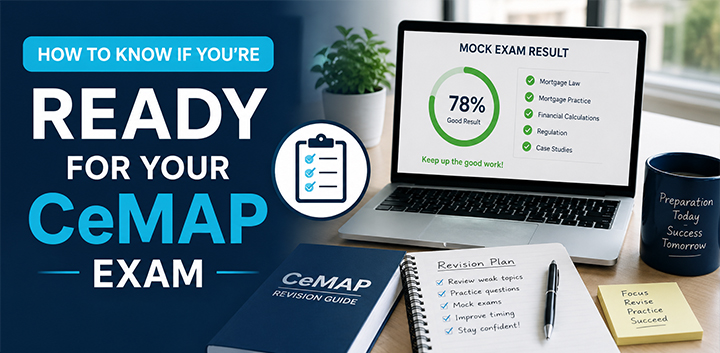
How to Know If You’re Ready for Your CeMAP Exam

Learner reviewing CeMAP mock exam results on a laptop while preparing to book their CeMAP exam.

When am I ready for the CeMAP exam? You’re ready when you consistently demonstrate your knowledge under exam conditions, not simply because you’ve finished studying or feel confident. The best indicators are strong mock exam results, a solid understanding of key concepts, and the ability to explain why answers are correct rather than relying on memory alone.

Many learners reach a point where they wonder whether they should book their CeMAP exam or spend another week revising. It can be difficult to judge because confidence doesn’t always reflect how prepared you actually are. Some learners underestimate themselves despite being ready, while others book too early because they feel familiar with the material.

Knowing the difference can help you avoid unnecessary stress, additional exam fees, and disappointment.

This guide explains the signs that you’re genuinely ready, how mock exams should be used, and why understanding matters far more than simply feeling confident. The guidance follows best practice for educational content and focuses on helping learners make an informed decision rather than encouraging them to book before they’re prepared.

Learner reviewing CeMAP mock exam results on a laptop while preparing to book their CeMAP exam.

What Does Being Ready for the CeMAP Exam Actually Mean?

Being ready doesn’t mean knowing every page of the syllabus from memory.

Instead, readiness means you can apply your knowledge consistently across different question styles and recognise why the correct answer is right.

The London Institute of Banking & Finance (LIBF) CeMAP exams assess understanding as well as recall. Questions are often worded differently from practice materials, meaning learners who have only memorised facts can struggle.

A learner who is ready will usually be able to:

  • Explain key topics in their own words.
  • Apply knowledge to different scenarios.
  • Recognise incorrect answers as well as correct ones.
  • Complete questions within the available time.
  • Stay reasonably calm during practice exams.

Perfection isn’t the goal. Consistency is.

What Are the Signs You're Ready for the CeMAP Exam?

Rather than relying on instinct, look for evidence that your preparation is working.

Some of the strongest indicators include:

You Consistently Pass Mock Exams

One good mock result isn’t enough.

A better sign is achieving strong scores across several different mock exams over time.

This suggests your understanding is consistent rather than based on remembering individual questions.

If your scores vary dramatically between attempts, there may still be knowledge gaps worth addressing.

You Understand Why Answers Are Correct

Many learners focus on whether they chose the correct option.

A better question is:

“Could I explain why the other answers are wrong?”

Being able to justify your answer shows genuine understanding rather than recognition.

This becomes especially important when the real exam presents familiar topics in unfamiliar ways.

You’re No Longer Guessing Frequently

Every learner makes the occasional educated guess.

However, if you regularly narrow questions down without really knowing the answer, your revision may still need work.

Confidence based on guessing can disappear quickly when exam wording changes.

You Can Recall Information Without Looking It Up

If you constantly need your notes beside you, you may not yet be ready.

During revision, try answering questions before checking textbooks or revision guides.

Retrieving information from memory strengthens learning far more than repeatedly reading the same material.

You Can Explain Topics to Someone Else

One of the simplest tests is explaining a topic aloud.

If you can describe concepts such as mortgage regulation, affordability, protection products or the house buying process clearly without reading from your notes, you’re likely developing a deeper understanding.

If your explanation quickly breaks down, you’ve identified an area for further revision.

Why Are Mock Exams So Important?

CeMAP Mock exams are one of the most useful tools for measuring readiness because they simulate the way knowledge must be applied during the real assessment.

They’re far more valuable than simply rereading notes.

Good mock exams help you:

  • Identify weak topics.
  • Practise working under time pressure.
  • Become familiar with question styles.
  • Improve exam technique.
  • Build realistic confidence.

The aim isn’t simply to achieve a high score.

It’s to discover where your understanding still needs strengthening before exam day.

Learner completing a CeMAP mock exam on a laptop with revision notes, flashcards and study materials on a desk.

Can Confidence Be Misleading?

Yes.

Confidence and ability don’t always develop at the same speed.

Some learners feel extremely confident because they’ve spent many hours studying, yet struggle when answering application-based questions.

Others worry they’re underprepared despite regularly achieving excellent mock scores.

Instead of asking:

“Do I feel ready?”

Ask:

  • What do my mock exam results show?
  • Which topics consistently cause problems?
  • Can I explain difficult concepts without my notes?
  • Have I improved over several weeks rather than one good day?

Evidence is a much better guide than emotion.

What Happens If You Book Your CeMAP Exam Too Early?

Booking before you’re ready increases pressure without improving your chances of success.

Although everyone wants to qualify as quickly as possible, sitting the exam before you’ve developed consistent understanding can lead to unnecessary setbacks.

Potential risks include:

  • Failing the exam and needing to pay another exam fee.
  • Losing confidence.
  • Spending additional time revising areas that could have been addressed beforehand.
  • Creating unnecessary stress around future exams.

A short delay spent improving weaker areas is often far more productive than rushing into an assessment.

How Can You Test Your Readiness Before Booking?

A useful self-assessment combines several measures rather than relying on one.

Ask yourself:

Are your mock exam scores consistently strong?

Avoid judging readiness from a single result.

Can you complete questions within the allocated time?

Running out of time during practice may indicate more exam practice is needed.

Do you understand the syllabus rather than memorise it?

If questions are slightly reworded, can you still reach the correct answer?

Have you reviewed your weaker topics?

Every learner has stronger and weaker subjects.

Before booking, make sure you’ve revisited the areas where mistakes regularly occur.

Are mistakes becoming less frequent?

Improvement over time is one of the strongest indicators that your revision is working.

What Should You Do If You're Not Quite Ready?

Not feeling ready doesn’t necessarily mean you’re far away from passing.

Often only a few targeted improvements are needed.

Instead of restarting the entire syllabus:

  • Review the topics where mock exams reveal repeated mistakes.
  • Complete more timed practice questions.
  • Focus on understanding rather than memorisation.
  • Use active recall techniques instead of rereading notes.
  • Leave a short gap before attempting another mock exam.

Small improvements in weaker areas often make a significant difference to overall performance.

Should You Wait Until You Feel Completely Ready?

Probably not.

Very few learners ever feel 100% prepared.

There will almost always be topics you’d like to revise one more time.

The goal isn’t complete certainty.

The goal is having enough evidence that you’re capable of passing.

If your mock exam results are consistently strong, your understanding is solid, and you’re applying knowledge confidently across the syllabus, waiting several more weeks may add very little value.
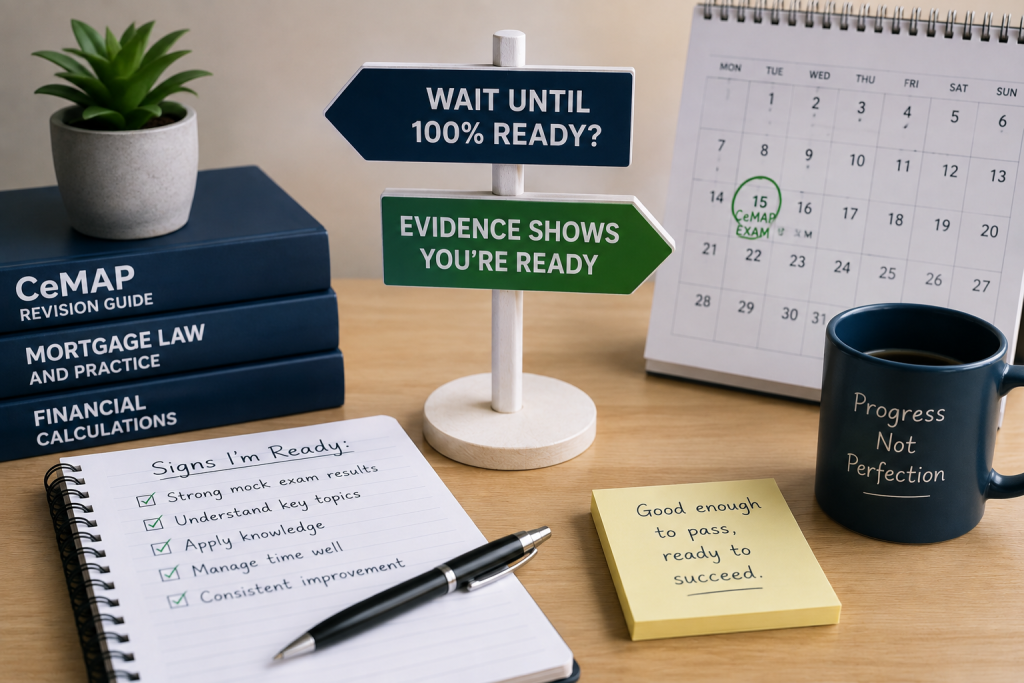
CeMAP revision books, study checklist and exam calendar representing deciding when to book a CeMAP exam based on readiness rather than perfect confidence.

Final Thoughts

Knowing when you’re ready for your CeMAP examhttps://cemap123.co.uk/ isn’t about reaching a perfect level of confidence.

It’s about demonstrating consistent performance through practice.

Strong mock exam results, a genuine understanding of the syllabus, and the ability to apply knowledge under exam conditions are much more reliable indicators than simply feeling prepared.

If your evidence shows you’re performing consistently, booking your exam is likely the next sensible step. If it highlights weaknesses, use that information positively by focusing your revision where it will have the greatest impact.

Remember, the aim isn’t just to pass the exam. It’s to build the knowledge and confidence that will support you throughout your future career as a mortgage adviser.

For additional support, many learners find it helpful to combine structured revision with high-quality mock exams, topic-by-topic practice questions and active recall techniques. These resources can help you identify any remaining knowledge gaps before you book your assessment.

Looking for training support?

We offer CeMAP training for learners working towards a career in mortgage advice. Our courses follow the London Institute of Banking & Finance syllabus and are designed to support understanding of mortgage regulation and advice requirements.

Explore our accredited CeMAP training courses

> Futuretrend Financial Training 

How to Approach Multiple-Choice Exams Properly

Multiple-choice exam answer sheet with pencil marking answers, stopwatch and notebook, representing how to approach MCQ exams properly.

Professional CeMAP multiple-choice exams can feel unfamiliar if you have not taken one before. Many learners assume they are simple because the answer is on the page. Others assume they are full of tricks.

Neither is true.

LIBF CeMAP Multiple-choice exams are carefully designed assessments. They test how well you understand a subject, how clearly you can apply knowledge, and how accurately you can distinguish between similar ideas. When you understand how they work, they feel far more manageable.

This guide explains how multiple-choice exams work and how to approach them with a calm and structured mindset.

Multiple-choice exam answer sheet with pencil marking answers, stopwatch and notebook, representing how to approach MCQ exams properly.

How do multiple-choice exams work?

The CeMAP multiple-choice exam presents a question followed by a set of possible answers. Your task is to select the one option that best answers the question.

That may sound simple, but the purpose is more specific than it first appears.

Multiple-choice exams are designed to test:

  • Recognition of correct information
  • Understanding of key principles
  • Ability to apply knowledge to short scenarios
  • Ability to distinguish between closely related concepts

They are not designed to reward guessing. They are not designed to catch you out. They are structured to measure whether you can reliably identify the correct answer among alternatives.

Professional MCQ exams are built using detailed assessment criteria. Each question is mapped to a specific learning outcome. This means every question exists for a reason. There is no filler.

Understanding this helps reduce anxiety. The exam is not random. It is structured and deliberate.

How are multiple-choice questions designed?

Multiple-choice questions follow a clear structure.

Each question contains:

  • A stem – the main question or scenario
  • A set of answer options
  • One answer that is considered the most accurate

The wording is carefully chosen. Good MCQs are written to test understanding, not memory alone.

For example, a question may:

  • Present a short scenario and ask what principle applies
  • Ask which definition is correct
  • Ask which action would be appropriate in a given situation

The goal is to assess whether you recognise the correct application of knowledge.

Importantly, professional MCQs are written to avoid ambiguity. There should always be one best answer based on the syllabus or learning content. If two options look similar, one will align more precisely with the required knowledge.

When learners struggle, it is often not because the question is unfair. It is because two options feel familiar. That is different from both being correct.

Multiple-choice exam answer sheet with pencil marking answers, stopwatch and notebook, representing how to approach MCQ exams properly.

Why do multiple-choice exams include wrong answers?

Wrong answers exist for a specific reason.

They are not there to trick you. They are there to reflect common misunderstandings.

Examiners know the typical mistakes learners make. They know which definitions are often confused. They know which principles are commonly misapplied. These common errors are used to construct the incorrect options.

This serves two purposes:

  1. It tests whether you truly understand the material.
  2. It prevents someone from passing by guessing or recognising words without understanding them.

If an incorrect answer looks appealing, that usually means it reflects a partial understanding. It might contain a familiar phrase or a related idea, but it will not fully answer the question asked.

This is why careful reading matters.

A helpful way to think about wrong answers is this: they are plausible, but incomplete or slightly inaccurate. Your role is not to find something that sounds right. Your role is to find what is fully correct.

Why is reading the question carefully so important?

In professional multiple-choice exams, reading is often more important than speed.

Many errors happen because learners answer the question they expected to see, rather than the question that is actually written.

A small word can change the meaning entirely. Words such as:

  • “Most appropriate”
  • “First”
  • “Best”
  • “Primary”
  • “Except”

These words define what the question is asking. Missing one of them can lead to choosing an answer that is technically correct, but not the best answer in that context.

It helps to approach each question in three stages:

  1. Read the question slowly and fully.
  2. Identify what it is actually asking.
  3. Then look at the answer options.

If you read the answers first, you may be influenced by wording before you fully understand the task.

Another common mistake is rushing because the format feels familiar. Multiple-choice questions look short. That does not mean they require little thought. Some of the shortest questions test the most precise distinctions.

Taking a few extra seconds to confirm what is being asked is rarely wasted time.

Graphic showing a multiple-choice question with key words highlighted, demonstrating why reading the question carefully is important in MCQ exams.

How should you make decisions under exam pressure?

Even well-prepared learners can feel uncertain during an exam. This is normal.

Pressure affects confidence more than knowledge. Under stress, you may doubt answers you would select calmly at home.

A structured approach helps:

1. Stay objective

Treat each question as a separate task. Do not let a difficult question affect the next one. If you are unsure, make your best decision and move on. Lingering too long can increase anxiety without improving clarity.

2. Avoid overthinking

Many learners assume there must be a hidden trick. This leads to second-guessing simple, correct answers.

Professional exams are not puzzles. If an answer clearly matches the learning material and fits the wording of the question, it is usually correct. Complicating it rarely improves accuracy.

3. Trust preparation, not emotion

Confidence should come from preparation, not how you feel in the moment.

If two answers seem possible, ask yourself:

  • Which one fully answers the question?
  • Which one aligns exactly with the principle I studied?
  • Which one leaves no gap?

Often one answer will be slightly more precise. That precision matters.

4. Accept uncertainty

You do not need to feel 100% certain about every question to pass. Professional exams are designed with a pass mark below 100% for a reason. A small degree of uncertainty is expected.

Your goal is not perfection. Your goal is consistent, informed decision-making.

Common misunderstandings about multiple-choice exams

First-time professional learners often carry unhelpful assumptions.

“It’s just guessing.”

Guessing is possible, but it is not reliable. MCQs are built to reward knowledge and penalise shallow recognition. Understanding makes a significant difference.

“The examiner is trying to catch me out.”

LIBF Examiners are trying to assess competence, not trick candidates. Questions are structured around defined learning outcomes. If something feels confusing, it is usually testing precision rather than attempting deception.

“If two answers look right, the question is unfair.”

In most professional exams, one answer will be more accurate or more complete. The task is to identify the best answer, not a vaguely acceptable one.

“Fast answers mean I understand.”

Speed is not the measure of competence. Accuracy is. Some confident learners work steadily rather than quickly. That is often more effective.

Educational graphic outlining common misunderstandings about multiple-choice exams and explaining why MCQs test understanding rather than guessing.

A healthy mental approach to multiple-choice exams

A good mental approach is calm, steady and deliberate.

You are not trying to decode hidden messages.
You are not trying to outsmart the examiner.
You are demonstrating understanding.


Multiple-choice exams reward clarity. They reward careful reading. They reward the ability to distinguish between similar ideas.


If you prepare thoroughly, read questions properly, and make objective decisions, the format becomes predictable rather than intimidating.


The key mindset is this:

  • Read carefully.
  • Think clearly.
  • Choose the best answer.
  • Move forward.


Professional MCQ exams are structured assessments. When approached with patience and precision, they are a fair and reliable way to measure understanding.

Looking for training support?

We offer CeMAP training for learners working towards a career in mortgage advice. Our courses follow the London Institute of Banking & Finance syllabus and are designed to support understanding of mortgage regulation and advice requirements.

Explore our accredited CeMAP training courses

> Futuretrend Financial Training