
Many new learners ask the same question before they begin: what is the hardest part of CeMAP 1?
The honest answer is that most people find the regulatory and legal content the most challenging. Not because it is impossible to understand, but because it feels unfamiliar, detailed and less practical than expected.
CeMAP 1 is very different from what many people imagine. It is not about mortgage calculations or sales techniques. It focuses on regulation, ethics and the legal framework that underpins financial services in the UK.
Understanding why this feels difficult can remove a lot of unnecessary anxiety.
What Does CeMAP 1 Actually Test?
CeMAP 1 is formally known as Financial Services Regulation and Ethics (FSRE). It is the first module of the CeMAP qualification and is awarded by the London Institute of Banking & Finance.
CeMAP is the industry standard qualification for mortgage advisers in the UK. It meets the education requirements set by the Financial Conduct Authority for giving regulated mortgage advice.
CeMAP 1 focuses on:
- The structure of financial services regulation in the UK
- The role and powers of the Financial Conduct Authority
- Ethical standards and professional conduct
- Consumer protection
- Complaints and compensation processes
- Financial crime and anti-money laundering principles
It tests understanding of how the regulatory system works and how advisers are expected to behave within it.
It does not test how to sell mortgages. It tests whether someone understands the rules that govern the industry.
What Is the Hardest Part of CeMAP 1?
For most learners, the hardest part of CeMAP 1 is grasping the regulatory framework and remembering who is responsible for what.
This includes:
- Understanding how regulation developed
- Knowing the roles of different bodies
- Distinguishing between rules, principles and guidance
- Interpreting ethical scenarios
The difficulty usually comes from three factors:
- The volume of terminology
- The abstract nature of regulation
- The level of detail required
It is not usually mathematical complexity or technical mortgage knowledge that causes difficulty. It is the legal and compliance language.
Why Does Regulation-Based Learning Feel So Difficult?
Is It Because the Content Is Too Complicated?
Not necessarily. The content is logical, but it uses precise language.
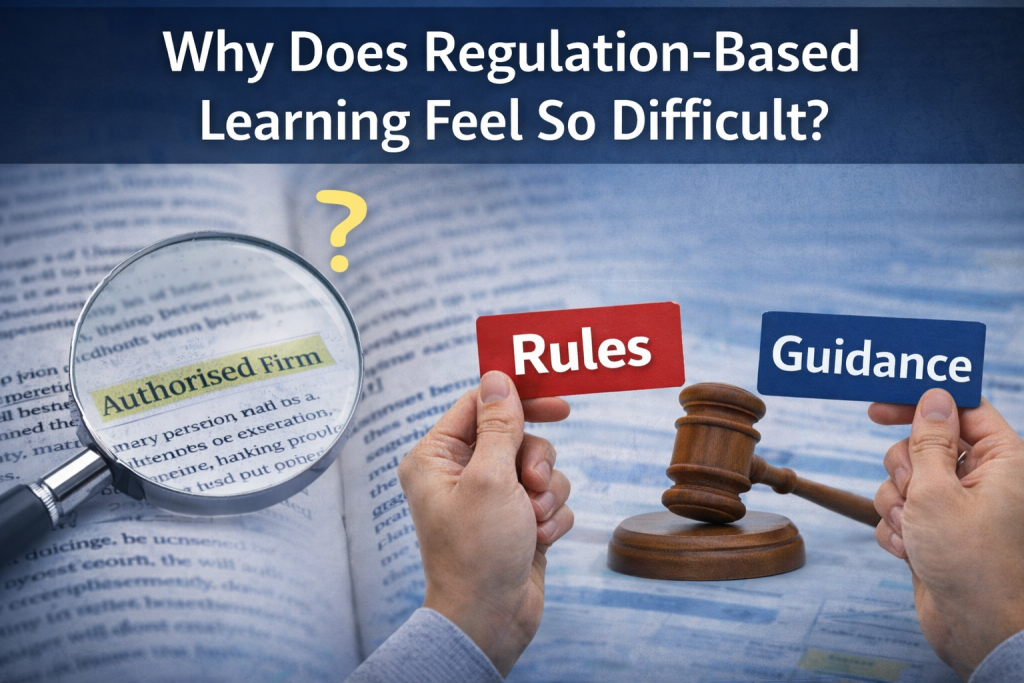
Regulation is written to remove ambiguity. That means terms have specific meanings. Words such as “authorised”, “regulated activity”, and “consumer duty” are not general phrases. They carry defined legal meaning.
For learners who are new to financial services, this can feel heavy at first.
Is It Because There Is So Much to Remember?
Partly, yes.
CeMAP 1 contains structured knowledge that builds on itself. For example:
- Understanding the regulator
- Understanding authorised firms
- Understanding approved persons
- Understanding conduct standards
Each concept links to another. If the foundation feels unclear, later sections feel harder.
That can create the impression that the whole module is difficult, when in reality it is about becoming familiar with a new framework.
Which Areas Do Learners Most Commonly Struggle With?
Understanding the Role of the Financial Conduct Authority
Many learners initially confuse what the Financial Conduct Authority actually does.
The Financial Conduct Authority is the UK regulator responsible for overseeing financial services firms and ensuring markets function well. It sets rules, supervises firms and has enforcement powers.
Learners sometimes mix up supervision, rule-making and enforcement functions. They may also struggle to understand how the FCA’s objectives influence its approach.
Because these concepts are theoretical rather than practical, they can feel less tangible.
The Principles and Rules Framework
CeMAP 1 explains how regulation operates at different levels:
- High-level principles
- Detailed rules
- Guidance
Understanding the difference between these levels can be challenging.
Principles are broad standards of behaviour. Rules are specific requirements. Guidance explains how rules may be applied.
Learners often find it harder to interpret principles because they are not checklist items. They require judgement and understanding.
Ethics and Professional Conduct
Ethics is another area that learners underestimate.
Ethics in CeMAP 1 refers to professional behaviour standards expected within regulated financial services. It includes integrity, treating customers fairly and managing conflicts of interest.
The difficulty is not the idea of being ethical. The difficulty lies in applying ethical principles to scenarios.
Questions may describe situations where more than one answer seems reasonable. That can create doubt.
Complaints and Compensation Structures
The structure of complaints handling and compensation arrangements can feel procedural.
Understanding the difference between:
- A firm’s internal complaints process
- The escalation route
- The role of ombudsman services
- Compensation schemes
requires careful reading.
Learners sometimes struggle because they try to memorise processes without fully understanding why those processes exist.
Financial Crime and Anti-Money Laundering
Financial crime topics are often detailed and rule-based.
This includes:
- The purpose of anti-money laundering controls
- Suspicious activity reporting
- The responsibilities of regulated firms
The terminology can feel technical, particularly for learners without prior exposure to compliance roles.
Why Do Learners Often Expect CeMAP 1 to Be Easier?
A common misconception is that CeMAP 1 will be the “basic” module because it is first.
In reality, it lays the regulatory foundation for the rest of the qualification.
Some learners assume:
- It will focus mainly on mortgages
- It will be practical and scenario-based
- It will involve simple definitions
Instead, it focuses on structure, governance and professional standards.
When expectations do not match reality, the module can feel harder than it truly is.
Is CeMAP 1 Harder Than the Other Modules?
It depends on the individual.
Some learners with legal, compliance or financial services backgrounds find CeMAP 1 straightforward.
Others who are more comfortable with practical product knowledge may find later modules more natural.
CeMAP 1 feels harder to many people because it is abstract. Later modules feel more concrete, particularly when discussing mortgage products and case-based scenarios.
Difficulty is often about familiarity rather than ability.
Does Struggling With CeMAP 1 Mean You Are Not Suited to the Industry?
No
Many capable mortgage advisers found CeMAP 1 challenging at the beginning.
Regulatory learning is a skill in itself. It requires:
- Attention to detail
- Comfort with structured rules
- Careful reading
These are not innate talents. They develop with exposure.
Struggling at first does not indicate a lack of potential. It often reflects encountering a new type of subject matter.

Why Standards Still Matter
While it is important to normalise difficulty, it is equally important not to minimise standards.
CeMAP 1 exists because mortgage advice is regulated.
Advisers handle large financial commitments for clients. Regulation protects consumers and ensures consistent professional conduct.
Understanding regulation is not optional. It is central to the role.
The purpose of CeMAP 1 is not to make the qualification harder. It is to ensure that anyone progressing understands the framework they will operate within.
How Should Learners View CeMAP 1?
A helpful perspective is to see CeMAP 1 as learning the rules of the road before driving.
It may not feel as exciting as discussing mortgage products. It may involve more reading than expected.
However, once the structure becomes familiar, the content becomes more logical.
Many learners report that:
- The first exposure feels dense
- The second reading feels clearer
- The overall system starts to connect
The perceived difficulty often reduces as understanding grows.
Final Perspective: What Is Really the Hardest Part of CeMAP 1?
The hardest part of CeMAP 1 for most learners is adjusting to regulatory thinking.
It requires:
- Learning precise terminology
- Understanding a formal framework
- Applying ethical principles
It is not about intelligence. It is about familiarity and mindset.
CeMAP 1 sets the professional foundation for mortgage advice in the UK. It introduces the regulatory environment that advisers must work within.
If it feels challenging, that is normal. It reflects the seriousness of the industry rather than a personal limitation.
With time and structured learning, what first feels abstract usually becomes clear and manageable.
The key point is perspective. Difficulty at the start is common. It does not predict the outcome.
Looking for training support?
We offer CeMAP training for learners working towards a career in mortgage advice. Our courses follow the London Institute of Banking & Finance syllabus and are designed to support understanding of mortgage regulation and advice requirements.
Explore our accredited CeMAP training courses
> Futuretrend Financial Training


