How to Deal with Information Overload in CeMAP

Student managing CeMAP information overload with organised study notes, revision books and a structured learning plan for the mortgage adviser qualification.

Starting the Certificate in Mortgage Advice and Practice (CeMAP) can feel like opening a textbook that never seems to end. Many learners begin with enthusiasm, only to find themselves overwhelmed by the sheer volume of information. From financial regulations and mortgage products to legal principles and industry terminology, there is a lot to absorb.

Information overload is one of the biggest reasons learners lose confidence early in their studies. Fortunately, it does not mean you’re incapable of passing CeMAP. It usually means you’re trying to learn too much at once.

Understanding why information overload happens, and having a simple way to manage it, can make studying feel far more achievable

Student managing CeMAP information overload with organised study notes, revision books and a structured learning plan for the mortgage adviser qualification.

Why Does CeMAP Feel Like Too Much Information?

Information overload happens when your brain receives more new information than it can comfortably organise and retain.

CeMAP introduces many concepts that are unfamiliar to people entering the mortgage industry. You’re not only learning facts but also understanding how different areas connect, including regulation, ethics, lending criteria, protection products and the wider financial services market.

Because everything feels new, it’s easy to think every sentence deserves equal attention. This often leads to reading pages repeatedly without remembering much afterwards.

The important thing to remember is that feeling overwhelmed is a normal part of learning something substantial. Your brain is building new knowledge rather than simply recalling familiar information.

What Makes CeMAP Content Feel So Overwhelming?

Several factors combine to create the feeling of overload.

Everything Appears Equally Important

When you’re new to CeMAP, it’s difficult to distinguish essential concepts from supporting detail. Without experience, every paragraph can seem equally critical.

Over time, patterns begin to emerge. Core principles are revisited throughout the qualification, while some supporting details simply provide context.

New Terminology Slows Learning

CeMAP introduces many financial and regulatory terms that most learners have never encountered before.

Every unfamiliar word requires extra mental effort to understand before you can even absorb the topic itself. Once this vocabulary becomes familiar, studying becomes much faster.

Trying to Learn Too Much in One Sitting

Many learners believe long study sessions produce better results. In reality, concentration naturally declines after extended periods.

Trying to complete multiple chapters in one evening often leaves you remembering very little by the end.

Shorter, focused sessions usually produce stronger understanding and better long-term memory.

How Do You Manage CeMAP Content Without Feeling Overwhelmed?

The simplest approach is to stop thinking about CeMAP as one large qualification.

Instead, think of it as hundreds of small learning tasks.

Rather than aiming to “study CeMAP tonight”, aim to understand one topic well.

For example:

  • Mortgage regulation
  • Types of repayment mortgages
  • Interest calculations
  • The house buying process

Completing one manageable topic provides a sense of progress without creating unnecessary pressure.

Small wins build confidence much more effectively than attempting huge amounts of reading.

CeMAP learner studying one topic at a time with organised notes and textbooks to manage information overload effectively.

Why Should You Break Topics Into Smaller Parts?

Breaking information into smaller sections reduces the amount your working memory has to process at once.

Instead of reading an entire chapter, divide it naturally into sections.

A simple approach might look like this:

  1. Read one small section.
  2. Summarise it in your own words.
  3. Test yourself without looking at your notes.
  4. Move on only when you understand the basic idea.

This keeps learning active rather than passive.

Understanding one topic thoroughly is more valuable than rushing through several chapters without retaining them.

How Do You Prioritise What to Learn?

Not every piece of information requires the same level of attention during your first study session.

A useful approach is to separate content into three categories.

Must Understand

These are the core principles that underpin multiple parts of CeMAP.

Examples include:

  • FCA regulation
  • Mortgage repayment methods
  • Types of mortgage products
  • Affordability principles
  • Consumer protection

These topics deserve your greatest attention because they appear repeatedly throughout your studies.

Useful Supporting Knowledge

Some sections provide context that helps explain the bigger picture.

These are still important but become easier once you understand the core concepts first.

Fine Detail

Certain facts, figures or definitions can be refined during later revision.

Trying to memorise every detail on your first reading often causes unnecessary stress.

Building understanding before memorisation usually produces better exam preparation.

A Simple Framework for Managing CeMAP Content

You do not need complicated revision systems or expensive productivity apps.

A straightforward four-step framework is often enough.

Step 1: Choose One Topic

Avoid opening multiple modules at once.

Decide exactly what you’re studying before you begin.

Step 2: Understand Before Memorising

Focus on answering one question:

“Do I understand why this works?”

If the answer is yes, remembering the details becomes much easier later.

Step 3: Review Soon Afterwards

A short review later that day or the following day helps reinforce what you’ve learned before it begins to fade.

Frequent reviews are usually more effective than one long revision session weeks later.

Step 4: Move On Gradually

Once you’re comfortable with one topic, begin the next.

This steady approach creates lasting knowledge without overwhelming yourself.

Should You Study Everything Perfectly the First Time?

No.

One of the biggest causes of information overload is believing every page must be fully understood immediately.

Learning rarely works like that.

Most successful CeMAP learners revisit topics several times.

Each review strengthens understanding because you’re connecting new knowledge with concepts you’ve already learned.

Progress is built through repetition rather than perfection.

How Can You Tell If You're Experiencing Information Overload?

Common signs include:

  • Reading the same paragraph repeatedly.
  • Forgetting what you read a few minutes earlier.
  • Feeling mentally exhausted after short study sessions.
  • Jumping between multiple topics without finishing any.
  • Feeling busy without making progress.

These signs usually indicate that it’s time to simplify your study approach rather than work harder.

CeMAP learner feeling overwhelmed while studying with books, notes and revision materials spread across a desk.

Should You Take Breaks When Studying CeMAP?

Yes.

Learning depends on giving your brain time to process information.

Short breaks between focused study sessions help maintain concentration and reduce mental fatigue.

Stepping away for ten minutes after completing a topic is often far more productive than forcing yourself to continue when your concentration has dropped.

Consistency over several weeks is much more valuable than one exhausting day of revision.

Does Information Overload Get Better?

Yes.

As your understanding grows, new topics begin connecting with previous ones instead of feeling completely unfamiliar.

Financial terminology becomes easier.

Regulatory concepts become more familiar.

Mortgage products begin to make logical sense.

Many learners find that the first few weeks are the hardest because almost everything is new. Once you’ve established a solid foundation, learning generally becomes more manageable.

Frequently Asked Questions

How do I manage CeMAP content?

The most effective way to manage CeMAP content is to break it into small, manageable topics, focus on understanding core CeMAP concepts before memorising details, review regularly and study consistently rather than trying to learn large amounts in one sitting.

How many CeMAP topics should I study each day?

There is no perfect number. Many learners make better progress by focusing on one or two topics thoroughly instead of rushing through several chapters.

Is it normal to forget what I’ve studied?

Yes. Forgetting some information is a normal part of learning. Regular review helps strengthen memory and improves long-term understanding.

Should I make detailed notes on everything?

Not necessarily. Notes should help clarify key ideas rather than copy entire textbooks. Simple summaries written in your own words are often more useful than lengthy notes.

Final Thoughts

Information overload is one of the most common challenges faced by CeMAP learners, particularly during the early stages of study. It happens because you’re absorbing a significant amount of new information in a relatively short period, not because you’re incapable of learning it.

The key is to simplify your approach. Break large topics into smaller sections, focus on understanding before memorising, prioritise the most important concepts and review your learning regularly. Small, consistent steps almost always lead to better results than trying to master everything at once.

Remember that CeMAP is designed to build your knowledge over time. As your understanding develops, subjects that once felt overwhelming gradually become familiar, helping you study with greater confidence and less stress.

Looking for training support?

We offer CeMAP training for learners working towards a career in mortgage advice. Our courses follow the London Institute of Banking & Finance syllabus and are designed to support understanding of mortgage regulation and advice requirements.

Explore our accredited CeMAP training courses

> Futuretrend Financial Training 

What to Do When CeMAP Stops Making Sense

Student studying CeMAP after reaching a learning block, reviewing notes and using practical strategies to understand difficult mortgage adviser qualification topics.

Studying for CeMAP can feel rewarding one week and frustrating the next. Many learners experience a point where concepts that once seemed manageable suddenly become confusing. You may read the same page several times without understanding it, struggle to connect different topics, or feel as though you’ve forgotten everything you studied previously.

If this sounds familiar, you’re not alone. It does not necessarily mean you’re falling behind or that CeMAP is too difficult for you. Learning complex financial and regulatory subjects often involves periods where progress feels slower before your understanding improves.

The key is knowing how to respond when you reach one of these learning blocks rather than pushing through without changing your approach.

Student studying CeMAP after reaching a learning block, reviewing notes and using practical strategies to understand difficult mortgage adviser qualification topics.

What If I Don't Understand CeMAP Topics?

If you don’t understand a CeMAP topic, the best approach is to pause, identify exactly where your understanding breaks down, revisit the basics, and build your knowledge back up step by step. Most learning blocks happen because an earlier concept hasn’t fully clicked, rather than because the new topic is impossible to understand.

CeMAP, awarded by the London Institute of Banking & Finance (LIBF), is designed to test your understanding of mortgage advice principles rather than your ability to memorise isolated facts. Because topics build on one another, confusion in one area can affect several later chapters.

Rather than feeling discouraged, treat confusion as a sign that it’s time to adjust your learning strategy.

Why Do CeMAP Topics Suddenly Stop Making Sense?

Many learners assume that if they understood yesterday’s study session but struggle today, something has gone wrong. In reality, this is a normal part of learning.

There are several reasons why topics can suddenly feel confusing.

Too Much New Information

CeMAP introduces many unfamiliar terms, financial concepts and regulatory requirements. Even if each section makes sense on its own, studying several chapters in one sitting can overload your memory.

Your brain needs time to organise new information before it becomes easier to recall.

Missing One Important Building Block

Sometimes one misunderstood definition causes problems later.

For example, if you’re uncertain about how different mortgage repayment methods work, later discussions about affordability, suitability or recommendations may become much harder to follow.

Rather than struggling with the advanced material, it’s often more productive to revisit the earlier topic first.

Mental Fatigue

Studying when you’re tired rarely produces your best learning.

If you’ve been concentrating for a long period, even familiar material can begin to feel confusing. Taking a proper break often improves understanding more than another hour of reading.

How Can You Reset When You're Stuck?

When a topic stops making sense, avoid repeatedly reading the same paragraph without changing your approach.

Instead, try a simple reset.

Step 1: Stop and Identify the Problem

Ask yourself exactly what you don’t understand.

Is it:

  • A definition?
  • A calculation?
  • A regulation?
  • How one topic links to another?

Being specific makes it much easier to solve the problem.

Step 2: Return to the Previous Topic

CeMAP is structured so that each section supports the next.

If today’s material feels confusing, spend fifteen or twenty minutes reviewing the previous chapter. Often you’ll discover that the missing piece was introduced earlier.

Step 3: Explain It in Your Own Words

One of the best ways to check understanding is to explain the topic without looking at your notes.

If you can’t describe it simply, you probably need another review before moving on.

You don’t need perfect wording. The goal is to understand the idea rather than memorise sentences.

Why Is Revisiting the Basics So Important?

Many learners worry that going backwards means they’re failing.

In reality, revisiting the basics is one of the fastest ways to move forwards.

Strong foundations make every later topic easier.

For example, understanding:

  • mortgage terminology
  • repayment methods
  • interest calculations
  • property types
  • regulatory principles

will make many later chapters feel far more logical.

Professional learners rarely study everything once and never return to it. Revisiting earlier material helps strengthen long-term understanding rather than simply preparing for the next chapter.

CeMAP study materials arranged to represent building strong foundations by revisiting core mortgage adviser qualification concepts.

Should You Keep Studying Difficult Topics?

Persistence is valuable, but repeatedly struggling without making progress is not always productive.

A useful approach is to set yourself a reasonable limit.

If you’ve genuinely tried to understand a topic for a while and still feel stuck, move on temporarily and come back later.

Sometimes learning another section provides the missing context.

Equally, taking a break for a few hours or even until the next day can make previously confusing material much clearer.

Learning is rarely completely linear.

How Can You Make Difficult Topics Easier?

Breaking larger subjects into smaller pieces makes them much more manageable.

Instead of aiming to understand an entire chapter, focus on one concept at a time.

For example:

  • Learn the terminology first.
  • Understand how the concept works.
  • Look at practical examples.
  • Answer a few practice questions.
  • Review any mistakes before moving on.

This structured approach prevents information becoming overwhelming.

Small wins gradually build confidence.

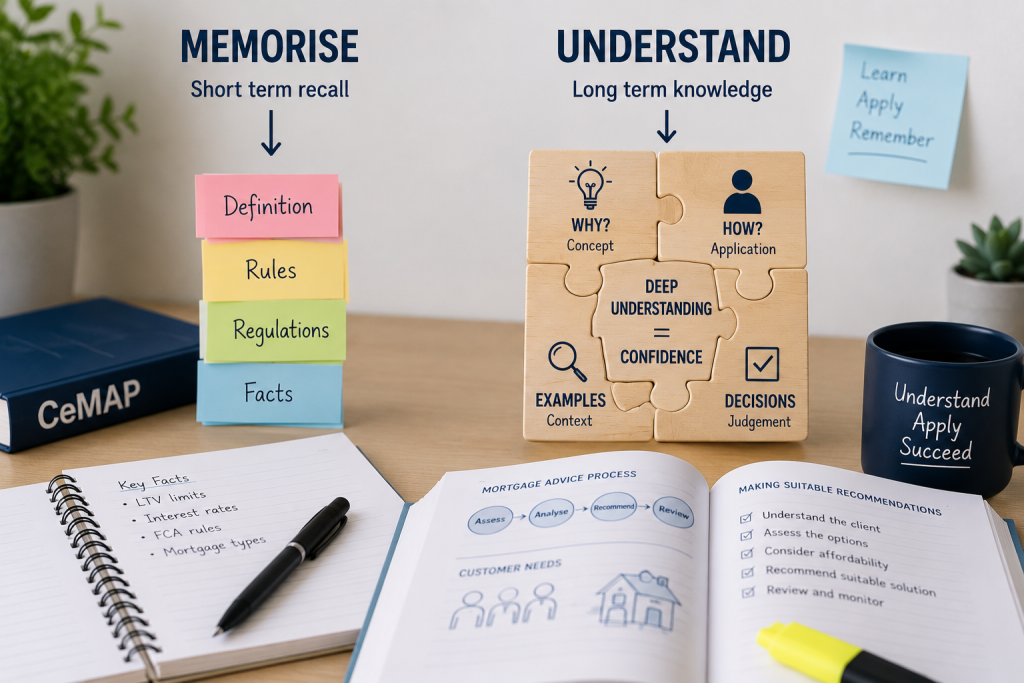
Should You Memorise or Understand?

CeMAP rewards understanding more than simple memorisation.

While some definitions and regulations naturally need remembering, many exam questions test whether you can apply your knowledge.

For that reason, ask yourself questions such as:

  • Why does this rule exist?
  • What problem does this mortgage solve?
  • How would this apply to a customer?
  • What makes this option different from another?

Thinking beyond memorised facts helps information stay with you for much longer.

Study resources illustrating the difference between memorising facts and understanding CeMAP concepts for long-term learning.

When Should You Ask for Help?

Many learners wait too long before asking questions.

If you’ve reviewed the material several times and still cannot understand a topic, seeking support is usually the most efficient next step.

Support might come from:

  • your course tutor
  • a virtual classroom session
  • a study group
  • discussion with fellow learners
  • additional learning resources

Often, hearing the same concept explained differently is enough for everything to click.

There’s no disadvantage in asking questions. In fact, recognising when you need clarification is a valuable professional skill.

How Can You Avoid Getting Stuck Again?

Although learning blocks can’t always be prevented, good study habits reduce how often they happen.

Try to:

  • study consistently rather than cramming
  • review earlier topics regularly
  • complete practice questions throughout your course
  • keep notes in your own words
  • take regular breaks
  • avoid rushing through chapters simply to finish them

Learning steadily usually produces better understanding than covering large amounts of material quickly.

Does Everyone Experience Learning Blocks?

Yes. Almost everyone studying a professional qualification encounters topics that feel more difficult than others.

Some learners struggle with regulations.

Others find calculations challenging.

Some understand technical knowledge quickly but need more time with case study questions.

This variation is completely normal.

The important point is that temporary confusion does not predict your final result.

Most successful learners experience periods where they question their progress before everything begins to come together.

Building Confidence One Topic at a Time

When CeMAP stops making sense, it’s tempting to believe you’re simply not suited to the qualification. In most cases, that’s not true.

Learning complex subjects involves periods of uncertainty. The difference between learners who continue progressing and those who lose confidence is usually how they respond to those moments.

Instead of repeatedly reading the same material, take a step back. Revisit the basics, identify the specific gap in your understanding, and use the support available to you.

Each topic you fully understand becomes another building block for the next stage of your learning.

With patience, structured study and regular review, those confusing moments become less frequent, and your confidence grows alongside your knowledge.

Looking for training support?

We offer CeMAP training for learners working towards a career in mortgage advice. Our courses follow the London Institute of Banking & Finance syllabus and are designed to support understanding of mortgage regulation and advice requirements.

Explore our accredited CeMAP training courses

> Futuretrend Financial Training 

What good CeMAP study support actually looks like

CeMAP study support image showing tutor support structured learning and exam feedback

When people ask What support do you get with CeMAP?”, they are usually trying to work out one thing: will they be left to figure it all out alone, or guided properly through it?

Study support is not just about having materials. It is about how you are helped to understand, apply, and stay on track while working towards a regulated qualification.

This matters because CeMAP is not simply about memorising facts. It is about understanding how mortgage advice works in practice, within rules set by the Financial Conduct Authority (FCA). The way support is delivered can shape how confident and prepared you feel when you move into the role.

CeMAP study support image showing tutor support structured learning and exam feedback

What does “study support” mean for CeMAP?

Study support refers to the guidance, structure, and feedback available to help you progress through the CeMAP qualification.

In practical terms, it usually includes:

  • Access to tutors or subject specialists
  • Structured learning materials and study plans
  • Feedback on practice questions or assessments
  • Help with understanding difficult topics
  • Support with exam preparation

Good support makes the learning process clearer and more manageable. It reduces the risk of getting stuck or misunderstanding key concepts.

Poor or limited support can leave learners unsure whether they are on the right track, especially if they are new to financial services.

What support do you get with CeMAP?

The support you receive with CeMAP depends on how you choose to study, but effective support usually includes three core elements: access to tutors, structured learning, and meaningful feedback.

Each of these plays a different role in helping you progress.

How important is tutor access?

Tutor access is one of the most important parts of CeMAP study support.

A tutor is not there just to answer questions. They help you:

  • Break down complex topics
  • Explain how rules apply in real scenarios
  • Clarify areas where textbooks feel unclear
  • Keep your understanding aligned with exam expectations

For example, topics such as regulation, affordability, and mortgage products can seem straightforward at first, but often involve nuance. A tutor can explain not just what the rule is, but why it matters and how it is applied.

Good tutor support usually means:

  • You can ask questions when needed
  • Responses are clear and relevant
  • Explanations are practical, not just theoretical

Without this, learners often rely on guesswork or spend too long trying to interpret material on their own.

What does structured learning actually look like?

Structure is what turns a large amount of content into something manageable.

CeMAP covers multiple modules, each with its own topics, terminology, and regulatory context. Without structure, it is easy to feel overwhelmed.

Effective structured support usually includes:

  • A clear study plan or pathway
  • Content broken into manageable sections
  • Suggested timelines (without rigid deadlines)
  • Logical progression from basic to more complex topics

Structure helps you answer key questions while studying:

  • What should I focus on today?
  • What comes next?
  • Am I covering everything I need?
CeMAP structured learning plan with study schedule checklist and organised modules

It also reduces the risk of skipping important areas or spending too long on less relevant details.

Importantly, structure should guide you, not pressure you. Everyone learns at a different pace, and good support allows flexibility while still providing direction.

Should you look for a LIBF accredited learning support provider?

Looking for a London Institute of Banking & Finance (LIBF) accredited learning support provider can be one way to assess the quality of study resources.

CeMAP is awarded by LIBF, so accredited providers have had their learning materials reviewed against the qualification standards. This can give learners confidence that the content is aligned with the syllabus.

In practical terms, this may mean:

  • Study materials follow the correct CeMAP structure
  • Key topics are covered in line with exam requirements
  • Content reflects current standards set by LIBF
LIBF accredited CeMAP learning support provider with study materials and syllabus alignment

However, accreditation relates to the quality and relevance of the learning materials, not the level of personal support you will receive.

It does not guarantee:

  • Faster completion
  • Better exam results
  • A specific level of tutor access or feedback

This is why it should be seen as one indicator of effective study support, rather than the only factor.


A balanced approach is to look for:

  • Accredited learning materials
  • Clear structure and guidance
  • Access to tutors when needed
  • Opportunities for feedback and exam practice


Together, these give a more complete picture of what your study experience is likely to be.

How does feedback improve your learning?

Feedback is where learning becomes active rather than passive.

Reading materials alone can give a false sense of understanding. You only really test your knowledge when you apply it.

Good CeMAP support includes:

  • Practice questions
  • Mock exams
  • Explanations of correct and incorrect answers


The key part is not just whether an answer is right or wrong, but why.

Effective feedback helps you:

  • Spot gaps in your knowledge
  • Understand how questions are structured
  • Improve exam technique
  • Build confidence over time


For example, if you misunderstand a question about mortgage regulation, feedback should explain both the rule and the reasoning behind the correct answer.

Without this, learners may repeat the same mistakes without realising it.

How does study support affect the overall experience?

Study support has a direct impact on how manageable and realistic the qualification feels.

With strong support:

  • Learning feels guided rather than overwhelming
  • You are less likely to feel stuck
  • Progress feels steady and measurable
  • Confidence builds gradually


With limited support:

  • It can feel unclear whether you are doing things correctly
  • Small misunderstandings can build into bigger problems
  • Motivation may drop if progress feels uncertain


The difference is not just about passing exams. It is about understanding the material well enough to apply it later in a real role.

This is important because CeMAP is designed to meet the FCA’s education requirements for mortgage advisers. The goal is not just to pass, but to develop a working understanding of how advice and regulation fit together.

What role does flexibility play in good support?

Flexibility is often overlooked, but it is a key part of effective support.

Many people studying CeMAP are:

  • Changing careers
  • Working full-time
  • Managing other commitments


Good support allows you to:

  • Study at times that suit you
  • Move at your own pace
  • Revisit topics when needed


At the same time, flexibility should still be balanced with structure. Too much freedom without guidance can lead to delays or loss of focus.

The best support sits somewhere in the middle. It gives you control over your schedule, while still helping you stay on track.

How does support help with exam preparation?

Exam preparation is where support becomes especially valuable.

CeMAP exams are not just about recalling information. They test how well you understand concepts and apply them in realistic scenarios.

Good support in this stage includes:

  • Practice exams that reflect real exam style
  • Guidance on how questions are worded
  • Help with time management during exams
  • Techniques for handling more difficult questions

This helps reduce uncertainty.

CeMAP exam preparation support with mock exam results feedback and study materials

Rather than going into the exam unsure of what to expect, you have already worked through similar formats and understand how to approach them.

That familiarity can make a noticeable difference in how confident you feel on the day.

What does poor or limited support look like?

Understanding what good support looks like is easier when you recognise the signs of limited support.

This might include:

  • No access to tutors or delayed responses
  • Large amounts of content with little structure
  • Practice questions without clear explanations
  • No guidance on exam technique

In these situations, learners often spend more time trying to organise their learning than actually learning.

It does not mean progress is impossible, but it can make the process slower and more frustrating.

Why does study support matter beyond the exams?

CeMAP is the starting point for becoming a mortgage adviser, not the end point.

The way you learn during this stage can affect how prepared you feel when you begin working in the role.

Strong support helps you:

  • Understand real-world application, not just theory
  • Build confidence in explaining concepts
  • Develop habits that carry into professional learning

For example, understanding why certain rules exist makes it easier to apply them when dealing with clients later on.

This is particularly important in a regulated environment, where decisions must be both accurate and justifiable.

Do all learners need the same level of support?

No, and this is where personal preference comes in.

Some learners prefer:

  • More independence
  • Learning at their own pace with minimal input

Others benefit from:

  • Regular guidance
  • Clear checkpoints
  • Ongoing reassurance that they are progressing correctly

Neither approach is right or wrong.

The key is understanding what helps you stay consistent and confident.

If you are new to financial services, more structured support and tutor access often make the learning curve smoother.

If you already have some background knowledge, you may rely less on support but still benefit from feedback and exam preparation.

How can you tell if support is actually effective?

Effective support is usually noticeable in how you feel while studying.

Signs that support is working well include:

  • You understand topics rather than just memorising them
  • You know what to study next
  • You can identify and correct mistakes
  • You feel gradually more confident over time

If you find yourself:

  • Re-reading the same material without clarity
  • Unsure whether you are progressing correctly
  • Avoiding certain topics because they feel confusing

It may be a sign that support is not meeting your needs.

A clear way to think about CeMAP study support

CeMAP study support is best understood as a combination of guidance, structure, and feedback that helps you move from confusion to clarity.

It is not about being constantly assisted. It is about having the right help available at the right time.

At its best, support allows you to:

  • Understand what you are learning
  • Apply that knowledge in context
  • Prepare realistically for exams
  • Build confidence step by step

Final thoughts

When asking What support do you get with CeMAP?”, the more useful question is often:

“What kind of support will help me learn effectively?”

The answer will vary depending on your experience, your schedule, and how you prefer to learn.

What remains consistent is this: good support is practical, structured, and responsive. It helps you understand the material, not just get through it.

And that understanding is what carries forward when you move from studying into real mortgage advice.

Looking for training support?

We offer CeMAP training for learners working towards a career in mortgage advice. Our courses follow the London Institute of Banking & Finance syllabus and are designed to support understanding of mortgage regulation and advice requirements.

Explore our accredited CeMAP training courses

> Futuretrend Financial Training