
What skills do mortgage advisers need?

Mortgage adviser explaining options to clients showing communication, organisation, empathy and professionalism skills

Choosing a career in mortgage advice is not just about passing exams or gaining a qualification. It is about how you work with people, how you handle responsibility, and how you make decisions that affect real financial outcomes.

A mortgage adviser is someone who helps clients understand their borrowing options and make informed choices. In the UK, this typically involves meeting the qualification requirements set by the Financial Conduct Authority, often through qualifications like CeMAP awarded by the London Institute of Banking & Finance.

But qualifications alone do not define whether someone will feel comfortable or effective in the role. The day-to-day work relies heavily on practical skills and personal traits that develop over time.

This article looks at the key skills and traits that support success in mortgage advice, with a focus on development rather than natural ability.

Mortgage adviser explaining options to clients showing communication, organisation, empathy and professionalism skills

Do you need strong communication skills to be a mortgage adviser?

Yes. Communication is one of the most important skills in mortgage advice, but it is not about being a confident speaker or a “natural salesperson”.

It is about clarity.

Mortgage advisers deal with complex information, including interest rates, lending criteria, affordability assessments, and legal processes. Clients often come in with limited understanding or with assumptions that are not quite right. Your role is to explain things in a way that makes sense to them.

What good communication looks like in practice

Clear communication in this role usually means:

  • Explaining financial concepts in plain language
  • Checking understanding rather than assuming it
  • Listening carefully before offering solutions
  • Adjusting how you explain things depending on the client

For example, one client may want a detailed breakdown of options, while another may feel overwhelmed and prefer a simple comparison.

Listening matters as much as explaining

A common misconception is that communication is mostly about talking. In reality, listening is often more important.

Clients may not always explain their situation clearly at first. They might leave out key details or focus on the wrong concerns. Being able to pick up on what is not being said, and ask the right follow-up questions, is a skill that improves with experience.

This is especially important when discussing sensitive topics such as income, debt, or financial difficulties.

How important is organisation in mortgage advice?

Organisation is essential because mortgage advice involves managing multiple moving parts at once.

You are not just having conversations. You are also:

  • Handling documents and evidence
  • Tracking application progress
  • Meeting lender requirements
  • Managing deadlines and client expectations

Without a structured approach, it becomes easy to miss details or create delays.
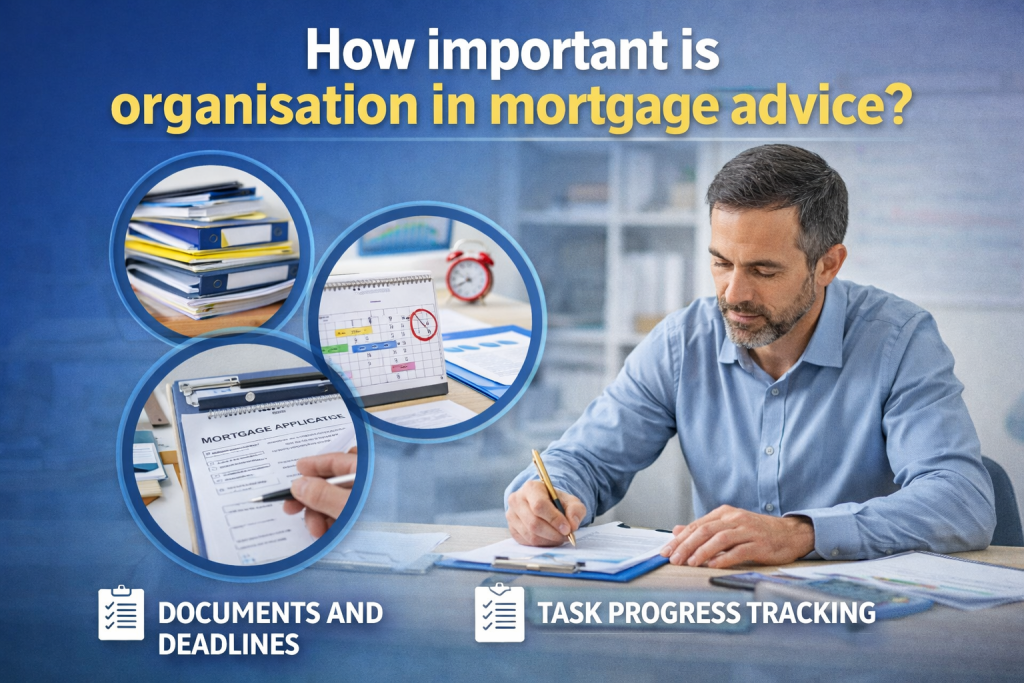
Mortgage adviser organising documents and tracking tasks showing importance of organisation in mortgage advice

Why organisation affects client experience

From a client’s perspective, the mortgage process can already feel stressful. Delays, missing paperwork, or unclear updates can make that worse.

An organised adviser helps by:

  • Keeping processes moving smoothly
  • Providing timely updates
  • Reducing uncertainty

This does not mean you need to be naturally “ultra-organised”. Many advisers develop systems over time, using checklists, workflows, and CRM tools to stay on track.

Small habits make a big difference

Organisation in this role often comes down to consistent habits, such as:

  • Recording information accurately after meetings
  • Following up when you say you will
  • Keeping clear notes on each case

These are learnable behaviours rather than fixed traits.

What kind of judgement do mortgage advisers need?

Mortgage advisers regularly make judgement calls, even within structured rules and regulations.

This includes:

  • Assessing which mortgage products may suit a client’s situation
  • Deciding how to present options clearly
  • Identifying potential risks or complications

While lenders provide criteria, real client situations are not always straightforward.

Judgement is about applying knowledge, not guessing

Good judgement does not mean relying on instinct alone. It comes from:

  • Understanding how different lenders operate
  • Recognising patterns in client situations
  • Knowing when something needs further clarification

Over time, advisers build a sense of what is likely to work and what may cause issues later in the process.

Knowing when to slow down

An important part of judgement is recognising when not to rush.

If something does not seem clear or complete, taking time to check details can prevent larger problems later. This might mean going back to the client for more information or double-checking lender criteria.

Why does empathy matter in mortgage advice?

Empathy plays a central role because mortgages are not just financial transactions. They are tied to major life events.

Clients may be:

  • Buying their first home
  • Moving due to family changes
  • Dealing with financial pressure
  • Unsure about long-term commitments

Understanding how someone feels about their situation helps you communicate more effectively and provide appropriate support.

Mortgage adviser showing empathy to clients discussing financial situation and mortgage decisions

Empathy is about awareness, not emotion

You do not need to be overly emotional to be empathetic. It is more about recognising:

  • When a client feels uncertain or anxious
  • When they need reassurance or clarity
  • When to slow down and explain things more carefully

A calm and respectful approach often matters more than trying to be overly reassuring.

Building trust through understanding

Clients are more likely to trust advice when they feel understood. This trust is important because they are relying on you to guide them through decisions that may affect them for years.

Empathy supports that trust, but it develops naturally through experience and exposure to different client situations.

What does professionalism mean in this role?

Professionalism in mortgage advice is about consistency, responsibility, and clear boundaries.

It includes:

  • Being accurate and careful with information
  • Following regulatory requirements
  • Communicating clearly and honestly
  • Managing expectations appropriately

Why professionalism is critical

Mortgage advisers operate within a regulated environment. The standards set by the Financial Conduct Authority are there to protect clients.

This means professionalism is not optional. It is part of the role.

For example, this includes:

  • Avoiding misleading statements
  • Ensuring advice is suitable for the client
  • Keeping records of recommendations

Professional behaviour builds long-term credibility

Clients may not always understand the technical side of what you do, but they do notice how you behave.

Reliability, honesty, and clarity contribute to a professional reputation over time.

Can these skills be developed, or do you need them already?

These skills can be developed. They are not fixed traits that you either have or do not have.

This is an important point, especially for people considering whether mortgage advice is the right fit.

Development happens through experience

Most advisers improve their skills through:

  • Training and structured learning
  • Practical experience with real clients
  • Feedback from managers or mentors

For example:

  • Communication improves through repeated client conversations
  • Organisation improves through building systems and routines
  • Judgement improves through exposure to different cases

Confidence often follows competence

Many people assume they need confidence before starting. In reality, confidence tends to grow as skills improve.

Early on, it is normal to feel unsure or cautious. Over time, as processes become familiar, confidence develops naturally.

What skills do mortgage advisers need overall?

Mortgage advisers need a combination of communication, organisation, judgement, empathy, and professionalism.

No single skill defines success. Instead, it is how these areas work together.

In simple terms:

  • Communication helps clients understand
  • Organisation keeps the process on track
  • Judgement supports decision-making
  • Empathy builds trust
  • Professionalism ensures standards are met

These are practical, developable skills rather than fixed personality traits.

Mortgage adviser with icons showing communication, organisation, empathy, judgement and professionalism skills

Final thoughts

Mortgage advice is a people-focused role built on clear thinking and responsible communication.

It does not require a specific personality type or a perfect starting point. What matters more is a willingness to learn, adapt, and improve over time.

If you are assessing whether the role suits you, it is worth focusing less on whether you already have these skills and more on whether you are open to developing them.

That mindset tends to matter far more in the long run.

Looking for training support?

We offer CeMAP training for learners working towards a career in mortgage advice. Our courses follow the London Institute of Banking & Finance syllabus and are designed to support understanding of mortgage regulation and advice requirements.

Explore our accredited CeMAP training courses

> Futuretrend Financial Training 

What does a mortgage adviser actually do day to day?

Mortgage adviser meeting clients while reviewing paperwork and mortgage options at a desk

Most people have a rough idea of what a mortgage adviser is, but the day-to-day reality is often quite different from the stereotype. It is not just about finding the “best deal” or talking to clients all day. The role combines client conversations, detailed research, strict compliance work, and a significant amount of administration.

A mortgage adviser’s day is structured around helping clients secure suitable mortgage solutions while meeting regulatory requirements set by the Financial Conduct Authority (FCA). That balance between advice, accuracy, and responsibility shapes everything they do.

Mortgage adviser meeting clients while reviewing paperwork and mortgage options at a desk

What are the core responsibilities of a mortgage adviser?

At its core, a mortgage adviser’s role is to assess a client’s financial situation and recommend appropriate mortgage products.

This involves several key responsibilities:

Understanding client circumstances

A mortgage adviser gathers detailed information about a client’s income, expenses, credit history, and future plans. This forms the foundation of any advice given.

Recommending suitable mortgage options

Based on that information, the adviser researches and recommends mortgage products that fit the client’s needs. This must be suitable, not just competitive on price.

Explaining options clearly

Clients are often unfamiliar with mortgage terms, so advisers must explain products, risks, and commitments in plain language.

Ensuring regulatory compliance

Every recommendation must meet FCA rules. Advisers must be able to justify why a product is suitable for that specific client.

Managing the application process

Once a client agrees to proceed, the adviser supports the application from start to finish, liaising with lenders and other parties.

In simple terms, a mortgage adviser is responsible for guiding a client from initial enquiry through to mortgage completion, while ensuring everything is accurate, compliant, and appropriate.

What does client-facing work involve?

A large part of the role involves direct interaction with clients, but it is more structured than many people expect.

Initial consultations

The day often begins with client meetings, either in person, over the phone, or via video. During this stage, the adviser gathers detailed information about the client’s situation.

This includes:

  • Income and employment details
  • Existing debts or financial commitments
  • Deposit size
  • Property goals

These conversations are not casual chats. They are structured fact-finds that must be recorded accurately.

Explaining mortgage options

Once research is completed, the adviser presents suitable options. This involves breaking down:

  • Interest rates
  • Fixed vs variable products
  • Monthly repayments
  • Fees and charges
  • Risks, such as rate changes

The goal is clarity, not persuasion. Clients need to understand what they are agreeing to.

Answering questions and concerns

Clients often have concerns about affordability, approval chances, or the process itself. Advisers spend time addressing these questions in a clear and balanced way.

Ongoing communication

Client interaction does not end after the recommendation. Advisers regularly update clients on application progress, lender responses, and next steps.

Client-facing work is a key part of the job, but it is only one part. Much of the work happens outside of these conversations.

What happens behind the scenes?

A significant portion of a mortgage adviser’s day is spent on tasks that clients rarely see.

Researching mortgage products

Advisers use sourcing systems and lender criteria to find suitable products. This involves:

  • Comparing rates and fees
  • Checking lender criteria
  • Assessing affordability models
  • Reviewing special conditions

This is not just about finding the lowest rate. The product must match the client’s circumstances and pass lender checks.

Mortgage adviser completing paperwork and compliance checks at desk during mortgage application process

Completing documentation

Mortgage advice requires detailed paperwork. Advisers must produce and maintain:

  • Fact-find documents
  • Suitability reports
  • Key Facts Illustrations (KFIs)
  • Compliance notes

These documents explain why a recommendation was made and must meet regulatory standards.

Submitting applications

Advisers complete and submit mortgage applications, ensuring all details are accurate. Errors can delay or even derail a case.

Liaising with third parties

A typical day may involve communication with:

  • Mortgage lenders
  • Estate agents
  • Solicitors
  • Underwriters

Each party plays a role in moving the application forward.

Monitoring progress

Applications do not move instantly. Advisers track progress, respond to lender queries, and provide additional information when required.

This behind-the-scenes work is essential. Without it, even the best advice cannot turn into a completed mortgage.

How important is compliance and regulation?

Compliance is a central part of a mortgage adviser’s daily work, not an occasional task.

Mortgage advice in the UK is regulated by the Financial Conduct Authority (FCA). This means advisers must follow strict rules to ensure clients are treated fairly.

Recording everything

Every interaction, recommendation, and decision must be documented. Advisers need to show:

  • What information was collected
  • What options were considered
  • Why a specific recommendation was made
Mortgage adviser reviewing compliance documents to meet FCA regulations during mortgage advice process

Providing suitable advice

Advice must be based on the client’s needs and circumstances, not convenience or preference.

Following processes carefully

There are defined steps for giving advice, issuing documents, and handling applications. Skipping or rushing these steps is not acceptable.

Staying up to date

Regulations, lender criteria, and market conditions change. Advisers must keep their knowledge current.

Compliance work can take up a large part of the day, especially for complex cases. It is one of the main reasons the role is more detailed than people assume.

How much admin is involved?

Administration is a major part of the job, often more than people expect.

A mortgage adviser does not spend the entire day speaking to clients. In many cases, admin tasks take up equal or greater time.

Typical admin work includes:

  • Updating client records
  • Chasing documents
  • Checking application details
  • Responding to emails
  • Preparing reports
  • Logging compliance notes

This work requires attention to detail. Small mistakes can cause delays or issues with lenders.

Admin is not separate from the advisory role. It supports it. Without accurate records and documentation, advice cannot be delivered properly.

Do all mortgage advisers have the same daily routine?

No, the day-to-day experience can vary significantly depending on the role and working environment.

Employed vs self-employed advisers

  • Employed advisers may have structured schedules, set appointments, and support from admin teams
  • Self-employed advisers often manage their own workload, including marketing and business development

Whole-of-market vs tied advisers

  • Whole-of-market advisers can access a wide range of lenders, which may increase research time
  • Tied advisers work with a limited panel, which can streamline product selection
Mortgage advisers working in different environments showing variation in daily routines and responsibilities

Office-based vs remote roles

Some advisers work in offices or estate agencies, while others work remotely. This affects how they interact with clients and manage their day.

Experience level

  • New advisers may spend more time on research and compliance checks
  • Experienced advisers may work more efficiently but often handle more complex cases

Despite these differences, the core elements of the role remain the same: client advice, research, compliance, and administration.

What does a typical day actually look like?

While no two days are identical, a typical day for a mortgage adviser might include:

  • Morning: reviewing emails, checking application updates, preparing for client meetings
  • Midday: conducting client consultations and follow-up calls
  • Afternoon: researching products, writing recommendations, submitting applications
  • Throughout the day: responding to lender queries, updating records, handling admin tasks

Some days are heavily client-focused, while others are more administrative, especially when managing multiple ongoing cases.

Is the role more complex than people think?

Yes, it usually is.

From the outside, the role can seem straightforward. In reality, it involves:

  • Detailed financial assessment
  • Careful product matching
  • Strict regulatory compliance
  • Ongoing case management

A mortgage adviser is not just a middle person between a client and a lender. They are responsible for ensuring the advice is suitable, accurate, and properly documented.

Final thoughts

A mortgage adviser’s day is a mix of client interaction, detailed research, compliance work, and administration. It is a structured and responsible role that requires accuracy, organisation, and clear communication.

While there is regular contact with clients, much of the work happens behind the scenes. Advisers must balance helping people make important financial decisions with meeting strict regulatory standards.

Understanding this gives a more realistic picture of the role. It is not about quick deals or simple recommendations. It is about careful, informed advice delivered in a consistent and compliant way.

Looking for training support?

We offer CeMAP training for learners working towards a career in mortgage advice. Our courses follow the London Institute of Banking & Finance syllabus and are designed to support understanding of mortgage regulation and advice requirements.

Explore our accredited CeMAP training courses

> Futuretrend Financial Training