How to Get the Most Out of a CeMAP Virtual Classroom Course

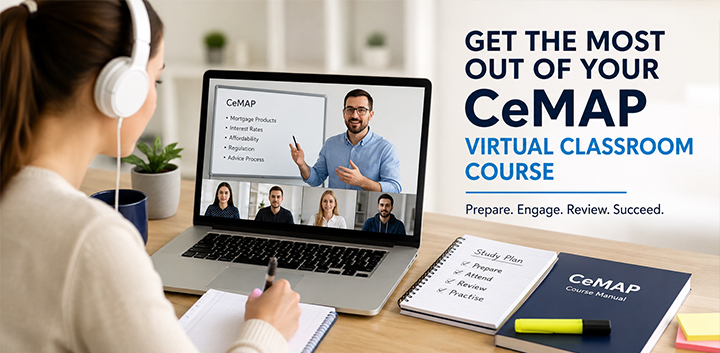
Student attending a live CeMAP virtual classroom course on a laptop while taking notes during online mortgage adviser training.

Virtual classroom learning has become one of the most popular ways to study for CeMAP. It offers the structure of live teaching while allowing learners to study from home or another convenient location. For many people, it provides a balance between the flexibility of online learning and the support of a traditional classroom.

However, simply attending the sessions is only part of the process. The learners who gain the most from a CeMAP virtual classroom course are usually those who prepare before each lesson, stay engaged during teaching and review what they have learned afterwards.

Whether you have already enrolled or are deciding if live online training is right for you, understanding how to use virtual classroom CeMAP training effectively can help you make the most of your investment of both time and effort. This approach aligns with best practices for educational, answer-led content and clear learner guidance.

Student attending a live CeMAP virtual classroom course on a laptop while taking notes during online mortgage adviser training.

What Is a CeMAP Virtual Classroom Course?

A CeMAP virtual classroom course is a live online training programme where an instructor teaches learners in real time using video conferencing software. Rather than watching pre-recorded videos whenever you choose, you join scheduled sessions alongside other learners.

The course typically follows a structured timetable, allowing tutors to explain key topics, answer questions and guide learners through the CeMAP syllabus.

Most virtual classroom providers also include supporting resources such as:

  • Digital course manuals
  • Practice questions
  • Revision materials
  • Mock exams
  • Tutor support between sessions

This combination of live teaching and independent study gives learners regular guidance while still allowing time to study between classes.

What Should You Expect from a CeMAP Virtual Classroom Session?

Knowing what happens during a session helps reduce uncertainty before your course begins.

Although every provider structures lessons slightly differently, most sessions follow a similar pattern.

A typical lesson may include:

  • A review of previous topics
  • Introduction of new learning outcomes
  • Tutor explanations using presentations or examples
  • Opportunities to ask questions
  • Worked examples and practice questions
  • Discussion of common exam misunderstandings
  • Guidance on what to study before the next lesson

Rather than expecting to memorise everything during the live session, think of each class as building your understanding of the subject. Your own revision afterwards is what helps turn that understanding into exam knowledge.

Learner attending a live CeMAP virtual classroom session on a laptop while taking notes during online mortgage adviser training.

How Should You Prepare Before Each Virtual Classroom Session?

Preparing before each lesson makes it much easier to follow the tutor and participate confidently.

Even spending 20 to 30 minutes beforehand can improve your understanding considerably.

Read Any Pre-Course Materials

Many training providers send course notes or reading materials before each lesson.

Having a basic awareness of the topic means you spend less time trying to understand unfamiliar terminology during the session and more time listening to the tutor’s explanations.

You do not need to master the content beforehand. Simply becoming familiar with the main concepts can make a noticeable difference.

Create a Suitable Study Environment

Virtual learning works best when you treat it like attending a physical classroom.

Choose somewhere:

  • Quiet
  • Comfortable
  • Well lit
  • Free from interruptions
  • With a reliable internet connection

If possible, avoid studying from places where you are likely to become distracted, such as the living room while others are watching television.

A dedicated workspace also helps you mentally switch into study mode.

Check Your Technology Beforehand

Technical problems can interrupt learning unnecessarily.

Before your first session, check:

  • Your internet connection
  • Camera
  • Microphone
  • Speakers or headset
  • Laptop charger
  • Login details

Joining five or ten minutes early gives you time to resolve any problems before teaching begins.

How Can You Stay Engaged During Virtual Classroom CeMAP Training?

One of the biggest advantages of live online learning is the ability to interact with experienced tutors.

Taking an active role usually leads to better understanding than simply watching passively.

Ask Questions When Something Is Unclear

Many learners worry about asking questions because they think everyone else understands the topic.

In reality, other learners often have the same question.

Good tutors expect questions throughout the course and can often explain concepts in several different ways.

If something does not make sense, asking immediately is usually better than hoping it becomes clearer later.

Take Your Own Notes

Even if comprehensive course manuals are provided, writing your own notes helps reinforce learning.

Rather than copying every word from the presentation, focus on:

  • Key definitions
  • Important rules
  • Areas you find difficult
  • Tutor explanations that helped something make sense

These personalised notes often become some of your most useful revision resources later.

Minimise Distractions

Studying from home brings temptations that would not exist in a classroom.

Try to avoid:

  • Checking emails
  • Looking at social media
  • Watching television
  • Using your phone unnecessarily
  • Working on unrelated tasks

Even brief interruptions can make it harder to follow detailed financial concepts.

Why Participation Matters More Than Attendance

Attending every session is important, but participation is what helps develop understanding.

Learners who contribute during discussions often remember information more effectively because they are actively processing what they hear.

Participation might include:

  • Answering tutor questions
  • Joining discussions
  • Completing exercises
  • Sharing your reasoning
  • Asking for clarification

You do not need to speak constantly. Simply engaging with the learning process keeps your attention focused.

CeMAP learner actively participating in a live virtual classroom by asking questions and engaging with the online tutor.

How Should You Review After Each Session?

One of the biggest mistakes learners make is assuming the live lesson is enough.

The most effective learning usually happens after the session ends.

Review Your Notes the Same Day

Revisiting your notes while the lesson is still fresh helps strengthen your memory.

Even a short review can identify areas that need further study before they become larger problems.

Review Your Notes the Same Day

Revisiting your notes while the lesson is still fresh helps strengthen your memory.

Even a short review can identify areas that need further study before they become larger problems.

Complete Practice Questions

CeMAP examinations test how well you understand the syllabus rather than whether you attended lessons.

Practice questions help you:

  • Apply your knowledge
  • Identify weak areas
  • Become familiar with exam wording
  • Build confidence gradually

If you answer questions incorrectly, use them as learning opportunities rather than signs of failure.

Organise Your Revision

After each lesson, organise your notes alongside your course materials.

Keeping everything clearly labelled makes later revision much easier.

Many learners use folders or digital note systems organised by CeMAP unit, allowing them to find information quickly when preparing for exams.

Should You Study Between Virtual Classroom Sessions?

Yes. Independent study is an important part of every CeMAP virtual classroom course.

Live sessions introduce and explain topics, but personal study helps reinforce and retain that knowledge.

Between lessons, you could:

  • Re-read course materials
  • Complete practice questions
  • Review tutor notes
  • Create revision summaries
  • Revise difficult topics
  • Test yourself using flashcards

Studying little and often is generally more effective than leaving everything until just before the exam.

What Are the Most Common Mistakes Learners Make?

Understanding common mistakes can help you avoid unnecessary difficulties during your course.

Expecting the Tutor to Do All the Learning

Tutors explain complex topics clearly, but learning still requires personal effort.

Virtual classroom training works best when learners actively revise outside scheduled sessions.

Falling Behind After Missing One Lesson

Life sometimes gets in the way, and missing a session does not automatically mean you cannot succeed.

The important thing is catching up promptly by reviewing recordings if available, reading the course materials and speaking with your tutor if necessary.

Leaving gaps for several weeks often makes later topics much harder to understand.

Ignoring Areas That Feel Difficult

It can be tempting to focus on subjects you already understand.

Instead, spend additional time on weaker topics while tutor support is still available.

Addressing small misunderstandings early is usually much easier than revisiting them shortly before the exam.

Not Using Available Support

Many virtual classroom providers offer additional support beyond the live lessons.

This may include tutor email access, revision sessions, discussion groups or extra learning resources.

Making use of these opportunities can help clarify difficult topics and maintain momentum throughout the course.

Is Virtual Classroom Learning Right for Everyone?

Not necessarily.

Some learners enjoy the flexibility and interaction of live online teaching, while others may prefer self-paced study or traditional classroom learning.

Virtual classroom courses often suit learners who:

  • Like structured study schedules
  • Benefit from live explanations
  • Want opportunities to ask questions
  • Appreciate regular accountability
  • Prefer learning from home

Those who need complete flexibility because of unpredictable work patterns may find on-demand online learning more suitable.

Choosing the right format depends on your learning style, availability and personal preferences rather than one method being better than another.
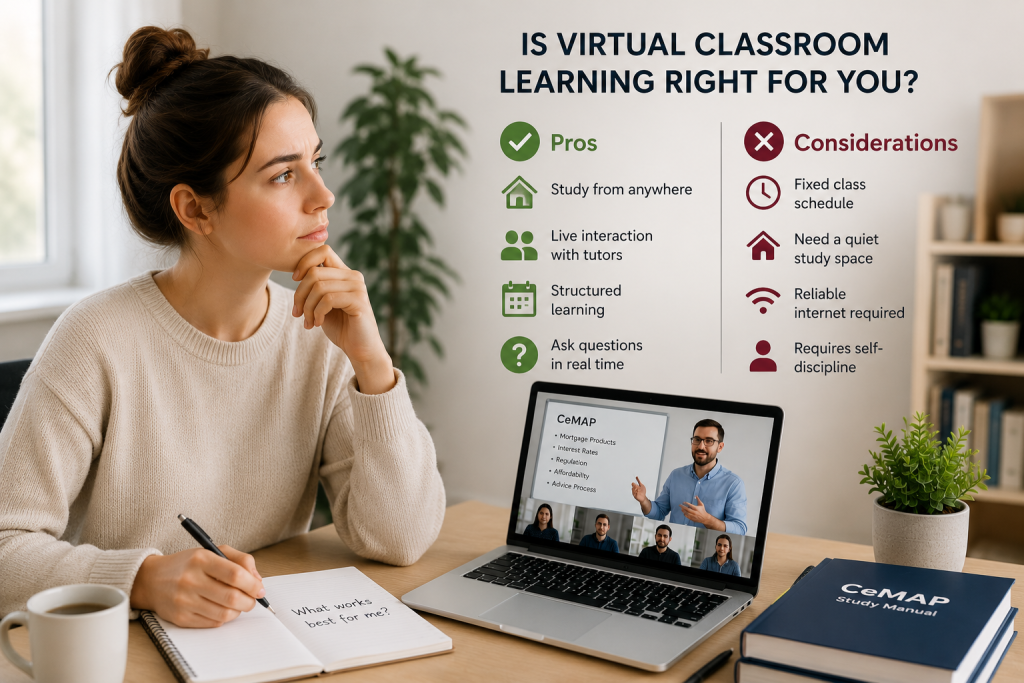
Prospective CeMAP learner considering whether a virtual classroom course suits their learning style and study needs.

How to Use Virtual Classroom CeMAP Training Successfully

Getting the most from a CeMAP virtual classroom course is about more than simply logging in each day. Preparing before lessons, engaging during teaching and reviewing afterwards all contribute to stronger understanding and greater confidence.

The live sessions provide valuable structure, guidance and opportunities to ask questions, but they work best when combined with regular independent study. Treat each lesson as part of an ongoing learning process rather than a standalone event.

With consistent preparation, active participation and steady revision, virtual classroom training can provide an effective route towards achieving your CeMAP qualification while giving you the support of experienced tutors and fellow learners throughout your studies.

Looking for training support?

We offer CeMAP training for learners working towards a career in mortgage advice. Our courses follow the London Institute of Banking & Finance syllabus and are designed to support understanding of mortgage regulation and advice requirements.

Explore our accredited CeMAP training courses

> Futuretrend Financial Training 
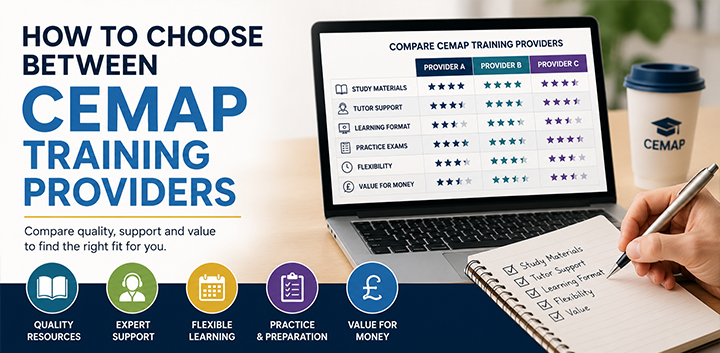
How to Choose Between CeMAP Training Providers

How to choose between CeMAP training providers by comparing study support, learning resources, course structure and overall value.

If you’ve decided to study for CeMAP, one of the first choices you’ll face is deciding which training provider to use. A quick online search reveals dozens of companies offering CeMAP courses, all claiming to help you succeed.

So how do you know which CeMAP provider is best?

The honest answer is that there isn’t one provider that’s automatically the best for everyone. The right choice depends on how you learn, the level of support you want, your available study time and what you expect from your training.

While price often catches people’s attention first, it rarely tells the whole story. A cheaper course can end up costing more if it lacks support or leaves you needing additional resources later. Equally, the most expensive provider isn’t necessarily the best fit either.

This guide explains the key factors to compare so you can choose a CeMAP training provider based on quality, transparency and overall value rather than simply the lowest price. It follows best practice for clear, answer-led educational content.

How to choose between CeMAP training providers by comparing study support, learning resources, course structure and overall value.

Which CeMAP Provider Is Best?

The best CeMAP provider is the one that offers the right balance of high-quality learning materials, experienced tutor support, flexible study options and clear guidance throughout your studies. Rather than focusing only on cost, compare how each provider helps learners understand the syllabus and prepare for the exams.

When comparing providers, ask yourself:

  • Will this course suit the way I learn?
  • Is help available if I get stuck?
  • Are the study materials up to date?
  • Is everything included in the price?
  • Can I see examples before I buy?

These questions often reveal far more than the headline price.

What Should You Compare Between CeMAP Training Providers?

Although providers all teach the same qualification, the learning experience can vary considerably.

The most useful comparisons include:

Quality of Study Materials

Good CeMAP learning materials should explain concepts clearly rather than simply repeat the official syllabus.

Look for resources that include:

  • Clear explanations in plain English
  • Worked mortgage examples
  • Practice questions
  • Mock exams
  • Revision summaries
  • Progress tracking

The aim is not simply to provide information but to help you understand it.

If the sample materials feel confusing or overly technical, studying the full course may become much harder than necessary.

Tutor Support

Support is one of the biggest differences between providers.

Some learners rarely need help, while others benefit from being able to ask questions when they become stuck.

Consider:

  • Can you contact tutors directly?
  • How quickly do they normally respond?
  • Are there scheduled support sessions?
  • Can you ask unlimited questions?
  • Is support available throughout the course?

Having access to knowledgeable tutors can save hours of frustration and prevent small misunderstandings becoming bigger problems.

Learning Format

Everyone learns differently.

Some people enjoy studying independently, while others stay motivated through structured teaching.

Common learning formats include:

Self-study

Ideal for independent learners who want maximum flexibility.

Virtual live classes

Online sessions with tutors that provide structure while allowing you to study from home.

Classroom training

Face-to-face teaching over a set timetable with direct interaction.

Many providers also offer blended learning, combining live tuition with online resources and self-study.

Rather than asking which format is “best”, think about which one fits your schedule and learning style.

Why Does Tutor Experience Matter?

Experienced tutors often explain difficult topics more simply because they understand where learners commonly struggle.

This doesn’t necessarily mean they have been teaching for decades. Instead, look for providers whose tutors:

  • Understand the CeMAP syllabus thoroughly
  • Can explain complex topics clearly
  • Encourage questions
  • Keep course content current
  • Have experience supporting adult learners

Teaching ability is just as important as subject knowledge.

Are Practice Questions and Mock Exams Important?

Yes.

Reading course notes alone is rarely enough preparation for CeMAP exams.

Practice questions help you:

  • Apply what you’ve learned
  • Identify weak areas
  • Become familiar with question styles
  • Build confidence before sitting the real exam

Mock exams are especially valuable because they recreate exam conditions and highlight topics that need further revision.

Providers offering a wide range of realistic practice questions often give learners better opportunities to test their understanding before exam day.

Should You Choose the Cheapest CeMAP Course?

Not necessarily.

A lower price may represent excellent value, but only if the course includes everything you need.

Sometimes lower-cost courses exclude:

  • Tutor support
  • Revision resources
  • Mock exams
  • Updated materials
  • Additional learning aids

If you later need to buy extra resources or seek additional tuition, the overall cost may end up being higher.

Instead of asking, “Which course is cheapest?”, ask, “What am I getting for my money?”

That simple change in mindset often leads to a better long-term decision.

Comparing the cheapest CeMAP course with better value training by considering tutor support, study materials and learning resources.

What's the Difference Between Price and Value?

Price is simply the amount you pay.

Value is what you receive in return.

Two providers might charge similar fees while offering very different learning experiences.

For example, one course might include:

  • Live tutor sessions
  • Comprehensive study manuals
  • Video lessons
  • Practice exams
  • Ongoing learner support

Another may provide only downloadable notes with little or no assistance.

The second option may appear cheaper, but the first could offer considerably better value if it improves your understanding and confidence.

Looking beyond the initial price often helps you make a more informed decision.

Why Is Transparency Important?

Good training providers are open about what they offer.

Before enrolling, you should be able to find clear information about:

  • Course content
  • Study methods
  • What’s included
  • Support availability
  • Expected study commitment
  • Costs

If important information is difficult to find or seems unclear, it’s reasonable to ask questions before committing.

Transparent providers usually make it easier for learners to understand exactly what they’re purchasing.

Should Providers Offer Course Previews?

Course previews can be extremely helpful.

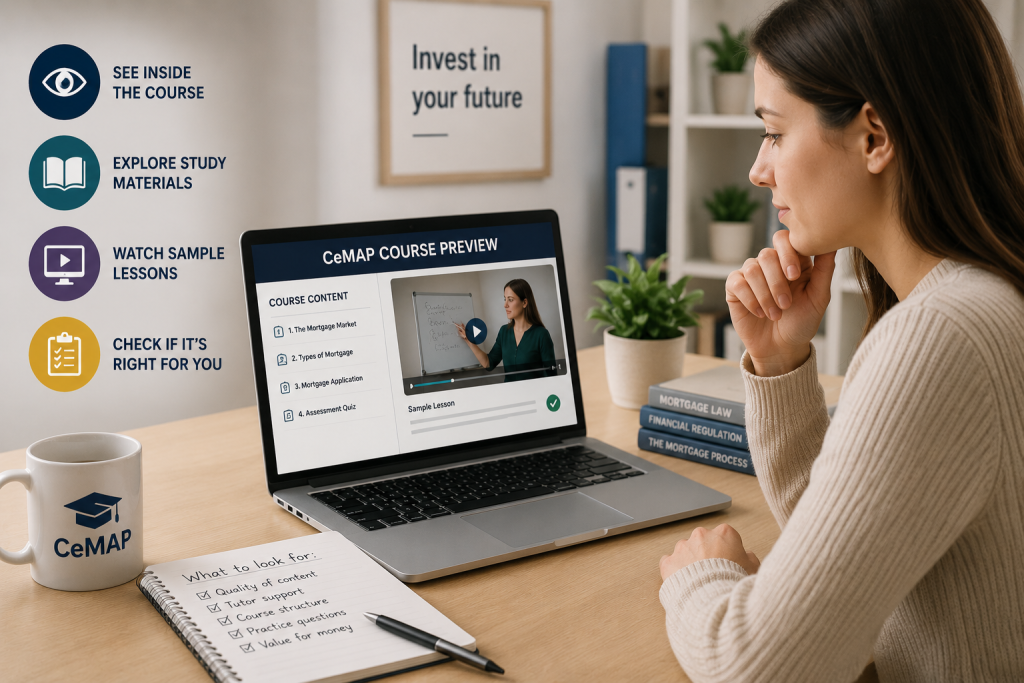
Many reputable providers allow prospective learners to view sample CeMAP materials, watch introductory videos or explore demonstrations of their learning platform.

A preview lets you judge:

  • Whether the explanations make sense to you
  • The quality of the learning materials
  • How easy the platform is to use
  • Whether the teaching style suits you

Since everyone learns differently, seeing part of the course before buying can make choosing much easier.

Learner viewing a CeMAP course preview online to compare study materials, lesson structure and learning platform before enrolling.

What Are the Warning Signs of a Poor Training Provider?

Not every provider offers the same level of quality.

While no single issue automatically means a provider should be avoided, several warning signs deserve careful consideration.

These include:

Unrealistic Promises

Be cautious of claims that suggest guaranteed exam passes, guaranteed careers or exceptionally quick qualification with little effort.

CeMAP requires genuine study, and no provider can guarantee individual outcomes.

What Are the Warning Signs of a Poor Training Provider?

Not every provider offers the same level of quality.

While no single issue automatically means a provider should be avoided, several warning signs deserve careful consideration.

These include:

Unrealistic Promises

Be cautious of claims that suggest guaranteed exam passes, guaranteed careers or exceptionally quick qualification with little effort.

CeMAP requires genuine study, and no provider can guarantee individual outcomes.

Lack of Clear Information

If it’s difficult to discover:

  • what’s included,
  • who provides support,
  • how learning works, or
  • what happens after enrolment,

it may be harder to know exactly what you’re paying for.

Outdated Course Information

Financial regulation and qualification content can change over time.

Training providers should clearly maintain and update their learning materials when necessary.

Studying from outdated content can create unnecessary confusion.

Limited Ways to Get Help

If support is only available through slow or restricted channels, learners may struggle when they need clarification.

Reliable communication is often an important part of successful study.

Poor Reviews Without Context

Reviews should never be the only deciding factor.

Instead of focusing on overall ratings alone, read comments carefully.

Look for repeated themes such as:

  • quality of support
  • responsiveness
  • organisation
  • learning experience

Every provider will receive occasional negative feedback, but consistent patterns can

Should Online Reviews Influence Your Decision?

Reviews can help, but they shouldn’t make the decision for you.

People are more likely to leave reviews after either extremely positive or extremely negative experiences.

Instead, combine reviews with other evidence, including:

  • course previews
  • available support
  • study resources
  • transparency
  • learning format
  • your own preferences

Taking a balanced view usually leads to a better decision than relying solely on ratings.

Does the Learning Platform Matter?

Absolutely.

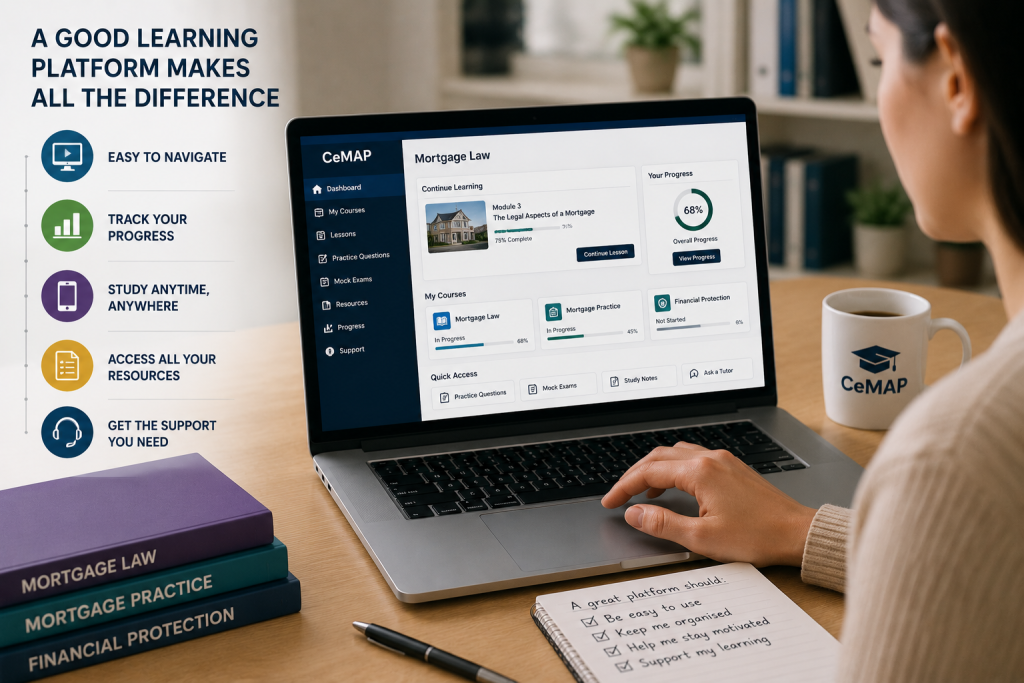
If you’ll be studying CeMAP online for several weeks or months, you’ll spend a lot of time using the provider’s learning platform.

A good platform should make studying easier by offering:

  • simple navigation
  • clear lesson structure
  • progress tracking
  • mobile compatibility where appropriate
  • easy access to learning resources

A confusing platform can make studying feel more difficult than it needs to be.

Learner using an online CeMAP learning platform with progress tracking, study resources and tutor support.

Questions to Ask Before You Enrol

Before making your final decision, consider asking:

  • What support is included?
  • Are study materials updated regularly?
  • Are mock exams included?
  • Can I study at my own pace?
  • Is there a course demonstration available?
  • What happens if I need additional help?
  • Are there any additional costs?

The answers should help you compare providers fairly.

Final Thoughts

Choosing a LIBF CeMAP training provider isn’t about finding the cheapest course or the company making the biggest promises. It’s about finding the learning experience that gives you the best chance of understanding the material, staying motivated and preparing confidently for your exams.

The strongest providers are usually transparent about what they offer, provide high-quality study resources, make support readily available and help learners understand the qualification rather than simply memorise it.

By comparing structure, resources, support and overall value, you can make a decision based on what will genuinely help you succeed.

After all, investing in the right learning experience from the beginning can make your CeMAP journey smoother, more enjoyable and ultimately more rewarding.

Looking for training support?

We offer CeMAP training for learners working towards a career in mortgage advice. Our courses follow the London Institute of Banking & Finance syllabus and are designed to support understanding of mortgage regulation and advice requirements.

Explore our accredited CeMAP training courses

> Futuretrend Financial Training 

Is online CeMAP training as effective as classroom-based learning?

Is online CeMAP training as effective as classroom-based learning

Choosing how to study for CeMAP is one of the first real decisions you make on the path to becoming a mortgage adviser. The two most common routes are online learning and classroom-based learning, including virtual classrooms.

Both can work. Neither is automatically better. The difference comes down to how the training is structured and how well it fits your time, learning style, and support needs.

This guide explains how each method works, where each one helps, and how to decide what suits you.

Is online CeMAP training as effective as classroom-based learning

What is CeMAP and how is it typically studied?

CeMAP (Certificate in Mortgage Advice and Practice) is the industry standard qualification for mortgage advisers in the UK. It is awarded by the London Institute of Banking & Finance (LIBF) and meets the Financial Conduct Authority (FCA) education requirements for giving mortgage advice.

You can study CeMAP in several ways:

  • Fully online through structured learning platforms
  • Virtual classroom sessions with live tutors
  • In-person classroom courses
  • A blended approach combining all three

Most modern CeMAP training programmes combine elements of online study with tutor support, rather than relying on a single format.

How does online CeMAP training work?

Online CeMAP training is typically delivered through a digital learning platform. This is often referred to as a home study or self-paced course.

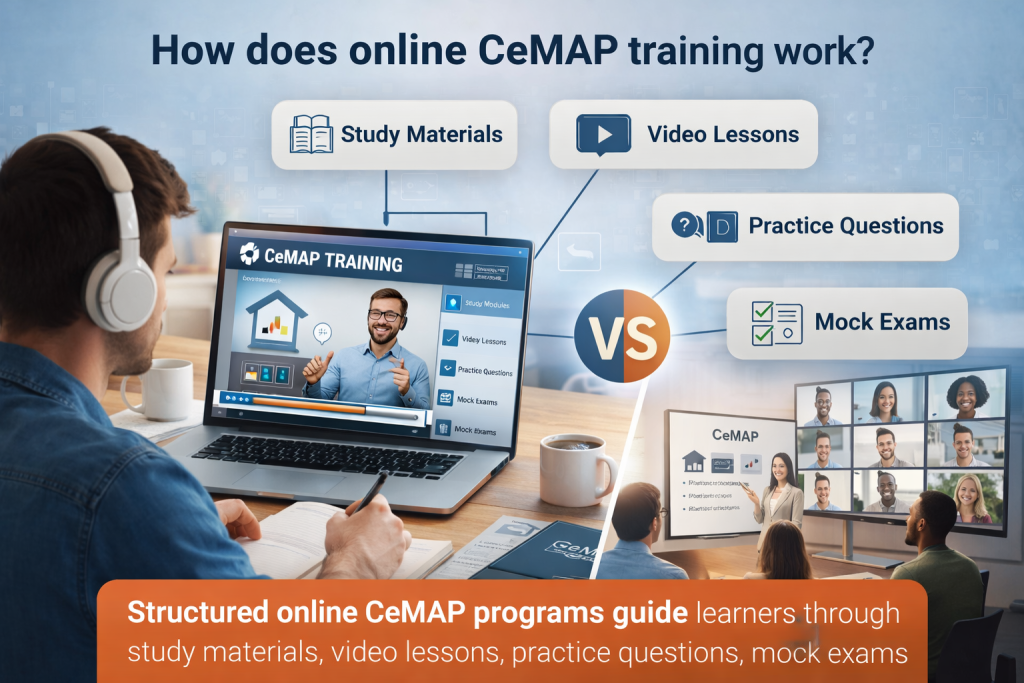
A well-structured online programme usually includes:

  • Study materials that break down the syllabus into manageable topics
  • Video lessons explaining key concepts
  • Topic-based questions to test understanding
  • Mock exams and LIBF specimen papers
  • Recaps and summaries to reinforce learning
  • Ongoing updates aligned with syllabus changes

The key point is structure. Online learning is not just reading a textbook. The more effective programmes guide you through the syllabus step by step.

Many learners use platforms that include full study support resources such as topic walkthroughs, exam-style questions, and revision tools designed to mirror the CeMAP exam format.

How online CeMAP training works with study materials, video lessons, practice questions and mock exams

What are the advantages of online CeMAP training?

Online learning can be very effective when it is used properly.

Flexibility around your schedule

You can study at times that suit you. This is especially useful if you are working, changing careers, or balancing other commitments.

Control over pace

You can spend longer on difficult topics and move quickly through areas you already understand. This is often important in CeMAP 1, where financial regulation can take time to absorb.

Repeatable learning

You can revisit videos, notes, and questions as many times as needed. This helps reinforce understanding rather than relying on memory from a single session.

Continuous access to resources

Good online CeMAP training platforms provide ongoing access to materials, meaning you can revise whenever needed rather than relying on fixed course dates.

Lower barriers to entry

Online training often removes travel and scheduling constraints, making it easier to start studying sooner.

That said, flexibility can also be a drawback if it leads to inconsistency.

What are the limitations of online learning?

Online CeMAP training is only as effective as the structure and discipline behind it.

Requires self-motivation

Without fixed sessions, it is easy to delay studying or lose momentum. This is one of the most common reasons learners struggle.

Less immediate interaction

If you are unsure about a topic, you may not get an instant explanation unless support is built into the course.

Risk of passive learning

Watching videos or reading notes does not always translate into exam readiness. Active practice through questions and mock exams is essential.

Can feel isolating

Some learners prefer discussion and interaction, especially when working through complex areas like mortgage products or case study scenarios in CeMAP 3.

This is why many online programmes now include additional support layers such as tutor access or virtual classrooms.

What does structured learning actually look like?

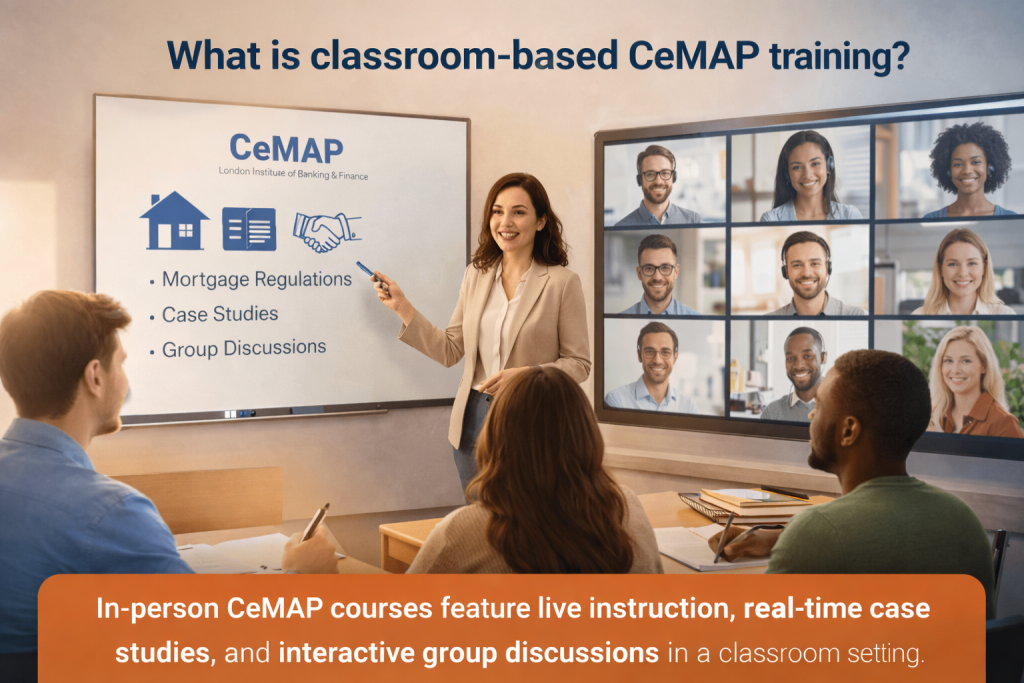
Classroom-based training involves learning in a structured environment, either in person or through a live virtual classroom.

Traditional classroom learning usually includes:

  • Scheduled sessions led by a tutor
  • Group discussions and interaction
  • Real-time explanations and examples
  • A fixed pace covering the syllabus

Virtual classroom training follows a similar structure but is delivered online through live sessions rather than in a physical location.

Many CeMAP providers now offer virtual classrooms with smaller groups, allowing learners to ask questions and engage with the tutor while still studying remotely.

Classroom-based CeMAP training with tutor-led session, group discussion and virtual classroom participants

What are the benefits of classroom and virtual classroom learning?

Classroom-style learning offers a different type of support.

Structured schedule

You follow a set timetable, which helps maintain consistency and progress.

Immediate clarification

You can ask questions and get answers straight away, which is useful for more complex topics.

Guided learning

The tutor controls the pace and ensures key areas are covered thoroughly.

Accountability

Attending sessions creates a sense of commitment, which can help learners stay on track.

Peer interaction

Learning alongside others can help reinforce understanding and highlight different ways of approaching questions.

Virtual classrooms offer many of these benefits while removing the need to travel.

What are the limitations of classroom-based learning?

Classroom training is effective, but it is not always the best fit for everyone.

Fixed pace

You move at the speed of the group. If you fall behind or already understand a topic, it can feel restrictive.

Less flexibility

You must attend at specific times, which may not suit work or personal commitments.

Limited repetition

Once a session is finished, you cannot always revisit it unless recordings or additional materials are provided.

Travel (for in-person courses)

Attending physical classes may involve time and cost that not all learners can accommodate.

Because of this, many learners combine classroom sessions with online resources to reinforce learning.

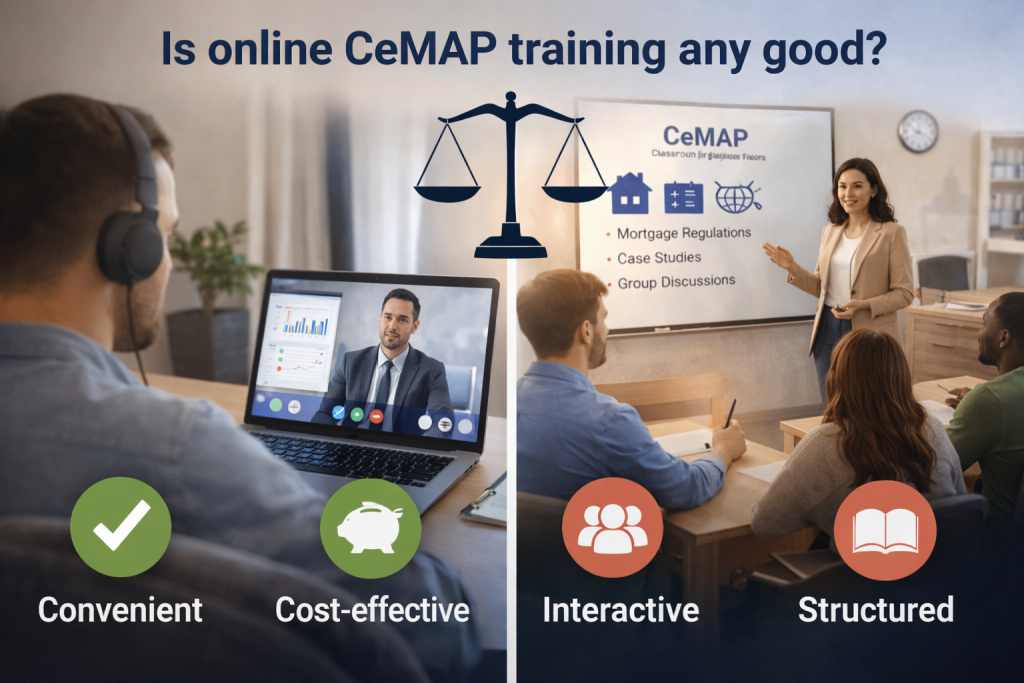
Is online CeMAP training any good?

Yes, online CeMAP training can be very effective, but only when it is structured properly and used consistently.

The quality of the programme matters more than the delivery method.

A strong online course should:

  • Follow the full LIBF syllabus clearly
  • Break topics into manageable sections
  • Include exam-style questions and mock tests
  • Provide explanations, not just information
  • Support different learning styles through varied content

When these elements are in place, many learners perform just as well as those in classroom settings.

However, if the course lacks structure or the learner struggles with self-discipline, progress can slow down.

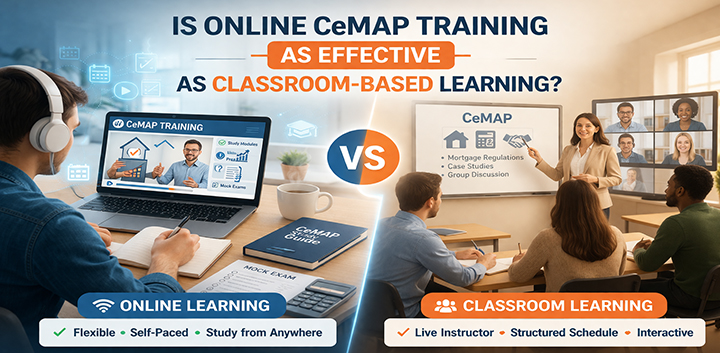
Is online CeMAP training any good comparison showing online learning flexibility and classroom structure

How does virtual classroom learning bridge the gap?

Virtual classroom learning sits between fully online and traditional classroom study.

It combines:

  • The structure of scheduled sessions
  • Live tutor interaction
  • The convenience of studying from home

Many CeMAP learners use virtual classrooms alongside online study platforms. For example, they may:

  • Study topics independently using structured online materials
  • Attend live sessions to reinforce understanding
  • Use tutor sessions to clarify difficult areas

This blended approach is becoming more common because it supports both flexibility and structure.

Which learning method suits different types of learners?

The best method depends on how you learn and how you manage your time.

Online learning often suits learners who:

  • Prefer studying at their own pace
  • Are comfortable learning independently
  • Need flexibility around work or family commitments
  • Like revisiting material multiple times

Classroom or virtual classroom learning often suits learners who:

  • Prefer structured schedules
  • Benefit from live explanations
  • Like asking questions in real time
  • Stay motivated through routine and accountability

There is no right or wrong choice. The key is being honest about what helps you stay consistent and engaged.

Does the learning method affect exam success?

The method itself does not determine whether you pass CeMAP exams.

What matters more is:

  • How well you understand the syllabus
  • How much practice you do with exam-style questions
  • How familiar you are with the exam structure
  • How consistently you study

For example:

  • A learner using a structured online CeMAP training platform with regular practice may perform better than someone attending classroom sessions without revising properly.
  • Equally, a learner who benefits from tutor guidance may progress faster in a virtual classroom environment.

Both routes can lead to the same outcome if used effectively.

How important is structure in CeMAP training?

Structure is one of the most important factors in successful CeMAP study.

Regardless of whether you choose online or classroom learning, your training should:

  • Follow a clear path through the syllabus
  • Build knowledge step by step
  • Include regular knowledge checks
  • Prepare you for exam-style questions
  • Reinforce learning through repetition

Many modern CeMAP training programmes are designed with this in mind, combining:

  • Structured study materials
  • Video explanations
  • Topic-based questions
  • Mock exams
  • Tutor support

This kind of approach is often more important than whether the delivery is online or in a classroom.

Should you look for a LIBF accredited learning support provider?

Yes, and many learners do.

A combined approach might include:

  • Studying core topics through an online learning platform
  • Attending virtual classroom sessions for key areas
  • Using mock exams and question banks for revision
  • Accessing tutor support when needed

This allows you to benefit from both flexibility and structured guidance.

It also reflects how many learners naturally study. Few rely on a single method throughout the entire CeMAP journey.

Blended CeMAP training combining online learning and classroom sessions with tutor and virtual participants

Final thoughts

Online CeMAP training is effective when it is structured, supported, and used consistently. Classroom and virtual classroom learning are effective when they provide clarity, guidance, and accountability.

The real difference is not the format, but how well the method fits you.

If you need flexibility and control, online learning can work very well.
If you prefer structure and interaction, classroom-style learning may suit you better.
If you want both, a blended approach often provides the best balance.

Most importantly, focus on how you learn, not just how the course is delivered. The right structure, resources, and consistency will always matter more than the format alone.

Looking for training support?

We offer CeMAP training for learners working towards a career in mortgage advice. Our courses follow the London Institute of Banking & Finance syllabus and are designed to support understanding of mortgage regulation and advice requirements.

Explore our accredited CeMAP training courses

> Futuretrend Financial Training