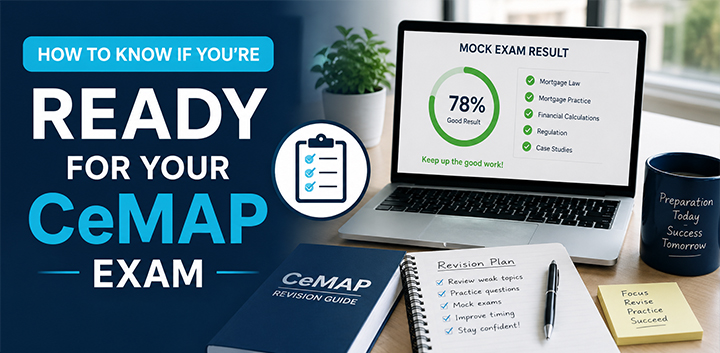
When am I ready for the CeMAP exam? You’re ready when you consistently demonstrate your knowledge under exam conditions, not simply because you’ve finished studying or feel confident. The best indicators are strong mock exam results, a solid understanding of key concepts, and the ability to explain why answers are correct rather than relying on memory alone.
Many learners reach a point where they wonder whether they should book their CeMAP exam or spend another week revising. It can be difficult to judge because confidence doesn’t always reflect how prepared you actually are. Some learners underestimate themselves despite being ready, while others book too early because they feel familiar with the material.
Knowing the difference can help you avoid unnecessary stress, additional exam fees, and disappointment.
This guide explains the signs that you’re genuinely ready, how mock exams should be used, and why understanding matters far more than simply feeling confident. The guidance follows best practice for educational content and focuses on helping learners make an informed decision rather than encouraging them to book before they’re prepared.
What Does Being Ready for the CeMAP Exam Actually Mean?
Being ready doesn’t mean knowing every page of the syllabus from memory.
Instead, readiness means you can apply your knowledge consistently across different question styles and recognise why the correct answer is right.
The London Institute of Banking & Finance (LIBF) CeMAP exams assess understanding as well as recall. Questions are often worded differently from practice materials, meaning learners who have only memorised facts can struggle.
A learner who is ready will usually be able to:
- Explain key topics in their own words.
- Apply knowledge to different scenarios.
- Recognise incorrect answers as well as correct ones.
- Complete questions within the available time.
- Stay reasonably calm during practice exams.
Perfection isn’t the goal. Consistency is.
What Are the Signs You're Ready for the CeMAP Exam?
Rather than relying on instinct, look for evidence that your preparation is working.
Some of the strongest indicators include:
You Consistently Pass Mock Exams
One good mock result isn’t enough.
A better sign is achieving strong scores across several different mock exams over time.
This suggests your understanding is consistent rather than based on remembering individual questions.
If your scores vary dramatically between attempts, there may still be knowledge gaps worth addressing.
You Understand Why Answers Are Correct
Many learners focus on whether they chose the correct option.
A better question is:
“Could I explain why the other answers are wrong?”
Being able to justify your answer shows genuine understanding rather than recognition.
This becomes especially important when the real exam presents familiar topics in unfamiliar ways.
You’re No Longer Guessing Frequently
Every learner makes the occasional educated guess.
However, if you regularly narrow questions down without really knowing the answer, your revision may still need work.
Confidence based on guessing can disappear quickly when exam wording changes.
You Can Recall Information Without Looking It Up
If you constantly need your notes beside you, you may not yet be ready.
During revision, try answering questions before checking textbooks or revision guides.
Retrieving information from memory strengthens learning far more than repeatedly reading the same material.
You Can Explain Topics to Someone Else
One of the simplest tests is explaining a topic aloud.
If you can describe concepts such as mortgage regulation, affordability, protection products or the house buying process clearly without reading from your notes, you’re likely developing a deeper understanding.
If your explanation quickly breaks down, you’ve identified an area for further revision.
Why Are Mock Exams So Important?
CeMAP Mock exams are one of the most useful tools for measuring readiness because they simulate the way knowledge must be applied during the real assessment.
They’re far more valuable than simply rereading notes.
Good mock exams help you:
- Identify weak topics.
- Practise working under time pressure.
- Become familiar with question styles.
- Improve exam technique.
- Build realistic confidence.
The aim isn’t simply to achieve a high score.
It’s to discover where your understanding still needs strengthening before exam day.

Can Confidence Be Misleading?
Yes.
Confidence and ability don’t always develop at the same speed.
Some learners feel extremely confident because they’ve spent many hours studying, yet struggle when answering application-based questions.
Others worry they’re underprepared despite regularly achieving excellent mock scores.
Instead of asking:
“Do I feel ready?”
Ask:
- What do my mock exam results show?
- Which topics consistently cause problems?
- Can I explain difficult concepts without my notes?
- Have I improved over several weeks rather than one good day?
Evidence is a much better guide than emotion.
What Happens If You Book Your CeMAP Exam Too Early?
Booking before you’re ready increases pressure without improving your chances of success.
Although everyone wants to qualify as quickly as possible, sitting the exam before you’ve developed consistent understanding can lead to unnecessary setbacks.
Potential risks include:
- Failing the exam and needing to pay another exam fee.
- Losing confidence.
- Spending additional time revising areas that could have been addressed beforehand.
- Creating unnecessary stress around future exams.
A short delay spent improving weaker areas is often far more productive than rushing into an assessment.
How Can You Test Your Readiness Before Booking?
A useful self-assessment combines several measures rather than relying on one.
Ask yourself:
Are your mock exam scores consistently strong?
Avoid judging readiness from a single result.
Can you complete questions within the allocated time?
Running out of time during practice may indicate more exam practice is needed.
Do you understand the syllabus rather than memorise it?
If questions are slightly reworded, can you still reach the correct answer?
Have you reviewed your weaker topics?
Every learner has stronger and weaker subjects.
Before booking, make sure you’ve revisited the areas where mistakes regularly occur.
Are mistakes becoming less frequent?
Improvement over time is one of the strongest indicators that your revision is working.
What Should You Do If You're Not Quite Ready?
Not feeling ready doesn’t necessarily mean you’re far away from passing.
Often only a few targeted improvements are needed.
Instead of restarting the entire syllabus:
- Review the topics where mock exams reveal repeated mistakes.
- Complete more timed practice questions.
- Focus on understanding rather than memorisation.
- Use active recall techniques instead of rereading notes.
- Leave a short gap before attempting another mock exam.
Small improvements in weaker areas often make a significant difference to overall performance.
Should You Wait Until You Feel Completely Ready?
Probably not.
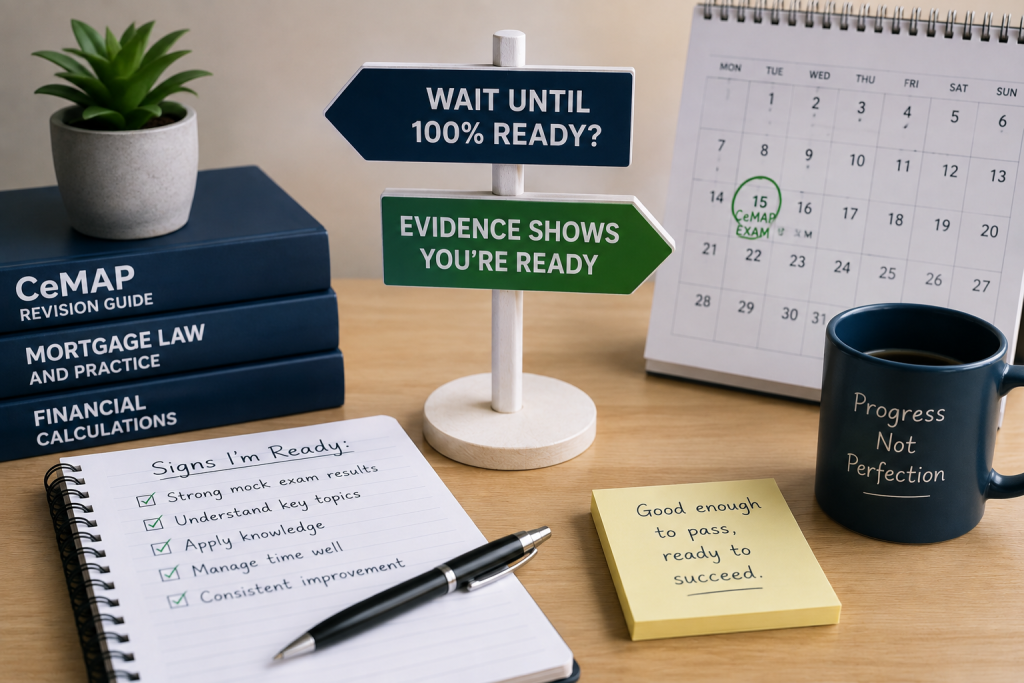
Very few learners ever feel 100% prepared.
There will almost always be topics you’d like to revise one more time.
The goal isn’t complete certainty.
The goal is having enough evidence that you’re capable of passing.
If your mock exam results are consistently strong, your understanding is solid, and you’re applying knowledge confidently across the syllabus, waiting several more weeks may add very little value.
Final Thoughts
Knowing when you’re ready for your CeMAP examhttps://cemap123.co.uk/ isn’t about reaching a perfect level of confidence.
It’s about demonstrating consistent performance through practice.
Strong mock exam results, a genuine understanding of the syllabus, and the ability to apply knowledge under exam conditions are much more reliable indicators than simply feeling prepared.
If your evidence shows you’re performing consistently, booking your exam is likely the next sensible step. If it highlights weaknesses, use that information positively by focusing your revision where it will have the greatest impact.
Remember, the aim isn’t just to pass the exam. It’s to build the knowledge and confidence that will support you throughout your future career as a mortgage adviser.
For additional support, many learners find it helpful to combine structured revision with high-quality mock exams, topic-by-topic practice questions and active recall techniques. These resources can help you identify any remaining knowledge gaps before you book your assessment.
Looking for training support?
We offer CeMAP training for learners working towards a career in mortgage advice. Our courses follow the London Institute of Banking & Finance syllabus and are designed to support understanding of mortgage regulation and advice requirements.
Explore our accredited CeMAP training courses
> Futuretrend Financial Training