Preparing for CeMAP can feel like a marathon. Many learners start with good intentions, build momentum, and then hit a wall. They feel tired, unfocused, and frustrated, even though they are putting in more hours than ever.
The truth is simple: more revision does not always lead to better results.
A well-planned study routine is far more effective than long, exhausting sessions. If you are feeling drained, it may not mean you are falling behind. It may mean you need a smarter approach.
This guide explains how to revise for CeMAP without burning out, how to spot the warning signs of over-revision, and how to keep your energy steady through to exam day.
Can You Over-Revise for CeMAP?
Yes, it is possible to over-revise for CeMAP.
Over-revision happens when you spend so much time studying that your concentration, motivation, and memory begin to decline. Instead of reinforcing what you know, you start reading the same pages repeatedly without taking much in.
CeMAP covers a large amount of technical material, including regulation, mortgage law, and product knowledge. Because there is so much to learn, many learners feel guilty when they are not studying. That often leads to longer sessions and fewer breaks.
However, effective revision is about consistency and retention, not total hours spent.
If your revision leaves you too tired to focus, it is likely doing more harm than good.
What Causes Revision Burnout?
Revision burnout usually develops gradually rather than all at once.
It tends to happen when learners push themselves hard for several weeks without enough rest or variation in their study routine.
Studying for Too Many Hours
A ten-hour study day may feel productive, but concentration drops sharply after a few hours of focused work.
When you are mentally fatigued, reading another chapter often adds very little value.
Unrealistic Expectations
Some learners expect to understand every topic perfectly on the first attempt.
CeMAP contains detailed concepts that often need revisiting. Expecting instant mastery creates unnecessary pressure.
Skipping Breaks
Regular breaks help your brain process information. Without them, attention and recall tend to weaken.
Comparing Yourself to Others
Online forums and social media can make it seem as if everyone else is studying constantly.
In reality, revision quality matters far more than quantity.
Lack of Balance
When study takes over evenings, weekends, and time with family or friends, motivation can fade quickly.
How is a Study Hub structured?
Burnout is easier to manage when you spot it early.
Common warning signs include:
- Reading pages without remembering what you just read
- Feeling irritable or easily distracted
- Procrastinating despite having plenty to do
- Losing confidence in topics you previously understood
- Dreading study sessions
- Struggling to stay focused
- Constantly changing revision plans
- Feeling mentally drained after short periods of study
These signs do not mean you are failing. They usually mean your current study pattern needs adjusting.

Why More Revision Does Not Always Mean Better Results
Learning depends on absorbing and recalling information, not simply spending time with your books.
When your mind is tired:
- Concentration becomes weaker
- Memory retention drops
- Mistakes increase
- Motivation declines
A focused two-hour session can be far more useful than six hours of distracted study.
That is especially true for CeMAP, where understanding concepts matters more than memorising isolated facts.
How Many Hours a Day Should You Revise for CeMAP?
There is no perfect number, but most learners benefit from one to three hours of focused study on weekdays, with slightly longer sessions at weekends if needed.
The key is productive study time.
If you work full-time, even 60 to 90 minutes of concentrated revision each evening can be enough when done consistently.
A sustainable routine always beats occasional marathon sessions.
How to Revise for CeMAP Without Burning Out
Study in Short, Focused Sessions
Try studying in blocks of 25 to 50 minutes followed by a short break.
This helps you stay mentally fresh and reduces the temptation to push beyond your concentration limits.
Set One Clear Goal for Each Session
Rather than vaguely planning to “revise CeMAP”, choose a specific task such as:
- Review affordability assessment rules
- Complete 20 practice questions
- Summarise mortgage regulation notes
Clear goals make sessions feel more achievable.
Use Active Revision Methods
Passive reading is tiring and often ineffective.
Better methods include:
- Practice questions
- Flashcards
- Explaining concepts aloud
- Writing brief summaries from memory
These techniques reveal what you genuinely understand.
Rotate Topics
Switching between different areas helps maintain focus and prevents boredom.
For example, alternate between regulation, mortgage products, and ethics.
Build in Rest Days
Taking time away from study can improve retention and motivation.
A short break is often more productive than forcing another unproductive session.
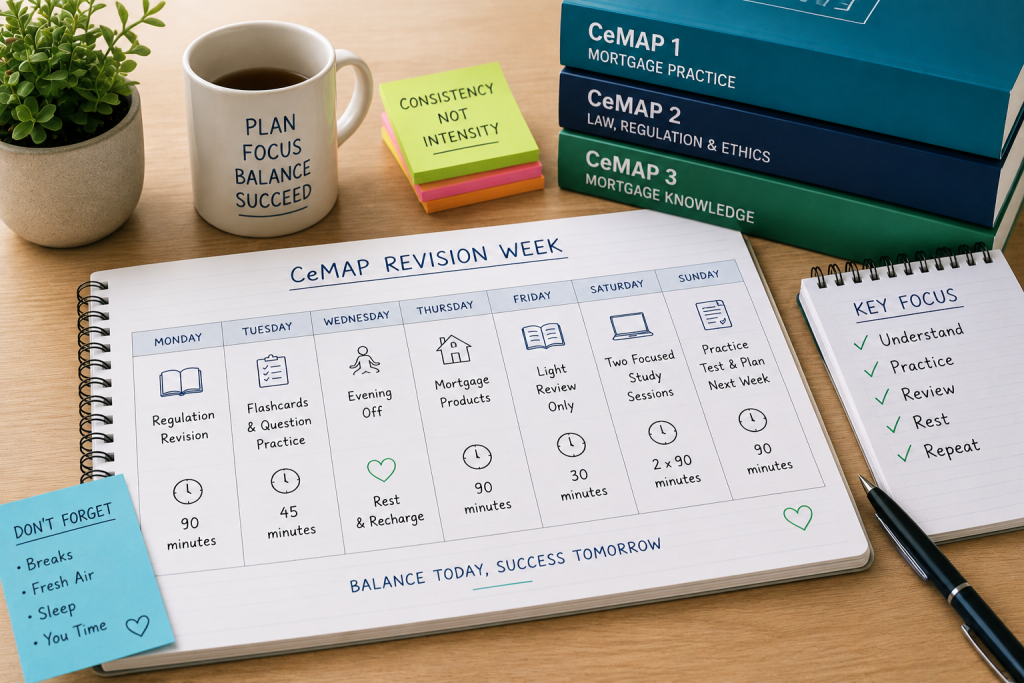
What Does a Balanced CeMAP Revision Week Look Like?
A practical study schedule might look like this:
- Monday: 90 minutes of regulation revision
- Tuesday: 45 minutes of flashcards and question practice
- Wednesday: Evening off
- Thursday: 90 minutes on mortgage products
- Friday: Light review only
- Saturday: Two focused study sessions
- Sunday: Practice test and planning for the next week
This approach keeps progress steady without overwhelming you.
How to Know When You Need a Break
Sometimes the most productive decision is to stop studying for the day.
Consider taking a break if:
- You keep rereading the same section
- Practice scores are falling because of careless mistakes
- You feel unusually frustrated
- Your concentration has disappeared
A short pause can restore focus and make your next session more effective.
How to Stay Motivated During CeMAP Revision
Motivation is easier to maintain when your study plan feels realistic.
Track Small Wins
Keep a record of completed topics and practice scores.
Seeing progress builds confidence.
Focus on Consistency
Studying regularly matters more than occasional intense efforts.
Remember Your Goal
CeMAP is the qualification that meets the educational requirement to give mortgage advice in the UK. Keeping that goal in mind can help you stay committed.
Accept Imperfect Days
Some sessions will be more productive than others. That is completely normal.
Should You Revise Every Day?
Not necessarily.
Daily study works well for some learners, but others benefit from planned evenings off.
What matters most is maintaining a routine you can sustain over several months.
If studying every day leaves you exhausted, reducing the frequency may improve your overall results.
Is Taking a Break Before the Exam a Good Idea?
Yes. Many learners find it helpful to scale back the day before the exam.
A light review of key notes and formulas is usually more useful than cramming late into the evening.
Arriving rested and clear-headed is often the best preparation.
Practical Tips for Sustainable Revision
To keep your CeMAP revision manageable:
- Plan weekly study goals
- Use practice questions regularly
- Keep sessions focused
- Take regular breaks
- Schedule time away from study
- Review progress weekly
- Adjust your timetable when needed
Small changes can make revision feel much more sustainable.
Final Thoughts
You can over-revise for CeMAP, and when that happens, studying becomes less effective.
Burnout is usually caused by long hours, unrealistic expectations, and too little rest. Warning signs include poor concentration, irritability, and a drop in motivation.
The most effective revision strategy is one you can maintain consistently. Focus on short, purposeful study sessions, active learning, and regular breaks.
CeMAP is challenging, but it does not require you to study every waking hour. A balanced approach will help you retain more information and feel better prepared when exam day arrives.
Looking for training support?
We offer CeMAP training for learners working towards a career in mortgage advice. Our courses follow the London Institute of Banking & Finance syllabus and are designed to support understanding of mortgage regulation and advice requirements.
Explore our accredited CeMAP training courses
> Futuretrend Financial Training