
Can you study CeMAP cheaply?
Yes, you can study CeMAP on a budget. But “cheap” and “effective” are not the same thing.
CeMAP is the industry standard qualification for mortgage advisers in the UK. It is awarded by the London Institute of Banking & Finance and meets the Financial Conduct Authority’s education requirements for giving mortgage advice.
You can reduce costs by choosing self-study options, spreading payments, and avoiding unnecessary extras. However, cutting too far can leave you without the structure, support, or resources needed to pass your exams.
A low-cost route works best when it is planned carefully. The aim is not to spend as little as possible, but to spend in a way that supports your chances of passing.
What are the main costs when studying CeMAP?
The main costs come down to how you prepare rather than the qualification itself.
Most learners will need to budget for:
- Study materials (books, online content, question banks)
- Exam fees
- Tuition or support (if included)
- Access to materials over time
Exam fees are fixed, so your decisions sit around study resources and support.
A simple way to think about it:
- Exams are unavoidable
- Materials are essential
- Support is optional but often useful
If you remove something to reduce cost, you should be clear about what impact that has on your learning.
Where can you realistically save money?
You can reduce costs without harming your chances, but it needs to be done carefully.
Self-study instead of classroom learning
Self-study is usually the most affordable route. You avoid the cost of in-person training while still covering the same syllabus.
This works well if you:
- Are comfortable studying independently
- Can stay organised without external pressure
- Prefer working at your own pace

Flexible payment options
Some providers offer instalment plans. This does not reduce the total cost, but it can make it easier to manage.
Choosing the right level of support
Not everyone needs full tutor support. Some learners only need:
- Structured materials
- Practice questions
- Clear exam guidance
Paying for support you will not use adds unnecessary cost. But removing support entirely can slow you down.
The right balance depends on how you learn.
Where do learners make false savings?
This is where budget decisions can backfire.
Trying to spend as little as possible often leads to choices that cost more later.
Choosing the cheapest option without checking quality
Low-cost materials can lack:
- Clear explanations
- A mix of learning formats (for example, text only with no variation)
- Up-to-date content
- Exam-style practice questions
If the material is difficult to follow, you may end up replacing it.

Limited access to resources
Some options restrict how long you can access materials.
If your access ends before you are ready, you may need to pay again.
Life can easily disrupt study plans, so access time matters more than many expect. Many learners take several months to complete CeMAP when studying alongside other commitments.
No structured learning plan
Without structure, learners often:
- Jump between topics
- Miss key areas
- Delay revision
This increases the risk of failing exams, which adds cost.
No support when you get stuck
Even confident learners come across difficult topics.
Without any support, progress can slow or stop completely.
Saving money upfront can lead to longer study time and extra exam fees.
Why does cheaper not always mean better value?
Lower cost does not always mean better value.
Value comes from how well the materials and support help you pass.
A cheaper option may lack:
- Clear guidance
- Practice materials
- Ongoing access
This can make studying harder and slower.
A slightly higher-cost option that includes structure and better resources can reduce:
- Study time
- Stress
- Risk of resits
In that sense, it can be better value overall.
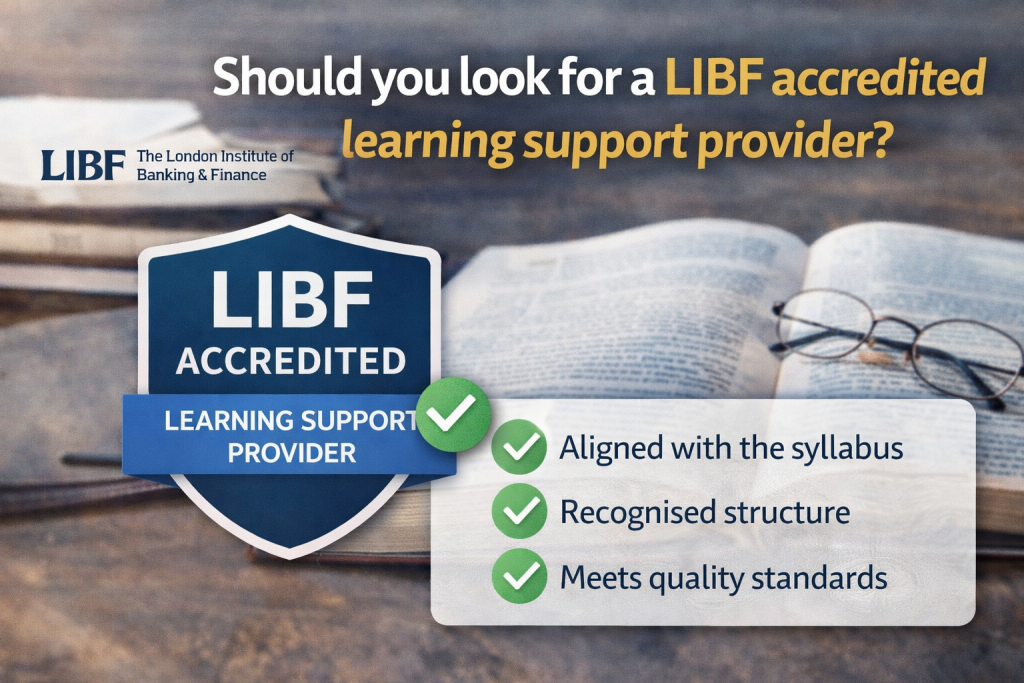
Should you look for a LIBF accredited learning support provider?
Yes, this can be a useful way to assess quality.
An Accredited CeMAP Learning Support Provider by The London Institute of Banking & Finance has had its learning support reviewed against specific standards.
This does not guarantee success, but it suggests:
- Materials are aligned to the syllabus
- The structure supports learning
- The provider meets recognised standards
Be careful with wording.
Some providers may say they offer “CeMAP training” or describe themselves as “qualified”, but that is not the same as being LIBF accredited.
If accreditation matters to you, check:
- The exact wording used
- Whether official accreditation is clearly stated
This helps reduce the risk of choosing poor-quality resources.
How do you choose resources that match your learning style?
Your budget should not ignore how you learn best.
Ask yourself:
- Do I prefer reading, watching, or practising questions?
- Do I need structure or can I organise my own study?
- How much support will I realistically use?
For example:
- Visual learners may benefit from video-based content
- Independent learners may prefer written materials and question banks
- Some learners need tutor access to stay on track
Choosing a cheaper option that does not suit your learning style often leads to delays.
A better approach is to balance affordability with usability.
How long should you have access to your materials?
Access duration should match your realistic study timeline.
If you are studying alongside work or other commitments, you may need longer than expected.
Short access periods can create pressure and lead to rushed exam attempts.
When comparing options, check:
- How long materials are available
- Whether extensions are possible
- What happens if your timeline changes
Paying slightly more for longer access can prevent having to repurchase materials.
How can you plan your CeMAP study budget realistically?
A simple plan can help you stay in control of costs.
Step 1: Set a total budget
Decide what you can afford without creating pressure.
Step 2: Prioritise essentials
Focus on:
- Reliable study materials
- Exam fees
- Access duration
Step 3: Add support where needed
Only include support you will actually use.
Step 4: Allow for flexibility
Leave room for:
- Extra time
- Possible resits
- Additional resources if needed
This reduces the risk of unexpected costs.

Are there balanced options for studying on a budget?
Some providers offer home study options designed to balance cost and support.
Structured home study packages with instalment options can make learning more accessible without requiring a large upfront payment.
Futuretrend’s CeMAP home study options are one example where learners can spread costs while still having structured materials.
The key point is the approach rather than the provider:
- Structured learning
- Manageable payments
- Sufficient access time
These features support learners without removing important elements.
What is the biggest mistake when studying CeMAP on a budget?
The biggest mistake is focusing only on price.
When cost becomes the main decision factor, learners often:
- Choose unsuitable materials
- Underestimate study time
- Lack support when needed
This can lead to delays, resits, and higher overall costs.
A better question to ask is:
What gives me the best chance of passing efficiently?
Final thoughts: balancing cost and your chances of success
Studying CeMAP on a budget is entirely possible.
Many learners take this route successfully, but it works best when decisions are balanced.
Keep in mind:
- Lower-cost options can work if they are structured
- Accreditation can help indicate quality
- Access time matters
- Your learning style should guide your choice
Avoid decisions that seem cheaper now but create problems later.
A steady, well-planned approach is often the most cost-effective in the long run.
Looking for training support?
We offer CeMAP training for learners working towards a career in mortgage advice. Our courses follow the London Institute of Banking & Finance syllabus and are designed to support understanding of mortgage regulation and advice requirements.
Explore our accredited CeMAP training courses
> Futuretrend Financial Training