Why CeMAP 3 Is About Judgement, Not Trick Questions

CeMAP 3 judgement based exam graphic asking “Is CeMAP 3 full of trick questions?

Many learners approaching CeMAP 3 ask the same thing:

“Is CeMAP 3 full of trick questions?”

The short answer is no.

CeMAP 3 is not designed to trick you. It is designed to assess judgement.

Understanding that distinction changes how the synoptic module feels. It shifts the focus away from hunting for traps and towards understanding what the assessment is really measuring.

CeMAP 3 judgement based exam graphic asking “Is CeMAP 3 full of trick questions?

What Is CeMAP 3 and What Is It Designed to Test?

CeMAP 3 is the final module of the Certificate in Mortgage Advice and Practice, awarded by the London Institute of Banking & Finance.

It is a synoptic assessment, meaning it brings together knowledge from earlier modules and tests how well you can apply it.

CeMAP as a qualification meets the education requirements set by the Financial Conduct Authority for those who wish to give mortgage advice in the UK. However, meeting education requirements is not the same as memorising rules. Advisers must demonstrate the ability to make appropriate, suitable recommendations.

CeMAP 3 exists to assess that ability.

It does not test whether you can recall isolated facts.
It tests whether you can use knowledge responsibly.

Is CeMAP 3 Full of Trick Questions?

No. CeMAP 3 is not written to mislead candidates.

What sometimes feels like a trick question is usually a question that requires:

  • Careful reading
  • Balanced thinking
  • An understanding of suitability
  • The ability to distinguish between “possible” and “appropriate”

When learners expect factual recall and instead face judgement-based scenarios, it can feel uncomfortable. That discomfort is often mistaken for trickery.

But the assessment is not trying to catch you out. It is checking whether you can think like a mortgage adviser.

What Does “Judgement-Based Assessment” Actually Mean?

A judgement-based assessment tests your ability to:

  • Interpret client information
  • Weigh up competing factors
  • Recognise risks
  • Identify what is most suitable in context

In real life, mortgage advice is rarely about one clear rule. Two products may technically fit a client’s circumstances. One may be more suitable based on risk tolerance, long-term plans, income stability, or regulatory considerations.

CeMAP 3 reflects that reality.

Judgement-based assessment means:

You are being tested on decision quality, not memory.

This is very different from modules that focus more heavily on definitions, regulation, or standalone knowledge areas.
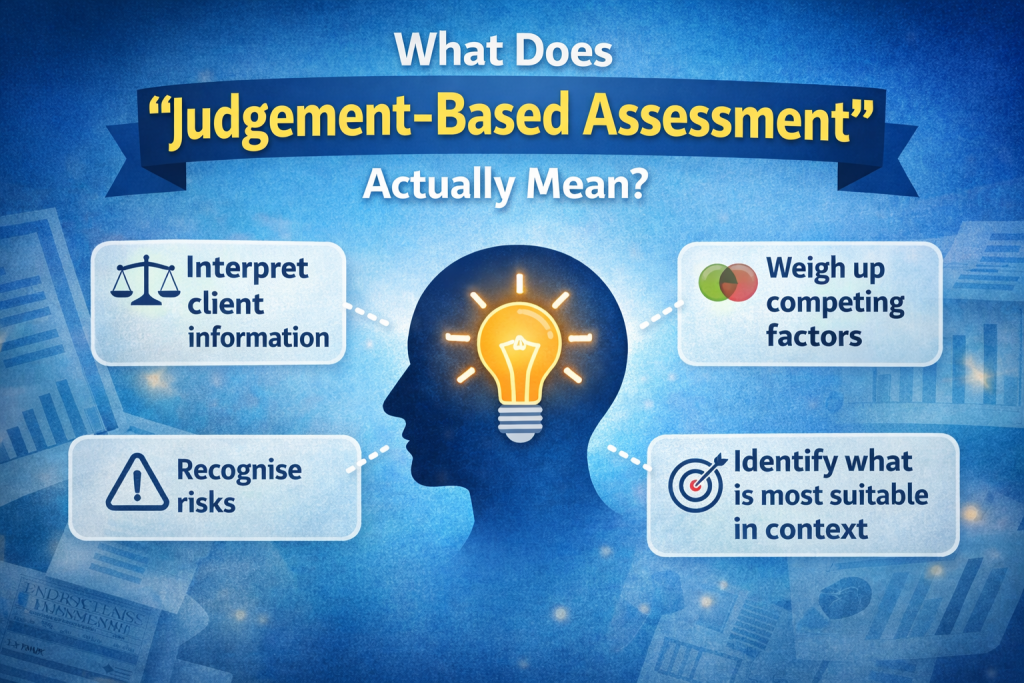
Graphic explaining what judgement-based assessment means in CeMAP 3 synoptic exam

Why Does CeMAP 3 Feel Harder Than Earlier Modules?

Some learners find CeMAP 3 more demanding because it changes the type of thinking required.

Earlier modules such as Financial Services Regulation and Ethics focus more clearly on defined rules, frameworks and principles. There is often a right answer based on regulation.

CeMAP 3 moves into applied suitability.

Instead of asking:

What is the rule?

It is effectively asking:

What would be the most appropriate course of action for this client?

That shift can feel unsettling. There is often more than one answer that looks reasonable at first glance. The task is to identify the most suitable option based on the client’s full circumstances.

That is not a trick. It is professional judgement.

Why Suitability Thinking Is Central to CeMAP 3

Suitability is the foundation of regulated mortgage advice.

A mortgage adviser must recommend products that are appropriate for the client’s needs, objectives and financial situation. This includes:

  • Affordability
  • Risk
  • Term length
  • Repayment method
  • Future plans
  • Protection considerations

CeMAP 3 assesses whether you understand how these pieces fit together.

It is not enough to know what an interest-only mortgage is. You must recognise when it may or may not be suitable.

It is not enough to know what a fixed rate does. You must consider whether stability or flexibility better matches a client’s situation.

That is the essence of judgement.
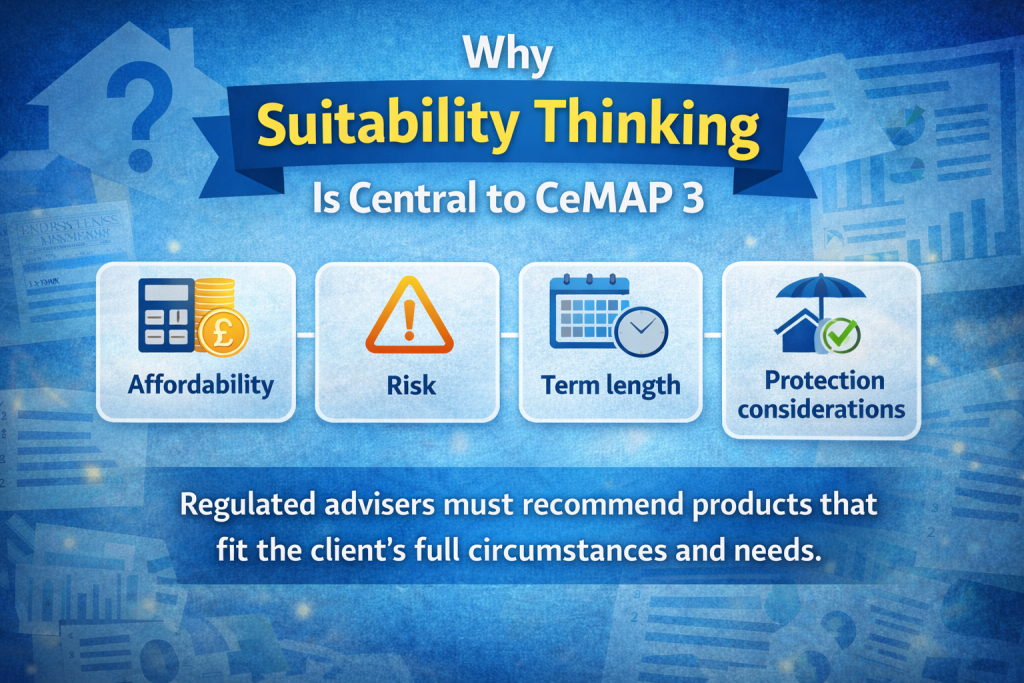
Why suitability thinking is central to CeMAP 3 synoptic mortgage exam

Why Learners Sometimes Assume There Are Trick Questions

There are a few common reasons why the “trick question” myth persists.

1. Confidence drops when answers are less obvious

In knowledge-based modules, you may feel more certain. You either know the rule or you do not.

In CeMAP 3, two options can appear plausible. Choosing between them requires deeper evaluation. That uncertainty can feel like a trap, even when it is not.

2. Over-reliance on memorisation

If preparation has focused heavily on memorising facts without understanding how they interact, the synoptic paper can feel unfamiliar.

CeMAP 3 rewards understanding. Pure recall is rarely enough.

3. Expecting hidden wording tricks

Some candidates assume questions are deliberately written to mislead. In reality, professional exam bodies design assessments to be fair, consistent and aligned to learning outcomes.

The aim is to measure competence, not to reduce pass rates.

How Does CeMAP 3 Reflect Real-World Advice?

Mortgage advice is not theoretical.

Advisers gather information, assess risk, consider lender criteria, and recommend solutions that are in the client’s best interests.

Real clients do not present in neat textbook scenarios. They have mixed priorities, imperfect finances and changing plans.

CeMAP 3 mirrors that environment in a structured way.

It tests whether you can:

  • Identify relevant facts
  • Filter out less relevant details
  • Prioritise client needs
  • Recognise potential risks
  • Apply regulatory principles

This is not about spotting tricks. It is about showing that you can think responsibly.
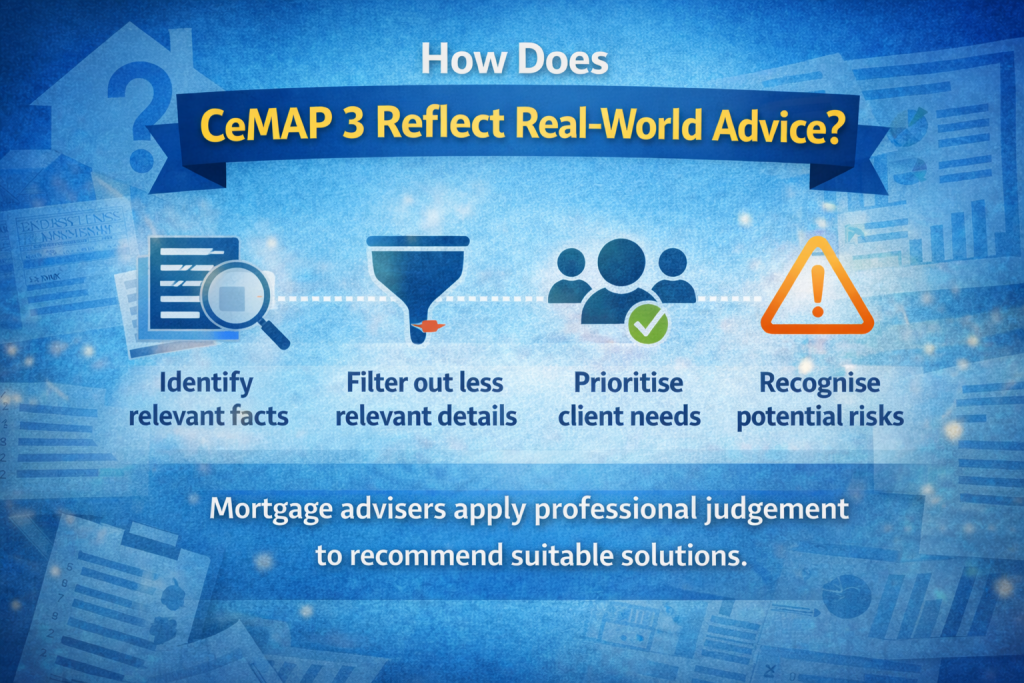
How CeMAP 3 reflects real world mortgage advice and professional judgement

Does CeMAP 3 Try to Catch You Out?

No. Professional awarding bodies design synoptic assessments to ensure consistency and fairness.

The purpose of CeMAP 3 is to confirm that a candidate:

  • Understands core mortgage knowledge
  • Can apply that knowledge appropriately
  • Can recognise suitable and unsuitable recommendations
  • Understands ethical responsibility

If a question feels difficult, it is usually because it requires careful evaluation of all the information provided.

Difficulty does not equal deception.

Why Judgement Matters More Than Perfect Recall

In regulated financial services, correct judgement protects:

  • The client
  • The firm
  • The adviser

Regulation exists to ensure consumers receive appropriate advice. The Financial Conduct Authority sets standards to ensure fair treatment of customers. Education standards, including CeMAP, exist to support that framework.

A qualification that only tested memory would not be enough.

CeMAP 3 therefore assesses whether you can:

  • Balance competing priorities
  • Recognise unsuitable risks
  • Understand long-term consequences
  • Apply ethical principles

That is why the exam focuses on judgement.

What Is the Real Purpose of the Synoptic Module?

The word “synoptic” simply means it draws together knowledge from across the qualification.

CeMAP 3 is not a new subject. It is the integration of everything learned earlier.

Its purpose is to confirm that you can:

  • Combine regulatory understanding
  • Apply product knowledge
  • Interpret client information
  • Make appropriate decisions

It is a bridge between theory and professional practice.

What is the real purpose of the CeMAP 3 synoptic module

Should You Be Worried About Hidden Tricks?

There is no evidence that CeMAP 3 is designed around hidden traps or deceptive wording.

What it does require is:

  • Careful reading
  • Structured thinking
  • Calm evaluation

If something feels like a trick, pause and ask:

Is this testing my knowledge of a rule, or my judgement about suitability?

Most often, it is the latter.

Understanding that reduces anxiety.

A Clear Answer: Is CeMAP 3 Full of Trick Questions?

No.

CeMAP 3 is not built around trick questions. It is built around professional judgement.

It assesses your ability to think like a mortgage adviser. It checks whether you can apply knowledge responsibly, ethically and appropriately.

When learners reframe the exam as a judgement assessment rather than a memory test, it becomes clearer why the questions are structured the way they are.

Final Thoughts: Reframing How You View CeMAP 3

CeMAP 3 often feels different because it asks you to think differently.

It moves from:

“What is the correct definition?”

to

“What is the most suitable outcome for this client?”

That shift is deliberate.

The mortgage advice profession relies on good judgement. The synoptic module exists to reflect that responsibility.

If you approach CeMAP 3 expecting tricks, you may see complexity as deception.
If you approach it expecting judgement, the structure begins to make sense.

CeMAP 3 is not trying to catch you out.
It is asking whether you are ready to think like an adviser.

Looking for training support?

We offer CeMAP training for learners working towards a career in mortgage advice. Our courses follow the London Institute of Banking & Finance syllabus and are designed to support understanding of mortgage regulation and advice requirements.

Explore our accredited CeMAP training courses

> Futuretrend Financial Training 
The Most Common CeMAP Exam Mistakes and How to Avoid Them

CeMAP exam mistakes illustration showing a multiple-choice answer sheet, clock and warning icons representing common errors in CeMAP 1, 2 and 3 exams.

Preparing for CeMAP can feel demanding, especially when you know the exams are designed to test understanding rather than memory alone. Over the years, certain patterns appear again and again. Not because learners lack ability, but because professional exams work differently from school or university assessments.

CeMAP is the industry standard mortgage advice qualification in the UK. It is awarded by the London Institute of Banking & Finance and meets the Financial Conduct Authority’s education requirements for giving regulated mortgage advice. The 2025/26 syllabus structure includes:

CeMAP exam mistakes illustration showing a multiple-choice answer sheet, clock and warning icons representing common errors in CeMAP 1, 2 and 3 exams.

All modules are assessed by computer-based multiple-choice exams, with CeMAP 3 built around case-study style assessment.

The most common mistakes in CeMAP exams are not usually about intelligence. They tend to be about interpretation, behaviour under pressure, and preparation habits.

Below are the errors seen most often and the reasons behind them.

Misunderstanding What Questions Are Really Asking

One of the most common CeMAP exam mistakes is answering the question you think is being asked rather than the one on the screen.

CeMAP questions are carefully written to test application of knowledge. This is especially true in CeMAP 2 and CeMAP 3 under the 2025/26 structure. Questions often include small details that change the correct answer.

Why does this happen?

Many learners revise topics in isolation. They understand definitions and concepts but are less confident when those ideas are placed into a practical scenario.

In CeMAP 1 (Financial Services Regulation and Ethics), for example, a question may test understanding of regulatory principles in context rather than simply asking for a definition. In CeMAP 3, the case study may include several facts, but only some are relevant to the question being asked.

When pressure builds, the brain looks for familiar words. If you spot a keyword you recognise, it is tempting to choose the answer that matches that keyword without fully analysing the scenario.

What reduces this mistake?

Awareness helps. Understanding that CeMAP questions are written to assess interpretation encourages slower, more deliberate reading. The exam is not trying to trick you, but it does expect careful thinking.

A clear approach to revision that focuses on understanding how rules apply in practice, not just what they are, makes a significant difference.

Rushing Through Questions Too Quickly

Another frequent issue is rushing.

CeMAP exams are timed, and seeing a countdown clock can make learners anxious. That anxiety often leads to speeding up unnecessarily, especially in the earlier part of the exam.

Why rushing causes problems

When learners rush:

  • Important words are missed, such as most appropriate, first step, or except
  • Details in case studies are overlooked
  • Answers are selected without full evaluation

In CeMAP 3 particularly, case-study questions require steady concentration. Skimming the background information can lead to incorrect assumptions about the client’s circumstances.

The irony is that many learners actually have enough time but lose marks through avoidable reading errors.

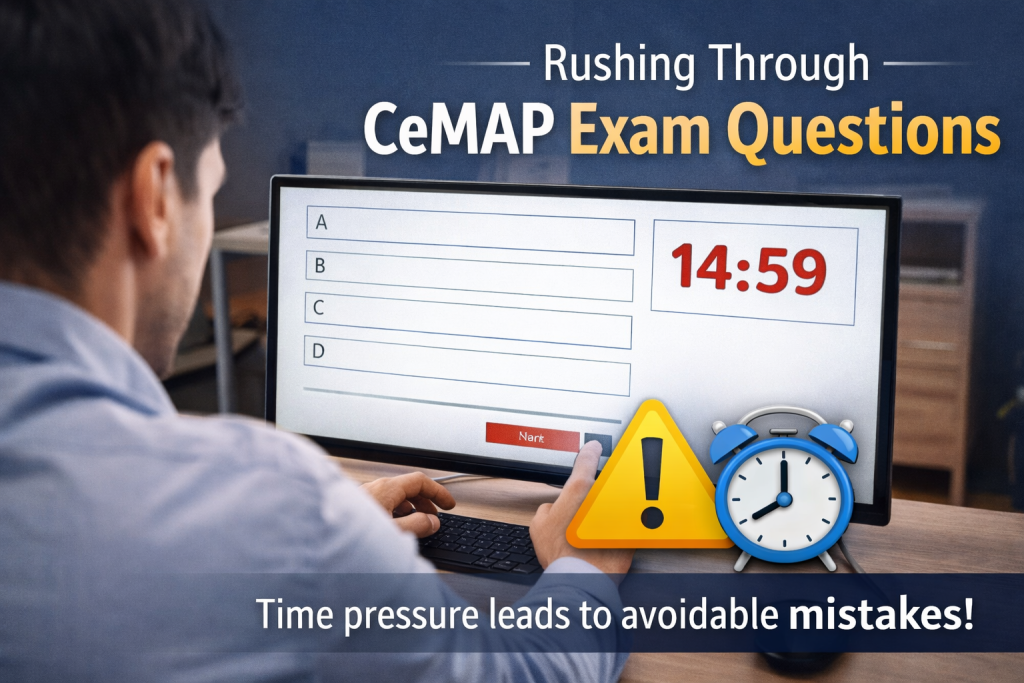
Learner rushing through a computer-based CeMAP multiple-choice exam with a countdown timer visible, illustrating time pressure and avoidable mistakes.

What helps prevent rushing?

Understanding the structure of the exam beforehand helps reduce panic. All CeMAP modules follow a consistent multiple-choice format, delivered on demand at approved test centres.

Recognising that the exam is designed to test professional judgement, not speed, encourages a calmer pace. Confidence comes from familiarity with the format rather than trying to “beat the clock”.

Second-Guessing Correct Answers

Second-guessing is another common behavioural pattern.

A learner selects an answer, feels uncertain, changes it, and later discovers their first instinct was correct.

Why does second-guessing happen?

Professional exams feel high stakes. That pressure can create doubt, even when knowledge is solid.

In CeMAP 1 (FSRE), for example, learners sometimes overcomplicate straightforward regulatory questions because they assume there must be a hidden twist. In CeMAP 2, they may question their understanding of mortgage product features even when they know the core principle.

This habit is often linked to lack of confidence rather than lack of preparation.

Learner hesitating over a multiple-choice CeMAP exam question on a computer screen, illustrating second-guessing correct answers.

How can it be reduced?

Stronger conceptual understanding reduces doubt. When learners know why an answer is correct, rather than simply remembering it, they are less likely to change it unnecessarily.

Confidence grows from structured preparation and repeated exposure to exam-style thinking, not from blind optimism.

Poor Preparation Habits

Some mistakes originate long before exam day.

Preparation habits have a direct impact on performance, and certain patterns regularly lead to avoidable errors.

Relying on memorisation alone

CeMAP is not designed as a memory test. Especially under the updated 2025/26 syllabus, the focus is on understanding regulatory principles, mortgage structures, and suitability.

Memorising lists without understanding how they apply can lead to confusion when questions are scenario-based.

Ignoring weaker topics

It is natural to prefer revising areas you already understand. However, CeMAP exams draw from across the syllabus.

In CeMAP 2, for instance, learners sometimes avoid complex areas such as repayment methods or specialist lending because they feel technical. In CeMAP 1, ethics and conduct topics may be underestimated because they appear straightforward at first glance.

Weak areas rarely disappear on exam day.

Learner surrounded by open books and notes looking tired while revising for a CeMAP exam, representing poor preparation habits.

Leaving preparation too late

Compressed revision often increases stress and reduces comprehension. Professional exams require mental stamina as well as knowledge.

Preparation spread over time supports deeper understanding and reduces last-minute panic.

Misunderstanding the Level of Application Required

Another recurring issue is misunderstanding how applied the questions can be.

CeMAP 3, in particular, tests the ability to assess mortgage advice knowledge within a client scenario. It assumes familiarity with the technical content from CeMAP 2 and the regulatory framework from CeMAP 1.

Learners sometimes prepare for modules in isolation without recognising how they link together.

CeMAP as a qualification is structured progressively:

  • CeMAP 1 builds regulatory and ethical foundations
  • CeMAP 2 develops technical mortgage knowledge
  • CeMAP 3 tests applied advice understanding

Seeing them as separate subjects rather than connected stages can create gaps in reasoning.

A joined-up understanding makes exam questions feel more logical and less fragmented.

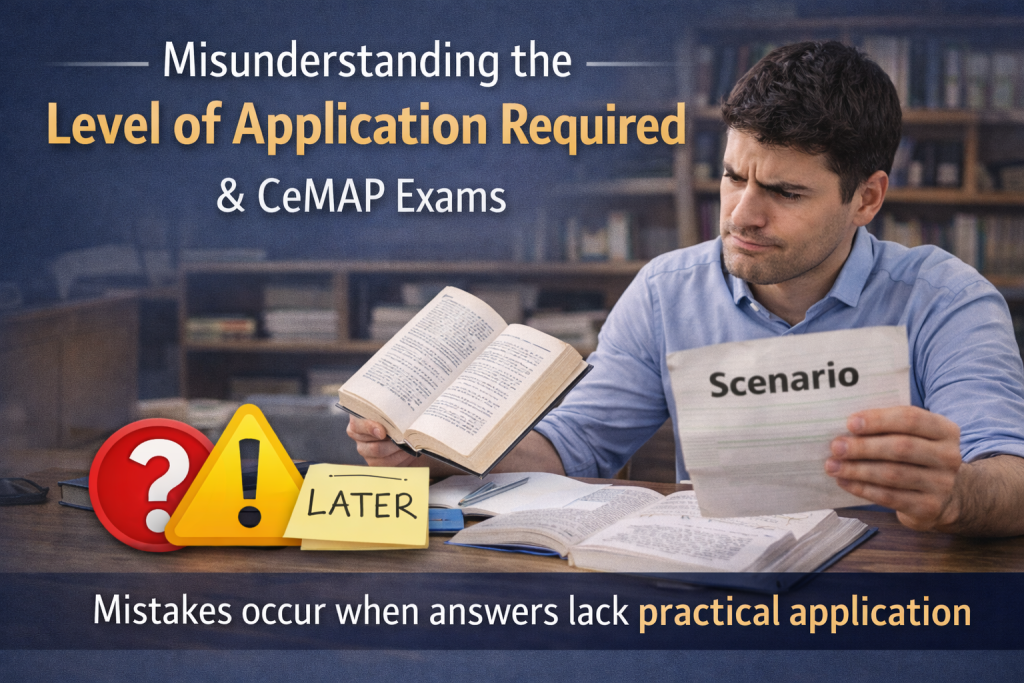
Learner comparing a textbook and a scenario sheet while revising for a CeMAP exam, illustrating misunderstanding of applied knowledge requirements.

Losing Focus During the Exam

Mental fatigue is another underestimated factor.

Even though each CeMAP module is manageable in length, sustained concentration is required. Small lapses in focus can lead to avoidable errors, especially toward the end of an exam.

Common focus-related mistakes include:

  • Clicking the wrong option accidentally
  • Misreading numerical details
  • Skipping key words in longer scenarios

These errors are rarely about knowledge. They are usually about attention.

Building familiarity with exam-style material in advance helps strengthen concentration over time.

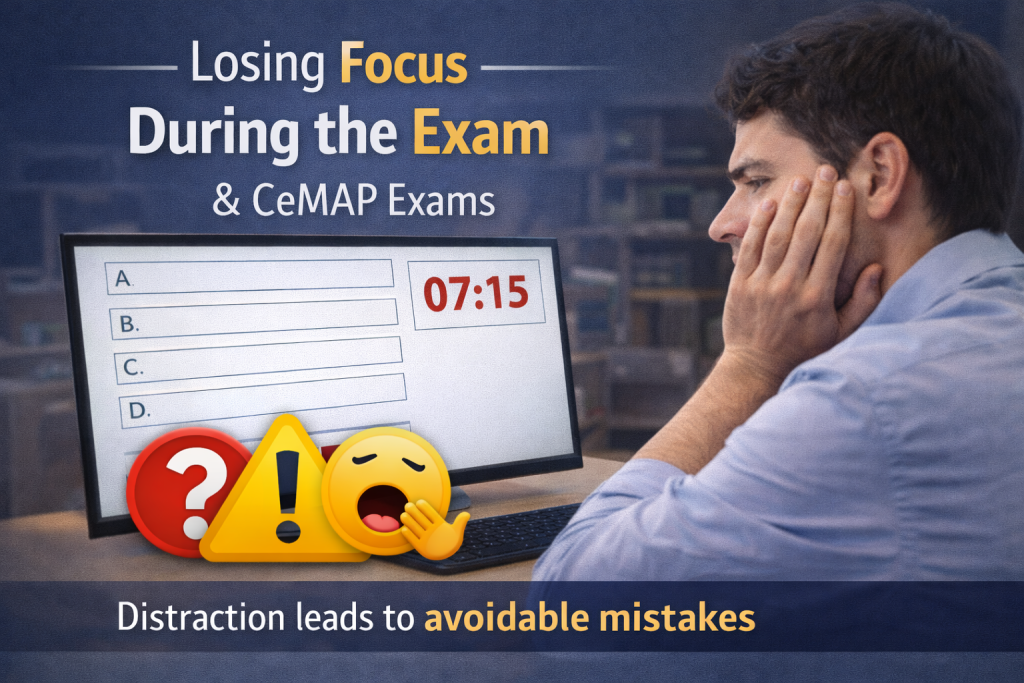
Learner appearing distracted during a computer-based CeMAP exam with a visible countdown timer, representing loss of focus.

Overcomplicating Straightforward Questions

Some learners assume every question must be complex. This can lead to adding layers of interpretation that are not required.

CeMAP exams are designed to test professional competence at the required level. Not every question contains a hidden angle.

If a question in CeMAP 1 clearly relates to a core regulatory principle, the correct answer is usually grounded in that principle rather than in an obscure exception.

Clarity often beats over-analysis.

How Does Awareness Reduce CeMAP Exam Mistakes?

Understanding common patterns changes how learners approach preparation.

When you know that:

  • Questions test application, not just recall
  • Reading carefully matters more than speed
  • Confidence reduces second-guessing
  • Preparation habits influence performance

You start to view the exam differently.

CeMAP exams are structured assessments designed to confirm knowledge and understanding at an appropriate professional level. They are not designed to catch learners out or reward tricks.

Mistakes tend to fall into predictable categories: interpretation errors, behavioural reactions under pressure, and uneven preparation.

Recognising those categories early allows learners to adjust their approach before exam day.

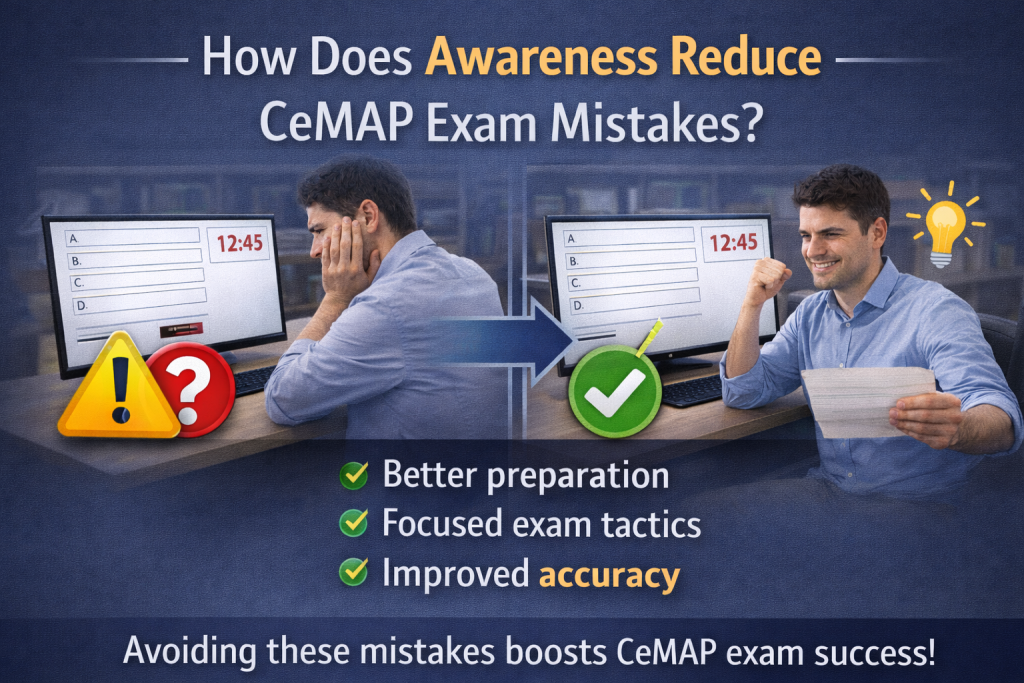
Comparison image of a stressed and then confident learner during a CeMAP exam, showing how awareness reduces common exam mistakes.

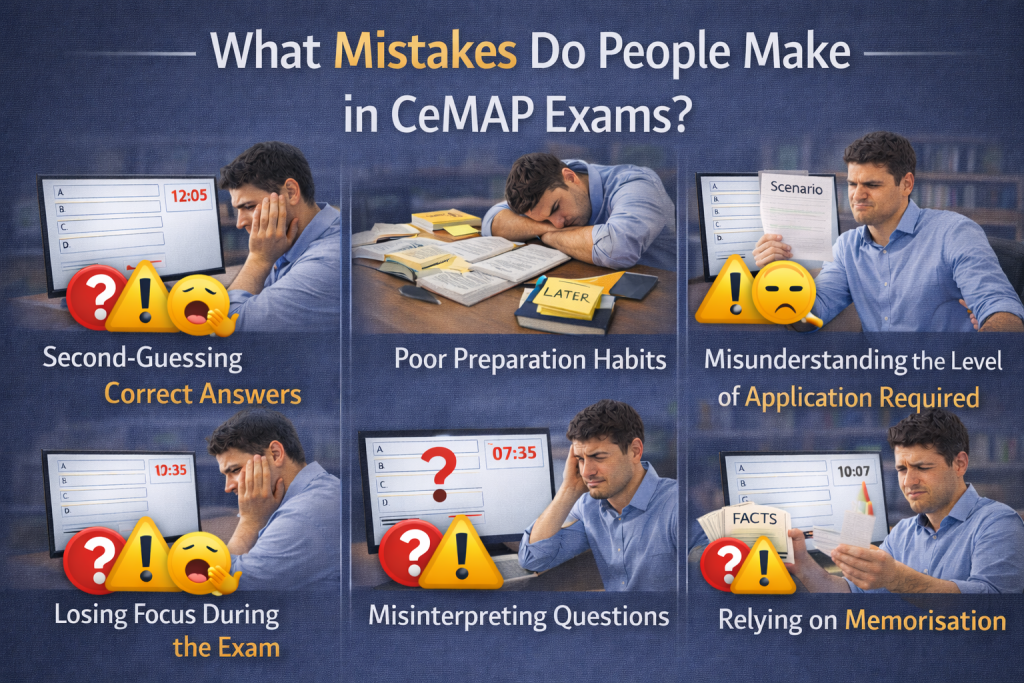
What Mistakes Do People Make in CeMAP Exams?

In summary, the most common CeMAP exam mistakes include:

  1. Misreading or misinterpreting what the question is asking
  2. Rushing due to time pressure
  3. Second-guessing correct answers
  4. Relying on memorisation without understanding
  5. Avoiding difficult topics during revision
  6. Underestimating applied, scenario-based questions
  7. Losing concentration

These patterns appear repeatedly across CeMAP 1 (Financial Services Regulation and Ethics), CeMAP 2 (Mortgages), and CeMAP 3 (Assessment of Mortgage Advice Knowledge) under the 2025/26 syllabus structure.

They are behavioural and preparation-based issues, not indicators of ability.

Infographic showing common CeMAP exam mistakes including second-guessing, poor preparation, misinterpreting questions, losing focus, and relying on memorisation.

Final Thoughts

Most CeMAP exam mistakes are avoidable once you recognise them.

The qualification, awarded by the London Institute of Banking & Finance, exists to confirm that advisers understand regulation, ethics, mortgage products, and suitability. It reflects the standards expected by the Financial Conduct Authority for those giving mortgage advice in the UK.

Approaching the exams with clarity, steady preparation, and awareness of common pitfalls reduces unnecessary errors.

No one sits a professional exam perfectly. But understanding where mistakes typically arise helps you prepare in a more informed and balanced way.

And that, more than anything else, improves your chances of walking into the exam room feeling ready rather than uncertain.

Looking for training support?

We offer CeMAP training for learners working towards a career in mortgage advice. Our courses follow the London Institute of Banking & Finance syllabus and are designed to support understanding of mortgage regulation and advice requirements.

Explore our accredited CeMAP training courses

> Futuretrend Financial Training