How Hard Are the CeMAP Exams Really and Which Module Feels Hardest?

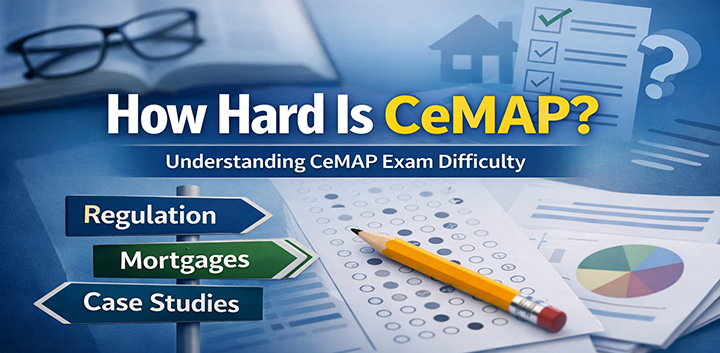
How hard is CeMAP exam graphic showing regulation, mortgages and case studies modules

Many learners ask a simple question before they begin: how hard is CeMAP?

Many learners ask a simple question before they begin: how hard is CeMAP?

The honest answer is that the CeMAP exams are academically manageable for most people, but they require structured preparation and consistent study. They are not designed to catch people out, yet they do test detailed knowledge, regulation, ethics, and the ability to apply what you have learned. For some, the exams feel straightforward. For others, they feel demanding. The difference usually comes down to preparation, familiarity with financial concepts, and confidence with multiple-choice exams.

CeMAP is the industry standard qualification for mortgage advisers in the UK. It is awarded by the London Institute of Banking & Finance and meets the Financial Conduct Authority’s education requirements for giving mortgage advice. Because it leads to a regulated profession, the exams must test knowledge and ethical understanding properly. That is why they feel serious.

This article explains why difficulty is subjective, how the modules differ under the current syllabus, and why preparation matters more than natural ability.

How hard is CeMAP exam graphic showing regulation, mortgages and case studies modules

Why Does CeMAP Feel Hard for Some People?

CeMAP often feels hard because it combines new terminology, regulation, ethics, and exam pressure.

For learners who have never worked in financial services, terms relating to regulatory frameworks, conduct rules, and ethical responsibilities can feel unfamiliar. Even core mortgage concepts such as loan-to-value ratios or different repayment structures may be new. That initial learning curve can create the impression that the qualification is harder than it actually is.

Does Previous Experience Make a Difference?

Yes, but not always in the way people expect.

Someone with experience in banking or estate agency may recognise certain mortgage concepts. That familiarity can reduce learning time in CeMAP 2. However, regulatory and ethical content in CeMAP 1 still needs to be learned carefully, regardless of background.

Learners from unrelated careers often succeed because they approach the material methodically. CeMAP does not require advanced mathematics or essay writing. It requires understanding and careful recall.

Is It an Academic Exam?

CeMAP is knowledge-based rather than essay-based. You are tested through multiple-choice questions and, in the final module, case-study style assessment. You are not required to write long answers. Instead, you must recognise the correct response from several options.

For many people, this format feels manageable. For others, multiple-choice exams create uncertainty because more than one answer can appear reasonable. That is where careful reading becomes essential.

What Makes One Module Feel Harder Than Another?

CeMAP is structured in three modules. Each feels challenging for different reasons.

The modules are designed to build on each other. They do not test identical skills, so difficulty can feel different at each stage.

Under the updated 2025/26 syllabus, the modules are:

  • CeMAP 1: Financial Services Regulation and Ethics (FSRE)

  • CeMAP 2: Mortgages

  • CeMAP 3: Assessment of Mortgage Advice

The content focus has shifted slightly in CeMAP 1, and that affects how learners experience the difficulty.

CeMAP 1: Financial Services Regulation and Ethics (FSRE)

CeMAP 1 focuses on financial services regulation and ethical standards.

It covers the UK regulatory framework, the role of the Financial Conduct Authority, principles of conduct, consumer protection, and ethical responsibilities within financial services. Mortgage knowledge is still included, but the emphasis is on regulation and professional standards.

Many learners find this module challenging because of the volume of detailed definitions and the precision required in understanding regulatory language. The difficulty lies in accuracy rather than complexity.

For those new to financial services, this can feel abstract at first. Once the structure of regulation and ethical principles becomes clear, it tends to feel more logical.

CeMAP 2: Mortgages

CeMAP 2 concentrates on mortgage products and how they operate in practice.

This includes repayment methods, interest types, property considerations, underwriting factors, and different lending scenarios. The subject matter is more product-focused and practical.

Learners who prefer tangible examples sometimes find this module easier because they can visualise how mortgages work. Others find it demanding because of the range of product knowledge required.

The challenge is applying knowledge accurately rather than memorising rules alone.

CeMAP 3: Assessment of Mortgage Advice

CeMAP 3 assesses your ability to apply knowledge in realistic client situations.

It uses case-study style questions to test whether you can identify suitable advice within regulatory and ethical boundaries. It draws directly from content covered in both CeMAP 1 and CeMAP 2.

Some learners find this the hardest module because it requires judgement and careful interpretation of client information. Others find it more intuitive because it mirrors real mortgage advice scenarios.

The perception depends on whether you feel more comfortable recalling structured rules or applying them in context.

Is There a “Hardest” CeMAP Module?

There is no single hardest CeMAP module for everyone.

Some learners say CeMAP 1 feels hardest because of the regulatory and ethical detail. Others say CeMAP 3 feels hardest because of the case-study format. The perception usually reflects personal strengths and learning style.

If you prefer structured theory and definitions, CeMAP 1 may feel manageable.

If you prefer product knowledge, CeMAP 2 may feel more straightforward.

If you prefer applied scenarios, CeMAP 3 may feel more natural.

The qualification is designed to test competence across regulation, ethics, product knowledge, and advice skills. It is not structured so that one module is deliberately more difficult than another.
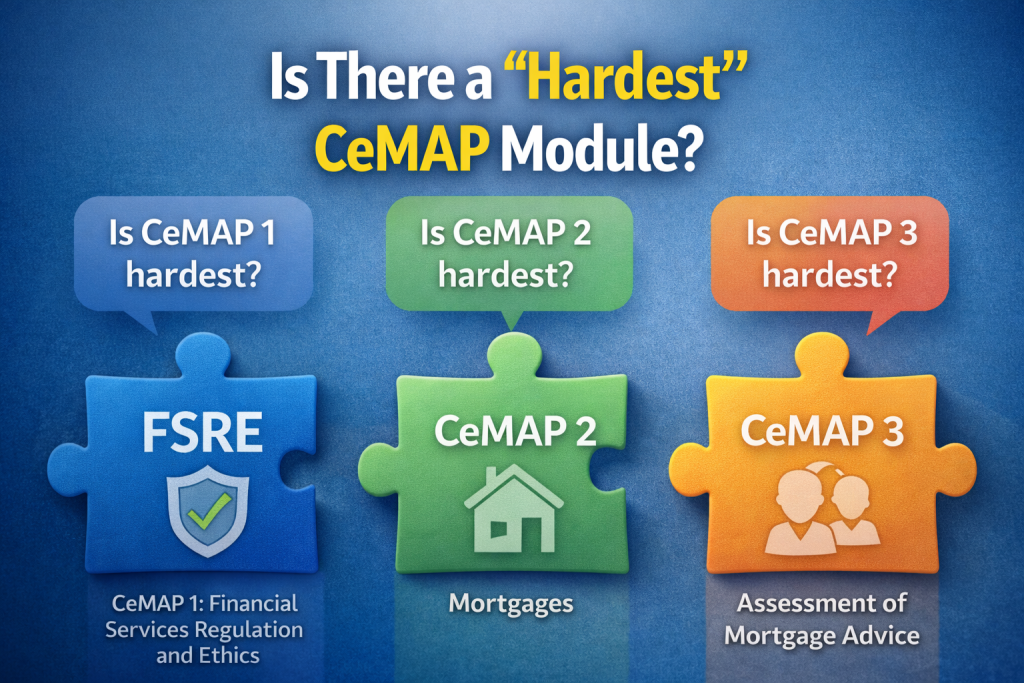
Is there a hardest CeMAP module graphic showing CeMAP 1 FSRE, CeMAP 2 Mortgages and CeMAP 3 Assessment of Mortgage Advice

How Hard Is CeMAP Compared to Other Qualifications?

CeMAP sits at Level 3 on the Regulated Qualifications Framework. This is broadly comparable to A-level standard in terms of academic level.

Most learners taking CeMAP are adults balancing work and other commitments. Time management and consistent study usually matter more than academic background.

CeMAP does not require advanced mathematics. Calculations are limited and practical. The main requirement is understanding regulation, ethics, and mortgage structures clearly.

Does the Pass Mark Mean It Is Difficult?

The pass mark reflects the standard required to meet regulatory expectations, not an attempt to make the exam difficult.

Because mortgage advice is a regulated activity, the Financial Conduct Authority expects advisers to demonstrate knowledge and ethical awareness before giving advice to clients. The exams are structured to confirm that standard.

They are not designed to reduce pass numbers. They are designed to confirm competence.

What Actually Makes CeMAP Manageable?

Preparation makes CeMAP manageable.

Most learners who initially feel that CeMAP is hard change their view once they understand the structure and style of questioning.

Structured Study

Breaking the syllabus into manageable sections prevents overwhelm. CeMAP content can appear large when viewed as a whole. Studied in stages, it becomes clearer.

Practice Questions

Becoming comfortable with multiple-choice questions changes how difficult the exam feels. Practice helps you recognise how questions are framed and how distractor answers are constructed.

Consistency Over Intensity

Short, regular study sessions are often more effective than occasional long sessions. The knowledge builds logically across the three modules.
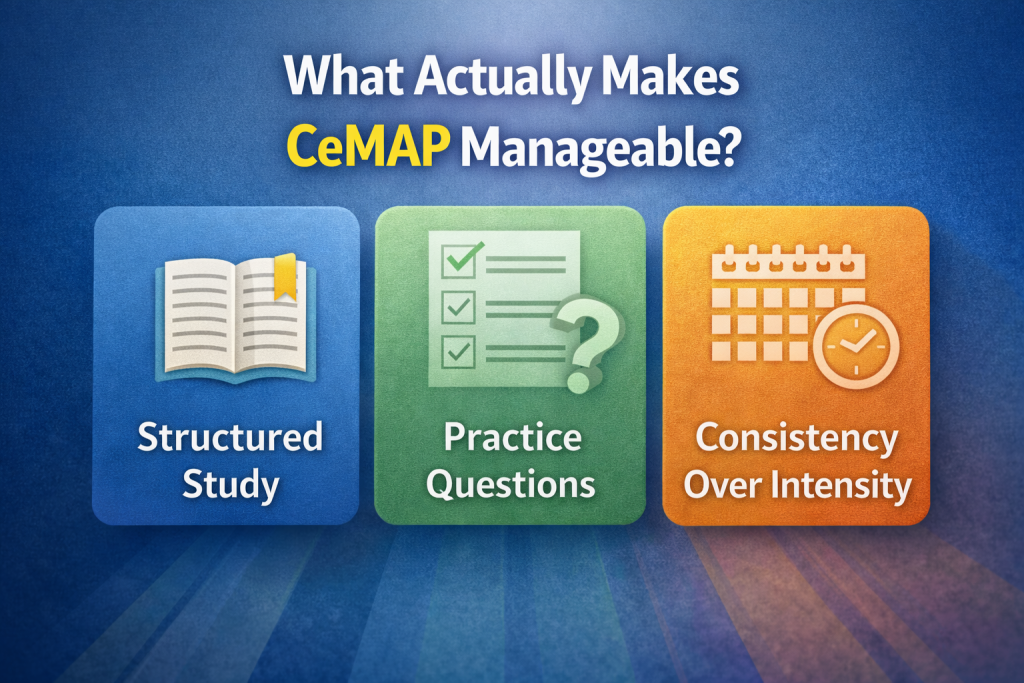
What makes CeMAP manageable illustration showing structured study, practice questions and consistent revision

Does Intelligence Determine Success in CeMAP?

CeMAP does not require exceptional academic ability.

Success is usually linked to preparation, organisation, and attention to detail. Learners from a wide range of educational backgrounds complete the qualification each year.

The exams test understanding of regulation, ethics, and mortgage practice. Being methodical often matters more than being naturally academic.

Why Do Some Learners Feel Overwhelmed at the Start?

CeMAP introduces a regulated and ethically structured environment with precise terminology. That can feel unfamiliar.

Regulation and ethics require careful wording. Small differences in phrasing can change meaning. This can create early frustration, particularly in CeMAP 1.

Once learners adjust to that precision, confidence usually improves. What feels complex at first often becomes routine with repetition.

Is Exam Anxiety Making CeMAP Feel Harder?

In many cases, yes.

Anxiety can amplify perceived difficulty. Learners may know the content but doubt themselves during the exam. Multiple-choice formats can increase second-guessing.

Clear preparation and familiarity with the structure reduce this effect.

How Hard Is CeMAP Really?

CeMAP is challenging but achievable.

It is not designed to trick learners, nor is it effortless. It requires understanding financial services regulation, ethical standards, mortgage products, and the application of advice principles at a professional level.

Which module feels hardest depends on individual strengths. For most learners, CeMAP feels hardest at the beginning, when everything is new. As knowledge builds, confidence usually increases.

The key factor is not natural intelligence or prior background. It is preparation, consistency, and engagement with the material.

With realistic expectations and structured study, the CeMAP exams are demanding but manageable.
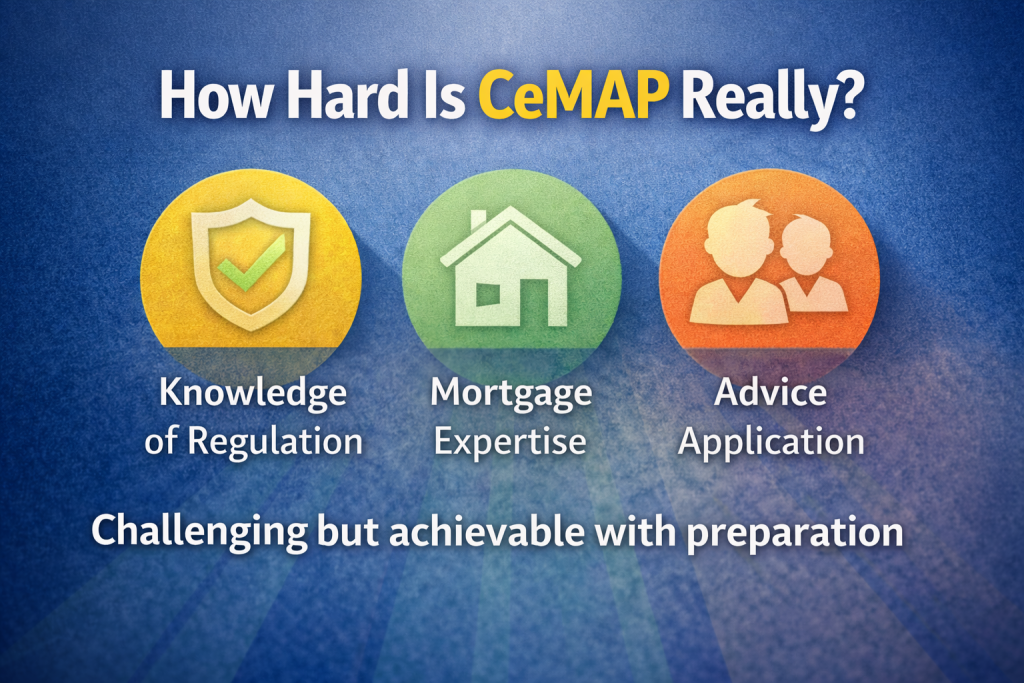
How hard is CeMAP really graphic showing regulation knowledge, mortgage expertise and advice application

Looking for training support?

We offer CeMAP training for learners working towards a career in mortgage advice. Our courses follow the London Institute of Banking & Finance syllabus and are designed to support understanding of mortgage regulation and advice requirements.

Explore our accredited CeMAP training courses

> Futuretrend Financial Training 

CeMAP 2 explained: mortgages in practice (MRT)

What is CeMAP 2 showing mortgages in practice with MRT1 and MRT2

CeMAP 2 is where learners move from understanding regulation into understanding mortgages themselves. While CeMAP 1 explains the rules and standards advisers operate under, CeMAP 2 focuses on how mortgage advice works in practice.

This module introduces mortgage products, borrower types, property considerations, and the application of mortgage rules. It is the core mortgage knowledge required before an adviser can begin recommending mortgages to clients.

This article explains what CeMAP 2 is, what learners study in MRT1 and MRT2, how each unit is assessed, and how the content links directly to real mortgage advice work.

What is CeMAP 2 showing mortgages in practice with MRT1 and MRT2

What is CeMAP 2?

CeMAP 2 is the mortgage-focused module of the Certificate in Mortgage Advice and Practice. It builds on the regulatory foundation of CeMAP 1 and introduces mortgage-specific knowledge used in day-to-day advice.

CeMAP is awarded by the London Institute of Banking & Finance, which forms part of the Walbrook Group, and meets the Financial Conduct Authority education requirements for mortgage advisers in the UK.

CeMAP 2 focuses on understanding how mortgages work in practice, rather than simply knowing mortgage terminology.

What is the purpose of CeMAP 2?

The purpose of CeMAP 2 is to ensure advisers understand the mortgage process, mortgage products, and borrower considerations well enough to support suitable and responsible advice.

In real advice work, mortgage recommendations depend on more than interest rates. Advisers must understand:

  • how mortgage applications progress from enquiry to completion
  • how lenders assess risk and affordability
  • how different mortgage products operate
  • what can happen after a mortgage completes

CeMAP 2 provides the mortgage-specific knowledge needed to support those decisions.

What is the purpose of CeMAP 2 showing real-world mortgages and adviser knowledge

What do you study in MRT1?

MRT1: Mortgage law, practice and application focuses on how mortgages are arranged and the legal and practical framework around them.

It provides the structure of mortgage advice work and explains how the mortgage process fits within regulation.

Mortgage advice and regulation in practice

MRT1 explains:

  • when mortgage advice is regulated
  • what constitutes a regulated mortgage contract
  • why consumer protection applies to mortgage lending

This knowledge helps advisers understand when FCA rules apply and what responsibilities arise when advising clients.

The house-buying process and key parties

Mortgage advice sits within a wider property transaction. MRT1 covers:

  • the stages of buying a property
  • the roles of estate agents, lenders, solicitors, and surveyors
  • how valuation and surveying link to lending decisions

Advisers need this knowledge to manage client expectations and identify potential issues early.

How lenders assess mortgage applications

MRT1 includes how lenders evaluate applications, including:

  • income and expenditure assessment
  • credit history and commitments
  • loan-to-value considerations
  • affordability and responsible lending principles


In practice, this helps advisers avoid unsuitable recommendations and explain lender decisions clearly to clients.

What do you study in MRT2?

MRT2: Mortgage products and post completion focuses on mortgage products themselves and what happens after the mortgage completes.

It builds on MRT1 by moving from process into product selection and longer-term considerations.

Mortgage product types and features

MRT2 covers how different mortgage products work, including:

  • repayment and interest-only mortgages
  • fixed, variable, tracker, capped, and discounted rates
  • fees, incentives, and early repayment charges

The focus is on understanding how features affect suitability, not memorising individual lender deals.

Suitability and product choice

MRT2 supports advisers in understanding how product choice links to:

  • client objectives and priorities
  • payment stability versus flexibility
  • foreseeable changes in circumstances

This is where mortgage knowledge becomes advice rather than information.

Post-completion issues

MRT2 also covers what can happen after completion, including:

  • borrower payment difficulties
  • arrears in principle
  • the consequences of missed payments

Mortgage advice does not end at completion. Advisers often deal with remortgages, changes in circumstances, or clients experiencing financial pressure.

How are the MRT1 and MRT2 exams structured?

Under the current CeMAP structure, MRT1 and MRT2 are assessed separately, and neither exam includes case studies.

Both exams are computer-based multiple-choice assessments taken online.

MRT1 exam structure

MRT1: Mortgage law, practice and application is assessed by:

  • 1-hour exam
  • 50 standalone multiple-choice questions
  • Pass mark: 70 percent
  • Minimum score to pass: 35 out of 50

Questions focus on mortgage process, regulation, and application principles.

MRT2 exam structure

MRT2: Mortgage products and post completion is assessed by:

  • 1-hour exam
  • 40 standalone multiple-choice questions
  • Pass mark: 70 percent
  • Minimum score to pass: 28 out of 40

Questions focus on mortgage products, suitability, and post-completion considerations.

Key points for learners

  • MRT1 = 50 multiple-choice questions
  • MRT2 = 40 multiple-choice questions
  • Both exams are 1 hour
  • No case studies in CeMAP 2

How does CeMAP 2 link to real mortgage advice work?

CeMAP 2 reflects the decisions advisers make daily.

In practice, the knowledge gained supports advisers in:

  • assessing borrower suitability
  • understanding lender requirements
  • identifying property-related risks
  • explaining mortgage features clearly
  • discussing longer-term implications with clients


Many advice issues arise from misunderstanding borrower circumstances or product features. CeMAP 2 addresses these risks directly.

How CeMAP 2 links to real mortgage advice work showing study applied to client advice

Common misconceptions about CeMAP 2

“CeMAP 2 is just about mortgage products”

CeMAP 2 includes product knowledge, but it also covers process, application, and post-completion risks. Product knowledge alone is not enough to give suitable advice.


“You only need this once you start advising”

CeMAP 2 provides the foundation advisers rely on from day one. Without it, advisers cannot assess suitability or explain mortgage risks properly.


“Post completion does not matter”

Clients remortgage, move home, experience income changes, or struggle financially. MRT2 ensures advisers understand mortgage implications beyond the initial sale.

What CeMAP 2 does and does not do

CeMAP 2 does:

  • build mortgage-specific knowledge
  • support suitable mortgage recommendations
  • explain mortgage risks and responsibilities


CeMAP 2 does not:

  • authorise advisers to give advice on its own
  • replace supervised workplace training
  • remove the need to work under an FCA-authorised firm

Why CeMAP 2 exists

CeMAP 2 exists to protect consumers and support competent mortgage advice.

Mortgages are long-term financial commitments. Errors can have serious consequences. CeMAP 2 ensures advisers understand how mortgages work, how products differ, and how advice decisions affect clients over time.

Why CeMAP 2 exists showing mortgage knowledge, training standards and competent advisers

CeMAP 2 (MRT) Frequently Asked Questions

What is CeMAP 2?

CeMAP 2 is the mortgage module of the Certificate in Mortgage Advice and Practice. It covers mortgage law, practice, application, mortgage products, and post-completion issues.

What do MRT1 and MRT2 stand for?

  • MRT1 stands for Mortgage law, practice and application
  • MRT2 stands for Mortgage products and post completion

How many exams are in CeMAP 2?

There are two exams: one for MRT1 and one for MRT2. Both must be passed to complete CeMAP 2.

How many questions are in each exam?

  • MRT1: 50 multiple-choice questions
  • MRT2: 40 multiple-choice questions

Are there any case studies in CeMAP 2?

No. CeMAP 2 exams consist only of standalone multiple-choice questions.

Does passing CeMAP 2 allow you to give mortgage advice?

No. Advisers must also complete CeMAP 1 and CeMAP 3 and work under a firm authorised by the Financial Conduct Authority.

Looking for training support?

We offer CeMAP training for learners working towards a career in mortgage advice. Our courses follow the London Institute of Banking & Finance syllabus and are designed to support understanding of mortgage regulation and advice requirements.

Explore our accredited CeMAP training courses

> Futuretrend Financial Training 

Guide to the CeMAP 2 Qualification

Overcoming Challenges in Your First Year as a Mortgage Adviser

Guide to the CeMAP 2 Qualification

Alright, let’s dive into CeMAP 2, the second module of the CeMAP qualification.

The good news is that the hardest part may well be over as many find CeMAP 1 to be the most difficult out of the three. By doing CeMAP 1 first you’ll have done the hardest part for most people as many people find CeMAP 2 and 3 relatively easy after CeMAP 1. There is a lot of duplication in CeMAP 2 from the CeMAP 1 module and this module is a lot more relatable.

This module, officially known as Mortgages (MORT), serves as the next building block in your journey into the world of mortgage advice.

In CeMAP 2, you’ll be introduced to the essential knowledge you will need to fully understand mortgage advice. The course syllabus covers topics such as mortgage law, applications, mortgage protection products and payment methods as well as issues that may arise after completion. All of this will give you a thorough grounding in the mortgage application process.

The LIBF state that your CeMAP studies here will cover things like 

  • The house buying process including Buying property at auction
  • The mortgage conduct of business rules
  • The economic and regulatory context for giving mortgage advice
  • The role of a mortgage advisor providing advice
  • Types of security, fees and charges involved in arranging a mortgage
  • Property defects and their implications
  • Principal factors affecting the value on a property, types of valuation and surveys
  • Types of mortgage and their features
  • Mortgage related protection
  • Additional finance and debt consolidation
  • Mortgage arrears and other breaches of the mortgage deed, legal rights and remedies available to lenders in respect of non-payment from the borrower
Ultimate Guide to Becoming a CeMAP Mortgage Adviser: Steps, Tips & Resources

Now, let’s break it down further. CeMAP 2 consists of four separate units, each designed to help you develop the specialist knowledge required in this field.

Unit 3: Mortgage law, policy, practice and markets

This unit introduces you to the regulation of the different types of mortgages and equity release products. It provides an overview of the house-buying process and the different types of borrower. You will also gain an appreciation of the Mortgage Conduct of Business Rules.

Unit 4: Mortgage applications

This unit introduces you to the mortgage application process and procedures. It provides you with an understanding of the role of the mortgage adviser, the different types of fees and charges relating to mortgage application and the factors affecting the valuation of a property and the different types of valuation.

Unit 5: Mortgage related protected products

This unit introduces you to the protection market with an overview of the range of mortgage related protection products available and their suitability in the event of death, illness or disability. It also covers house insurance, including landlord insurance and insurance for self-build projects.

Unit 6: Mortgage payment methods and post completion issues

This unit introduces you to the different types of mortgage products and repayment methods providing you with an understanding of the suitability of each type of mortgage for different clients. It will also look at the processes and procedures for raising additional money on an existing mortgage and the treatment of clients and types of assistance for people who are experience difficulties in repaying their mortgage.

As you can see, CeMAP 2 is all about getting a thorough grounding in the mortgage application process including different products available and the issues borrowers may face after completion.

The entire CeMAP qualification typically spans 6 to 12 months, providing you with a comprehensive learning journey. When it comes specifically to CeMAP 2, if you’re pursuing it through self-study, you can expect to invest around two to four months to complete this module.

However, we understand that time is of the essence for many aspiring Mortgage Advisers. That’s where Fast Track training options come into play. There are programs, such as the Futuretrend 5-day combined CeMAP 2 & 3 Live Virtual Classroom, designed to accelerate your learning process. These intensive courses aim to support you in completing the second module within just a few weeks.

CeMAP 2 Exam

Now that we’ve covered what CeMAP 2 involves, let’s talk about the next step that many of you pushing towards – the exam.

You will need to register with the awarding body, The London Institute of Banking and Finance, also known as LIBF. If you already have taken your CeMAP 1 you then it will add this module to your current account. Each module currently costs £215. This fee covers your registration, a hard copy of the syllabus, and a single exam sitting for that module.


Exam Format:

The CeMAP 2 module is assessed through a 2-hour exam comprising 100 multiple-choice questions just like CeMAP 1. However, this exam is split into the four units we discussed earlier and timing and question allocations differ between each.


Time and Questions Allocation:

Unlike CeMAP 1 where the Units are split evenly in questions and time allocation, CeMAP 2 is divided slightly differently.

For unit 3 & 4, you have 30 minutes to answer 25 questions on each.

With Unit 5 you have 24 minutes to answer 20 questions.

Finally Unit 6 you have 36 minutes to answer 30 questions so clearly the largest unit.


Pass Mark:

Even though the units have different question amounts and duration, the pass mark for each unit is 70%.

So for units 3 & 4 you will need to answer 17 out of 25 to pass.

Unit 5 you will need 14 out of 20.

And finally unit 6 you will need 21 out of 30.


Module Grading:

Each unit is graded separately. If, for any reason, you don’t pass a unit, you only need to retake that specific unit, not the entire exam.


Results:

After completing the exam, you won’t have to wait long for the results. You’ll receive them on the same day via your LIBF Portal.


Preparing for the CeMAP 2 exam can be challenging, but with the right resources and study approach, you’ll be well-equipped to succeed.

Next Steps / What Comes Next

Once you have successfully navigated through CeMAP 2, and passed the exam, what comes next?

To complete your CeMAP qualification, your journey continues with the final module CeMAP 3 Qualification.

CeMAP 3 focuses on Assessment of Mortgage Advice Knowledge enabling you to provide an holistic assessment of client’s mortgage needs.

Look out for future posts where we’ll cover the CeMAP 3 Module in detail. We’ll explore the modules requirements, exam type, study options, and insights to help you excel in this next phase of your CeMAP journey.

As we transition to CeMAP 3, we’ll continue to provide guidance, tips, and support to ensure your success in the entire CeMAP qualification.

Learn how UK mortgage advisers assess affordability. Understand the key factors and see real examples. Read now for expert insights.

To conclude, CeMAP 2 is not just a module but really a pinnacle part of your syllabus studies in achieving your full CeMAP qualification as it will effect your progress in CeMAP 3, so it’s crucial that you continue the solid start you hopefully made with CeMAP 1 to put you in a good position for the final module of the qualification.

Images Designed by Freepik (www.freepik.com) and AI