What “Structured Learning” Really Means in CeMAP Training

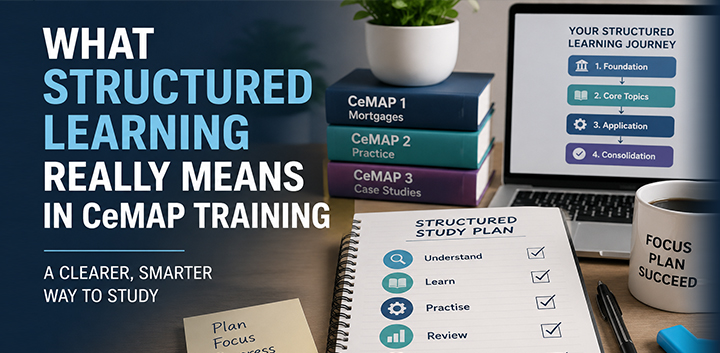
Structured CeMAP study plan with organised books, checklist and laptop showing how structured learning helps mortgage adviser students study step by step.

If you have been researching CeMAP courses, you have probably seen the phrase structured learning used again and again. It sounds helpful, but it is not always explained clearly.

Structured learning is simply a study approach where the material is organised into a logical order, with each topic building on the one before it. Instead of deciding what to study next on your own, you follow a planned path that helps you understand the syllabus step by step.

For a qualification like CeMAP, this matters more than many learners realise.

The Certificate in Mortgage Advice and Practice (CeMAP), awarded by the London Institute of Banking & Finance, covers a large amount of technical information. It includes regulation, mortgage law, products, calculations, and client advice principles. Without a clear structure, it is easy to feel overwhelmed or miss important links between topics.

This article explains what structured learning really means, how it differs from unstructured study, and why it can make preparing for CeMAP more manageable and effective.

Structured CeMAP study plan with organised books, checklist and laptop showing how structured learning helps mortgage adviser students study step by step.

What Is Structured Learning?

Structured learning is a method of studying where:

  • Topics are arranged in a logical sequence
  • Each lesson builds on previous knowledge
  • Learning objectives are clear
  • Progress is broken into manageable sections
  • Revision is planned rather than random

In simple terms, structured learning gives you a roadmap.

Rather than asking, “What should I study today?”, the answer is already set out for you.

For example, in CeMAP 1 you would normally begin with the UK financial services industry and regulation before moving on to mortgages, house-buying, and taxation. That order makes sense because the later topics rely on knowledge from the earlier ones.

Why Structured Learning Matters for CeMAP

CeMAP is not just about memorising isolated facts.

The exams test whether you understand how different areas fit together. For instance:

  • Regulation affects what advisers can recommend
  • Tax rules influence affordability and property decisions
  • Mortgage products are linked to customer circumstances
  • Legal processes affect how transactions are completed

If you study topics in a random order, these relationships can be harder to grasp.

Structured learning helps you build understanding layer by layer, which makes the whole syllabus easier to absorb.

Step-by-step blocks leading to CeMAP books and a graduation cap, showing how structured learning builds knowledge and confidence for CeMAP exams.

What Does Structured Learning Look Like in Practice?

A structured CeMAP course usually includes several elements working together:

A Clear Study Plan

You know exactly what to cover each week and in what order.

Guided Lessons

Lessons explain each topic before moving on to the next.

Revision Activities

Knowledge checks, quizzes, and recap exercises reinforce learning.

Progress Tracking

You can see what you have completed and what still needs attention.

Tutor Support

If you are studying with a provider, tutors can answer questions and clarify difficult topics.

Together, these elements reduce uncertainty and help you focus on learning rather than planning.

What Is Unstructured Study?

Unstructured study is the opposite approach.

It usually means:

  • Jumping between topics
  • Reading whatever feels easiest
  • Revising only familiar areas
  • Skipping difficult subjects
  • Having no clear timetable

This is common when learners rely solely on textbooks or internet searches without a defined plan.

Although it can feel flexible, it often leads to inconsistent progress.

Structured Learning vs Unstructured Study

Structured Learning

Follows a logical order

Builds understanding gradually

Includes progress milestones

Encourages regular study habits

Reduces decision fatigue

Unstructured Study

Topics covered randomly

Important connections may be missed

Progress feels uncertain

Revision can become inconsistent

Time is spent deciding what to do

The key difference is that structured learning removes guesswork.

How Structured Learning Improves Consistency

One of the biggest challenges with CeMAP is maintaining momentum over several months.

Many learners start strongly but lose focus when:

  • Work becomes busy
  • Family commitments increase
  • Topics become more technical
  • They are unsure what to study next

Structured learning helps because each study session has a clear purpose.

Instead of spending 20 minutes deciding what to revise, you simply continue with the next lesson.

This makes it easier to maintain regular study habits, even when time is limited.

Weekly CeMAP study plan with books and checklist showing how structured learning helps students study consistently.

How Structured Learning Improves Understanding

Consistency is useful, but understanding is what ultimately helps you pass.

When learning is structured:

  1. New ideas are introduced in context.
  2. Related topics are grouped together.
  3. Concepts are revisited at the right time.
  4. Knowledge builds naturally.

For example, understanding the role of the Financial Conduct Authority helps make sense of adviser responsibilities later in the syllabus.

Without that foundation, later topics can seem disconnected and more difficult than they really are.

Why Structure Reduces Overwhelm

CeMAP can appear intimidating because of the amount of material involved.

Structured learning breaks the syllabus into manageable sections.

Rather than viewing CeMAP as one huge qualification, you focus on:

  • One module at a time
  • One topic at a time
  • One lesson at a time

This makes progress feel achievable and helps reduce the feeling of being buried under information.

Simple Example: Structured vs Unstructured Revision

Imagine two learners studying CeMAP 1.

Learner A: Structured Approach

  • Follows a weekly study plan
  • Completes lessons in order
  • Revises after each topic
  • Tracks progress

Learner B: Unstructured Approach

  • Reads chapters at random
  • Revises only when motivated
  • Skips difficult areas
  • Unsure what has been covered

After several weeks, Learner A usually has a clearer understanding and greater confidence because each topic has been built on solid foundations.

Does Structured Learning Mean Studying at a Fixed Pace?

No.

Structured CeMAP learning provides order, not rigid deadlines.

You can move faster through familiar topics and spend longer on areas you find difficult.

The important part is that the sequence remains logical.

Think of it as following a map rather than wandering without direction.

Is Structured Learning Only for Beginners?

Not at all.

Even experienced professionals benefit from structured learning when studying for a formal qualification.

CeMAP includes many areas that may be unfamiliar, particularly regulation and technical knowledge.

A structured approach helps ensure that nothing important is overlooked.

What Should You Look for in a Structured CeMAP Course?

If you are comparing courses, look for evidence that the training includes:

  • A clear lesson sequence
  • Study schedules or recommended timetables
  • Progress tracking
  • Topic-based quizzes
  • Tutor support
  • Revision resources

These are practical signs that the learning experience is organised rather than simply providing access to materials.

Can You Create Your Own Structured Learning Plan?

Yes.

If you are studying independently, you can still apply structured learning by:

  1. Breaking the syllabus into weekly sections.
  2. Studying topics in the order set by the qualification.
  3. Reviewing each topic before moving on.
  4. Scheduling regular recap sessions.
  5. Tracking your progress.

This requires more discipline, but the principles are exactly the same.

Personal CeMAP study plan with weekly checklist, books and notes showing how learners can create their own structured learning plan.

What Is Structured Learning? A Simple Definition

Structured learning is a planned approach to studying where topics are organised in a logical order, each lesson builds on previous knowledge, and progress is guided step by step.

For CeMAP learners, structured learning reduces overwhelm, improves consistency, and helps you understand how the syllabus fits together.

Why Structured Learning Helps CeMAP Learners

CeMAP is a detailed professional qualification with many connected topics.

Structured learning helps by:

  • Giving you a clear study path
  • Reducing uncertainty
  • Building understanding gradually
  • Encouraging regular revision
  • Making progress easier to track

Instead of trying to piece the syllabus together yourself, you follow a sequence designed to support learning.

Final Thoughts

Structured learning is not a buzzword. It is a practical way to study more effectively.

When your learning is organised, you spend less time wondering what to do next and more time actually understanding the material.

For a qualification as broad as CeMAP, that clarity can make a significant difference.

Whether you choose a tutor-led course, an online Study Hub, or self-study, the most effective approach is one that follows a clear and logical structure.

That is what structured learning really means.

Looking for training support?

We offer CeMAP training for learners working towards a career in mortgage advice. Our courses follow the London Institute of Banking & Finance syllabus and are designed to support understanding of mortgage regulation and advice requirements.

Explore our accredited CeMAP training courses

> Futuretrend Financial Training 
What do you actually get with a CeMAP course?

What you get with a CeMAP course including study materials structured learning and support

If you are looking at CeMAP training, one of the most common questions is simple: what am I actually paying for?

A CeMAP course is not just a bundle of revision notes. It is a structured learning experience designed to help you understand the syllabus, apply it, and prepare for assessment in a supported way.

Understanding what is included helps you compare providers properly and avoid choosing based on price alone.

What you get with a CeMAP course including study materials structured learning and support

What is included in a CeMAP course?

A CeMAP course usually includes three core elements:

  • Teaching or guided learning
  • Study materials and resources
  • Ongoing learner support

At its most basic, the course is designed to help you move through the CeMAP syllabus in a structured way, rather than trying to work everything out on your own.

CeMAP, awarded by the London Institute of Banking & Finance, is the industry standard qualification for mortgage advisers and meets the education requirements set by the Financial Conduct Authority. Because of that, the syllabus is detailed and quite broad.

A course exists to organise that complexity into something manageable.

What does “teaching” actually mean in a CeMAP course?

Teaching in a CeMAP course can take different forms depending on the provider, but the purpose is the same: to explain the syllabus in a way that builds understanding, not just memorisation.

This might include:

  • Tutor-led sessions (online or in person)
  • Recorded lessons or walkthroughs
  • Topic-by-topic explanations
  • Worked examples and discussions

The key difference between teaching and self-study is guidance.

Instead of reading a section and trying to interpret it yourself, the content is explained in a way that highlights what matters, how topics connect, and where learners often struggle.

Good teaching does not just repeat the textbook. It translates it.

What study materials are usually included?

Most CeMAP courses come with a set of structured study materials designed to support different stages of learning.

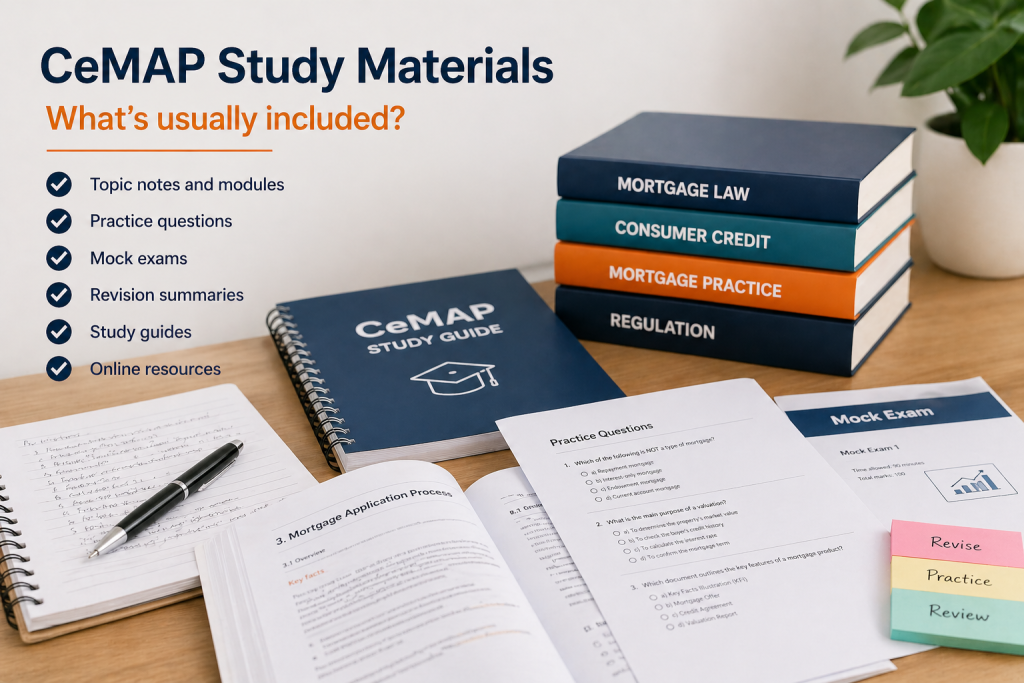
These often include:

  • Core learning content aligned to the syllabus
  • Topic-based notes or modules
  • Practice questions or knowledge checks
  • Mock exams or assessment-style tests
  • Revision summaries

The important point is not just what materials are included, but how they are organised.

A well-structured course breaks the syllabus into manageable sections, often by topic or sub-topic, so you are not faced with everything at once. This makes it easier to track progress and stay consistent.

CeMAP study materials including notes practice questions mock exams and study guides

What is a Study Hub and why does it matter?

Many modern CeMAP providers offer a Study Hub or online learning platform.

This is where the course comes together.

A Study Hub typically includes:

  • All learning materials in one place
  • Progress tracking
  • Structured topic navigation
  • Integrated quizzes or tests
  • Access to support or tutors

Rather than jumping between PDFs, emails, and notes, everything is centralised.

The value here is structure.

Instead of deciding what to study next, the course guides you through the process step by step. For many learners, this reduces overwhelm and makes it easier to stay on track.

What is the difference between content and guided learning?

This is one of the most important distinctions when comparing CeMAP courses.

Content-only learning means you are given materials and left to work through them yourself.

Guided learning means the course actively helps you understand how to use those materials.

Guided learning often includes:

  • Clear study pathways
  • Explanations of difficult areas
  • Direction on what to focus on
  • Reinforcement through questions and feedback

Two courses might both include the same syllabus content, but the experience can feel very different.

Content gives you information.
Guided learning helps you make sense of it.

How important is support in a CeMAP course?

Support is often one of the least visible but most valuable parts of a course.

This can include:

  • Access to tutors for questions
  • Help with difficult topics
  • Clarification on confusing areas
  • Guidance when you feel stuck

CeMAP can feel straightforward at first, but some areas require careful understanding. When you hit those points, having support available can make a noticeable difference.

It is not just about getting answers. It is about reducing uncertainty and keeping momentum.

What does structure add that self-study does not?

You can study CeMAP without a course, so it is fair to ask what extra value a structured course provides.

The main difference is organisation and direction.

A structured course:

  • Breaks the syllabus into logical sections
  • Presents topics in a sensible order
  • Reinforces learning as you go
  • Helps you avoid missing key areas

Without that structure, learners often:

  • Jump between topics
  • Spend too long on some areas and not enough on others
  • Struggle to judge their progress
  • Feel unsure about exam readiness

Structure does not replace effort, but it makes that effort more focused.

Do all CeMAP courses include the same things?

No, and this is where comparisons become important.

Most courses include the core elements, but the depth and quality can vary.

Differences might include:

  • Level of tutor involvement
  • Quality and clarity of materials
  • How detailed the Study Hub is
  • Availability of support
  • Range of practice questions and mock exams

Two providers might both say they offer “full course materials”, but that could mean very different things in practice.

This is why it is worth looking beyond simple descriptions and understanding what the learning experience actually looks like.

What is an accredited CeMAP learning support provider?

Not all CeMAP training providers are recognised in the same way. Some are listed as accredited learning support providers by the London Institute of Banking & Finance.

An accredited provider has been reviewed by the awarding body and is approved to offer structured learning support for the qualification.

This does not mean the provider delivers the qualification itself. CeMAP is still awarded by the London Institute of Banking & Finance. It means the training provider meets certain standards in how they support learners through the syllabus.

Accredited CeMAP Learning Support Provider by The London Institute of Banking & Finance

Why does provider approval matter?

Choosing a provider that is approved or accredited adds a layer of reassurance about how the course is structured and delivered.

It suggests that:

  • The materials are aligned to the official syllabus
  • The course is designed to support understanding, not just content delivery
  • The learning experience has been reviewed against recognised standards

That said, accreditation is not a guarantee of outcomes. It does not mean a learner will pass automatically or find the course easy.

What it does offer is confidence that the course has been built with a clear understanding of what the qualification requires.

How does this differ from general training providers?

Some providers offer CeMAP courses without formal accreditation or recognition.

This does not automatically mean the course is poor. However, it does mean:

  • The structure and materials have not been reviewed by the awarding body
  • The quality can vary more between providers
  • You may need to look more closely at what is actually included

In contrast, accredited providers have an additional level of oversight, which can help when comparing options.

What should you look for alongside accreditation?

Accreditation is one factor, but it should not be the only one you rely on.

It is still important to look at:

  • How the course is structured
  • Whether support is available
  • The clarity of the materials
  • How the Study Hub or platform works

A strong course combines recognised standards with clear, practical delivery.

How do you know if a course offers real value?

Value in a CeMAP course is not just about how much content is included.

It is about how well that content is delivered and supported.

Signs of a well-developed course include:

  • Clear explanations rather than dense text
  • Materials broken into manageable topics
  • A mix of formats (not just written content)
  • Structured progression through the syllabus
  • Access to help when needed

Some providers also offer previews, walkthroughs, or sample materials. These can give a clearer idea of what you are actually getting before committing.

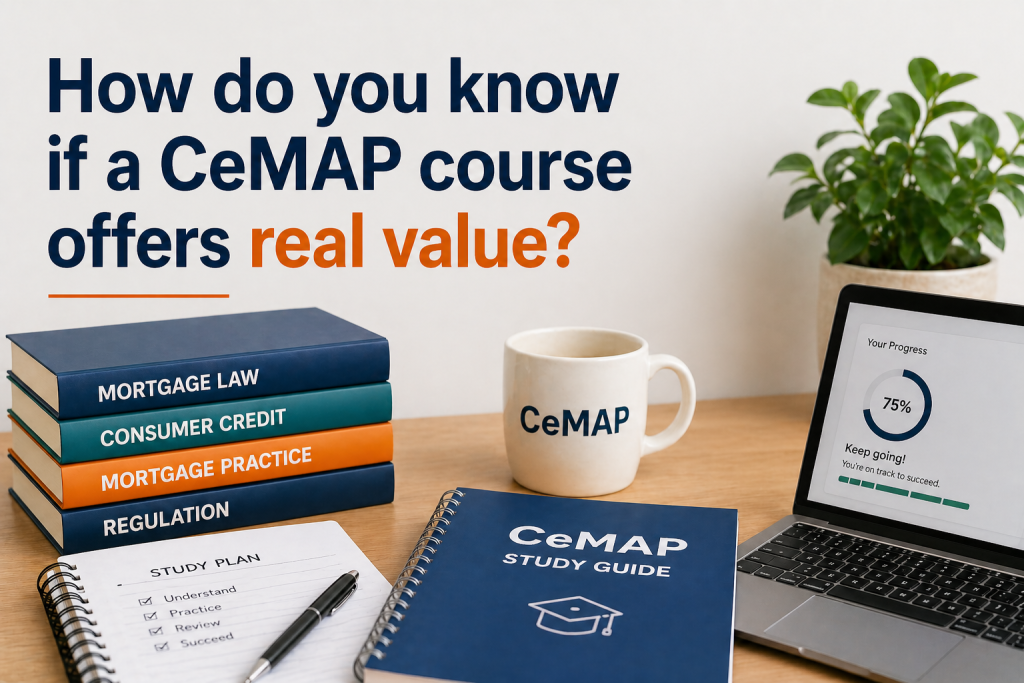
How to know if a CeMAP course offers real value with structured learning materials and support

Is a CeMAP course just about passing the exam?

A CeMAP course is designed to support exam preparation, but its purpose is broader than that.

The qualification itself is about understanding how mortgage advice works, including regulation, products, and client needs.

A good course helps you:

  • Understand concepts, not just memorise facts
  • See how topics connect
  • Build confidence in applying knowledge

This matters because the exam is testing understanding as well as knowledge.

Simply reading information is not always enough.

Why do some courses feel easier to follow than others?

This usually comes down to how the course is designed, not how “hard” the content is.

Courses that feel easier to follow tend to:

  • Use plain, clear explanations
  • Avoid unnecessary complexity
  • Build topics gradually
  • Reinforce learning consistently

Courses that feel difficult often:

  • Present too much information at once
  • Lack clear structure
  • Assume prior knowledge
  • Offer limited guidance

The syllabus is the same either way. The difference is how it is delivered.

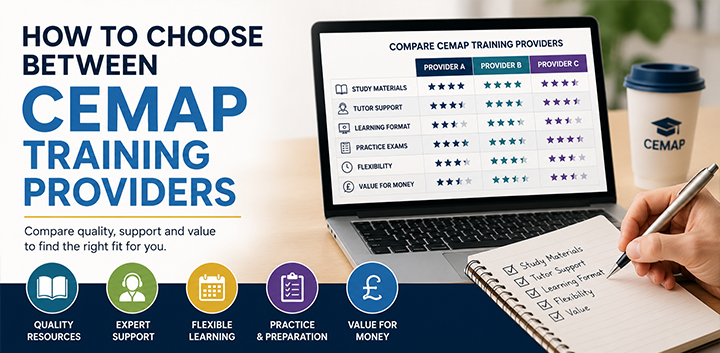
What should you focus on when comparing CeMAP courses?

When comparing options, it helps to look beyond surface-level features.

Instead of asking “what do I get?”, consider:

  • How is the learning structured?
  • Is there guidance, or just content?
  • What support is available if I struggle?
  • How are materials presented and organised?

These questions give a clearer picture of the learning experience.

A simple way to think about it

At its core, a CeMAP course is a combination of:

  • Information (the syllabus)
  • Explanation (teaching)
  • Organisation (structure)
  • Reinforcement (practice)
  • Support (guidance)

All courses include these in some form, but the balance and quality can vary.

Understanding that helps you make a more informed choice.

A simple way to think about it

A CeMAP course is not just a set of materials. It is a framework for learning a detailed and regulated subject in a manageable way.

The real value comes from how well that framework supports you.

If it provides clear structure, useful explanations, and access to support, it can make the process feel far more straightforward.

If it does not, even good content can feel difficult to use.

That is why understanding what is included matters just as much as deciding to take the qualification in the first place.

Looking for training support?

We offer CeMAP training for learners working towards a career in mortgage advice. Our courses follow the London Institute of Banking & Finance syllabus and are designed to support understanding of mortgage regulation and advice requirements.

Explore our accredited CeMAP training courses

> Futuretrend Financial Training 

CeMAP Qualification FAQ: Career Progression and Achieving CAS

After obtaining your CeMAP qualification, the next steps involve gaining practical experience, achieving CAS, and exploring various career advancement opportunities. Below are 10 frequently asked questions to guide you through this phase.​

Frequently Asked CeMAP Questions

What is Competent Adviser Status (CAS)?

Competent Adviser Status signifies that a mortgage adviser has demonstrated the competence to provide mortgage advice independently, without supervision. It’s a standard set by employers and regulatory bodies to ensure advisers can handle client interactions and mortgage applications effectively.

How do I achieve CAS after CeMAP?

To attain CAS, you typically need to:​

  • Secure a trainee adviser position.​
  • Undergo initial training and mentorship.​
  • Complete practical assessments and case studies.​
  • Pass regular compliance and quality checks.​

This process ensures you’re competent to offer financial advice independently.

Can I work as a mortgage adviser without CAS?

While you can start in a supervised role after CeMAP, you cannot advise clients independently until you achieve CAS. Working under supervision allows you to gain the necessary experience to qualify for CAS.

How long does it take to obtain CAS?

The duration varies based on individual performance and the employer’s assessment process. Typically, it takes a few months of supervised practice, during which you must demonstrate competence in advising clients and handling applications. ​

What career paths are available after achieving CAS?

Post-CAS, you can explore various roles, including:

  • Independent Mortgage Adviser.​
  • Specialist in areas like equity release or commercial mortgages.
  • Team leader or managerial positions.​
  • Setting up your own brokerage.​

These roles offer opportunities for increased responsibility and income. ​

Is CeMAP sufficient for all mortgage adviser roles?

CeMAP is the foundational qualification for mortgage advisers. However, for specialised areas like equity release, additional qualifications such as CeRER may be required. ​

How can I gain practical experience after CeMAP?

Seek trainee positions with firms that offer structured training programs. These roles provide supervised experience, allowing you to handle real cases and receive feedback, which is crucial for achieving CAS. ​

What support is available for newly qualified advisers?

Many training providers and employers offer mentorship programs, workshops, and continuous professional development courses to support advisers in gaining CAS and advancing their careers. ​

Can I specialise in a niche area after CeMAP?

Yes, after gaining experience and CAS, you can specialise in areas like buy-to-let mortgages, self-employed clients, or adverse credit cases. Specialisation can enhance your expertise and marketability. ​

What is the earning potential after achieving CAS?

Earnings vary based on experience, specialisation, and employment type. As a CAS-qualified adviser, you can expect higher earning potential, especially if you move into specialised roles or establish your own brokerage.

Final Thoughts

Achieving CAS is a significant milestone in a mortgage adviser’s career, marking the transition to independent practice. With CAS, you unlock opportunities for specialisation, increased earnings, and career advancement.​

For more information on CeMAP courses and career opportunities, consider reaching out to accredited training providers or industry professionals.

Images Designed by Freepik (www.freepik.com) and AI

CeMAP Qualification FAQ: Your Essential Guide for Aspiring Mortgage Advisers

Frequently Asked CeMAP Questions

If you’re thinking about a career in mortgage advice, you’ve probably heard of CeMAP – the Certificate in Mortgage Advice and Practice. To help you get a clear understanding of what CeMAP is and how it can boost your career, we’ve put together 15 frequently asked questions. This FAQ covers everything from what CeMAP is and how long it takes to complete, to the benefits and costs involved, and how to become CeMAP qualified.

Frequently Asked CeMAP Questions

What is CeMAP?

CeMAP stands for the Certificate in Mortgage Advice and Practice. It is the industry-standard qualification for mortgage advisers in the UK, recognised by the Financial Conduct Authority (FCA). Essentially, it equips you with the skills and knowledge to provide sound mortgage advice to clients.

What does CeMAP stand for?

CeMAP is an acronym for Certificate in Mortgage Advice and Practice. This qualification is crucial for anyone wanting to work as a regulated mortgage adviser in the UK.

What is a CeMAP qualification?

A CeMAP qualification is a Level 3 certification that covers essential areas such as mortgage markets, financial services regulation, mortgage law, and practical advisory techniques. It is widely recognised by employers and is necessary to work as a regulated mortgage adviser.

What level is CeMAP on the UK National Qualifications Framework?

CeMAP is a Level 3 qualification, which is equivalent to A-levels. This means it provides a strong foundation in mortgage advice practice that is accessible even for those without a prior degree in finance.

How long does it typically take to complete CeMAP?

The time required to complete CeMAP depends on the study method you choose:

  • Full-time study: Some providers offer accelerated courses that can be completed in as little as 1 months with two weeks study, then revision time and exam sittings.

  • Part-time or distance learning: Many candidates take 3-6 month while balancing work or other commitments.

What are the entry requirements for a CeMAP course?

There are minimal entry requirements for CeMAP. You should have a good standard of English and maths. No previous experience in finance is required, making it an ideal option for career changers as well as recent graduates.

How do I get CeMAP qualified?

To become CeMAP qualified, follow these steps:

  1. Choose a Reputable Provider: Research training companies approved by LIBF.

  2. Enrol on a Course: Select the format that suits you best – classroom-based, online, or an apprenticeship.

  3. Study the Modules: Learn about mortgage markets, regulations, ethics, and practical advice.

  4. Pass the Exams: Sit for and pass the required multiple-choice exams for each module.

  5. Receive Your Certificate: Once all exams are passed, you are officially CeMAP qualified and can register as a regulated mortgage adviser.

How much does a CeMAP course cost?

The cost of a CeMAP course varies between providers and study methods. Some training companies offer competitive pricing and flexible payment options. Additionally, you might have the opportunity for employer sponsorship or to join a mortgage adviser apprenticeship, which can help cover the cost.

What study options are available for CeMAP?

There are several study options available, including:

  • Full-time courses: Accelerated and intensive, ideal if you want to complete the qualification quickly.

  • Part-time courses: Suitable for those balancing work or other commitments.

  • Online/distance learning: Offers flexibility to study at your own pace.

  • Apprenticeships/on Job: Allow you to earn while you learn and gain valuable on-the-job experience. (Note: Although this could be a nice option, some of these companies T&Cs require you to pay back your studies, exams and time given to you if you leave employment within a set time. normally at a higher amount then would have cost to study private) 

What topics does the CeMAP course cover?

The CeMAP course covers a range of topics, including:

  • The fundamentals of financial services and mortgage markets.

  • Detailed information on mortgage products and how to advise on them.

  • The legal and regulatory framework governing mortgage advice in the UK.

  • Ethical practices and professional standards necessary for advising clients.

What can I do with a CeMAP qualification?

Once you are CeMAP qualified, you can work as a mortgage adviser or broker in various settings such as banks, building societies, or independent brokerage firms. It also opens up opportunities for career progression into senior roles, such as team management or specialising in areas like equity release or commercial mortgages. Many advisers eventually choose to work independently, setting their own hours and building their client base.

Why is CeMAP so widely recognised in the mortgage industry?

CeMAP is widely recognised because it meets the rigorous standards set by the FCA. Employers and clients alike trust that a CeMAP-qualified adviser has the necessary knowledge and ethical grounding to offer sound mortgage advice. It is the benchmark qualification in the UK mortgage industry, making it a critical asset for any career in this field.

How can employer sponsorship or apprenticeships help with CeMAP?

Many employers offer sponsorship for CeMAP courses or run their own training schemes, which can significantly reduce the financial burden. Apprenticeships not only provide hands-on experience but also enable you to earn a salary while studying. These routes are particularly beneficial if you’re looking to gain both practical experience and theoretical knowledge simultaneously.

How do I choose the right training provider for CeMAP?

When choosing a training provider, consider factors such as:

  • Reputation and Reviews: Look for providers with high pass rates and positive feedback from past students.

  • Flexibility: Check if they offer study options that suit your lifestyle (full-time, part-time, online).

  • Support Services: Ensure they offer adequate support such as tutoring, revision materials, and exam preparation sessions.

  • Accreditation: Confirm that the provider is approved by LIBF as an accredited training support provider.

What are the benefits of being CeMAP qualified for your career?

Being CeMAP qualified enhances your credibility as a mortgage adviser, opens up a wide range of career opportunities, and demonstrates your commitment to professional standards. It allows you to provide regulated advice, which is essential for building trust with clients. Additionally, the qualification can be a stepping stone for further specialisation and career advancement within the financial services industry.

Final Thoughts

Achieving a CeMAP qualification is a vital step for anyone looking to build a career in mortgage advice. These FAQs provide a comprehensive overview of what CeMAP is, how to get qualified, and the many benefits it offers. Whether you choose a full-time course, part-time study, or an apprenticeship, CeMAP equips you with the knowledge and skills needed to succeed in the mortgage industry.

If you found these FAQs helpful, share this guide with others considering a career in mortgage advice. For more detailed information on CeMAP courses and further resources, visit LIBF or your chosen training provider’s website.

Images Designed by Freepik (www.freepik.com) and AI