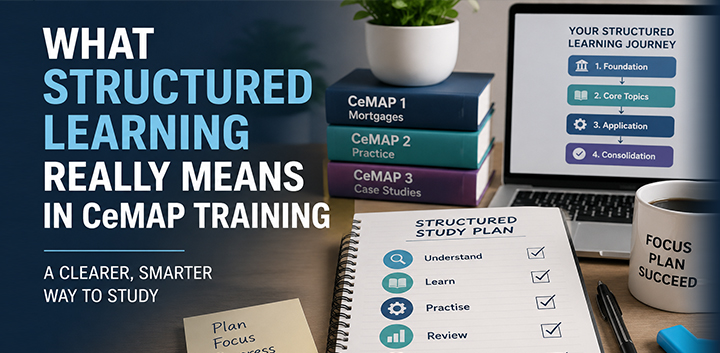
If you have been researching CeMAP courses, you have probably seen the phrase structured learning used again and again. It sounds helpful, but it is not always explained clearly.
Structured learning is simply a study approach where the material is organised into a logical order, with each topic building on the one before it. Instead of deciding what to study next on your own, you follow a planned path that helps you understand the syllabus step by step.
For a qualification like CeMAP, this matters more than many learners realise.
The Certificate in Mortgage Advice and Practice (CeMAP), awarded by the London Institute of Banking & Finance, covers a large amount of technical information. It includes regulation, mortgage law, products, calculations, and client advice principles. Without a clear structure, it is easy to feel overwhelmed or miss important links between topics.
This article explains what structured learning really means, how it differs from unstructured study, and why it can make preparing for CeMAP more manageable and effective.
What Is Structured Learning?
Structured learning is a method of studying where:
- Topics are arranged in a logical sequence
- Each lesson builds on previous knowledge
- Learning objectives are clear
- Progress is broken into manageable sections
- Revision is planned rather than random
In simple terms, structured learning gives you a roadmap.
Rather than asking, “What should I study today?”, the answer is already set out for you.
For example, in CeMAP 1 you would normally begin with the UK financial services industry and regulation before moving on to mortgages, house-buying, and taxation. That order makes sense because the later topics rely on knowledge from the earlier ones.
Why Structured Learning Matters for CeMAP
CeMAP is not just about memorising isolated facts.
The exams test whether you understand how different areas fit together. For instance:
- Regulation affects what advisers can recommend
- Tax rules influence affordability and property decisions
- Mortgage products are linked to customer circumstances
- Legal processes affect how transactions are completed
If you study topics in a random order, these relationships can be harder to grasp.
Structured learning helps you build understanding layer by layer, which makes the whole syllabus easier to absorb.

What Does Structured Learning Look Like in Practice?
A structured CeMAP course usually includes several elements working together:
A Clear Study Plan
You know exactly what to cover each week and in what order.
Guided Lessons
Lessons explain each topic before moving on to the next.
Revision Activities
Knowledge checks, quizzes, and recap exercises reinforce learning.
Progress Tracking
You can see what you have completed and what still needs attention.
Tutor Support
If you are studying with a provider, tutors can answer questions and clarify difficult topics.
Together, these elements reduce uncertainty and help you focus on learning rather than planning.
What Is Unstructured Study?
Unstructured study is the opposite approach.
It usually means:
- Jumping between topics
- Reading whatever feels easiest
- Revising only familiar areas
- Skipping difficult subjects
- Having no clear timetable
This is common when learners rely solely on textbooks or internet searches without a defined plan.
Although it can feel flexible, it often leads to inconsistent progress.
Structured Learning vs Unstructured Study
Structured Learning |
Follows a logical order |
Builds understanding gradually |
Includes progress milestones |
Encourages regular study habits |
Reduces decision fatigue |
Unstructured Study |
Topics covered randomly |
Important connections may be missed |
Progress feels uncertain |
Revision can become inconsistent |
Time is spent deciding what to do |
The key difference is that structured learning removes guesswork.
How Structured Learning Improves Consistency
One of the biggest challenges with CeMAP is maintaining momentum over several months.
Many learners start strongly but lose focus when:
- Work becomes busy
- Family commitments increase
- Topics become more technical
- They are unsure what to study next
Structured learning helps because each study session has a clear purpose.
Instead of spending 20 minutes deciding what to revise, you simply continue with the next lesson.
This makes it easier to maintain regular study habits, even when time is limited.
How Structured Learning Improves Understanding
Consistency is useful, but understanding is what ultimately helps you pass.
When learning is structured:
- New ideas are introduced in context.
- Related topics are grouped together.
- Concepts are revisited at the right time.
- Knowledge builds naturally.
For example, understanding the role of the Financial Conduct Authority helps make sense of adviser responsibilities later in the syllabus.
Without that foundation, later topics can seem disconnected and more difficult than they really are.
Why Structure Reduces Overwhelm
CeMAP can appear intimidating because of the amount of material involved.
Structured learning breaks the syllabus into manageable sections.
Rather than viewing CeMAP as one huge qualification, you focus on:
- One module at a time
- One topic at a time
- One lesson at a time
This makes progress feel achievable and helps reduce the feeling of being buried under information.
Simple Example: Structured vs Unstructured Revision
Imagine two learners studying CeMAP 1.
Learner A: Structured Approach
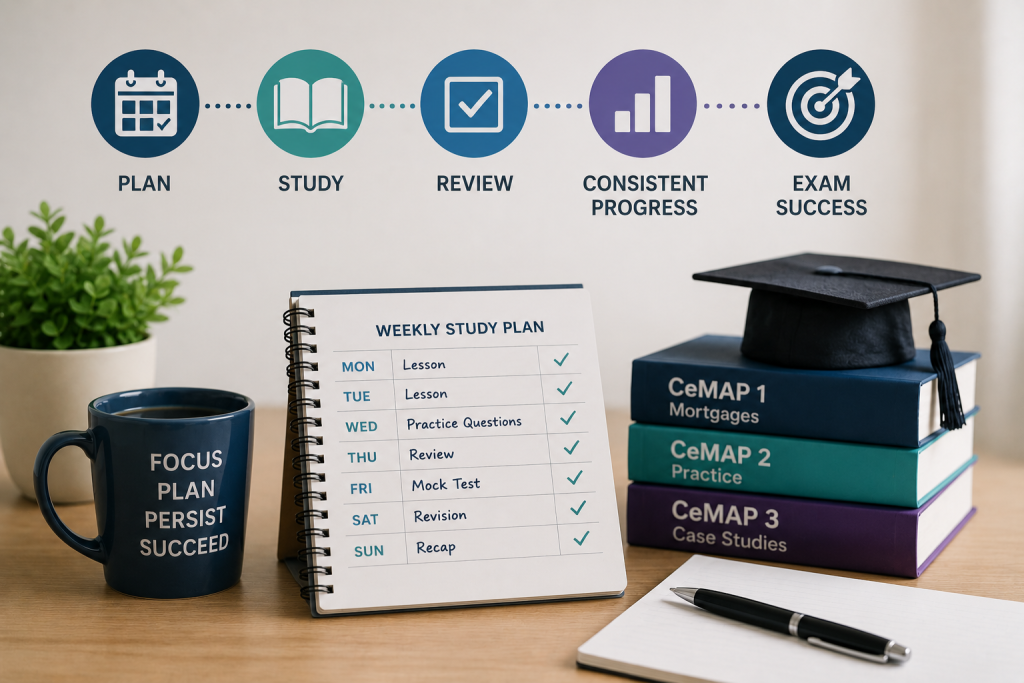
- Follows a weekly study plan
- Completes lessons in order
- Revises after each topic
- Tracks progress
Learner B: Unstructured Approach
- Reads chapters at random
- Revises only when motivated
- Skips difficult areas
- Unsure what has been covered
After several weeks, Learner A usually has a clearer understanding and greater confidence because each topic has been built on solid foundations.
Does Structured Learning Mean Studying at a Fixed Pace?
No.
Structured CeMAP learning provides order, not rigid deadlines.
You can move faster through familiar topics and spend longer on areas you find difficult.
The important part is that the sequence remains logical.
Think of it as following a map rather than wandering without direction.
Is Structured Learning Only for Beginners?
Not at all.
Even experienced professionals benefit from structured learning when studying for a formal qualification.
CeMAP includes many areas that may be unfamiliar, particularly regulation and technical knowledge.
A structured approach helps ensure that nothing important is overlooked.
What Should You Look for in a Structured CeMAP Course?
If you are comparing courses, look for evidence that the training includes:
- A clear lesson sequence
- Study schedules or recommended timetables
- Progress tracking
- Topic-based quizzes
- Tutor support
- Revision resources
These are practical signs that the learning experience is organised rather than simply providing access to materials.
Can You Create Your Own Structured Learning Plan?
Yes.
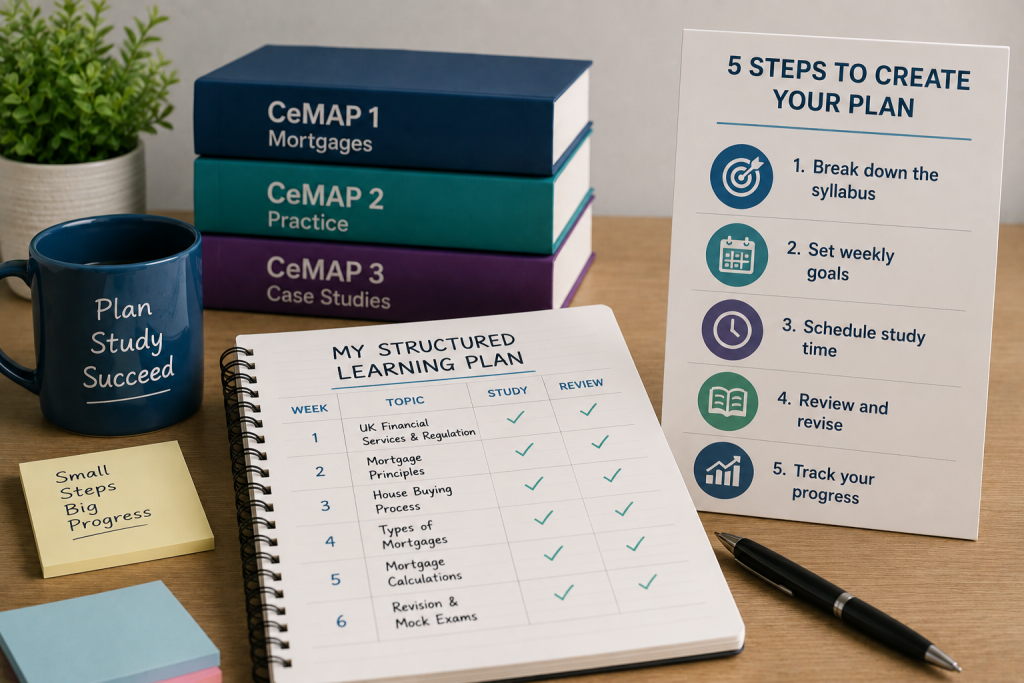
If you are studying independently, you can still apply structured learning by:
- Breaking the syllabus into weekly sections.
- Studying topics in the order set by the qualification.
- Reviewing each topic before moving on.
- Scheduling regular recap sessions.
- Tracking your progress.
This requires more discipline, but the principles are exactly the same.
What Is Structured Learning? A Simple Definition
Structured learning is a planned approach to studying where topics are organised in a logical order, each lesson builds on previous knowledge, and progress is guided step by step.
For CeMAP learners, structured learning reduces overwhelm, improves consistency, and helps you understand how the syllabus fits together.
Why Structured Learning Helps CeMAP Learners
CeMAP is a detailed professional qualification with many connected topics.
Structured learning helps by:
- Giving you a clear study path
- Reducing uncertainty
- Building understanding gradually
- Encouraging regular revision
- Making progress easier to track
Instead of trying to piece the syllabus together yourself, you follow a sequence designed to support learning.
Final Thoughts
Structured learning is not a buzzword. It is a practical way to study more effectively.
When your learning is organised, you spend less time wondering what to do next and more time actually understanding the material.
For a qualification as broad as CeMAP, that clarity can make a significant difference.
Whether you choose a tutor-led course, an online Study Hub, or self-study, the most effective approach is one that follows a clear and logical structure.
That is what structured learning really means.
Looking for training support?
We offer CeMAP training for learners working towards a career in mortgage advice. Our courses follow the London Institute of Banking & Finance syllabus and are designed to support understanding of mortgage regulation and advice requirements.
Explore our accredited CeMAP training courses
> Futuretrend Financial Training