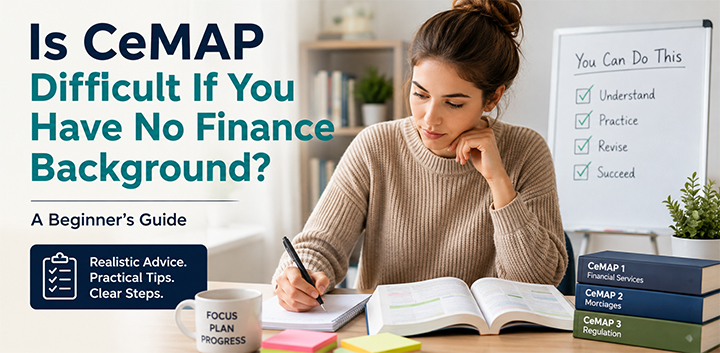
No, you do not need a finance or banking background to study CeMAP. The qualification covers subjects that may be completely new to you, so there is a learning curve, but previous experience in financial services is not a requirement for understanding the course.
For complete beginners, the main challenge is often familiarity. CeMAP introduces financial terminology, mortgage concepts, regulation and processes that you may never have encountered before. Once those unfamiliar terms start to make sense, the subject usually becomes much more manageable.
The way you study also matters. Clear explanations, a sensible learning structure, regular question practice and access to support can make a significant difference when you are starting without previous experience.
Is CeMAP Hard With No Experience?
CeMAP can be challenging with no previous experience because you are learning both new terminology and new concepts at the same time. However, having no experience does not automatically put you at a disadvantage.
The Certificate in Mortgage Advice and Practice (CeMAP) is a recognised qualification for people working towards becoming mortgage advisers in the UK. It develops the knowledge needed to understand areas including financial services, regulation, mortgages and mortgage advice.
For somebody already working in banking, mortgages or financial services, some of this may sound familiar. A complete beginner may need more time initially because almost everything is new.
That does not mean the material is beyond a beginner. It means you need to learn it properly rather than expecting to recognise the answers from previous experience.
Why Can CeMAP Feel Difficult at the Beginning?
One of the biggest reasons CeMAP can initially feel difficult is the amount of unfamiliar language.
Terms and concepts that are normal within financial services can sound complicated when you encounter them for the first time. You may also need to understand how different rules, products and processes connect rather than simply remembering individual definitions.
Imagine starting a new job where everyone uses terminology you have never heard before. During the first few days, even a straightforward conversation might require concentration. A few weeks later, many of those same words have become familiar.
CeMAP can feel similar.
The early stages often involve building your financial vocabulary as well as learning the actual subject. This is why struggling with a topic when you first encounter it should not automatically be taken as a sign that you cannot learn CeMAP.
Do You Need to Have Worked in Banking or Mortgages Before Studying CeMAP?
No. Previous experience in banking, mortgages or financial services is not necessary simply to begin learning CeMAP.
Experience can give some learners a useful head start because they may recognise terminology or understand how certain processes work in practice. However, workplace familiarity and exam knowledge are not the same thing.
Someone who has worked around mortgages may still need to learn specific rules, definitions and concepts in the depth required for their studies.
A beginner approaches the same material from a different starting point. They may initially spend longer understanding terminology, but they can build their knowledge systematically without relying on assumptions from previous roles.
This is why a well-structured CeMAP course for beginners should explain concepts from the ground up rather than assuming learners already understand financial services.
How Should CeMAP Be Taught to Complete Beginners?
CeMAP learning should build knowledge gradually, with new subjects introduced in a logical order and reinforced through different types of study activity.
Simply giving a beginner a large textbook or collection of notes is not the same as teaching them.
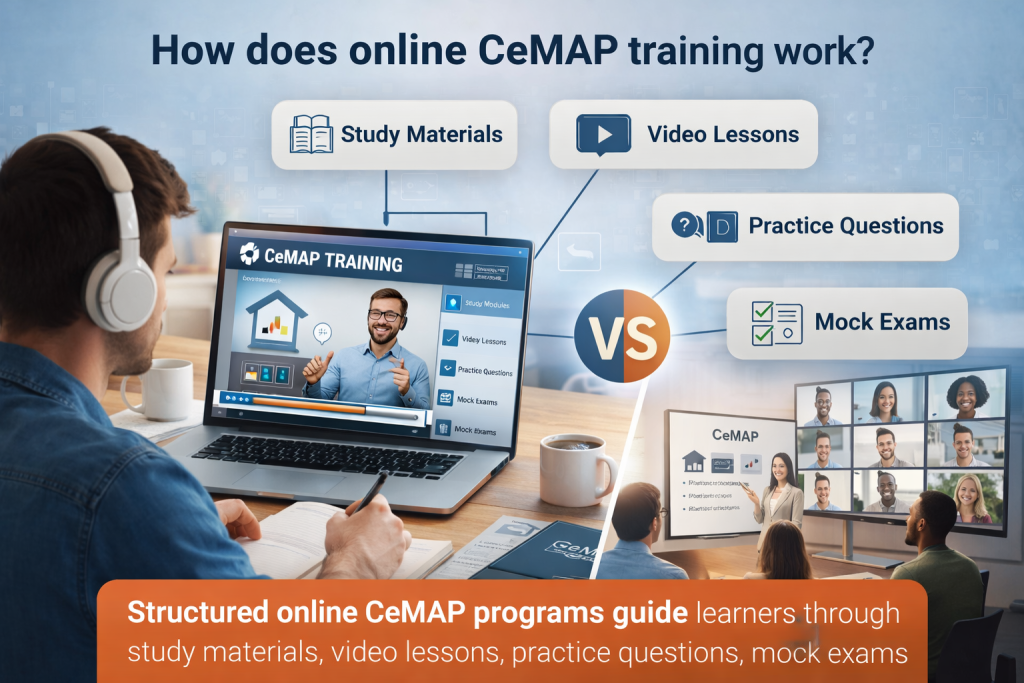
A more useful structure introduces a topic, explains unfamiliar terminology, breaks larger subjects into manageable sections and then gives the learner opportunities to check whether they have understood what they have studied.
This might include a combination of:
- structured study materials
- tutor explanations or teaching
- revision notes and study cards
- visual learning resources
- topic-based practice questions
- mock exams
- explanations of incorrect answers
Different resources perform different jobs. Detailed materials help build knowledge, while shorter revision resources help reinforce it. Practice questions then help learners recognise whether they can apply what they have learned.
Learners comparing CeMAP training options should therefore look beyond how much content is included and consider how that content is actually structured and supported.

How Do Beginners Successfully Learn CeMAP?
Beginners succeed by building their knowledge in stages rather than trying to understand everything immediately.
A useful approach is to treat CeMAP as a sequence of smaller subjects rather than one large qualification.
For example, after studying a topic, you should be able to explain its main ideas in your own words before moving heavily into question practice. If you cannot explain something simply, that can be a sign that you need to revisit it.
Practice questions can then reveal where your understanding is strong and where there are gaps.
This is also where CeMAP mock exams become particularly useful. Mock exams are not only about achieving a particular score. They help you become familiar with retrieving information, interpreting questions and applying your knowledge under exam-style conditions.
Getting questions wrong during study is useful when you understand why you got them wrong.
Is CeMAP Mostly About Memorising Information?
There is information you need to remember, but effective CeMAP study involves more than memorising facts.
You need to understand what terms mean, how concepts relate to one another and how your knowledge applies when answering questions.
This distinction matters for beginners.
Repeatedly reading a page until it looks familiar can create the impression that you know the subject. Being able to answer a question without looking at the material provides a much better test of whether that knowledge has actually stuck.
Active study methods such as practice questions, study cards, short self-tests and explaining concepts aloud can therefore be more useful than repeatedly rereading the same notes.
What Should You Do When You Do Not Understand a CeMAP Topic?
Go back to the underlying concept rather than repeatedly trying to memorise something that does not make sense.
Sometimes the difficulty is not the topic itself. It is one term or earlier concept that has not been properly understood.
For example, if an explanation contains several unfamiliar financial terms, looking at the whole section repeatedly may not solve the problem. Identifying those individual terms and understanding them first can make the wider explanation much clearer.
This is one reason CeMAP learner support can be valuable, particularly for complete beginners. Being able to ask a question and receive clarification can prevent one misunderstanding from affecting later topics.
Whether you choose CeMAP home study or tutor-led virtual classroom CeMAP training, consider what happens when you get stuck, not just what resources you receive at the beginning.

What Are the Best CeMAP Study Tips for Beginners?
If you are starting CeMAP with no finance experience, a few simple habits can make studying much more productive.
Learn the language as you go.
Keep a list of unfamiliar terms and make sure you understand them rather than simply recognising them.
Study in manageable sections.
Smaller, regular study sessions can make it easier to absorb unfamiliar material than trying to cover large sections at once.
Test yourself regularly.
Do not wait until you have finished everything before attempting questions.
Review incorrect answers.
Understanding why an answer was wrong is more useful than simply recording your score.
Use different learning formats.
Detailed notes, videos, tutor explanations, study cards, diagrams and practice questions can reinforce the same topic in different ways.
Ask for clarification when needed.
Spending hours stuck on one concept is rarely an efficient use of study time if support is available.
Track understanding, not just progress.
Completing ten chapters is not necessarily better than completing six and properly understanding them.
Does Having No Finance Experience Affect How Long CeMAP Takes?
It can affect how quickly you move through the early material, but there is no single study time that applies to every beginner.
Previous knowledge, available study time, learning style, work commitments and how quickly you understand new topics can all affect progress.
Someone working in financial services might recognise certain subjects immediately. A complete beginner may spend longer on those same sections.
That is perfectly reasonable.
The important point is not to compare your progress too closely with somebody starting from a different position. A sensible CeMAP study plan should allow time for learning, consolidation, question practice and revision rather than focusing only on completing materials quickly.
Can CeMAP Help You Understand the Mortgage Industry If You Are Completely New?
Yes. Studying CeMAP can give beginners a structured introduction to many of the concepts they will encounter when learning about mortgage advice and UK financial services.
The qualification provides the academic knowledge required for the relevant examinations, while practical workplace experience develops separately as you move into the industry.
This distinction is important. Passing CeMAP does not mean somebody instantly has the practical experience of an established mortgage adviser.
For learners considering a career change, it can therefore help to explore how to become a mortgage adviser alongside their studies so they understand both the qualification and what comes afterwards.
So, Is CeMAP Difficult Without a Finance Background?
CeMAP requires proper study, but a lack of finance experience should not be treated as a reason you cannot do it.
Complete beginners often have more unfamiliar terminology to learn at the start. The important factors are how clearly the material is explained, whether learning follows a logical structure, how regularly you practise questions and whether you can get clarification when something does not make sense.
You do not need to arrive already knowing about mortgages and financial services. That knowledge is what you are studying to develop.
If you are starting from scratch, focus less on whether you already know enough and more on whether your chosen learning approach gives you a clear route from beginner knowledge through to exam preparation.
Looking for training support?
We offer CeMAP training for learners working towards a career in mortgage advice. Our courses follow the London Institute of Banking & Finance syllabus and are designed to support understanding of mortgage regulation and advice requirements.
Explore our accredited CeMAP training courses
> Futuretrend Financial Training