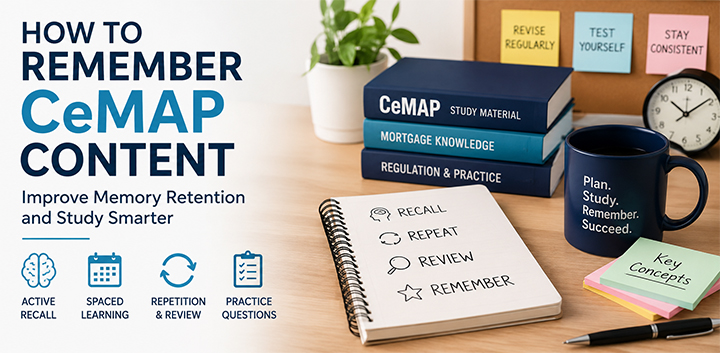
How to Improve Memory Retention for CeMAP Topics

How to Remember CeMAP Content and Improve Memory Retention

If you understand a CeMAP topic while studying but struggle to remember it a few days later, the problem may not be how much you are studying. It may be how you are reviewing and using the information.

To remember CeMAP content more effectively, focus on repeated recall rather than repeatedly reading the same material. Study a topic in manageable sections, test yourself without looking at your notes, return to it at intervals and use practice questions to check whether you can apply what you have learned.

CeMAP contains a mixture of terminology, regulation, processes, responsibilities and mortgage-related concepts. Trying to remember everything after seeing it once is unrealistic. Memory retention develops when important information is revisited and actively retrieved over time.
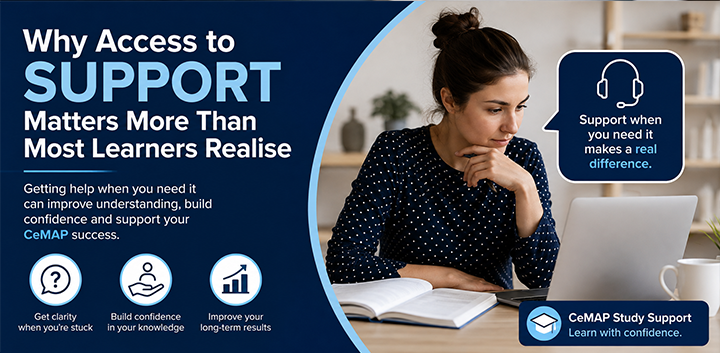
CeMAP learner studying independently with access to support when help and clarification are needed

Why Do I Keep Forgetting CeMAP Topics?

Forgetting CeMAP topics is often caused by moving through the material without giving yourself enough opportunities to retrieve it.

Reading a chapter can create a strong sense of familiarity. You recognise the terminology and understand the explanations while they are in front of you. However, recognition is different from being able to recall information independently.

For example, you might read a section about mortgage regulation and feel comfortable with it. Two days later, if somebody asks you to explain the key points without your notes, you may find that much harder.

That does not necessarily mean you failed to learn the topic. It means the information needs further retrieval and reinforcement.

This is why effective CeMAP revision should include more than reading.

How Does Repetition Help You Remember CeMAP Content?

Repetition helps reinforce CeMAP knowledge, but it works best when you do something with the information each time you return to it.

Simply reading the same page several times can become passive. Instead, change what you do during each review.

You could:

  • Read and understand the topic initially.
  • Close your notes and write down the main points you remember.
  • Use study cards to test key terminology or rules.
  • Answer practice questions on the topic.
  • Return to difficult areas a few days later.
  • Explain the concept aloud in your own words.

This creates repeated contact with the material without simply repeating the same study activity.

A useful question to ask yourself is not “Have I read this?” but “Could I explain or answer a question about this without looking it up?”

That is a much better test of whether the information is becoming retrievable.

What Is Active Recall and How Can It Help With CeMAP?

Active recall means trying to retrieve information from memory before checking the answer. It can be particularly useful for CeMAP because it turns revision into a test of what you genuinely know.

Suppose you have just studied a section covering a particular mortgage concept.

Instead of immediately reading the section again, close your study material and ask yourself:

What were the main points?

Write down everything you can remember. Then reopen your notes and compare your answer with the material.

The gaps become your next revision targets.

You can use the same technique with study cards. Look at the question or prompt first and attempt the answer before turning the card over.

Even getting an answer wrong can be useful because it identifies something that needs further attention.

How Can You Use Active Learning When Studying CeMAP?

Active learning means interacting with CeMAP content rather than only reading or watching it.

There are several simple ways to do this.

You might turn a page of notes into five questions, create a short summary from memory or explain a concept as though you were teaching it to somebody else.

You can also compare related concepts.

For example, rather than trying to memorise two similar terms separately, create a small comparison showing:

  • what each one means;
  • where they differ;
  • when each may apply;
  • any important distinction you need to remember.

Creating the comparison requires you to think about the information rather than simply copy it.

The technique does not need to be complicated. The important part is that your brain has to retrieve, organise or apply what you have studied.

CeMAP learner using active learning techniques including mind maps, study notes and flashcards to understand mortgage topics.

What Is Spaced Learning for CeMAP?

Spaced learning means returning to CeMAP material at intervals rather than trying to learn and revise everything in one long session.

You do not need a complicated revision system to use this approach.

For example, after studying a topic on Monday, you might briefly review it again on Wednesday, test yourself at the weekend and revisit weaker areas the following week.

The exact timings can vary depending on your study schedule and how difficult you find the material.

The principle is more important than a rigid timetable: do not leave a topic behind permanently once you have completed it.

As you progress through CeMAP, older topics should continue appearing in your revision.

This also helps prevent a common problem where learners remember the material studied most recently but struggle with topics covered several weeks earlier.

Should You Mix Old and New CeMAP Topics?

Yes. Combining new learning with short reviews of earlier CeMAP topics can help keep previous knowledge active while you continue progressing through the course.

For example, a study session might include:

New learning: 45 minutes on your current topic.

Recall: 10 minutes testing yourself on something studied earlier.

Practice: 15 minutes answering questions from a mixture of topics.

This is only an example, not a fixed study plan. Some learners will need longer sessions, while others may learn more effectively through shorter periods of study.

The important point is that progression and revision should happen alongside each other.

If all your time is spent moving forwards, earlier knowledge can gradually become harder to retrieve.

How Can Practice Questions Improve CeMAP Memory?

Practice questions help you retrieve knowledge and use it in context, making them an important part of CeMAP revision.

They can also reveal the difference between remembering a fact and knowing when that information is relevant.

When answering practice questions, avoid focusing only on your final score.

Review why you got each incorrect answer wrong.

Was it because you:

  • could not remember the information;
  • confused two similar concepts;
  • misunderstood the question;
  • missed an important word;
  • knew the topic but applied it incorrectly?

These are different problems and may require different responses.

If you cannot remember the information, return to that area and revise it. If you knew the content but misread the question, repeatedly rereading the entire topic may not solve the problem.

Practice questions are therefore useful for both memory and identifying gaps in exam technique.

How Can You Remember Difficult CeMAP Terms and Concepts?

Difficult CeMAP terminology can become easier to remember when you connect it to meaning rather than trying to memorise isolated words.

Start by writing a plain-English explanation of the term.

Then connect it to something else you already understand. This could be its purpose, a related concept, a simple scenario or a comparison with something similar.

For example, if two concepts keep becoming mixed up, place them side by side and identify the one distinction that separates them.

Study cards can also work well for terminology, particularly when the front contains a question rather than simply a word.

Instead of:

Term: [CeMAP term]

try:

Question: What does [CeMAP term] mean and when is it relevant?

This encourages retrieval and understanding together.
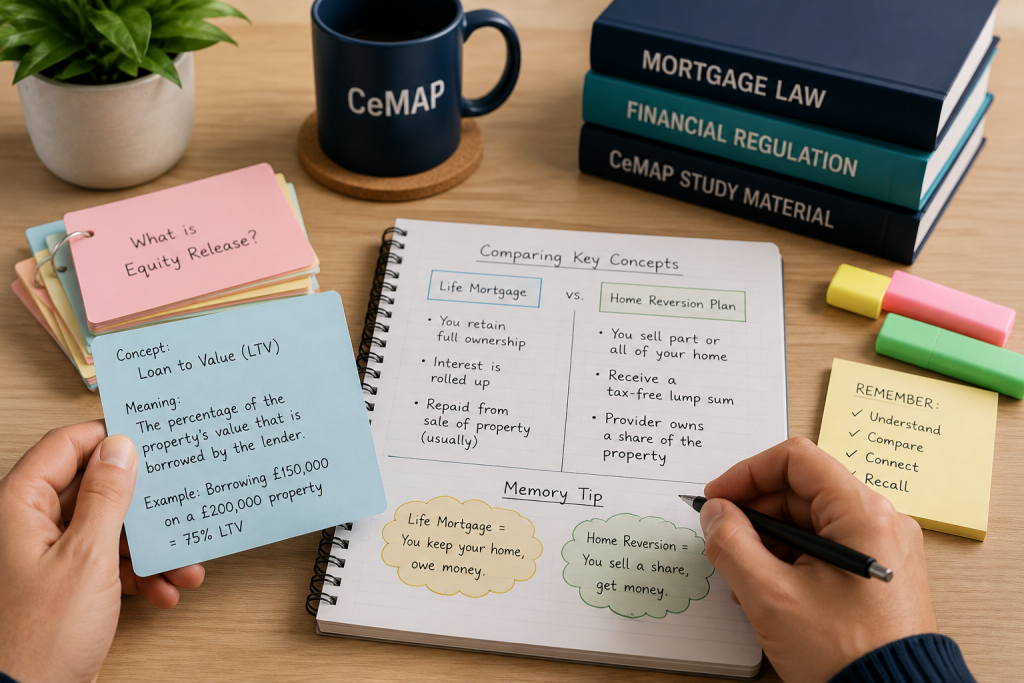
Remembering CeMAP Concepts Through Comparison

Should You Rewrite All Your CeMAP Notes?

Rewriting every CeMAP note is not automatically an effective way to improve memory.

Writing can support learning when you are selecting, summarising and reorganising information. Copying large sections word for word is much more passive.

If you use written revision, try reducing information rather than reproducing it.

Turn a detailed section into:

  • a short summary;
  • five key points;
  • several questions;
  • a comparison table;
  • a simple process;
  • a set of study cards.

The aim is to make yourself decide what the information means and which parts matter.

A short summary created from memory can often tell you more about your current understanding than several pages copied from study material.

What Is a Practical CeMAP Memory Routine?

A simple memory routine can be built into normal CeMAP study without dramatically increasing your study time.

After completing a section, close your material and spend a few minutes recalling the main points.

At the start of your next study session, test yourself on something from the previous session before beginning new material.

At the end of the week, return to several earlier topics and complete a mixture of recall activities and practice questions.

As you get closer to the exam, continue mixing older material with newer topics rather than concentrating exclusively on whichever section you studied last.

This creates a cycle of:

Learn → Recall → Check → Revisit → Apply

You are not trying to memorise the entire CeMAP syllabus in one go. You are gradually strengthening your ability to retrieve the information when you need it.

What Are Common CeMAP Memory and Revision Mistakes?

One of the biggest mistakes is confusing familiarity with knowledge. Seeing a page several times does not necessarily mean you could answer a question about it without the page in front of you.

Other common problems include spending too long making perfect notes, revising only favourite topics, repeatedly reviewing information you already know and avoiding practice questions because mistakes feel discouraging.

Another mistake is waiting until the end of your studies before returning to earlier material.

Regular short reviews can make revision more manageable because you are maintaining knowledge rather than trying to rebuild it shortly before the exam.
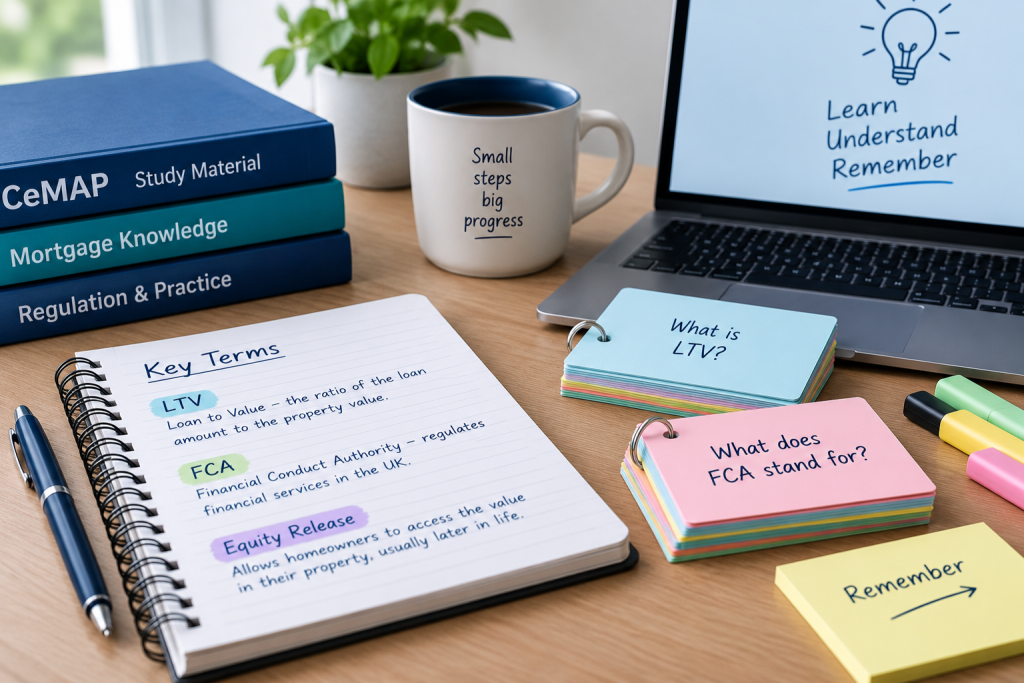
CeMAP study notes and flashcards used to remember key mortgage terms and financial concepts.

How Can You Tell Whether You Really Remember a CeMAP Topic?

The best test is whether you can retrieve and use the information without relying heavily on your notes.

Try asking yourself:

Can I explain this clearly without looking at the course material?

Can I answer questions on it when it is mixed with other topics?

Can I identify the difference between similar concepts?

Can I still remember the important points several days later?

If the answer is no, that topic probably needs another review.

This does not mean starting again from the beginning. Identify the specific gaps, revisit them and test yourself again.

How Do You Remember CeMAP Content More Effectively?

The most effective CeMAP revision is usually not about reading more. It is about retrieving more.

Use your study materials to understand each topic, but regularly put them aside and see what you can remember independently. Combine active recall, study cards, practice questions and spaced reviews so that earlier topics remain part of your learning as you progress.

Most importantly, expect to forget some information.

Forgetting something and then successfully retrieving or relearning it is part of the study process. The aim is not to remember every CeMAP topic perfectly after one study session. It is to build stronger recall through repeated, purposeful revision until you can recognise, understand and apply the knowledge when it matters.

Looking for training support?

We offer CeMAP training for learners working towards a career in mortgage advice. Our courses follow the London Institute of Banking & Finance syllabus and are designed to support understanding of mortgage regulation and advice requirements.

Explore our accredited CeMAP training courses

> Futuretrend Financial Training 

Why Access to Support Matters More Than Most CeMAP Learners Realise

CeMAP learner studying independently with access to support when help and clarification are needed

Studying for CeMAP involves more than reading course material and remembering facts. At some point, most learners will come across something they do not fully understand, a question they cannot work out, or a topic that simply does not seem to make sense.

That does not necessarily mean they need someone teaching them every step of the way. It does, however, show why access to support can be an important part of CeMAP study.

Support is often undervalued because learners tend to think about it before they have started studying. At that stage, it is easy to imagine working through the material independently and looking things up when necessary.

The value of support often becomes clearer later, when a learner knows what they are struggling with but cannot work out why.

CeMAP learner studying independently with access to support when help and clarification are needed

Do I Need Support for CeMAP?

You do not necessarily need regular tutor support to study CeMAP successfully. Some learners are comfortable studying independently and may require very little help.

However, having access to CeMAP support can be valuable when you encounter something you cannot resolve confidently on your own.

There is an important difference between needing constant assistance and knowing that help is available when required.

For many learners, support acts as a safety net. They can continue studying independently most of the time but have somewhere to turn when a particular concept, calculation or question causes difficulty.

This can prevent a relatively small misunderstanding from becoming a much bigger obstacle later in their studies.

What Happens When You Get Stuck While Studying CeMAP?

Getting stuck is a normal part of learning. The problem is not encountering something difficult. It is what happens next.

Imagine you are studying a mortgage-related concept and the explanation does not quite make sense. You read it again. You search online. You find another explanation, but it uses different terminology and now you are less certain than before.

You might eventually decide that you understand it well enough and move on.

That uncertainty can then reappear when you encounter the subject in a practice question. If you answer incorrectly, you may not know whether you misunderstood the topic, misread the question or applied the wrong rule.

A small gap in understanding has now affected another part of your study.

Having access to someone who can clarify the original point may allow you to resolve the problem much sooner.

Why Is Clarification So Important When Studying CeMAP?

Clarification helps turn partial understanding into something a learner can actually use.

CeMAP study involves learning terminology, principles, rules and how different concepts apply to mortgage advice. Simply recognising information on a page is not always the same as understanding it well enough to answer a question about it.

A learner might understand what a particular rule says but remain unsure about when it applies. Another learner may know the correct calculation but struggle to identify when a question is asking them to use it.

Good support is therefore not simply about being given an answer.

It can involve explaining the same concept in a different way, providing a practical example, identifying where the learner’s reasoning has gone wrong or helping them interpret what a question is actually testing.

Sometimes a five-minute explanation can resolve something that a learner has spent considerably longer trying to understand independently.

Can You Just Search Online When You Have a CeMAP Question?

Online research can certainly help, but it has limitations.

There is a huge amount of information about mortgages and financial services online. The difficulty for a learner is deciding whether the information they find is relevant to the CeMAP syllabus, current, accurate and explained at the appropriate level.

Search results can also lead learners much further into a subject than they need to go.

For example, you might search for clarification of a particular mortgage regulation and find detailed professional or regulatory material. The information may be accurate, but it could contain considerably more detail than you need for your current studies.

Effective CeMAP support can help distinguish between what you need to understand for your learning and additional information that may not help you at that stage.

That can make study more focused rather than simply giving you more material to read.

NOTE: All questions for exams come from the syllabus that is updated yearly. If changes come into play in the industry these do not mean they are in the sylabus.

CeMAP learner searching online for help with a study question

How Can CeMAP Support Affect Your Confidence?

Support can improve confidence by helping learners establish whether their understanding is correct.

Confidence in CeMAP study should come from understanding rather than simply feeling comfortable with the material.

There are two common problems.

A learner may understand a topic correctly but keep second-guessing themselves because they have nobody to confirm their reasoning. Alternatively, they may feel confident about a topic while having misunderstood an important part of it.

Practice questions and mock exams can help expose these gaps, but support can help explain why the gap exists.

For example, repeatedly getting questions wrong on one subject can become frustrating. A learner may start thinking that they are simply “bad” at that topic.

A tutor or support adviser might instead identify one specific misunderstanding that is affecting several questions.

Once that point is clarified, the subject can suddenly become much easier to manage.

What Does Useful CeMAP Support Actually Look Like?

Useful support does not have to mean spending hours speaking to a tutor every week.

For many learners, the most useful model is independent CeMAP study with support available when needed.

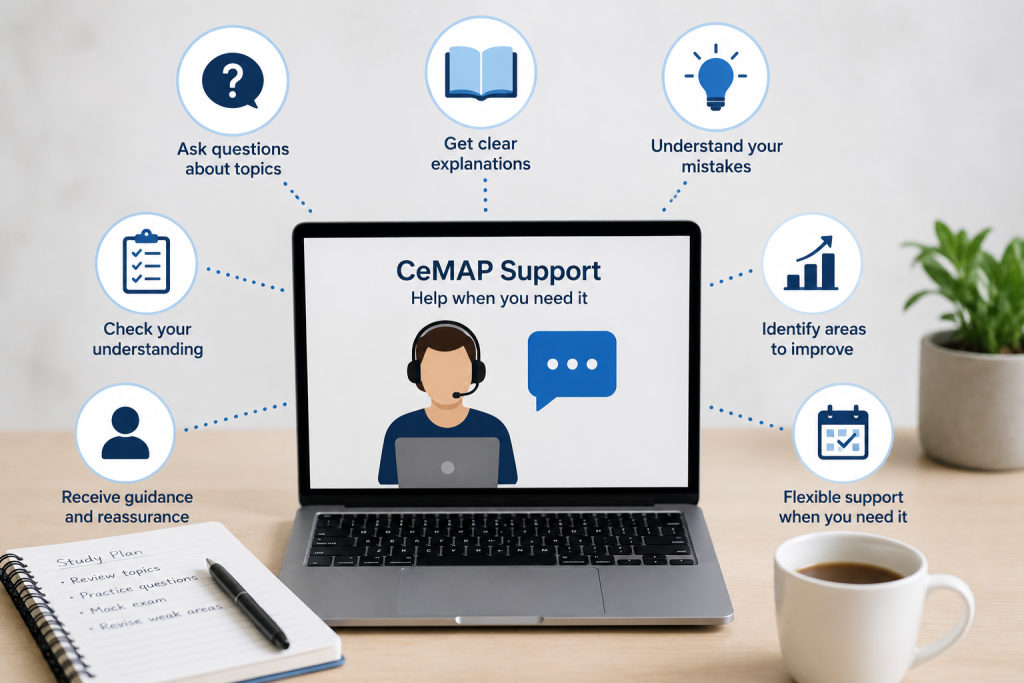
That support might include:

  • asking questions about difficult concepts;
  • checking your understanding of a topic;
  • getting a different explanation when something is unclear;
  • discussing why you answered a practice question incorrectly;
  • getting guidance about areas that may need further revision; and
  • talking through study difficulties before they begin affecting progress.

The important factor is accessibility.

If obtaining help is complicated or takes so long that you have already moved several topics ahead, its usefulness can be reduced.

Support works best when it helps remove obstacles while allowing the learner to remain responsible for their own study.

CeMAP study support providing explanations, guidance and help with questions

What Are Some Realistic Examples of When CeMAP Support Helps?

Consider a learner working through a section they initially find straightforward. They then complete practice questions and consistently score poorly.

Without support, they might simply reread the entire section.

With support, they could discuss the questions they are getting wrong and discover that they understand most of the topic but have confused two closely related concepts. They can then concentrate their revision on the actual problem.

Another learner may be doing well academically but struggling to interpret certain question wording. Their knowledge is not necessarily the issue. They need help understanding how to slow down, identify what is being asked and separate relevant information from distractions.

A third learner may have been away from formal education for many years. They understand the course material but are unsure how to organise their study or use practice results effectively.

These are different problems and they require different forms of support.

That is one reason access can matter more than the amount of support used.

Does Asking for Help Make CeMAP Study Less Independent?

No. Effective independent learning includes recognising when additional explanation would be useful.

Self-study does not have to mean studying entirely alone.

In fact, repeatedly spending hours trying to solve one problem can sometimes be less effective than asking a focused question, understanding the answer and continuing with your study.

The aim should not be to ask for help whenever something requires effort. Working through challenging material independently is an important part of learning.

The better approach is to recognise the difference between something that is difficult and something that you genuinely do not understand.

If another attempt, your study material and your notes resolve the issue, additional help may not be necessary.

If you remain confused, clarification can save time and prevent incorrect understanding from becoming established.

Can Support Help With CeMAP Practice Questions and Mock Exams?

Support can be particularly useful when reviewing practice questions and mock exam results.

A score tells you how many questions you answered correctly. It does not always tell you why you made the mistakes you did.

Two learners achieving the same score could have completely different problems.

One might have knowledge gaps in several topics. Another might know the material but rush through questions and miss important wording. Someone else may repeatedly change correct answers because they lack confidence.

Reviewing mistakes carefully helps turn question practice into learning.

Where a pattern is difficult to identify independently, support can help a learner understand whether they need more revision, a clearer explanation or simply a better approach to answering questions.

CeMAP learner reviewing mock exam results and practice question mistakes with study support

What Is the Long-Term Effect of Having Access to Support?

The longer-term benefit of support is not simply getting individual questions answered. It can help learners become better at identifying and resolving their own learning difficulties.

When someone explains why your reasoning was incorrect, you begin to recognise similar problems yourself.

When you learn how to review a mock exam properly, you can use the same approach on future attempts.

When a difficult concept is explained through a practical example, you may become better at connecting other parts of the syllabus to real mortgage situations.

Over time, the learner should ideally become less dependent on support rather than more dependent on it.

That is an important distinction.

Good support should help build independent understanding, not replace it.

Should Support Be a Factor When Choosing How to Study CeMAP?

Yes. Even if you expect to study mostly independently, it is worth considering what happens if you need help.

When comparing CeMAP study options, learners naturally look at course content, study materials, practice questions, mock exams, price and flexibility.

Access to support deserves to be considered alongside them.

Ask practical questions. Is there somewhere to ask questions? Who provides the answers? Can difficult concepts be explained rather than simply directing you back to the course material? Can you get help understanding mistakes in your practice work?

You may use that support frequently, occasionally or hardly at all.

The important point is that your need for support is difficult to predict before you begin studying.

Having access to it gives you another way to resolve problems when independent study alone is not providing the answer.

So, Do You Really Need Support for CeMAP?

Not every CeMAP learner needs regular support, and some people are perfectly comfortable completing most of their studies independently.

But there is a strong case for having access to support when you need clarification, become stuck or cannot understand why you are making mistakes.

The real value of support is not having someone constantly telling you what to do.

It is knowing that when you reach a genuine obstacle, you do not have to choose between guessing, spending hours searching for an explanation or simply moving on without fully understanding it.

For many learners, support may only play a small part in their overall CeMAP study.

But when it is needed, that small part can make a significant difference to how effectively they learn.

Looking for training support?

We offer CeMAP training for learners working towards a career in mortgage advice. Our courses follow the London Institute of Banking & Finance syllabus and are designed to support understanding of mortgage regulation and advice requirements.

Explore our accredited CeMAP training courses

> Futuretrend Financial Training 
How to Combine Self-Study with Structured Support for Better CeMAP Results

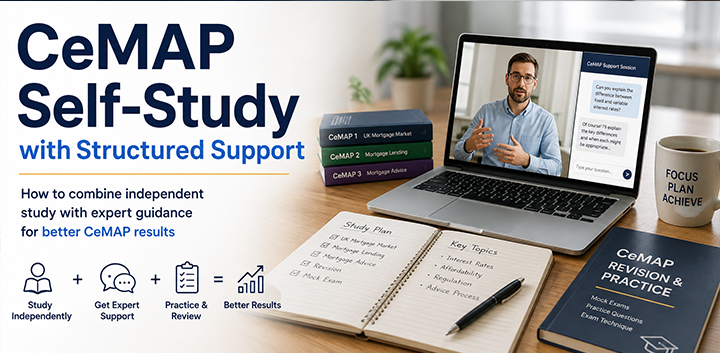
CeMAP self-study with structured support and tutor guidance

Can I self-study CeMAP with support? Yes. Self-study and structured support do not have to be separate ways of learning CeMAP. Combining the flexibility of independent study with access to guidance, explanations and feedback can give learners a more balanced way to prepare.

Self-study gives you control over when, where and how quickly you learn. Structured support can then help when a topic is unclear, your progress stalls or you need reassurance that you have understood something correctly.

The important part is knowing how to use each approach effectively. Support should strengthen your independent learning rather than replace it.

CeMAP self-study with structured support and tutor guidance

Can You Self-Study CeMAP with Support?

Yes. You can complete much of your CeMAP learning independently while using structured support at specific points during your studies.

CeMAP, the Certificate in Mortgage Advice and Practice, requires learners to understand a considerable amount of information and then apply that knowledge accurately when answering exam questions. Independent study can work well for learning and revising the material, particularly when you have clear resources and a sensible study plan.

However, studying independently does not mean you have to work entirely alone.

Structured support might include:

  • access to a tutor when you have questions;
  • scheduled teaching or revision sessions;
  • explanations of difficult topics;
  • feedback on areas where you are struggling;
  • mock exams and question practice;
  • guidance on how to organise your studies.

The result is a hybrid approach where you remain responsible for your own learning but have somewhere to turn when you need additional help.

What Are the Limitations of Studying CeMAP Completely on Your Own?

The main limitation of complete self-study is that it can be difficult to recognise when you have misunderstood something.

Reading a section and feeling that it makes sense is not always the same as being able to recall that information or use it correctly in an exam question.

There are several other challenges.

You may spend too much time on areas you already understand while avoiding topics you find difficult. You might become stuck on one particular concept and lose valuable study time trying to resolve it yourself. It can also be difficult to judge whether your revision is progressing at the right pace.

Another common problem is studying without enough structure. Having access to plenty of material does not automatically create an effective learning plan.

Self-study works best when you know:

  1. what you need to learn;
  2. the order in which to learn it;
  3. how to check your understanding;
  4. when to revisit weaker areas.

Without those elements, it is easy for self-study to become a cycle of reading, highlighting and rereading without properly testing what you can remember.

CeMAP learner struggling with the limitations of studying alone

What Does Structured Support Add to CeMAP Self-Study?

Structured support gives you access to another source of explanation and direction when independent learning is not enough.

Its purpose is not to provide someone who simply gives you the answers. Good support should help you understand why an answer is correct and identify where your understanding needs further work.

This can be particularly useful with topics where several rules or concepts appear similar.

A tutor may be able to explain the same subject in a different way, use a practical mortgage-related example or identify the particular part of a topic that is causing confusion.

That can save you from repeatedly rereading the same material without resolving the underlying problem.

Support can also provide some accountability. When all your study is completely independent, it can be easy to keep postponing revision. Having a learning structure, planned sessions or progress points can help you maintain a more consistent routine.

How Should You Combine Self-Study and Structured Support?

A useful approach is to make CeMAP self-study your foundation and support your safety net.

Start by working through each topic independently using your main study materials. Make notes where useful, test yourself regularly and identify anything you cannot confidently explain or answer.

Rather than immediately seeking help whenever something feels difficult, spend some time trying to work it out yourself. This encourages active learning and helps you identify exactly what you do not understand.

When you still cannot resolve the issue, use the support available to you.

For example, instead of asking:

“I don’t understand this topic.”

Try to narrow the problem down:

“I understand how this rule works, but I don’t understand why it applies differently in this example.”

That gives a tutor a much clearer starting point and makes the support more useful.

After receiving an explanation, return to independent study. Try some questions on the topic or explain the concept in your own words without looking at your notes.

Support has then helped you overcome a specific obstacle without taking over the learning process.

What Is a Practical Hybrid CeMAP Study Routine?

A hybrid CeMAP study routine does not need to be complicated.

A simple cycle could look like this:

Learn → Test → Identify gaps → Get support → Retest → Review

Start with a manageable section of your CeMAP materials rather than trying to cover too much at once.

Once you have studied it, close your materials and test what you can remember. This might involve answering practice questions, writing down key points from memory or explaining the subject aloud.

Next, check your answers and identify gaps.

Some gaps will be simple mistakes that you can correct yourself. Others may show that you have not properly understood the underlying subject. These are the areas where structured support can be particularly valuable.

Once the issue has been explained, do not simply move on. Return to the topic later and test yourself again.

That final stage matters because understanding an explanation while somebody is giving it to you does not necessarily mean you will remember it independently.

When Should You Ask for CeMAP Study Support?

You do not need to wait until you are completely stuck before asking for help.

Support may be useful when:

  • you repeatedly get questions wrong on the same subject;
  • an explanation in your study materials still does not make sense;
  • you understand individual facts but struggle to connect them;
  • you are unsure why an answer is wrong;
  • your mock exam results reveal a consistent weak area;
  • you are spending a disproportionate amount of time on one topic.

There is also a difference between a knowledge gap and an exam technique problem.

If you do not know the underlying information, you need to return to learning and revision.

If you know the subject but regularly misread questions, overlook important wording or change correct answers unnecessarily, the issue may be how you are approaching the questions rather than your knowledge of the syllabus.

Structured support can help you distinguish between the two.

Can Too Much Support Make Self-Study Less Effective?

It can, particularly if support becomes a substitute for thinking independently.

If you ask for an explanation before attempting a topic yourself, repeatedly rely on someone else to interpret questions or only study when a tutor is present, you may not develop the independent recall needed for the exam.

CeMAP exams ultimately require you to read, interpret and answer questions without a tutor beside you.

That means some of your preparation needs to reproduce those conditions.

You should regularly complete question practice independently, including timed mock exams where appropriate. This gives you a clearer picture of what you can actually do without notes, prompts or explanations.

Support should gradually help you become more independent, not more dependent on it.

What Are the Benefits of Hybrid CeMAP Learning?

The biggest benefit is that hybrid learning combines two useful approaches rather than forcing you to choose between them.

Self-study provides:

  • flexibility around work and other commitments;
  • control over your study pace;
  • time to revisit topics when necessary;
  • independent recall and question practice.

Structured support can provide:

  • clarification when something is unclear;
  • alternative explanations;
  • practical examples;
  • help identifying weaknesses;
  • additional structure and accountability.

Used together, these can create a more responsive way of studying.

A learner who understands a topic quickly can continue independently without waiting for a scheduled lesson. Someone who encounters a difficult section can slow down, work through it and seek additional help where necessary.

This makes the learning process adaptable to the individual rather than assuming every topic requires the same amount of time or support.

CeMAP learner combining self-study with structured support

How Can You Avoid Becoming Over-Reliant on a CeMAP Tutor?

Use your tutor to improve your understanding rather than to shorten the learning process.

Before asking a question, try three things:

  1. Revisit the relevant study material.
  2. Attempt a practice question or example.
  3. Identify precisely what you do not understand.

Then ask for help.

Afterwards, test yourself without assistance.

This creates an important distinction between supported learning and dependent CeMAP learning.

Supported learning helps you become capable of answering questions yourself. Dependent learning can make something feel easy while help is available but leave you unsure when that help is removed.

As your exam approaches, independent practice should become increasingly important.

How Do You Know If Your Hybrid Study Approach Is Working?

Your progress should be visible in what you can do, not simply in how much material you have completed.

Look at whether you can:

  • recall important information without referring to notes;
  • explain concepts accurately in your own words;
  • answer questions across different topics;
  • recognise and correct recurring mistakes;
  • maintain your performance in mock exams;
  • complete questions independently.

Do not judge progress purely by the number of hours you have studied.

Ten hours spent repeatedly reading familiar material may achieve less than a shorter period spent testing yourself, identifying weaknesses and correcting them.

Your results from practice questions and mock exams can provide useful evidence of where your study is working and where further attention is needed.

Is Hybrid Learning Better Than Self-Study Alone for CeMAP?

There is no single study method that will suit every CeMAP learner.

Some people are comfortable studying largely independently. Others benefit from more regular explanation and interaction. Many sit somewhere between the two.

The advantage of a hybrid approach is that you do not have to choose one method exclusively.

You can use independent study for learning, revision and practice while drawing on structured support when it genuinely adds value.

The aim is not to receive as much support as possible. It is to have the right CeMAP support at the right point in your studies.

If you can learn a topic effectively on your own, continue. If you become stuck, repeatedly make the same mistakes or cannot understand why an answer is wrong, use the support available and then return to independent practice.

That balance allows you to keep the flexibility of self-study while avoiding one of its biggest weaknesses: having nobody to turn to when you cannot resolve a problem yourself.

For many learners, that can make CeMAP study more structured, manageable and purposeful without taking away the independence that makes self-study attractive in the first place.

Looking for training support?

We offer CeMAP training for learners working towards a career in mortgage advice. Our courses follow the London Institute of Banking & Finance syllabus and are designed to support understanding of mortgage regulation and advice requirements.

Explore our accredited CeMAP training courses

> Futuretrend Financial Training 

What Makes a CeMAP Course Actually Effective (Beyond Content)?

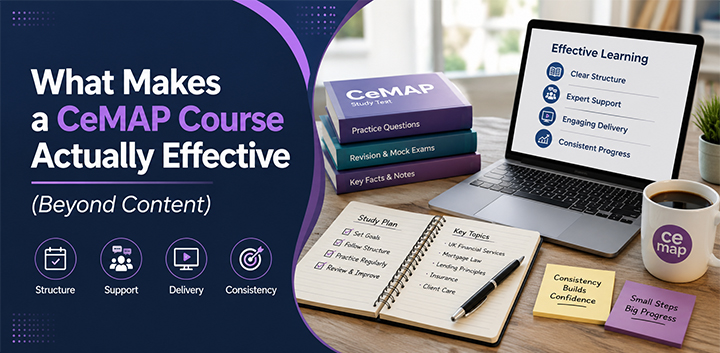
Student studying CeMAP with organised study materials, laptop and notebook, illustrating how structure, support, delivery and consistency contribute to an effective CeMAP course.

When people compare CeMAP courses, it’s easy to focus on what seems most obvious. How many modules are included? How thick is the study manual? Are there mock exams? Is there video content?

While all of these things have value, they don’t necessarily determine whether a course will help you learn effectively.

A good CeMAP course is not simply one with the most content. It’s one that helps learners understand, retain and apply the material consistently over time. The way information is organised, delivered and supported often has a far greater impact than the quantity of resources available.

If you’re comparing providers, looking beyond the course materials themselves can help you choose a learning experience that genuinely suits the way you study.

Student studying CeMAP with organised study materials, laptop and notebook, illustrating how structure, support, delivery and consistency contribute to an effective CeMAP course.

What Makes a Good CeMAP Course?

A good CeMAP course combines accurate learning materials with clear structure, effective delivery, ongoing support and a study approach that encourages consistent progress. Success comes from how well learners engage with the material, not simply how much content is provided.

The most effective courses recognise that learning is a process rather than a collection of documents.

Why Isn't More Content Always Better?

One of the biggest misconceptions is that more resources automatically create a better course.

It’s understandable why this belief exists. If one provider offers hundreds of pages of notes, dozens of videos and countless downloadable documents, it can appear to offer greater value.

In reality, too much information can sometimes make studying harder.

When learners are faced with large volumes of material without clear guidance, they may struggle to identify what matters most. Instead of building understanding step by step, they spend valuable study time deciding where to start.

Effective learning is about selecting the right information at the right time.

A well-designed CeMAP course focuses attention on the syllabus, explains concepts clearly and builds knowledge gradually rather than overwhelming learners with every possible resource.

Why Does Course Structure Matter?

Structure is often the hidden factor that separates effective learning from frustrating learning.

A structured course guides learners through topics in a logical sequence. Each lesson builds naturally on previous knowledge, making new concepts easier to understand.

Without structure, learners may:

  • Jump between unrelated topics
  • Miss important foundation knowledge
  • Spend too much time revising weaker areas while neglecting others
  • Feel overwhelmed despite studying regularly

Good course design removes unnecessary decision-making.

Instead of asking, “What should I study next?”, learners always know the next step.

This creates momentum, which is one of the biggest contributors to consistent progress.

Organised CeMAP study workspace with structured learning materials, progress blocks and study planning representing the importance of course structure for effective learning.

How Does Good Delivery Improve Learning?

The same information can be taught in very different ways.

Delivery refers to how course content is presented, explained and reinforced.

Some learners absorb information best through reading.

Others benefit from hearing explanations during tutor-led sessions.

Some prefer diagrams, worked examples or practical scenarios that demonstrate how concepts apply in real situations.

An effective CeMAP course recognises that simply providing information isn’t enough.

Good delivery focuses on making difficult concepts easier to understand.

Examples include:

  • Breaking complex topics into smaller sections
  • Explaining technical language in plain English
  • Using realistic mortgage scenarios
  • Revisiting important concepts throughout the course
  • Allowing time for questions and clarification

Learning becomes much easier when explanations reduce confusion rather than increase it.

Why Is Support So Important During a CeMAP Course?

Support is often overlooked when comparing courses, yet it can make a significant difference.

Even motivated learners occasionally reach topics that don’t immediately make sense.

Without support, small misunderstandings can become larger problems as new topics build on earlier knowledge.

Support may include:

  • Tutor guidance
  • Question and answer sessions
  • Feedback on practice questions
  • Clarification of difficult concepts
  • Study advice when learners lose momentum

Importantly, support isn’t about giving learners the answers.

It’s about helping them understand why an answer is correct so they can apply the same thinking elsewhere.

Knowing that help is available can also reduce anxiety, making learners more willing to tackle difficult areas instead of avoiding them.

What's the Difference Between Content and Learning?

This is perhaps the most important distinction to understand.

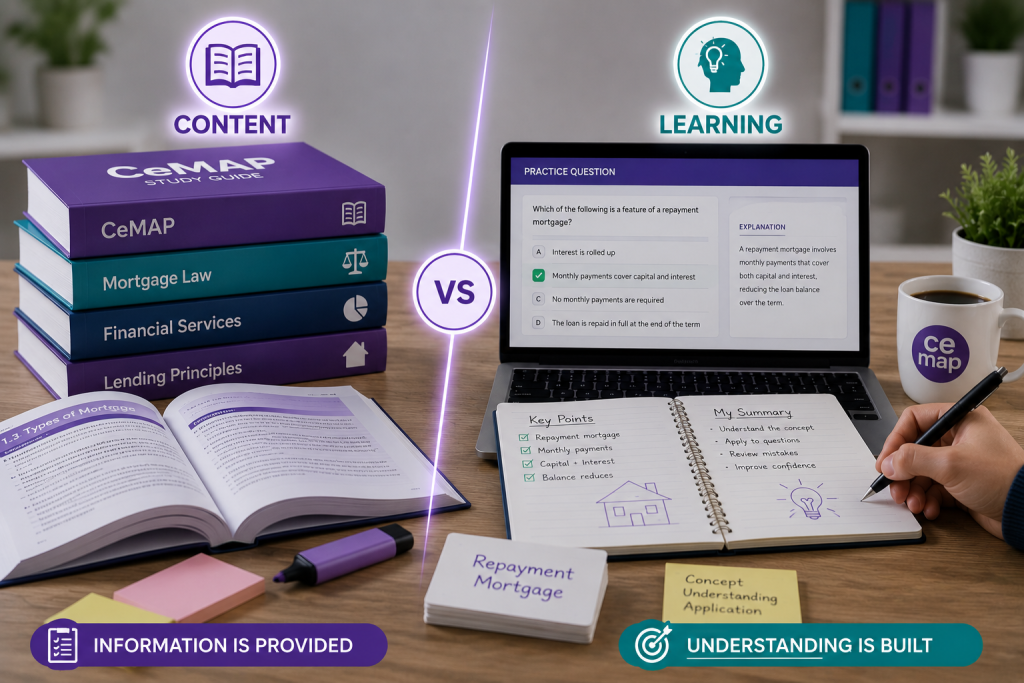
Content is the information.

Learning is what happens after someone engages with that information.

Two learners can read exactly the same chapter yet leave with very different levels of understanding.

Learning involves:

  • Understanding concepts
  • Remembering information
  • Applying knowledge to exam questions
  • Identifying mistakes
  • Improving over time

Simply reading study notes repeatedly does not guarantee learning.

Effective courses encourage active participation rather than passive reading.

That might involve practice questions, discussions, revision activities or opportunities to test understanding throughout the course.

The goal isn’t simply to complete the materials.

The goal is to build lasting understanding.

CeMAP study workspace comparing study materials with active learning methods, showing the difference between reading content and building understanding through practice and revision.

Why Does Consistency Matter More Than Intensity?

Many learners begin their CeMAP studies with enthusiasm.

They spend entire weekends studying, cover several chapters and make rapid early progress.

Then work becomes busy, motivation drops or life gets in the way.

Large gaps between study sessions often make revision harder because previously learned information begins to fade.

Consistent study generally produces better long-term understanding than occasional intensive sessions.

Effective CeMAP courses encourage steady progress by presenting manageable learning goals rather than expecting learners to absorb everything quickly.

Small, regular study sessions often make it easier to:

  • Retain information
  • Build confidence
  • Identify weak areas early
  • Reduce exam stress
  • Maintain motivation over several months

Learning is usually more sustainable when it becomes part of a routine.

How Does Active Learning Improve a CeMAP Course?

One feature common to effective CeMAP learning programmes is active engagement.

Active learning means learners regularly test their understanding instead of simply consuming information.

Examples include:

  • Answering practice questions
  • Explaining concepts in their own words
  • Completing mock exams
  • Reviewing incorrect answers
  • Revisiting difficult topics until they become familiar

These activities strengthen recall and highlight areas that still need attention.

By contrast, passive activities such as repeatedly reading notes can create the impression of progress without revealing knowledge gaps.

A good course encourages learners to interact with the material rather than simply read it.

Should Flexibility Be Part of an Effective CeMAP Course?

Flexibility matters because learners have different responsibilities outside their studies.

Some study around full-time employment.

Others balance family commitments or changing work patterns.

An effective course allows learners to build study around their lives while still maintaining enough structure to encourage progress.

Flexibility should not mean complete absence of guidance.

Instead, it should give learners options while still providing a clear pathway through the syllabus.

Finding the right balance between freedom and direction often leads to a more positive learning experience.

What Questions Should You Ask Before Choosing a CeMAP Course?

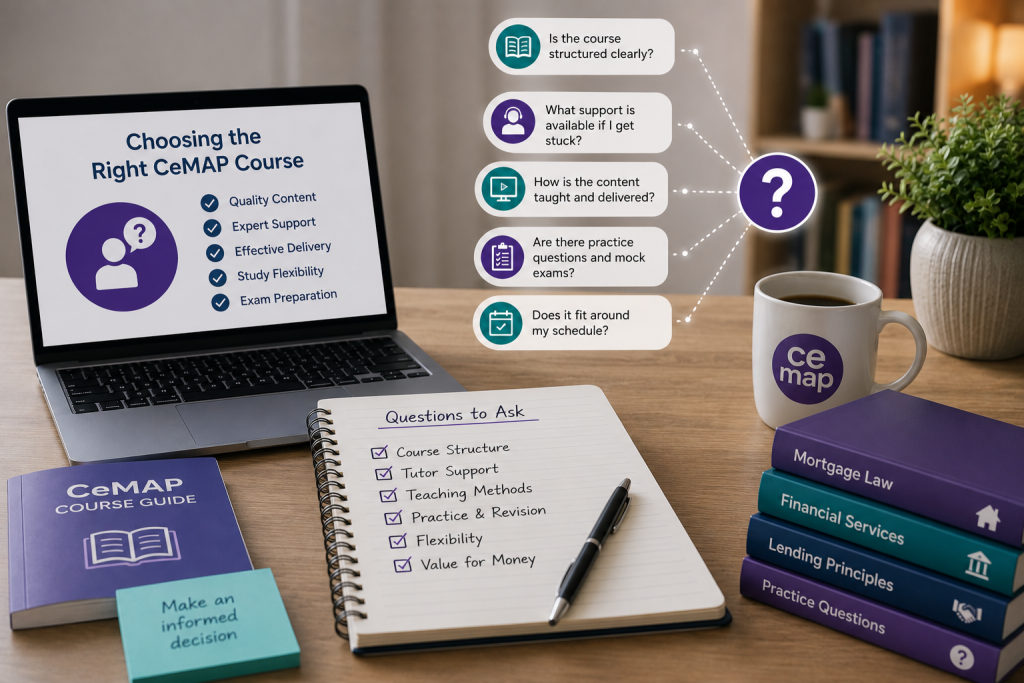
Rather than comparing only price or the amount of content included, consider asking questions such as:

  • Is the course structured logically?
  • How is difficult content explained?
  • What learner support is available?
  • Are there opportunities to ask questions?
  • Does the course encourage regular practice?
  • Is there guidance on revision?
  • Does the learning style suit the way I prefer to study?

These questions often reveal more about the overall learning experience than a list of downloadable resources.

Student comparing CeMAP courses using a checklist, laptop and study materials to evaluate course structure, tutor support, teaching methods and learning resources.

Can the Best Course Guarantee Success?

No.

No CeMAP course can guarantee exam success because learning ultimately depends on how learners engage with the material.

The most effective courses provide the tools, guidance and support needed to build understanding, but learners still need to study consistently, practise regularly and develop confidence over time.

Choosing a course that matches your preferred learning style can make studying more productive, but personal commitment remains an essential part of success.

Final Thoughts

When people ask, “What makes a good CeMAP course?“, they’re often expecting the answer to be about books, videos or revision notes.

In reality, those are only part of the picture.

A genuinely effective CeMAP course combines well-organised content with thoughtful structure, clear delivery, meaningful support and opportunities for active learning. It helps learners understand the syllabus rather than simply work through it.

Ultimately, learning is not measured by how much content you receive but by how confidently you can apply what you’ve learned in the exam and beyond.

When comparing CeMAP courses, looking beyond the materials themselves can help you choose a learning experience that supports steady, confident progress rather than simply providing more information.

Looking for training support?

We offer CeMAP training for learners working towards a career in mortgage advice. Our courses follow the London Institute of Banking & Finance syllabus and are designed to support understanding of mortgage regulation and advice requirements.

Explore our accredited CeMAP training courses

> Futuretrend Financial Training