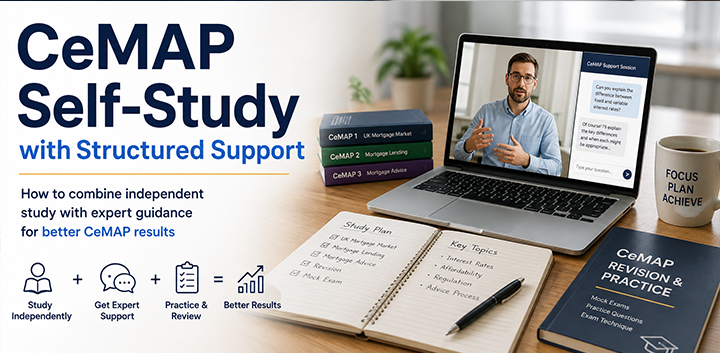
Can I self-study CeMAP with support? Yes. Self-study and structured support do not have to be separate ways of learning CeMAP. Combining the flexibility of independent study with access to guidance, explanations and feedback can give learners a more balanced way to prepare.
Self-study gives you control over when, where and how quickly you learn. Structured support can then help when a topic is unclear, your progress stalls or you need reassurance that you have understood something correctly.
The important part is knowing how to use each approach effectively. Support should strengthen your independent learning rather than replace it.
Can You Self-Study CeMAP with Support?
Yes. You can complete much of your CeMAP learning independently while using structured support at specific points during your studies.
CeMAP, the Certificate in Mortgage Advice and Practice, requires learners to understand a considerable amount of information and then apply that knowledge accurately when answering exam questions. Independent study can work well for learning and revising the material, particularly when you have clear resources and a sensible study plan.
However, studying independently does not mean you have to work entirely alone.
Structured support might include:
- access to a tutor when you have questions;
- scheduled teaching or revision sessions;
- explanations of difficult topics;
- feedback on areas where you are struggling;
- mock exams and question practice;
- guidance on how to organise your studies.
The result is a hybrid approach where you remain responsible for your own learning but have somewhere to turn when you need additional help.
What Are the Limitations of Studying CeMAP Completely on Your Own?
The main limitation of complete self-study is that it can be difficult to recognise when you have misunderstood something.
Reading a section and feeling that it makes sense is not always the same as being able to recall that information or use it correctly in an exam question.
There are several other challenges.
You may spend too much time on areas you already understand while avoiding topics you find difficult. You might become stuck on one particular concept and lose valuable study time trying to resolve it yourself. It can also be difficult to judge whether your revision is progressing at the right pace.
Another common problem is studying without enough structure. Having access to plenty of material does not automatically create an effective learning plan.
Self-study works best when you know:
- what you need to learn;
- the order in which to learn it;
- how to check your understanding;
- when to revisit weaker areas.
Without those elements, it is easy for self-study to become a cycle of reading, highlighting and rereading without properly testing what you can remember.

What Does Structured Support Add to CeMAP Self-Study?
Structured support gives you access to another source of explanation and direction when independent learning is not enough.
Its purpose is not to provide someone who simply gives you the answers. Good support should help you understand why an answer is correct and identify where your understanding needs further work.
This can be particularly useful with topics where several rules or concepts appear similar.
A tutor may be able to explain the same subject in a different way, use a practical mortgage-related example or identify the particular part of a topic that is causing confusion.
That can save you from repeatedly rereading the same material without resolving the underlying problem.
Support can also provide some accountability. When all your study is completely independent, it can be easy to keep postponing revision. Having a learning structure, planned sessions or progress points can help you maintain a more consistent routine.
How Should You Combine Self-Study and Structured Support?
A useful approach is to make CeMAP self-study your foundation and support your safety net.
Start by working through each topic independently using your main study materials. Make notes where useful, test yourself regularly and identify anything you cannot confidently explain or answer.
Rather than immediately seeking help whenever something feels difficult, spend some time trying to work it out yourself. This encourages active learning and helps you identify exactly what you do not understand.
When you still cannot resolve the issue, use the support available to you.
For example, instead of asking:
“I don’t understand this topic.”
Try to narrow the problem down:
“I understand how this rule works, but I don’t understand why it applies differently in this example.”
That gives a tutor a much clearer starting point and makes the support more useful.
After receiving an explanation, return to independent study. Try some questions on the topic or explain the concept in your own words without looking at your notes.
Support has then helped you overcome a specific obstacle without taking over the learning process.
What Is a Practical Hybrid CeMAP Study Routine?
A hybrid CeMAP study routine does not need to be complicated.
A simple cycle could look like this:
Learn → Test → Identify gaps → Get support → Retest → Review
Start with a manageable section of your CeMAP materials rather than trying to cover too much at once.
Once you have studied it, close your materials and test what you can remember. This might involve answering practice questions, writing down key points from memory or explaining the subject aloud.
Next, check your answers and identify gaps.
Some gaps will be simple mistakes that you can correct yourself. Others may show that you have not properly understood the underlying subject. These are the areas where structured support can be particularly valuable.
Once the issue has been explained, do not simply move on. Return to the topic later and test yourself again.
That final stage matters because understanding an explanation while somebody is giving it to you does not necessarily mean you will remember it independently.
When Should You Ask for CeMAP Study Support?
You do not need to wait until you are completely stuck before asking for help.
Support may be useful when:
- you repeatedly get questions wrong on the same subject;
- an explanation in your study materials still does not make sense;
- you understand individual facts but struggle to connect them;
- you are unsure why an answer is wrong;
- your mock exam results reveal a consistent weak area;
- you are spending a disproportionate amount of time on one topic.
There is also a difference between a knowledge gap and an exam technique problem.
If you do not know the underlying information, you need to return to learning and revision.
If you know the subject but regularly misread questions, overlook important wording or change correct answers unnecessarily, the issue may be how you are approaching the questions rather than your knowledge of the syllabus.
Structured support can help you distinguish between the two.
Can Too Much Support Make Self-Study Less Effective?
It can, particularly if support becomes a substitute for thinking independently.
If you ask for an explanation before attempting a topic yourself, repeatedly rely on someone else to interpret questions or only study when a tutor is present, you may not develop the independent recall needed for the exam.
CeMAP exams ultimately require you to read, interpret and answer questions without a tutor beside you.
That means some of your preparation needs to reproduce those conditions.
You should regularly complete question practice independently, including timed mock exams where appropriate. This gives you a clearer picture of what you can actually do without notes, prompts or explanations.
Support should gradually help you become more independent, not more dependent on it.
What Are the Benefits of Hybrid CeMAP Learning?
The biggest benefit is that hybrid learning combines two useful approaches rather than forcing you to choose between them.
Self-study provides:
- flexibility around work and other commitments;
- control over your study pace;
- time to revisit topics when necessary;
- independent recall and question practice.
Structured support can provide:
- clarification when something is unclear;
- alternative explanations;
- practical examples;
- help identifying weaknesses;
- additional structure and accountability.
Used together, these can create a more responsive way of studying.
A learner who understands a topic quickly can continue independently without waiting for a scheduled lesson. Someone who encounters a difficult section can slow down, work through it and seek additional help where necessary.
This makes the learning process adaptable to the individual rather than assuming every topic requires the same amount of time or support.

How Can You Avoid Becoming Over-Reliant on a CeMAP Tutor?
Use your tutor to improve your understanding rather than to shorten the learning process.
Before asking a question, try three things:
- Revisit the relevant study material.
- Attempt a practice question or example.
- Identify precisely what you do not understand.
Then ask for help.
Afterwards, test yourself without assistance.
This creates an important distinction between supported learning and dependent CeMAP learning.
Supported learning helps you become capable of answering questions yourself. Dependent learning can make something feel easy while help is available but leave you unsure when that help is removed.
As your exam approaches, independent practice should become increasingly important.
How Do You Know If Your Hybrid Study Approach Is Working?
Your progress should be visible in what you can do, not simply in how much material you have completed.
Look at whether you can:
- recall important information without referring to notes;
- explain concepts accurately in your own words;
- answer questions across different topics;
- recognise and correct recurring mistakes;
- maintain your performance in mock exams;
- complete questions independently.
Do not judge progress purely by the number of hours you have studied.
Ten hours spent repeatedly reading familiar material may achieve less than a shorter period spent testing yourself, identifying weaknesses and correcting them.
Your results from practice questions and mock exams can provide useful evidence of where your study is working and where further attention is needed.
Is Hybrid Learning Better Than Self-Study Alone for CeMAP?
There is no single study method that will suit every CeMAP learner.
Some people are comfortable studying largely independently. Others benefit from more regular explanation and interaction. Many sit somewhere between the two.
The advantage of a hybrid approach is that you do not have to choose one method exclusively.
You can use independent study for learning, revision and practice while drawing on structured support when it genuinely adds value.
The aim is not to receive as much support as possible. It is to have the right CeMAP support at the right point in your studies.
If you can learn a topic effectively on your own, continue. If you become stuck, repeatedly make the same mistakes or cannot understand why an answer is wrong, use the support available and then return to independent practice.
That balance allows you to keep the flexibility of self-study while avoiding one of its biggest weaknesses: having nobody to turn to when you cannot resolve a problem yourself.
For many learners, that can make CeMAP study more structured, manageable and purposeful without taking away the independence that makes self-study attractive in the first place.
Looking for training support?
We offer CeMAP training for learners working towards a career in mortgage advice. Our courses follow the London Institute of Banking & Finance syllabus and are designed to support understanding of mortgage regulation and advice requirements.
Explore our accredited CeMAP training courses
> Futuretrend Financial Training