How do I prepare for my CeMAP exam in the final weeks?

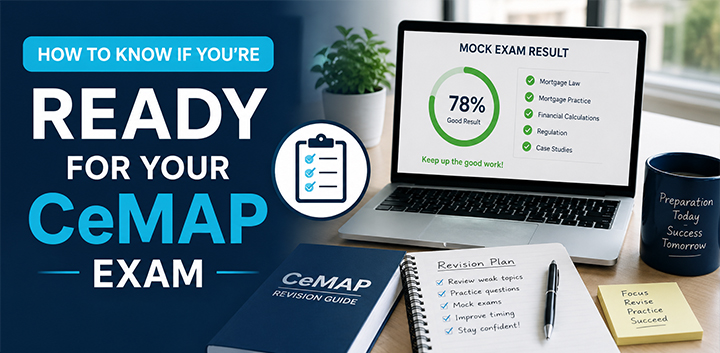
Study setup with CeMAP mock exam paper and notes showing final weeks preparation for a CeMAP exam

Preparing for a CeMAP exam in the final weeks is less about learning new content and more about strengthening what you already understand. The focus shifts from covering ground to consolidating knowledge, building confidence, and managing expectations.

CeMAP, awarded by the London Institute of Banking & Finance (LIBF), is the industry standard qualification for mortgage advisers in the UK. It meets the Financial Conduct Authority (FCA) education requirements for giving mortgage advice. That means the exams are designed to test applied understanding, not just memory.

In the final stretch, preparation becomes more about clarity than effort.

Study setup with CeMAP mock exam paper and notes showing final weeks preparation for a CeMAP exam

Why do the final weeks before a CeMAP exam feel different?

The final weeks often feel more intense, even if you are studying less new material. This shift happens because your role as a learner changes.

Earlier in your studies, the focus is on exposure. You are encountering topics for the first time, building familiarity, and trying to understand how everything fits together. In the final weeks, that changes. You are no longer asking “What is this?” but instead “Do I really understand this?”

That difference matters.

You may notice:

  • Gaps in knowledge that were not obvious before
  • Topics that felt clear now feel less certain
  • A stronger awareness of the exam itself

This is normal. It is a sign that you are moving from learning to refining.

Many learners assume this feeling means they are not ready. In reality, it often means the opposite. You are becoming more aware of the detail, which is exactly what the exam requires.

Should you still be learning new content in the final weeks?

In most cases, the final weeks are not the time to introduce large amounts of new material.

CeMAP exams assess how well you understand the full syllabus. Trying to add new topics late can dilute your focus and create confusion. Instead, the priority is consolidation.

Consolidation means:

  • Strengthening your understanding of core concepts
  • Revisiting topics you have already studied
  • Connecting different areas of the syllabus together

That does not mean avoiding new content completely. If there are small gaps or areas you have not covered at all, it is reasonable to address them. The key is proportion.

The majority of your time should be spent improving what you already know.

A useful way to think about it is this: it is better to have a solid grasp of most topics than a shallow understanding of everything.

What does consolidation actually involve?

Consolidation is often misunderstood. It is not just re-reading notes or going over the same material again.

It is about making your understanding more reliable.

This includes:

Recognising patterns

Many CeMAP topics are linked. For example, regulation, products, and client circumstances all interact. Consolidation helps you see these connections more clearly.

Clarifying definitions

Some areas rely on precise wording. Being able to explain key terms in your own words is a strong sign of understanding.

Reducing uncertainty

You are not aiming for perfection, but you are aiming to reduce hesitation. If a topic feels unclear, it is worth revisiting.

Building confidence in application

The exam is not just about recalling facts. It is about applying knowledge in context. Consolidation helps you feel more comfortable doing that.

This stage is quieter than earlier study phases, but it is where a lot of progress happens.

How useful are mock papers and study materials in the final weeks?

Mock papers and structured study materials can play an important role in the final stage of CeMAP preparation, but their value comes from how they are used rather than how many you complete.

In the final weeks, these resources support consolidation rather than new learning.

Mock papers help bring the syllabus together. They expose how different topics appear in exam-style questions and highlight where your understanding feels solid and where it does not. This is less about scoring highly and more about recognising patterns and identifying areas that still feel uncertain.

CeMAP mock exam paper and study materials on desk showing how learners revise in the final weeks before the exam

Reviewing your existing study materials is equally important. By this stage, you are not looking for new explanations, but clearer ones. Revisiting well-structured content can help reinforce key ideas and make connections between topics easier to see.

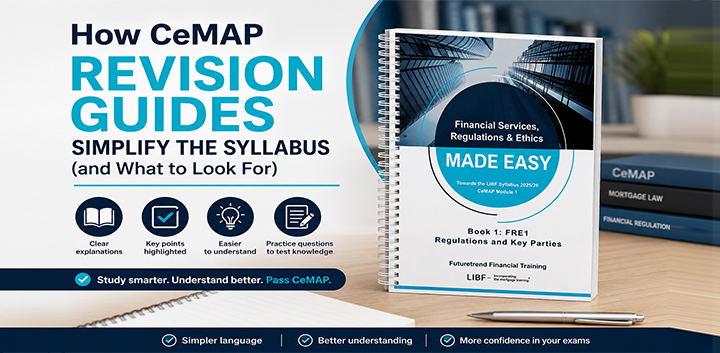
This is where the quality and structure of your CeMAP training materials can make a difference. Learning resources that are organised into clear topics and sub-topics allow you to return to specific areas without losing context. Materials that include a mix of formats, such as written explanations alongside supported learning content, can also help strengthen understanding from different angles.

Some learners also find value in using training providers that offer access to mock papers and revision support as part of a wider programme. When these resources are aligned with the structure of the syllabus, they can make the final preparation phase feel more focused and manageable.

The key point is that both mock exams and study materials are tools for clarity. They help you confirm what you know, not chase what you don’t.

How should your focus change in the final weeks?

Your focus should move from quantity to quality.

Earlier on, progress might have been measured by how much of the syllabus you covered. In the final weeks, progress is measured by how well you understand what you have already studied.

This shift can feel uncomfortable, especially if you are used to structured learning plans. There is less of a sense of “completing” something and more emphasis on judgement.

That judgement includes:

  • Knowing which topics need more attention
  • Deciding when something is “good enough”
  • Accepting that not everything will feel perfect

This is where well-structured learning materials can make a difference. Content that is clearly organised into topics and sub-topics can help you revisit areas more effectively, rather than feeling lost in a large syllabus.

How big is the CeMAP syllabus and why does that matter now?

The CeMAP syllabus is broad because it covers the full knowledge required for mortgage advice. It includes regulation, mortgage products, client needs, and the wider financial environment.

In the final weeks, the size of the syllabus matters less than how you relate to it.

At this stage, you are not trying to “cover” the syllabus again. You are trying to:

  • Feel familiar with the structure
  • Understand how topics link together
  • Recognise where your weaker areas are

When the syllabus feels large close to the exam, it is often because you are looking at it as a whole again. The key is to bring it back into smaller, manageable sections.

This is where breaking content into topics and sub-topics remains useful, even at the end.

How do you deal with anxiety before a CeMAP exam?

Feeling anxious before a CeMAP exam is common. It is a professional qualification with real implications, so some level of pressure is expected.

The important thing is how that anxiety is understood.

In many cases, anxiety comes from uncertainty, not lack of ability.

You might be asking:

  • “What if I get something unexpected?”
  • “What if I forget something I know?”
  • “What if I am not ready?”

These questions are normal, but they are not always helpful.

CeMAP study setup with notes and mock exam paper showing learner anxiety before exam and preparation environment

A more useful way to approach this stage is to focus on what you can control:

  • Your understanding of the material
  • Your familiarity with the structure of the syllabus
  • Your ability to stay calm and think clearly

It is also worth recognising that no learner feels completely ready. Waiting for that feeling is not a reliable indicator.

Confidence tends to build through engagement with the material, not by avoiding uncertainty.

What expectations should you have going into the exam?

A realistic expectation is that you will not know everything perfectly.

CeMAP exams are designed to test overall understanding, not flawless recall. You are expected to make informed decisions based on your knowledge, not to remember every detail without hesitation.

In practical terms, this means:

  • You may encounter questions that feel unfamiliar
  • You may need to think through answers rather than recognise them instantly
  • You may not feel confident about every response

That does not mean you are underprepared.

It means you are engaging with the exam at the right level.

Setting balanced expectations helps reduce unnecessary pressure. The goal is not perfection. It is competence.

How important is mindset in the final weeks?

Mindset plays a larger role than many learners expect.

By this stage, most of the learning has already happened. What changes now is how you approach what you know.

A steady, realistic mindset can help you:

  • Stay focused on consolidation rather than panic
  • Avoid overloading yourself with new material
  • Maintain a clearer sense of progress

On the other hand, a reactive mindset can lead to:

  • Jumping between topics without depth
  • Doubting areas you already understand
  • Increasing stress without improving performance

This is why the final weeks are often described as a transition. You are moving from learning to trusting your preparation.

Can training structure affect final exam preparation?

The structure of your training can have a noticeable impact in the final weeks.

If your learning materials are clearly organised, it becomes easier to:

  • Revisit specific topics quickly
  • Identify weaker areas
  • Reinforce understanding without starting from scratch

For example, CeMAP training that breaks the syllabus into clear topics and sub-topics allows you to focus your attention more precisely. This can make consolidation more efficient and less overwhelming.

Well-developed training programmes also tend to present information in multiple formats, which can help reinforce understanding in different ways.

This does not change the content of the syllabus, but it can influence how manageable it feels at this stage.

What skills are you really using in the final preparation phase?

In the final weeks, preparation is less about effort and more about judgement.

You are using skills such as:

  • Awareness – recognising what you understand and what you do not
  • Organisation – focusing your time where it matters most
  • Resilience – staying steady even when confidence dips
  • Clarity – being able to explain concepts simply

These are the same types of skills that support success in mortgage advice itself. The ability to process information, stay calm, and make informed decisions is central to both the exam and the role.

What does effective final preparation for a CeMAP exam look like overall?

Effective preparation in the final weeks is focused, calm, and realistic.

It involves:

  • Consolidating existing knowledge rather than chasing new topics
  • Strengthening understanding across the full syllabus
  • Managing expectations about what “ready” feels like
  • Maintaining a steady mindset approaching the exam

The question “How do I prepare for my CeMAP exam?” does not have a single method or formula. Instead, it comes down to using this phase in the right way.

The final weeks are not about doing more. They are about making what you already know more reliable.

When that happens, the exam becomes less about pressure and more about demonstrating understanding.

Looking for training support?

We offer CeMAP training for learners working towards a career in mortgage advice. Our courses follow the London Institute of Banking & Finance syllabus and are designed to support understanding of mortgage regulation and advice requirements.

Explore our accredited CeMAP training courses

> Futuretrend Financial Training 
What “in-house learning materials” really means

n-house CeMAP learning materials illustration showing books, revision guides, online learning and mock exam preparation for CeMAP students

When you read a CeMAP course description, you will often see the phrase “in-house learning materials”. It sounds reassuring, but it is rarely explained clearly.

For learners comparing training providers, understanding what this actually means can make it easier to assess course quality and suitability.

This article explains what in-house materials are, how they are created, and how they relate to studying for CeMAP, which is awarded by the London Institute of Banking & Finance.

n-house CeMAP learning materials illustration showing books, revision guides, online learning and mock exam preparation for CeMAP students

What are in-house CeMAP materials?

In-house CeMAP materials are study resources created and maintained by a training provider, rather than being supplied by an external publisher or textbook provider.

They are designed to support learners working towards CeMAP and typically include:

  • Course notes aligned to the CeMAP syllabus
  • Structured online learning modules
  • Revision guides and summary materials
  • Practice questions and mock exams
  • Tutor-led presentation slides or workshop content

Why do training providers create their own materials?

Training providers often develop their own materials to better control how learners experience the course.

Control over structure and delivery

By creating materials in-house, providers can decide:

  • The order topics are taught in
  • How complex areas are explained
  • How content is broken into manageable sections

This is particularly useful for a qualification like CeMAP, where the syllabus set by the London Institute of Banking & Finance can feel large without clear structure.

Alignment with structured online learning and classroom delivery

In-house materials are often designed to match:

This alignment means learners are not switching between different styles or formats, which can make studying more consistent.

Flexibility to update content

Because providers own the materials, they can update them when needed.

This helps ensure alignment with:

  • The current CeMAP syllabus
  • Updates from the London Institute of Banking & Finance
  • Regulatory context set by the Financial Conduct Authority

What are the benefits of in-house learning materials?

In-house materials can support learning effectively when they are well designed.

More focused explanations

Some in-house materials are written to simplify complex areas of the CeMAP syllabus.

This can help learners:

  • Understand key concepts more quickly
  • Focus on what matters for the exam
  • Avoid getting lost in unnecessary detail

This is often supported by clear revision guides that highlight core knowledge areas.

Benefits of In-House CeMAP Learning Materials

Better integration with revision and practice

When materials are created as part of a full course, they tend to link closely with:

  • Topic-based revision guides
  • End-of-unit quizzes
  • Mock exam practice

This joined-up approach can make revision more structured and easier to manage.

Consistency across the learning journey

Learners using in-house materials often benefit from:

  • A consistent structure across all topics
  • Familiar formats for notes and questions
  • A clearer progression from learning to revision

This can be particularly helpful when working through larger units within CeMAP.

Are there any limitations to in-house materials?

In-house materials are not automatically better than external resources. Their quality depends entirely on how they are developed.

Quality can vary between providers

There is no universal standard for in-house materials, so the quality can differ significantly.

Some providers invest heavily in:

  • Instructional design
  • Clear structure and layout
  • Regular updates aligned to LIBF expectations

Others may offer materials that are:

  • Outdated
  • Overly simplified or too detailed
  • Not well aligned with how CeMAP is assessed

Because of this, the phrase “in-house materials” on its own does not guarantee quality.

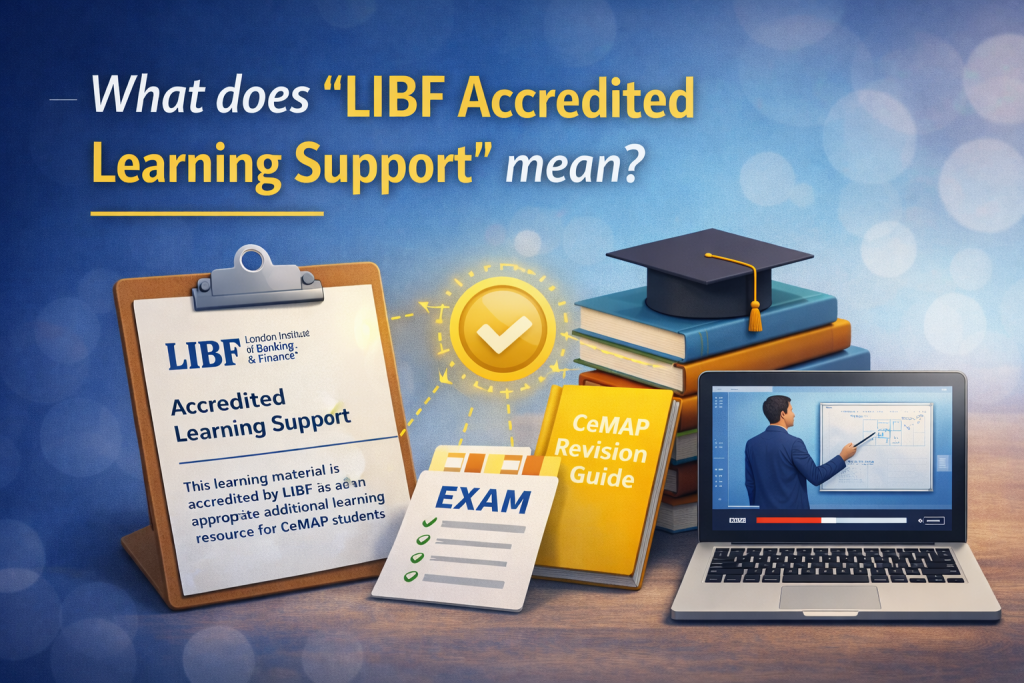
What does “LIBF Accredited Learning Support” mean?

Some training providers are selected to have their learning materials reviewed through an accreditation process linked to the London Institute of Banking & Finance.

You may see the following statement:

“This learning material is accredited by the LIBF as being an appropriate additional learning resource for students undertaking its CeMAP qualification.”

What the accreditation is designed to indicate

This means the materials have been reviewed and are considered:

  • Appropriate to support CeMAP study
  • Comparable in level to LIBF learning materials
  • Fit for purpose in terms of structure and coverage
  • Supportive of a positive learning experience

It also indicates that the materials are designed to help build knowledge in a way that supports professional standards.

LIBF accredited learning support for CeMAP showing study materials, revision guides, online learning and exam preparation resources

What it does not mean

It does not mean:

  • The provider is officially endorsed as superior
  • The materials guarantee exam success
  • The qualification itself is different

All learners are still assessed against the same standards set by the LIBF.

Why this matters

Because in-house materials can vary, this type of accreditation provides a useful point of reference when comparing providers.

It offers reassurance that the materials are aligned to the expected level of study for CeMAP.

Who is responsible for keeping in-house materials up to date?

When a provider creates their own materials, they are fully responsible for maintaining them.

This includes ensuring alignment with:

  • The current CeMAP syllabus
  • Updates issued by the London Institute of Banking & Finance
  • Relevant regulatory context from the Financial Conduct Authority

Why updates matter

Outdated materials can lead to:

  • Gaps in knowledge
  • Confusion during revision
  • Misalignment with exam expectations

For a qualification like CeMAP, accuracy is essential because the content reflects real industry standards.

How can you tell if in-house materials are well developed?

Since quality varies, it helps to look for practical indicators.

Clear structure and topic breakdown

Good materials should:

  • Follow the CeMAP syllabus logically
  • Break topics into manageable sections
  • Support step-by-step learning

This is especially important for structured online learning environments.

Consistent use of revision tools

Look for:

  • Well-designed revision guides
  • Practice questions linked to each topic
  • Mock exams that reflect real assessments

These elements show the materials are designed to support the full learning cycle.

Alignment with assessment style

Materials should reflect how CeMAP exams are structured, rather than just presenting information.

This helps learners prepare more effectively for assessment.

Do providers clearly show what you will receive?

One of the simplest ways to assess in-house materials is to look at how clearly a training provider explains what is included in their course.

Well-developed courses will usually give a clear breakdown of:

  • The types of study materials provided
  • Whether structured online learning is included
  • Access to revision guides and practice questions
  • The availability of mock exams or assessments

If the description is vague or limited, it can be harder to understand how the materials will support your learning.

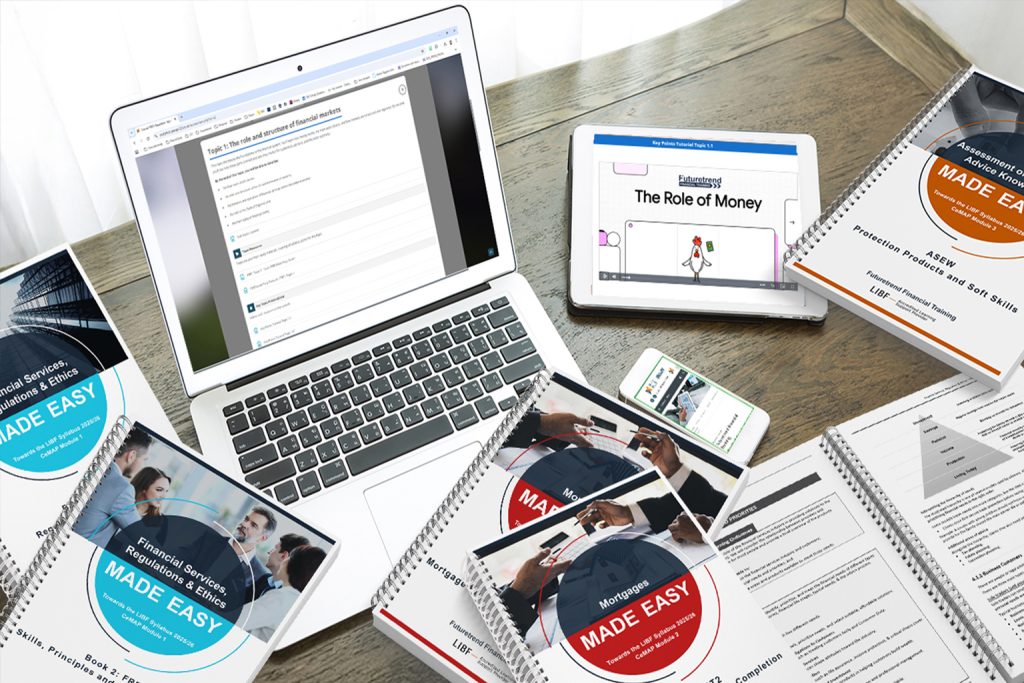
CeMAP in-house learning materials including revision guides, structured online learning, course notes and study resources for exam preparation

Is the content more than just text or video?

Good in-house materials are rarely built around a single format.

Most learners benefit from a mix of resources, which may include:

  • Written course notes
  • Video-based learning
  • Interactive quizzes or knowledge checks
  • Revision guides for key topics

A broader mix of materials can make it easier to stay engaged and adapt your approach as you move through the CeMAP syllabus set by the London Institute of Banking & Finance.

Can you preview the materials before enrolling?

Some providers offer sample materials or walkthroughs of their learning platform.

This might include:

  • Sample revision guides
  • Demo access to structured online learning
  • Example lessons or topic breakdowns

Being able to see how the materials are presented can help you judge:

  • Clarity of explanations
  • Level of detail
  • Overall quality of the learning experience

Providers who are open about showing their materials often make it easier for learners to make informed decisions.

Do in-house materials mean better learning outcomes?

Not necessarily.

In-house materials can improve clarity and structure, but outcomes depend on:

  • How the materials are used
  • The level of support available
  • The learner’s own approach to study

CeMAP is awarded by the London Institute of Banking & Finance, and all learners are assessed against the same standard.

Materials can support learning, but they do not replace consistent study and understanding.

How do in-house materials compare to external textbooks?

Both approaches can support learning in different ways.

In-house materials

  • Tailored to structured courses
  • Integrated with revision guides and practice
  • Easier to update in line with LIBF changes

External textbooks

  • Standardised and widely used
  • Often more detailed
  • Less tailored to specific course delivery

Some learners prefer structured materials, while others prefer more detailed reading. In some cases, providers use both.

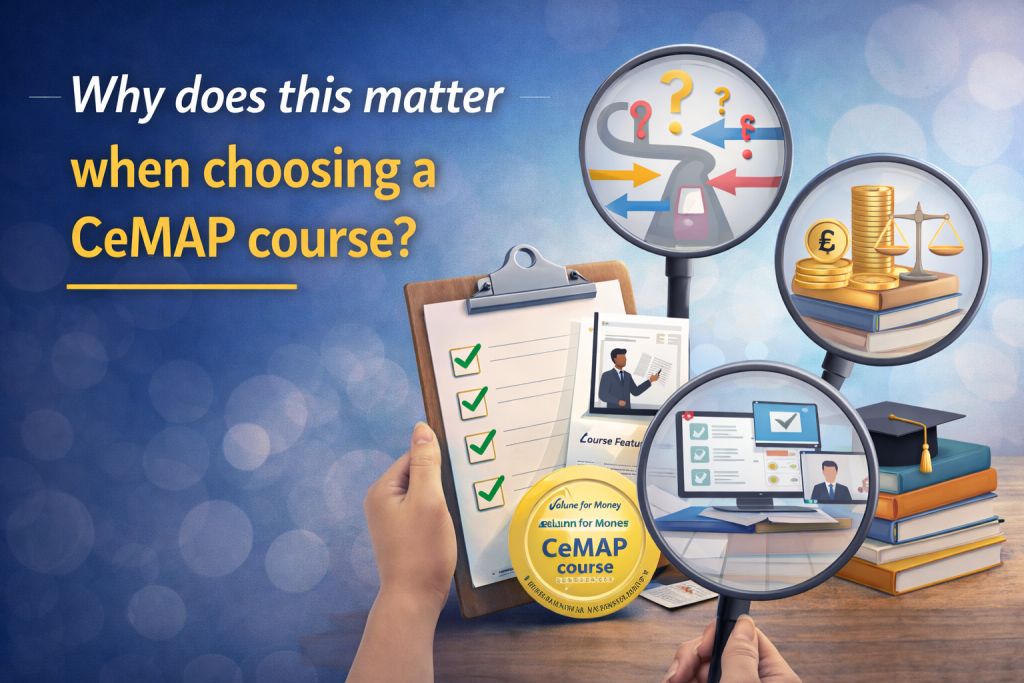
Why does this matter when choosing a CeMAP course?

Understanding what “in-house learning materials” means helps you look beyond marketing language.

Instead of focusing on the label, it is more useful to consider:

  • How the materials are structured
  • Whether they include revision guides and mock exams
  • How they support structured online learning
  • Whether they are kept up to date with LIBF expectations

This allows you to focus on how well the course supports your learning, rather than how it is described.

Choosing a CeMAP course illustration showing comparison of learning materials, structured online learning, revision guides and course features

Final thoughts

“In-house learning materials” simply means that a training provider creates its own study content to support learners working towards CeMAP.

They can offer clear advantages when they are structured well, regularly updated, and aligned with the syllabus set by the London Institute of Banking & Finance.

At the same time, their quality depends entirely on how they are developed and maintained.

For learners, the most important factor is not whether materials are in-house or external, but whether they are clear, accurate, and genuinely support understanding and revision.

Looking for training support?

We offer CeMAP training for learners working towards a career in mortgage advice. Our courses follow the London Institute of Banking & Finance syllabus and are designed to support understanding of mortgage regulation and advice requirements.

Explore our accredited CeMAP training courses

> Futuretrend Financial Training 

CeMAP Study Hub Portal: Your All-in-One Self-Study Solution

CeMAP Study Hub Portal dashboard showing user overview and navigation menu

Struggling to organise your CeMAP revision? The CeMAP Study Hub Portal is here to help. We are a LIBF‑accredited Learning and Support provider and our online platform offers structured guidance in bite‑sized topics. You can study at your own pace on any device. On average, learners complete the course in three months – that’s around 150 hours of study. Choose from digital‑only or digital plus hard‑copy bundles. 

Ready to see it in action?

▶️ Watch the Demo Video

CeMAP Study Hub Portal dashboard showing user overview and navigation menu

What Is the CeMAP Study Hub Portal?

You will have one years access to the Futuretrend Study Hub, an online portal designed to bring you clearer structure, guidance, and a wealth of resources to support your CeMAP studies. Browse our resource library for each Units Topic that includes our Made Easy Revision guides, digital presentations videos, audio tutorials, topic podcast discussions, and test yourself with our online topic questions and full CeMAP exam papers.

Easy Login & Multi‑Device Access

You will get a username and password by email. Log in on any web browser—desktop, tablet or mobile. No app download is needed.

Self‑Paced, Structured Roadmaps

The portal breaks each CeMAP unit into topics matching the LIBF syllabus. Study one topic per session or tackle more if you prefer. This flexible approach means you control your pace.

  • No extra software required

  • Study anywhere with internet access

  • Typical completion: three months (150 hours) part‑time

Inside Your Portal—Resource Breakdown

Digital “Made Easy” Revision Guides

Our two guides – UK Financial Regulations Made Easy & Mortgages Made Easy Revision books have been created by our industry professional tutors breaking down the current LiBF CeMAP syllabus into easy to understand, plain English sections without all the complicated jargon. Each book is approximately 180 to 220 pages long and is part of our London Institute of Banking & Finance recognised learning support.

Made Easy Revision Guide - Topic 1 Screenshot

Video & Audio Tutorials

To support learners in there studies we have converted the made easy revision guides into both presentation videos and audio books.

Digital Presentation Videos
PowerPoint video conversation of key points taken from the Made Easy Guides

▶️VideoCeMAP 1 – Topic 1: Introduction to the Financial Services Industry (one of a series of explainer videos).

Audio Tutorials
Digital audio books of the Made Easy Revision Guides

Free to view samples of 2 of our topic audio tutorials
▶️Audio FileCeMAP 1 Topic 1(Taken from over 16 hours of audio covering all topics).
▶️Audio FileCeMAP 2 Topic 1 (Taken from over 16 hours of audio covering all topics).

Topic 1 Digital Video Presentation

Podcasts & Topic FAQs

Tune into expert discussions on tricky concepts. Get instant answers to common questions in the FAQs section for each topic.

Expert-led conversations on tricky concepts and real-world scenarios.

🎙️ Listen to Podcast Discussion for CeMAP 1: Topic 1

CeMAP Podcasts

Mock Exams & Reviews

Official LIBF digital questions papers, randomised, times and auto marked to not only test your knowledge and understanding of the units but prepare you for the style and type of questions you may get in your final exams.

Samples of mock questions below taken from the official specimen papers (Hard copy edition)
📄UK Financial Regulations Specimen Paper (First few pages).
📄Mortgages Specimen Paper (First few pages).

Reinforce learning with end‑of‑topic and unit reviews.

Official LIBF Specimen Papers

Choose Your Perfect Study Package

Digital Access Only

You will have one years access to the Futuretrend Study Hub, an online portal designed to bring you clearer structure, guidance, and a wealth of resources to support your CeMAP studies. Browse our resource library for each Units Topic that includes our digital Made Easy Revision guides, digital presentations videos, audio tutorials, topic podcast discussions, and test yourself with our online topic questions and full CeMAP exam papers.

Study Hub Learning Portal

Digital + Hard Copy Material

If you prefer physical materials to complement our digital resources, we offer a package that includes printed copies of the Made Easy Revision Guides and LIBF Specimen Papers. These hard-copy resources are delivered directly to you, providing additional support for your studies.

Hard Copies of Made Easy Revision Guide and Official LIBF Specimen Papers

How It Works—From Sign Up to Exam Day

Registration & Study Hub Access

Sign up on our website. You’ll receive login details by email. Log in and start studying straight away. Any Hard Copy Resources will be dispatched and normally arrive within 2 working days.

Enquire to Get Started

Study & Practice

Follow the structured roadmaps for each Unit. Watch videos, listen to audio tutorials and review FAQs. Complete topic questions and end‑of‑unit quizzes.

Exam Booking & Completion

When you are ready for your exams you will need to register with the London Institute of Banking and Finance. This is the awarding body who issue your certificate and exams are charged at £223 per module.

Exams are taken when you are ready at a Pearson Vue Centres and also available online with a moderator observing you via your web camera.

👉 Click here to find out more details

Frequently Asked Questions (FAQ)

Who is the Study Hub best for?

Complete beginners, career‑changers and those needing extra support for CeMAP exams.

Can I switch packages mid‑course?

Yes. Contact support to upgrade at any time. Enquire Here

How long do I have access?

One year’s digital access. Printed materials are dispatched on purchase.

How often are resources updated?

We update materials annually for syllabus changes. You’ll get portal notifications when updates are live.

Conclusion

The CeMAP Study Hub Portal delivers structured, LIBF‑accredited support for your exam success. With flexible pacing, varied formats and mock exams, it suits all learners. Benefit from our 25 years’ experience in training and a 90% first‑time pass rate.

LIBF
Images Designed by Futuretrend and LIBF