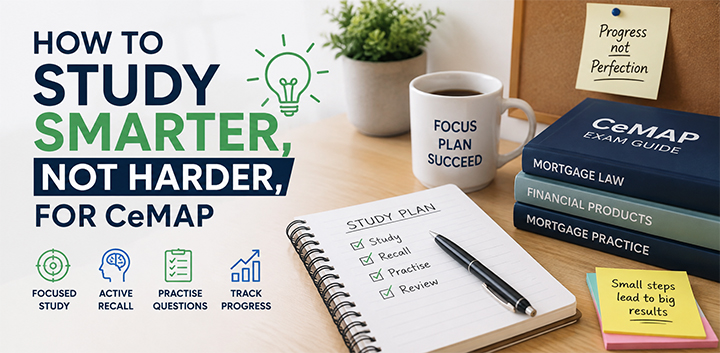
Studying for CeMAP can quickly feel like a large workload. There are regulations to understand, financial terminology to learn, mortgage concepts to remember and exam questions to prepare for.
The solution is not necessarily to spend more hours studying.
Studying CeMAP efficiently means using your available study time on activities that improve understanding, recall and exam performance. This usually involves structured study sessions, active recall, regular question practice and targeted revision rather than repeatedly reading the same material.
A focused 45-minute study session can sometimes achieve more than several hours of unfocused reading.
The aim should therefore be to make your study time productive, not simply longer.
How Can You Study CeMAP Efficiently?
An efficient CeMAP study routine should combine learning new material with recalling previous topics and applying your knowledge through questions.
Rather than treating studying and revision as two completely separate stages, try to include both throughout your preparation.
A study session might involve:
- learning one manageable section of a topic
- summarising the main points without looking at your notes
- completing a small number of relevant questions
- reviewing anything you answered incorrectly
- briefly revisiting an earlier topic
This gives each study session a clear purpose.
It also helps prevent a common problem where learners spend weeks working through course material but discover later that they have forgotten much of what they studied at the beginning.
Why Does Spending More Time Studying CeMAP Not Always Produce Better Results?
The amount of time spent studying matters, but what you do during that time matters just as much.
Reading a CeMAP chapter for two hours may feel productive because you have covered plenty of pages. However, reaching the end of a chapter does not necessarily mean you can remember or apply what you have read.
This is particularly important when preparing for multiple-choice assessments.
You need to recognise relevant information, distinguish between similar answers and apply your knowledge to the question being asked.
Simply recognising information when you see it in your study material can create a false sense of familiarity.
Test yourself instead.
Close your notes and ask:
What can I explain without looking?
That provides a much better indication of what you actually know.
What CeMAP Study Techniques Make Better Use of Your Time?
Effective CeMAP study should require you to actively work with the information rather than simply consume it.
Use active recall
Active recall means trying to retrieve information from memory without immediately checking your study materials.
For example, after studying a section on mortgage regulation, put your notes aside and write down the key points you remember.
Then compare your answer with your study material.
The gaps show you what needs further attention.
Study cards can also be useful for this because they force you to produce an answer before checking whether you were correct.
Practise questions regularly
Do not leave question practice until you have finished everything.
Questions can help identify whether you understand a topic well enough to apply it. They can also reveal areas where two concepts appear similar but have important differences.
When you get a question wrong, do more than memorise the correct option.
Ask yourself why your answer was wrong and why the correct answer was better.
That turns one incorrect question into a useful revision exercise.
Explain topics in your own words
If you can explain a CeMAP concept clearly without relying on textbook wording, you are more likely to understand it.
Imagine you are explaining the subject to another learner.
If you cannot explain it simply, return to the material and identify the part you do not fully understand.
How Should You Structure a CeMAP Study Session?
Giving each session a simple structure can stop study time becoming unfocused.
For example, a 60-minute session could be divided into:
10 minutes: Recall an earlier topic or review study cards.
30 minutes: Work through new CeMAP material.
15 minutes: Complete questions relating to what you have studied.
5 minutes: Record anything that needs further revision.
The exact timings are not important. Some learners will prefer longer sessions and others will work better in shorter blocks.
The important point is that the session contains a mixture of learning, retrieval and application.
This is usually more useful than deciding to “study CeMAP for two hours” without deciding what you actually want to achieve.

How Can You Avoid Wasting Time When Studying CeMAP?
One of the biggest sources of wasted study time is treating every topic as though it needs exactly the same amount of attention.
It probably will not.
You may understand one section after studying it once but struggle with another after several attempts.
Your study plan should respond to that.
Keep a simple record using categories such as:
- confident
- needs more practice
- weak
Spend more revision time on the areas marked weak while continuing to revisit stronger areas occasionally.
This prevents you repeatedly studying topics you already understand simply because they feel comfortable.
Another potential time trap is producing excessive notes.
Notes are useful when they help you process and retrieve information. Rewriting large sections of course material word for word is less useful if you are concentrating on copying rather than understanding.
Try reducing a section to its essential points instead.
Should You Finish All the CeMAP Material Before Starting Revision?
You do not need to wait until the end of your studies before revising earlier material.
Regular review throughout your CeMAP preparation can make final revision much more manageable.
Suppose you study Topic A on Monday and move to Topic B later in the week. Before beginning Topic B, spend a few minutes trying to recall the main points from Topic A.
Return to Topic A again later.
This type of spaced review helps keep earlier information active while you continue progressing through the syllabus.
Otherwise, you can reach the end of your studies and find that the first topics feel almost new again.
How Can Mock Exams Make CeMAP Study More Efficient?
Mock exams become particularly useful once you have built enough knowledge to attempt questions across a wider range of topics.
They should not simply be used to generate a score.
A mock exam can show:
- which subjects you consistently understand
- where you are making repeated mistakes
- whether you are misreading questions
- where your knowledge is incomplete
- whether you are managing your time effectively
The review after the mock is therefore just as important as completing it.
Create a list of the topics behind your incorrect answers and use that list to plan your next revision sessions.
This gives your revision a clear direction rather than returning to the beginning of your notes and studying everything again.
What Should You Do When a CeMAP Topic Is Taking Too Long?
Getting stuck on one difficult section can consume a large amount of study time.
If something is not making sense, repeating the same explanation may not solve the problem.
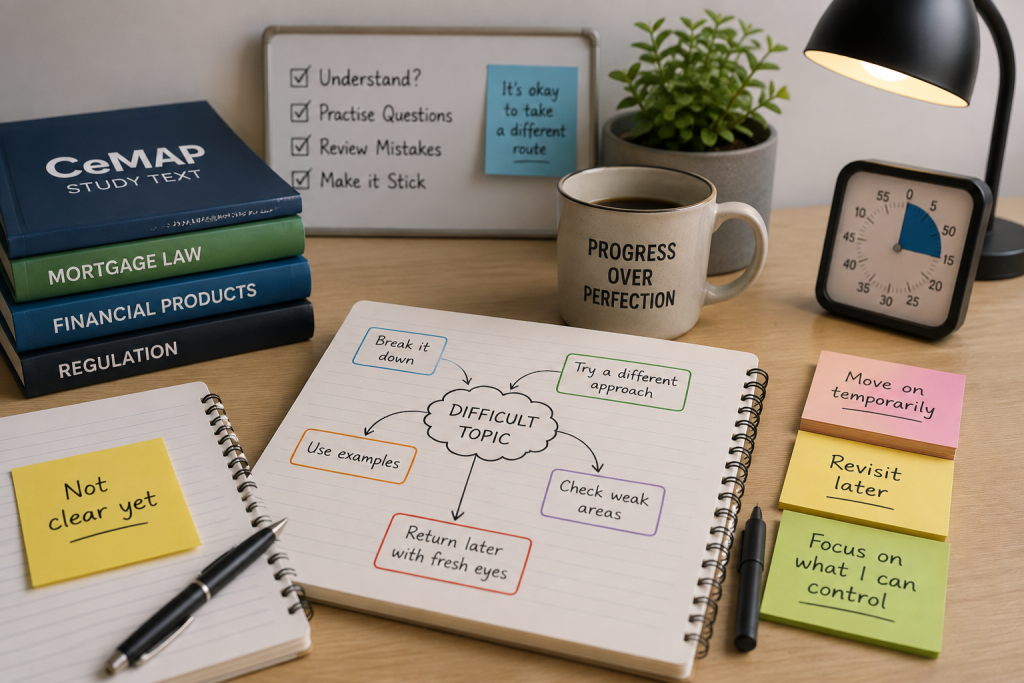
Try changing how you approach it.
You could use a worked example, create a simple diagram, break the concept into smaller parts, use study cards or attempt a few questions to see exactly where your understanding breaks down.
Sometimes it is also sensible to move on temporarily.
You may encounter the same concept again from a different angle, which can make the earlier material easier to understand when you return to it.
The important thing is to mark it for further review rather than quietly skipping it.
How Can You Study CeMAP Efficiently Around Work and Other Commitments?
A realistic routine is usually more useful than an ambitious timetable that you cannot maintain.
If you work full-time or have other responsibilities, you may not have several uninterrupted hours available each evening.
That does not prevent you from making progress.
Smaller study opportunities can be used for specific activities. A short period might be enough to review study cards, revisit an earlier concept or analyse questions you previously answered incorrectly.
Save longer sessions for activities that require greater concentration, such as learning new material or completing mock exams.
Try planning what you will study rather than simply when you will study.
“Tuesday, 7 pm: CeMAP” gives you a time.
“Tuesday, 7 pm: complete the next section and answer 10 related questions” gives you a task.
That small difference can make a study plan much easier to follow.
How Do You Know Whether Your CeMAP Study Method Is Working?
Measure progress by what you can remember and apply rather than how many hours you have studied.
Ask yourself:
Can I explain this topic without my notes?
Can I answer questions on it consistently?
Do I understand why incorrect answers are wrong?
Can I still remember the topic several days later?
If the answer is repeatedly no, your study method needs adjusting.
That does not automatically mean you need to study for longer. You may need more active recall, additional question practice or a different explanation of the subject.
What Is the Best Way to Study Smarter for CeMAP?
The most efficient way to study CeMAP is to make every session purposeful.
Learn manageable amounts of new material, test yourself regularly, practise questions, revisit previous topics and use your mistakes to decide what to study next.
Avoid measuring progress purely by pages read or hours completed.
CeMAP study becomes more efficient when your revision is guided by what you can actually recall, understand and apply.
You will still need to put the work in. Studying smarter does not remove the need to learn the syllabus properly.
It simply helps make sure that the time you are already investing in CeMAP is being used where it can make the biggest difference.
Looking for training support?
We offer CeMAP training for learners working towards a career in mortgage advice. Our courses follow the London Institute of Banking & Finance syllabus and are designed to support understanding of mortgage regulation and advice requirements.
Explore our accredited CeMAP training courses
> Futuretrend Financial Training