How CeMAP exam questions are written and what they test

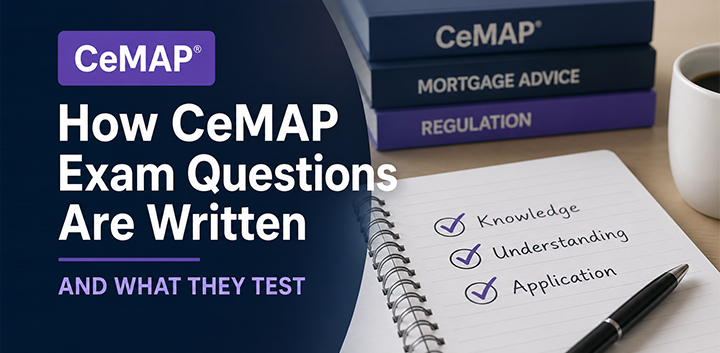
CeMAP exam questions explained showing knowledge understanding and application checklist on study notebook

Understanding how exam questions are designed can make a big difference to how you interpret them. Many learners feel confident with the content but become unsure when faced with the wording of the exam itself. That usually comes down to not fully understanding what the questions are actually trying to assess.

This guide explains how CeMAP exam questions are structured, what they are designed to test, and why they are written the way they are.

CeMAP exam questions explained showing knowledge understanding and application checklist on study notebook

What do CeMAP exam questions test?

CeMAP exam questions are designed to assess whether you can apply knowledge in a realistic context, not just recall facts.

They test:

  • Your understanding of key concepts
  • Your ability to interpret information
  • Your judgement in applying rules and principles
  • Your awareness of how knowledge fits into real situations

The exams are not trying to catch you out. They are designed to reflect the kind of thinking required in a real mortgage advice role.

That means simply memorising facts is not enough on its own.

Why are CeMAP exams structured this way?

CeMAP is awarded by the London Institute of Banking & Finance and is aligned with the expectations of the Financial Conduct Authority.

The purpose of the qualification is to ensure that individuals advising on mortgages have the knowledge and understanding required to do so responsibly.

Because of this, exam questions are written to reflect real-world decision making, not just textbook learning.

A definition-style explanation makes this clearer:

CeMAP exam questions are structured to assess applied knowledge, meaning they test how well a learner can use information in context, rather than simply recall isolated facts.

This is why the wording can sometimes feel more complex than expected.

Do CeMAP questions test knowledge or understanding?

They test both, but the emphasis is on understanding.

Knowledge still matters

You need a solid grasp of:

  • Regulations
  • Mortgage products
  • Processes
  • Terminology

Without that foundation, you will struggle to interpret questions properly.

But understanding is what is really assessed

Understanding means:

  • Recognising what information is relevant
  • Interpreting what a question is asking
  • Applying knowledge to a scenario

Two learners might know the same facts, but the one who understands how to use them will perform better.

This is where many learners get caught out. They revise thoroughly but focus mainly on remembering content, rather than thinking about how it might be used.

Why do some CeMAP questions feel confusing?

This is one of the most common concerns.

The confusion usually comes from how questions are phrased, not from the difficulty of the content itself.

Questions are designed to require interpretation

Rather than asking for a direct definition, questions often:

  • Present information in a slightly indirect way
  • Require you to identify what is important
  • Expect you to connect different parts of the syllabus

This can feel unfamiliar if you are used to more straightforward testing styles.

Language is precise, not tricky

It is easy to assume questions are designed to mislead. In reality, they are carefully written to be precise.

Small differences in wording can change the meaning of a question. That is deliberate, because in real financial advice, details matter.

Context is often implied

You may not be given every piece of information explicitly. Instead, you are expected to:

  • Recognise what is being described
  • Understand the situation being presented
  • Apply the correct knowledge

This reflects real-world scenarios, where clients do not always present information in a perfectly structured way.

What is the purpose behind the way questions are written?

Every question has a purpose beyond simply checking memory.

To reflect real decision-making

Mortgage advisers do not work from memory alone. They:

  • Interpret client situations
  • Apply regulatory rules
  • Make informed judgements

Exam questions are written to reflect that process.

To test clarity of understanding

If you truly understand a topic, you should be able to recognise it even when it is presented differently.

This is why questions may:

  • Rephrase familiar ideas
  • Combine multiple concepts
  • Use slightly varied terminology

To ensure consistency and fairness

Exam design follows strict standards. Questions are reviewed to ensure they:

  • Accurately reflect the syllabus
  • Test appropriate levels of understanding
  • Avoid ambiguity where possible

While some questions may feel challenging, they are not random or subjective.

Common misconceptions about CeMAP exam questions

There are a few misunderstandings that tend to make the exams feel harder than they need to be.

“The questions are designed to trick you”

This is probably the biggest misconception.

Questions are not designed to trick you. They are designed to check whether you:

  • Understand the material
  • Can apply it correctly

If a question feels tricky, it is usually because it requires careful reading, not because it is misleading.

“If I memorise everything, I will pass easily”

Memorisation helps, but it is not enough on its own.

You might recognise the topic, but still struggle if you cannot:

  • Interpret the wording
  • Apply the knowledge in context

Understanding always matters more than volume of revision.

“The exam is harder than the syllabus”

The exam does not go beyond the syllabus.

However, it can feel harder because:

  • Questions are applied rather than direct
  • Topics are sometimes combined
  • Wording requires interpretation

The challenge is not new content. It is how the existing content is used.

Why understanding wording matters so much

One of the key skills being tested is your ability to read and interpret questions accurately.

In practice, this means:

  • Picking up on key terms
  • Not overlooking small details
  • Understanding what is actually being asked

This is important because in real mortgage advice:

  • Misunderstanding a client’s situation can lead to poor outcomes
  • Missing details can have regulatory implications
  • Clear communication is essential

The exam reflects these expectations.

How different topics are assessed within questions

Although all questions are based on the syllabus, they often draw on more than one area at once.

Topics are rarely isolated

Instead of testing one idea in complete isolation, questions may:

  • Combine regulation and product knowledge
  • Link processes with practical scenarios
  • Require you to think across topics

This reflects how knowledge is used in real situations.

Some areas test recognition

Certain parts of the syllabus are more knowledge-based.

These might involve:

  • Identifying definitions
  • Recognising key terms
  • Understanding core principles

Others test application

Other areas focus more on:

  • Interpreting situations
  • Applying rules correctly
  • Making informed judgements

Most exams include a mix of both.

Why applied questions are important for future advisers

It is worth remembering that CeMAP is not just an academic qualification.

It is designed to prepare people for working in financial services.

Applied questions matter because they:

  • Reflect real client interactions
  • Reinforce responsible decision-making
  • Build confidence in practical understanding

A learner who can apply knowledge is better prepared for the realities of the role.

How this affects the way you experience the exam

If you expect questions to be purely fact-based, the exam can feel more difficult than it actually is.

Once you understand what is being assessed, things usually start to make more sense.

You begin to see that:

  • Questions follow patterns
  • Wording has a clear purpose
  • The focus is on understanding, not memorisation

That shift in perspective often reduces confusion.

Why some learners find this adjustment challenging

The move from learning to application is not always easy.

Some reasons include:

  • Previous exams may have focused more on recall
  • The syllabus feels large, so learners prioritise memorising
  • Confidence can drop when questions are not straightforward

This is a normal part of the learning process.

Recognising that the exam is testing understanding rather than memory helps you adjust expectations.

What should you take away from this?

CeMAP exam questions are carefully designed to assess how well you understand and apply knowledge, not just how much you can remember.

They are:

  • Structured around real-world thinking
  • Written with precise language
  • Focused on interpretation and judgement

If the wording feels unfamiliar, that does not mean the exam is unfair. It usually means it is testing a deeper level of understanding.

Final thought

If you find CeMAP questions confusing at first, you are not alone. It is a common experience, especially for those new to this style of assessment.

The key is recognising that the exam is not about catching you out. It is about checking whether you can think like a mortgage adviser.

Once you understand that, the structure of the questions starts to feel far more logical.

Looking for training support?

We offer CeMAP training for learners working towards a career in mortgage advice. Our courses follow the London Institute of Banking & Finance syllabus and are designed to support understanding of mortgage regulation and advice requirements.

Explore our accredited CeMAP training courses

> Futuretrend Financial Training 

How to break down the CeMAP syllabus into manageable study blocks

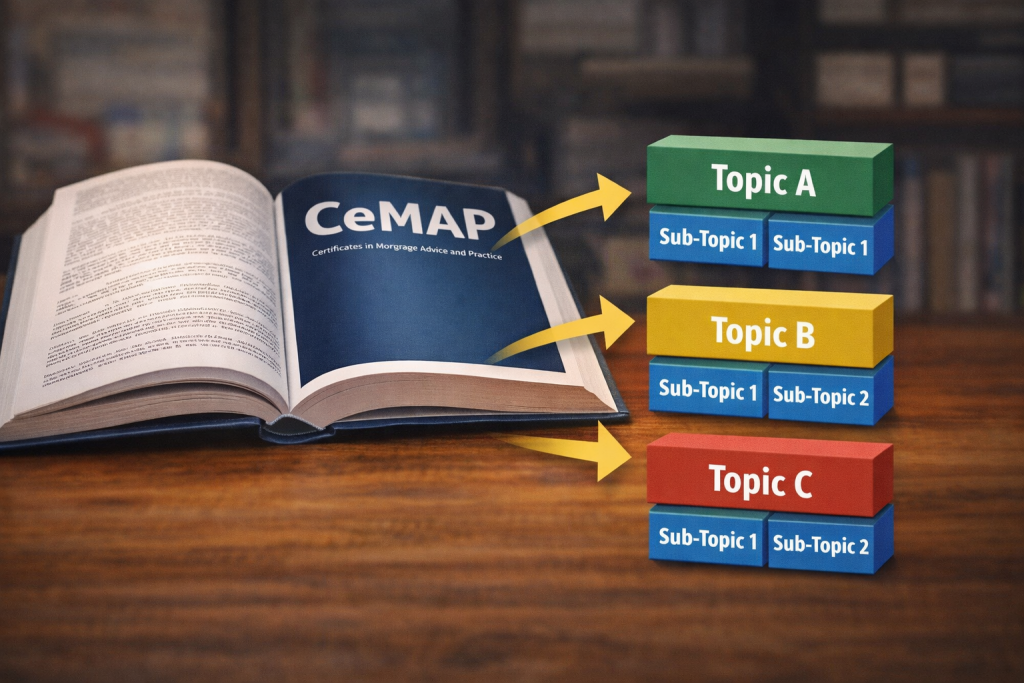
CeMAP syllabus broken into manageable study blocks with topics and subtopics visualised using stacked blocks

How big is the CeMAP syllabus?

The CeMAP syllabus is often described as large because it covers a wide range of knowledge needed for mortgage advice. It is split across three modules and includes topics such as regulation, mortgage law, products, and financial protection.

In simple terms, it is not just one subject. It is a collection of related subjects that build towards a single professional understanding. That is why it can feel overwhelming at first.

The size of the syllabus is not just about length. It is about variety. Learners are expected to understand rules, apply knowledge, and recognise real-world scenarios. This mix makes the content feel heavier than it might look on paper.

CeMAP syllabus broken into manageable study blocks with topics and subtopics visualised using stacked blocks

Why does the CeMAP syllabus feel overwhelming?

For many learners, the challenge is not ability. It is how the content is presented.

The syllabus is structured in a formal way because it is designed to meet industry requirements set by the London Institute of Banking & Finance and aligned with expectations from the Financial Conduct Authority. This means it is written for completeness, not ease of learning.

That creates a few common problems:

It feels like one continuous block of information

When you first look at the syllabus, it can appear as one long list. Without clear mental separation, everything blends together.

Different types of knowledge sit side by side

You might move from legal rules to product features to calculations in a short space of time. That shift can feel disjointed.

There is no obvious starting point

Because everything is important, it can be hard to know where to begin or how to group things.

This is why many learners feel stuck before they even properly start. The issue is not the content itself, but how it is mentally organised.

What does “breaking the syllabus into study blocks” actually mean?

Breaking the syllabus into study blocks means turning a large, complex structure into smaller, clearly defined parts that make sense on their own.

A study block is not a timetable or a schedule. It is simply a way of grouping related ideas together so they are easier to understand.

Each block should:

  • Focus on one clear topic
  • Contain closely related sub-topics
  • Feel complete when studied on its own

This approach mirrors how people naturally learn. We understand things better when they are grouped logically, rather than presented all at once.

Visual showing CeMAP syllabus broken into topics and sub-topics using stacked blocks and arrows from study material

How can you break the CeMAP syllabus into topics?

The most effective way to organise the CeMAP syllabus is to think in layers.

Start with broad topics, then break those down into smaller parts.

Layer 1: Core topic areas

At the highest level, the syllabus can be grouped into a few key themes:

  • Regulation and the role of the adviser
  • Mortgage law and the house buying process
  • Mortgage products and repayment types
  • Financial protection

These are not official labels, but they reflect how the content naturally clusters.

Seeing the syllabus this way helps reduce the feeling that everything is separate. Instead, you begin to see patterns.

Layer 2: Topic groups within each area

Each core area can then be divided into smaller topic groups.

For example, within regulation you might have:

  • The role of the Financial Conduct Authority
  • Conduct of business rules
  • Consumer protection principles

Within mortgage products:

  • Types of mortgages
  • Interest rate structures
  • Repayment methods

These groupings start to make the content feel more manageable because they reflect real themes rather than a long list.

Layer 3: Sub-topics for deeper sections

Some parts of the syllabus are naturally larger and need further breakdown.

For example, a topic like mortgage types can be split into:

  • Fixed rate mortgages
  • Variable rate mortgages
  • Discounted products
  • Offset mortgages

Each of these becomes a small, focused unit of learning.

This is where the real benefit comes in. Instead of trying to understand “mortgages” as a whole, you deal with one type at a time.

Why does this approach make learning easier?

Breaking the syllabus into structured blocks changes how your brain processes the information.

It reduces cognitive overload

When too much information is presented at once, it becomes harder to retain anything. Smaller blocks are easier to absorb.

It creates a sense of progress

Working through clearly defined sections gives you visible progress. That matters for motivation, especially with a larger qualification.

It improves understanding, not just memory

When topics are grouped logically, it becomes easier to see how ideas connect. This leads to deeper understanding rather than surface memorisation.

How detailed should your study blocks be?

There is a balance to get right.

If your blocks are too large, you are back to feeling overwhelmed. If they are too small, you lose the bigger picture.

A good rule is this:

A study block should feel like something you can understand in one sitting, but still meaningful enough to connect to the wider topic.

For example:

  • “Mortgage regulation” is too broad
  • “FCA rules on disclosure” is more focused
  • “What must be disclosed to a client before recommendation” is even clearer

You are aiming for clarity, not perfection.

CeMAP study blocks shown in levels from broad topics to detailed sub-topics illustrating how much detail is needed

What should you do with longer or more complex sections?

Some areas of the CeMAP syllabus are naturally more detailed. These often include regulation and mortgage products.

Instead of trying to simplify them too quickly, break them down further.

Example: Regulation

Rather than treating regulation as one topic, you can divide it into:

  • Who regulates the market
  • Why regulation exists
  • Key rules advisers must follow
  • How those rules apply in practice

Each of these becomes its own learning unit.

Example: Mortgage products

This can be broken into:

  • How interest is applied
  • How repayments are structured
  • How products differ in risk and flexibility

Then each of those can be split again if needed.

This layered approach allows you to go deeper without feeling lost.

Does this mean you should ignore the official syllabus structure?

No. The official structure is still important because it reflects how the exams are designed.

However, there is a difference between how content is structured for assessment and how it is best understood by a learner.

The syllabus is designed for completeness and accuracy.

Your study blocks are designed for clarity and understanding.

You are not replacing the syllabus. You are reorganising it in a way that works better for learning.

How do you know if your breakdown is working?

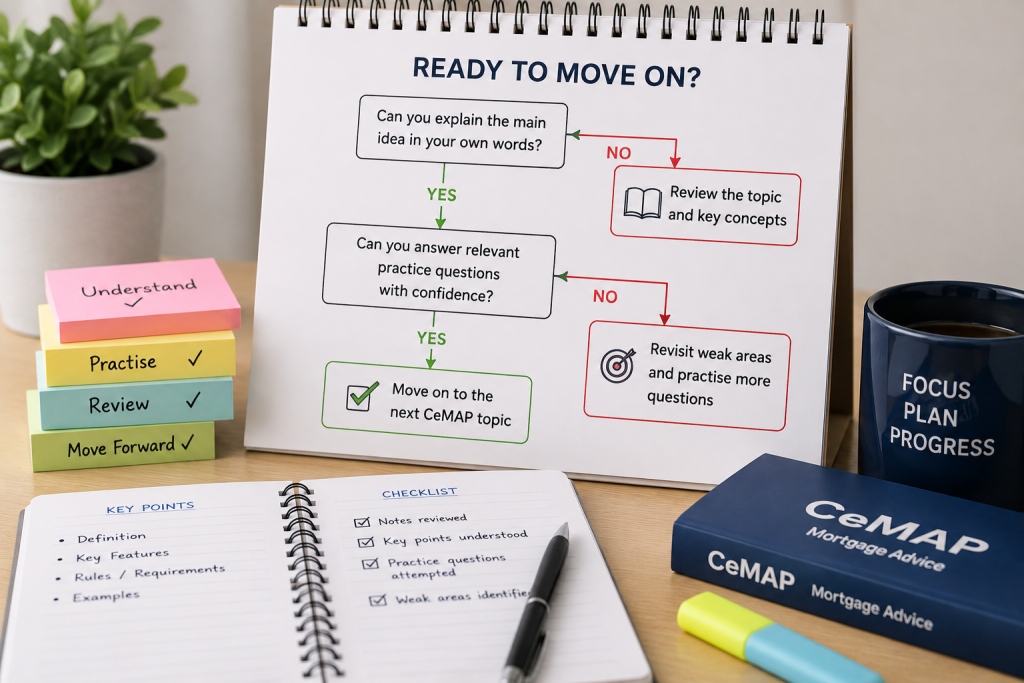
A simple way to check is to ask yourself:

  • Can I explain this topic in simple terms?
  • Do I understand how this connects to other topics?
  • Does this feel like a complete piece of knowledge?

If the answer is no, the block may still be too large or unclear.

If the answer is yes, you have likely found the right level of detail.

Why do some learners still feel stuck even after breaking things down?

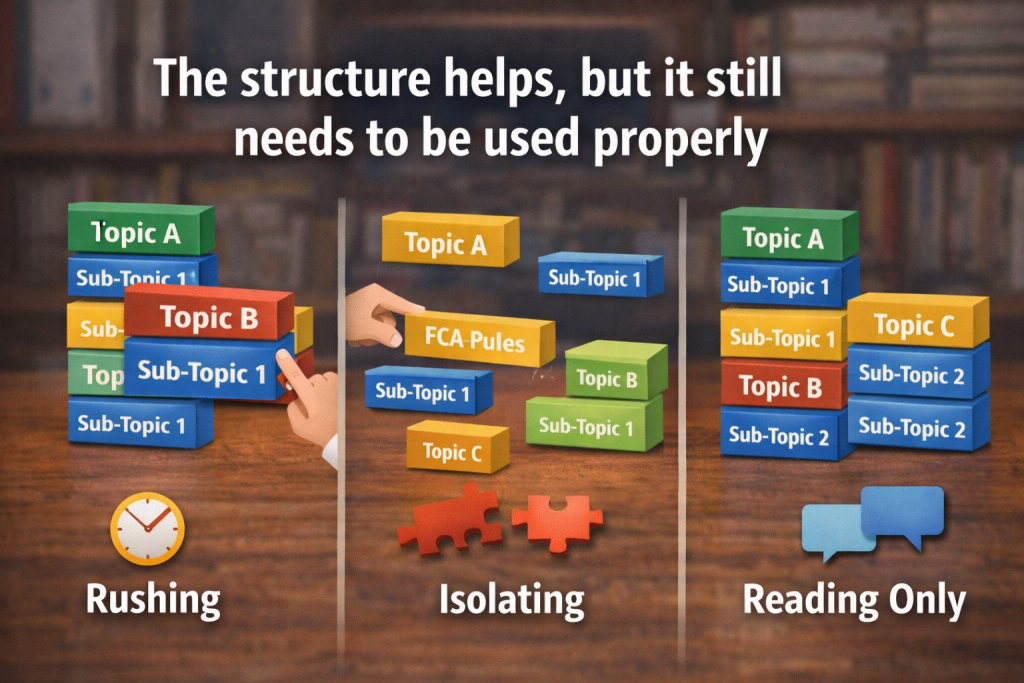
Breaking the syllabus into blocks helps, but it does not solve everything.

Some learners still struggle because:

They try to rush through blocks

Understanding takes time. Smaller sections do not mean

They treat blocks as isolated

Each topic connects to others. If you ignore those links, knowledge can feel fragmented.

They focus only on reading

Understanding often comes from thinking about how knowledge applies, not just seeing it written down.

The structure helps, but it still needs to be used properly.

How does this approach reflect real-world learning?

In practice, mortgage advisers do not think in terms of exam modules. They think in terms of situations.

For example:

  • What does the client need?
  • What rules apply here?
  • Which product fits best?

These decisions rely on grouped knowledge, not isolated facts.

By breaking the syllabus into logical blocks, you are closer to how the knowledge is actually used in real life.

CeMAP study blocks showing common mistakes like rushing, isolating topics, and only reading without applying knowledge

Final thoughts: making a large syllabus feel manageable

The CeMAP syllabus is not small, and it is not meant to be. It reflects the level of knowledge required to give responsible mortgage advice.

What makes it manageable is not reducing the content, but organising it in a way that makes sense.

Breaking the syllabus into topics and sub-topics helps you:

  • See structure instead of volume
  • Focus on one thing at a time
  • Build understanding step by step

Many learners find that once the structure becomes clear, the sense of overwhelm starts to reduce.

The key idea is simple.

You are not trying to tackle the whole syllabus at once.

You are working through one clear, connected piece at a time.

Looking for training support?

We offer CeMAP training for learners working towards a career in mortgage advice. Our courses follow the London Institute of Banking & Finance syllabus and are designed to support understanding of mortgage regulation and advice requirements.

Explore our accredited CeMAP training courses

> Futuretrend Financial Training 

Why experience matters in professional training

Does trainer experience matter for CeMAP training with tutor explaining concepts to adult learners

When choosing a training provider, one question often sits quietly in the background: does the experience of the trainer actually matter?

The short answer is yes. Experience shapes how content is taught, how clearly it is explained, and how well it prepares you for real situations rather than just exams.

For learners working towards qualifications like CeMAP, this can make a noticeable difference to both confidence and understanding.

Does trainer experience matter for CeMAP training with tutor explaining concepts to adult learners

Does trainer experience matter for CeMAP?

Yes, trainer experience matters for CeMAP because it affects how well complex topics are explained and how easily learners can apply what they study in real-world scenarios.

CeMAP, awarded by the London Institute of Banking & Finance, meets the education requirements set by the Financial Conduct Authority. That means the content is not just academic. It reflects real regulatory expectations and client-facing responsibilities.

An experienced trainer understands this balance. They are more likely to:

  • Explain why rules exist, not just what they are
  • Link theory to real client situations
  • Highlight common misunderstandings before they become problems

Without that depth, learning can become a process of memorising facts rather than building usable knowledge.

What is the difference between theory-based teaching and applied teaching?

Theory-based teaching focuses on delivering information. Applied teaching focuses on helping you use it.

Both have a place, but they feel very different as a learner.

Theory-based teaching

This approach usually follows the syllabus closely. It explains definitions, rules, and structures in a clear but often rigid way.

You might learn:

  • What a repayment mortgage is
  • The definition of affordability
  • The structure of regulation

This is important, especially for exams. But on its own, it can feel disconnected from real life.

Applied teaching

Applied teaching takes those same topics and places them into context.

For example:

  • How affordability changes based on a client’s situation
  • Why certain products suit different borrowers
  • What can go wrong if advice is not suitable

Instead of just knowing the answer, you understand the reasoning behind it.

That difference becomes critical when moving from study into practice.

How does trainer experience affect how things are explained?

Experience often shows in how clearly something is broken down.

A trainer who has worked with real scenarios tends to:

  • Use simpler language for complex topics
  • Give examples that make sense immediately
  • Anticipate where learners might struggle

For instance, regulation can feel abstract when taught purely from a textbook. An experienced trainer may explain it through everyday situations, making it easier to understand and remember.

This is not about making things easier. It is about making them clearer.

Trainer explaining complex CeMAP concepts to learners showing how experience improves understanding

How does this impact your learning as a student?

The impact is practical rather than theoretical.

Learners studying under experienced trainers often find that:

  • Topics “click” sooner
  • Less time is spent re-learning the same material
  • Confidence builds earlier in the process

This matters because CeMAP is not just about passing exams. It is about preparing for a role where decisions affect real people and their finances.

If learning is too surface-level, it can lead to:

  • Memorising without understanding
  • Difficulty applying knowledge later
  • Lower confidence when facing unfamiliar questions

A more experienced approach helps bridge that gap.

Why do real-world examples make such a difference?

Examples act as a bridge between knowledge and application.

Without them, information can feel isolated. With them, it becomes easier to connect ideas.

For example:

  • A definition explains what a concept is
  • An example shows how it works in practice

Experienced trainers tend to have a wider range of examples to draw from. They can adjust explanations depending on the learner, rather than relying on one fixed way of teaching.

This flexibility can be especially helpful when topics feel repetitive or difficult.

Trainer using real world examples to explain CeMAP concepts to learners in a classroom setting

Does experience influence the quality of learning materials?

Yes, and often more than people expect.

Learning materials are not just about covering the syllabus. They shape how you interact with the content.

Materials created with experience behind them are more likely to:

  • Break topics into manageable sections
  • Focus on clarity rather than volume
  • Include questions that reflect real exam style
  • Reinforce key ideas without unnecessary complexity

In contrast, less refined materials can feel:

  • Overly dense
  • Poorly structured
  • Focused on information rather than understanding

The difference is not always obvious at first, but it becomes clear as you progress.

What role does structure play in professional training?

Structure is where experience quietly does a lot of work.

A well-structured course:

  • Builds knowledge in a logical order
  • Revisits key ideas at the right time
  • Balances theory with application

An experienced trainer or content creator understands how learners typically progress. They know where confusion tends to happen and design the learning journey to reduce it.

Without that structure, even good content can feel difficult to follow.

Can less experienced trainers still be effective?

Yes, but there is a distinction.

A less experienced trainer can still deliver accurate information and support learners. The difference is usually in depth rather than correctness.

You may notice:

  • Fewer real-world insights
  • More reliance on scripted explanations
  • Less flexibility when questions go beyond the basics

This does not make the training ineffective. It simply means learners may need to do more work themselves to connect theory with practice.

How can you recognise experience in a training provider?

It is not always about years alone. It is about how that experience shows up in the learning process.

You might notice:

  • Clear, confident explanations without overcomplication
  • Examples that feel realistic and relevant
  • Materials that guide you, not overwhelm you
  • A focus on understanding, not just exam preparation

These are often signs that the content has been shaped by real teaching experience rather than just assembled from a syllabus.

How to recognise experience in a training provider with trainer and learning quality indicators shown

Why does this matter beyond the exam?

Passing CeMAP is one milestone. Applying the knowledge is another.

In practice, mortgage advisers need to:

  • Understand client needs
  • Apply regulation correctly
  • Explain options clearly

Training that includes applied understanding makes this transition smoother.

Without it, there can be a gap between:

  • Knowing the answer in an exam
  • Knowing what to do in a real situation

That gap is where experience in training becomes most valuable.

Final thoughts

Experience in professional training is not about prestige. It is about clarity, relevance, and depth.

For learners, the difference is often felt in small ways:

  • How quickly something makes sense
  • How confident you feel moving forward
  • How well you can apply what you have learned

Good training should help you understand, not just remember.

Looking for training support?

We offer CeMAP training for learners working towards a career in mortgage advice. Our courses follow the London Institute of Banking & Finance syllabus and are designed to support understanding of mortgage regulation and advice requirements.

Explore our accredited CeMAP training courses

> Futuretrend Financial Training 

Different learning approaches and how they affect CeMAP study

CeMAP study methods showing different learning approaches including reading, video learning and practice questions

Why does CeMAP feel harder for some learners?

CeMAP can feel harder for some learners because the way it is studied does not match how the learner processes and retains information.

CeMAP is the industry standard qualification for mortgage advisers in the UK. It is awarded by the London Institute of Banking & Finance and meets the Financial Conduct Authority’s education requirements for giving mortgage advice. It is knowledge-heavy, exam-focused, and requires both understanding and recall.

CeMAP study methods showing different learning approaches including reading, video learning and practice questions

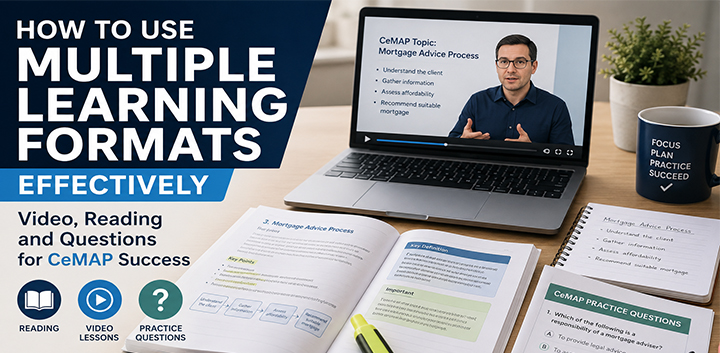
Some learners approach it by reading large amounts of material and hoping it sticks. Others rely on videos but do not test themselves. Some focus only on practice questions without fully understanding the content. None of these approaches are wrong in isolation, but each can become ineffective if used on its own.

What often feels like “difficulty” is actually a mismatch between method and outcome.

CeMAP is not designed to suit one type of learner. It requires a mix of understanding, application, and exam technique. If your current approach only covers one of these, progress can feel slow or frustrating.

Why does one-size-fits-all learning not work for CeMAP?

One-size-fits-all learning does not work because adult learners bring different habits, experiences, and expectations into their study.

Some learners are returning to study after years away from education. Others are used to structured environments with tutors and deadlines. Some prefer independent learning, while others need regular guidance to stay consistent.

CeMAP does not adapt itself to the learner. The learner has to adapt their approach to the structure of the qualification.

A fixed method, such as “just read the book” or “just watch videos”, assumes that all learners absorb and apply knowledge in the same way. In reality, most people need a combination of:

  • Exposure to new information
  • Time to process and understand it
  • Opportunities to apply it
  • Feedback on mistakes

If one of these steps is missing, gaps appear. Those gaps usually show up during practice questions or exams.

What study approaches do learners typically use?

Most CeMAP learners fall into a few broad study patterns. These are not strict categories, but they help explain why some methods feel more effective than others.

Reading-heavy approach

Some learners rely mainly on textbooks or written materials. This can work well for building a strong base of knowledge, especially for detailed topics.

However, reading alone often creates a false sense of understanding. It is easy to recognise information when you see it again, but harder to recall it in an exam.

Without active recall or testing, this approach can feel productive but lead to weak exam performance.

Video-led learning

Video content can make complex topics easier to understand, especially when concepts are explained step by step.

Many learners find this more engaging than reading. It can help with initial understanding, particularly for topics like regulation or mortgage products.

The limitation is that passive watching does not guarantee retention. If learners do not pause, reflect, or test themselves, much of the content is quickly forgotten.

Practice question focus

Some learners prefer to learn by doing. They use topic questions and specimen papers to guide their study.

This approach is useful for understanding how questions are structured and how knowledge is applied in exams.

However, relying only on questions can lead to shallow understanding. If a learner does not fully grasp why an answer is correct, they may struggle when questions are phrased differently.

Structured programme approach

A structured approach combines multiple elements:

  • Guided content
  • Regular checkpoints
  • Practice questions
  • Recaps and revision tools

This tends to support consistency and reduce gaps in knowledge.

It does not remove the need for effort, but it helps learners cover the full syllabus in a balanced way.

How does your approach affect your progress?

Your study approach directly affects how well you understand, retain, and apply information.

If your method focuses only on input, such as reading or watching, you may feel comfortable but struggle to recall information under pressure.

If your method focuses only on testing, you may improve exam technique but lack depth of understanding.

Progress in CeMAP usually comes from combining:

  • Learning new content
  • Revisiting it regularly
  • Testing your understanding
  • Identifying weak areas

When one of these is missing, progress becomes uneven. You may do well in some topics and struggle in others without a clear reason.

CeMAP structured learning plan with study schedule checklist and organised modules

What does effective CeMAP study actually involve?

Effective CeMAP study is not about finding the “best” method. It is about using a mix of approaches that support both understanding and exam performance.

Most learners benefit from a structure that includes:

Breaking down the syllabus

CeMAP covers a wide range of topics. Trying to study large sections at once can feel overwhelming.

Breaking content into smaller topics makes it easier to focus and track progress.

Active learning

Active learning means doing something with the information, not just consuming it.

This includes:

  • Answering topic questions
  • Writing short notes in your own words
  • Explaining concepts aloud

These actions strengthen understanding and memory.

Regular testing

Testing is not just about checking what you know. It helps reinforce learning.

Practice questions and specimen papers from the London Institute of Banking & Finance are particularly useful because they reflect the structure of the real exams.

Revisiting weak areas

It is normal to struggle with certain topics. Effective learners identify these early and revisit them.

Ignoring weaker areas often leads to repeated mistakes.

Why do some learners feel stuck even when they are studying regularly?

Feeling stuck is usually a sign that effort is not translating into effective learning.

This often happens when:

  • Study sessions are too passive
  • There is no clear structure or plan
  • Progress is not being measured
  • Weak areas are avoided rather than addressed

For example, a learner might spend hours reading but never test themselves. Another might complete questions but not review mistakes properly.

In both cases, time is being spent, but learning is limited.

CeMAP requires deliberate practice. This means focusing on areas that are difficult, not just repeating what feels comfortable.

CeMAP learner feeling stuck despite regular studying with notes, textbooks and practice questions

How can you identify what is not working?

study approach starts with honest reflection.

Ask yourself:

  • Can I explain key topics without looking at notes?
  • Do I understand why answers are correct, or am I guessing?
  • Am I improving in practice questions over time?
  • Do I avoid certain topics because they feel difficult?

If the answer to any of these is no, your approach may need adjusting.

This is not a sign of failure. It is part of the learning process.

CeMAP learner reviewing progress and identifying knowledge gaps using notes and practice results

How can you adapt your study approach effectively?

Adapting your approach does not mean starting again. Small changes can make a significant difference.

Combine different methods

If you mainly read, add practice questions.
If you rely on videos, add note-taking and recall.
If you focus on questions, revisit the theory behind them.

A balanced approach covers more of what CeMAP requires.

Use structured resources

Resources such as topic-based videos, breakdown guides, and recap materials can help organise your study.

Many learners benefit from having:

  • Clear explanations of each topic
  • Questions at the end of each section
  • Recaps to reinforce learning

This creates a more complete learning cycle.

Focus on understanding, not speed

Trying to move quickly through the syllabus can lead to gaps.

It is more effective to understand a topic properly before moving on, even if it takes longer.

Build exam familiarity

CeMAP exams are multiple choice, and CeMAP 3 includes case study elements.

Practising with official-style questions helps you understand how knowledge is tested, not just what you need to know.

Does changing your approach really make a difference?

Yes, but it is not immediate.

Changing how you study can feel uncomfortable at first. Active learning requires more effort than passive methods. Testing yourself can highlight gaps you did not notice before.

However, this is where real progress happens.

Over time, learners who adapt their approach tend to:

  • Retain information more effectively
  • Feel more confident in exams
  • Reduce repeated mistakes

The goal is not to make CeMAP easy. It is to make your effort more effective.

CeMAP learner improving results by changing study approach and reviewing progress notes

What if you are not sure which study approach suits you?

If you are unsure how you learn best, you are not alone. Many CeMAP learners only figure this out after trying a few different approaches.

Futuretrend’s Home Study option on the Study Hub was built with this in mind. Rather than assuming one way of learning works for everyone, it combines different methods to support a wider range of learners.

This includes:

  • Structured topic-by-topic learning to break down the syllabus
  • Video content to support understanding of key areas
  • Written materials that explain concepts clearly
  • Topic questions to test knowledge as you progress
  • Recaps and revision tools to reinforce learning
  • Access to official-style specimen papers to prepare for exam format

The aim is not to force a single way of studying, but to give you the tools to find what works for you and build a consistent approach around it.

If you are still unsure which study method suits you, it can help to talk it through. Futuretrend’s Learning and Development team can help you review your current approach and suggest a structure that better supports your progress.

Sometimes a short conversation is enough to identify what is missing and help you move forward with more confidence.

Final thoughts: focus on awareness, not labels

There is no single “type” of learner that succeeds in CeMAP.

What matters is understanding how you are currently studying and whether it is helping you make progress. If something is not working, it is usually a sign that your approach needs adjusting, not that you are unable to succeed.

CeMAP is designed to test understanding, not just effort. That is why some learners find it harder at first. Once your study method starts to match what the exams require, progress often becomes more consistent.

A balanced approach that includes learning, testing, and revisiting weaker areas will usually lead to better results over time.

The more aware you are of how you learn, the easier it becomes to improve your approach and move forward with confidence.

Looking for training support?

We offer CeMAP training for learners working towards a career in mortgage advice. Our courses follow the London Institute of Banking & Finance syllabus and are designed to support understanding of mortgage regulation and advice requirements.

Explore our accredited CeMAP training courses

> Futuretrend Financial Training 
Studying CeMAP on a budget without damaging your chances

Studying CeMAP on a budget with books, calculator and savings jar showing cost planning for exam preparation

Can you study CeMAP cheaply?

Yes, you can study CeMAP on a budget. But “cheap” and “effective” are not the same thing.

CeMAP is the industry standard qualification for mortgage advisers in the UK. It is awarded by the London Institute of Banking & Finance and meets the Financial Conduct Authority’s education requirements for giving mortgage advice.

You can reduce costs by choosing self-study options, spreading payments, and avoiding unnecessary extras. However, cutting too far can leave you without the structure, support, or resources needed to pass your exams.

A low-cost route works best when it is planned carefully. The aim is not to spend as little as possible, but to spend in a way that supports your chances of passing.

Studying CeMAP on a budget with books, calculator and savings jar showing cost planning for exam preparation

What are the main costs when studying CeMAP?

The main costs come down to how you prepare rather than the qualification itself.

Most learners will need to budget for:

  • Study materials (books, online content, question banks)
  • Exam fees
  • Tuition or support (if included)
  • Access to materials over time

Exam fees are fixed, so your decisions sit around study resources and support.

A simple way to think about it:

  • Exams are unavoidable
  • Materials are essential
  • Support is optional but often useful

If you remove something to reduce cost, you should be clear about what impact that has on your learning.

Where can you realistically save money?

You can reduce costs without harming your chances, but it needs to be done carefully.

Self-study instead of classroom learning

Self-study is usually the most affordable route. You avoid the cost of in-person training while still covering the same syllabus.

This works well if you:

  • Are comfortable studying independently
  • Can stay organised without external pressure
  • Prefer working at your own pace
Ways to save money when studying CeMAP including self study, flexible payments and choosing the right support level

Flexible payment options

Some providers offer instalment plans. This does not reduce the total cost, but it can make it easier to manage.

Choosing the right level of support

Not everyone needs full tutor support. Some learners only need:

  • Structured materials
  • Practice questions
  • Clear exam guidance

Paying for support you will not use adds unnecessary cost. But removing support entirely can slow you down.

The right balance depends on how you learn.

Where do learners make false savings?

This is where budget decisions can backfire.

Trying to spend as little as possible often leads to choices that cost more later.

Choosing the cheapest option without checking quality

Low-cost materials can lack:

  • Clear explanations
  • A mix of learning formats (for example, text only with no variation)
  • Up-to-date content
  • Exam-style practice questions

If the material is difficult to follow, you may end up replacing it.

Common mistakes when trying to save money studying CeMAP including cheap materials limited access and lack of support

Limited access to resources

Some options restrict how long you can access materials.

If your access ends before you are ready, you may need to pay again.

Life can easily disrupt study plans, so access time matters more than many expect. Many learners take several months to complete CeMAP when studying alongside other commitments.

No structured learning plan

Without structure, learners often:

  • Jump between topics
  • Miss key areas
  • Delay revision

This increases the risk of failing exams, which adds cost.

No support when you get stuck

Even confident learners come across difficult topics.

Without any support, progress can slow or stop completely.

Saving money upfront can lead to longer study time and extra exam fees.

Why does cheaper not always mean better value?

Lower cost does not always mean better value.

Value comes from how well the materials and support help you pass.

A cheaper option may lack:

  • Clear guidance
  • Practice materials
  • Ongoing access

This can make studying harder and slower.

A slightly higher-cost option that includes structure and better resources can reduce:

  • Study time
  • Stress
  • Risk of resits

In that sense, it can be better value overall.

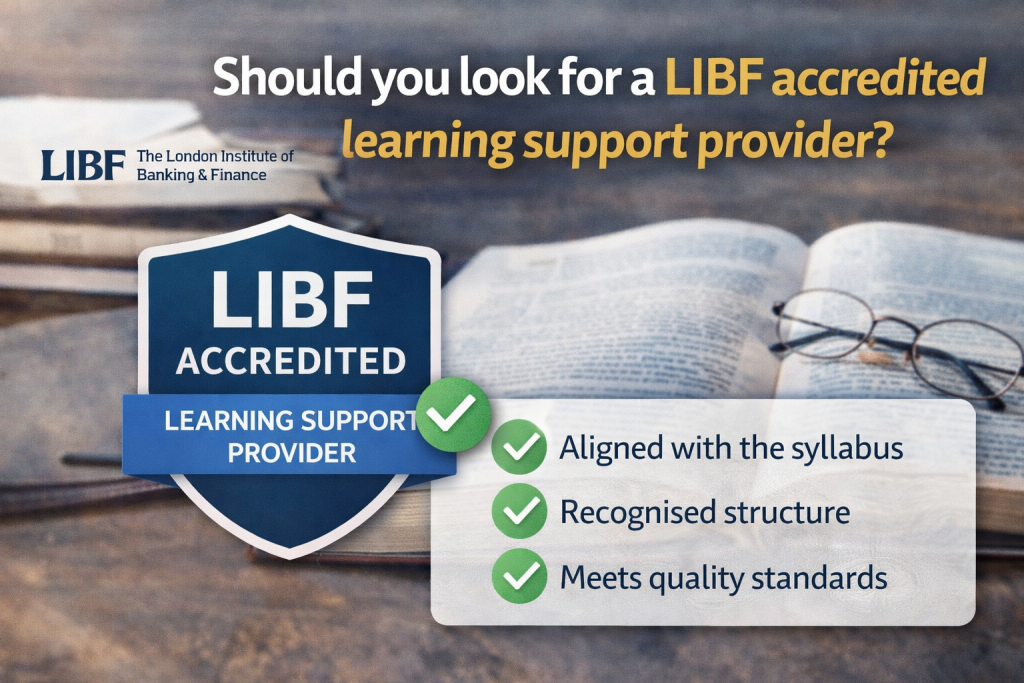
Should you look for a LIBF accredited learning support provider?

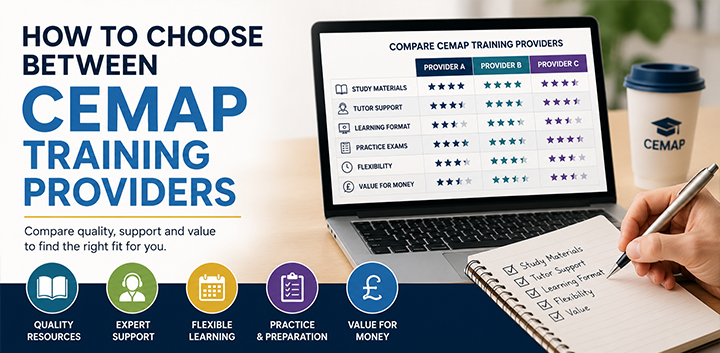
Yes, this can be a useful way to assess quality.

An Accredited CeMAP Learning Support Provider by The London Institute of Banking & Finance has had its learning support reviewed against specific standards.

This does not guarantee success, but it suggests:

  • Materials are aligned to the syllabus
  • The structure supports learning
  • The provider meets recognised standards

Be careful with wording.

Some providers may say they offer “CeMAP training” or describe themselves as “qualified”, but that is not the same as being LIBF accredited.

If accreditation matters to you, check:

  • The exact wording used
  • Whether official accreditation is clearly stated

This helps reduce the risk of choosing poor-quality resources.

LIBF accredited CeMAP learning support provider badge with study materials showing recognised quality and structured learning support

How do you choose resources that match your learning style?

Your budget should not ignore how you learn best.

Ask yourself:

  • Do I prefer reading, watching, or practising questions?
  • Do I need structure or can I organise my own study?
  • How much support will I realistically use?

For example:

  • Visual learners may benefit from video-based content
  • Independent learners may prefer written materials and question banks
  • Some learners need tutor access to stay on track

Choosing a cheaper option that does not suit your learning style often leads to delays.

A better approach is to balance affordability with usability.

How long should you have access to your materials?

Access duration should match your realistic study timeline.

If you are studying alongside work or other commitments, you may need longer than expected.

Short access periods can create pressure and lead to rushed exam attempts.

When comparing options, check:

  • How long materials are available
  • Whether extensions are possible
  • What happens if your timeline changes

Paying slightly more for longer access can prevent having to repurchase materials.

How can you plan your CeMAP study budget realistically?

A simple plan can help you stay in control of costs.

Step 1: Set a total budget

Decide what you can afford without creating pressure.

Step 2: Prioritise essentials

Focus on:

  • Reliable study materials
  • Exam fees
  • Access duration

Step 3: Add support where needed

Only include support you will actually use.

Step 4: Allow for flexibility

Leave room for:

  • Extra time
  • Possible resits
  • Additional resources if needed

This reduces the risk of unexpected costs.

Planning a CeMAP study budget with materials fees timeline and calculator showing realistic cost planning

Are there balanced options for studying on a budget?

Some providers offer home study options designed to balance cost and support.

Structured home study packages with instalment options can make learning more accessible without requiring a large upfront payment.

Futuretrend’s CeMAP home study options are one example where learners can spread costs while still having structured materials.

The key point is the approach rather than the provider:

  • Structured learning
  • Manageable payments
  • Sufficient access time

These features support learners without removing important elements.

What is the biggest mistake when studying CeMAP on a budget?

The biggest mistake is focusing only on price.

When cost becomes the main decision factor, learners often:

  • Choose unsuitable materials
  • Underestimate study time
  • Lack support when needed

This can lead to delays, resits, and higher overall costs.

A better question to ask is:

What gives me the best chance of passing efficiently?

Final thoughts: balancing cost and your chances of success

Studying CeMAP on a budget is entirely possible.

Many learners take this route successfully, but it works best when decisions are balanced.

Keep in mind:

  • Lower-cost options can work if they are structured
  • Accreditation can help indicate quality
  • Access time matters
  • Your learning style should guide your choice

Avoid decisions that seem cheaper now but create problems later.

A steady, well-planned approach is often the most cost-effective in the long run.

Looking for training support?

We offer CeMAP training for learners working towards a career in mortgage advice. Our courses follow the London Institute of Banking & Finance syllabus and are designed to support understanding of mortgage regulation and advice requirements.

Explore our accredited CeMAP training courses

> Futuretrend Financial Training 

How long does it take to become a mortgage adviser?

How long it takes to become a mortgage adviser in the UK with CeMAP study and career path illustration

Becoming a mortgage adviser does not follow a single fixed timeline. For most people, it involves three main stages: gaining the required qualification, becoming authorised through a firm, and building experience in the role. Each stage takes a different amount of time depending on your circumstances, pace of study, and the route you take into the industry.

This guide explains what actually happens at each stage and why the overall timeline can vary quite a lot from one person to another.

How long it takes to become a mortgage adviser in the UK with CeMAP study and career path illustration

How long does the qualification stage take?

The first step is gaining a recognised qualification that meets regulatory requirements. In the UK, this is typically CeMAP (Certificate in Mortgage Advice and Practice).

For many learners, the qualification stage takes several months, but this is not fixed.

Some key factors that affect how long this stage takes:

Study pace

If you are studying alongside a full-time job or other commitments, progress will usually be slower. Learners who study more intensively can move through the material more quickly, but that depends on availability and confidence with exams.

Previous knowledge

If you already have experience in financial services, you may find parts of the content more familiar. If you are completely new to the industry, you may need more time to understand the terminology and concepts.

Exam readiness

Passing the exams is not just about reading. Many learners need time to practise applying knowledge, not just recognising it. This often extends the timeline beyond what people expect at the start.

A realistic way to view this stage is not as a race, but as a period of building a solid foundation. Rushing through it can make later stages harder.

What happens after you pass CeMAP?

Passing the qualification does not mean you can immediately start advising clients.

You must work under an authorised firm, and that firm is responsible for ensuring you are competent before you advise customers independently.

This stage is often referred to as authorisation, onboarding, or competency sign-off.

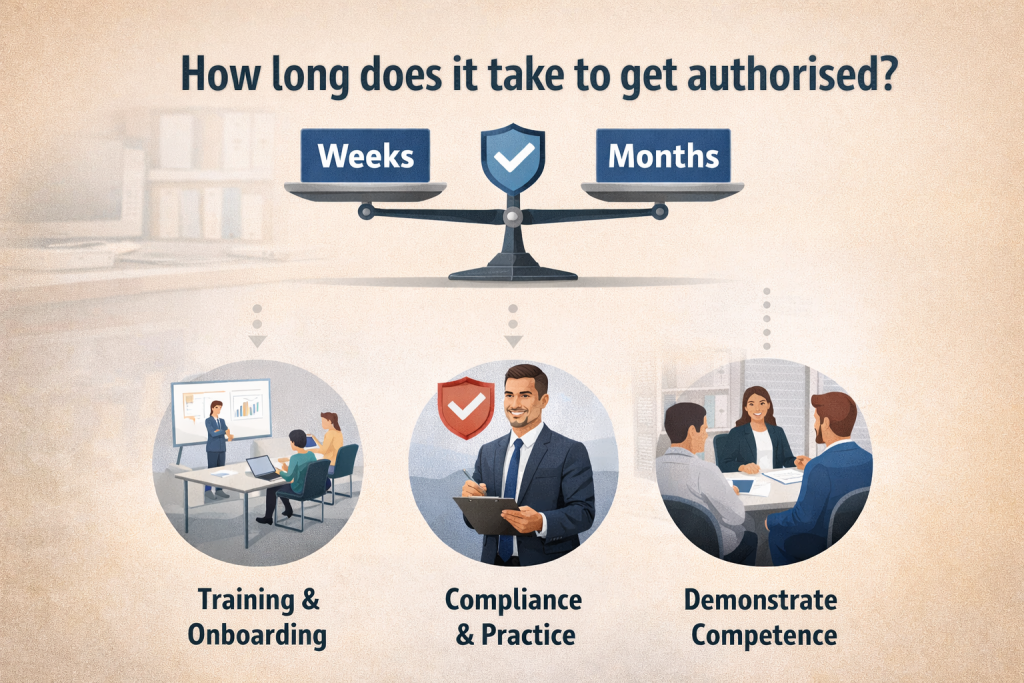
How long does it take to get authorised?

There is no single timeframe for authorisation because it depends heavily on the firm you join.

Most firms will require:

  • Initial training on their systems and processes
  • Understanding of compliance and regulation
  • Supervised practice before advising independently
  • Demonstration of competence

This process can take weeks to several months, depending on:

Mortgage adviser authorisation process showing weeks to months timeline with training, compliance and competency stages

The firm’s structure

Some firms have formal training academies with structured timelines. Others take a more gradual, on-the-job approach.

Your starting point

If you are new to financial services, there may be more to learn before you are ready to advise. If you already have relevant experience, progression may be quicker.

Your starting point

If you are new to financial services, there may be more to learn before you are ready to advise. If you already have relevant experience, progression may be quicker.

Compliance requirements

Mortgage advice is regulated, so firms must be confident you can give suitable advice. This is not something that can be rushed.

A key point here is that authorisation is not just a box to tick. It is about proving you can apply knowledge safely in real situations.

What does “competent adviser status” mean?

A mortgage adviser is usually considered fully operational once they are signed off as competent by their firm.

This means they can:

  • Advise clients without supervision
  • Recommend suitable mortgage products
  • Follow regulatory and compliance standards

Reaching this stage takes time because it involves real client interaction, not just theory.

Many new advisers underestimate how different real-world advice is compared to studying.

How long does it take to feel confident in the role?

Even after becoming authorised, there is still a learning curve.

In the early months, advisers are often:

  • Building confidence in client conversations
  • Learning how to gather accurate information
  • Understanding lender criteria in practice
  • Managing application processes

It is common for this stage to take several more months before things start to feel natural.

Confidence develops through repetition and experience, not just training.

What does a typical overall timeline look like?

While there is no fixed timeline, a broad structure often looks like this:

  • Qualification: several months
  • Authorisation and onboarding: a few months
  • Early experience and confidence building: ongoing

In total, becoming fully comfortable in the role can take many months to over a year.

That does not mean you are not working during that time. It means you are developing into the role gradually.

Why do timelines vary so much?

One of the most common questions people ask is why timelines differ so widely. The answer is that becoming a mortgage adviser depends on more than just passing exams.

Personal circumstances

Study time, work commitments, and learning pace all affect how quickly you move through the qualification stage.

Career background

Someone coming from a financial services role may progress differently to someone changing careers entirely.

Why mortgage adviser timelines vary showing factors like firm requirements, regulation, and experience level

Type of employer

Different firms have different onboarding processes. Some move quickly, others focus on longer development periods.

Learning style

Some people prefer to take time to fully understand topics, while others move faster but may need to revisit areas later.

Confidence and communication

Mortgage advice involves working with people, not just numbers. Developing communication skills can take time, especially if it is new to you.

Because of these factors, two people starting at the same point can reach the same role at very different speeds.

Can you speed up the process?

It is possible to move more quickly through certain stages, but there are limits.

You can:

  • Study more consistently
  • Use a mix of learning methods, not just reading
  • Practise exam-style questions
  • Prepare for interviews and job applications early


However, you cannot skip:

  • Regulatory requirements
  • Competency assessments
  • Real-world experience


Trying to rush through these areas can make the transition into the role more difficult later on.

Is there a “fast track” route?

Some training providers or employers describe fast-track routes into mortgage advice.

These usually mean:

While these can reduce downtime between stages, they do not remove the need for:

  • Passing exams
  • Demonstrating competence
  • Gaining experience

So while the structure may feel quicker, the core steps remain the same.

What should you focus on instead of time?

A better question than “How quickly can I become a mortgage adviser?” is:

“How well prepared will I be when I get there?”

Focusing only on speed can lead to:

  • Gaps in knowledge
  • Low confidence in client situations
  • Difficulty applying theory in practice


Focusing on preparation helps you:

  • Understand the material properly
  • Build confidence gradually
  • Transition more smoothly into the role


In the long run, this often leads to better outcomes than trying to move as quickly as possible.

What is the realistic expectation?

A realistic expectation is that becoming a mortgage adviser is a process, not a single step.

It includes:

  1. Learning the knowledge
  2. Proving competence
  3. Applying that knowledge in real situations

Each stage builds on the previous one.

Most people do not become fully confident advisers overnight. They develop into the role over time.

Final thoughts

So, how long does it take to become a mortgage adviser?

The honest answer is that it depends, but it is rarely immediate. For most people, it takes several months to gain the qualification, followed by further time to become authorised and confident in the role.

There is no standard timeline because the journey depends on your background, your pace, and the path you take into the industry.

What matters most is not how quickly you reach the role, but how prepared you are when you do. A steady, well-understood progression tends to lead to a stronger and more sustainable career.

Looking for training support?

We offer CeMAP training for learners working towards a career in mortgage advice. Our courses follow the London Institute of Banking & Finance syllabus and are designed to support understanding of mortgage regulation and advice requirements.

Explore our accredited CeMAP training courses

> Futuretrend Financial Training 

Can You Study CeMAP While Working Full Time?

Woman studying CeMAP at a desk in the evening while working full time, with laptop, notebook and study materials.

Studying for CeMAP while working full time is not unusual. Many people complete the qualification alongside employment, family responsibilities and other commitments.

CeMAP, awarded by the London Institute of Banking & Finance, is the industry-recognised qualification that meets the Financial Conduct Authority’s education requirements for giving mortgage advice in the UK. It is a professional qualification, but it is designed for adult learners. A large proportion of candidates are already working.

The more important question is not whether it is possible. It is how to approach it in a way that is realistic and sustainable.

Working full time changes how you study. It affects your energy, your attention and your available time. Understanding that from the start makes a significant difference.

Woman studying CeMAP at a desk in the evening while working full time, with laptop, notebook and study materials.

What Does Studying CeMAP While Working Full Time Actually Involve?

Studying CeMAP while working full time means accepting that your progress may be steadier rather than fast.

Full-time work usually means:

  • Limited weekday study hours
  • Mental fatigue after work
  • Competing priorities at weekends
  • Occasional unexpected disruptions


CeMAP is structured across three modules. Each module requires focused reading, understanding of regulation and application of knowledge to realistic scenarios. This is not passive learning. It requires concentration.

That is why time pressure matters.

If you are working full time, you are unlikely to have large uninterrupted study blocks every day. Instead, your study will often happen in shorter sessions. That does not make it less effective. It simply means consistency becomes more important than intensity.

How Much Time Do Full-Time Workers Realistically Have?

Many learners overestimate how much study time they will have.

After a full working day, concentration levels are often lower. Even if you have two or three hours available in theory, that does not mean those hours will always be productive.

A more realistic view often looks like:

  • 45–90 minutes on selected weekdays
  • A longer focused session at the weekend
  • Occasional lighter days when work is demanding

This varies from person to person. Some people prefer early mornings before work. Others study better at weekends. There is no single right pattern.

The key is recognising that steady weekly input builds momentum. Large bursts followed by long gaps usually feel harder.

What Does Realistic CeMAP Study Look Like?

Realistic CeMAP study is structured but flexible.

It usually includes:

  • Reading and understanding core content
  • Revisiting complex topics
  • Reflecting on how rules apply in practical situations
  • Gradually building confidence rather than cramming

It does not usually involve:

  • Studying for hours every evening without a break
  • Trying to complete an entire module in a few weeks while working full time
  • Expecting constant motivation

Professional qualifications reward familiarity. Seeing the material repeatedly over time makes it easier to understand how topics connect.

Adult learner studying CeMAP at a desk with textbooks and laptop, illustrating realistic and steady professional study.

For example, regulation principles studied in CeMAP 1 underpin suitability decisions assessed later in the qualification. When you allow time for information to settle, those links become clearer.

Short, focused sessions done regularly often feel calmer and more manageable than intense study marathons.

Is It Better to Study Intensively or Consistently?

For full-time workers, consistency tends to be more sustainable than intensity.

Studying intensively for a short period can feel productive. However, when combined with full-time employment, it can also lead to:

  • Mental fatigue
  • Frustration
  • Reduced retention
  • Burnout

Consistency, on the other hand, builds routine. When study becomes part of your weekly rhythm, it feels less disruptive.

Even modest weekly progress accumulates. Over several months, small sessions add up to significant coverage of the syllabus.

CeMAP is not a speed test. It is an assessment of knowledge and judgement. Understanding develops over time.

What Are the Most Common Planning Mistakes?

Many full-time learners face similar difficulties. The issue is rarely ability. It is usually planning assumptions.

1. Overloading the first few weeks

It is common to start strongly and attempt to cover too much content too quickly. This can create early pressure and make the qualification feel heavier than it needs to be.

2. Comparing your pace to others

Some learners study full time. Others may have fewer external commitments. Comparing timelines rarely helps. Your circumstances are unique.

3. Treating missed days as failure

Work can be unpredictable. Deadlines shift. Family demands change. Missing a few planned sessions does not undo progress. What matters is returning to the routine.

4. Ignoring mental energy

Study is not only about available hours. It is also about cognitive capacity. If your work is demanding, your evening study sessions may need to be shorter and more focused.

Recognising these traps early prevents unnecessary self-doubt.

How Long Does It Take to Complete CeMAP While Working?

There is no single timeline.

Some full-time workers complete the qualification within several months. Others spread it across a longer period to reduce pressure.

The important factor is steady progression rather than speed.

Because CeMAP is modular, you can focus on one unit at a time. Many learners find it easier to treat each module as a separate phase. Completing one creates a sense of progress before moving to the next.

Completion time should reflect your wider life, not someone else’s schedule.

Adult learner studying CeMAP at home with textbooks and laptop, representing the time commitment of completing CeMAP while working full time.

How Can You Manage Study Fatigue?

Fatigue is one of the biggest challenges for full-time learners.

After a working day, especially in client-facing or analytical roles, concentration may be limited. Pushing through exhaustion often reduces efficiency.

It can help to:

  • Study at consistent times so it becomes habitual
  • Break topics into smaller sections
  • Rotate between reading and applied thinking
  • Accept that some sessions will feel easier than others

Rest is not a weakness. It protects long-term consistency.

Professional study is a marathon rather than a sprint. That perspective reduces unnecessary pressure.

Does Working Full Time Make CeMAP Harder?

Working full time does not make CeMAP academically harder. The syllabus and assessment standard remain the same for everyone.

However, it can make time management more complex.

The challenge is rarely intellectual capacity. It is managing competing responsibilities.

Many adult learners bring advantages to their study:

  • Work discipline
  • Structured thinking
  • Practical understanding of financial concepts
  • Experience balancing commitments

These strengths often offset limited study hours.

How Should You Think About Progress?

Progress while working full time is rarely dramatic. It is gradual.

You may not feel dramatic improvement from week to week. But over several months, familiarity grows.

Reframing progress helps:

  • Completing a chapter is progress
  • Revisiting a difficult topic is progress
  • Understanding how regulation links to advice is progress


CeMAP builds layered understanding. Early topics support later ones. Allowing knowledge to accumulate steadily usually leads to stronger confidence.

Adult learner studying CeMAP at home with notebook and laptop, illustrating steady progress and gradual knowledge development.

What If You Feel Behind?

Feeling behind is common among adult learners.

If you sense you are progressing slowly, it may help to ask:

  • Are my expectations realistic for my current workload?
  • Am I measuring progress by effort or by comparison?
  • Would slightly adjusting my timeline reduce pressure?

Professional study alongside full-time employment is an additional commitment. Adjusting your pace is not a setback. It is responsible planning.

Can You Successfully Study CeMAP While Working Full Time?

Yes, many people do.

Studying CeMAP while working full time is achievable when approached with:

  • Realistic expectations
  • Consistent weekly effort
  • Flexible planning
  • Patience with progress

It is less about finding perfect study conditions and more about building steady habits.

The qualification is designed for adult learners entering or progressing within the mortgage advice profession. Full-time employment does not prevent success. It simply shapes the route you take.

If you allow your study plan to reflect your real life rather than an ideal one, the process tends to feel more manageable.

Professional development rarely happens in perfect circumstances. It happens alongside work, responsibilities and ordinary life.

And that is entirely normal.

Looking for training support?
We offer CeMAP training for learners working towards a career in mortgage advice. Our courses follow the London Institute of Banking & Finance syllabus and are designed to support understanding of mortgage regulation and advice requirements.

Explore our accredited CeMAP training courses

> Futuretrend Financial Training