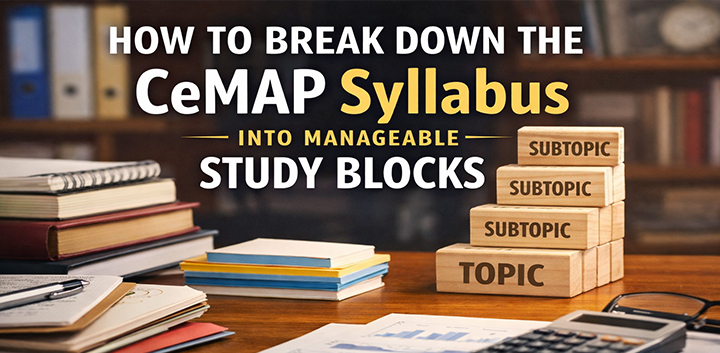
How big is the CeMAP syllabus?
The CeMAP syllabus is often described as large because it covers a wide range of knowledge needed for mortgage advice. It is split across three modules and includes topics such as regulation, mortgage law, products, and financial protection.
In simple terms, it is not just one subject. It is a collection of related subjects that build towards a single professional understanding. That is why it can feel overwhelming at first.
The size of the syllabus is not just about length. It is about variety. Learners are expected to understand rules, apply knowledge, and recognise real-world scenarios. This mix makes the content feel heavier than it might look on paper.
Why does the CeMAP syllabus feel overwhelming?
For many learners, the challenge is not ability. It is how the content is presented.
The syllabus is structured in a formal way because it is designed to meet industry requirements set by the London Institute of Banking & Finance and aligned with expectations from the Financial Conduct Authority. This means it is written for completeness, not ease of learning.
That creates a few common problems:
It feels like one continuous block of information
When you first look at the syllabus, it can appear as one long list. Without clear mental separation, everything blends together.
Different types of knowledge sit side by side
You might move from legal rules to product features to calculations in a short space of time. That shift can feel disjointed.
There is no obvious starting point
Because everything is important, it can be hard to know where to begin or how to group things.
This is why many learners feel stuck before they even properly start. The issue is not the content itself, but how it is mentally organised.
What does “breaking the syllabus into study blocks” actually mean?
Breaking the syllabus into study blocks means turning a large, complex structure into smaller, clearly defined parts that make sense on their own.
A study block is not a timetable or a schedule. It is simply a way of grouping related ideas together so they are easier to understand.
Each block should:
- Focus on one clear topic
- Contain closely related sub-topics
- Feel complete when studied on its own
This approach mirrors how people naturally learn. We understand things better when they are grouped logically, rather than presented all at once.
How can you break the CeMAP syllabus into topics?
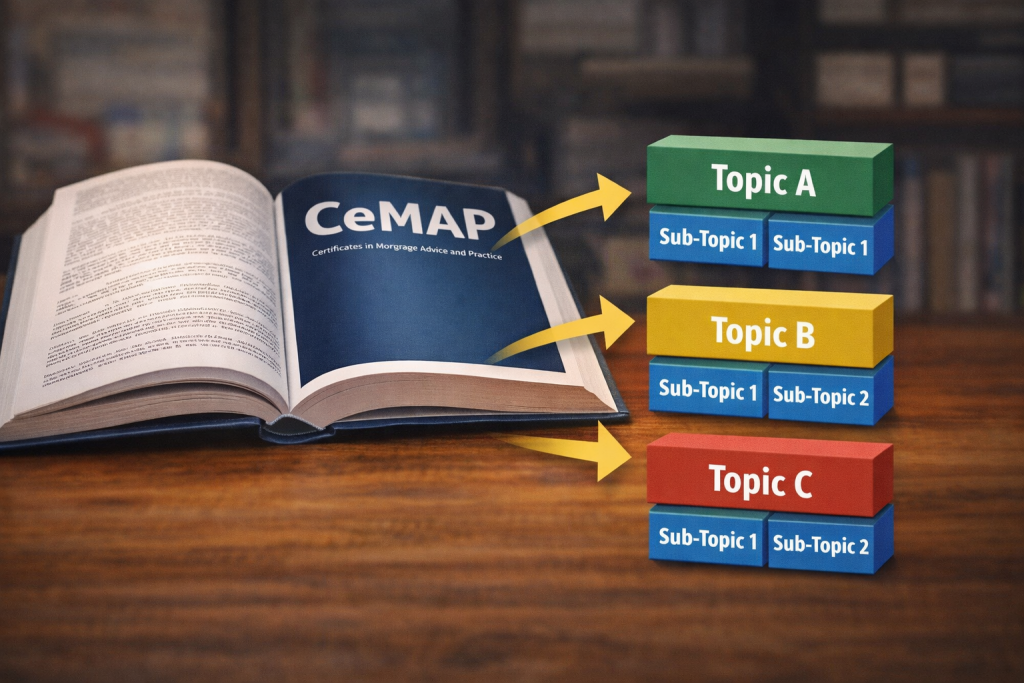
The most effective way to organise the CeMAP syllabus is to think in layers.
Start with broad topics, then break those down into smaller parts.
Layer 1: Core topic areas
At the highest level, the syllabus can be grouped into a few key themes:
- Regulation and the role of the adviser
- Mortgage law and the house buying process
- Mortgage products and repayment types
- Financial protection
These are not official labels, but they reflect how the content naturally clusters.
Seeing the syllabus this way helps reduce the feeling that everything is separate. Instead, you begin to see patterns.
Layer 2: Topic groups within each area
Each core area can then be divided into smaller topic groups.
For example, within regulation you might have:
- The role of the Financial Conduct Authority
- Conduct of business rules
- Consumer protection principles
Within mortgage products:
- Types of mortgages
- Interest rate structures
- Repayment methods
These groupings start to make the content feel more manageable because they reflect real themes rather than a long list.
Layer 3: Sub-topics for deeper sections
Some parts of the syllabus are naturally larger and need further breakdown.
For example, a topic like mortgage types can be split into:
- Fixed rate mortgages
- Variable rate mortgages
- Discounted products
- Offset mortgages
Each of these becomes a small, focused unit of learning.
This is where the real benefit comes in. Instead of trying to understand “mortgages” as a whole, you deal with one type at a time.
Why does this approach make learning easier?
Breaking the syllabus into structured blocks changes how your brain processes the information.
It reduces cognitive overload
When too much information is presented at once, it becomes harder to retain anything. Smaller blocks are easier to absorb.
It creates a sense of progress
Working through clearly defined sections gives you visible progress. That matters for motivation, especially with a larger qualification.
It improves understanding, not just memory
When topics are grouped logically, it becomes easier to see how ideas connect. This leads to deeper understanding rather than surface memorisation.
How detailed should your study blocks be?
There is a balance to get right.
If your blocks are too large, you are back to feeling overwhelmed. If they are too small, you lose the bigger picture.
A good rule is this:
A study block should feel like something you can understand in one sitting, but still meaningful enough to connect to the wider topic.
For example:
- “Mortgage regulation” is too broad
- “FCA rules on disclosure” is more focused
- “What must be disclosed to a client before recommendation” is even clearer
You are aiming for clarity, not perfection.

What should you do with longer or more complex sections?
Some areas of the CeMAP syllabus are naturally more detailed. These often include regulation and mortgage products.
Instead of trying to simplify them too quickly, break them down further.
Example: Regulation
Rather than treating regulation as one topic, you can divide it into:
- Who regulates the market
- Why regulation exists
- Key rules advisers must follow
- How those rules apply in practice
Each of these becomes its own learning unit.
Example: Mortgage products
This can be broken into:
- How interest is applied
- How repayments are structured
- How products differ in risk and flexibility
Then each of those can be split again if needed.
This layered approach allows you to go deeper without feeling lost.
Does this mean you should ignore the official syllabus structure?
No. The official structure is still important because it reflects how the exams are designed.
However, there is a difference between how content is structured for assessment and how it is best understood by a learner.
The syllabus is designed for completeness and accuracy.
Your study blocks are designed for clarity and understanding.
You are not replacing the syllabus. You are reorganising it in a way that works better for learning.
How do you know if your breakdown is working?
A simple way to check is to ask yourself:
- Can I explain this topic in simple terms?
- Do I understand how this connects to other topics?
- Does this feel like a complete piece of knowledge?
If the answer is no, the block may still be too large or unclear.
If the answer is yes, you have likely found the right level of detail.
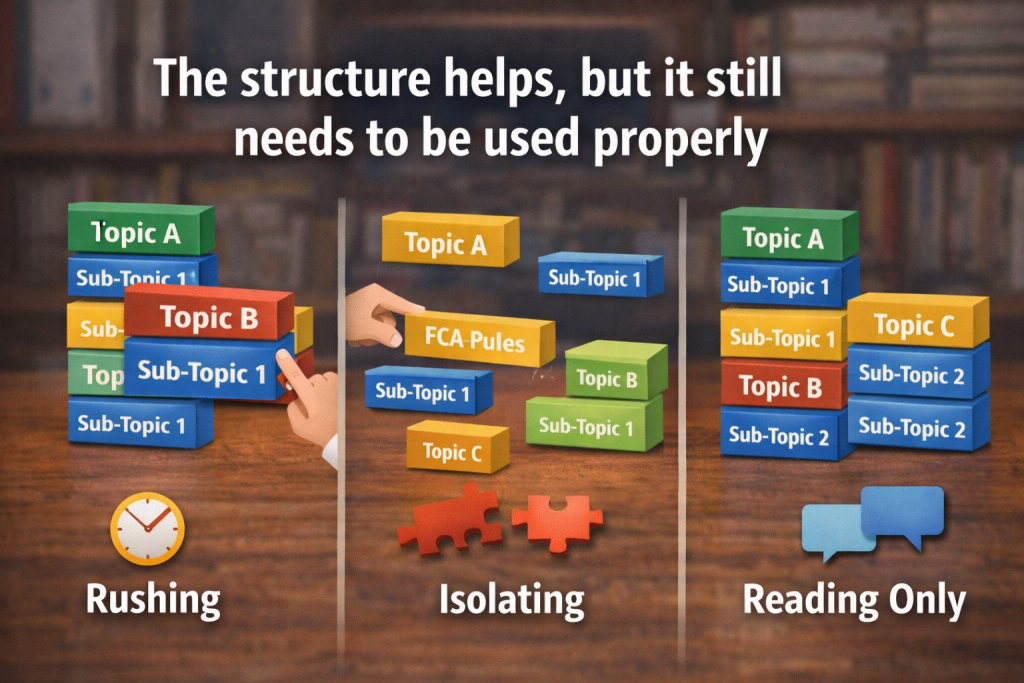
Why do some learners still feel stuck even after breaking things down?
Breaking the syllabus into blocks helps, but it does not solve everything.
Some learners still struggle because:
They try to rush through blocks
Understanding takes time. Smaller sections do not mean
They treat blocks as isolated
Each topic connects to others. If you ignore those links, knowledge can feel fragmented.
They focus only on reading
Understanding often comes from thinking about how knowledge applies, not just seeing it written down.
The structure helps, but it still needs to be used properly.
How does this approach reflect real-world learning?
In practice, mortgage advisers do not think in terms of exam modules. They think in terms of situations.
For example:
- What does the client need?
- What rules apply here?
- Which product fits best?
These decisions rely on grouped knowledge, not isolated facts.
By breaking the syllabus into logical blocks, you are closer to how the knowledge is actually used in real life.
Final thoughts: making a large syllabus feel manageable
The CeMAP syllabus is not small, and it is not meant to be. It reflects the level of knowledge required to give responsible mortgage advice.
What makes it manageable is not reducing the content, but organising it in a way that makes sense.
Breaking the syllabus into topics and sub-topics helps you:
- See structure instead of volume
- Focus on one thing at a time
- Build understanding step by step
Many learners find that once the structure becomes clear, the sense of overwhelm starts to reduce.
The key idea is simple.
You are not trying to tackle the whole syllabus at once.
You are working through one clear, connected piece at a time.
Looking for training support?
We offer CeMAP training for learners working towards a career in mortgage advice. Our courses follow the London Institute of Banking & Finance syllabus and are designed to support understanding of mortgage regulation and advice requirements.
Explore our accredited CeMAP training courses
> Futuretrend Financial Training