What Are Common CeMAP Myths? Clearing Up the Misunderstandings

Common CeMAP myths explained with study manual, magnifying glass over the word myths, calculator and mortgage notes on desk

If you have spent any time on forums or social media groups, you will have seen strong opinions about CeMAP. Some are helpful. Others are not.

CeMAP is often discussed in half-truths. People repeat what they have heard rather than what they have checked. Over time, those ideas start to sound like facts.

This article answers the question clearly: what are common CeMAP myths? It explains where they come from and replaces them with accurate information, so you can make decisions based on facts rather than hearsay.

Common CeMAP myths explained with study manual, magnifying glass over the word myths, calculator and mortgage notes on desk

What Is CeMAP?

CeMAP stands for the Certificate in Mortgage Advice and Practice. It is awarded by the London Institute of Banking & Finance and is the industry standard qualification for mortgage advisers in the UK.

CeMAP meets the Financial Conduct Authority’s education requirements for giving regulated mortgage advice. The Financial Conduct Authority sets the regulatory standards for advisers, while the qualification itself is delivered and examined through the awarding body.

CeMAP is a qualification. It is not a licence, not employment, and not authorisation on its own.

Understanding that distinction clears up many of the myths straight away.

Myth 1:

CeMAP Is Extremely Difficult and Most People Fail

This is one of the most common statements you will see online.

Why this myth persists

People who struggle are more likely to post about it than people who quietly pass. Forums often amplify negative experiences. It can also feel reassuring to blame the exam rather than preparation.

The accurate picture

CeMAP is a professional qualification. It requires study, understanding and exam technique. But it is designed for new entrants to the industry, not academic specialists.

The exams test knowledge of:

  • The UK mortgage market
  • Regulation and ethics
  • Mortgage products and repayment methods
  • The advice process

Learners who prepare properly, use structured materials and take practice questions generally perform well. There is no evidence that “most people fail”. Outcomes depend largely on preparation and exam readiness.

CeMAP is demanding, but it is not designed to catch people out.

Myth 2:

You Need a Finance Degree to Pass CeMAP

This idea can put people off before they even begin.

Why this myth persists

Mortgage advice involves regulation, law and financial calculations. That can sound technical, so some assume you need a university background in finance or economics.

The accurate picture

CeMAP does not require a degree. Many successful advisers come from retail, estate agency, customer service, administration or completely unrelated sectors.

The qualification starts with core principles. It explains:

  • How the UK financial system works
  • Basic regulatory structures
  • Mortgage types and features
  • Affordability and suitability principles

It builds knowledge step by step. What matters more than academic background is consistency and attention to detail.

Myth 3:

CeMAP Is Only for Bank Employees

Some learners believe CeMAP is relevant only if you already work in a bank.

Why this myth persists

Historically, high street banks were the most visible employers of mortgage advisers. That perception still lingers.

The accurate picture

CeMAP is required for anyone who wants to give regulated mortgage advice in the UK, whether they work:

  • For a bank
  • For a building society
  • For a mortgage brokerage
  • As an appointed representative under a network

It is not tied to a specific employer. It is the recognised qualification across the industry.

Myth 4:

Passing CeMAP Automatically Makes You a Mortgage Adviser

This misunderstanding can cause real confusion.

Why this myth persists

People often equate qualifications with licences. In some professions, passing an exam does lead directly to practising.

The accurate picture

CeMAP meets the education requirement for giving mortgage advice. It does not provide regulatory authorisation.

To advise clients, you must also:

  • Be authorised by the Financial Conduct Authority, or
  • Work under a firm that is authorised

Firms will also usually require supervised experience and internal training before allowing advisers to give advice independently.

CeMAP is a key step. It is not the final step.

Myth 5:

CeMAP Guarantees You a Job

This belief can lead to disappointment.

Why this myth persists

Training providers and recruiters sometimes highlight industry demand for advisers. Over time, this can be misinterpreted as a promise of employment.

The accurate picture

CeMAP is a recognised entry requirement for mortgage adviser roles. It improves your eligibility. It does not guarantee a job.

Employment depends on:

  • Interview performance
  • Communication skills
  • Commercial awareness
  • Cultural fit with a firm
  • Local job availability

Many learners do find roles after qualifying. But recruitment decisions are made by employers, not by the qualification provider.

Myth 6:

You Must Complete CeMAP in a Few Weeks or It Looks Bad

Online discussions often create pressure around timelines.

Why this myth persists

Some learners complete CeMAP quickly and share their results. Others feel behind and assume they are failing.

The accurate picture

There is no fixed “correct” pace.

CeMAP is typically completed over several months by learners studying alongside work. Others may take longer if balancing family or career commitments.

What matters is understanding the material, not racing through it. Employers are generally more interested in competence than speed.

Myth 7:

CeMAP Is Outdated and Doesn’t Reflect Real Advice

You may see comments suggesting that CeMAP is too theoretical.

Why this myth persists

New advisers sometimes find that real client conversations feel different from textbook scenarios. That contrast can be interpreted as a flaw in the qualification.

The accurate picture

CeMAP focuses on regulation, structure and product knowledge. It ensures advisers understand:

  • The legal framework
  • Consumer protection rules
  • Affordability and suitability principles
  • Ethical responsibilities

Practical confidence develops with experience. The qualification provides the foundation required by the regulator. Workplace training builds on that foundation.

Myth 8:

You Only Need to Revise the Practice Questions

This is a risky approach.

Why this myth persists

Practice questions are useful. Some learners believe memorising them is enough to pass.

The accurate picture

Practice questions help you understand exam style and timing. They do not replace understanding.

CeMAP exams assess applied knowledge. Questions are often scenario-based. Memorising sample answers without grasping underlying principles can lead to confusion if wording changes.

Effective preparation includes:

  • Reading and understanding core materials
  • Revising key definitions and rules
  • Completing varied practice questions
  • Reviewing weaker areas

Understanding always outperforms memorisation.

Myth 9:

If You Fail Once, You’re Not Suited to the Industry

This can feel personal, but it should not be.

Why this myth persists

Exams can feel like judgement. Failing may seem like proof of ability rather than a snapshot of performance on one day.

The accurate picture

Many capable advisers have failed one CeMAP unit at some point. Reasons vary:

  • Nerves
  • Poor time management
  • Underestimating certain topics
  • Life circumstances

A resit is an opportunity to strengthen weak areas. It is not a verdict on long-term suitability.

Resilience and willingness to improve are valuable traits in financial services.

Why Do CeMAP Myths Spread So Easily?

Understanding this helps you filter what you read.

1. Online forums favour extremes

People rarely post “It was fine”. They post strong opinions. That skews perception.

2. Personal experience becomes general advice

One person’s difficulty becomes “everyone struggles”.

3. Confusion between qualification and career

CeMAP is often discussed alongside job searching, income expectations and self-employment. These are separate issues, but they become blurred.

4. Outdated information lingers

Regulation and qualification structures evolve. Old comments remain searchable long after they are relevant.

What Should You Believe About CeMAP?

A balanced view looks like this:

  • CeMAP is a recognised, regulated qualification.
  • It meets the education standards for mortgage advice in the UK.
  • It requires structured study and exam preparation.
  • It does not guarantee employment or authorisation.
  • It is achievable for learners from varied backgrounds.

If you focus on preparation rather than opinion, the process becomes far more manageable.

Final Thoughts: Replace Noise with Facts

When asking “What are common CeMAP myths?”, the answer is not that people are wrong on purpose. Most misinformation spreads through assumption and repetition.

The safest approach is to rely on:

  • Official guidance from the awarding body
  • Clear regulatory information
  • Structured learning materials

Treat online commentary as personal opinion, not evidence.

CeMAP is neither impossibly difficult nor effortlessly simple. It is a professional qualification designed to prepare advisers to work within a regulated environment.

If you approach it with realistic expectations and steady preparation, you are far more likely to form your own view based on experience rather than myth.

Looking for training support?

We offer CeMAP training for learners working towards a career in mortgage advice. Our courses follow the London Institute of Banking & Finance syllabus and are designed to support understanding of mortgage regulation and advice requirements.

Explore our accredited CeMAP training courses

> Futuretrend Financial Training 
How Hard Are the CeMAP Exams Really and Which Module Feels Hardest?

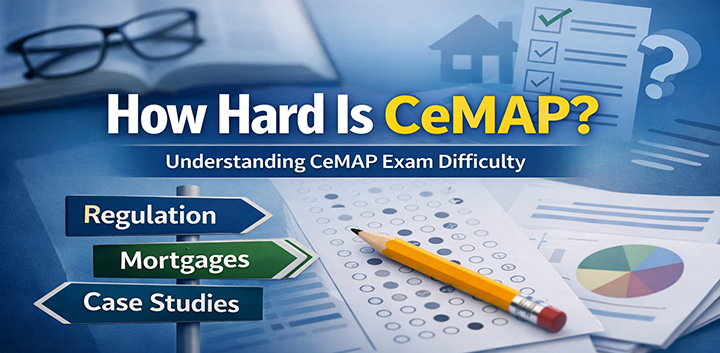
How hard is CeMAP exam graphic showing regulation, mortgages and case studies modules

Many learners ask a simple question before they begin: how hard is CeMAP?

Many learners ask a simple question before they begin: how hard is CeMAP?

The honest answer is that the CeMAP exams are academically manageable for most people, but they require structured preparation and consistent study. They are not designed to catch people out, yet they do test detailed knowledge, regulation, ethics, and the ability to apply what you have learned. For some, the exams feel straightforward. For others, they feel demanding. The difference usually comes down to preparation, familiarity with financial concepts, and confidence with multiple-choice exams.

CeMAP is the industry standard qualification for mortgage advisers in the UK. It is awarded by the London Institute of Banking & Finance and meets the Financial Conduct Authority’s education requirements for giving mortgage advice. Because it leads to a regulated profession, the exams must test knowledge and ethical understanding properly. That is why they feel serious.

This article explains why difficulty is subjective, how the modules differ under the current syllabus, and why preparation matters more than natural ability.

How hard is CeMAP exam graphic showing regulation, mortgages and case studies modules

Why Does CeMAP Feel Hard for Some People?

CeMAP often feels hard because it combines new terminology, regulation, ethics, and exam pressure.

For learners who have never worked in financial services, terms relating to regulatory frameworks, conduct rules, and ethical responsibilities can feel unfamiliar. Even core mortgage concepts such as loan-to-value ratios or different repayment structures may be new. That initial learning curve can create the impression that the qualification is harder than it actually is.

Does Previous Experience Make a Difference?

Yes, but not always in the way people expect.

Someone with experience in banking or estate agency may recognise certain mortgage concepts. That familiarity can reduce learning time in CeMAP 2. However, regulatory and ethical content in CeMAP 1 still needs to be learned carefully, regardless of background.

Learners from unrelated careers often succeed because they approach the material methodically. CeMAP does not require advanced mathematics or essay writing. It requires understanding and careful recall.

Is It an Academic Exam?

CeMAP is knowledge-based rather than essay-based. You are tested through multiple-choice questions and, in the final module, case-study style assessment. You are not required to write long answers. Instead, you must recognise the correct response from several options.

For many people, this format feels manageable. For others, multiple-choice exams create uncertainty because more than one answer can appear reasonable. That is where careful reading becomes essential.

What Makes One Module Feel Harder Than Another?

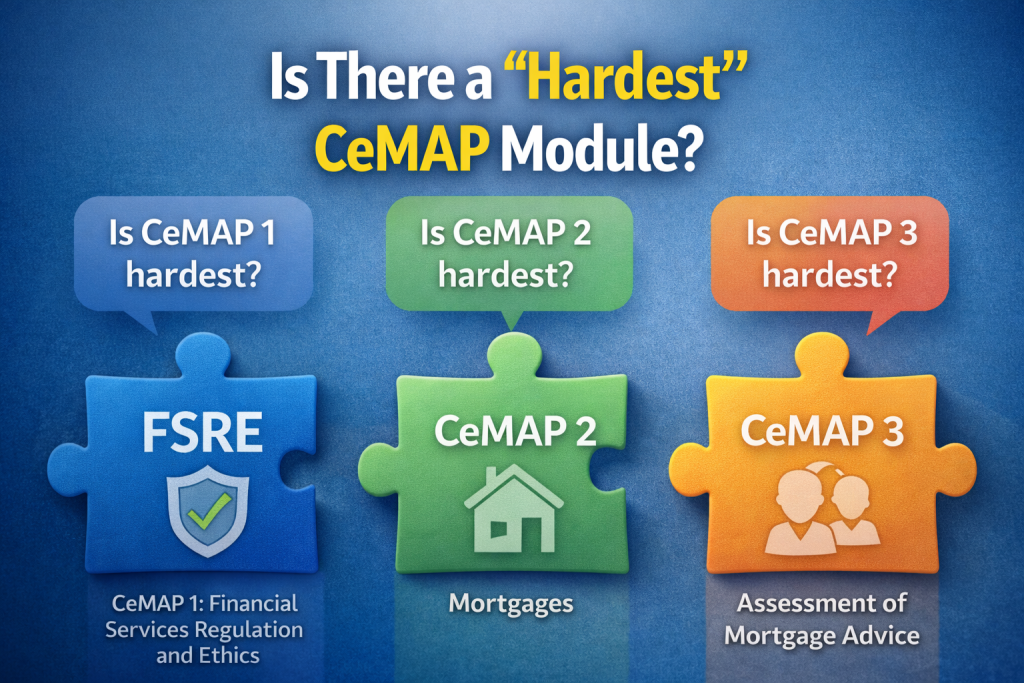
CeMAP is structured in three modules. Each feels challenging for different reasons.

The modules are designed to build on each other. They do not test identical skills, so difficulty can feel different at each stage.

Under the updated 2025/26 syllabus, the modules are:

  • CeMAP 1: Financial Services Regulation and Ethics (FSRE)

  • CeMAP 2: Mortgages

  • CeMAP 3: Assessment of Mortgage Advice

The content focus has shifted slightly in CeMAP 1, and that affects how learners experience the difficulty.

CeMAP 1: Financial Services Regulation and Ethics (FSRE)

CeMAP 1 focuses on financial services regulation and ethical standards.

It covers the UK regulatory framework, the role of the Financial Conduct Authority, principles of conduct, consumer protection, and ethical responsibilities within financial services. Mortgage knowledge is still included, but the emphasis is on regulation and professional standards.

Many learners find this module challenging because of the volume of detailed definitions and the precision required in understanding regulatory language. The difficulty lies in accuracy rather than complexity.

For those new to financial services, this can feel abstract at first. Once the structure of regulation and ethical principles becomes clear, it tends to feel more logical.

CeMAP 2: Mortgages

CeMAP 2 concentrates on mortgage products and how they operate in practice.

This includes repayment methods, interest types, property considerations, underwriting factors, and different lending scenarios. The subject matter is more product-focused and practical.

Learners who prefer tangible examples sometimes find this module easier because they can visualise how mortgages work. Others find it demanding because of the range of product knowledge required.

The challenge is applying knowledge accurately rather than memorising rules alone.

CeMAP 3: Assessment of Mortgage Advice

CeMAP 3 assesses your ability to apply knowledge in realistic client situations.

It uses case-study style questions to test whether you can identify suitable advice within regulatory and ethical boundaries. It draws directly from content covered in both CeMAP 1 and CeMAP 2.

Some learners find this the hardest module because it requires judgement and careful interpretation of client information. Others find it more intuitive because it mirrors real mortgage advice scenarios.

The perception depends on whether you feel more comfortable recalling structured rules or applying them in context.

Is There a “Hardest” CeMAP Module?

There is no single hardest CeMAP module for everyone.

Some learners say CeMAP 1 feels hardest because of the regulatory and ethical detail. Others say CeMAP 3 feels hardest because of the case-study format. The perception usually reflects personal strengths and learning style.

If you prefer structured theory and definitions, CeMAP 1 may feel manageable.

If you prefer product knowledge, CeMAP 2 may feel more straightforward.

If you prefer applied scenarios, CeMAP 3 may feel more natural.

The qualification is designed to test competence across regulation, ethics, product knowledge, and advice skills. It is not structured so that one module is deliberately more difficult than another.

Is there a hardest CeMAP module graphic showing CeMAP 1 FSRE, CeMAP 2 Mortgages and CeMAP 3 Assessment of Mortgage Advice

How Hard Is CeMAP Compared to Other Qualifications?

CeMAP sits at Level 3 on the Regulated Qualifications Framework. This is broadly comparable to A-level standard in terms of academic level.

Most learners taking CeMAP are adults balancing work and other commitments. Time management and consistent study usually matter more than academic background.

CeMAP does not require advanced mathematics. Calculations are limited and practical. The main requirement is understanding regulation, ethics, and mortgage structures clearly.

Does the Pass Mark Mean It Is Difficult?

The pass mark reflects the standard required to meet regulatory expectations, not an attempt to make the exam difficult.

Because mortgage advice is a regulated activity, the Financial Conduct Authority expects advisers to demonstrate knowledge and ethical awareness before giving advice to clients. The exams are structured to confirm that standard.

They are not designed to reduce pass numbers. They are designed to confirm competence.

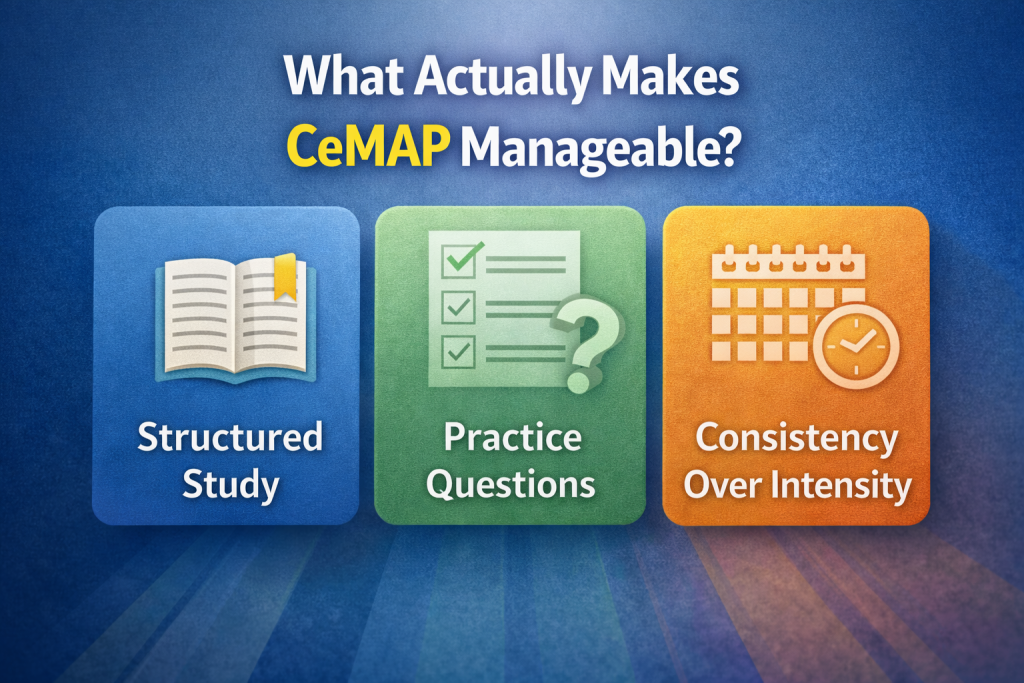
What Actually Makes CeMAP Manageable?

Preparation makes CeMAP manageable.

Most learners who initially feel that CeMAP is hard change their view once they understand the structure and style of questioning.

Structured Study

Breaking the syllabus into manageable sections prevents overwhelm. CeMAP content can appear large when viewed as a whole. Studied in stages, it becomes clearer.

Practice Questions

Becoming comfortable with multiple-choice questions changes how difficult the exam feels. Practice helps you recognise how questions are framed and how distractor answers are constructed.

Consistency Over Intensity

Short, regular study sessions are often more effective than occasional long sessions. The knowledge builds logically across the three modules.

What makes CeMAP manageable illustration showing structured study, practice questions and consistent revision

Does Intelligence Determine Success in CeMAP?

CeMAP does not require exceptional academic ability.

Success is usually linked to preparation, organisation, and attention to detail. Learners from a wide range of educational backgrounds complete the qualification each year.

The exams test understanding of regulation, ethics, and mortgage practice. Being methodical often matters more than being naturally academic.

Why Do Some Learners Feel Overwhelmed at the Start?

CeMAP introduces a regulated and ethically structured environment with precise terminology. That can feel unfamiliar.

Regulation and ethics require careful wording. Small differences in phrasing can change meaning. This can create early frustration, particularly in CeMAP 1.

Once learners adjust to that precision, confidence usually improves. What feels complex at first often becomes routine with repetition.

Is Exam Anxiety Making CeMAP Feel Harder?

In many cases, yes.

Anxiety can amplify perceived difficulty. Learners may know the content but doubt themselves during the exam. Multiple-choice formats can increase second-guessing.

Clear preparation and familiarity with the structure reduce this effect.

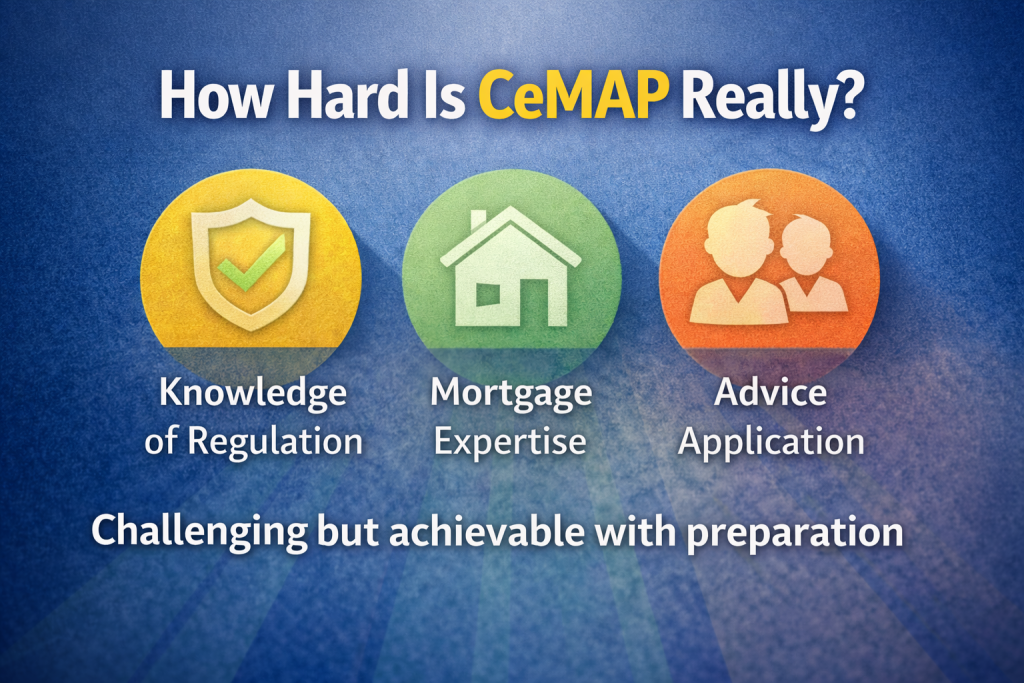
How Hard Is CeMAP Really?

CeMAP is challenging but achievable.

It is not designed to trick learners, nor is it effortless. It requires understanding financial services regulation, ethical standards, mortgage products, and the application of advice principles at a professional level.

Which module feels hardest depends on individual strengths. For most learners, CeMAP feels hardest at the beginning, when everything is new. As knowledge builds, confidence usually increases.

The key factor is not natural intelligence or prior background. It is preparation, consistency, and engagement with the material.

With realistic expectations and structured study, the CeMAP exams are demanding but manageable.

How hard is CeMAP really graphic showing regulation knowledge, mortgage expertise and advice application

Looking for training support?

We offer CeMAP training for learners working towards a career in mortgage advice. Our courses follow the London Institute of Banking & Finance syllabus and are designed to support understanding of mortgage regulation and advice requirements.

Explore our accredited CeMAP training courses

> Futuretrend Financial Training 
CPD Demystified: Why Continuing Professional Development Matters for Mortgage Advisers

cpd-for-mortgage-advisers

Continuing Professional Development (CPD) is often viewed by new mortgage advisers as a box-ticking chore mandated by regulators. In reality, CPD is a powerful tool that keeps your knowledge fresh, your skills sharp, and your career trajectory on the rise.

Whether you’re striving to meet the FCA’s requirements, deepen your understanding of complex mortgage products, or simply impress clients with up-to-date expertise, a robust CPD strategy is indispensable. In this article, we’ll unpack what CPD really entails, why it matters beyond compliance, and practical steps to make it work for you.

cpd-for-mortgage-advisers

What Is CPD in the Context of Mortgage Advice?

CPD, at its core, represents the ongoing learning and development activities that professionals undertake to maintain and enhance their skills. For mortgage advisers, CPD is formalised by both the Financial Conduct Authority (FCA) and the London Institute of Banking & Finance (LIBF). The FCA’s Senior Managers & Certification Regime (SM&CR) and the Mortgage Conduct of Business (MCOB) handbook emphasise that advisers must stay competent. Meanwhile, the LIBF requires CeMAP-qualified advisers to complete a set number of CPD hours each year to retain accreditation. Understanding these frameworks ensures you’re not only compliant but also delivering the highest standard of service.

FCA Expectations for CPD

The FCA views CPD as a critical component of its broader “Treating Customers Fairly” initiative. Under SYSC (Senior Management Arrangements, Systems and Controls) rules, firms must ensure their employees are competent for their roles. This means advisers need up-to-date knowledge of regulatory changes, market developments, and ethical best practices. The FCA doesn’t prescribe exact topics, but it does expect that CPD activities are relevant, structured, and reflective. Keeping a detailed CPD log is not merely administrative—it demonstrates to both your firm and potential clients that you’re committed to excellence.

FCA Mortgage Reforms Explained for Mortgage Advisers

LIBF Requirements for CeMAP Holders

For those who have completed their CeMAP qualification through an LIBF-accredited provider, ongoing CPD is non-negotiable. The LIBF mandates a minimum of 35 hours of CPD each year, with 5 hours dedicated specifically to ethics and regulation. Activities can range from attending industry webinars and conferences to completing short online courses or even writing professional articles. Crucially, LIBF-issued CPD records are audited annually, so maintaining accurate records of your activities and reflections is vital to avoid any compliance complaints or accreditation lapses.

LIBF

Why CPD Isn’t Just a Box-Ticking Exercise

Viewing CPD as a mere compliance requirement is a missed opportunity. Each CPD activity you undertake can directly enhance your client interactions, broaden your product knowledge, and fortify your professional confidence. Imagine tackling a complex self-employed mortgage case with insights gained from a specialised lender webinar—suddenly, you’re not just compliant, you’re delivering premium service. Moreover, demonstrating a commitment to ongoing learning can set you apart in a crowded market, giving you a compelling talking point in client meetings and job interviews alike.

How to Track and Manage Your CPD

Effective CPD management starts with a simple yet consistent process. First, set clear learning objectives—whether it’s mastering the latest Buy-to-Let criteria or understanding Help-to-Buy updates. Next, choose a logging method: many advisers use spreadsheet templates, CPD-tracking apps, or even built-in modules from their training provider. After each activity, record the date, duration, learning outcomes, and personal reflections. Regular reviews—quarterly or bi-annual—help you spot gaps early and plan future CPD. Remember, a well-organised CPD log not only satisfies regulators but also offers a roadmap of your professional growth.

Best Free and Paid CPD Resources

There is an abundance of quality CPD resources, but knowing where to look can save you time and ensure relevance:

  • Free Options: Many lenders and industry bodies offer no-cost webinars on product changes and regulatory updates. The FCA website itself runs periodic workshops.
  • Accredited Providers: Futuretrend’s CPD Blogs and Podcasts cover niche topics—from green mortgages to digital compliance—packaged in short articles. LIBF-approved online courses are also available through platforms like LIBF Learn.
  • Professional Journals & Podcasts: Subscribing to publications such as Mortgage Strategy or listening to specialist podcasts can count towards your reflection hours.

Each resource type brings unique benefits—mix and match to keep your learning diverse and engaging.

Conclusion & Next Steps

CPD is far more than a regulatory hurdle; it’s the engine that drives your professional excellence and credibility. By understanding the expectations set by the FCA and LIBF, embracing a structured tracking system, and choosing the right mix of resources, you’ll not only stay compliant but also continuously elevate your advisory skills. Make CPD a strategic priority, and watch your confidence—and career prospects—soar.

Elevate Your Expertise with Futuretrend

Ready to take your CPD to the next level?

Explore more of our blogs and podcasts, designed to keep you ahead of industry changes and deliver exceptional client outcomes.

Images Designed by Freepik (www.freepik.com) and AI

Compliance 101: Staying on the Right Side of FCA Regulations

Compliance 101: Staying on the Right Side of FCA Regulations

Compliance is far more than just paperwork—it’s the cornerstone of trust in financial services. As a newly qualified mortgage adviser, you must navigate the Financial Conduct Authority (FCA) rulebook to protect both your clients and your career. In this extended guide, we’ll delve deeper into the FCA’s key regulations, share advanced best practices for day-to-day compliance, and provide real-world examples to help you apply the rules with confidence.

Compliance 101: Staying on the Right Side of FCA Regulations

The FCA Rulebook: Structure & Key Handbooks

Before you can apply any compliance measures, it’s crucial to understand how the FCA’s regulatory framework is organised. The FCA publishes a series of handbooks, each covering specific sectors and operational principles. Knowing where to find guidance ensures you consistently follow the right rules and helps you anticipate upcoming regulatory changes.

The FCA’s framework is extensive. Understanding how handbooks interlink helps you find the right guidance:

  1. Handbook Structure
    • High-Level Modules: Principles, Scope, Glossary.
    • Sector-Specific Modules: MCOB for mortgages, COBS for investments.

  2. Mortgage Conduct of Business (MCOB)
    • Scope: Covers all consumer credit secured on land, including regulated mortgage contracts.
    • Key Requirements: marketing, disclosures, suitability, arrears handling.

  3. Consumer Duty
    • Effective July 2023, it demands firms deliver good outcomes through:
      • Consumer Understanding
      • Product & Service Design
      • Price & Value
      • Consumer Support

  4. Senior Managers & Certification Regime (SM&CR)
    • Defines individual accountability.
    • Whole-of-firm approach to governance, conduct rules, and fitness assessments.

Pro Tip: 

Subscribe to the FCA’s Policy Statement and Consultation Papers to anticipate upcoming changes.

Deep Dive: Suitability & Fact-Finding

Every piece of advice you give must be underpinned by a detailed fact-find and a well-documented suitability report. This isn’t just a compliance exercise; it’s how you demonstrate professional integrity and protect clients from unsuitable product recommendations. Let’s go beyond basic checklists to elevate your fact-finding process.

A robust fact-find is your frontline defence against unsuitable advice complaints. Go beyond a basic checklist:


Enhanced Fact-Find Techniques

  • Behavioural Insights: Use open-ended questions (“How do you feel about risk?”) to uncover client attitudes.
  • Life-Stage Mapping: Align mortgage solutions with life events (e.g., growing family, retirement plan).
  • Document Verification: Always upload ID, proof of address, payslips to your CRM’s secure portal.


Suitability Report Essentials

  • Client Objectives: State clearly (“Client wishes to fix rate for 5 years.”)
  • Analysis: Show comparative reasoning across 3+ products.
  • Recommendation Rationale: Explain why the chosen product outperforms alternatives in terms of cost, flexibility, and lender criteria.

Case Study: 

Sarah’s suitability report prevented a potential arrears situation by selecting a lender with flexible payment breaks aligned to her contract work.

Record-Keeping: From Good to Great

Accurate and comprehensive record-keeping goes beyond mere compliance—it’s your strongest defence in the event of a client complaint or FCA investigation. By implementing robust documentation processes and leveraging technology, you safeguard your advice and build credibility with both clients and regulators.

Good record-keeping is mandatory; great record-keeping protects you further.


Comprehensive Documentation

  • Fact-Find Records: Dated, version-controlled digital forms.
  • Client Communications: Email chains, recorded calls (with consent).
  • Advice Outputs: KFI, suitability reports, application tracking.


Retention & Audit

  • Retention Periods: 3 years for mortgages, 5 years for MiFID activities.
  • Audit Trail: Use time-stamped logs to demonstrate compliance steps taken.


Leveraging Technology

  • Automated Alerts: Set CRM triggers for review deadlines.
  • Secure Cloud Storage: Ensure ISO 27001-certified platforms.
  • Data Protection: GDPR-aligned processes—encrypt sensitive files and manage access

Pro Tip: 

Perform monthly mini-audits to clear outdated drafts and verify critical records.

Disclosure & Transparency: Building Client Confidence

Transparent communication is the bedrock of a trusting adviser-client relationship. By proactively disclosing fees, commissions, and potential conflicts, you empower clients to make informed decisions and demonstrate your commitment to their best interests.

Transparent communication is key to compliance and client trust.


Essential Disclosures

  • Key Facts Illustration (KFI): Must be in writing before application.
  • Costs & Charges Document: Break down fees, commission, product fees.
  • Regulatory Status: Disclose if you’re a tied adviser or whole-of-market broker.


Practical Disclosure Tips

  • Provide all documents in PDF format and ensure clients confirm receipt via email.
  • Use plain-language summaries at the top of technical disclosures.


Handling Conflicts of Interest

  • Maintain a conflicts register and update it quarterly.
  • If a conflict arises, inform the client in writing and seek consent to proceed.

Pro Tip: Example

Advising on a lender where you receive higher commission requires explicit disclosure and documented client approval.

Avoiding Common Pitfalls

Even seasoned advisers can make compliance missteps. By understanding typical pitfalls and following a proactive checklist, you reduce risk and ensure every piece of advice you provide meets the FCA’s high standards.

Even experienced advisers slip up. Here’s how to stay safe:

  1. Product Oversell: Recommend products based solely on client needs, not commission rates.

  2. Document Gaps: Double-check every advice file against an internal compliance checklist.

  3. Non-Compliance with SM&CR: Understand your role’s responsibilities—don’t perform tasks outside your certification.

  4. Neglecting CPD: CPD hours aren’t optional—missing them can lead to regulator action.

Building a Compliance-First Culture

A compliance-first culture ensures that regulatory considerations are embedded in every process, from client onboarding to ongoing client reviews. By fostering open communication, ongoing training, and continuous improvement, you build a resilient advisory practice that regulators and clients trust.

Create an environment where compliance is ingrained, not enforced.


Training & Knowledge Sharing

  • Quarterly FCA update workshops.
  • Peer-review sessions for suitability reports.


Communication & Accountability

  • Monthly team huddles focused on recent compliance alerts.
  • A clear whistleblowing policy—protect staff who raise concerns.


Continuous Improvement

  • Collect client feedback on your process clarity.
  • Adapt procedures based on FCA thematic reviews and industry best practice.

Pro Tip: 

Appoint a ‘compliance champion’ among new advisers to foster peer learning and ownership.

Final Thoughts

Mastering FCA compliance is a journey, not a destination. By understanding the rulebook, refining your fact-finds, maintaining impeccable records, and fostering a culture of transparency and accountability, you’ll not only meet regulatory requirements but also earn lasting client trust.

Ready to advance your mortgage expertise? Explore our CeMAP mortgage modules and gain the confidence to advise clients on tracker mortgages and beyond.

Ready for more exam-style examples?

Book our CeMAP Home Study course or visit our website for full training resources:
https://cemap123.co.uk/home-study-training/

Images Designed by Freepik (www.freepik.com) and AI

How to Become a Mortgage Adviser in the UK: A Step-by-Step Guide

How to Become a Mortgage Adviser in the UK: A Step-by-Step Guide

Are you considering a career as a mortgage adviser in the UK? The role of a mortgage adviser, also known as a mortgage broker, is crucial in helping clients navigate the complexities of securing a home loan. Whether you are interested in working for a financial institution, an independent brokerage, or starting your own business, this guide will walk you through the essential steps on how to become a mortgage adviser in the UK.

What Does a Mortgage Adviser Do?

A mortgage adviser helps individuals and businesses secure the right mortgage products based on their financial circumstances. This includes advising clients on suitable loan options, helping them understand the terms and conditions, and ensuring they meet the necessary criteria to qualify for a mortgage. Mortgage advisers can either work directly with clients or liaise with lenders to find the best deals.

How to Become a Mortgage Adviser in the UK: A Step-by-Step Guide

Steps to Become a Mortgage Adviser in the UK

Understand the Role and Responsibilities

Before diving into the qualifications and training required to become a mortgage adviser, it’s essential to understand the role itself. As a mortgage adviser, you will:

  • Assess clients’ financial situations and recommend suitable mortgage products.
  • Provide guidance on interest rates, repayment terms, and the mortgage application process.
  • Stay updated on changes in mortgage regulations and market conditions.
  • Build relationships with lenders, estate agents, and other financial professionals.

Understanding these responsibilities will help you determine if this career path aligns with your skills and interests.

Meet the Basic Eligibility Criteria

To become a mortgage adviser in the UK, you must meet certain eligibility criteria. These typically include:

  • Age Requirement: You must be at least 18 years old.
  • Right to Work in the UK: You should have legal permission to work in the UK, either as a UK citizen or with appropriate work visas.
  • Educational Background: While formal qualifications are not always required to start, a background in finance, business, or economics can be beneficial.

Obtain the Necessary Qualifications

To provide mortgage advice legally in the UK, you must be qualified and regulated by the Financial Conduct Authority (FCA). The key qualification required is the Level 3 Certificate in Mortgage Advice and Practice (CeMAP). This is the most widely recognized qualification for mortgage advisers in the UK and is offered by the London Institute of Banking & Finance (LIBF).

CeMAP Qualification

The CeMAP qualification is designed to give you the knowledge and skills necessary to advise clients on mortgages. It covers various topics, including:

  • Regulation and Ethics: Understanding the rules and regulations that govern the mortgage industry.
  • Mortgage Products: Knowledge of different types of mortgage products, including fixed-rate, variable-rate, and interest-only mortgages.
  • Client Needs: How to assess clients’ financial situations and recommend suitable mortgage products.
  • Legal Aspects: Understanding the legal framework surrounding mortgage lending and advising clients.

The CeMAP qualification is typically split into three modules:

  • CeMAP 1: This covers the financial services industry, regulation, and the role of a mortgage adviser.
  • CeMAP 2: Focuses on mortgage law and the application process.
  • CeMAP 3: Concentrates on the practical skills required for advising clients on mortgage products.

Once you have completed and passed the CeMAP exams, you are eligible to work as a fully qualified mortgage adviser.

Gain Experience in the Industry

While the CeMAP qualification is essential, gaining practical experience is equally important. Many mortgage advisers start in entry-level roles, such as administrative assistants or trainee mortgage advisers, where they can learn the ropes of the industry. These roles allow you to:

  • Develop a deeper understanding of mortgage products and the application process.
  • Build relationships with lenders and clients.
  • Learn about the different aspects of the mortgage industry, including compliance and regulations.

Some employers may even offer to sponsor your CeMAP training as part of your employment package, but look carefully at the T&Cs of this option as may mean you are tied into an agreement with high fees if you want to leave.

Register with the Financial Conduct Authority (FCA)

In the UK, mortgage advisers must be authorised and regulated by the Financial Conduct Authority (FCA) to provide mortgage advice. This ensures that advisers are qualified and adhere to industry standards.

Once you have completed your CeMAP qualification, you can apply for FCA authorisation. The process involves:

  • Completing an application form, providing details of your qualifications and experience.
  • Passing a fit and proper test, which assesses your integrity, honesty, and competence.
  • Paying a registration fee to the FCA.

Once authorised, you can legally advise clients on mortgages and offer mortgage-related services.

Consider Further Specialisations and Certifications

While CeMAP is the core qualification for mortgage advisers, some professionals choose to pursue additional certifications or specialisations. This can help you stand out in a competitive market and increase your earning potential.

Some of the advanced qualifications include:

  • CeRER: For those who want to offer equity release to your clients .
  • Diploma in Regulated Financial Planning: For mortgage advisers who want to expand their expertise into broader financial planning.
  • Advanced CeMAP: This qualification provides in-depth knowledge of complex mortgage products and regulations.

Develop Soft Skills and Build Your Network

Being a successful mortgage adviser requires more than just technical knowledge. Soft skills, such as communication, negotiation, and problem-solving, are essential for building trust with clients and lenders. You’ll need to be able to explain complex mortgage terms in simple terms and help clients make informed decisions.

Networking with other professionals in the industry, including estate agents, financial planners, and solicitors, can also help you grow your client base and gain referrals.

Start Advising Clients

Once you have completed your training, gained experience, and obtained FCA authorization, you are ready to start advising clients on mortgages. You can choose to work for a financial institution, join an independent brokerage, or set up your own practice.

If you decide to become self-employed, you’ll need to set up your business, manage your client relationships, and ensure compliance with all relevant regulations.

Ongoing Professional Development

The mortgage industry is constantly evolving, with new products, regulations, and market conditions. As a mortgage adviser, you must commit to ongoing professional development. This includes:

This includes:

  • Keeping up with changes in mortgage laws and financial regulations.
  • Attending industry seminars and workshops.
  • Regularly renewing your CeMAP qualification (if required) and pursuing additional certifications.

Conclusion

Becoming a mortgage adviser in the UK can be a rewarding and lucrative career. By following the steps outlined in this guide, you can ensure that you are well-equipped with the necessary qualifications, experience, and regulatory approval to help clients navigate the complex world of mortgages.

Whether you’re just starting out or looking to further your career in the mortgage advice sector, the right qualifications, experience, and dedication will set you on the path to success.

Images Designed by Freepik (www.freepik.com) and AI