How CeMAP Revision Guides Simplify the Syllabus (and What to Look For)

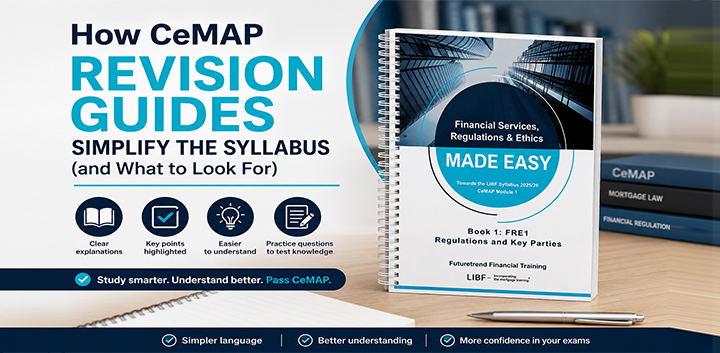
CeMAP revision guide book showing how simplified study materials make the CeMAP syllabus easier to understand

Studying for CeMAP (Certificate in Mortgage Advice and Practice) can feel overwhelming at first.

The official syllabus from the London Institute of Banking & Finance (LIBF) and the regulatory material linked to the Financial Conduct Authority (FCA) are detailed for a reason. They are designed to define what mortgage advisers need to know before giving regulated advice.

But there is a big difference between a syllabus that lists what you must learn and a revision guide that helps you actually understand it.

A good CeMAP revision guide should take a large, technical syllabus and turn it into something manageable, clear and easier to remember.

CeMAP revision guide book showing how simplified study materials make the CeMAP syllabus easier to understand

What Is a CeMAP Revision Guide?

A CeMAP revision guide is a study resource designed to explain the official syllabus in simpler language.

It should:

  • Cover all examinable topics
  • Break complex ideas into smaller sections
  • Use plain English instead of technical jargon
  • Highlight key facts and definitions
  • Help learners prepare for the exam efficiently

The purpose of a revision guide is not to replace the official syllabus. Its job is to make that syllabus easier to understand and revise.

That distinction matters.

The official syllabus tells you what you need to know. A revision guide should help you understand how to learn it.

Why the Official CeMAP Material Can Feel Difficult

The CeMAP qualification is the industry-standard mortgage advice qualification in the UK. It is awarded by the London Institute of Banking & Finance and meets the FCA’s education requirements for advisers who want to provide mortgage advice.

That does not mean the study material is always easy to digest.

Many learners struggle because the content includes:

  • Legal and regulatory terminology
  • Detailed product rules
  • Large amounts of factual information
  • Technical definitions
  • Long paragraphs with little explanation

If you are new to financial services, this can feel like being handed a dictionary and told to memorise it.

That is where revision guides become useful.

CeMAP student feeling overwhelmed by dense study materials and official mortgage regulation textbooks

Dense Material vs Simplified Material

Not all study resources are created in the same way.

Dense Material

Dense material often:

  • Uses formal wording taken directly from regulations
  • Includes long blocks of text
  • Introduces several concepts at once
  • Provides limited explanation
  • Assumes prior knowledge

This approach may be technically accurate, but it can be hard to absorb.

Simplified Material

A well-written revision guide should:

  • Explain one idea at a time
  • Use examples to illustrate concepts
  • Translate technical terms into everyday language
  • Highlight the most important facts
  • Summarise key points clearly

For example, rather than simply stating that a mortgage intermediary must comply with FCA disclosure requirements, a simplified guide might explain:

“Mortgage advisers must tell clients who they are, what service they offer and how they are paid before giving advice.”

The rule remains the same, but the explanation is much easier to understand.

How Good Revision Guides Break Down Topics

The best CeMAP study guides divide each topic into smaller, logical chunks.

Instead of presenting an entire chapter on mortgage regulation in one go, they break it into sections such as:

  • Who regulates mortgage advice
  • What advisers are allowed to do
  • Required disclosures
  • Complaints procedures
  • Consumer protection rules

This step-by-step structure helps learners build understanding gradually.

It is much easier to remember five short explanations than one long wall of text.

Examples of Topics That Benefit from Simplification

Some CeMAP topics are particularly suited to simplified explanations.

Regulation and Compliance

Rules and definitions can sound intimidating, but they become clearer when explained in practical terms.

Mortgage Products

Understanding the difference between repayment, interest-only, fixed-rate and tracker mortgages is easier when each product is compared side by side.

Calculations

Concepts such as loan-to-value (LTV) and debt-to-income ratios are more memorable when shown with worked examples.

Protection Products

Life cover, critical illness and income protection are easier to grasp when their purpose is explained in plain English.

What to Look for in a Good CeMAP Revision Guide

If you are comparing study materials, there are several signs of quality.

Clear, Simple Language

The guide should explain technical terms without making them sound more complicated than they are.

Logical Structure

Topics should be organised in the same order as the syllabus so you can track your progress.

Bite-Sized Sections

Short sections are easier to review and revisit.

Key Point Summaries

Important facts should be clearly highlighted.

Practical Examples

Examples help turn abstract concepts into real-world situations.

Practice Questions

Questions test understanding and reveal weak areas.

Up-to-Date Content

Mortgage regulation changes over time, so materials should reflect the current syllabus.

Are CeMAP Revision Guides Enough?

For many learners, a good revision guide is enough to understand the syllabus and prepare effectively for the exams.

However, revision guides work best when used alongside:

  • Practice questions and mock exams
  • The official syllabus specification
  • Additional explanations for difficult topics
  • A structured study plan

Think of a revision guide as the core of your study materials rather than the only tool you use.

If your guide covers the full syllabus clearly and you complete enough question practice, it may be all you need academically.

If you struggle with exam technique or motivation, you may benefit from extra support such as workshops, tuition or structured learning programmes.

How to Use CeMAP Revision Guides Effectively

Even the best guide is only useful if you use it properly.

1. Start With the Syllabus

Understand what each unit covers so you know what the exam expects.

2. Read in Small Sections

Focus on one topic at a time.

3. Make Your Own Notes

Writing summaries in your own words improves retention.

4. Test Yourself Regularly

Use practice questions after each chapter.

5. Revisit Weak Areas

Spend extra time on topics that consistently trip you up.

6. Use Spaced Revision

Review topics several times over a period of weeks rather than cramming.

Signs Your Current Materials May Not Be Working

You may need better revision guides if you find that:

  • You keep rereading the same pages
  • The explanations feel overly technical
  • You understand the words but not the meaning
  • You struggle to connect concepts together
  • Your mock exam scores are not improving

Good study materials should make learning feel clearer, not more confusing.

Why Simpler Explanations Improve Exam Performance

The CeMAP exams test understanding as well as recall.

If you genuinely understand a topic, you are more likely to:

  • Interpret questions correctly
  • Spot distractor answers
  • Apply knowledge to scenarios
  • Retain information longer

Simplified study materials help build this understanding by reducing unnecessary complexity.

That does not mean oversimplifying the content. It means presenting it in a way that is easier to learn.

CeMAP revision guide and study workspace showing how clear explanations improve understanding and exam performance

Can Revision Guides Replace the Official Textbooks?

Revision guides are designed to support learning, not to change the syllabus.

A comprehensive guide should cover the same topics as the official material, but in a more accessible format.

Many learners find they understand concepts faster when they start with simplified notes and then refer to official wording only when needed.

This approach saves time and reduces frustration.

Choosing the Right Study Materials for Your Learning Style

Different learners prefer different formats.

You may find it helpful to use:

  • Printed study guides for focused reading
  • Digital guides for quick searching
  • Audio lessons for learning on the move
  • Flashcards for memorising key facts
  • Mock exams for exam practice

The best resources are the ones you can use consistently.

Final Thoughts

CeMAP revision guides should make the syllabus easier to understand, easier to remember and easier to revise.

A good guide will:

  • Cover the full syllabus
  • Use clear language
  • Break topics into manageable sections
  • Include examples and summaries
  • Support effective exam preparation

If your current materials feel dense or confusing, it may not be the syllabus that is the problem. It may simply be the way the information is presented.

The right revision guide turns a daunting qualification into a structured learning journey that feels far more manageable.

Looking for training support?

We offer CeMAP training for learners working towards a career in mortgage advice. Our courses follow the London Institute of Banking & Finance syllabus and are designed to support understanding of mortgage regulation and advice requirements.

Explore our accredited CeMAP training courses

> Futuretrend Financial Training 
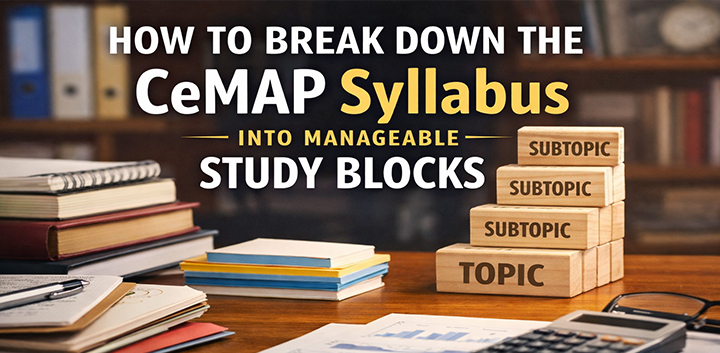
How to break down the CeMAP syllabus into manageable study blocks

CeMAP syllabus broken into manageable study blocks with topics and subtopics visualised using stacked blocks

How big is the CeMAP syllabus?

The CeMAP syllabus is often described as large because it covers a wide range of knowledge needed for mortgage advice. It is split across three modules and includes topics such as regulation, mortgage law, products, and financial protection.

In simple terms, it is not just one subject. It is a collection of related subjects that build towards a single professional understanding. That is why it can feel overwhelming at first.

The size of the syllabus is not just about length. It is about variety. Learners are expected to understand rules, apply knowledge, and recognise real-world scenarios. This mix makes the content feel heavier than it might look on paper.

CeMAP syllabus broken into manageable study blocks with topics and subtopics visualised using stacked blocks

Why does the CeMAP syllabus feel overwhelming?

For many learners, the challenge is not ability. It is how the content is presented.

The syllabus is structured in a formal way because it is designed to meet industry requirements set by the London Institute of Banking & Finance and aligned with expectations from the Financial Conduct Authority. This means it is written for completeness, not ease of learning.

That creates a few common problems:

It feels like one continuous block of information

When you first look at the syllabus, it can appear as one long list. Without clear mental separation, everything blends together.

Different types of knowledge sit side by side

You might move from legal rules to product features to calculations in a short space of time. That shift can feel disjointed.

There is no obvious starting point

Because everything is important, it can be hard to know where to begin or how to group things.

This is why many learners feel stuck before they even properly start. The issue is not the content itself, but how it is mentally organised.

What does “breaking the syllabus into study blocks” actually mean?

Breaking the syllabus into study blocks means turning a large, complex structure into smaller, clearly defined parts that make sense on their own.

A study block is not a timetable or a schedule. It is simply a way of grouping related ideas together so they are easier to understand.

Each block should:

  • Focus on one clear topic
  • Contain closely related sub-topics
  • Feel complete when studied on its own

This approach mirrors how people naturally learn. We understand things better when they are grouped logically, rather than presented all at once.

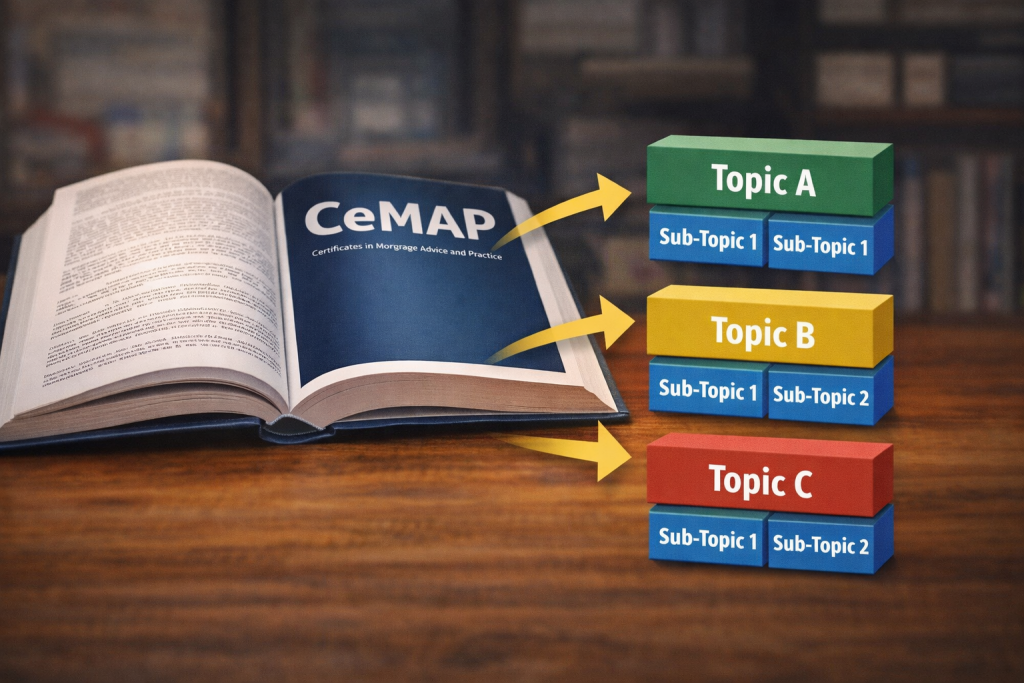
Visual showing CeMAP syllabus broken into topics and sub-topics using stacked blocks and arrows from study material

How can you break the CeMAP syllabus into topics?

The most effective way to organise the CeMAP syllabus is to think in layers.

Start with broad topics, then break those down into smaller parts.

Layer 1: Core topic areas

At the highest level, the syllabus can be grouped into a few key themes:

  • Regulation and the role of the adviser
  • Mortgage law and the house buying process
  • Mortgage products and repayment types
  • Financial protection

These are not official labels, but they reflect how the content naturally clusters.

Seeing the syllabus this way helps reduce the feeling that everything is separate. Instead, you begin to see patterns.

Layer 2: Topic groups within each area

Each core area can then be divided into smaller topic groups.

For example, within regulation you might have:

  • The role of the Financial Conduct Authority
  • Conduct of business rules
  • Consumer protection principles

Within mortgage products:

  • Types of mortgages
  • Interest rate structures
  • Repayment methods

These groupings start to make the content feel more manageable because they reflect real themes rather than a long list.

Layer 3: Sub-topics for deeper sections

Some parts of the syllabus are naturally larger and need further breakdown.

For example, a topic like mortgage types can be split into:

  • Fixed rate mortgages
  • Variable rate mortgages
  • Discounted products
  • Offset mortgages

Each of these becomes a small, focused unit of learning.

This is where the real benefit comes in. Instead of trying to understand “mortgages” as a whole, you deal with one type at a time.

Why does this approach make learning easier?

Breaking the syllabus into structured blocks changes how your brain processes the information.

It reduces cognitive overload

When too much information is presented at once, it becomes harder to retain anything. Smaller blocks are easier to absorb.

It creates a sense of progress

Working through clearly defined sections gives you visible progress. That matters for motivation, especially with a larger qualification.

It improves understanding, not just memory

When topics are grouped logically, it becomes easier to see how ideas connect. This leads to deeper understanding rather than surface memorisation.

How detailed should your study blocks be?

There is a balance to get right.

If your blocks are too large, you are back to feeling overwhelmed. If they are too small, you lose the bigger picture.

A good rule is this:

A study block should feel like something you can understand in one sitting, but still meaningful enough to connect to the wider topic.

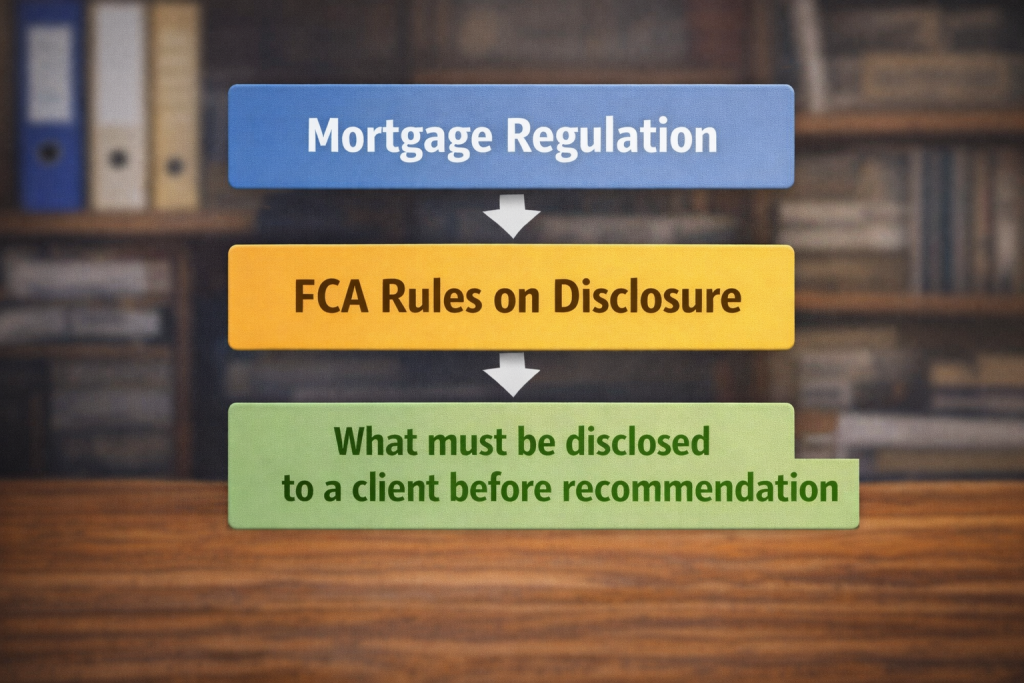
For example:

  • “Mortgage regulation” is too broad
  • “FCA rules on disclosure” is more focused
  • “What must be disclosed to a client before recommendation” is even clearer

You are aiming for clarity, not perfection.

CeMAP study blocks shown in levels from broad topics to detailed sub-topics illustrating how much detail is needed

What should you do with longer or more complex sections?

Some areas of the CeMAP syllabus are naturally more detailed. These often include regulation and mortgage products.

Instead of trying to simplify them too quickly, break them down further.

Example: Regulation

Rather than treating regulation as one topic, you can divide it into:

  • Who regulates the market
  • Why regulation exists
  • Key rules advisers must follow
  • How those rules apply in practice

Each of these becomes its own learning unit.

Example: Mortgage products

This can be broken into:

  • How interest is applied
  • How repayments are structured
  • How products differ in risk and flexibility

Then each of those can be split again if needed.

This layered approach allows you to go deeper without feeling lost.

Does this mean you should ignore the official syllabus structure?

No. The official structure is still important because it reflects how the exams are designed.

However, there is a difference between how content is structured for assessment and how it is best understood by a learner.

The syllabus is designed for completeness and accuracy.

Your study blocks are designed for clarity and understanding.

You are not replacing the syllabus. You are reorganising it in a way that works better for learning.

How do you know if your breakdown is working?

A simple way to check is to ask yourself:

  • Can I explain this topic in simple terms?
  • Do I understand how this connects to other topics?
  • Does this feel like a complete piece of knowledge?

If the answer is no, the block may still be too large or unclear.

If the answer is yes, you have likely found the right level of detail.

Why do some learners still feel stuck even after breaking things down?

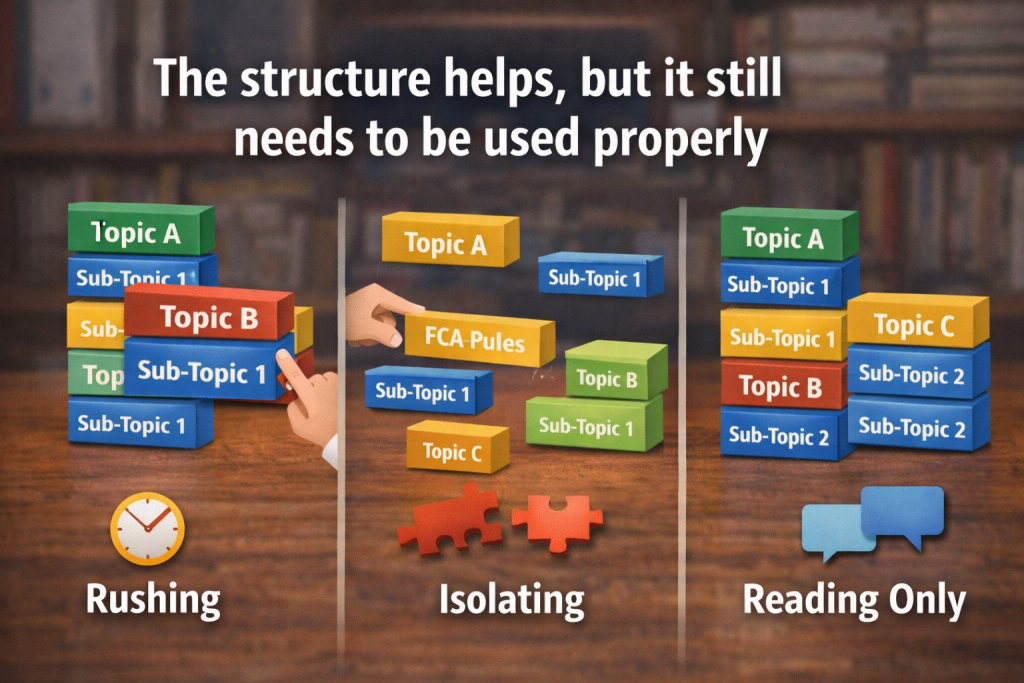
Breaking the syllabus into blocks helps, but it does not solve everything.

Some learners still struggle because:

They try to rush through blocks

Understanding takes time. Smaller sections do not mean

They treat blocks as isolated

Each topic connects to others. If you ignore those links, knowledge can feel fragmented.

They focus only on reading

Understanding often comes from thinking about how knowledge applies, not just seeing it written down.

The structure helps, but it still needs to be used properly.

How does this approach reflect real-world learning?

In practice, mortgage advisers do not think in terms of exam modules. They think in terms of situations.

For example:

  • What does the client need?
  • What rules apply here?
  • Which product fits best?

These decisions rely on grouped knowledge, not isolated facts.

By breaking the syllabus into logical blocks, you are closer to how the knowledge is actually used in real life.

CeMAP study blocks showing common mistakes like rushing, isolating topics, and only reading without applying knowledge

Final thoughts: making a large syllabus feel manageable

The CeMAP syllabus is not small, and it is not meant to be. It reflects the level of knowledge required to give responsible mortgage advice.

What makes it manageable is not reducing the content, but organising it in a way that makes sense.

Breaking the syllabus into topics and sub-topics helps you:

  • See structure instead of volume
  • Focus on one thing at a time
  • Build understanding step by step

Many learners find that once the structure becomes clear, the sense of overwhelm starts to reduce.

The key idea is simple.

You are not trying to tackle the whole syllabus at once.

You are working through one clear, connected piece at a time.

Looking for training support?

We offer CeMAP training for learners working towards a career in mortgage advice. Our courses follow the London Institute of Banking & Finance syllabus and are designed to support understanding of mortgage regulation and advice requirements.

Explore our accredited CeMAP training courses

> Futuretrend Financial Training