The Most Common CeMAP Exam Mistakes and How to Avoid Them

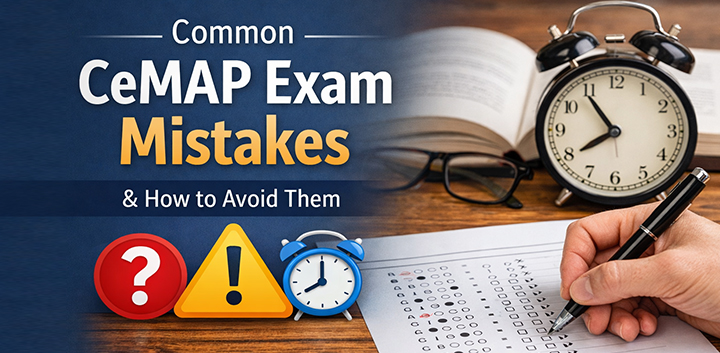
CeMAP exam mistakes illustration showing a multiple-choice answer sheet, clock and warning icons representing common errors in CeMAP 1, 2 and 3 exams.

Preparing for CeMAP can feel demanding, especially when you know the exams are designed to test understanding rather than memory alone. Over the years, certain patterns appear again and again. Not because learners lack ability, but because professional exams work differently from school or university assessments.

CeMAP is the industry standard mortgage advice qualification in the UK. It is awarded by the London Institute of Banking & Finance and meets the Financial Conduct Authority’s education requirements for giving regulated mortgage advice. The 2025/26 syllabus structure includes:

CeMAP exam mistakes illustration showing a multiple-choice answer sheet, clock and warning icons representing common errors in CeMAP 1, 2 and 3 exams.

All modules are assessed by computer-based multiple-choice exams, with CeMAP 3 built around case-study style assessment.

The most common mistakes in CeMAP exams are not usually about intelligence. They tend to be about interpretation, behaviour under pressure, and preparation habits.

Below are the errors seen most often and the reasons behind them.

Misunderstanding What Questions Are Really Asking

One of the most common CeMAP exam mistakes is answering the question you think is being asked rather than the one on the screen.

CeMAP questions are carefully written to test application of knowledge. This is especially true in CeMAP 2 and CeMAP 3 under the 2025/26 structure. Questions often include small details that change the correct answer.

Why does this happen?

Many learners revise topics in isolation. They understand definitions and concepts but are less confident when those ideas are placed into a practical scenario.

In CeMAP 1 (Financial Services Regulation and Ethics), for example, a question may test understanding of regulatory principles in context rather than simply asking for a definition. In CeMAP 3, the case study may include several facts, but only some are relevant to the question being asked.

When pressure builds, the brain looks for familiar words. If you spot a keyword you recognise, it is tempting to choose the answer that matches that keyword without fully analysing the scenario.

What reduces this mistake?

Awareness helps. Understanding that CeMAP questions are written to assess interpretation encourages slower, more deliberate reading. The exam is not trying to trick you, but it does expect careful thinking.

A clear approach to revision that focuses on understanding how rules apply in practice, not just what they are, makes a significant difference.

Rushing Through Questions Too Quickly

Another frequent issue is rushing.

CeMAP exams are timed, and seeing a countdown clock can make learners anxious. That anxiety often leads to speeding up unnecessarily, especially in the earlier part of the exam.

Why rushing causes problems

When learners rush:

  • Important words are missed, such as most appropriate, first step, or except
  • Details in case studies are overlooked
  • Answers are selected without full evaluation

In CeMAP 3 particularly, case-study questions require steady concentration. Skimming the background information can lead to incorrect assumptions about the client’s circumstances.

The irony is that many learners actually have enough time but lose marks through avoidable reading errors.
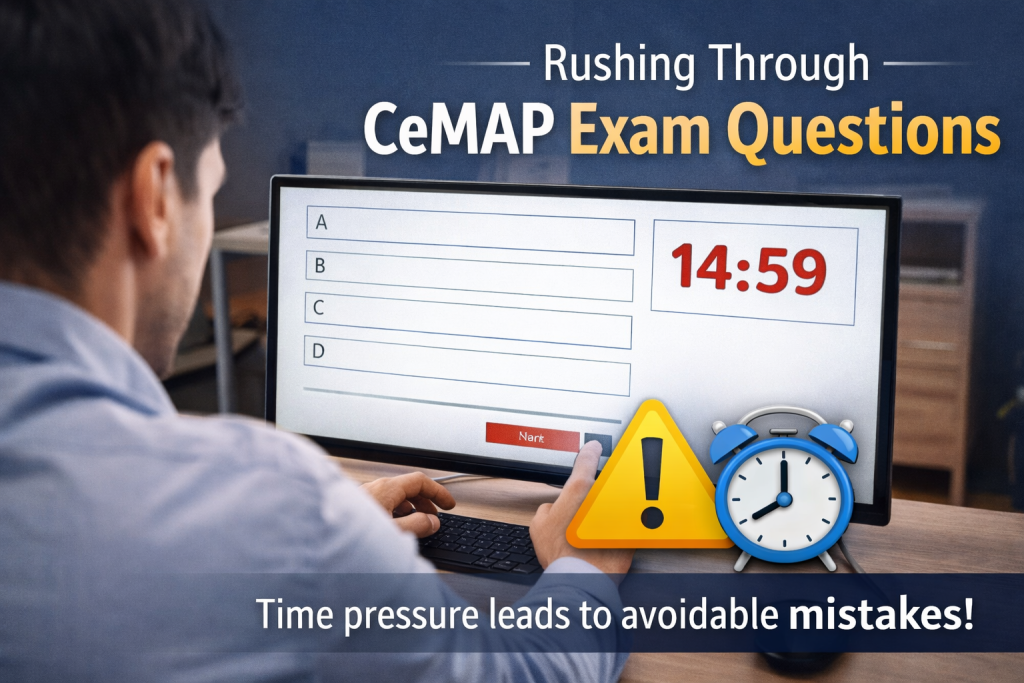
Learner rushing through a computer-based CeMAP multiple-choice exam with a countdown timer visible, illustrating time pressure and avoidable mistakes.

What helps prevent rushing?

Understanding the structure of the exam beforehand helps reduce panic. All CeMAP modules follow a consistent multiple-choice format, delivered on demand at approved test centres.

Recognising that the exam is designed to test professional judgement, not speed, encourages a calmer pace. Confidence comes from familiarity with the format rather than trying to “beat the clock”.

Second-Guessing Correct Answers

Second-guessing is another common behavioural pattern.

A learner selects an answer, feels uncertain, changes it, and later discovers their first instinct was correct.

Why does second-guessing happen?

Professional exams feel high stakes. That pressure can create doubt, even when knowledge is solid.

In CeMAP 1 (FSRE), for example, learners sometimes overcomplicate straightforward regulatory questions because they assume there must be a hidden twist. In CeMAP 2, they may question their understanding of mortgage product features even when they know the core principle.

This habit is often linked to lack of confidence rather than lack of preparation.

Learner hesitating over a multiple-choice CeMAP exam question on a computer screen, illustrating second-guessing correct answers.

How can it be reduced?

Stronger conceptual understanding reduces doubt. When learners know why an answer is correct, rather than simply remembering it, they are less likely to change it unnecessarily.

Confidence grows from structured preparation and repeated exposure to exam-style thinking, not from blind optimism.

Poor Preparation Habits

Some mistakes originate long before exam day.

Preparation habits have a direct impact on performance, and certain patterns regularly lead to avoidable errors.

Relying on memorisation alone

CeMAP is not designed as a memory test. Especially under the updated 2025/26 syllabus, the focus is on understanding regulatory principles, mortgage structures, and suitability.

Memorising lists without understanding how they apply can lead to confusion when questions are scenario-based.

Ignoring weaker topics

It is natural to prefer revising areas you already understand. However, CeMAP exams draw from across the syllabus.

In CeMAP 2, for instance, learners sometimes avoid complex areas such as repayment methods or specialist lending because they feel technical. In CeMAP 1, ethics and conduct topics may be underestimated because they appear straightforward at first glance.

Weak areas rarely disappear on exam day.

Learner surrounded by open books and notes looking tired while revising for a CeMAP exam, representing poor preparation habits.

Leaving preparation too late

Compressed revision often increases stress and reduces comprehension. Professional exams require mental stamina as well as knowledge.

Preparation spread over time supports deeper understanding and reduces last-minute panic.

Misunderstanding the Level of Application Required

Another recurring issue is misunderstanding how applied the questions can be.

CeMAP 3, in particular, tests the ability to assess mortgage advice knowledge within a client scenario. It assumes familiarity with the technical content from CeMAP 2 and the regulatory framework from CeMAP 1.

Learners sometimes prepare for modules in isolation without recognising how they link together.

CeMAP as a qualification is structured progressively:

  • CeMAP 1 builds regulatory and ethical foundations
  • CeMAP 2 develops technical mortgage knowledge
  • CeMAP 3 tests applied advice understanding

Seeing them as separate subjects rather than connected stages can create gaps in reasoning.

A joined-up understanding makes exam questions feel more logical and less fragmented.
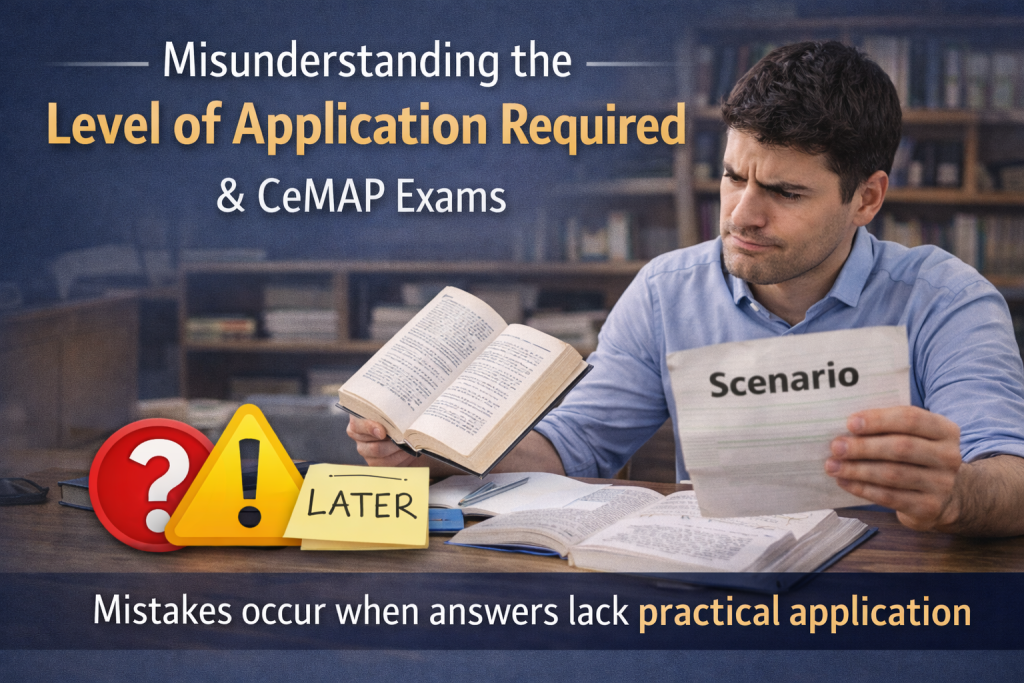
Learner comparing a textbook and a scenario sheet while revising for a CeMAP exam, illustrating misunderstanding of applied knowledge requirements.

Losing Focus During the Exam

Mental fatigue is another underestimated factor.

Even though each CeMAP module is manageable in length, sustained concentration is required. Small lapses in focus can lead to avoidable errors, especially toward the end of an exam.

Common focus-related mistakes include:

  • Clicking the wrong option accidentally
  • Misreading numerical details
  • Skipping key words in longer scenarios

These errors are rarely about knowledge. They are usually about attention.

Building familiarity with exam-style material in advance helps strengthen concentration over time.
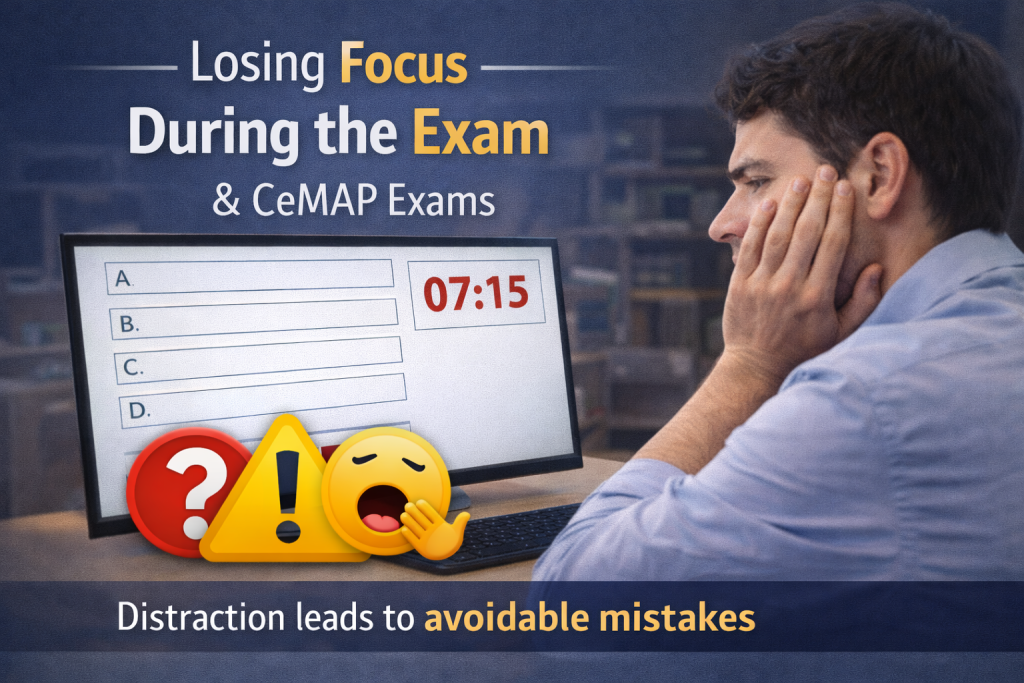
Learner appearing distracted during a computer-based CeMAP exam with a visible countdown timer, representing loss of focus.

Overcomplicating Straightforward Questions

Some learners assume every question must be complex. This can lead to adding layers of interpretation that are not required.

CeMAP exams are designed to test professional competence at the required level. Not every question contains a hidden angle.

If a question in CeMAP 1 clearly relates to a core regulatory principle, the correct answer is usually grounded in that principle rather than in an obscure exception.

Clarity often beats over-analysis.

How Does Awareness Reduce CeMAP Exam Mistakes?

Understanding common patterns changes how learners approach preparation.

When you know that:

  • Questions test application, not just recall
  • Reading carefully matters more than speed
  • Confidence reduces second-guessing
  • Preparation habits influence performance

You start to view the exam differently.

CeMAP exams are structured assessments designed to confirm knowledge and understanding at an appropriate professional level. They are not designed to catch learners out or reward tricks.

Mistakes tend to fall into predictable categories: interpretation errors, behavioural reactions under pressure, and uneven preparation.

Recognising those categories early allows learners to adjust their approach before exam day.
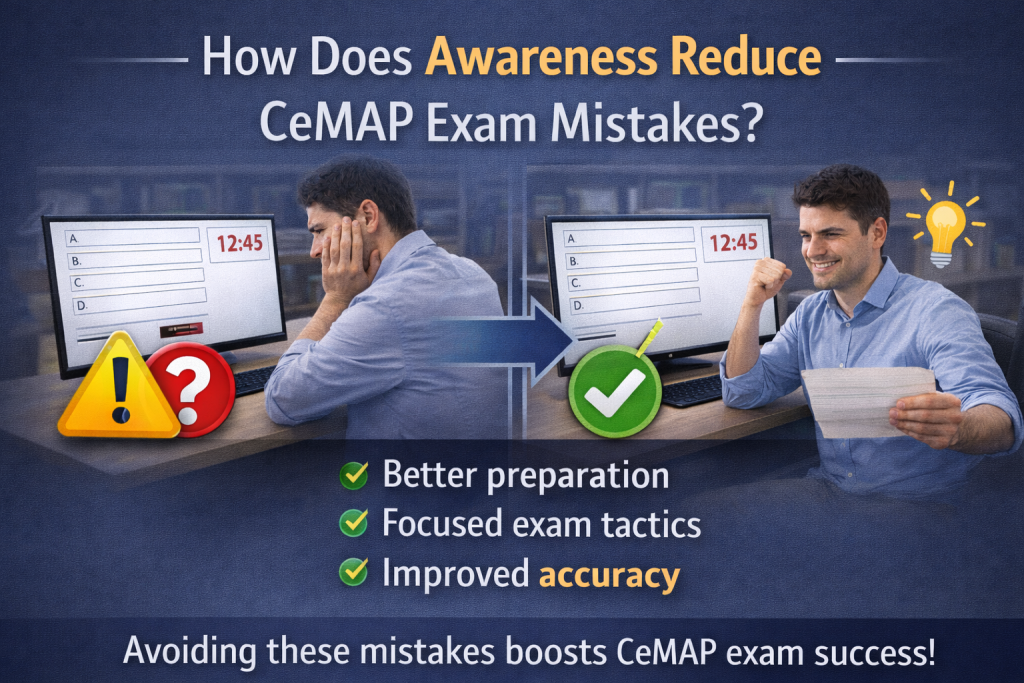
Comparison image of a stressed and then confident learner during a CeMAP exam, showing how awareness reduces common exam mistakes.

What Mistakes Do People Make in CeMAP Exams?

In summary, the most common CeMAP exam mistakes include:

  1. Misreading or misinterpreting what the question is asking
  2. Rushing due to time pressure
  3. Second-guessing correct answers
  4. Relying on memorisation without understanding
  5. Avoiding difficult topics during revision
  6. Underestimating applied, scenario-based questions
  7. Losing concentration

These patterns appear repeatedly across CeMAP 1 (Financial Services Regulation and Ethics), CeMAP 2 (Mortgages), and CeMAP 3 (Assessment of Mortgage Advice Knowledge) under the 2025/26 syllabus structure.

They are behavioural and preparation-based issues, not indicators of ability.
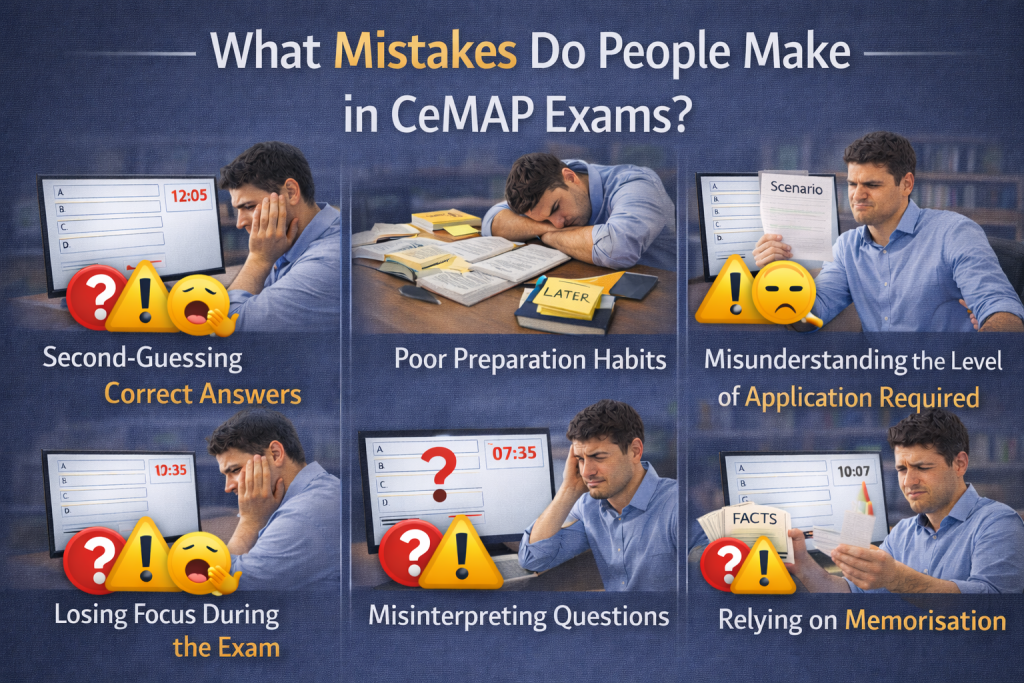
Infographic showing common CeMAP exam mistakes including second-guessing, poor preparation, misinterpreting questions, losing focus, and relying on memorisation.

Final Thoughts

Most CeMAP exam mistakes are avoidable once you recognise them.

The qualification, awarded by the London Institute of Banking & Finance, exists to confirm that advisers understand regulation, ethics, mortgage products, and suitability. It reflects the standards expected by the Financial Conduct Authority for those giving mortgage advice in the UK.

Approaching the exams with clarity, steady preparation, and awareness of common pitfalls reduces unnecessary errors.

No one sits a professional exam perfectly. But understanding where mistakes typically arise helps you prepare in a more informed and balanced way.

And that, more than anything else, improves your chances of walking into the exam room feeling ready rather than uncertain.

Looking for training support?

We offer CeMAP training for learners working towards a career in mortgage advice. Our courses follow the London Institute of Banking & Finance syllabus and are designed to support understanding of mortgage regulation and advice requirements.

Explore our accredited CeMAP training courses

> Futuretrend Financial Training 

What Learners Usually Find Hardest in CeMAP 1 – And Why

What is the hardest part of CeMAP 1 featured image showing regulation, ethics and compliance study themes.

Many new learners ask the same question before they begin: what is the hardest part of CeMAP 1?

The honest answer is that most people find the regulatory and legal content the most challenging. Not because it is impossible to understand, but because it feels unfamiliar, detailed and less practical than expected.

CeMAP 1 is very different from what many people imagine. It is not about mortgage calculations or sales techniques. It focuses on regulation, ethics and the legal framework that underpins financial services in the UK.

Understanding why this feels difficult can remove a lot of unnecessary anxiety.

What is the hardest part of CeMAP 1 featured image showing regulation, ethics and compliance study themes.

What Does CeMAP 1 Actually Test?

CeMAP 1 is formally known as Financial Services Regulation and Ethics (FSRE). It is the first module of the CeMAP qualification and is awarded by the London Institute of Banking & Finance.

CeMAP is the industry standard qualification for mortgage advisers in the UK. It meets the education requirements set by the Financial Conduct Authority for giving regulated mortgage advice.

CeMAP 1 focuses on:

  • The structure of financial services regulation in the UK
  • The role and powers of the Financial Conduct Authority
  • Ethical standards and professional conduct
  • Consumer protection
  • Complaints and compensation processes
  • Financial crime and anti-money laundering principles

It tests understanding of how the regulatory system works and how advisers are expected to behave within it.

It does not test how to sell mortgages. It tests whether someone understands the rules that govern the industry.

What Is the Hardest Part of CeMAP 1?

For most learners, the hardest part of CeMAP 1 is grasping the regulatory framework and remembering who is responsible for what.

This includes:

  • Understanding how regulation developed
  • Knowing the roles of different bodies
  • Distinguishing between rules, principles and guidance
  • Interpreting ethical scenarios

The difficulty usually comes from three factors:

  1. The volume of terminology
  2. The abstract nature of regulation
  3. The level of detail required

It is not usually mathematical complexity or technical mortgage knowledge that causes difficulty. It is the legal and compliance language.

Why Does Regulation-Based Learning Feel So Difficult?

Is It Because the Content Is Too Complicated?

Not necessarily. The content is logical, but it uses precise language.

Regulation is written to remove ambiguity. That means terms have specific meanings. Words such as “authorised”, “regulated activity”, and “consumer duty” are not general phrases. They carry defined legal meaning.

For learners who are new to financial services, this can feel heavy at first.

Is It Because There Is So Much to Remember?

Partly, yes.

CeMAP 1 contains structured knowledge that builds on itself. For example:

  • Understanding the regulator
  • Understanding authorised firms
  • Understanding approved persons
  • Understanding conduct standards

Each concept links to another. If the foundation feels unclear, later sections feel harder.

That can create the impression that the whole module is difficult, when in reality it is about becoming familiar with a new framework.

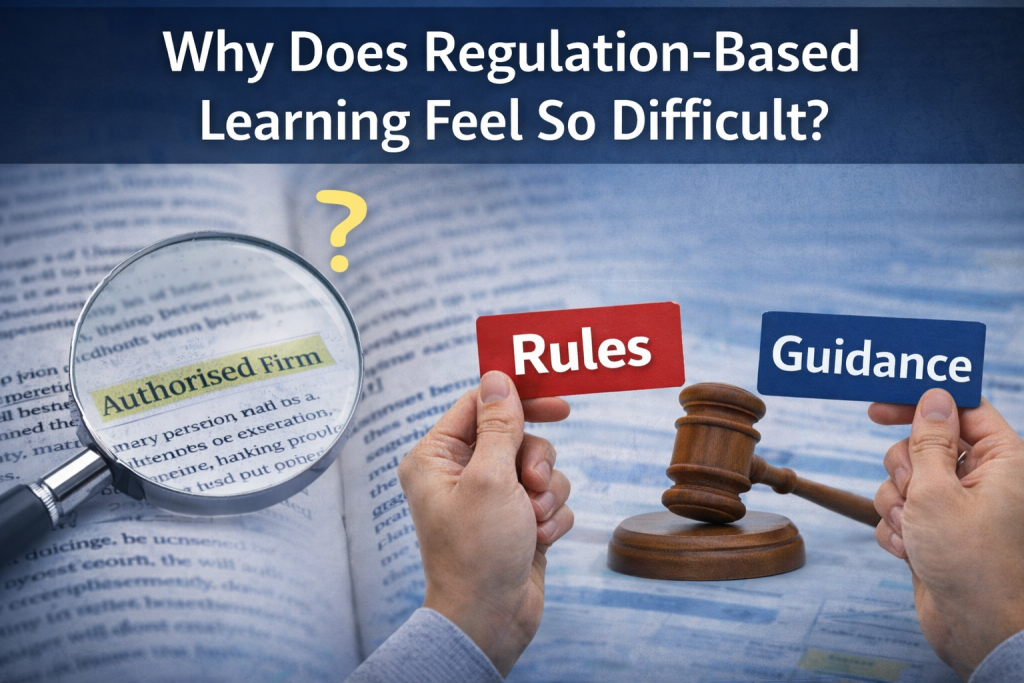
Regulation-based learning concept showing rules, guidance and authorised firm terminology in CeMAP 1 study material.

Which Areas Do Learners Most Commonly Struggle With?

Understanding the Role of the Financial Conduct Authority

Many learners initially confuse what the Financial Conduct Authority actually does.

The Financial Conduct Authority is the UK regulator responsible for overseeing financial services firms and ensuring markets function well. It sets rules, supervises firms and has enforcement powers.

Learners sometimes mix up supervision, rule-making and enforcement functions. They may also struggle to understand how the FCA’s objectives influence its approach.

Because these concepts are theoretical rather than practical, they can feel less tangible.

The Principles and Rules Framework

CeMAP 1 explains how regulation operates at different levels:

  • High-level principles
  • Detailed rules
  • Guidance

Understanding the difference between these levels can be challenging.

Principles are broad standards of behaviour. Rules are specific requirements. Guidance explains how rules may be applied.

Learners often find it harder to interpret principles because they are not checklist items. They require judgement and understanding.

Ethics and Professional Conduct

Ethics is another area that learners underestimate.

Ethics in CeMAP 1 refers to professional behaviour standards expected within regulated financial services. It includes integrity, treating customers fairly and managing conflicts of interest.

The difficulty is not the idea of being ethical. The difficulty lies in applying ethical principles to scenarios.

Questions may describe situations where more than one answer seems reasonable. That can create doubt.

Complaints and Compensation Structures

The structure of complaints handling and compensation arrangements can feel procedural.

Understanding the difference between:

  • A firm’s internal complaints process
  • The escalation route
  • The role of ombudsman services
  • Compensation schemes

requires careful reading.

Learners sometimes struggle because they try to memorise processes without fully understanding why those processes exist.

Financial Crime and Anti-Money Laundering

Financial crime topics are often detailed and rule-based.

This includes:

  • The purpose of anti-money laundering controls
  • Suspicious activity reporting
  • The responsibilities of regulated firms

The terminology can feel technical, particularly for learners without prior exposure to compliance roles.

Why Do Learners Often Expect CeMAP 1 to Be Easier?

A common misconception is that CeMAP 1 will be the “basic” module because it is first.

In reality, it lays the regulatory foundation for the rest of the qualification.

Some learners assume:

  • It will focus mainly on mortgages
  • It will be practical and scenario-based
  • It will involve simple definitions

Instead, it focuses on structure, governance and professional standards.

When expectations do not match reality, the module can feel harder than it truly is.

Is CeMAP 1 Harder Than the Other Modules?

It depends on the individual.

Some learners with legal, compliance or financial services backgrounds find CeMAP 1 straightforward.

Others who are more comfortable with practical product knowledge may find later modules more natural.

CeMAP 1 feels harder to many people because it is abstract. Later modules feel more concrete, particularly when discussing mortgage products and case-based scenarios.

Difficulty is often about familiarity rather than ability.

Does Struggling With CeMAP 1 Mean You Are Not Suited to the Industry?

No

Many capable mortgage advisers found CeMAP 1 challenging at the beginning.

Regulatory learning is a skill in itself. It requires:

  • Attention to detail
  • Comfort with structured rules
  • Careful reading

These are not innate talents. They develop with exposure.

Struggling at first does not indicate a lack of potential. It often reflects encountering a new type of subject matter.

Learner studying CeMAP 1 looking concerned, with question about suitability for the mortgage industry.

Why Standards Still Matter

While it is important to normalise difficulty, it is equally important not to minimise standards.

CeMAP 1 exists because mortgage advice is regulated.

Advisers handle large financial commitments for clients. Regulation protects consumers and ensures consistent professional conduct.

Understanding regulation is not optional. It is central to the role.

The purpose of CeMAP 1 is not to make the qualification harder. It is to ensure that anyone progressing understands the framework they will operate within.

How Should Learners View CeMAP 1?

A helpful perspective is to see CeMAP 1 as learning the rules of the road before driving.

It may not feel as exciting as discussing mortgage products. It may involve more reading than expected.

However, once the structure becomes familiar, the content becomes more logical.

Many learners report that:

  • The first exposure feels dense
  • The second reading feels clearer
  • The overall system starts to connect

The perceived difficulty often reduces as understanding grows.

Final Perspective: What Is Really the Hardest Part of CeMAP 1?

The hardest part of CeMAP 1 for most learners is adjusting to regulatory thinking.

It requires:

  • Learning precise terminology
  • Understanding a formal framework
  • Applying ethical principles

It is not about intelligence. It is about familiarity and mindset.

CeMAP 1 sets the professional foundation for mortgage advice in the UK. It introduces the regulatory environment that advisers must work within.

If it feels challenging, that is normal. It reflects the seriousness of the industry rather than a personal limitation.

With time and structured learning, what first feels abstract usually becomes clear and manageable.

The key point is perspective. Difficulty at the start is common. It does not predict the outcome.

Looking for training support?

We offer CeMAP training for learners working towards a career in mortgage advice. Our courses follow the London Institute of Banking & Finance syllabus and are designed to support understanding of mortgage regulation and advice requirements.

Explore our accredited CeMAP training courses

> Futuretrend Financial Training