How CeMAP exam questions are written and what they test

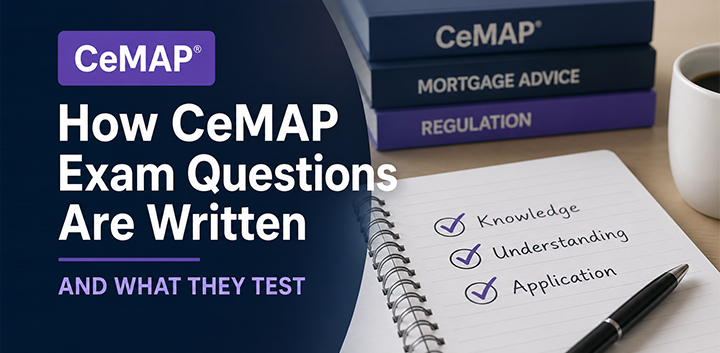
CeMAP exam questions explained showing knowledge understanding and application checklist on study notebook

Understanding how exam questions are designed can make a big difference to how you interpret them. Many learners feel confident with the content but become unsure when faced with the wording of the exam itself. That usually comes down to not fully understanding what the questions are actually trying to assess.

This guide explains how CeMAP exam questions are structured, what they are designed to test, and why they are written the way they are.

CeMAP exam questions explained showing knowledge understanding and application checklist on study notebook

What do CeMAP exam questions test?

CeMAP exam questions are designed to assess whether you can apply knowledge in a realistic context, not just recall facts.

They test:

  • Your understanding of key concepts
  • Your ability to interpret information
  • Your judgement in applying rules and principles
  • Your awareness of how knowledge fits into real situations

The exams are not trying to catch you out. They are designed to reflect the kind of thinking required in a real mortgage advice role.

That means simply memorising facts is not enough on its own.

Why are CeMAP exams structured this way?

CeMAP is awarded by the London Institute of Banking & Finance and is aligned with the expectations of the Financial Conduct Authority.

The purpose of the qualification is to ensure that individuals advising on mortgages have the knowledge and understanding required to do so responsibly.

Because of this, exam questions are written to reflect real-world decision making, not just textbook learning.

A definition-style explanation makes this clearer:

CeMAP exam questions are structured to assess applied knowledge, meaning they test how well a learner can use information in context, rather than simply recall isolated facts.

This is why the wording can sometimes feel more complex than expected.

Do CeMAP questions test knowledge or understanding?

They test both, but the emphasis is on understanding.

Knowledge still matters

You need a solid grasp of:

  • Regulations
  • Mortgage products
  • Processes
  • Terminology

Without that foundation, you will struggle to interpret questions properly.

But understanding is what is really assessed

Understanding means:

  • Recognising what information is relevant
  • Interpreting what a question is asking
  • Applying knowledge to a scenario

Two learners might know the same facts, but the one who understands how to use them will perform better.

This is where many learners get caught out. They revise thoroughly but focus mainly on remembering content, rather than thinking about how it might be used.

Why do some CeMAP questions feel confusing?

This is one of the most common concerns.

The confusion usually comes from how questions are phrased, not from the difficulty of the content itself.

Questions are designed to require interpretation

Rather than asking for a direct definition, questions often:

  • Present information in a slightly indirect way
  • Require you to identify what is important
  • Expect you to connect different parts of the syllabus

This can feel unfamiliar if you are used to more straightforward testing styles.

Language is precise, not tricky

It is easy to assume questions are designed to mislead. In reality, they are carefully written to be precise.

Small differences in wording can change the meaning of a question. That is deliberate, because in real financial advice, details matter.

Context is often implied

You may not be given every piece of information explicitly. Instead, you are expected to:

  • Recognise what is being described
  • Understand the situation being presented
  • Apply the correct knowledge

This reflects real-world scenarios, where clients do not always present information in a perfectly structured way.

What is the purpose behind the way questions are written?

Every question has a purpose beyond simply checking memory.

To reflect real decision-making

Mortgage advisers do not work from memory alone. They:

  • Interpret client situations
  • Apply regulatory rules
  • Make informed judgements

Exam questions are written to reflect that process.

To test clarity of understanding

If you truly understand a topic, you should be able to recognise it even when it is presented differently.

This is why questions may:

  • Rephrase familiar ideas
  • Combine multiple concepts
  • Use slightly varied terminology

To ensure consistency and fairness

Exam design follows strict standards. Questions are reviewed to ensure they:

  • Accurately reflect the syllabus
  • Test appropriate levels of understanding
  • Avoid ambiguity where possible

While some questions may feel challenging, they are not random or subjective.

Common misconceptions about CeMAP exam questions

There are a few misunderstandings that tend to make the exams feel harder than they need to be.

“The questions are designed to trick you”

This is probably the biggest misconception.

Questions are not designed to trick you. They are designed to check whether you:

  • Understand the material
  • Can apply it correctly

If a question feels tricky, it is usually because it requires careful reading, not because it is misleading.

“If I memorise everything, I will pass easily”

Memorisation helps, but it is not enough on its own.

You might recognise the topic, but still struggle if you cannot:

  • Interpret the wording
  • Apply the knowledge in context

Understanding always matters more than volume of revision.

“The exam is harder than the syllabus”

The exam does not go beyond the syllabus.

However, it can feel harder because:

  • Questions are applied rather than direct
  • Topics are sometimes combined
  • Wording requires interpretation

The challenge is not new content. It is how the existing content is used.

Why understanding wording matters so much

One of the key skills being tested is your ability to read and interpret questions accurately.

In practice, this means:

  • Picking up on key terms
  • Not overlooking small details
  • Understanding what is actually being asked

This is important because in real mortgage advice:

  • Misunderstanding a client’s situation can lead to poor outcomes
  • Missing details can have regulatory implications
  • Clear communication is essential

The exam reflects these expectations.

How different topics are assessed within questions

Although all questions are based on the syllabus, they often draw on more than one area at once.

Topics are rarely isolated

Instead of testing one idea in complete isolation, questions may:

  • Combine regulation and product knowledge
  • Link processes with practical scenarios
  • Require you to think across topics

This reflects how knowledge is used in real situations.

Some areas test recognition

Certain parts of the syllabus are more knowledge-based.

These might involve:

  • Identifying definitions
  • Recognising key terms
  • Understanding core principles

Others test application

Other areas focus more on:

  • Interpreting situations
  • Applying rules correctly
  • Making informed judgements

Most exams include a mix of both.

Why applied questions are important for future advisers

It is worth remembering that CeMAP is not just an academic qualification.

It is designed to prepare people for working in financial services.

Applied questions matter because they:

  • Reflect real client interactions
  • Reinforce responsible decision-making
  • Build confidence in practical understanding

A learner who can apply knowledge is better prepared for the realities of the role.

How this affects the way you experience the exam

If you expect questions to be purely fact-based, the exam can feel more difficult than it actually is.

Once you understand what is being assessed, things usually start to make more sense.

You begin to see that:

  • Questions follow patterns
  • Wording has a clear purpose
  • The focus is on understanding, not memorisation

That shift in perspective often reduces confusion.

Why some learners find this adjustment challenging

The move from learning to application is not always easy.

Some reasons include:

  • Previous exams may have focused more on recall
  • The syllabus feels large, so learners prioritise memorising
  • Confidence can drop when questions are not straightforward

This is a normal part of the learning process.

Recognising that the exam is testing understanding rather than memory helps you adjust expectations.

What should you take away from this?

CeMAP exam questions are carefully designed to assess how well you understand and apply knowledge, not just how much you can remember.

They are:

  • Structured around real-world thinking
  • Written with precise language
  • Focused on interpretation and judgement

If the wording feels unfamiliar, that does not mean the exam is unfair. It usually means it is testing a deeper level of understanding.

Final thought

If you find CeMAP questions confusing at first, you are not alone. It is a common experience, especially for those new to this style of assessment.

The key is recognising that the exam is not about catching you out. It is about checking whether you can think like a mortgage adviser.

Once you understand that, the structure of the questions starts to feel far more logical.

Looking for training support?

We offer CeMAP training for learners working towards a career in mortgage advice. Our courses follow the London Institute of Banking & Finance syllabus and are designed to support understanding of mortgage regulation and advice requirements.

Explore our accredited CeMAP training courses

> Futuretrend Financial Training 

What you study in CeMAP 1 (FSRE) and why it matters

CeMAP 1 FSRE explained showing financial services, regulation and ethics icons

Many people starting CeMAP are surprised by how much regulation is covered before they reach mortgages. This often leads learners to question why CeMAP 1 exists at all.

CeMAP 1 is not about mortgage products. It is about the rules, responsibilities, and ethical standards that apply to anyone giving regulated mortgage advice in the UK. Without this foundation, mortgage advice cannot be given safely or compliantly.

This article explains exactly what you study in CeMAP 1, what Financial Services, Regulation and Ethics (FSRE) means, how FRE1 and FRE2 are structured and assessed, and why this content matters in real mortgage advice.

CeMAP 1 FSRE explained showing financial services, regulation and ethics icons

What do you study in CeMAP 1?

CeMAP 1 is the first module of the Certificate in Mortgage Advice and Practice. It focuses on financial services regulation, professional conduct, and ethics.

CeMAP 1 does not teach mortgage lending rules or product knowledge. Instead, it explains the regulatory environment in which mortgage advice takes place and the standards advisers are expected to meet.


The module covers Financial Services, Regulation and Ethics (FSRE) and is split into two units:

  • FRE1: Regulation, legislation and key parties
  • FRE2: Skills, principles and ethical behaviours


Together, these units provide the regulatory and ethical foundation required before progressing to mortgage-specific study.

What is FSRE in CeMAP?

Financial Services, Regulation and Ethics (FSRE) describes the subject content covered in CeMAP 1.

FSRE focuses on how the UK financial services industry operates, how it is regulated, and how advisers are expected to behave when dealing with clients.

CeMAP is awarded by the London Institute of Banking & Finance, which forms part of the Walbrook Group, and meets the Financial Conduct Authority education requirements for giving mortgage advice in the UK.

FSRE exists to ensure advisers understand not just what they can advise on, but how they must operate when dealing with consumers.

What is FSRE in CeMAP showing financial services, regulation and ethics icons

What does FRE1 cover in CeMAP 1?

FRE1 focuses on the structure, regulation, and legal framework of the UK financial services industry.

It explains who regulates financial services, why regulation exists, and how different parts of the system interact.

Regulation of financial services in the UK

FRE1 covers:

  • The purpose of financial regulation
  • How regulation has developed over time
  • The role of statutory regulation in protecting consumers

You study the responsibilities of the Financial Conduct Authority and the Prudential Regulation Authority, including how their roles differ.

This matters for mortgage advisers because all mortgage advice falls under FCA regulation, even when advisers are employed by a firm with its own compliance structure.

Key legislation and legal principles

FRE1 introduces the legal framework that underpins financial advice, including:

  • How financial services law is created and enforced
  • The difference between legislation, regulation, and guidance
  • Legal responsibilities of firms and individuals

This content explains why regulatory rules are enforceable and why breaches can lead to sanctions, complaints, or loss of permissions.

The financial services industry and markets

FRE1 also covers:

  • The structure of the UK financial services industry
  • Types of financial institutions and their roles
  • How money flows through financial markets
  • The relationship between risk and reward


Although this content is broader than mortgages, it provides context for how mortgage lending fits into the wider financial system.

What does FRE2 cover in CeMAP 1?

FRE2 focuses on adviser behaviour, ethical standards, and the advice process.

While FRE1 explains the system, FRE2 explains how advisers are expected to operate within it.

The advice process and suitability

FRE2 covers the stages of giving regulated advice, including:

  • Establishing client circumstances and objectives
  • Assessing suitability
  • Making appropriate recommendations
  • Reviewing and maintaining advice

These principles apply directly to mortgage advice, even though the examples are not mortgage-specific.

Ethics and professional standards

A significant part of FRE2 is understanding ethical behaviour in practice.

This includes:

  • Acting in the client’s best interests
  • Treating customers fairly
  • Managing conflicts of interest
  • Maintaining integrity and professionalism

These principles underpin FCA conduct rules and are central to how adviser behaviour is judged.

Consumer protection and complaints

FRE2 also explains:

  • Consumer rights and protections
  • How complaints are handled
  • The role of redress mechanisms such as the Financial Ombudsman Service

Mortgage advisers must understand these processes because complaints often focus on conduct rather than technical product errors.

How are the FRE1 and FRE2 exams structured?

Both FRE1 and FRE2 exams are structured in exactly the same way. The syllabus content differs, but the assessment format does not.

Each unit is assessed by a one-hour computer-based multiple-choice exam consisting of 40 questions.

Exam question breakdown

Each exam is split into two parts.

Part 1: Case study questions

  • 3 short case studies
  • Each case study has 5 multiple-choice questions
  • Total case study questions: 15

These questions test how well learners can apply regulatory and ethical principles to realistic advisory situations.


Part 2: Standalone multiple-choice questions

  • 25 standard multiple-choice questions
  • These assess knowledge and understanding of the syllabus content

Pass mark and requirements

  • Pass mark: 70%
  • Minimum score to pass: 28 out of 40
  • Exams are taken online via the LIBF assessment platform
  • FRE1 and FRE2 must both be passed to complete CeMAP 1

The use of case studies reflects how regulation operates in real advisory work, rather than treating it as abstract theory.

Why does FSRE matter in real mortgage advice?

FSRE matters because mortgage advice carries legal and ethical responsibility.

In practice, FSRE knowledge helps advisers:

  • Understand why certain client information must be collected
  • Assess suitability correctly
  • Communicate risks clearly
  • Avoid inappropriate or misleading advice
  • Act within regulatory permissions

Most regulatory breaches and complaints relate to conduct and process, not interest rates or product mechanics. FSRE addresses exactly those areas.

Why FSRE matters in real mortgage advice showing consumer protection, regulation and ethics

Common misconceptions about CeMAP 1 FSRE

“FSRE is just irrelevant law”

FSRE explains the rules that govern every client interaction. These rules exist to protect consumers and advisers alike. Ignoring them does not remove responsibility.


“You don’t use this in real life”

FSRE shapes how advisers assess clients, document advice, and justify recommendations. It influences daily decisions, even when advisers are not consciously thinking about regulation.


“CeMAP 1 has nothing to do with mortgages”

CeMAP 1 provides the regulatory foundation that allows mortgage advice to take place. Without it, advisers would not meet the required professional standards.

What CeMAP 1 does and does not do

CeMAP 1 does:

  • Explain the regulatory environment for mortgage advice
  • Set expectations for adviser behaviour
  • Establish ethical and professional standards


CeMAP 1 does not:

  • Authorise individuals to give advice
  • Replace firm-level training or supervision
  • Teach mortgage products or lending criteria


Passing CeMAP 1 meets education requirements, but advisers must still operate under a regulated firm.

Why CeMAP 1 exists

CeMAP 1 exists because mortgage advice involves risk, responsibility, and consumer protection.

FSRE ensures advisers understand:

  • The rules they operate under
  • The standards they are judged against
  • Their obligations to clients and the wider market

For learners questioning its value, CeMAP 1 is not an academic barrier. It is the foundation of competent, compliant mortgage advice.

Why CeMAP 1 exists showing FCA requirements, training standards and mortgage adviser qualification

CeMAP 1 (FSRE) Frequently Asked Questions

What is CeMAP 1?

CeMAP 1 is the first module of the Certificate in Mortgage Advice and Practice. It covers Financial Services, Regulation and Ethics (FSRE) and explains how the UK financial services industry is regulated and how advisers are expected to behave.

What does FSRE stand for in CeMAP?

FSRE stands for Financial Services, Regulation and Ethics. It describes the subject content covered in CeMAP 1 rather than being a separate qualification.

Is CeMAP 1 about mortgages?

CeMAP 1 is not about mortgage products or lending criteria. It focuses on regulation, ethics, and adviser conduct. Mortgage-specific knowledge is covered later in CeMAP 2.

What is the difference between FRE1 and FRE2?

FRE1 focuses on the structure and regulation of the UK financial services industry, including regulators, legislation, and key parties.
FRE2 focuses on adviser behaviour, ethics, the advice process, and consumer protection.

How many exams are there in CeMAP 1?

There are two exams in CeMAP 1: one for FRE1 and one for FRE2. Both exams must be passed to complete the module.

How are the FRE1 and FRE2 exams structured?

Each exam is one hour long and contains 40 multiple-choice questions. This includes 15 case study questions and 25 standalone multiple-choice questions. The pass mark is 70 percent.

Why does regulation matter for mortgage advisers?

Mortgage advisers give regulated financial advice. Regulation exists to protect consumers and ensure advice is suitable, fair, and ethical. Most complaints and regulatory action relate to conduct, not product choice.

Does passing CeMAP 1 allow you to give mortgage advice?

No. Passing CeMAP 1 meets part of the education requirement, but advisers must also complete CeMAP 2 and 3 and operate under a regulated firm authorised by the Financial Conduct Authority.

Who awards CeMAP 1?

CeMAP is awarded by the London Institute of Banking & Finance, which forms part of the Walbrook Group.

Is CeMAP 1 difficult?

CeMAP 1 is detailed rather than technical. Many learners find it challenging because it covers unfamiliar regulatory content, but it reflects the real responsibilities of working in regulated mortgage advice.

Looking for training support?

We offer CeMAP training for learners working towards a career in mortgage advice. Our courses follow the London Institute of Banking & Finance syllabus and are designed to support understanding of mortgage regulation and advice requirements.

Explore our accredited CeMAP training courses

> Futuretrend Financial Training