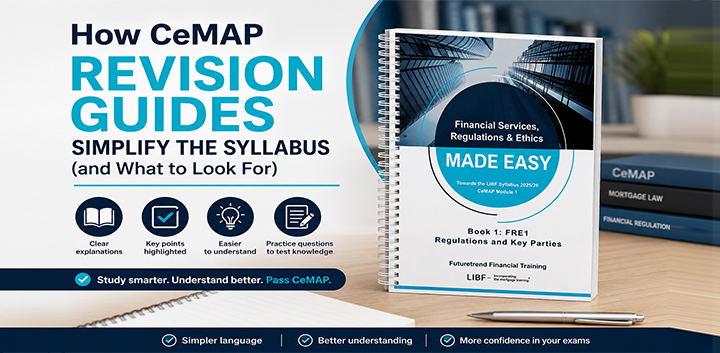
How CeMAP Revision Guides Simplify the Syllabus (and What to Look For)

CeMAP revision guide book showing how simplified study materials make the CeMAP syllabus easier to understand

Studying for CeMAP (Certificate in Mortgage Advice and Practice) can feel overwhelming at first.

The official syllabus from the London Institute of Banking & Finance (LIBF) and the regulatory material linked to the Financial Conduct Authority (FCA) are detailed for a reason. They are designed to define what mortgage advisers need to know before giving regulated advice.

But there is a big difference between a syllabus that lists what you must learn and a revision guide that helps you actually understand it.

A good CeMAP revision guide should take a large, technical syllabus and turn it into something manageable, clear and easier to remember.

CeMAP revision guide book showing how simplified study materials make the CeMAP syllabus easier to understand

What Is a CeMAP Revision Guide?

A CeMAP revision guide is a study resource designed to explain the official syllabus in simpler language.

It should:

  • Cover all examinable topics
  • Break complex ideas into smaller sections
  • Use plain English instead of technical jargon
  • Highlight key facts and definitions
  • Help learners prepare for the exam efficiently

The purpose of a revision guide is not to replace the official syllabus. Its job is to make that syllabus easier to understand and revise.

That distinction matters.

The official syllabus tells you what you need to know. A revision guide should help you understand how to learn it.

Why the Official CeMAP Material Can Feel Difficult

The CeMAP qualification is the industry-standard mortgage advice qualification in the UK. It is awarded by the London Institute of Banking & Finance and meets the FCA’s education requirements for advisers who want to provide mortgage advice.

That does not mean the study material is always easy to digest.

Many learners struggle because the content includes:

  • Legal and regulatory terminology
  • Detailed product rules
  • Large amounts of factual information
  • Technical definitions
  • Long paragraphs with little explanation

If you are new to financial services, this can feel like being handed a dictionary and told to memorise it.

That is where revision guides become useful.

CeMAP student feeling overwhelmed by dense study materials and official mortgage regulation textbooks

Dense Material vs Simplified Material

Not all study resources are created in the same way.

Dense Material

Dense material often:

  • Uses formal wording taken directly from regulations
  • Includes long blocks of text
  • Introduces several concepts at once
  • Provides limited explanation
  • Assumes prior knowledge

This approach may be technically accurate, but it can be hard to absorb.

Simplified Material

A well-written revision guide should:

  • Explain one idea at a time
  • Use examples to illustrate concepts
  • Translate technical terms into everyday language
  • Highlight the most important facts
  • Summarise key points clearly

For example, rather than simply stating that a mortgage intermediary must comply with FCA disclosure requirements, a simplified guide might explain:

“Mortgage advisers must tell clients who they are, what service they offer and how they are paid before giving advice.”

The rule remains the same, but the explanation is much easier to understand.

How Good Revision Guides Break Down Topics

The best CeMAP study guides divide each topic into smaller, logical chunks.

Instead of presenting an entire chapter on mortgage regulation in one go, they break it into sections such as:

  • Who regulates mortgage advice
  • What advisers are allowed to do
  • Required disclosures
  • Complaints procedures
  • Consumer protection rules

This step-by-step structure helps learners build understanding gradually.

It is much easier to remember five short explanations than one long wall of text.

Examples of Topics That Benefit from Simplification

Some CeMAP topics are particularly suited to simplified explanations.

Regulation and Compliance

Rules and definitions can sound intimidating, but they become clearer when explained in practical terms.

Mortgage Products

Understanding the difference between repayment, interest-only, fixed-rate and tracker mortgages is easier when each product is compared side by side.

Calculations

Concepts such as loan-to-value (LTV) and debt-to-income ratios are more memorable when shown with worked examples.

Protection Products

Life cover, critical illness and income protection are easier to grasp when their purpose is explained in plain English.

What to Look for in a Good CeMAP Revision Guide

If you are comparing study materials, there are several signs of quality.

Clear, Simple Language

The guide should explain technical terms without making them sound more complicated than they are.

Logical Structure

Topics should be organised in the same order as the syllabus so you can track your progress.

Bite-Sized Sections

Short sections are easier to review and revisit.

Key Point Summaries

Important facts should be clearly highlighted.

Practical Examples

Examples help turn abstract concepts into real-world situations.

Practice Questions

Questions test understanding and reveal weak areas.

Up-to-Date Content

Mortgage regulation changes over time, so materials should reflect the current syllabus.

Are CeMAP Revision Guides Enough?

For many learners, a good revision guide is enough to understand the syllabus and prepare effectively for the exams.

However, revision guides work best when used alongside:

  • Practice questions and mock exams
  • The official syllabus specification
  • Additional explanations for difficult topics
  • A structured study plan

Think of a revision guide as the core of your study materials rather than the only tool you use.

If your guide covers the full syllabus clearly and you complete enough question practice, it may be all you need academically.

If you struggle with exam technique or motivation, you may benefit from extra support such as workshops, tuition or structured learning programmes.

How to Use CeMAP Revision Guides Effectively

Even the best guide is only useful if you use it properly.

1. Start With the Syllabus

Understand what each unit covers so you know what the exam expects.

2. Read in Small Sections

Focus on one topic at a time.

3. Make Your Own Notes

Writing summaries in your own words improves retention.

4. Test Yourself Regularly

Use practice questions after each chapter.

5. Revisit Weak Areas

Spend extra time on topics that consistently trip you up.

6. Use Spaced Revision

Review topics several times over a period of weeks rather than cramming.

Signs Your Current Materials May Not Be Working

You may need better revision guides if you find that:

  • You keep rereading the same pages
  • The explanations feel overly technical
  • You understand the words but not the meaning
  • You struggle to connect concepts together
  • Your mock exam scores are not improving

Good study materials should make learning feel clearer, not more confusing.

Why Simpler Explanations Improve Exam Performance

The CeMAP exams test understanding as well as recall.

If you genuinely understand a topic, you are more likely to:

  • Interpret questions correctly
  • Spot distractor answers
  • Apply knowledge to scenarios
  • Retain information longer

Simplified study materials help build this understanding by reducing unnecessary complexity.

That does not mean oversimplifying the content. It means presenting it in a way that is easier to learn.

CeMAP revision guide and study workspace showing how clear explanations improve understanding and exam performance

Can Revision Guides Replace the Official Textbooks?

Revision guides are designed to support learning, not to change the syllabus.

A comprehensive guide should cover the same topics as the official material, but in a more accessible format.

Many learners find they understand concepts faster when they start with simplified notes and then refer to official wording only when needed.

This approach saves time and reduces frustration.

Choosing the Right Study Materials for Your Learning Style

Different learners prefer different formats.

You may find it helpful to use:

  • Printed study guides for focused reading
  • Digital guides for quick searching
  • Audio lessons for learning on the move
  • Flashcards for memorising key facts
  • Mock exams for exam practice

The best resources are the ones you can use consistently.

Final Thoughts

CeMAP revision guides should make the syllabus easier to understand, easier to remember and easier to revise.

A good guide will:

  • Cover the full syllabus
  • Use clear language
  • Break topics into manageable sections
  • Include examples and summaries
  • Support effective exam preparation

If your current materials feel dense or confusing, it may not be the syllabus that is the problem. It may simply be the way the information is presented.

The right revision guide turns a daunting qualification into a structured learning journey that feels far more manageable.

Looking for training support?

We offer CeMAP training for learners working towards a career in mortgage advice. Our courses follow the London Institute of Banking & Finance syllabus and are designed to support understanding of mortgage regulation and advice requirements.

Explore our accredited CeMAP training courses

> Futuretrend Financial Training 

Why CeMAP 3 Is About Judgement, Not Trick Questions

CeMAP 3 judgement based exam graphic asking “Is CeMAP 3 full of trick questions?

Many learners approaching CeMAP 3 ask the same thing:

“Is CeMAP 3 full of trick questions?”

The short answer is no.

CeMAP 3 is not designed to trick you. It is designed to assess judgement.

Understanding that distinction changes how the synoptic module feels. It shifts the focus away from hunting for traps and towards understanding what the assessment is really measuring.

CeMAP 3 judgement based exam graphic asking “Is CeMAP 3 full of trick questions?

What Is CeMAP 3 and What Is It Designed to Test?

CeMAP 3 is the final module of the Certificate in Mortgage Advice and Practice, awarded by the London Institute of Banking & Finance.

It is a synoptic assessment, meaning it brings together knowledge from earlier modules and tests how well you can apply it.

CeMAP as a qualification meets the education requirements set by the Financial Conduct Authority for those who wish to give mortgage advice in the UK. However, meeting education requirements is not the same as memorising rules. Advisers must demonstrate the ability to make appropriate, suitable recommendations.

CeMAP 3 exists to assess that ability.

It does not test whether you can recall isolated facts.
It tests whether you can use knowledge responsibly.

Is CeMAP 3 Full of Trick Questions?

No. CeMAP 3 is not written to mislead candidates.

What sometimes feels like a trick question is usually a question that requires:

  • Careful reading
  • Balanced thinking
  • An understanding of suitability
  • The ability to distinguish between “possible” and “appropriate”

When learners expect factual recall and instead face judgement-based scenarios, it can feel uncomfortable. That discomfort is often mistaken for trickery.

But the assessment is not trying to catch you out. It is checking whether you can think like a mortgage adviser.

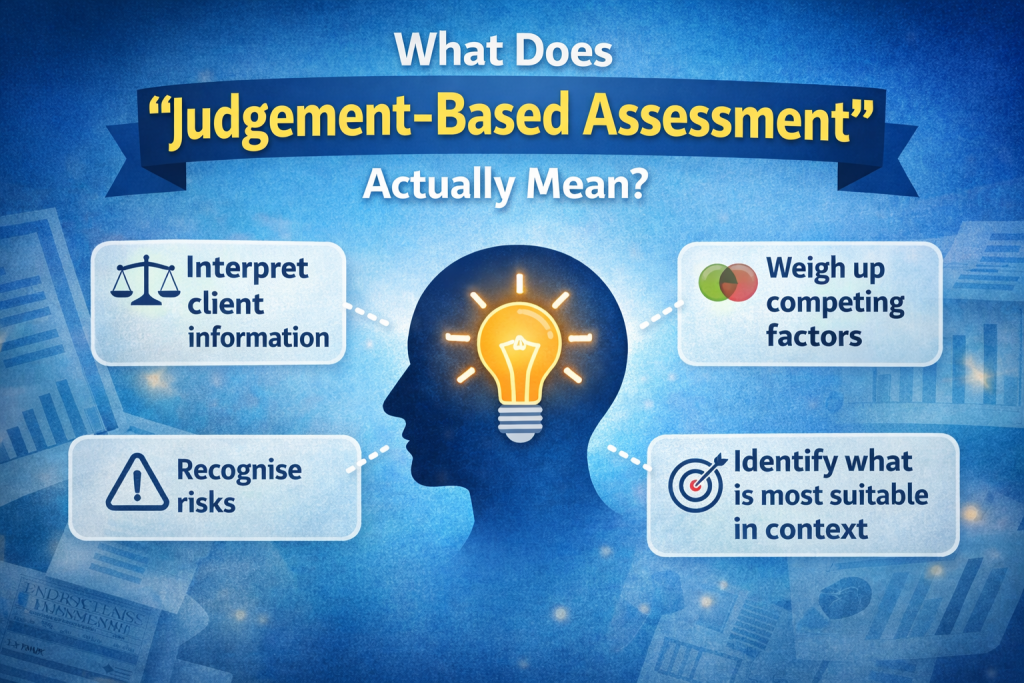
What Does “Judgement-Based Assessment” Actually Mean?

A judgement-based assessment tests your ability to:

  • Interpret client information
  • Weigh up competing factors
  • Recognise risks
  • Identify what is most suitable in context

In real life, mortgage advice is rarely about one clear rule. Two products may technically fit a client’s circumstances. One may be more suitable based on risk tolerance, long-term plans, income stability, or regulatory considerations.

CeMAP 3 reflects that reality.

Judgement-based assessment means:

You are being tested on decision quality, not memory.

This is very different from modules that focus more heavily on definitions, regulation, or standalone knowledge areas.

Graphic explaining what judgement-based assessment means in CeMAP 3 synoptic exam

Why Does CeMAP 3 Feel Harder Than Earlier Modules?

Some learners find CeMAP 3 more demanding because it changes the type of thinking required.

Earlier modules such as Financial Services Regulation and Ethics focus more clearly on defined rules, frameworks and principles. There is often a right answer based on regulation.

CeMAP 3 moves into applied suitability.

Instead of asking:

What is the rule?

It is effectively asking:

What would be the most appropriate course of action for this client?

That shift can feel unsettling. There is often more than one answer that looks reasonable at first glance. The task is to identify the most suitable option based on the client’s full circumstances.

That is not a trick. It is professional judgement.

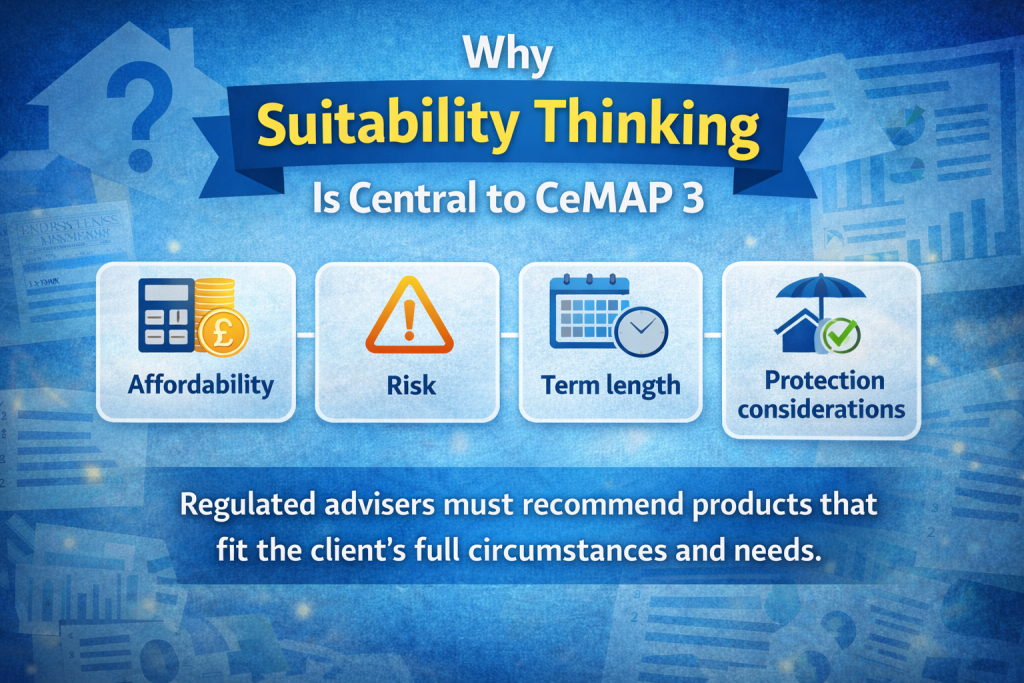
Why Suitability Thinking Is Central to CeMAP 3

Suitability is the foundation of regulated mortgage advice.

A mortgage adviser must recommend products that are appropriate for the client’s needs, objectives and financial situation. This includes:

  • Affordability
  • Risk
  • Term length
  • Repayment method
  • Future plans
  • Protection considerations

CeMAP 3 assesses whether you understand how these pieces fit together.

It is not enough to know what an interest-only mortgage is. You must recognise when it may or may not be suitable.

It is not enough to know what a fixed rate does. You must consider whether stability or flexibility better matches a client’s situation.

That is the essence of judgement.

Why suitability thinking is central to CeMAP 3 synoptic mortgage exam

Why Learners Sometimes Assume There Are Trick Questions

There are a few common reasons why the “trick question” myth persists.

1. Confidence drops when answers are less obvious

In knowledge-based modules, you may feel more certain. You either know the rule or you do not.

In CeMAP 3, two options can appear plausible. Choosing between them requires deeper evaluation. That uncertainty can feel like a trap, even when it is not.

2. Over-reliance on memorisation

If preparation has focused heavily on memorising facts without understanding how they interact, the synoptic paper can feel unfamiliar.

CeMAP 3 rewards understanding. Pure recall is rarely enough.

3. Expecting hidden wording tricks

Some candidates assume questions are deliberately written to mislead. In reality, professional exam bodies design assessments to be fair, consistent and aligned to learning outcomes.

The aim is to measure competence, not to reduce pass rates.

How Does CeMAP 3 Reflect Real-World Advice?

Mortgage advice is not theoretical.

Advisers gather information, assess risk, consider lender criteria, and recommend solutions that are in the client’s best interests.

Real clients do not present in neat textbook scenarios. They have mixed priorities, imperfect finances and changing plans.

CeMAP 3 mirrors that environment in a structured way.

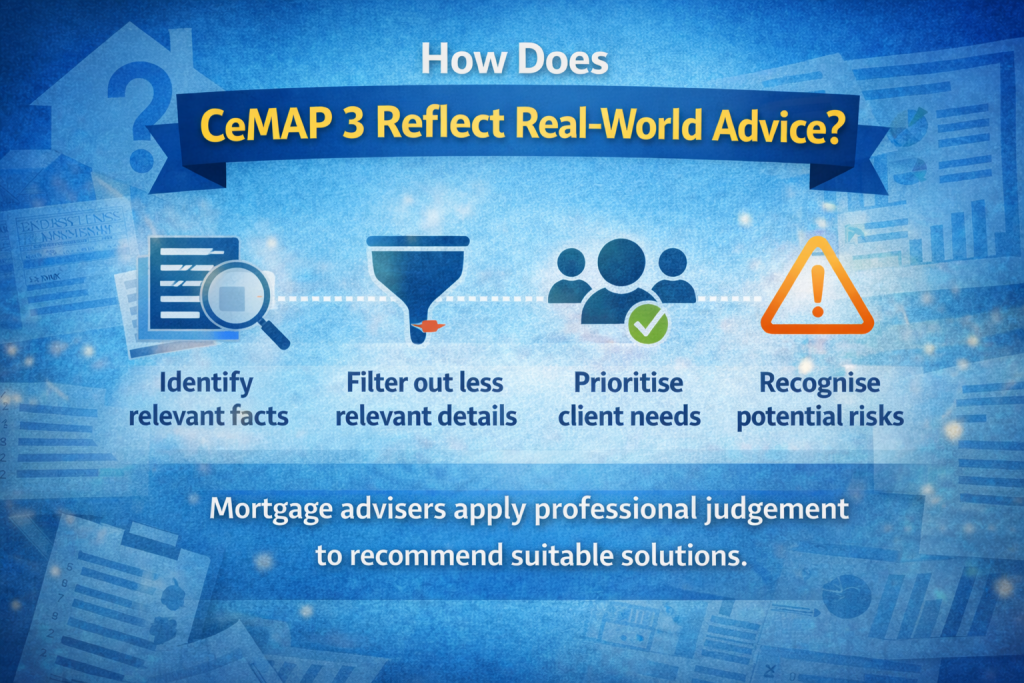
It tests whether you can:

  • Identify relevant facts
  • Filter out less relevant details
  • Prioritise client needs
  • Recognise potential risks
  • Apply regulatory principles

This is not about spotting tricks. It is about showing that you can think responsibly.

How CeMAP 3 reflects real world mortgage advice and professional judgement

Does CeMAP 3 Try to Catch You Out?

No. Professional awarding bodies design synoptic assessments to ensure consistency and fairness.

The purpose of CeMAP 3 is to confirm that a candidate:

  • Understands core mortgage knowledge
  • Can apply that knowledge appropriately
  • Can recognise suitable and unsuitable recommendations
  • Understands ethical responsibility

If a question feels difficult, it is usually because it requires careful evaluation of all the information provided.

Difficulty does not equal deception.

Why Judgement Matters More Than Perfect Recall

In regulated financial services, correct judgement protects:

  • The client
  • The firm
  • The adviser

Regulation exists to ensure consumers receive appropriate advice. The Financial Conduct Authority sets standards to ensure fair treatment of customers. Education standards, including CeMAP, exist to support that framework.

A qualification that only tested memory would not be enough.

CeMAP 3 therefore assesses whether you can:

  • Balance competing priorities
  • Recognise unsuitable risks
  • Understand long-term consequences
  • Apply ethical principles

That is why the exam focuses on judgement.

What Is the Real Purpose of the Synoptic Module?

The word “synoptic” simply means it draws together knowledge from across the qualification.

CeMAP 3 is not a new subject. It is the integration of everything learned earlier.

Its purpose is to confirm that you can:

  • Combine regulatory understanding
  • Apply product knowledge
  • Interpret client information
  • Make appropriate decisions

It is a bridge between theory and professional practice.

What is the real purpose of the CeMAP 3 synoptic module

Should You Be Worried About Hidden Tricks?

There is no evidence that CeMAP 3 is designed around hidden traps or deceptive wording.

What it does require is:

  • Careful reading
  • Structured thinking
  • Calm evaluation

If something feels like a trick, pause and ask:

Is this testing my knowledge of a rule, or my judgement about suitability?

Most often, it is the latter.

Understanding that reduces anxiety.

A Clear Answer: Is CeMAP 3 Full of Trick Questions?

No.

CeMAP 3 is not built around trick questions. It is built around professional judgement.

It assesses your ability to think like a mortgage adviser. It checks whether you can apply knowledge responsibly, ethically and appropriately.

When learners reframe the exam as a judgement assessment rather than a memory test, it becomes clearer why the questions are structured the way they are.

Final Thoughts: Reframing How You View CeMAP 3

CeMAP 3 often feels different because it asks you to think differently.

It moves from:

“What is the correct definition?”

to

“What is the most suitable outcome for this client?”

That shift is deliberate.

The mortgage advice profession relies on good judgement. The synoptic module exists to reflect that responsibility.

If you approach CeMAP 3 expecting tricks, you may see complexity as deception.
If you approach it expecting judgement, the structure begins to make sense.

CeMAP 3 is not trying to catch you out.
It is asking whether you are ready to think like an adviser.

Looking for training support?

We offer CeMAP training for learners working towards a career in mortgage advice. Our courses follow the London Institute of Banking & Finance syllabus and are designed to support understanding of mortgage regulation and advice requirements.

Explore our accredited CeMAP training courses

> Futuretrend Financial Training 
How Hard Are the CeMAP Exams Really and Which Module Feels Hardest?

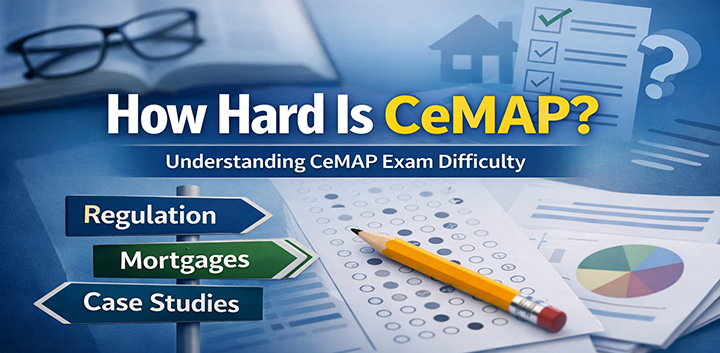
How hard is CeMAP exam graphic showing regulation, mortgages and case studies modules

Many learners ask a simple question before they begin: how hard is CeMAP?

Many learners ask a simple question before they begin: how hard is CeMAP?

The honest answer is that the CeMAP exams are academically manageable for most people, but they require structured preparation and consistent study. They are not designed to catch people out, yet they do test detailed knowledge, regulation, ethics, and the ability to apply what you have learned. For some, the exams feel straightforward. For others, they feel demanding. The difference usually comes down to preparation, familiarity with financial concepts, and confidence with multiple-choice exams.

CeMAP is the industry standard qualification for mortgage advisers in the UK. It is awarded by the London Institute of Banking & Finance and meets the Financial Conduct Authority’s education requirements for giving mortgage advice. Because it leads to a regulated profession, the exams must test knowledge and ethical understanding properly. That is why they feel serious.

This article explains why difficulty is subjective, how the modules differ under the current syllabus, and why preparation matters more than natural ability.

How hard is CeMAP exam graphic showing regulation, mortgages and case studies modules

Why Does CeMAP Feel Hard for Some People?

CeMAP often feels hard because it combines new terminology, regulation, ethics, and exam pressure.

For learners who have never worked in financial services, terms relating to regulatory frameworks, conduct rules, and ethical responsibilities can feel unfamiliar. Even core mortgage concepts such as loan-to-value ratios or different repayment structures may be new. That initial learning curve can create the impression that the qualification is harder than it actually is.

Does Previous Experience Make a Difference?

Yes, but not always in the way people expect.

Someone with experience in banking or estate agency may recognise certain mortgage concepts. That familiarity can reduce learning time in CeMAP 2. However, regulatory and ethical content in CeMAP 1 still needs to be learned carefully, regardless of background.

Learners from unrelated careers often succeed because they approach the material methodically. CeMAP does not require advanced mathematics or essay writing. It requires understanding and careful recall.

Is It an Academic Exam?

CeMAP is knowledge-based rather than essay-based. You are tested through multiple-choice questions and, in the final module, case-study style assessment. You are not required to write long answers. Instead, you must recognise the correct response from several options.

For many people, this format feels manageable. For others, multiple-choice exams create uncertainty because more than one answer can appear reasonable. That is where careful reading becomes essential.

What Makes One Module Feel Harder Than Another?

CeMAP is structured in three modules. Each feels challenging for different reasons.

The modules are designed to build on each other. They do not test identical skills, so difficulty can feel different at each stage.

Under the updated 2025/26 syllabus, the modules are:

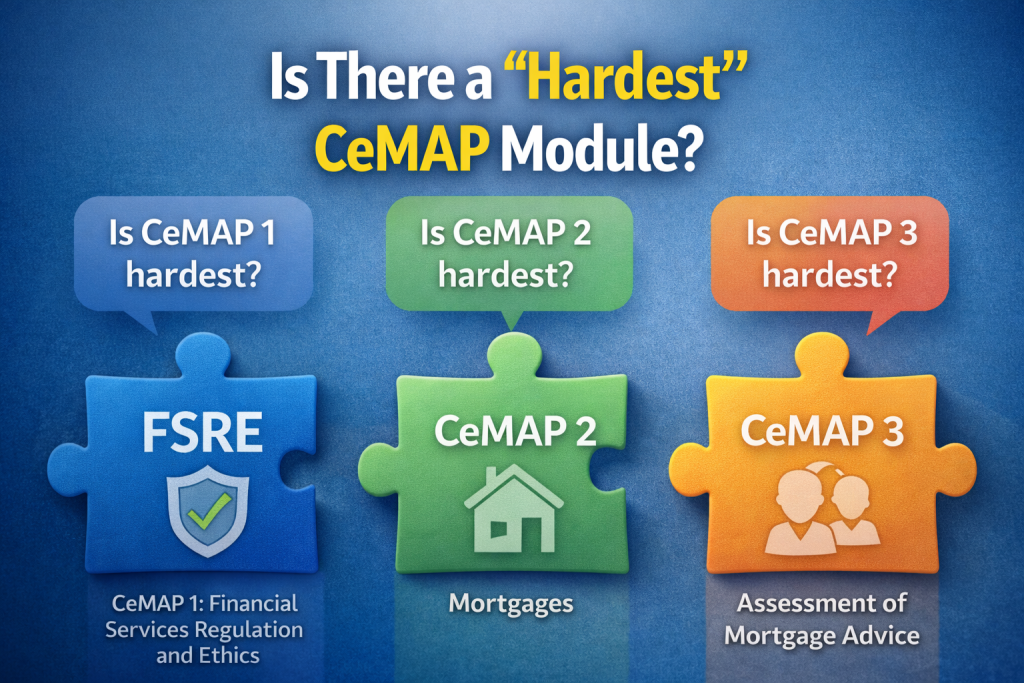
  • CeMAP 1: Financial Services Regulation and Ethics (FSRE)

  • CeMAP 2: Mortgages

  • CeMAP 3: Assessment of Mortgage Advice

The content focus has shifted slightly in CeMAP 1, and that affects how learners experience the difficulty.

CeMAP 1: Financial Services Regulation and Ethics (FSRE)

CeMAP 1 focuses on financial services regulation and ethical standards.

It covers the UK regulatory framework, the role of the Financial Conduct Authority, principles of conduct, consumer protection, and ethical responsibilities within financial services. Mortgage knowledge is still included, but the emphasis is on regulation and professional standards.

Many learners find this module challenging because of the volume of detailed definitions and the precision required in understanding regulatory language. The difficulty lies in accuracy rather than complexity.

For those new to financial services, this can feel abstract at first. Once the structure of regulation and ethical principles becomes clear, it tends to feel more logical.

CeMAP 2: Mortgages

CeMAP 2 concentrates on mortgage products and how they operate in practice.

This includes repayment methods, interest types, property considerations, underwriting factors, and different lending scenarios. The subject matter is more product-focused and practical.

Learners who prefer tangible examples sometimes find this module easier because they can visualise how mortgages work. Others find it demanding because of the range of product knowledge required.

The challenge is applying knowledge accurately rather than memorising rules alone.

CeMAP 3: Assessment of Mortgage Advice

CeMAP 3 assesses your ability to apply knowledge in realistic client situations.

It uses case-study style questions to test whether you can identify suitable advice within regulatory and ethical boundaries. It draws directly from content covered in both CeMAP 1 and CeMAP 2.

Some learners find this the hardest module because it requires judgement and careful interpretation of client information. Others find it more intuitive because it mirrors real mortgage advice scenarios.

The perception depends on whether you feel more comfortable recalling structured rules or applying them in context.

Is There a “Hardest” CeMAP Module?

There is no single hardest CeMAP module for everyone.

Some learners say CeMAP 1 feels hardest because of the regulatory and ethical detail. Others say CeMAP 3 feels hardest because of the case-study format. The perception usually reflects personal strengths and learning style.

If you prefer structured theory and definitions, CeMAP 1 may feel manageable.

If you prefer product knowledge, CeMAP 2 may feel more straightforward.

If you prefer applied scenarios, CeMAP 3 may feel more natural.

The qualification is designed to test competence across regulation, ethics, product knowledge, and advice skills. It is not structured so that one module is deliberately more difficult than another.

Is there a hardest CeMAP module graphic showing CeMAP 1 FSRE, CeMAP 2 Mortgages and CeMAP 3 Assessment of Mortgage Advice

How Hard Is CeMAP Compared to Other Qualifications?

CeMAP sits at Level 3 on the Regulated Qualifications Framework. This is broadly comparable to A-level standard in terms of academic level.

Most learners taking CeMAP are adults balancing work and other commitments. Time management and consistent study usually matter more than academic background.

CeMAP does not require advanced mathematics. Calculations are limited and practical. The main requirement is understanding regulation, ethics, and mortgage structures clearly.

Does the Pass Mark Mean It Is Difficult?

The pass mark reflects the standard required to meet regulatory expectations, not an attempt to make the exam difficult.

Because mortgage advice is a regulated activity, the Financial Conduct Authority expects advisers to demonstrate knowledge and ethical awareness before giving advice to clients. The exams are structured to confirm that standard.

They are not designed to reduce pass numbers. They are designed to confirm competence.

What Actually Makes CeMAP Manageable?

Preparation makes CeMAP manageable.

Most learners who initially feel that CeMAP is hard change their view once they understand the structure and style of questioning.

Structured Study

Breaking the syllabus into manageable sections prevents overwhelm. CeMAP content can appear large when viewed as a whole. Studied in stages, it becomes clearer.

Practice Questions

Becoming comfortable with multiple-choice questions changes how difficult the exam feels. Practice helps you recognise how questions are framed and how distractor answers are constructed.

Consistency Over Intensity

Short, regular study sessions are often more effective than occasional long sessions. The knowledge builds logically across the three modules.

What makes CeMAP manageable illustration showing structured study, practice questions and consistent revision

Does Intelligence Determine Success in CeMAP?

CeMAP does not require exceptional academic ability.

Success is usually linked to preparation, organisation, and attention to detail. Learners from a wide range of educational backgrounds complete the qualification each year.

The exams test understanding of regulation, ethics, and mortgage practice. Being methodical often matters more than being naturally academic.

Why Do Some Learners Feel Overwhelmed at the Start?

CeMAP introduces a regulated and ethically structured environment with precise terminology. That can feel unfamiliar.

Regulation and ethics require careful wording. Small differences in phrasing can change meaning. This can create early frustration, particularly in CeMAP 1.

Once learners adjust to that precision, confidence usually improves. What feels complex at first often becomes routine with repetition.

Is Exam Anxiety Making CeMAP Feel Harder?

In many cases, yes.

Anxiety can amplify perceived difficulty. Learners may know the content but doubt themselves during the exam. Multiple-choice formats can increase second-guessing.

Clear preparation and familiarity with the structure reduce this effect.

How Hard Is CeMAP Really?

CeMAP is challenging but achievable.

It is not designed to trick learners, nor is it effortless. It requires understanding financial services regulation, ethical standards, mortgage products, and the application of advice principles at a professional level.

Which module feels hardest depends on individual strengths. For most learners, CeMAP feels hardest at the beginning, when everything is new. As knowledge builds, confidence usually increases.

The key factor is not natural intelligence or prior background. It is preparation, consistency, and engagement with the material.

With realistic expectations and structured study, the CeMAP exams are demanding but manageable.

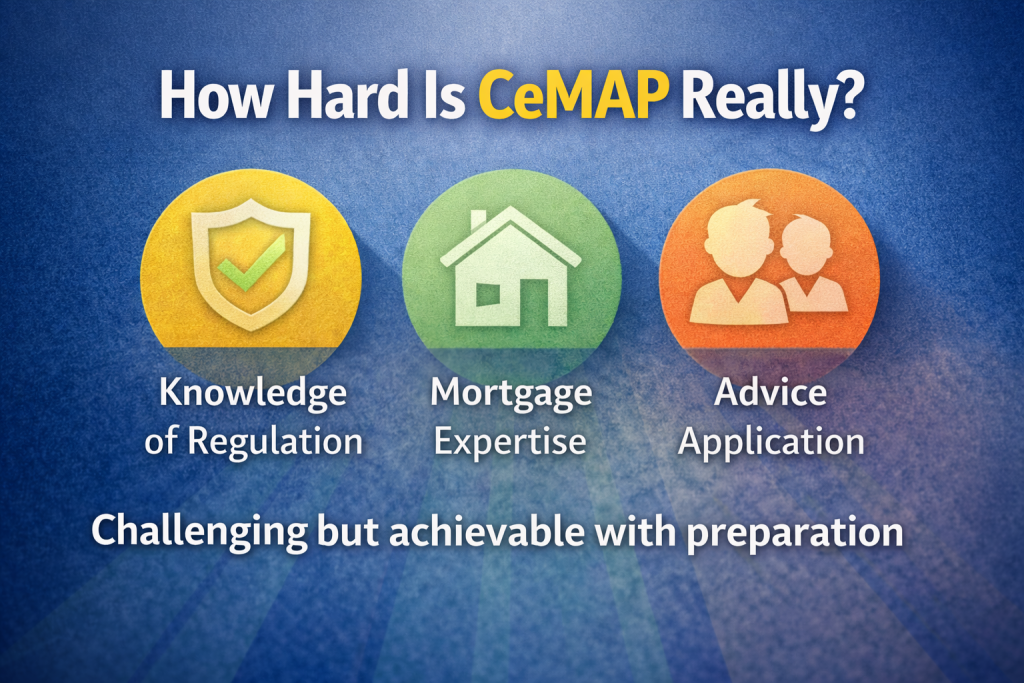
How hard is CeMAP really graphic showing regulation knowledge, mortgage expertise and advice application

Looking for training support?

We offer CeMAP training for learners working towards a career in mortgage advice. Our courses follow the London Institute of Banking & Finance syllabus and are designed to support understanding of mortgage regulation and advice requirements.

Explore our accredited CeMAP training courses

> Futuretrend Financial Training 
Mortgage Market Trends 2025: A Guide for CeMAP Advisers

Mortgage Market Trends 2025: What CeMAP Students Should Know

What’s shaping mortgage markets in 2025?

It’s a question worth asking for anyone who studied  CeMAP, especially those looking at there CPD. Lenders, advisers and borrowers are all adjusting to rising interest rates, a challenging housing supply, and fresh government policies.

Keeping up with these shifts isn’t just useful for real-life advising — it’s directly relevant to passing your CeMAP exams, where understanding the context behind mortgage product decisions and regulatory trends will help you build stronger answers.

In this post, we look at the key mortgage market trends for 2025, what’s causing them, and what they mean for future advisers. Whether you’re just starting CeMAP or nearing completion, this article should give you a clearer view of the market you’ll soon be working in.

Mortgage Market Trends 2025: What CeMAP Students Should Know

Macro Economic Drivers

Interest Rates and Monetary Policy

After several years of monetary tightening, interest rates remain a key driver of mortgage pricing in 2025. The Bank of England continues to balance inflation concerns with the risk of stagnating growth.

This creates uncertainty for both lenders and borrowers. Fixed-rate deals are still available, but tracker products have started to regain popularity due to growing sentiment that interest rates may soon ease.

The cost of borrowing affects mortgage affordability and lender risk appetite — two areas directly examined in Unit 6 of CeMAP.

Housing Market Supply and Demand

The UK’s housing supply remains tight. Planning delays, labour shortages and high construction costs continue to slow the delivery of new homes. At the same time, demand remains high, especially in areas outside major cities where hybrid working has made location more flexible for many buyers.

This imbalance keeps prices relatively firm in some regions, even as sales volumes slow. Advisers need to be aware of these local variations when assessing client affordability.

Government Policy and Regulation

Several schemes aimed at first-time buyers and affordable housing remain in place, although their long-term future is unclear. The government’s “First Homes” policy continues to offer some support, but uptake has been patchy.

From a regulatory standpoint, the Financial Conduct Authority (FCA) has maintained its focus on consumer duty and affordability, especially under rising cost pressures. These changes feed directly into how mortgage advice is given and assessed.

Emerging Lending Trends

Green Mortgages Gaining Ground

Lenders have begun to promote more green mortgage options. These products offer lower interest rates or cashback for homes that meet higher energy efficiency standards — typically EPC A or B rated.

The push is driven by investor demand for sustainable products, and government targets for reducing carbon in housing. For advisers, this means understanding how energy ratings can affect product eligibility and customer costs.

Tracker vs Fixed: A Changing Landscape

Fixed rates dominated for years, but that’s changing. With base rates more unpredictable, some borrowers are leaning back toward tracker mortgages, hoping to benefit from future rate cuts.

Advisers will need to explain the trade-offs between short-term flexibility and long-term certainty. This is particularly relevant when discussing product suitability under CeMAP Unit 4.

Tech-Driven Mortgages

Technology is quietly reshaping the mortgage process. More lenders are adopting Open Banking to assess income and spending. Automated approvals are becoming faster and more accurate.

While the fundamentals of advice remain unchanged, students and future advisers should be aware of how fintech is changing client expectations.

Implications for CeMAP Advisers

Stay Relevant, Stay Informed

Understanding the current mortgage market isn’t just about being better at exams. It’s part of building trust with clients. CeMAP-qualified advisers are expected to make recommendations based on both regulation and the current economic context.

For students, this means not treating the CeMAP syllabus as static. Use live data when thinking through case studies or practice questions on life after CeMAP.

Pro Tip: 

Use official sources like the FCA, UK Finance and the BoE when revising market trends. These will help you form solid, up-to-date answers and impress markers.

What to Watch for in Late 2025

Looking ahead, a few risks remain on the radar. Wage growth may slow, which could hurt affordability. If inflation sticks, the BoE may hold rates higher for longer. And with an election likely within the next 12 months, policy announcements could shape the market quickly.

Advisers need to keep a flexible view — and CeMAP students should stay curious.

Frequently Asked Questions

What is the biggest mortgage trend in 2025?

The shift toward tracker mortgages is a key change. Borrowers are looking for flexibility in an uncertain rate environment.

Why do CeMAP students need to follow market trends?

Unit 6 includes questions based on live market behaviour. Being aware of what’s happening in the real world also helps apply theoretical knowledge more confidently.

Where can I get regular mortgage market updates?

You can follow the Bank of England, FCA and UK Finance for formal updates. Futuretrend’s blog also offers insights from CeMAP tutors on market shifts.

Conclusion

The mortgage market in 2025 is shaped by interest rate uncertainty, government policy, and the growing role of technology and sustainability.

For CeMAP students, understanding these trends helps make sense of the syllabus — and sets the tone for how you’ll advise clients in the real world.

Ready to advance your mortgage expertise? Explore our CeMAP mortgage modules and gain the confidence to advise clients on tracker mortgages and beyond.

Ready for more exam-style examples?

Book our CeMAP Home Study course or visit our website for full training resources:
https://cemap123.co.uk/home-study-training/

Images Designed by Freepik (www.freepik.com) and AI

Learn Why LIBF Accreditation Matters for CeMAP Training in 2025

CeMAP via LIBF Accreditation

Over 80 per cent of UK mortgage firms shortlist only LIBF‑accredited CeMAP graduates. This accreditation is more than a badge—it is proof of rigorous standards in teaching, resources and compliance.

For anyone aiming to become a mortgage adviser, understanding LIBF accreditation for CeMAP training is essential. In this article, we explain what the London Institute of Banking & Finance (LIBF) does, outline the accreditation process and criteria, and show why Futuretrend is a leading accredited provider in 2025. By the end, you will know how to choose the right centre and why accreditation can boost your career prospects.

CeMAP via LIBF Accreditation

What Is the London Institute of Banking & Finance (LIBF)?

The LIBF is the UK’s specialist awarding body for banking, lending and financial services education. Established in 1879, it has built a reputation for stringent exam standards and industry‑aligned qualifications. Employers such as high‑street banks and mortgage brokerages trust LIBF credentials when recruiting new advisers.

Brief History & Reputation

  • Founded in 1879 to support professional standards in banking.
  • Regulatory endorsement from the Financial Conduct Authority (FCA) and Prudential Regulation Authority (PRA).
  • Industry trust: top mortgage firms often require LIBF‑certified training.

Core Functions for CeMAP

  • Syllabus design: sets and updates the CeMAP curriculum.
  • Exam security: oversees secure delivery, proctoring and moderation.
  • Continuing professional development (CPD): mandates frameworks for licensed advisers.

Accreditation Criteria & Process

LIBF accreditation involves rigorous assessment in three key areas: teaching quality, student support and infrastructure compliance. Centres typically complete accreditation in 8–12 weeks, including audit visits.

Quality of Teaching & Learning Resources

  • Tutor qualifications: all instructors must hold relevant CeMAP or mortgage‑advice credentials plus teaching certifications.
  • Learning materials: up‑to‑date textbooks, digital libraries and mock‑exam simulators.
  • Assessment rigour: secure online platforms, remote proctoring and exam moderation.
Ultimate Guide to Becoming a CeMAP Mortgage Adviser: Steps, Tips & Resources

Student Support & Pastoral Care

  • One‑to‑one tutoring: minimum contact hours to address individual learning needs.
  • Workshops and clinics: study skills, time‑management and mental‑wellbeing sessions.
  • Pass‑rate transparency: centres must publish historical outcomes and improvement plans.

Infrastructure & Compliance

  • Facilities: maximum 20‑student classrooms or secure, high‑bandwidth online platforms.
  • Exam integrity: rigorous ID checks, encrypted test distribution and post‑exam audits.
  • Ongoing reviews: LIBF conducts annual audits to ensure continued compliance.

Why LIBF Accreditation Matters to You

LIBF accreditation signals quality and increases employability in a competitive market.

Employer Recognition & Credibility

Banks and brokerages often filter applications by accredited‑centre credentials. Having “CeMAP via LIBF‑accredited centre” on your CV can improve interview callbacks.

Assurance of an Up to Date Curriculum

LIBF requires syllabus reviews every 12 months, ensuring you learn current rules such as Mortgage Conduct of Business (MCOB) and Consumer Duty.

Enhanced Student Experience

Accredited centres must offer a structured CPD path of at least 35 hours per year. You also gain access to exclusive LIBF webinars, events and professional networking.

Choosing the Right LIBF Accredited Provider

Selecting the best centre involves verifying accreditation status, evaluating support services and assessing delivery options.

Verifying Accreditation & Track Record

  • Check LIBF’s public directory for active centres.
  • Key metrics: first‑time pass rates, average completion times and tutor‑student ratios.
  • Questions to ask: “What was your first‑time pass rate last year?” and “How many one‑to‑one hours are included?”

Support Services & Added Value

  • Mock exams and masterclasses at no extra cost.
  • CPD bundles: simplify post‑qualification training.
  • Alumni networks: access past students for guidance and referrals.

Flexibility & Delivery Methods

  • In‑person vs. online: compare campus resources and digital platform reliability.
  • Payment options: instalment plans, early‑bird discounts and employer sponsorship.

Why Futuretrend Stands Out

Futuretrend has been LIBF‑accredited since 2020 and consistently scores highly in audit reviews.

Accreditation Highlights

  • Accredited in 2016 with a latest audit score of 95 per cent.
  • Tutor expertise: all trainers are practising mortgage advisers and qualified educators.
Hard Copies of Made Easy Revision Guide and Official LIBF Specimen Papers

Student Outcomes & Testimonials

  • “I passed CeMAP in six weeks and secured a role at a top broker,” says John, a 2024 graduate.
  • Historically, 89 per cent of learners pass first time.

Unique Value Propositions

  • 24/7 online resource portal with recorded lectures.
  • Flexible training options to fit work schedules.
  • Dedicated career‑support team for CV reviews and mock interviews.

Frequently Asked Questions

Why choose an LIBF‑accredited CeMAP centre?

Because it guarantees teaching excellence, secure exams, an updated syllabus and stronger industry recognition.

How long does LIBF accreditation take for centres?

Most centres complete accreditation within 8–12 weeks, including document review and audit visits.

Conclusion & Next Steps

Understanding LIBF accreditation for CeMAP training is crucial for a credible mortgage‑adviser career. It assures quality teaching, up‑to‑date curriculum and industry recognition. Futuretrend’s long‑standing accreditation, excellent audit results and student success rates make it a leading choice in 2025. Enrol on one of Futuretrend’s LIBF‑accredited CeMAP programmes today and download our free Accreditation Checklist to get started.

Ready to advance your mortgage expertise? Explore our CeMAP mortgage modules and gain the confidence to advise clients on tracker mortgages and beyond.

Ready for more exam-style examples?

Book our CeMAP Home Study course or visit our website for full training resources:
https://cemap123.co.uk/home-study-training/

Images Designed by Freepik (www.freepik.com), AI  and Inhouse