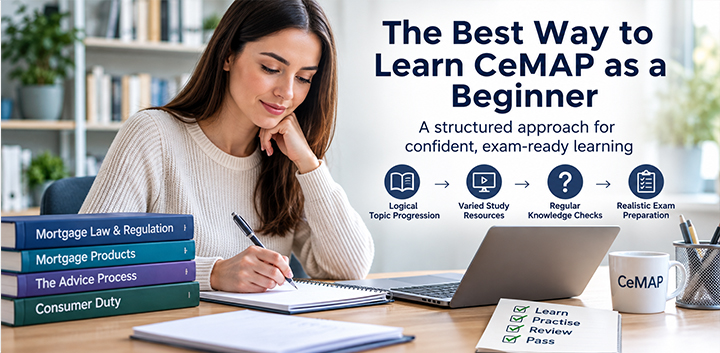
Many people begin studying for CeMAP believing they simply need to read a textbook from start to finish. While the official syllabus is the foundation of the qualification, the way that information is presented can have a huge impact on how easy it is to understand and remember.
For complete beginners, the challenge isn’t usually a lack of ability. It’s knowing where to start, how to build knowledge, and how to avoid becoming overwhelmed by the amount of new information.
A well-structured CeMAP course does more than provide study materials. It takes learners on a logical journey, introducing concepts in manageable stages, reinforcing learning in different ways, and helping build confidence before exam day.
If you’re wondering about the best way to learn CeMAP as a beginner, a structured learning approach is one of the biggest factors in long-term success.
Why Does Course Structure Matter for Complete Beginners?
CeMAP covers a broad range of topics, from regulation and mortgage law through to different mortgage products, affordability, and the advice process. For someone with no previous experience in financial services, that’s a lot of new information to absorb.
A beginner-friendly course recognises this. Instead of presenting everything at once, it introduces concepts in a logical order so that each new topic builds naturally on what has already been learned.
Think of it like learning to drive. You wouldn’t begin on a busy motorway before learning how to control the car. You start with the basics, become comfortable with them, and then gradually tackle more complex situations.
The same principle applies to CeMAP. Learning becomes much easier when each topic builds on a solid foundation rather than expecting learners to understand advanced concepts before they’ve mastered the basics.
What Is the Best Way to Learn CeMAP as a Beginner?
There isn’t one single study method that works for everyone.
Some people enjoy reading detailed explanations. Others learn more effectively by watching someone explain a topic or by testing themselves with questions. Many benefit from combining several methods throughout their studies.
The most effective approach is usually one that combines different types of learning rather than relying on just one.
For example, you might:
- Read a topic to understand the key concepts.
- Watch a video explaining how those concepts work in practice.
- Review a summary of the important points.
- Complete practice questions to check your understanding.
- Return to any areas you found difficult before moving on.
Each activity reinforces the same knowledge from a slightly different perspective, helping it stay in your long-term memory.

Why Should CeMAP Be Broken Into Smaller Topics?
Trying to study an entire CeMAP module as one large subject can quickly become overwhelming.
A well-structured course breaks the syllabus into smaller, manageable sections that allow learners to focus on one idea at a time.
This has several advantages.
Firstly, smaller study sessions feel more achievable. Completing one topic provides a sense of progress, which helps maintain motivation throughout the qualification.
Secondly, it’s easier to identify areas that need more attention. Rather than feeling that an entire module is difficult, you can pinpoint the specific topics that need further revision.
Finally, learning in smaller stages reduces cognitive overload. Instead of trying to remember dozens of unrelated facts, learners gradually build a connected understanding of how each topic fits together.
Why Are Different Types of Study Resources Important?
Everyone absorbs information slightly differently depending on the situation. That’s why relying on a single type of resource can make studying harder than it needs to be.
A well-designed CeMAP course often includes a variety of learning resources, each supporting a different stage of the learning process.
Written Study Guides
Written materials remain one of the most valuable resources because they allow learners to study at their own pace.
They’re ideal for:
- making notes
- highlighting key information
- revisiting difficult topics
- checking specific details during revision
Good study guides explain concepts clearly rather than simply repeating the official syllabus.
Video Lessons
Some topics become much easier to understand when someone explains them.
Video lessons allow learners to:
- hear complex ideas explained in plain English
- follow worked examples
- pause and replay difficult sections
- learn at a comfortable pace
For many beginners, hearing an explanation alongside visual examples can make unfamiliar subjects feel far less intimidating.
Audio Resources
Not every study session needs to happen at a desk.
Audio summaries allow learners to reinforce their knowledge while travelling, exercising or doing everyday tasks.
They’re particularly useful for revisiting topics that have already been studied, helping to strengthen memory without requiring additional reading time.
Revision Summaries
As exam day approaches, learners often need concise reminders rather than detailed explanations.
Revision summaries bring together the key points from each topic, making it easier to refresh knowledge without reading entire chapters again.
Visual Learning Aids
Some information is easier to understand visually.
Flowcharts, diagrams, comparison tables and illustrated processes can simplify subjects that might otherwise appear complicated.
For example, showing the stages of the mortgage advice process visually can often make the sequence much easier to remember than reading several pages of text.
Using a mixture of resources allows learners to revisit the same information in different ways, improving understanding and retention.
Why Is Reinforcement More Effective Than Simply Reading Once?
Reading a chapter once rarely leads to long-term understanding.
Most people naturally forget information unless they revisit it and actively use it.
That’s why reinforcement is such an important part of effective learning.
Instead of moving straight from one topic to the next, learners benefit from returning to previous subjects regularly.
A typical learning cycle might look like this:
- Read the topic.
- Watch an explanation.
- Make notes.
- Complete practice questions.
- Review any incorrect answers.
- Return to the topic later during revision.
Each revisit strengthens understanding and makes it easier to recall information during the exam.
When Should Practice Questions Be Introduced?
Many beginners believe they should wait until they’ve finished the entire syllabus before attempting any questions.
In reality, introducing practice questions after each topic is often much more effective.
Topic-based questions help learners:
- identify misunderstandings early
- confirm they’ve understood key concepts
- become familiar with exam-style wording
- build confidence gradually
If a learner struggles with questions immediately after studying a topic, it’s much easier to revisit that section than trying to remember it several weeks later.
Practice questions should support learning throughout the course, not just at the end.
Why Are Full Specimen Exams So Important?
While topic-based questions help measure understanding, full specimen exams serve a different purpose.
They prepare learners for the experience of sitting the actual assessment.
A full specimen paper allows learners to:
- answer questions across the entire syllabus
- practise managing their time
- become familiar with the style of the exam
- identify weaker areas before booking an assessment
- build confidence under realistic conditions
Completing specimen papers also helps learners judge whether they’re genuinely ready for the exam, rather than relying solely on how confident they feel.
Confidence is valuable, but it should always be supported by evidence from realistic exam practice.

How Can a Learning Plan Prevent Information Overload?
One of the biggest mistakes beginners make is trying to study too much in a single session.
Long study days often lead to tiredness, reduced concentration and poor retention.
A structured learning plan encourages consistent progress instead.
That might involve studying for an hour several evenings each week, reviewing previous topics regularly, and setting realistic milestones rather than rushing to complete the syllabus.
A good study plan should also allow flexibility.
Life, work and family commitments don’t stop while studying for CeMAP. A structured approach makes it easier to pause and continue without losing direction.
Consistency over several weeks is usually far more effective than occasional marathon revision sessions.
What Should Beginners Look For in a CeMAP Course?
When comparing CeMAP courses, it’s worth looking beyond the list of study materials.
Instead, consider how those resources are organised and whether they support the learning journey from beginning to end.
Some useful questions to ask include:
- Is the syllabus broken into manageable topics?
- Are difficult concepts explained in clear, straightforward language?
- Does the course include different types of learning resources?
- Are there opportunities to test understanding after each topic?
- Are realistic specimen exams available before sitting the real assessment?
- Is there a clear learning pathway rather than simply providing access to study materials?
The answers to these questions often reveal more about the quality of a course than the number of resources alone.
Final Thoughts
Starting CeMAP can feel daunting, especially if you’re completely new to mortgages and financial services. Fortunately, success isn’t about trying to absorb everything at once. It’s about following a structured learning journey that introduces knowledge gradually, reinforces understanding, and provides regular opportunities to check your progress.
What Makes a Good CeMAP Course?
A good CeMAP course combines accurate learning materials with clear structure, effective delivery, ongoing support and a study approach that encourages consistent progress. Success comes from how well learners engage with the material, not simply how much content is provided.
The most effective courses recognise that learning is a process rather than a collection of documents.
Looking for training support?
We offer CeMAP training for learners working towards a career in mortgage advice. Our courses follow the London Institute of Banking & Finance syllabus and are designed to support understanding of mortgage regulation and advice requirements.
Explore our accredited CeMAP training courses
> Futuretrend Financial Training