Can You Fail CeMAP? What Happens If You Do?

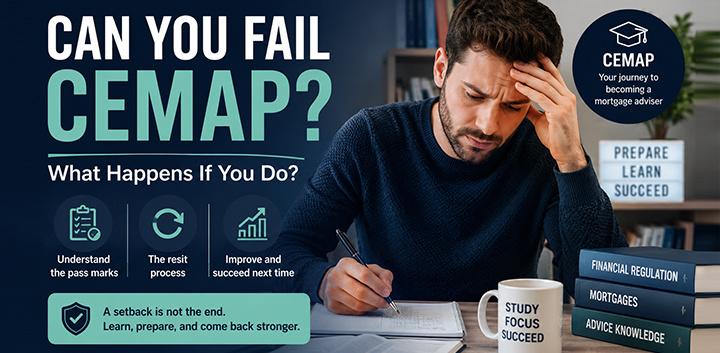
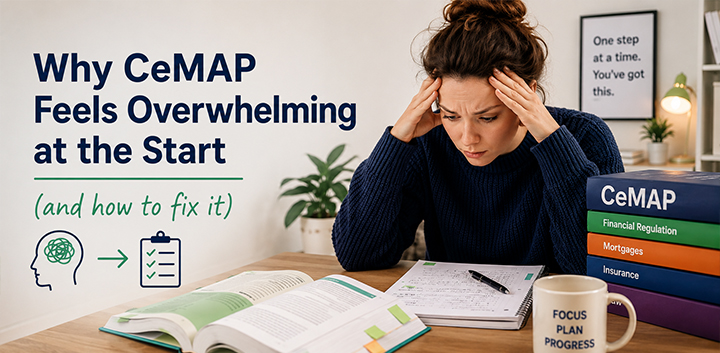
Learner studying for CeMAP exam looking worried, with text explaining what happens if you fail CeMAP and how to resit successfully.

Yes, you can fail a CeMAP exam. If you do, it does not mean you are not capable of becoming a mortgage adviser.

CeMAP is a professional qualification, and the exams are designed to test your understanding of mortgage regulation, products, and the advice process. Many learners pass first time, while others need more than one attempt. Both outcomes are part of the reality of studying for a recognised financial services qualification.

The important thing to remember is that failing CeMAP is a setback, not a dead end. You can resit the exam, learn from what went wrong, and come back better prepared.

CeMAP, or the Certificate in Mortgage Advice and Practice, is awarded by the London Institute of Banking & Finance (LIBF). It is the industry-standard qualification that meets the education requirements set by the Financial Conduct Authority for giving regulated mortgage advice in the UK.

Learner studying for CeMAP exam looking worried, with text explaining what happens if you fail CeMAP and how to resit successfully.

CeMAP Exams

 CeMAP exams are designed to assess whether you understand the syllabus well enough to apply your knowledge in practical situations.

The exams are not intended to catch people out, but they do require thorough preparation. You need to understand the material rather than simply recognise familiar terms.

Some learners underestimate the size of the syllabus, especially if they are new to financial services. Others struggle with timing, exam technique, or nerves.

Failing one exam does not mean you are unsuited to the profession. It usually means you need to adjust your preparation.

What Is the CeMAP Pass Mark?

The pass mark for each CeMAP exam is 70%.

As of 2026, the qualification is assessed through five separate exams.

CeMAP 1: UK Financial Regulation

CeMAP 1 is split into two exams:

  • Financial Regulation Essentials 1 (FRE1)
  • Financial Regulation Essentials 2 (FRE2)

You must pass both exams to complete CeMAP 1.

CeMAP 2: Mortgages

CeMAP 2 is also split into two exams:

  • Mortgage Advice and Knowledge (MRT1)
  • Mortgage Applications (MRT2)

Each exam requires a score of at least 70%.

CeMAP 3: Assessment of Mortgage Advice Knowledge

CeMAP 3 consists of one final exam:

  • Assessment of Skills and Exam Workshop (ASEW)

The pass mark is again 70%.

What Happens If You Fail CeMAP?

If you fail a CeMAP exam, you receive a result report showing:

  • Whether you passed or failed
  • Your score
  • Performance by topic area

This feedback helps you identify which parts of the syllabus need more work.

Do You Need to Retake the Whole Module if You Fail?

No. If you fail one exam, you only need to resit that specific exam.

For example:

  • Pass FRE1 but fail FRE2: resit FRE2 only.
  • Pass MRT1 but fail MRT2: resit MRT2 only.
  • Fail ASEW: resit ASEW only.

Any exams you have already passed remain valid.


Once you feel ready, you can book a resit for the failed exam.

You do not need to restart the qualification.

How Does the CeMAP Resit Process Work?

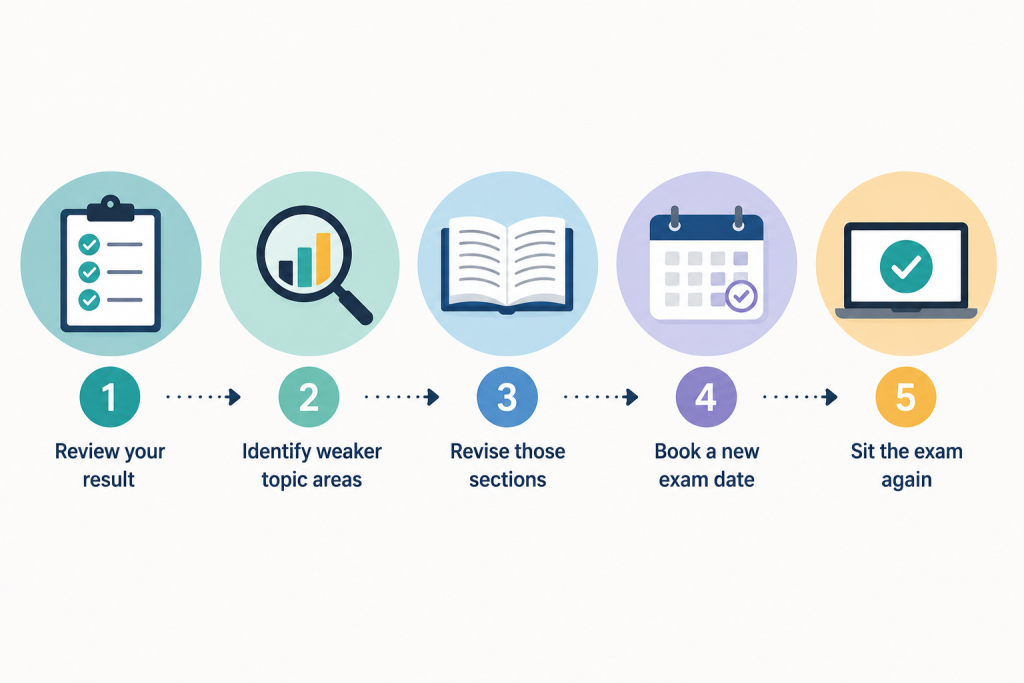
The resit process is straightforward:

  1. Review your result report.
  2. Identify weaker topics.
  3. Revise those areas thoroughly.
  4. Book a new exam date.
  5. Sit the exam again.

Most learners benefit from taking time to strengthen their understanding rather than booking another attempt immediately.

cemap-resit-process-steps-infographic

How Soon Can You Resit a Failed CeMAP Exam?

In many cases, you can book a resit quite quickly, depending on exam availability and booking schedules.

However, the better question is whether you are ready.

Taking a little extra time to address weaker areas often leads to a much stronger performance on your next attempt.

Do You Have to Pay Again for a CeMAP Resit?

Yes. If you fail an exam, you will need to pay the relevant resit exam fee to book another attempt.

The exact cost depends on the exam and the pricing in place at the time of booking.

Although it is frustrating, a resit is usually a temporary setback rather than a major obstacle.

Common Reasons People Fail CeMAP

Most learners fail because of preparation issues, not because they lack ability.

Not Fully Understanding the Question

CeMAP questions often test application, not just recall.

Relying Too Much on Memorisation

Remembering facts is useful, but understanding how topics fit together is essential.

Using Difficult Study Materials

Dense technical material can make learning slower and more frustrating.

Inconsistent Revision

Long gaps between study sessions can lead to repeated relearning.

Poor Exam Technique

Spending too long on one question or changing answers unnecessarily can cost marks.

Exam Nerves

Anxiety can affect even well-prepared learners.

Is CeMAP Difficult?

CeMAP is challenging, particularly if you are completely new to mortgages and financial regulation.

The qualification covers a broad syllabus and tests both knowledge and understanding.

That said, it is designed to be achievable. With structured study, clear resources, and regular practice, most learners can pass.

How Can You Improve After Failing CeMAP?

Review Your Result Breakdown

Focus first on the topics where you scored lowest.


Change Your Revision Approach

Use practice questions, quizzes, and active recall rather than passive reading alone.


Use Clearer Study Resources

Simpler explanations can make technical topics easier to understand.


Study Little and Often

Consistent revision tends to be more effective than occasional long sessions.


Practise Under Exam Conditions

Timed mock exams build confidence and improve pacing.


Ask for Support

Tutor support can help you work through difficult topics.

How Many Times Can You Resit CeMAP?

You can resit failed CeMAP exams in line with the current policies of the London Institute of Banking & Finance.

There is no need to retake exams you have already passed.

Always check the latest rules and fees when booking your next attempt.

Does Failing CeMAP Mean You Will Not Become a Mortgage Adviser?

No.

Many successful mortgage advisers have failed at least one professional exam during their studies.

What matters most is that you learn from the experience and complete the qualification.

Employers are generally interested in whether you are qualified, not whether you passed every exam first time.

failing-cemap-does-not-stop-you-becoming-a-mortgage-adviser

Should You Be Worried About Failing?

It is completely normal to feel nervous before a professional exam.

But worrying about failure should not stop you from starting.

CeMAP is designed to test competence, not perfection. If you prepare properly and use a structured study plan, you give yourself the best chance of success.

And if you do fail, you can try again.

Tips to Reduce the Risk of Failing CeMAP

  • Follow a structured study plan.
  • Use revision guides written in plain English.
  • Complete regular practice questions.
  • Focus on understanding, not just memorising.
  • Review weaker topics carefully.
  • Avoid last-minute cramming.
  • Sit the exam when you feel ready.

Frequently Asked Questions

What happens if you fail CeMAP?

You receive a result report, identify weaker areas, and book a resit for the exam you failed.

Do you have to retake the whole CeMAP qualification?

No. You only resit the specific exam you did not pass.

How many times can you resit CeMAP?

You can resit failed exams in line with current LIBF policies.

Is it common to fail CeMAP?

Some learners do fail individual exams, especially if they underestimate the syllabus or struggle with exam technique.

Does failing CeMAP affect your career prospects?

No. Once you complete the qualification, employers are primarily interested in the fact that you are qualified.

Final Thoughts

Yes, you can fail CeMAP. But failing one exam does not mean your goal of becoming a mortgage adviser is out of reach.

For most learners, it is simply a sign that they need to refine their revision approach.

With better preparation, clearer resources, and focused practice, many learners go on to pass confidently at the next attempt.

CeMAP is a worthwhile professional qualification, and persistence is often part of the journey.

Looking for training support?

We offer CeMAP training for learners working towards a career in mortgage advice. Our courses follow the London Institute of Banking & Finance syllabus and are designed to support understanding of mortgage regulation and advice requirements.

Explore our accredited CeMAP training courses

> Futuretrend Financial Training 
How CeMAP exam questions are written and what they test

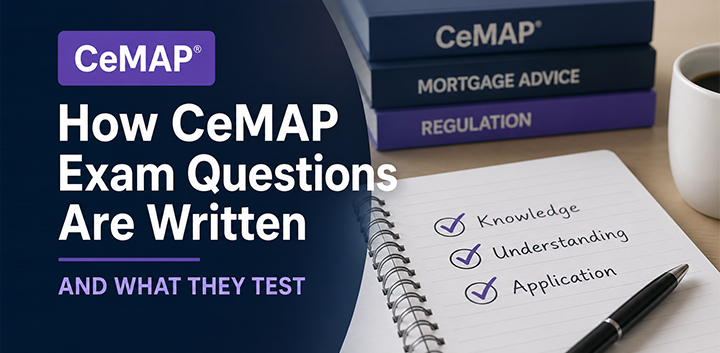
CeMAP exam questions explained showing knowledge understanding and application checklist on study notebook

Understanding how exam questions are designed can make a big difference to how you interpret them. Many learners feel confident with the content but become unsure when faced with the wording of the exam itself. That usually comes down to not fully understanding what the questions are actually trying to assess.

This guide explains how CeMAP exam questions are structured, what they are designed to test, and why they are written the way they are.

CeMAP exam questions explained showing knowledge understanding and application checklist on study notebook

What do CeMAP exam questions test?

CeMAP exam questions are designed to assess whether you can apply knowledge in a realistic context, not just recall facts.

They test:

  • Your understanding of key concepts
  • Your ability to interpret information
  • Your judgement in applying rules and principles
  • Your awareness of how knowledge fits into real situations

The exams are not trying to catch you out. They are designed to reflect the kind of thinking required in a real mortgage advice role.

That means simply memorising facts is not enough on its own.

Why are CeMAP exams structured this way?

CeMAP is awarded by the London Institute of Banking & Finance and is aligned with the expectations of the Financial Conduct Authority.

The purpose of the qualification is to ensure that individuals advising on mortgages have the knowledge and understanding required to do so responsibly.

Because of this, exam questions are written to reflect real-world decision making, not just textbook learning.

A definition-style explanation makes this clearer:

CeMAP exam questions are structured to assess applied knowledge, meaning they test how well a learner can use information in context, rather than simply recall isolated facts.

This is why the wording can sometimes feel more complex than expected.

Do CeMAP questions test knowledge or understanding?

They test both, but the emphasis is on understanding.

Knowledge still matters

You need a solid grasp of:

  • Regulations
  • Mortgage products
  • Processes
  • Terminology

Without that foundation, you will struggle to interpret questions properly.

But understanding is what is really assessed

Understanding means:

  • Recognising what information is relevant
  • Interpreting what a question is asking
  • Applying knowledge to a scenario

Two learners might know the same facts, but the one who understands how to use them will perform better.

This is where many learners get caught out. They revise thoroughly but focus mainly on remembering content, rather than thinking about how it might be used.

Why do some CeMAP questions feel confusing?

This is one of the most common concerns.

The confusion usually comes from how questions are phrased, not from the difficulty of the content itself.

Questions are designed to require interpretation

Rather than asking for a direct definition, questions often:

  • Present information in a slightly indirect way
  • Require you to identify what is important
  • Expect you to connect different parts of the syllabus

This can feel unfamiliar if you are used to more straightforward testing styles.

Language is precise, not tricky

It is easy to assume questions are designed to mislead. In reality, they are carefully written to be precise.

Small differences in wording can change the meaning of a question. That is deliberate, because in real financial advice, details matter.

Context is often implied

You may not be given every piece of information explicitly. Instead, you are expected to:

  • Recognise what is being described
  • Understand the situation being presented
  • Apply the correct knowledge

This reflects real-world scenarios, where clients do not always present information in a perfectly structured way.

What is the purpose behind the way questions are written?

Every question has a purpose beyond simply checking memory.

To reflect real decision-making

Mortgage advisers do not work from memory alone. They:

  • Interpret client situations
  • Apply regulatory rules
  • Make informed judgements

Exam questions are written to reflect that process.

To test clarity of understanding

If you truly understand a topic, you should be able to recognise it even when it is presented differently.

This is why questions may:

  • Rephrase familiar ideas
  • Combine multiple concepts
  • Use slightly varied terminology

To ensure consistency and fairness

Exam design follows strict standards. Questions are reviewed to ensure they:

  • Accurately reflect the syllabus
  • Test appropriate levels of understanding
  • Avoid ambiguity where possible

While some questions may feel challenging, they are not random or subjective.

Common misconceptions about CeMAP exam questions

There are a few misunderstandings that tend to make the exams feel harder than they need to be.

“The questions are designed to trick you”

This is probably the biggest misconception.

Questions are not designed to trick you. They are designed to check whether you:

  • Understand the material
  • Can apply it correctly

If a question feels tricky, it is usually because it requires careful reading, not because it is misleading.

“If I memorise everything, I will pass easily”

Memorisation helps, but it is not enough on its own.

You might recognise the topic, but still struggle if you cannot:

  • Interpret the wording
  • Apply the knowledge in context

Understanding always matters more than volume of revision.

“The exam is harder than the syllabus”

The exam does not go beyond the syllabus.

However, it can feel harder because:

  • Questions are applied rather than direct
  • Topics are sometimes combined
  • Wording requires interpretation

The challenge is not new content. It is how the existing content is used.

Why understanding wording matters so much

One of the key skills being tested is your ability to read and interpret questions accurately.

In practice, this means:

  • Picking up on key terms
  • Not overlooking small details
  • Understanding what is actually being asked

This is important because in real mortgage advice:

  • Misunderstanding a client’s situation can lead to poor outcomes
  • Missing details can have regulatory implications
  • Clear communication is essential

The exam reflects these expectations.

How different topics are assessed within questions

Although all questions are based on the syllabus, they often draw on more than one area at once.

Topics are rarely isolated

Instead of testing one idea in complete isolation, questions may:

  • Combine regulation and product knowledge
  • Link processes with practical scenarios
  • Require you to think across topics

This reflects how knowledge is used in real situations.

Some areas test recognition

Certain parts of the syllabus are more knowledge-based.

These might involve:

  • Identifying definitions
  • Recognising key terms
  • Understanding core principles

Others test application

Other areas focus more on:

  • Interpreting situations
  • Applying rules correctly
  • Making informed judgements

Most exams include a mix of both.

Why applied questions are important for future advisers

It is worth remembering that CeMAP is not just an academic qualification.

It is designed to prepare people for working in financial services.

Applied questions matter because they:

  • Reflect real client interactions
  • Reinforce responsible decision-making
  • Build confidence in practical understanding

A learner who can apply knowledge is better prepared for the realities of the role.

How this affects the way you experience the exam

If you expect questions to be purely fact-based, the exam can feel more difficult than it actually is.

Once you understand what is being assessed, things usually start to make more sense.

You begin to see that:

  • Questions follow patterns
  • Wording has a clear purpose
  • The focus is on understanding, not memorisation

That shift in perspective often reduces confusion.

Why some learners find this adjustment challenging

The move from learning to application is not always easy.

Some reasons include:

  • Previous exams may have focused more on recall
  • The syllabus feels large, so learners prioritise memorising
  • Confidence can drop when questions are not straightforward

This is a normal part of the learning process.

Recognising that the exam is testing understanding rather than memory helps you adjust expectations.

What should you take away from this?

CeMAP exam questions are carefully designed to assess how well you understand and apply knowledge, not just how much you can remember.

They are:

  • Structured around real-world thinking
  • Written with precise language
  • Focused on interpretation and judgement

If the wording feels unfamiliar, that does not mean the exam is unfair. It usually means it is testing a deeper level of understanding.

Final thought

If you find CeMAP questions confusing at first, you are not alone. It is a common experience, especially for those new to this style of assessment.

The key is recognising that the exam is not about catching you out. It is about checking whether you can think like a mortgage adviser.

Once you understand that, the structure of the questions starts to feel far more logical.

Looking for training support?

We offer CeMAP training for learners working towards a career in mortgage advice. Our courses follow the London Institute of Banking & Finance syllabus and are designed to support understanding of mortgage regulation and advice requirements.

Explore our accredited CeMAP training courses

> Futuretrend Financial Training 

How to manage CeMAP exam nerves and anxiety

Learner studying calmly at desk managing CeMAP exam nerves and anxiety before exam day

Is it normal to feel nervous before CeMAP?

Yes, it is completely normal to feel nervous before a CeMAP exam. In fact, most learners experience some level of anxiety as the exam approaches.

CeMAP, awarded by the London Institute of Banking & Finance, is a professional qualification that forms part of the education requirements set by the Financial Conduct Authority for mortgage advisers. Because of what it represents, it is natural for learners to attach importance to the outcome.

Nerves are not a sign that something is wrong. They usually mean that the exam matters to you and that you care about doing well.

For many learners, the challenge is not removing anxiety completely, but understanding it and keeping it in proportion.

Learner studying calmly at desk managing CeMAP exam nerves and anxiety before exam day

Why does exam anxiety happen?

Exam anxiety is a response to pressure, uncertainty, and expectation.

When you prepare for CeMAP, you are dealing with a large amount of information, new terminology, and the responsibility of passing a professional exam. Your mind naturally starts to anticipate the outcome. Questions such as “What if I fail?” or “What if I forget everything?” can start to surface.

This reaction is driven by three main factors:

Perceived importance

The more important something feels, the more pressure it creates. CeMAP is often linked to career progression, which can increase the emotional weight behind the exam.

Uncertainty

Even if you have studied well, you do not know exactly what questions will appear. That lack of control can make people uneasy.

Self-expectation

Many learners place high expectations on themselves. This can turn normal nerves into something that feels more intense.

It is worth remembering that this response is not unique to CeMAP. It happens with most professional exams and assessments.

What is the difference between nerves and being unprepared?

It is easy to confuse anxiety with a lack of preparation, but they are not the same thing.

Feeling nervous does not automatically mean you are unprepared. Many well-prepared learners still feel anxious before an exam.

A useful way to separate the two is to look at what your thoughts are focused on.

Nerves tend to sound like:

  • “I hope I remember everything”
  • “What if I make mistakes under pressure?”
  • “I feel tense about the exam day”

These thoughts are about performance, not knowledge.

Lack of preparation tends to sound like:

  • “I have not covered certain topics”
  • “I do not understand key areas”
  • “I have not practised questions”

These thoughts are about gaps in learning.

If your concern is mainly about how you will perform rather than what you know, you are likely dealing with nerves rather than unpreparedness.

Why some anxiety can actually help

A small amount of anxiety can be useful.

It can improve focus, increase alertness, and help you take the exam seriously. Without any pressure at all, it can be harder to stay engaged.

The goal is not to eliminate nerves completely, but to stop them becoming overwhelming.

Think of anxiety as a scale:

  • Too little: low motivation, reduced focus
  • Moderate: alert, focused, engaged
  • Too much: overwhelmed, distracted, fatigued

Most learners perform best somewhere in the middle.

Learner studying with focus showing how some anxiety can help improve performance in a CeMAP exam

What can make anxiety feel worse?

Certain habits and thought patterns can increase exam nerves without you realising.

Constant comparison

Looking at how others are progressing can create unnecessary pressure. Everyone studies at a different pace and in different ways.

Over-focusing on worst-case scenarios

Thinking repeatedly about failing can make that outcome feel more likely than it actually is.

Trying to do too much at the last minute

Attempting to cover large amounts of new material just before the exam can increase stress and reduce confidence.

Ignoring how you feel

Trying to push anxiety aside without acknowledging it can make it build up over time.

Being aware of these patterns can help you step back from them.

How can you manage anxiety in the final days before the exam?

In the final days, the focus should shift from learning new material to reinforcing what you already know.

At this stage, confidence often comes from familiarity rather than expansion.

Reinforce, do not overload

Revisiting topics you have already studied can help you feel more secure. Trying to learn entirely new areas can have the opposite effect.

Use familiar materials

Going back over your study materials and mock papers can help ground your understanding. These are things you have already worked through, which makes them less overwhelming.

Keep expectations realistic

You do not need to feel perfectly prepared to sit the exam. Most learners do not feel that way.

Accept some level of nerves

Expecting to feel completely calm can create frustration when you are not. Accepting that some anxiety will be present often makes it easier to manage.

What should you expect on exam day?

It is normal for anxiety to peak just before or at the start of the exam.

Many learners notice:

  • A faster heart rate
  • Difficulty concentrating at first
  • A sense of pressure or urgency

These feelings often settle once you begin answering questions and focus shifts to the task itself.

Your preparation does not disappear because you feel nervous. It is still there, even if it takes a few minutes to settle into the exam.

Learner sitting CeMAP exam showing what to expect on exam day and managing nerves during the test

How can you respond to anxiety during the exam?

When anxiety shows up during the exam, the aim is not to fight it, but to work alongside it.

Focus on the question in front of you

Bringing your attention back to one question at a time can reduce the feeling of being overwhelmed.

Accept temporary discomfort

Feeling uneasy does not mean you cannot continue. Many learners complete exams successfully while feeling nervous.

Avoid over-analysing

Spending too long questioning your answers can increase doubt. Trust your preparation where possible.

Keep perspective

One difficult question does not define the whole exam.

Does confidence come before or after the exam?

For many learners, confidence does not fully appear until after they have completed the exam.

This is important to understand, because waiting to feel confident before sitting the exam can lead to unnecessary delays.

Confidence often builds through action rather than before it.

Sitting the exam, experiencing the format, and working through the questions can reduce uncertainty for future attempts if needed.

How can you think about the outcome?

It is helpful to separate effort from outcome.

You can control:

  • How you prepare
  • How you approach the exam
  • How you manage your time and focus

You cannot fully control:

  • The exact questions
  • How you feel on the day
  • The final result

Focusing on what you can control tends to reduce anxiety, because it shifts attention away from uncertainty.

Final thoughts: managing nerves rather than removing them

Feeling nervous before a CeMAP exam is not a problem that needs to be fixed. It is a normal response to something that matters.

The aim is not to remove anxiety completely, but to keep it within a level that allows you to think clearly and perform as well as you can.

Most learners who feel anxious still go on to complete their exams successfully.

If you feel nervous, you are not behind, and you are not alone. You are responding in the same way many others do when facing an important step in their professional development.

That, in itself, is a sign that you are taking it seriously.

Looking for training support?

We offer CeMAP training for learners working towards a career in mortgage advice. Our courses follow the London Institute of Banking & Finance syllabus and are designed to support understanding of mortgage regulation and advice requirements.

Explore our accredited CeMAP training courses

> Futuretrend Financial Training 

How do I prepare for my CeMAP exam in the final weeks?

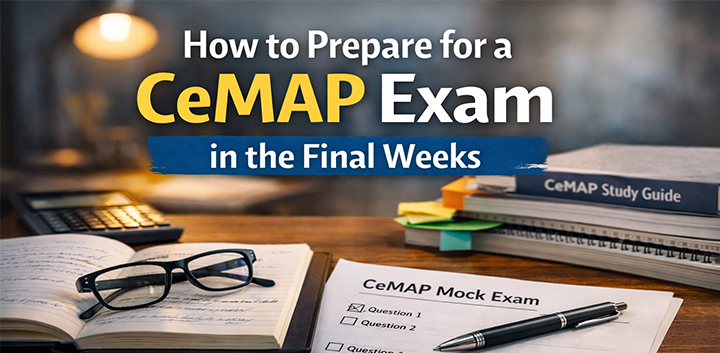
Study setup with CeMAP mock exam paper and notes showing final weeks preparation for a CeMAP exam

Preparing for a CeMAP exam in the final weeks is less about learning new content and more about strengthening what you already understand. The focus shifts from covering ground to consolidating knowledge, building confidence, and managing expectations.

CeMAP, awarded by the London Institute of Banking & Finance (LIBF), is the industry standard qualification for mortgage advisers in the UK. It meets the Financial Conduct Authority (FCA) education requirements for giving mortgage advice. That means the exams are designed to test applied understanding, not just memory.

In the final stretch, preparation becomes more about clarity than effort.

Study setup with CeMAP mock exam paper and notes showing final weeks preparation for a CeMAP exam

Why do the final weeks before a CeMAP exam feel different?

The final weeks often feel more intense, even if you are studying less new material. This shift happens because your role as a learner changes.

Earlier in your studies, the focus is on exposure. You are encountering topics for the first time, building familiarity, and trying to understand how everything fits together. In the final weeks, that changes. You are no longer asking “What is this?” but instead “Do I really understand this?”

That difference matters.

You may notice:

  • Gaps in knowledge that were not obvious before
  • Topics that felt clear now feel less certain
  • A stronger awareness of the exam itself

This is normal. It is a sign that you are moving from learning to refining.

Many learners assume this feeling means they are not ready. In reality, it often means the opposite. You are becoming more aware of the detail, which is exactly what the exam requires.

Should you still be learning new content in the final weeks?

In most cases, the final weeks are not the time to introduce large amounts of new material.

CeMAP exams assess how well you understand the full syllabus. Trying to add new topics late can dilute your focus and create confusion. Instead, the priority is consolidation.

Consolidation means:

  • Strengthening your understanding of core concepts
  • Revisiting topics you have already studied
  • Connecting different areas of the syllabus together

That does not mean avoiding new content completely. If there are small gaps or areas you have not covered at all, it is reasonable to address them. The key is proportion.

The majority of your time should be spent improving what you already know.

A useful way to think about it is this: it is better to have a solid grasp of most topics than a shallow understanding of everything.

What does consolidation actually involve?

Consolidation is often misunderstood. It is not just re-reading notes or going over the same material again.

It is about making your understanding more reliable.

This includes:

Recognising patterns

Many CeMAP topics are linked. For example, regulation, products, and client circumstances all interact. Consolidation helps you see these connections more clearly.

Clarifying definitions

Some areas rely on precise wording. Being able to explain key terms in your own words is a strong sign of understanding.

Reducing uncertainty

You are not aiming for perfection, but you are aiming to reduce hesitation. If a topic feels unclear, it is worth revisiting.

Building confidence in application

The exam is not just about recalling facts. It is about applying knowledge in context. Consolidation helps you feel more comfortable doing that.

This stage is quieter than earlier study phases, but it is where a lot of progress happens.

How useful are mock papers and study materials in the final weeks?

Mock papers and structured study materials can play an important role in the final stage of CeMAP preparation, but their value comes from how they are used rather than how many you complete.

In the final weeks, these resources support consolidation rather than new learning.

Mock papers help bring the syllabus together. They expose how different topics appear in exam-style questions and highlight where your understanding feels solid and where it does not. This is less about scoring highly and more about recognising patterns and identifying areas that still feel uncertain.

CeMAP mock exam paper and study materials on desk showing how learners revise in the final weeks before the exam

Reviewing your existing study materials is equally important. By this stage, you are not looking for new explanations, but clearer ones. Revisiting well-structured content can help reinforce key ideas and make connections between topics easier to see.

This is where the quality and structure of your CeMAP training materials can make a difference. Learning resources that are organised into clear topics and sub-topics allow you to return to specific areas without losing context. Materials that include a mix of formats, such as written explanations alongside supported learning content, can also help strengthen understanding from different angles.

Some learners also find value in using training providers that offer access to mock papers and revision support as part of a wider programme. When these resources are aligned with the structure of the syllabus, they can make the final preparation phase feel more focused and manageable.

The key point is that both mock exams and study materials are tools for clarity. They help you confirm what you know, not chase what you don’t.

How should your focus change in the final weeks?

Your focus should move from quantity to quality.

Earlier on, progress might have been measured by how much of the syllabus you covered. In the final weeks, progress is measured by how well you understand what you have already studied.

This shift can feel uncomfortable, especially if you are used to structured learning plans. There is less of a sense of “completing” something and more emphasis on judgement.

That judgement includes:

  • Knowing which topics need more attention
  • Deciding when something is “good enough”
  • Accepting that not everything will feel perfect

This is where well-structured learning materials can make a difference. Content that is clearly organised into topics and sub-topics can help you revisit areas more effectively, rather than feeling lost in a large syllabus.

How big is the CeMAP syllabus and why does that matter now?

The CeMAP syllabus is broad because it covers the full knowledge required for mortgage advice. It includes regulation, mortgage products, client needs, and the wider financial environment.

In the final weeks, the size of the syllabus matters less than how you relate to it.

At this stage, you are not trying to “cover” the syllabus again. You are trying to:

  • Feel familiar with the structure
  • Understand how topics link together
  • Recognise where your weaker areas are

When the syllabus feels large close to the exam, it is often because you are looking at it as a whole again. The key is to bring it back into smaller, manageable sections.

This is where breaking content into topics and sub-topics remains useful, even at the end.

How do you deal with anxiety before a CeMAP exam?

Feeling anxious before a CeMAP exam is common. It is a professional qualification with real implications, so some level of pressure is expected.

The important thing is how that anxiety is understood.

In many cases, anxiety comes from uncertainty, not lack of ability.

You might be asking:

  • “What if I get something unexpected?”
  • “What if I forget something I know?”
  • “What if I am not ready?”

These questions are normal, but they are not always helpful.

CeMAP study setup with notes and mock exam paper showing learner anxiety before exam and preparation environment

A more useful way to approach this stage is to focus on what you can control:

  • Your understanding of the material
  • Your familiarity with the structure of the syllabus
  • Your ability to stay calm and think clearly

It is also worth recognising that no learner feels completely ready. Waiting for that feeling is not a reliable indicator.

Confidence tends to build through engagement with the material, not by avoiding uncertainty.

What expectations should you have going into the exam?

A realistic expectation is that you will not know everything perfectly.

CeMAP exams are designed to test overall understanding, not flawless recall. You are expected to make informed decisions based on your knowledge, not to remember every detail without hesitation.

In practical terms, this means:

  • You may encounter questions that feel unfamiliar
  • You may need to think through answers rather than recognise them instantly
  • You may not feel confident about every response

That does not mean you are underprepared.

It means you are engaging with the exam at the right level.

Setting balanced expectations helps reduce unnecessary pressure. The goal is not perfection. It is competence.

How important is mindset in the final weeks?

Mindset plays a larger role than many learners expect.

By this stage, most of the learning has already happened. What changes now is how you approach what you know.

A steady, realistic mindset can help you:

  • Stay focused on consolidation rather than panic
  • Avoid overloading yourself with new material
  • Maintain a clearer sense of progress

On the other hand, a reactive mindset can lead to:

  • Jumping between topics without depth
  • Doubting areas you already understand
  • Increasing stress without improving performance

This is why the final weeks are often described as a transition. You are moving from learning to trusting your preparation.

Can training structure affect final exam preparation?

The structure of your training can have a noticeable impact in the final weeks.

If your learning materials are clearly organised, it becomes easier to:

  • Revisit specific topics quickly
  • Identify weaker areas
  • Reinforce understanding without starting from scratch

For example, CeMAP training that breaks the syllabus into clear topics and sub-topics allows you to focus your attention more precisely. This can make consolidation more efficient and less overwhelming.

Well-developed training programmes also tend to present information in multiple formats, which can help reinforce understanding in different ways.

This does not change the content of the syllabus, but it can influence how manageable it feels at this stage.

What skills are you really using in the final preparation phase?

In the final weeks, preparation is less about effort and more about judgement.

You are using skills such as:

  • Awareness – recognising what you understand and what you do not
  • Organisation – focusing your time where it matters most
  • Resilience – staying steady even when confidence dips
  • Clarity – being able to explain concepts simply

These are the same types of skills that support success in mortgage advice itself. The ability to process information, stay calm, and make informed decisions is central to both the exam and the role.

What does effective final preparation for a CeMAP exam look like overall?

Effective preparation in the final weeks is focused, calm, and realistic.

It involves:

  • Consolidating existing knowledge rather than chasing new topics
  • Strengthening understanding across the full syllabus
  • Managing expectations about what “ready” feels like
  • Maintaining a steady mindset approaching the exam

The question “How do I prepare for my CeMAP exam?” does not have a single method or formula. Instead, it comes down to using this phase in the right way.

The final weeks are not about doing more. They are about making what you already know more reliable.

When that happens, the exam becomes less about pressure and more about demonstrating understanding.

Looking for training support?

We offer CeMAP training for learners working towards a career in mortgage advice. Our courses follow the London Institute of Banking & Finance syllabus and are designed to support understanding of mortgage regulation and advice requirements.

Explore our accredited CeMAP training courses

> Futuretrend Financial Training 
Why CeMAP 3 Is About Judgement, Not Trick Questions

CeMAP 3 judgement based exam graphic asking “Is CeMAP 3 full of trick questions?

Many learners approaching CeMAP 3 ask the same thing:

“Is CeMAP 3 full of trick questions?”

The short answer is no.

CeMAP 3 is not designed to trick you. It is designed to assess judgement.

Understanding that distinction changes how the synoptic module feels. It shifts the focus away from hunting for traps and towards understanding what the assessment is really measuring.

CeMAP 3 judgement based exam graphic asking “Is CeMAP 3 full of trick questions?

What Is CeMAP 3 and What Is It Designed to Test?

CeMAP 3 is the final module of the Certificate in Mortgage Advice and Practice, awarded by the London Institute of Banking & Finance.

It is a synoptic assessment, meaning it brings together knowledge from earlier modules and tests how well you can apply it.

CeMAP as a qualification meets the education requirements set by the Financial Conduct Authority for those who wish to give mortgage advice in the UK. However, meeting education requirements is not the same as memorising rules. Advisers must demonstrate the ability to make appropriate, suitable recommendations.

CeMAP 3 exists to assess that ability.

It does not test whether you can recall isolated facts.
It tests whether you can use knowledge responsibly.

Is CeMAP 3 Full of Trick Questions?

No. CeMAP 3 is not written to mislead candidates.

What sometimes feels like a trick question is usually a question that requires:

  • Careful reading
  • Balanced thinking
  • An understanding of suitability
  • The ability to distinguish between “possible” and “appropriate”

When learners expect factual recall and instead face judgement-based scenarios, it can feel uncomfortable. That discomfort is often mistaken for trickery.

But the assessment is not trying to catch you out. It is checking whether you can think like a mortgage adviser.

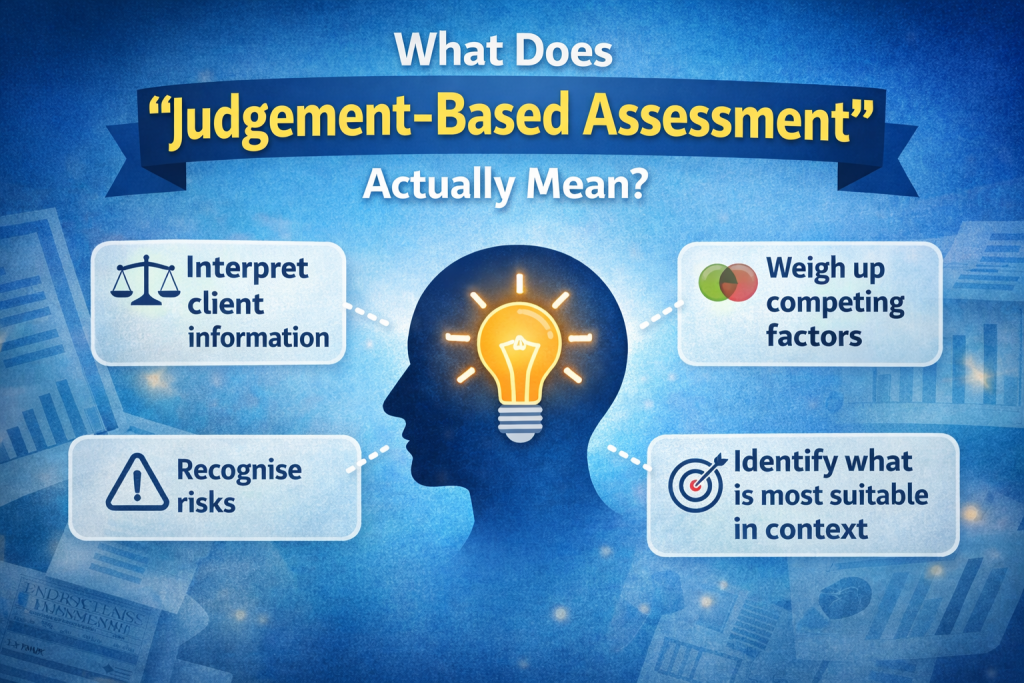
What Does “Judgement-Based Assessment” Actually Mean?

A judgement-based assessment tests your ability to:

  • Interpret client information
  • Weigh up competing factors
  • Recognise risks
  • Identify what is most suitable in context

In real life, mortgage advice is rarely about one clear rule. Two products may technically fit a client’s circumstances. One may be more suitable based on risk tolerance, long-term plans, income stability, or regulatory considerations.

CeMAP 3 reflects that reality.

Judgement-based assessment means:

You are being tested on decision quality, not memory.

This is very different from modules that focus more heavily on definitions, regulation, or standalone knowledge areas.

Graphic explaining what judgement-based assessment means in CeMAP 3 synoptic exam

Why Does CeMAP 3 Feel Harder Than Earlier Modules?

Some learners find CeMAP 3 more demanding because it changes the type of thinking required.

Earlier modules such as Financial Services Regulation and Ethics focus more clearly on defined rules, frameworks and principles. There is often a right answer based on regulation.

CeMAP 3 moves into applied suitability.

Instead of asking:

What is the rule?

It is effectively asking:

What would be the most appropriate course of action for this client?

That shift can feel unsettling. There is often more than one answer that looks reasonable at first glance. The task is to identify the most suitable option based on the client’s full circumstances.

That is not a trick. It is professional judgement.

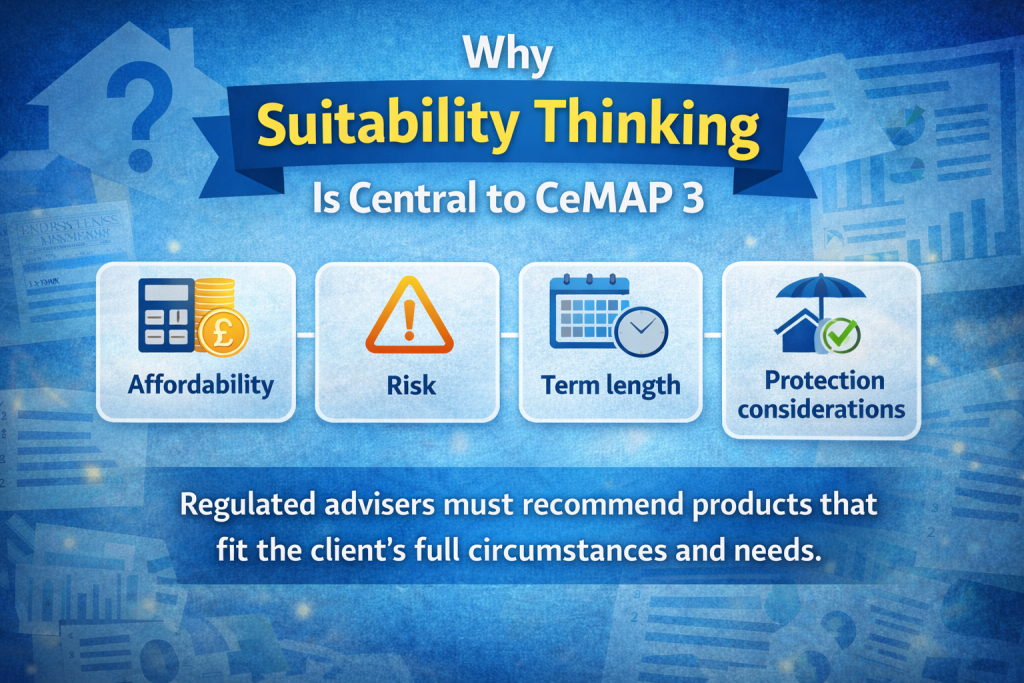
Why Suitability Thinking Is Central to CeMAP 3

Suitability is the foundation of regulated mortgage advice.

A mortgage adviser must recommend products that are appropriate for the client’s needs, objectives and financial situation. This includes:

  • Affordability
  • Risk
  • Term length
  • Repayment method
  • Future plans
  • Protection considerations

CeMAP 3 assesses whether you understand how these pieces fit together.

It is not enough to know what an interest-only mortgage is. You must recognise when it may or may not be suitable.

It is not enough to know what a fixed rate does. You must consider whether stability or flexibility better matches a client’s situation.

That is the essence of judgement.

Why suitability thinking is central to CeMAP 3 synoptic mortgage exam

Why Learners Sometimes Assume There Are Trick Questions

There are a few common reasons why the “trick question” myth persists.

1. Confidence drops when answers are less obvious

In knowledge-based modules, you may feel more certain. You either know the rule or you do not.

In CeMAP 3, two options can appear plausible. Choosing between them requires deeper evaluation. That uncertainty can feel like a trap, even when it is not.

2. Over-reliance on memorisation

If preparation has focused heavily on memorising facts without understanding how they interact, the synoptic paper can feel unfamiliar.

CeMAP 3 rewards understanding. Pure recall is rarely enough.

3. Expecting hidden wording tricks

Some candidates assume questions are deliberately written to mislead. In reality, professional exam bodies design assessments to be fair, consistent and aligned to learning outcomes.

The aim is to measure competence, not to reduce pass rates.

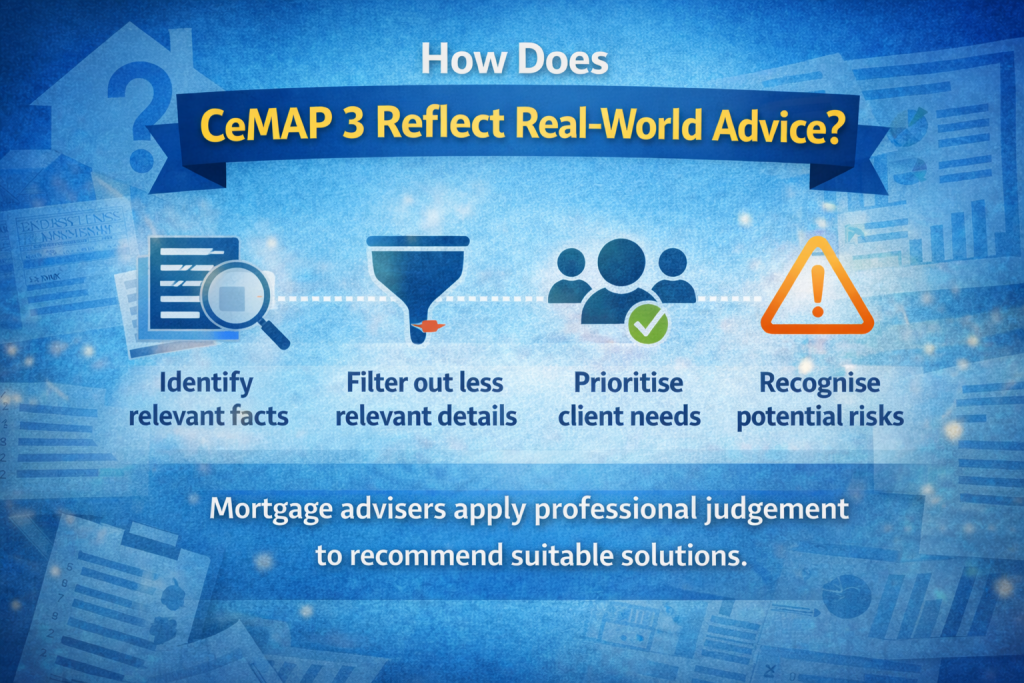
How Does CeMAP 3 Reflect Real-World Advice?

Mortgage advice is not theoretical.

Advisers gather information, assess risk, consider lender criteria, and recommend solutions that are in the client’s best interests.

Real clients do not present in neat textbook scenarios. They have mixed priorities, imperfect finances and changing plans.

CeMAP 3 mirrors that environment in a structured way.

It tests whether you can:

  • Identify relevant facts
  • Filter out less relevant details
  • Prioritise client needs
  • Recognise potential risks
  • Apply regulatory principles

This is not about spotting tricks. It is about showing that you can think responsibly.

How CeMAP 3 reflects real world mortgage advice and professional judgement

Does CeMAP 3 Try to Catch You Out?

No. Professional awarding bodies design synoptic assessments to ensure consistency and fairness.

The purpose of CeMAP 3 is to confirm that a candidate:

  • Understands core mortgage knowledge
  • Can apply that knowledge appropriately
  • Can recognise suitable and unsuitable recommendations
  • Understands ethical responsibility

If a question feels difficult, it is usually because it requires careful evaluation of all the information provided.

Difficulty does not equal deception.

Why Judgement Matters More Than Perfect Recall

In regulated financial services, correct judgement protects:

  • The client
  • The firm
  • The adviser

Regulation exists to ensure consumers receive appropriate advice. The Financial Conduct Authority sets standards to ensure fair treatment of customers. Education standards, including CeMAP, exist to support that framework.

A qualification that only tested memory would not be enough.

CeMAP 3 therefore assesses whether you can:

  • Balance competing priorities
  • Recognise unsuitable risks
  • Understand long-term consequences
  • Apply ethical principles

That is why the exam focuses on judgement.

What Is the Real Purpose of the Synoptic Module?

The word “synoptic” simply means it draws together knowledge from across the qualification.

CeMAP 3 is not a new subject. It is the integration of everything learned earlier.

Its purpose is to confirm that you can:

  • Combine regulatory understanding
  • Apply product knowledge
  • Interpret client information
  • Make appropriate decisions

It is a bridge between theory and professional practice.

What is the real purpose of the CeMAP 3 synoptic module

Should You Be Worried About Hidden Tricks?

There is no evidence that CeMAP 3 is designed around hidden traps or deceptive wording.

What it does require is:

  • Careful reading
  • Structured thinking
  • Calm evaluation

If something feels like a trick, pause and ask:

Is this testing my knowledge of a rule, or my judgement about suitability?

Most often, it is the latter.

Understanding that reduces anxiety.

A Clear Answer: Is CeMAP 3 Full of Trick Questions?

No.

CeMAP 3 is not built around trick questions. It is built around professional judgement.

It assesses your ability to think like a mortgage adviser. It checks whether you can apply knowledge responsibly, ethically and appropriately.

When learners reframe the exam as a judgement assessment rather than a memory test, it becomes clearer why the questions are structured the way they are.

Final Thoughts: Reframing How You View CeMAP 3

CeMAP 3 often feels different because it asks you to think differently.

It moves from:

“What is the correct definition?”

to

“What is the most suitable outcome for this client?”

That shift is deliberate.

The mortgage advice profession relies on good judgement. The synoptic module exists to reflect that responsibility.

If you approach CeMAP 3 expecting tricks, you may see complexity as deception.
If you approach it expecting judgement, the structure begins to make sense.

CeMAP 3 is not trying to catch you out.
It is asking whether you are ready to think like an adviser.

Looking for training support?

We offer CeMAP training for learners working towards a career in mortgage advice. Our courses follow the London Institute of Banking & Finance syllabus and are designed to support understanding of mortgage regulation and advice requirements.

Explore our accredited CeMAP training courses

> Futuretrend Financial Training 

The Most Common CeMAP Exam Mistakes and How to Avoid Them

CeMAP exam mistakes illustration showing a multiple-choice answer sheet, clock and warning icons representing common errors in CeMAP 1, 2 and 3 exams.

Preparing for CeMAP can feel demanding, especially when you know the exams are designed to test understanding rather than memory alone. Over the years, certain patterns appear again and again. Not because learners lack ability, but because professional exams work differently from school or university assessments.

CeMAP is the industry standard mortgage advice qualification in the UK. It is awarded by the London Institute of Banking & Finance and meets the Financial Conduct Authority’s education requirements for giving regulated mortgage advice. The 2025/26 syllabus structure includes:

CeMAP exam mistakes illustration showing a multiple-choice answer sheet, clock and warning icons representing common errors in CeMAP 1, 2 and 3 exams.

All modules are assessed by computer-based multiple-choice exams, with CeMAP 3 built around case-study style assessment.

The most common mistakes in CeMAP exams are not usually about intelligence. They tend to be about interpretation, behaviour under pressure, and preparation habits.

Below are the errors seen most often and the reasons behind them.

Misunderstanding What Questions Are Really Asking

One of the most common CeMAP exam mistakes is answering the question you think is being asked rather than the one on the screen.

CeMAP questions are carefully written to test application of knowledge. This is especially true in CeMAP 2 and CeMAP 3 under the 2025/26 structure. Questions often include small details that change the correct answer.

Why does this happen?

Many learners revise topics in isolation. They understand definitions and concepts but are less confident when those ideas are placed into a practical scenario.

In CeMAP 1 (Financial Services Regulation and Ethics), for example, a question may test understanding of regulatory principles in context rather than simply asking for a definition. In CeMAP 3, the case study may include several facts, but only some are relevant to the question being asked.

When pressure builds, the brain looks for familiar words. If you spot a keyword you recognise, it is tempting to choose the answer that matches that keyword without fully analysing the scenario.

What reduces this mistake?

Awareness helps. Understanding that CeMAP questions are written to assess interpretation encourages slower, more deliberate reading. The exam is not trying to trick you, but it does expect careful thinking.

A clear approach to revision that focuses on understanding how rules apply in practice, not just what they are, makes a significant difference.

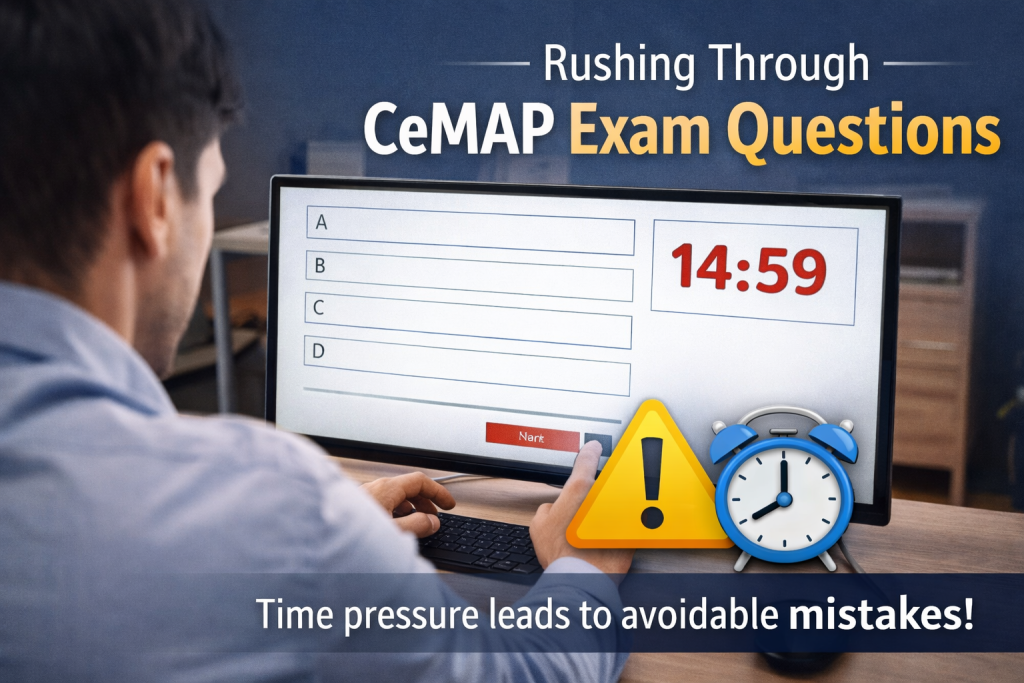
Rushing Through Questions Too Quickly

Another frequent issue is rushing.

CeMAP exams are timed, and seeing a countdown clock can make learners anxious. That anxiety often leads to speeding up unnecessarily, especially in the earlier part of the exam.

Why rushing causes problems

When learners rush:

  • Important words are missed, such as most appropriate, first step, or except
  • Details in case studies are overlooked
  • Answers are selected without full evaluation

In CeMAP 3 particularly, case-study questions require steady concentration. Skimming the background information can lead to incorrect assumptions about the client’s circumstances.

The irony is that many learners actually have enough time but lose marks through avoidable reading errors.

Learner rushing through a computer-based CeMAP multiple-choice exam with a countdown timer visible, illustrating time pressure and avoidable mistakes.

What helps prevent rushing?

Understanding the structure of the exam beforehand helps reduce panic. All CeMAP modules follow a consistent multiple-choice format, delivered on demand at approved test centres.

Recognising that the exam is designed to test professional judgement, not speed, encourages a calmer pace. Confidence comes from familiarity with the format rather than trying to “beat the clock”.

Second-Guessing Correct Answers

Second-guessing is another common behavioural pattern.

A learner selects an answer, feels uncertain, changes it, and later discovers their first instinct was correct.

Why does second-guessing happen?

Professional exams feel high stakes. That pressure can create doubt, even when knowledge is solid.

In CeMAP 1 (FSRE), for example, learners sometimes overcomplicate straightforward regulatory questions because they assume there must be a hidden twist. In CeMAP 2, they may question their understanding of mortgage product features even when they know the core principle.

This habit is often linked to lack of confidence rather than lack of preparation.

Learner hesitating over a multiple-choice CeMAP exam question on a computer screen, illustrating second-guessing correct answers.

How can it be reduced?

Stronger conceptual understanding reduces doubt. When learners know why an answer is correct, rather than simply remembering it, they are less likely to change it unnecessarily.

Confidence grows from structured preparation and repeated exposure to exam-style thinking, not from blind optimism.

Poor Preparation Habits

Some mistakes originate long before exam day.

Preparation habits have a direct impact on performance, and certain patterns regularly lead to avoidable errors.

Relying on memorisation alone

CeMAP is not designed as a memory test. Especially under the updated 2025/26 syllabus, the focus is on understanding regulatory principles, mortgage structures, and suitability.

Memorising lists without understanding how they apply can lead to confusion when questions are scenario-based.

Ignoring weaker topics

It is natural to prefer revising areas you already understand. However, CeMAP exams draw from across the syllabus.

In CeMAP 2, for instance, learners sometimes avoid complex areas such as repayment methods or specialist lending because they feel technical. In CeMAP 1, ethics and conduct topics may be underestimated because they appear straightforward at first glance.

Weak areas rarely disappear on exam day.

Learner surrounded by open books and notes looking tired while revising for a CeMAP exam, representing poor preparation habits.

Leaving preparation too late

Compressed revision often increases stress and reduces comprehension. Professional exams require mental stamina as well as knowledge.

Preparation spread over time supports deeper understanding and reduces last-minute panic.

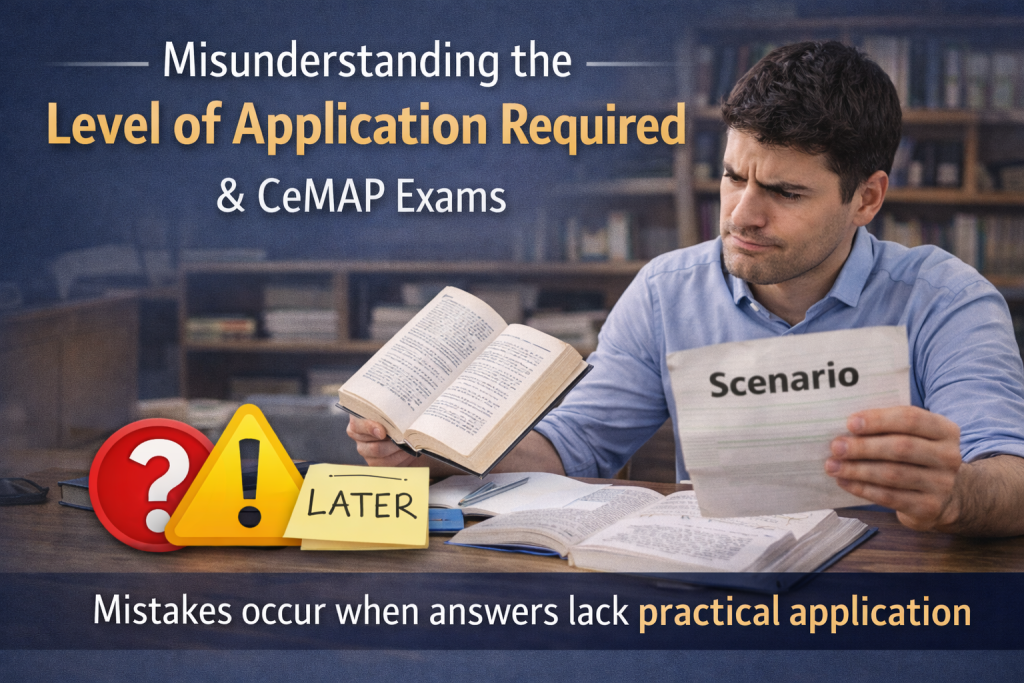
Misunderstanding the Level of Application Required

Another recurring issue is misunderstanding how applied the questions can be.

CeMAP 3, in particular, tests the ability to assess mortgage advice knowledge within a client scenario. It assumes familiarity with the technical content from CeMAP 2 and the regulatory framework from CeMAP 1.

Learners sometimes prepare for modules in isolation without recognising how they link together.

CeMAP as a qualification is structured progressively:

  • CeMAP 1 builds regulatory and ethical foundations
  • CeMAP 2 develops technical mortgage knowledge
  • CeMAP 3 tests applied advice understanding

Seeing them as separate subjects rather than connected stages can create gaps in reasoning.

A joined-up understanding makes exam questions feel more logical and less fragmented.

Learner comparing a textbook and a scenario sheet while revising for a CeMAP exam, illustrating misunderstanding of applied knowledge requirements.

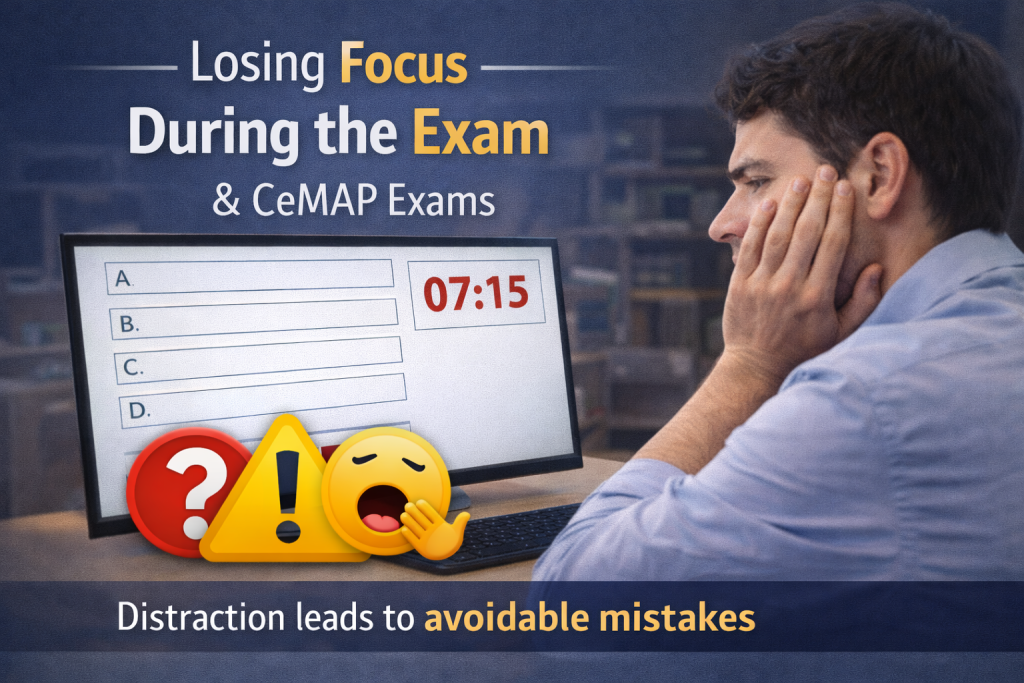
Losing Focus During the Exam

Mental fatigue is another underestimated factor.

Even though each CeMAP module is manageable in length, sustained concentration is required. Small lapses in focus can lead to avoidable errors, especially toward the end of an exam.

Common focus-related mistakes include:

  • Clicking the wrong option accidentally
  • Misreading numerical details
  • Skipping key words in longer scenarios

These errors are rarely about knowledge. They are usually about attention.

Building familiarity with exam-style material in advance helps strengthen concentration over time.

Learner appearing distracted during a computer-based CeMAP exam with a visible countdown timer, representing loss of focus.

Overcomplicating Straightforward Questions

Some learners assume every question must be complex. This can lead to adding layers of interpretation that are not required.

CeMAP exams are designed to test professional competence at the required level. Not every question contains a hidden angle.

If a question in CeMAP 1 clearly relates to a core regulatory principle, the correct answer is usually grounded in that principle rather than in an obscure exception.

Clarity often beats over-analysis.

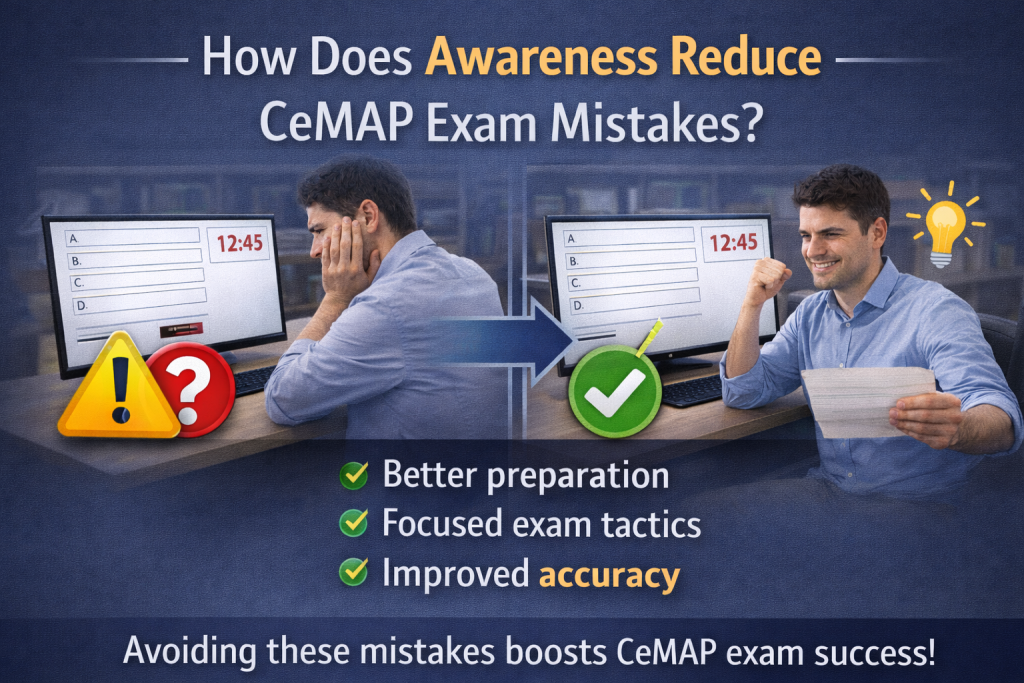
How Does Awareness Reduce CeMAP Exam Mistakes?

Understanding common patterns changes how learners approach preparation.

When you know that:

  • Questions test application, not just recall
  • Reading carefully matters more than speed
  • Confidence reduces second-guessing
  • Preparation habits influence performance

You start to view the exam differently.

CeMAP exams are structured assessments designed to confirm knowledge and understanding at an appropriate professional level. They are not designed to catch learners out or reward tricks.

Mistakes tend to fall into predictable categories: interpretation errors, behavioural reactions under pressure, and uneven preparation.

Recognising those categories early allows learners to adjust their approach before exam day.

Comparison image of a stressed and then confident learner during a CeMAP exam, showing how awareness reduces common exam mistakes.

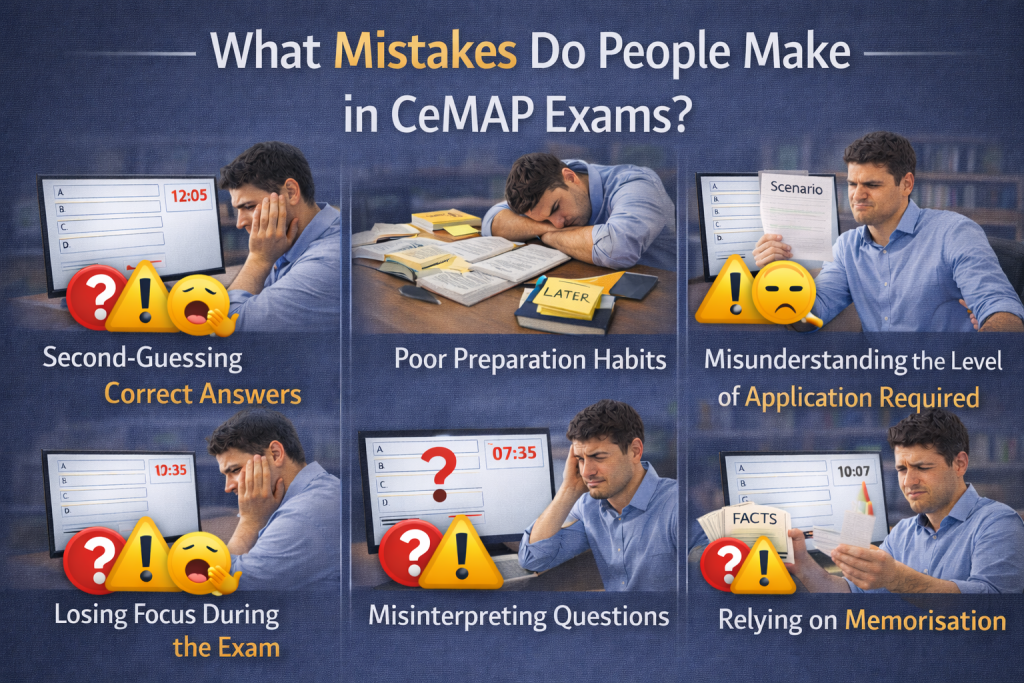
What Mistakes Do People Make in CeMAP Exams?

In summary, the most common CeMAP exam mistakes include:

  1. Misreading or misinterpreting what the question is asking
  2. Rushing due to time pressure
  3. Second-guessing correct answers
  4. Relying on memorisation without understanding
  5. Avoiding difficult topics during revision
  6. Underestimating applied, scenario-based questions
  7. Losing concentration

These patterns appear repeatedly across CeMAP 1 (Financial Services Regulation and Ethics), CeMAP 2 (Mortgages), and CeMAP 3 (Assessment of Mortgage Advice Knowledge) under the 2025/26 syllabus structure.

They are behavioural and preparation-based issues, not indicators of ability.

Infographic showing common CeMAP exam mistakes including second-guessing, poor preparation, misinterpreting questions, losing focus, and relying on memorisation.

Final Thoughts

Most CeMAP exam mistakes are avoidable once you recognise them.

The qualification, awarded by the London Institute of Banking & Finance, exists to confirm that advisers understand regulation, ethics, mortgage products, and suitability. It reflects the standards expected by the Financial Conduct Authority for those giving mortgage advice in the UK.

Approaching the exams with clarity, steady preparation, and awareness of common pitfalls reduces unnecessary errors.

No one sits a professional exam perfectly. But understanding where mistakes typically arise helps you prepare in a more informed and balanced way.

And that, more than anything else, improves your chances of walking into the exam room feeling ready rather than uncertain.

Looking for training support?

We offer CeMAP training for learners working towards a career in mortgage advice. Our courses follow the London Institute of Banking & Finance syllabus and are designed to support understanding of mortgage regulation and advice requirements.

Explore our accredited CeMAP training courses

> Futuretrend Financial Training