Is it normal to feel nervous before CeMAP?
Yes, it is completely normal to feel nervous before a CeMAP exam. In fact, most learners experience some level of anxiety as the exam approaches.
CeMAP, awarded by the London Institute of Banking & Finance, is a professional qualification that forms part of the education requirements set by the Financial Conduct Authority for mortgage advisers. Because of what it represents, it is natural for learners to attach importance to the outcome.
Nerves are not a sign that something is wrong. They usually mean that the exam matters to you and that you care about doing well.
For many learners, the challenge is not removing anxiety completely, but understanding it and keeping it in proportion.
Why does exam anxiety happen?
Exam anxiety is a response to pressure, uncertainty, and expectation.
When you prepare for CeMAP, you are dealing with a large amount of information, new terminology, and the responsibility of passing a professional exam. Your mind naturally starts to anticipate the outcome. Questions such as “What if I fail?” or “What if I forget everything?” can start to surface.
This reaction is driven by three main factors:
Perceived importance
The more important something feels, the more pressure it creates. CeMAP is often linked to career progression, which can increase the emotional weight behind the exam.
Uncertainty
Even if you have studied well, you do not know exactly what questions will appear. That lack of control can make people uneasy.
Self-expectation
Many learners place high expectations on themselves. This can turn normal nerves into something that feels more intense.
It is worth remembering that this response is not unique to CeMAP. It happens with most professional exams and assessments.
What is the difference between nerves and being unprepared?
It is easy to confuse anxiety with a lack of preparation, but they are not the same thing.
Feeling nervous does not automatically mean you are unprepared. Many well-prepared learners still feel anxious before an exam.
A useful way to separate the two is to look at what your thoughts are focused on.
Nerves tend to sound like:
- “I hope I remember everything”
- “What if I make mistakes under pressure?”
- “I feel tense about the exam day”
These thoughts are about performance, not knowledge.
Lack of preparation tends to sound like:
- “I have not covered certain topics”
- “I do not understand key areas”
- “I have not practised questions”
These thoughts are about gaps in learning.
If your concern is mainly about how you will perform rather than what you know, you are likely dealing with nerves rather than unpreparedness.
Why some anxiety can actually help
A small amount of anxiety can be useful.
It can improve focus, increase alertness, and help you take the exam seriously. Without any pressure at all, it can be harder to stay engaged.
The goal is not to eliminate nerves completely, but to stop them becoming overwhelming.
Think of anxiety as a scale:
- Too little: low motivation, reduced focus
- Moderate: alert, focused, engaged
- Too much: overwhelmed, distracted, fatigued
Most learners perform best somewhere in the middle.

What can make anxiety feel worse?
Certain habits and thought patterns can increase exam nerves without you realising.
Constant comparison
Looking at how others are progressing can create unnecessary pressure. Everyone studies at a different pace and in different ways.
Over-focusing on worst-case scenarios
Thinking repeatedly about failing can make that outcome feel more likely than it actually is.
Trying to do too much at the last minute
Attempting to cover large amounts of new material just before the exam can increase stress and reduce confidence.
Ignoring how you feel
Trying to push anxiety aside without acknowledging it can make it build up over time.
Being aware of these patterns can help you step back from them.
How can you manage anxiety in the final days before the exam?
In the final days, the focus should shift from learning new material to reinforcing what you already know.
At this stage, confidence often comes from familiarity rather than expansion.
Reinforce, do not overload
Revisiting topics you have already studied can help you feel more secure. Trying to learn entirely new areas can have the opposite effect.
Use familiar materials
Going back over your study materials and mock papers can help ground your understanding. These are things you have already worked through, which makes them less overwhelming.
Keep expectations realistic
You do not need to feel perfectly prepared to sit the exam. Most learners do not feel that way.
Accept some level of nerves
Expecting to feel completely calm can create frustration when you are not. Accepting that some anxiety will be present often makes it easier to manage.
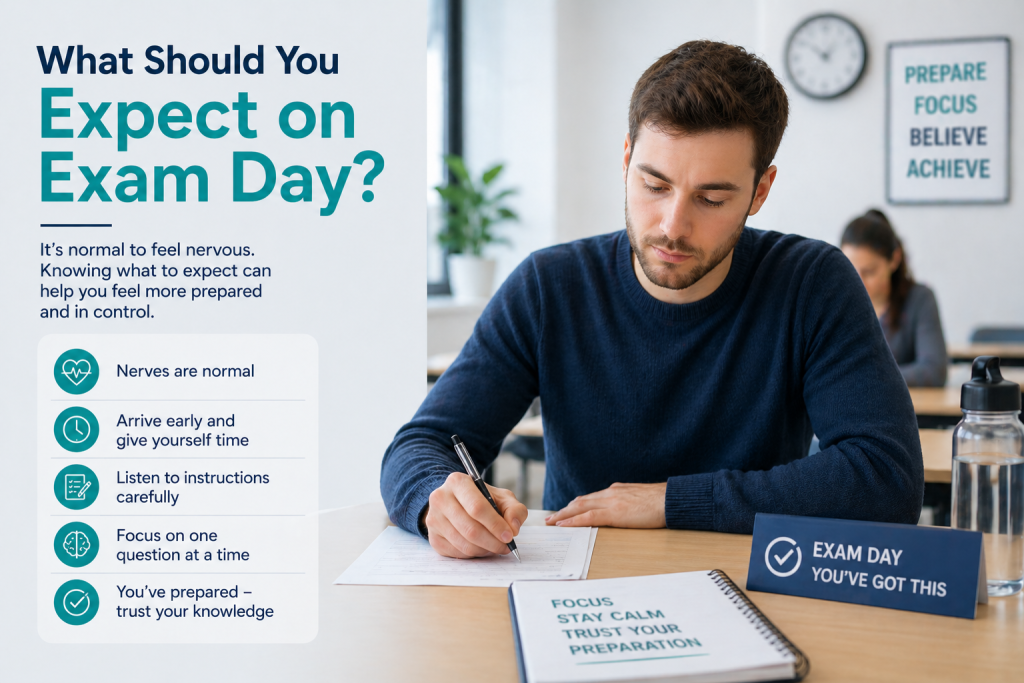
What should you expect on exam day?
It is normal for anxiety to peak just before or at the start of the exam.
Many learners notice:
- A faster heart rate
- Difficulty concentrating at first
- A sense of pressure or urgency
These feelings often settle once you begin answering questions and focus shifts to the task itself.
Your preparation does not disappear because you feel nervous. It is still there, even if it takes a few minutes to settle into the exam.
How can you respond to anxiety during the exam?
When anxiety shows up during the exam, the aim is not to fight it, but to work alongside it.
Focus on the question in front of you
Bringing your attention back to one question at a time can reduce the feeling of being overwhelmed.
Accept temporary discomfort
Feeling uneasy does not mean you cannot continue. Many learners complete exams successfully while feeling nervous.
Avoid over-analysing
Spending too long questioning your answers can increase doubt. Trust your preparation where possible.
Keep perspective
One difficult question does not define the whole exam.
Does confidence come before or after the exam?
For many learners, confidence does not fully appear until after they have completed the exam.
This is important to understand, because waiting to feel confident before sitting the exam can lead to unnecessary delays.
Confidence often builds through action rather than before it.
Sitting the exam, experiencing the format, and working through the questions can reduce uncertainty for future attempts if needed.
How can you think about the outcome?
It is helpful to separate effort from outcome.
You can control:
- How you prepare
- How you approach the exam
- How you manage your time and focus
You cannot fully control:
- The exact questions
- How you feel on the day
- The final result
Focusing on what you can control tends to reduce anxiety, because it shifts attention away from uncertainty.
Final thoughts: managing nerves rather than removing them
Feeling nervous before a CeMAP exam is not a problem that needs to be fixed. It is a normal response to something that matters.
The aim is not to remove anxiety completely, but to keep it within a level that allows you to think clearly and perform as well as you can.
Most learners who feel anxious still go on to complete their exams successfully.
If you feel nervous, you are not behind, and you are not alone. You are responding in the same way many others do when facing an important step in their professional development.
That, in itself, is a sign that you are taking it seriously.
Looking for training support?
We offer CeMAP training for learners working towards a career in mortgage advice. Our courses follow the London Institute of Banking & Finance syllabus and are designed to support understanding of mortgage regulation and advice requirements.
Explore our accredited CeMAP training courses
> Futuretrend Financial Training