What do you actually get with a CeMAP course?

What you get with a CeMAP course including study materials structured learning and support

If you are looking at CeMAP training, one of the most common questions is simple: what am I actually paying for?

A CeMAP course is not just a bundle of revision notes. It is a structured learning experience designed to help you understand the syllabus, apply it, and prepare for assessment in a supported way.

Understanding what is included helps you compare providers properly and avoid choosing based on price alone.

What you get with a CeMAP course including study materials structured learning and support

What is included in a CeMAP course?

A CeMAP course usually includes three core elements:

  • Teaching or guided learning
  • Study materials and resources
  • Ongoing learner support

At its most basic, the course is designed to help you move through the CeMAP syllabus in a structured way, rather than trying to work everything out on your own.

CeMAP, awarded by the London Institute of Banking & Finance, is the industry standard qualification for mortgage advisers and meets the education requirements set by the Financial Conduct Authority. Because of that, the syllabus is detailed and quite broad.

A course exists to organise that complexity into something manageable.

What does “teaching” actually mean in a CeMAP course?

Teaching in a CeMAP course can take different forms depending on the provider, but the purpose is the same: to explain the syllabus in a way that builds understanding, not just memorisation.

This might include:

  • Tutor-led sessions (online or in person)
  • Recorded lessons or walkthroughs
  • Topic-by-topic explanations
  • Worked examples and discussions

The key difference between teaching and self-study is guidance.

Instead of reading a section and trying to interpret it yourself, the content is explained in a way that highlights what matters, how topics connect, and where learners often struggle.

Good teaching does not just repeat the textbook. It translates it.

What study materials are usually included?

Most CeMAP courses come with a set of structured study materials designed to support different stages of learning.

These often include:

  • Core learning content aligned to the syllabus
  • Topic-based notes or modules
  • Practice questions or knowledge checks
  • Mock exams or assessment-style tests
  • Revision summaries

The important point is not just what materials are included, but how they are organised.

A well-structured course breaks the syllabus into manageable sections, often by topic or sub-topic, so you are not faced with everything at once. This makes it easier to track progress and stay consistent.

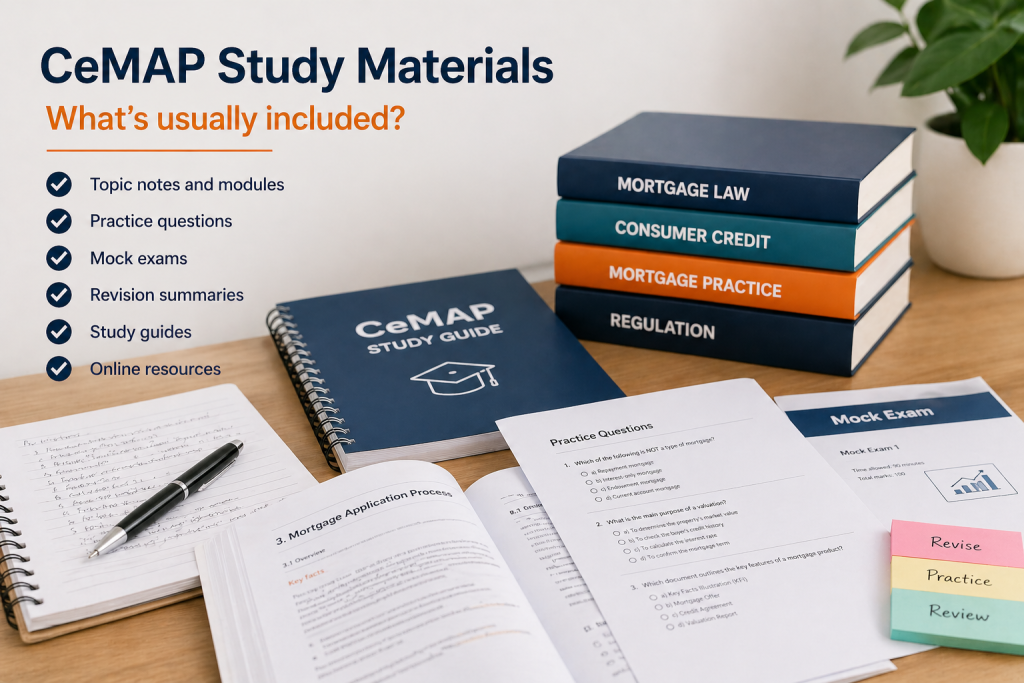
CeMAP study materials including notes practice questions mock exams and study guides

What is a Study Hub and why does it matter?

Many modern CeMAP providers offer a Study Hub or online learning platform.

This is where the course comes together.

A Study Hub typically includes:

  • All learning materials in one place
  • Progress tracking
  • Structured topic navigation
  • Integrated quizzes or tests
  • Access to support or tutors

Rather than jumping between PDFs, emails, and notes, everything is centralised.

The value here is structure.

Instead of deciding what to study next, the course guides you through the process step by step. For many learners, this reduces overwhelm and makes it easier to stay on track.

What is the difference between content and guided learning?

This is one of the most important distinctions when comparing CeMAP courses.

Content-only learning means you are given materials and left to work through them yourself.

Guided learning means the course actively helps you understand how to use those materials.

Guided learning often includes:

  • Clear study pathways
  • Explanations of difficult areas
  • Direction on what to focus on
  • Reinforcement through questions and feedback

Two courses might both include the same syllabus content, but the experience can feel very different.

Content gives you information.
Guided learning helps you make sense of it.

How important is support in a CeMAP course?

Support is often one of the least visible but most valuable parts of a course.

This can include:

  • Access to tutors for questions
  • Help with difficult topics
  • Clarification on confusing areas
  • Guidance when you feel stuck

CeMAP can feel straightforward at first, but some areas require careful understanding. When you hit those points, having support available can make a noticeable difference.

It is not just about getting answers. It is about reducing uncertainty and keeping momentum.

What does structure add that self-study does not?

You can study CeMAP without a course, so it is fair to ask what extra value a structured course provides.

The main difference is organisation and direction.

A structured course:

  • Breaks the syllabus into logical sections
  • Presents topics in a sensible order
  • Reinforces learning as you go
  • Helps you avoid missing key areas

Without that structure, learners often:

  • Jump between topics
  • Spend too long on some areas and not enough on others
  • Struggle to judge their progress
  • Feel unsure about exam readiness

Structure does not replace effort, but it makes that effort more focused.

Do all CeMAP courses include the same things?

No, and this is where comparisons become important.

Most courses include the core elements, but the depth and quality can vary.

Differences might include:

  • Level of tutor involvement
  • Quality and clarity of materials
  • How detailed the Study Hub is
  • Availability of support
  • Range of practice questions and mock exams

Two providers might both say they offer “full course materials”, but that could mean very different things in practice.

This is why it is worth looking beyond simple descriptions and understanding what the learning experience actually looks like.

What is an accredited CeMAP learning support provider?

Not all CeMAP training providers are recognised in the same way. Some are listed as accredited learning support providers by the London Institute of Banking & Finance.

An accredited provider has been reviewed by the awarding body and is approved to offer structured learning support for the qualification.

This does not mean the provider delivers the qualification itself. CeMAP is still awarded by the London Institute of Banking & Finance. It means the training provider meets certain standards in how they support learners through the syllabus.

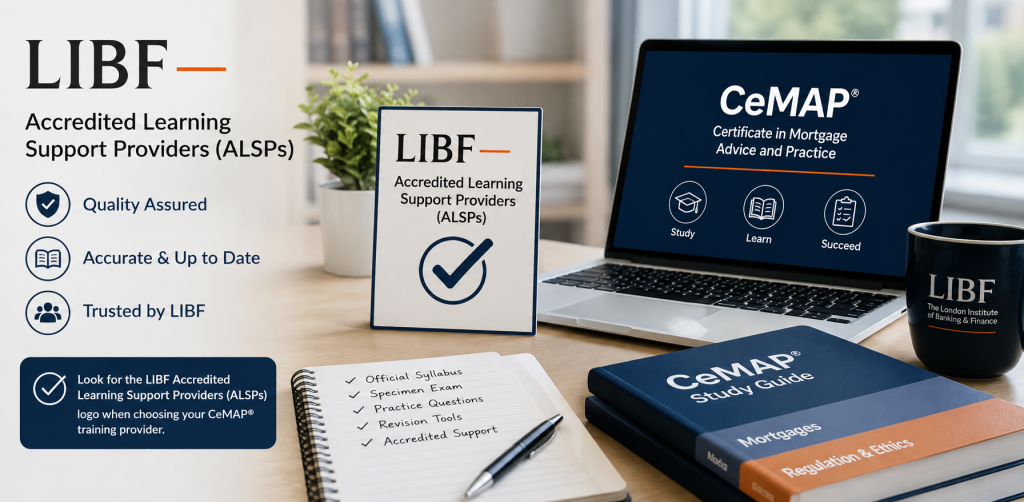
Accredited CeMAP Learning Support Provider by The London Institute of Banking & Finance

Why does provider approval matter?

Choosing a provider that is approved or accredited adds a layer of reassurance about how the course is structured and delivered.

It suggests that:

  • The materials are aligned to the official syllabus
  • The course is designed to support understanding, not just content delivery
  • The learning experience has been reviewed against recognised standards

That said, accreditation is not a guarantee of outcomes. It does not mean a learner will pass automatically or find the course easy.

What it does offer is confidence that the course has been built with a clear understanding of what the qualification requires.

How does this differ from general training providers?

Some providers offer CeMAP courses without formal accreditation or recognition.

This does not automatically mean the course is poor. However, it does mean:

  • The structure and materials have not been reviewed by the awarding body
  • The quality can vary more between providers
  • You may need to look more closely at what is actually included

In contrast, accredited providers have an additional level of oversight, which can help when comparing options.

What should you look for alongside accreditation?

Accreditation is one factor, but it should not be the only one you rely on.

It is still important to look at:

  • How the course is structured
  • Whether support is available
  • The clarity of the materials
  • How the Study Hub or platform works

A strong course combines recognised standards with clear, practical delivery.

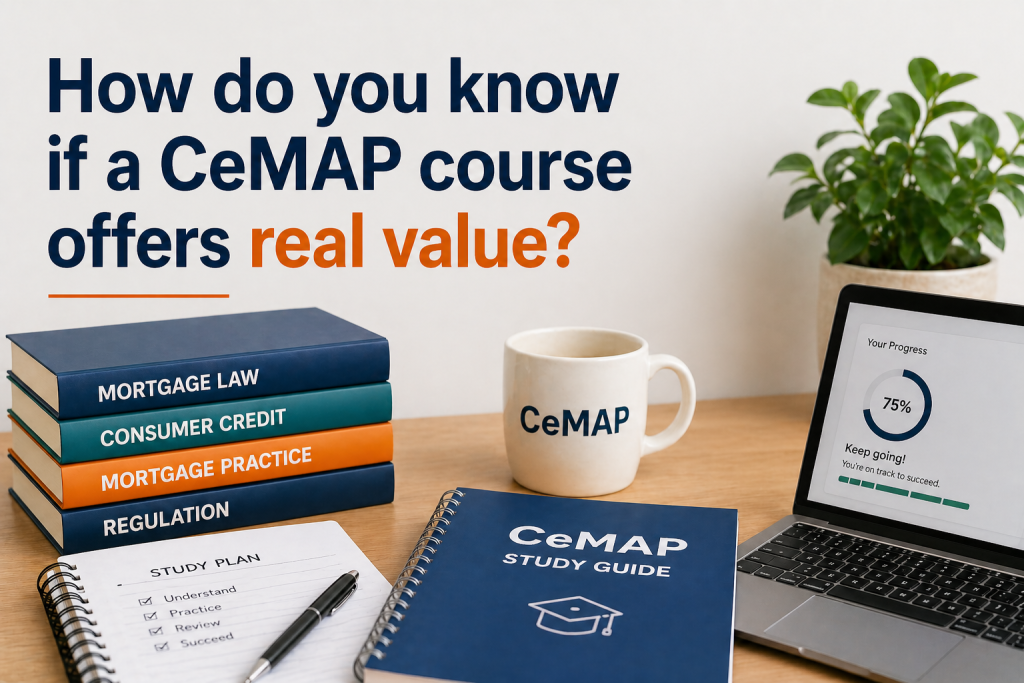
How do you know if a course offers real value?

Value in a CeMAP course is not just about how much content is included.

It is about how well that content is delivered and supported.

Signs of a well-developed course include:

  • Clear explanations rather than dense text
  • Materials broken into manageable topics
  • A mix of formats (not just written content)
  • Structured progression through the syllabus
  • Access to help when needed

Some providers also offer previews, walkthroughs, or sample materials. These can give a clearer idea of what you are actually getting before committing.

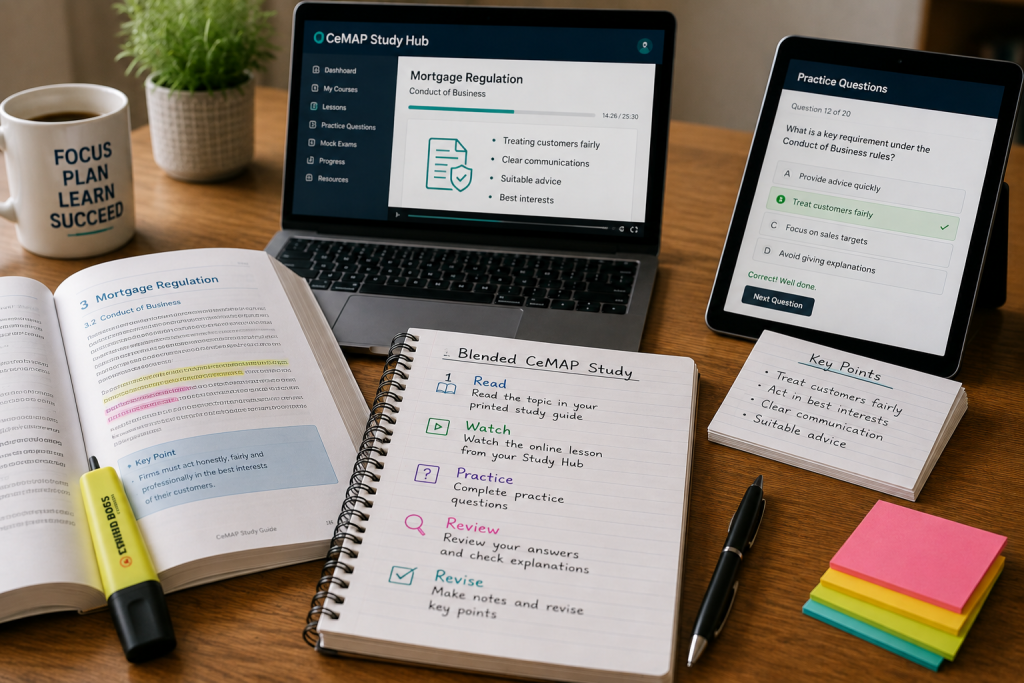
How to know if a CeMAP course offers real value with structured learning materials and support

Is a CeMAP course just about passing the exam?

A CeMAP course is designed to support exam preparation, but its purpose is broader than that.

The qualification itself is about understanding how mortgage advice works, including regulation, products, and client needs.

A good course helps you:

  • Understand concepts, not just memorise facts
  • See how topics connect
  • Build confidence in applying knowledge

This matters because the exam is testing understanding as well as knowledge.

Simply reading information is not always enough.

Why do some courses feel easier to follow than others?

This usually comes down to how the course is designed, not how “hard” the content is.

Courses that feel easier to follow tend to:

  • Use plain, clear explanations
  • Avoid unnecessary complexity
  • Build topics gradually
  • Reinforce learning consistently

Courses that feel difficult often:

  • Present too much information at once
  • Lack clear structure
  • Assume prior knowledge
  • Offer limited guidance

The syllabus is the same either way. The difference is how it is delivered.

What should you focus on when comparing CeMAP courses?

When comparing options, it helps to look beyond surface-level features.

Instead of asking “what do I get?”, consider:

  • How is the learning structured?
  • Is there guidance, or just content?
  • What support is available if I struggle?
  • How are materials presented and organised?

These questions give a clearer picture of the learning experience.

A simple way to think about it

At its core, a CeMAP course is a combination of:

  • Information (the syllabus)
  • Explanation (teaching)
  • Organisation (structure)
  • Reinforcement (practice)
  • Support (guidance)

All courses include these in some form, but the balance and quality can vary.

Understanding that helps you make a more informed choice.

A simple way to think about it

A CeMAP course is not just a set of materials. It is a framework for learning a detailed and regulated subject in a manageable way.

The real value comes from how well that framework supports you.

If it provides clear structure, useful explanations, and access to support, it can make the process feel far more straightforward.

If it does not, even good content can feel difficult to use.

That is why understanding what is included matters just as much as deciding to take the qualification in the first place.

Looking for training support?

We offer CeMAP training for learners working towards a career in mortgage advice. Our courses follow the London Institute of Banking & Finance syllabus and are designed to support understanding of mortgage regulation and advice requirements.

Explore our accredited CeMAP training courses

> Futuretrend Financial Training 
What “in-house learning materials” really means

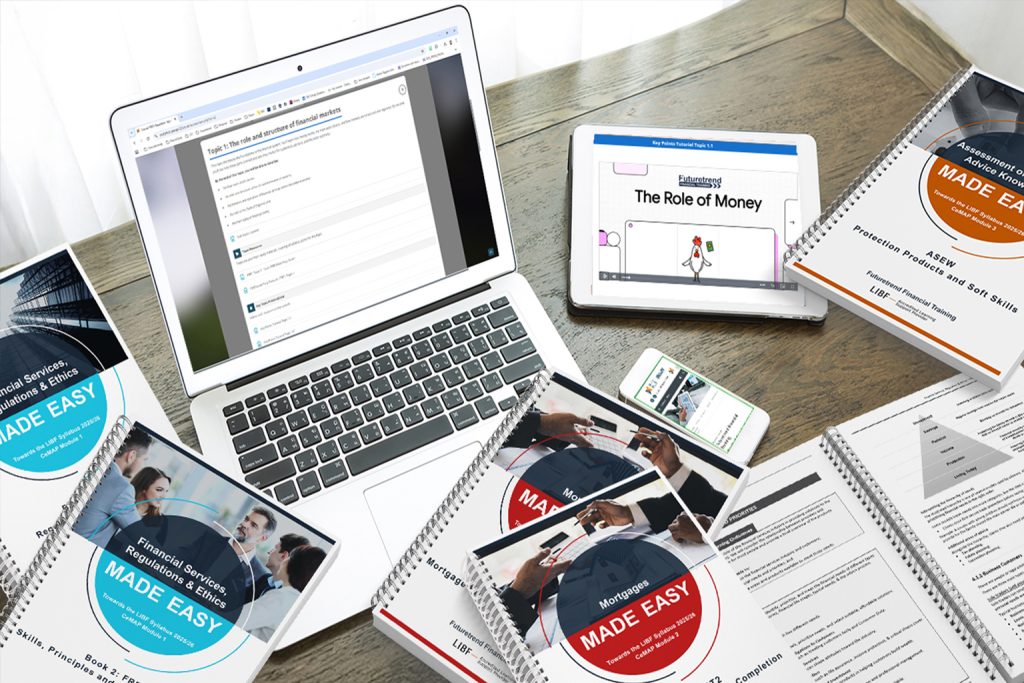
n-house CeMAP learning materials illustration showing books, revision guides, online learning and mock exam preparation for CeMAP students

When you read a CeMAP course description, you will often see the phrase “in-house learning materials”. It sounds reassuring, but it is rarely explained clearly.

For learners comparing training providers, understanding what this actually means can make it easier to assess course quality and suitability.

This article explains what in-house materials are, how they are created, and how they relate to studying for CeMAP, which is awarded by the London Institute of Banking & Finance.

n-house CeMAP learning materials illustration showing books, revision guides, online learning and mock exam preparation for CeMAP students

What are in-house CeMAP materials?

In-house CeMAP materials are study resources created and maintained by a training provider, rather than being supplied by an external publisher or textbook provider.

They are designed to support learners working towards CeMAP and typically include:

  • Course notes aligned to the CeMAP syllabus
  • Structured online learning modules
  • Revision guides and summary materials
  • Practice questions and mock exams
  • Tutor-led presentation slides or workshop content

Why do training providers create their own materials?

Training providers often develop their own materials to better control how learners experience the course.

Control over structure and delivery

By creating materials in-house, providers can decide:

  • The order topics are taught in
  • How complex areas are explained
  • How content is broken into manageable sections

This is particularly useful for a qualification like CeMAP, where the syllabus set by the London Institute of Banking & Finance can feel large without clear structure.

Alignment with structured online learning and classroom delivery

In-house materials are often designed to match:

This alignment means learners are not switching between different styles or formats, which can make studying more consistent.

Flexibility to update content

Because providers own the materials, they can update them when needed.

This helps ensure alignment with:

  • The current CeMAP syllabus
  • Updates from the London Institute of Banking & Finance
  • Regulatory context set by the Financial Conduct Authority

What are the benefits of in-house learning materials?

In-house materials can support learning effectively when they are well designed.

More focused explanations

Some in-house materials are written to simplify complex areas of the CeMAP syllabus.

This can help learners:

  • Understand key concepts more quickly
  • Focus on what matters for the exam
  • Avoid getting lost in unnecessary detail

This is often supported by clear revision guides that highlight core knowledge areas.

Benefits of In-House CeMAP Learning Materials

Better integration with revision and practice

When materials are created as part of a full course, they tend to link closely with:

  • Topic-based revision guides
  • End-of-unit quizzes
  • Mock exam practice

This joined-up approach can make revision more structured and easier to manage.

Consistency across the learning journey

Learners using in-house materials often benefit from:

  • A consistent structure across all topics
  • Familiar formats for notes and questions
  • A clearer progression from learning to revision

This can be particularly helpful when working through larger units within CeMAP.

Are there any limitations to in-house materials?

In-house materials are not automatically better than external resources. Their quality depends entirely on how they are developed.

Quality can vary between providers

There is no universal standard for in-house materials, so the quality can differ significantly.

Some providers invest heavily in:

  • Instructional design
  • Clear structure and layout
  • Regular updates aligned to LIBF expectations

Others may offer materials that are:

  • Outdated
  • Overly simplified or too detailed
  • Not well aligned with how CeMAP is assessed

Because of this, the phrase “in-house materials” on its own does not guarantee quality.

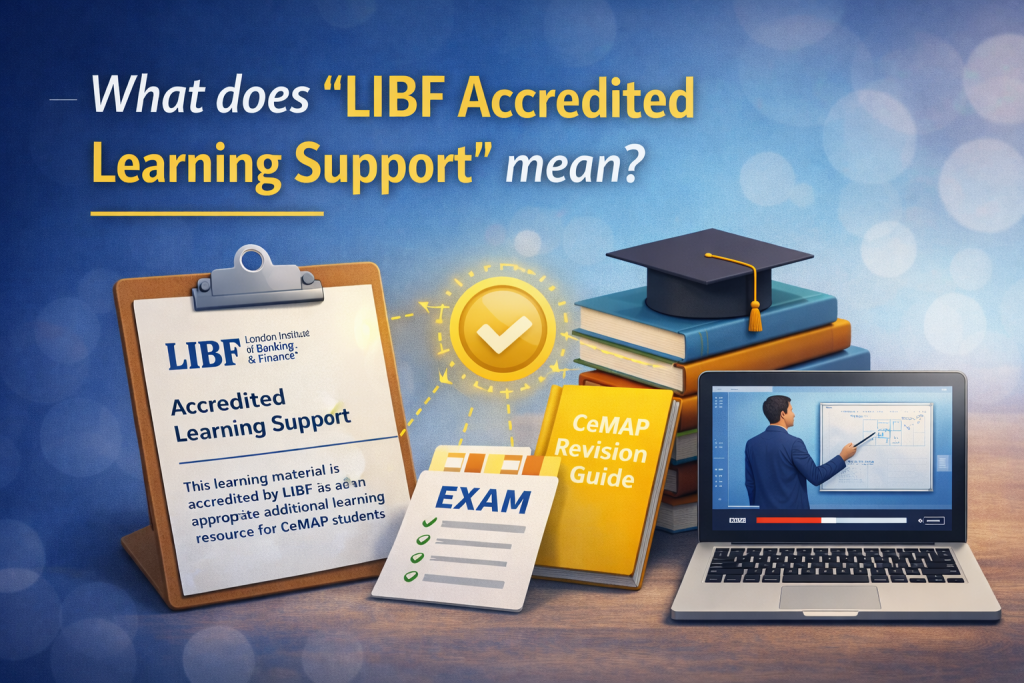
What does “LIBF Accredited Learning Support” mean?

Some training providers are selected to have their learning materials reviewed through an accreditation process linked to the London Institute of Banking & Finance.

You may see the following statement:

“This learning material is accredited by the LIBF as being an appropriate additional learning resource for students undertaking its CeMAP qualification.”

What the accreditation is designed to indicate

This means the materials have been reviewed and are considered:

  • Appropriate to support CeMAP study
  • Comparable in level to LIBF learning materials
  • Fit for purpose in terms of structure and coverage
  • Supportive of a positive learning experience

It also indicates that the materials are designed to help build knowledge in a way that supports professional standards.

LIBF accredited learning support for CeMAP showing study materials, revision guides, online learning and exam preparation resources

What it does not mean

It does not mean:

  • The provider is officially endorsed as superior
  • The materials guarantee exam success
  • The qualification itself is different

All learners are still assessed against the same standards set by the LIBF.

Why this matters

Because in-house materials can vary, this type of accreditation provides a useful point of reference when comparing providers.

It offers reassurance that the materials are aligned to the expected level of study for CeMAP.

Who is responsible for keeping in-house materials up to date?

When a provider creates their own materials, they are fully responsible for maintaining them.

This includes ensuring alignment with:

  • The current CeMAP syllabus
  • Updates issued by the London Institute of Banking & Finance
  • Relevant regulatory context from the Financial Conduct Authority

Why updates matter

Outdated materials can lead to:

  • Gaps in knowledge
  • Confusion during revision
  • Misalignment with exam expectations

For a qualification like CeMAP, accuracy is essential because the content reflects real industry standards.

How can you tell if in-house materials are well developed?

Since quality varies, it helps to look for practical indicators.

Clear structure and topic breakdown

Good materials should:

  • Follow the CeMAP syllabus logically
  • Break topics into manageable sections
  • Support step-by-step learning

This is especially important for structured online learning environments.

Consistent use of revision tools

Look for:

  • Well-designed revision guides
  • Practice questions linked to each topic
  • Mock exams that reflect real assessments

These elements show the materials are designed to support the full learning cycle.

Alignment with assessment style

Materials should reflect how CeMAP exams are structured, rather than just presenting information.

This helps learners prepare more effectively for assessment.

Do providers clearly show what you will receive?

One of the simplest ways to assess in-house materials is to look at how clearly a training provider explains what is included in their course.

Well-developed courses will usually give a clear breakdown of:

  • The types of study materials provided
  • Whether structured online learning is included
  • Access to revision guides and practice questions
  • The availability of mock exams or assessments

If the description is vague or limited, it can be harder to understand how the materials will support your learning.

CeMAP in-house learning materials including revision guides, structured online learning, course notes and study resources for exam preparation

Is the content more than just text or video?

Good in-house materials are rarely built around a single format.

Most learners benefit from a mix of resources, which may include:

  • Written course notes
  • Video-based learning
  • Interactive quizzes or knowledge checks
  • Revision guides for key topics

A broader mix of materials can make it easier to stay engaged and adapt your approach as you move through the CeMAP syllabus set by the London Institute of Banking & Finance.

Can you preview the materials before enrolling?

Some providers offer sample materials or walkthroughs of their learning platform.

This might include:

  • Sample revision guides
  • Demo access to structured online learning
  • Example lessons or topic breakdowns

Being able to see how the materials are presented can help you judge:

  • Clarity of explanations
  • Level of detail
  • Overall quality of the learning experience

Providers who are open about showing their materials often make it easier for learners to make informed decisions.

Do in-house materials mean better learning outcomes?

Not necessarily.

In-house materials can improve clarity and structure, but outcomes depend on:

  • How the materials are used
  • The level of support available
  • The learner’s own approach to study

CeMAP is awarded by the London Institute of Banking & Finance, and all learners are assessed against the same standard.

Materials can support learning, but they do not replace consistent study and understanding.

How do in-house materials compare to external textbooks?

Both approaches can support learning in different ways.

In-house materials

  • Tailored to structured courses
  • Integrated with revision guides and practice
  • Easier to update in line with LIBF changes

External textbooks

  • Standardised and widely used
  • Often more detailed
  • Less tailored to specific course delivery

Some learners prefer structured materials, while others prefer more detailed reading. In some cases, providers use both.

Why does this matter when choosing a CeMAP course?

Understanding what “in-house learning materials” means helps you look beyond marketing language.

Instead of focusing on the label, it is more useful to consider:

  • How the materials are structured
  • Whether they include revision guides and mock exams
  • How they support structured online learning
  • Whether they are kept up to date with LIBF expectations

This allows you to focus on how well the course supports your learning, rather than how it is described.

Choosing a CeMAP course illustration showing comparison of learning materials, structured online learning, revision guides and course features

Final thoughts

“In-house learning materials” simply means that a training provider creates its own study content to support learners working towards CeMAP.

They can offer clear advantages when they are structured well, regularly updated, and aligned with the syllabus set by the London Institute of Banking & Finance.

At the same time, their quality depends entirely on how they are developed and maintained.

For learners, the most important factor is not whether materials are in-house or external, but whether they are clear, accurate, and genuinely support understanding and revision.

Looking for training support?

We offer CeMAP training for learners working towards a career in mortgage advice. Our courses follow the London Institute of Banking & Finance syllabus and are designed to support understanding of mortgage regulation and advice requirements.

Explore our accredited CeMAP training courses

> Futuretrend Financial Training