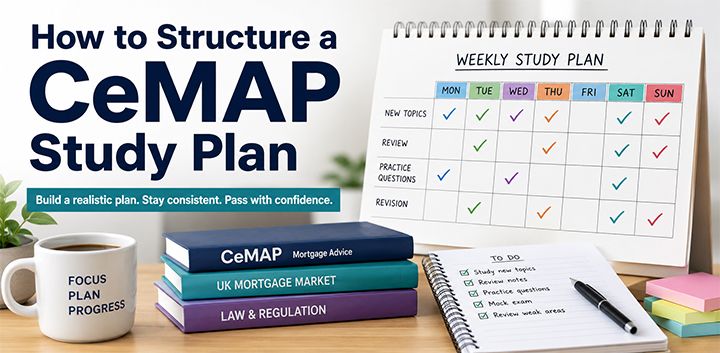
What “Structured Learning” Really Means in CeMAP Training

Structured CeMAP study plan with organised books, checklist and laptop showing how structured learning helps mortgage adviser students study step by step.

If you have been researching CeMAP courses, you have probably seen the phrase structured learning used again and again. It sounds helpful, but it is not always explained clearly.

Structured learning is simply a study approach where the material is organised into a logical order, with each topic building on the one before it. Instead of deciding what to study next on your own, you follow a planned path that helps you understand the syllabus step by step.

For a qualification like CeMAP, this matters more than many learners realise.

The Certificate in Mortgage Advice and Practice (CeMAP), awarded by the London Institute of Banking & Finance, covers a large amount of technical information. It includes regulation, mortgage law, products, calculations, and client advice principles. Without a clear structure, it is easy to feel overwhelmed or miss important links between topics.

This article explains what structured learning really means, how it differs from unstructured study, and why it can make preparing for CeMAP more manageable and effective.

Structured CeMAP study plan with organised books, checklist and laptop showing how structured learning helps mortgage adviser students study step by step.

What Is Structured Learning?

Structured learning is a method of studying where:

  • Topics are arranged in a logical sequence
  • Each lesson builds on previous knowledge
  • Learning objectives are clear
  • Progress is broken into manageable sections
  • Revision is planned rather than random

In simple terms, structured learning gives you a roadmap.

Rather than asking, “What should I study today?”, the answer is already set out for you.

For example, in CeMAP 1 you would normally begin with the UK financial services industry and regulation before moving on to mortgages, house-buying, and taxation. That order makes sense because the later topics rely on knowledge from the earlier ones.

Why Structured Learning Matters for CeMAP

CeMAP is not just about memorising isolated facts.

The exams test whether you understand how different areas fit together. For instance:

  • Regulation affects what advisers can recommend
  • Tax rules influence affordability and property decisions
  • Mortgage products are linked to customer circumstances
  • Legal processes affect how transactions are completed

If you study topics in a random order, these relationships can be harder to grasp.

Structured learning helps you build understanding layer by layer, which makes the whole syllabus easier to absorb.

Step-by-step blocks leading to CeMAP books and a graduation cap, showing how structured learning builds knowledge and confidence for CeMAP exams.

What Does Structured Learning Look Like in Practice?

A structured CeMAP course usually includes several elements working together:

A Clear Study Plan

You know exactly what to cover each week and in what order.

Guided Lessons

Lessons explain each topic before moving on to the next.

Revision Activities

Knowledge checks, quizzes, and recap exercises reinforce learning.

Progress Tracking

You can see what you have completed and what still needs attention.

Tutor Support

If you are studying with a provider, tutors can answer questions and clarify difficult topics.

Together, these elements reduce uncertainty and help you focus on learning rather than planning.

What Is Unstructured Study?

Unstructured study is the opposite approach.

It usually means:

  • Jumping between topics
  • Reading whatever feels easiest
  • Revising only familiar areas
  • Skipping difficult subjects
  • Having no clear timetable

This is common when learners rely solely on textbooks or internet searches without a defined plan.

Although it can feel flexible, it often leads to inconsistent progress.

Structured Learning vs Unstructured Study

Structured Learning

Follows a logical order

Builds understanding gradually

Includes progress milestones

Encourages regular study habits

Reduces decision fatigue

Unstructured Study

Topics covered randomly

Important connections may be missed

Progress feels uncertain

Revision can become inconsistent

Time is spent deciding what to do

The key difference is that structured learning removes guesswork.

How Structured Learning Improves Consistency

One of the biggest challenges with CeMAP is maintaining momentum over several months.

Many learners start strongly but lose focus when:

  • Work becomes busy
  • Family commitments increase
  • Topics become more technical
  • They are unsure what to study next

Structured learning helps because each study session has a clear purpose.

Instead of spending 20 minutes deciding what to revise, you simply continue with the next lesson.

This makes it easier to maintain regular study habits, even when time is limited.

Weekly CeMAP study plan with books and checklist showing how structured learning helps students study consistently.

How Structured Learning Improves Understanding

Consistency is useful, but understanding is what ultimately helps you pass.

When learning is structured:

  1. New ideas are introduced in context.
  2. Related topics are grouped together.
  3. Concepts are revisited at the right time.
  4. Knowledge builds naturally.

For example, understanding the role of the Financial Conduct Authority helps make sense of adviser responsibilities later in the syllabus.

Without that foundation, later topics can seem disconnected and more difficult than they really are.

Why Structure Reduces Overwhelm

CeMAP can appear intimidating because of the amount of material involved.

Structured learning breaks the syllabus into manageable sections.

Rather than viewing CeMAP as one huge qualification, you focus on:

  • One module at a time
  • One topic at a time
  • One lesson at a time

This makes progress feel achievable and helps reduce the feeling of being buried under information.

Simple Example: Structured vs Unstructured Revision

Imagine two learners studying CeMAP 1.

Learner A: Structured Approach

  • Follows a weekly study plan
  • Completes lessons in order
  • Revises after each topic
  • Tracks progress

Learner B: Unstructured Approach

  • Reads chapters at random
  • Revises only when motivated
  • Skips difficult areas
  • Unsure what has been covered

After several weeks, Learner A usually has a clearer understanding and greater confidence because each topic has been built on solid foundations.

Does Structured Learning Mean Studying at a Fixed Pace?

No.

Structured CeMAP learning provides order, not rigid deadlines.

You can move faster through familiar topics and spend longer on areas you find difficult.

The important part is that the sequence remains logical.

Think of it as following a map rather than wandering without direction.

Is Structured Learning Only for Beginners?

Not at all.

Even experienced professionals benefit from structured learning when studying for a formal qualification.

CeMAP includes many areas that may be unfamiliar, particularly regulation and technical knowledge.

A structured approach helps ensure that nothing important is overlooked.

What Should You Look for in a Structured CeMAP Course?

If you are comparing courses, look for evidence that the training includes:

  • A clear lesson sequence
  • Study schedules or recommended timetables
  • Progress tracking
  • Topic-based quizzes
  • Tutor support
  • Revision resources

These are practical signs that the learning experience is organised rather than simply providing access to materials.

Can You Create Your Own Structured Learning Plan?

Yes.

If you are studying independently, you can still apply structured learning by:

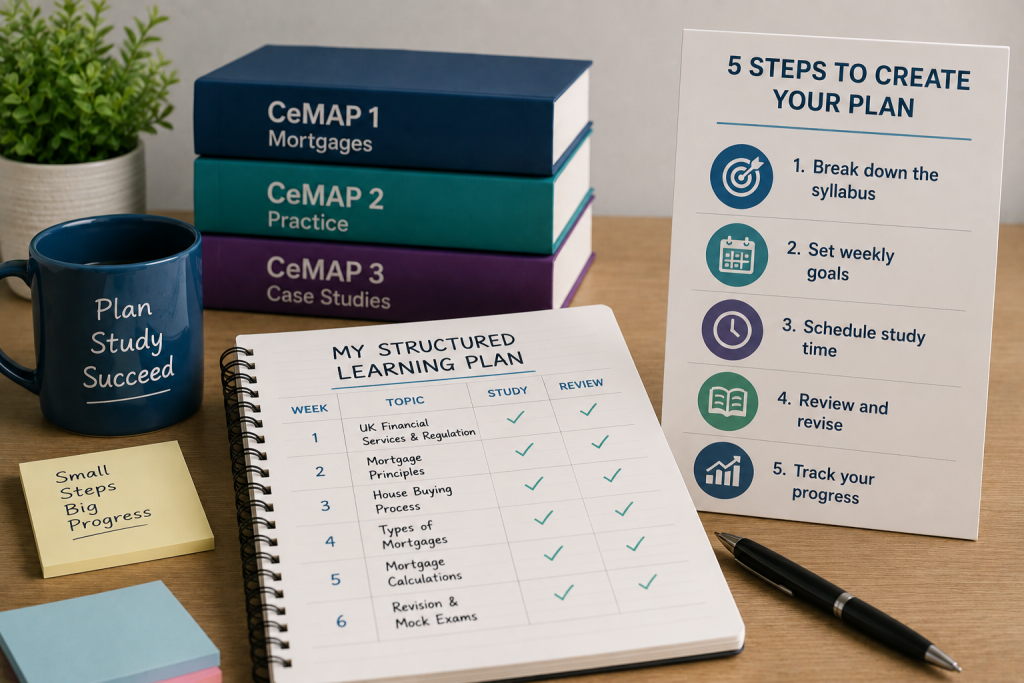
  1. Breaking the syllabus into weekly sections.
  2. Studying topics in the order set by the qualification.
  3. Reviewing each topic before moving on.
  4. Scheduling regular recap sessions.
  5. Tracking your progress.

This requires more discipline, but the principles are exactly the same.

Personal CeMAP study plan with weekly checklist, books and notes showing how learners can create their own structured learning plan.

What Is Structured Learning? A Simple Definition

Structured learning is a planned approach to studying where topics are organised in a logical order, each lesson builds on previous knowledge, and progress is guided step by step.

For CeMAP learners, structured learning reduces overwhelm, improves consistency, and helps you understand how the syllabus fits together.

Why Structured Learning Helps CeMAP Learners

CeMAP is a detailed professional qualification with many connected topics.

Structured learning helps by:

  • Giving you a clear study path
  • Reducing uncertainty
  • Building understanding gradually
  • Encouraging regular revision
  • Making progress easier to track

Instead of trying to piece the syllabus together yourself, you follow a sequence designed to support learning.

Final Thoughts

Structured learning is not a buzzword. It is a practical way to study more effectively.

When your learning is organised, you spend less time wondering what to do next and more time actually understanding the material.

For a qualification as broad as CeMAP, that clarity can make a significant difference.

Whether you choose a tutor-led course, an online Study Hub, or self-study, the most effective approach is one that follows a clear and logical structure.

That is what structured learning really means.

Looking for training support?

We offer CeMAP training for learners working towards a career in mortgage advice. Our courses follow the London Institute of Banking & Finance syllabus and are designed to support understanding of mortgage regulation and advice requirements.

Explore our accredited CeMAP training courses

> Futuretrend Financial Training 
How CeMAP Revision Guides Simplify the Syllabus (and What to Look For)

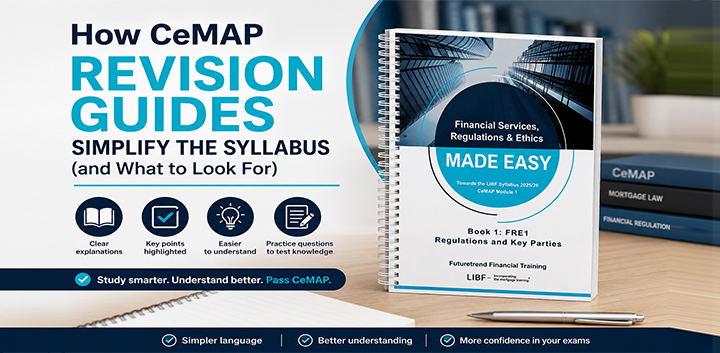
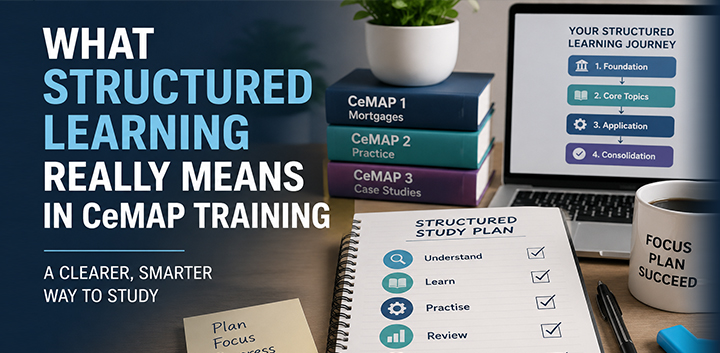
CeMAP revision guide book showing how simplified study materials make the CeMAP syllabus easier to understand

Studying for CeMAP (Certificate in Mortgage Advice and Practice) can feel overwhelming at first.

The official syllabus from the London Institute of Banking & Finance (LIBF) and the regulatory material linked to the Financial Conduct Authority (FCA) are detailed for a reason. They are designed to define what mortgage advisers need to know before giving regulated advice.

But there is a big difference between a syllabus that lists what you must learn and a revision guide that helps you actually understand it.

A good CeMAP revision guide should take a large, technical syllabus and turn it into something manageable, clear and easier to remember.

CeMAP revision guide book showing how simplified study materials make the CeMAP syllabus easier to understand

What Is a CeMAP Revision Guide?

A CeMAP revision guide is a study resource designed to explain the official syllabus in simpler language.

It should:

  • Cover all examinable topics
  • Break complex ideas into smaller sections
  • Use plain English instead of technical jargon
  • Highlight key facts and definitions
  • Help learners prepare for the exam efficiently

The purpose of a revision guide is not to replace the official syllabus. Its job is to make that syllabus easier to understand and revise.

That distinction matters.

The official syllabus tells you what you need to know. A revision guide should help you understand how to learn it.

Why the Official CeMAP Material Can Feel Difficult

The CeMAP qualification is the industry-standard mortgage advice qualification in the UK. It is awarded by the London Institute of Banking & Finance and meets the FCA’s education requirements for advisers who want to provide mortgage advice.

That does not mean the study material is always easy to digest.

Many learners struggle because the content includes:

  • Legal and regulatory terminology
  • Detailed product rules
  • Large amounts of factual information
  • Technical definitions
  • Long paragraphs with little explanation

If you are new to financial services, this can feel like being handed a dictionary and told to memorise it.

That is where revision guides become useful.

CeMAP student feeling overwhelmed by dense study materials and official mortgage regulation textbooks

Dense Material vs Simplified Material

Not all study resources are created in the same way.

Dense Material

Dense material often:

  • Uses formal wording taken directly from regulations
  • Includes long blocks of text
  • Introduces several concepts at once
  • Provides limited explanation
  • Assumes prior knowledge

This approach may be technically accurate, but it can be hard to absorb.

Simplified Material

A well-written revision guide should:

  • Explain one idea at a time
  • Use examples to illustrate concepts
  • Translate technical terms into everyday language
  • Highlight the most important facts
  • Summarise key points clearly

For example, rather than simply stating that a mortgage intermediary must comply with FCA disclosure requirements, a simplified guide might explain:

“Mortgage advisers must tell clients who they are, what service they offer and how they are paid before giving advice.”

The rule remains the same, but the explanation is much easier to understand.

How Good Revision Guides Break Down Topics

The best CeMAP study guides divide each topic into smaller, logical chunks.

Instead of presenting an entire chapter on mortgage regulation in one go, they break it into sections such as:

  • Who regulates mortgage advice
  • What advisers are allowed to do
  • Required disclosures
  • Complaints procedures
  • Consumer protection rules

This step-by-step structure helps learners build understanding gradually.

It is much easier to remember five short explanations than one long wall of text.

Examples of Topics That Benefit from Simplification

Some CeMAP topics are particularly suited to simplified explanations.

Regulation and Compliance

Rules and definitions can sound intimidating, but they become clearer when explained in practical terms.

Mortgage Products

Understanding the difference between repayment, interest-only, fixed-rate and tracker mortgages is easier when each product is compared side by side.

Calculations

Concepts such as loan-to-value (LTV) and debt-to-income ratios are more memorable when shown with worked examples.

Protection Products

Life cover, critical illness and income protection are easier to grasp when their purpose is explained in plain English.

What to Look for in a Good CeMAP Revision Guide

If you are comparing study materials, there are several signs of quality.

Clear, Simple Language

The guide should explain technical terms without making them sound more complicated than they are.

Logical Structure

Topics should be organised in the same order as the syllabus so you can track your progress.

Bite-Sized Sections

Short sections are easier to review and revisit.

Key Point Summaries

Important facts should be clearly highlighted.

Practical Examples

Examples help turn abstract concepts into real-world situations.

Practice Questions

Questions test understanding and reveal weak areas.

Up-to-Date Content

Mortgage regulation changes over time, so materials should reflect the current syllabus.

Are CeMAP Revision Guides Enough?

For many learners, a good revision guide is enough to understand the syllabus and prepare effectively for the exams.

However, revision guides work best when used alongside:

  • Practice questions and mock exams
  • The official syllabus specification
  • Additional explanations for difficult topics
  • A structured study plan

Think of a revision guide as the core of your study materials rather than the only tool you use.

If your guide covers the full syllabus clearly and you complete enough question practice, it may be all you need academically.

If you struggle with exam technique or motivation, you may benefit from extra support such as workshops, tuition or structured learning programmes.

How to Use CeMAP Revision Guides Effectively

Even the best guide is only useful if you use it properly.

1. Start With the Syllabus

Understand what each unit covers so you know what the exam expects.

2. Read in Small Sections

Focus on one topic at a time.

3. Make Your Own Notes

Writing summaries in your own words improves retention.

4. Test Yourself Regularly

Use practice questions after each chapter.

5. Revisit Weak Areas

Spend extra time on topics that consistently trip you up.

6. Use Spaced Revision

Review topics several times over a period of weeks rather than cramming.

Signs Your Current Materials May Not Be Working

You may need better revision guides if you find that:

  • You keep rereading the same pages
  • The explanations feel overly technical
  • You understand the words but not the meaning
  • You struggle to connect concepts together
  • Your mock exam scores are not improving

Good study materials should make learning feel clearer, not more confusing.

Why Simpler Explanations Improve Exam Performance

The CeMAP exams test understanding as well as recall.

If you genuinely understand a topic, you are more likely to:

  • Interpret questions correctly
  • Spot distractor answers
  • Apply knowledge to scenarios
  • Retain information longer

Simplified study materials help build this understanding by reducing unnecessary complexity.

That does not mean oversimplifying the content. It means presenting it in a way that is easier to learn.

CeMAP revision guide and study workspace showing how clear explanations improve understanding and exam performance

Can Revision Guides Replace the Official Textbooks?

Revision guides are designed to support learning, not to change the syllabus.

A comprehensive guide should cover the same topics as the official material, but in a more accessible format.

Many learners find they understand concepts faster when they start with simplified notes and then refer to official wording only when needed.

This approach saves time and reduces frustration.

Choosing the Right Study Materials for Your Learning Style

Different learners prefer different formats.

You may find it helpful to use:

  • Printed study guides for focused reading
  • Digital guides for quick searching
  • Audio lessons for learning on the move
  • Flashcards for memorising key facts
  • Mock exams for exam practice

The best resources are the ones you can use consistently.

Final Thoughts

CeMAP revision guides should make the syllabus easier to understand, easier to remember and easier to revise.

A good guide will:

  • Cover the full syllabus
  • Use clear language
  • Break topics into manageable sections
  • Include examples and summaries
  • Support effective exam preparation

If your current materials feel dense or confusing, it may not be the syllabus that is the problem. It may simply be the way the information is presented.

The right revision guide turns a daunting qualification into a structured learning journey that feels far more manageable.

Looking for training support?

We offer CeMAP training for learners working towards a career in mortgage advice. Our courses follow the London Institute of Banking & Finance syllabus and are designed to support understanding of mortgage regulation and advice requirements.

Explore our accredited CeMAP training courses

> Futuretrend Financial Training 

How long should you realistically study each week for CeMAP?

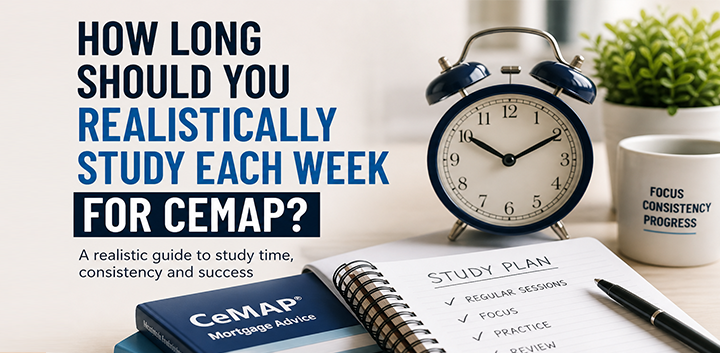
How many hours a week to study for CeMAP shown with study plan, books and clock

If you’ve been looking into CeMAP, you’ve probably asked the obvious question: how many hours a week should I study?

The honest answer is not a neat number. And that’s actually a good thing. It means you can shape your study around your life, rather than forcing your life around a fixed timetable.

What matters more is consistency, focus, and using your time well.

How many hours a week to study for CeMAP shown with study plan, books and clock

How many hours a week is CeMAP?

There isn’t a single weekly hour requirement for CeMAP.

Most learners study alongside work, family, and other commitments, so the time you need depends on how quickly you absorb information and how regularly you can study.

A realistic way to think about it is this:
you need steady, repeatable study time each week, rather than bursts of intense effort followed by long gaps.

Trying to pin it down to a fixed number can actually be misleading. Two people could spend the same amount of time studying and get very different results depending on how they use that time.

Why study time varies so much

CeMAP is awarded by the London Institute of Banking & Finance and covers mortgage law, regulation, products, and advice. That means it blends theory with practical understanding.

Because of that, study time varies for a few key reasons:

Your starting point

If you already work in financial services, some topics may feel familiar. You might move faster through areas like regulation or terminology.

If you’re completely new, you’ll likely need more time to build that foundation.

Neither is better or worse. It just changes the pace.

Your learning style

Some people learn quickly from reading. Others need to hear explanations, watch examples, or revisit topics a few times before it sticks.

If you need repetition, your study time will naturally be longer. That’s not a weakness. It’s how learning works.

Your schedule

A learner studying a little each day will usually progress more smoothly than someone trying to fit everything into one or two large sessions.

Short, regular sessions tend to reduce stress and improve memory.

How confident you want to feel

Some learners aim to pass as soon as possible. Others want to feel completely comfortable with the material before sitting the exam.

Both approaches are valid, but they affect how much time you spend each week.

Tutor-led study vs self-study

One of the biggest differences in weekly study time comes down to how you learn.

Tutor-led virtual CeMAP classroom

A structured course gives you a clear schedule. You attend sessions, follow a guided plan, and build knowledge step by step.

This usually means:

  • You study at set times each week
  • You’re less likely to fall behind
  • You spend less time figuring out what to study

Because of the structure, your weekly study time often feels more focused and efficient. You’re not wasting time deciding where to start.

You also benefit from explanation. If something doesn’t make sense, it gets clarified straight away instead of slowing you down later.

CeMAP Self-study

Self-study gives you flexibility, but it also puts more responsibility on you.

You need to:

  • Plan your own study schedule
  • Decide what to cover each session
  • Stay disciplined without external deadlines

Some learners thrive with this. Others find it harder to stay consistent.

In practice, self-study can sometimes take longer overall, not because the content is harder, but because:

  • Progress can be uneven
  • Motivation can dip
  • Topics may need revisiting more often

That said, if you’re organised and consistent, self-study can work very well.

Why long gaps slow you down

One of the most common mistakes is leaving large gaps between study sessions.

It feels harmless at the time. Life gets busy, you miss a few days, then a week, then suddenly you’re trying to remember where you left off.

The problem is not just lost time. It’s lost understanding.

When you take long breaks:

  • You forget key concepts
  • You lose momentum
  • You spend your next session recapping instead of progressing

Over time, this adds up. You end up studying more hours overall because you’re repeating work.

Steady, consistent study reduces the need for constant revision.

Even shorter sessions, done regularly, tend to be far more effective than occasional long ones.

Quality matters more than quantity

It’s easy to assume more hours equals better results. In reality, that’s not always true.

A focused, distraction-free study session can achieve far more than a long session where your attention drifts.

Good quality study usually includes:

  • Clear goals for each session
  • Active learning, not just reading
  • Testing your understanding as you go
  • Revisiting difficult areas intentionally

Poor quality study often looks like:

  • Reading without absorbing
  • Highlighting everything but understanding little
  • Multitasking while studying
  • Skimming instead of engaging

If you finish a session and can explain what you’ve learned in simple terms, that’s a strong sign your time was well spent.

CeMAP study example showing quality study methods like practice and review instead of long unfocused study hours

What does a realistic study week look like?

Instead of focusing on a fixed number of hours, think in terms of rhythm.

A realistic CeMAP study week usually includes:

  • Regular sessions spaced across the week
  • Time to review previous topics
  • Time to learn new material
  • Occasional practice questions

The key is balance. You want to move forward without forgetting what you’ve already covered.

Trying to rush everything into a short period often leads to overload. Spreading it out makes it manageable.

Setting realistic expectations

CeMAP is not designed to be rushed in a few days, but it’s also not something that needs to take over your life.

A realistic mindset is:

  • You will need consistent effort
  • Some topics will take longer than others
  • You won’t understand everything immediately
  • Progress may feel slow at times

That’s all normal.

What matters is staying consistent and not getting discouraged by difficult sections.

Many learners find that once the early concepts click, later topics start to feel easier.

Choosing the right study resources

The quality of your CeMAP resources has a direct impact on how long you need to study.

Clear, well-structured materials can save a huge amount of time.

Look for resources that:

  • Explain concepts plainly
  • Follow the CeMAP syllabus closely
  • Include examples and practice questions
  • Break topics into manageable sections

Poor resources often lead to:

  • Confusion
  • Re-reading the same content multiple times
  • Needing to find extra explanations elsewhere

That extra effort increases your weekly study time without improving results.

A simple way to approach your study time

Instead of asking, “How many hours should I study?”, a better question is:

“Can I study consistently every week without burning out?”

If the answer is yes, you’re on the right track.

Start with what fits your life now. Then adjust as you go.

If you feel overwhelmed, reduce session length but increase consistency.
If you feel comfortable, you can gradually increase your study time.

Flexibility is more sustainable than rigid targets.

Final thoughts

CeMAP study time isn’t about hitting a perfect weekly number. It’s about building a routine that works for you and sticking to it.

Consistency beats intensity.
Understanding beats rushing.
Quality beats quantity.

If you approach your study in a steady, practical way, you’ll make progress without it taking over your life.

And that’s exactly what most learners need.

Looking for training support?

We offer CeMAP training for learners working towards a career in mortgage advice. Our courses follow the London Institute of Banking & Finance syllabus and are designed to support understanding of mortgage regulation and advice requirements.

Explore our accredited CeMAP training courses

> Futuretrend Financial Training 
Ultimate Guide to Becoming a CeMAP Mortgage Adviser: Steps, Tips & Resources

Continuing Professional Development (CPD) Resources for Mortgage Advisers in 2025

Becoming a CeMAP Mortgage Adviser is your gateway to a rewarding career in the UK’s thriving mortgage sector. Whether you’re starting from scratch or looking to formalise your existing experience with a recognised qualification, this guide covers every step—from understanding the CeMAP syllabus to launching your first client meetings.

In this ultimate guide, you will discover:

  • What the CeMAP qualification entails and why it matters

  • A step-by-step roadmap to passing all three modules

  • Proven study strategies to boost knowledge retention

  • How to leverage Continuous Professional Development (CPD) to stay compliant and competitive

  • Top tips for writing a standout CV and kick-starting your mortgage advice career
Ultimate Guide to Becoming a CeMAP Mortgage Adviser: Steps, Tips & Resources

Let’s dive in and set you on the path to success as a certified CeMAP Mortgage Adviser.

Understanding the CeMAP Qualification

What Is CeMAP?

CeMAP, or the Certificate in Mortgage Advice and Practice, is the industry-standard qualification for individuals seeking to give mortgage advice in the UK. It is awarded by the London Institute of Banking & Finance (LIBF) and recognised by the Financial Conduct Authority (FCA).

Completing CeMAP demonstrates your knowledge of:

Checkout our full module breakdown posts for more details by clicking on links above

CeMAP 2025 Qualification Changes: What’s New and How It Affects You

Why CeMAP Matters

  • FCA Compliance: Only CeMAP-qualified advisers can provide regulated mortgage advice.

  • Industry Credibility: Employers and clients trust advisers with formal credentials.

  • Career Progression: Opens doors to roles in mortgage broking, bank advice desks, and financial planning firms.

Understanding the CeMAP Qualification

Time Management & Study Timetable

A structured approach increases your odds of first-time success:

12-Week Plan:

  • Weeks 1–4: Core reading and note-making
  • Weeks 5–8: Topic review and flashcard drills
  • Weeks 9–12: Mock exams and timed practice


Daily Routine:

  • 1 hour theory study
  • 30 minutes Q&A drills
  • Weekly: Full mock test under exam conditions

Recommended Resources

  • LIBF Official Textbooks: Comprehensive coverage of syllabus topics.
  • Futuretrend Study Hub: Structured study guidance, revision guides, digital videos, audio tutorials and podcast, specimen question and much more.
  • Online Revision Platforms: Interactive quizzes, video lectures, and progress tracking tools.

Harnessing CPD & Continuous Learning

Importance of CPD

  • As a CeMAP Qualified Mortgage Adviser, you must complete at least 35 hours of CPD each year to maintain FCA compliance. CPD:

    • Ensures you remain up-to-date with regulatory changes
    • Boosts your credibility with clients
    • Enhances service quality and trust

Launching Your Career

Writing a Stand-Out CV

  • Highlight CeMAP: Place “CeMAP Qualified Mortgage Adviser” prominently under your qualifications.

  • Quantify Achievements: “Advised 25+ first-time buyers, achieving a 96% satisfaction rate.”

  • Skills Section: Emphasise regulatory knowledge, financial analysis, and client communication.
Continuing Professional Development (CPD) Resources for Mortgage Advisers in 2025

Networking & Professional Bodies

  • Join the CII or ARLA Propertymark: Access to industry events, CPD resources, and peer forums.

  • Attend Local Meet-ups: Mortgage clubs and finance networking events help build referral pipelines.

Conclusion & Next Steps

Congratulations on reaching the end of this Ultimate Guide to Becoming a CeMAP Mortgage Adviser. You now have:

  1. A clear understanding of the CeMAP modules and requirements
  2. A proven 12-week study plan with top resource recommendations
  3. Strategies to stay compliant and continuously improve through CPD
  4. Practical tips for writing a compelling CV and growing your professional network

Ready to take the next step?

  • Visit our CeMAP Training Page to explore courses tailored for every learning style.
  • Share your biggest study challenge in the comments below—our experts will help you overcome it.
  • Enrol in our next cohort today and fast-track your career as a qualified CeMAP Mortgage Adviser!

Empower your mortgage advice career with Futuretrend’s 25+ years of training excellence—because your success is our future.

📘 Explore more help: Visit our Free Resources Page or take a Study Hub tour to see how we support CeMAP learners like you.

If you’re ready, consider joining our full CeMAP training programme.

Images Designed by Freepik (www.freepik.com) and AI