Five things every CeMAP learner should know before starting

CeMAP learner studying with notebook and laptop showing five key things to know before starting CeMAP qualification

Starting CeMAP can feel like a big step, especially if you are new to financial services. Most learners focus on how to revise or which course to choose, but there are a few basics that matter just as much and are often missed at the start.

This guide answers a simple but important question: what should you know before starting CeMAP? Getting these foundations right can make your study smoother, more manageable, and far less frustrating.

CeMAP learner studying with notebook and laptop showing five key things to know before starting CeMAP qualification

What is CeMAP and why does it matter?

CeMAP is the industry standard qualification for mortgage advisers in the UK. It is awarded by the London Institute of Banking & Finance and meets the Financial Conduct Authority education requirements for giving mortgage advice.

It matters because without it, you cannot legally advise on mortgages in the UK. It is not just a course. It is the starting point for a regulated career.

That context is important. You are not just studying to pass exams. You are learning knowledge that underpins real financial decisions for clients.

1. CeMAP is manageable, but it is not “easy”

A lot of learners ask whether CeMAP is difficult. The honest answer is that it is very manageable with the right approach, but it is not something you can rush through without effort.

Why this matters

Some learners start thinking it will be straightforward because it is an entry-level qualification. Others go the opposite way and assume it will be overwhelming.

Both views can cause problems:

  • Underestimating it leads to poor preparation
  • Overestimating it leads to unnecessary stress

The reality sits in the middle. The content is clear and structured, but there is quite a lot of it.

CeMAP learner studying with books and laptop showing that CeMAP is manageable but not easy

What to expect

CeMAP is split into three modules:

  • CeMAP 1 focuses on regulation and core financial services knowledge
  • CeMAP 2 covers mortgage products and processes
  • CeMAP 3 applies your knowledge through case studies

Each builds on the last. If you take shortcuts early on, it tends to catch up with you later, especially in CeMAP 3.

A steady, consistent approach works far better than trying to cram.

2. How you study matters as much as what you study

There is no single “best” way to study CeMAP. Some learners prefer structured lessons, others prefer self-paced learning.

Why this matters

Many learners struggle not because the content is too hard, but because their study method does not suit them.

For example:

  • Reading alone may not work if you need explanation
  • Videos alone may not stick without practice questions
  • Intensive courses may feel too fast if you need time to absorb topics
CeMAP learner studying with notes and laptop showing that how you study matters as much as what you study

Practical advice

Before you start, think about:

  • How you usually learn best
  • How much time you can realistically commit each week
  • Whether you need structure, flexibility, or a mix of both


Many learners benefit from combining resources. For example:

  • Study materials that break down the syllabus
  • Videos explaining each topic
  • Practice questions to check understanding
  • Mock exams to get used to the format

The key point is this: your study method should support your learning, not work against it.

3. Time management is one of the biggest challenges

One of the most common issues learners face is not difficulty with the content, but difficulty staying consistent.

Why this matters

CeMAP is often studied alongside:

  • Full-time work
  • Family commitments
  • Other responsibilities

Without a plan, it is easy to fall behind or lose momentum.

CeMAP learner struggling with time management while studying with notes, laptop and deadlines

What works in practice

You do not need a perfect timetable. You need a realistic one.

A simple approach:

  • Break the syllabus into smaller sections
  • Set weekly goals rather than vague intentions
  • Build in time for revision and practice exams


It is also worth accepting that some weeks will not go to plan. That is normal. The important thing is to get back on track rather than stopping altogether.

Consistency over time matters far more than short bursts of heavy studying.

4. Passing the exam is not just about memorising facts

It is easy to assume that CeMAP is mainly about remembering information. In reality, understanding is just as important.

Why this matters

The exams, particularly later modules, test how well you can apply knowledge, not just recall it.

For example:

  • Understanding why a regulation exists
  • Knowing how a mortgage product fits a situation
  • Interpreting information in a case study
CeMAP learner studying showing that passing exams requires understanding and not just memorising facts

Common mistake

A common mistake is relying too heavily on reading or passive learning without testing yourself.

This often leads to a situation where:

  • The content feels familiar
  • But confidence drops in the exam

Better approach

Use a mix of:

  • Topic-based questions after each section
  • Regular recap of key areas
  • Full mock exams to simulate the real experience

Practising exam-style questions is one of the most effective ways to build confidence and identify gaps.

5. Support and structure can make a big difference

Not all learners need the same level of support, but having access to guidance can make the process smoother.

Why this matters

Studying alone can work well for some people, but others benefit from:

  • Being able to ask questions
  • Having topics explained in different ways
  • Staying accountable to a study plan

Without support, it is easier to feel stuck or lose direction.

CeMAP learner studying with tutor support showing how structure and guidance improve learning

What to look for

Effective support does not have to be complicated. It can include:

  • Clear study materials that simplify the syllabus
  • Access to tutors or learning support teams
  • Structured learning paths
  • Practice resources aligned with the exam format

Some learners prefer virtual classrooms for structure, while others prefer flexible home study with support available when needed.

There is no right or wrong choice. It depends on what helps you stay consistent and confident.

How do these five points fit together?

Each of these insights connects to the same idea:

Success in CeMAP is less about ability and more about preparation and approach.

If you:

  • Understand what the qualification involves
  • Choose a study method that suits you
  • Manage your time realistically
  • Focus on understanding, not just memorising
  • Use support where needed

You give yourself a much stronger starting point.

What should you know before starting CeMAP?

Before you begin, you should know that:

  • CeMAP is a structured but manageable qualification
  • Your study approach will shape your experience
  • Time management is key to staying on track
  • Exams test understanding as well as knowledge
  • The right level of support can make a real difference

These are not complicated ideas, but they are often overlooked. Getting them right early can save time, reduce stress, and improve your chances of progressing smoothly through the qualification.

Final thoughts

Starting CeMAP is a practical step towards a regulated career, not just an academic exercise. That is why it is worth approaching it with a clear plan rather than rushing in.

You do not need to have everything figured out from day one. Most learners adjust their approach as they go. What matters is starting with a realistic view of what is involved and giving yourself the structure to succeed.

If you go in with the right expectations and a steady approach, CeMAP becomes far more straightforward than many people expect.

Looking for training support?

We offer CeMAP training for learners working towards a career in mortgage advice. Our courses follow the London Institute of Banking & Finance syllabus and are designed to support understanding of mortgage regulation and advice requirements.

Explore our accredited CeMAP training courses

> Futuretrend Financial Training 
What Are Common CeMAP Myths? Clearing Up the Misunderstandings

Common CeMAP myths explained with study manual, magnifying glass over the word myths, calculator and mortgage notes on desk

If you have spent any time on forums or social media groups, you will have seen strong opinions about CeMAP. Some are helpful. Others are not.

CeMAP is often discussed in half-truths. People repeat what they have heard rather than what they have checked. Over time, those ideas start to sound like facts.

This article answers the question clearly: what are common CeMAP myths? It explains where they come from and replaces them with accurate information, so you can make decisions based on facts rather than hearsay.

Common CeMAP myths explained with study manual, magnifying glass over the word myths, calculator and mortgage notes on desk

What Is CeMAP?

CeMAP stands for the Certificate in Mortgage Advice and Practice. It is awarded by the London Institute of Banking & Finance and is the industry standard qualification for mortgage advisers in the UK.

CeMAP meets the Financial Conduct Authority’s education requirements for giving regulated mortgage advice. The Financial Conduct Authority sets the regulatory standards for advisers, while the qualification itself is delivered and examined through the awarding body.

CeMAP is a qualification. It is not a licence, not employment, and not authorisation on its own.

Understanding that distinction clears up many of the myths straight away.

Myth 1:

CeMAP Is Extremely Difficult and Most People Fail

This is one of the most common statements you will see online.

Why this myth persists

People who struggle are more likely to post about it than people who quietly pass. Forums often amplify negative experiences. It can also feel reassuring to blame the exam rather than preparation.

The accurate picture

CeMAP is a professional qualification. It requires study, understanding and exam technique. But it is designed for new entrants to the industry, not academic specialists.

The exams test knowledge of:

  • The UK mortgage market
  • Regulation and ethics
  • Mortgage products and repayment methods
  • The advice process

Learners who prepare properly, use structured materials and take practice questions generally perform well. There is no evidence that “most people fail”. Outcomes depend largely on preparation and exam readiness.

CeMAP is demanding, but it is not designed to catch people out.

Myth 2:

You Need a Finance Degree to Pass CeMAP

This idea can put people off before they even begin.

Why this myth persists

Mortgage advice involves regulation, law and financial calculations. That can sound technical, so some assume you need a university background in finance or economics.

The accurate picture

CeMAP does not require a degree. Many successful advisers come from retail, estate agency, customer service, administration or completely unrelated sectors.

The qualification starts with core principles. It explains:

  • How the UK financial system works
  • Basic regulatory structures
  • Mortgage types and features
  • Affordability and suitability principles

It builds knowledge step by step. What matters more than academic background is consistency and attention to detail.

Myth 3:

CeMAP Is Only for Bank Employees

Some learners believe CeMAP is relevant only if you already work in a bank.

Why this myth persists

Historically, high street banks were the most visible employers of mortgage advisers. That perception still lingers.

The accurate picture

CeMAP is required for anyone who wants to give regulated mortgage advice in the UK, whether they work:

  • For a bank
  • For a building society
  • For a mortgage brokerage
  • As an appointed representative under a network

It is not tied to a specific employer. It is the recognised qualification across the industry.

Myth 4:

Passing CeMAP Automatically Makes You a Mortgage Adviser

This misunderstanding can cause real confusion.

Why this myth persists

People often equate qualifications with licences. In some professions, passing an exam does lead directly to practising.

The accurate picture

CeMAP meets the education requirement for giving mortgage advice. It does not provide regulatory authorisation.

To advise clients, you must also:

  • Be authorised by the Financial Conduct Authority, or
  • Work under a firm that is authorised

Firms will also usually require supervised experience and internal training before allowing advisers to give advice independently.

CeMAP is a key step. It is not the final step.

Myth 5:

CeMAP Guarantees You a Job

This belief can lead to disappointment.

Why this myth persists

Training providers and recruiters sometimes highlight industry demand for advisers. Over time, this can be misinterpreted as a promise of employment.

The accurate picture

CeMAP is a recognised entry requirement for mortgage adviser roles. It improves your eligibility. It does not guarantee a job.

Employment depends on:

  • Interview performance
  • Communication skills
  • Commercial awareness
  • Cultural fit with a firm
  • Local job availability

Many learners do find roles after qualifying. But recruitment decisions are made by employers, not by the qualification provider.

Myth 6:

You Must Complete CeMAP in a Few Weeks or It Looks Bad

Online discussions often create pressure around timelines.

Why this myth persists

Some learners complete CeMAP quickly and share their results. Others feel behind and assume they are failing.

The accurate picture

There is no fixed “correct” pace.

CeMAP is typically completed over several months by learners studying alongside work. Others may take longer if balancing family or career commitments.

What matters is understanding the material, not racing through it. Employers are generally more interested in competence than speed.

Myth 7:

CeMAP Is Outdated and Doesn’t Reflect Real Advice

You may see comments suggesting that CeMAP is too theoretical.

Why this myth persists

New advisers sometimes find that real client conversations feel different from textbook scenarios. That contrast can be interpreted as a flaw in the qualification.

The accurate picture

CeMAP focuses on regulation, structure and product knowledge. It ensures advisers understand:

  • The legal framework
  • Consumer protection rules
  • Affordability and suitability principles
  • Ethical responsibilities

Practical confidence develops with experience. The qualification provides the foundation required by the regulator. Workplace training builds on that foundation.

Myth 8:

You Only Need to Revise the Practice Questions

This is a risky approach.

Why this myth persists

Practice questions are useful. Some learners believe memorising them is enough to pass.

The accurate picture

Practice questions help you understand exam style and timing. They do not replace understanding.

CeMAP exams assess applied knowledge. Questions are often scenario-based. Memorising sample answers without grasping underlying principles can lead to confusion if wording changes.

Effective preparation includes:

  • Reading and understanding core materials
  • Revising key definitions and rules
  • Completing varied practice questions
  • Reviewing weaker areas

Understanding always outperforms memorisation.

Myth 9:

If You Fail Once, You’re Not Suited to the Industry

This can feel personal, but it should not be.

Why this myth persists

Exams can feel like judgement. Failing may seem like proof of ability rather than a snapshot of performance on one day.

The accurate picture

Many capable advisers have failed one CeMAP unit at some point. Reasons vary:

  • Nerves
  • Poor time management
  • Underestimating certain topics
  • Life circumstances

A resit is an opportunity to strengthen weak areas. It is not a verdict on long-term suitability.

Resilience and willingness to improve are valuable traits in financial services.

Why Do CeMAP Myths Spread So Easily?

Understanding this helps you filter what you read.

1. Online forums favour extremes

People rarely post “It was fine”. They post strong opinions. That skews perception.

2. Personal experience becomes general advice

One person’s difficulty becomes “everyone struggles”.

3. Confusion between qualification and career

CeMAP is often discussed alongside job searching, income expectations and self-employment. These are separate issues, but they become blurred.

4. Outdated information lingers

Regulation and qualification structures evolve. Old comments remain searchable long after they are relevant.

What Should You Believe About CeMAP?

A balanced view looks like this:

  • CeMAP is a recognised, regulated qualification.
  • It meets the education standards for mortgage advice in the UK.
  • It requires structured study and exam preparation.
  • It does not guarantee employment or authorisation.
  • It is achievable for learners from varied backgrounds.

If you focus on preparation rather than opinion, the process becomes far more manageable.

Final Thoughts: Replace Noise with Facts

When asking “What are common CeMAP myths?”, the answer is not that people are wrong on purpose. Most misinformation spreads through assumption and repetition.

The safest approach is to rely on:

  • Official guidance from the awarding body
  • Clear regulatory information
  • Structured learning materials

Treat online commentary as personal opinion, not evidence.

CeMAP is neither impossibly difficult nor effortlessly simple. It is a professional qualification designed to prepare advisers to work within a regulated environment.

If you approach it with realistic expectations and steady preparation, you are far more likely to form your own view based on experience rather than myth.

Looking for training support?

We offer CeMAP training for learners working towards a career in mortgage advice. Our courses follow the London Institute of Banking & Finance syllabus and are designed to support understanding of mortgage regulation and advice requirements.

Explore our accredited CeMAP training courses

> Futuretrend Financial Training 

How Hard Are the CeMAP Exams Really and Which Module Feels Hardest?

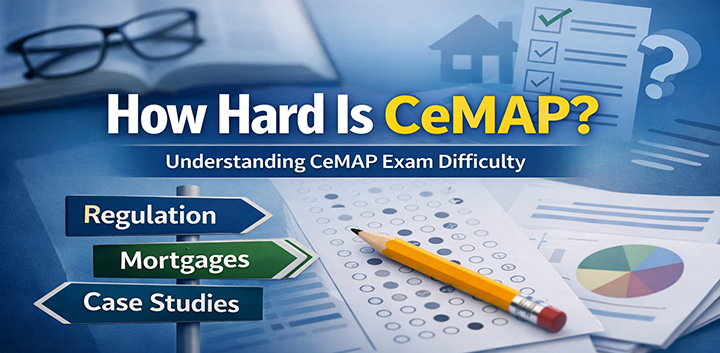
How hard is CeMAP exam graphic showing regulation, mortgages and case studies modules

Many learners ask a simple question before they begin: how hard is CeMAP?

Many learners ask a simple question before they begin: how hard is CeMAP?

The honest answer is that the CeMAP exams are academically manageable for most people, but they require structured preparation and consistent study. They are not designed to catch people out, yet they do test detailed knowledge, regulation, ethics, and the ability to apply what you have learned. For some, the exams feel straightforward. For others, they feel demanding. The difference usually comes down to preparation, familiarity with financial concepts, and confidence with multiple-choice exams.

CeMAP is the industry standard qualification for mortgage advisers in the UK. It is awarded by the London Institute of Banking & Finance and meets the Financial Conduct Authority’s education requirements for giving mortgage advice. Because it leads to a regulated profession, the exams must test knowledge and ethical understanding properly. That is why they feel serious.

This article explains why difficulty is subjective, how the modules differ under the current syllabus, and why preparation matters more than natural ability.

How hard is CeMAP exam graphic showing regulation, mortgages and case studies modules

Why Does CeMAP Feel Hard for Some People?

CeMAP often feels hard because it combines new terminology, regulation, ethics, and exam pressure.

For learners who have never worked in financial services, terms relating to regulatory frameworks, conduct rules, and ethical responsibilities can feel unfamiliar. Even core mortgage concepts such as loan-to-value ratios or different repayment structures may be new. That initial learning curve can create the impression that the qualification is harder than it actually is.

Does Previous Experience Make a Difference?

Yes, but not always in the way people expect.

Someone with experience in banking or estate agency may recognise certain mortgage concepts. That familiarity can reduce learning time in CeMAP 2. However, regulatory and ethical content in CeMAP 1 still needs to be learned carefully, regardless of background.

Learners from unrelated careers often succeed because they approach the material methodically. CeMAP does not require advanced mathematics or essay writing. It requires understanding and careful recall.

Is It an Academic Exam?

CeMAP is knowledge-based rather than essay-based. You are tested through multiple-choice questions and, in the final module, case-study style assessment. You are not required to write long answers. Instead, you must recognise the correct response from several options.

For many people, this format feels manageable. For others, multiple-choice exams create uncertainty because more than one answer can appear reasonable. That is where careful reading becomes essential.

What Makes One Module Feel Harder Than Another?

CeMAP is structured in three modules. Each feels challenging for different reasons.

The modules are designed to build on each other. They do not test identical skills, so difficulty can feel different at each stage.

Under the updated 2025/26 syllabus, the modules are:

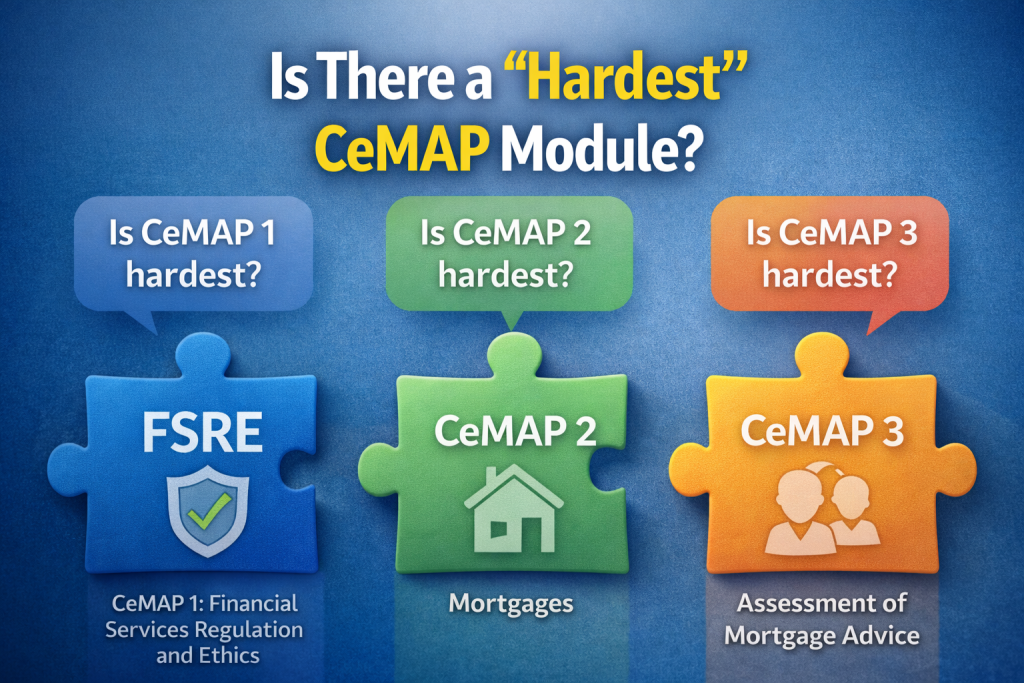
  • CeMAP 1: Financial Services Regulation and Ethics (FSRE)

  • CeMAP 2: Mortgages

  • CeMAP 3: Assessment of Mortgage Advice

The content focus has shifted slightly in CeMAP 1, and that affects how learners experience the difficulty.

CeMAP 1: Financial Services Regulation and Ethics (FSRE)

CeMAP 1 focuses on financial services regulation and ethical standards.

It covers the UK regulatory framework, the role of the Financial Conduct Authority, principles of conduct, consumer protection, and ethical responsibilities within financial services. Mortgage knowledge is still included, but the emphasis is on regulation and professional standards.

Many learners find this module challenging because of the volume of detailed definitions and the precision required in understanding regulatory language. The difficulty lies in accuracy rather than complexity.

For those new to financial services, this can feel abstract at first. Once the structure of regulation and ethical principles becomes clear, it tends to feel more logical.

CeMAP 2: Mortgages

CeMAP 2 concentrates on mortgage products and how they operate in practice.

This includes repayment methods, interest types, property considerations, underwriting factors, and different lending scenarios. The subject matter is more product-focused and practical.

Learners who prefer tangible examples sometimes find this module easier because they can visualise how mortgages work. Others find it demanding because of the range of product knowledge required.

The challenge is applying knowledge accurately rather than memorising rules alone.

CeMAP 3: Assessment of Mortgage Advice

CeMAP 3 assesses your ability to apply knowledge in realistic client situations.

It uses case-study style questions to test whether you can identify suitable advice within regulatory and ethical boundaries. It draws directly from content covered in both CeMAP 1 and CeMAP 2.

Some learners find this the hardest module because it requires judgement and careful interpretation of client information. Others find it more intuitive because it mirrors real mortgage advice scenarios.

The perception depends on whether you feel more comfortable recalling structured rules or applying them in context.

Is There a “Hardest” CeMAP Module?

There is no single hardest CeMAP module for everyone.

Some learners say CeMAP 1 feels hardest because of the regulatory and ethical detail. Others say CeMAP 3 feels hardest because of the case-study format. The perception usually reflects personal strengths and learning style.

If you prefer structured theory and definitions, CeMAP 1 may feel manageable.

If you prefer product knowledge, CeMAP 2 may feel more straightforward.

If you prefer applied scenarios, CeMAP 3 may feel more natural.

The qualification is designed to test competence across regulation, ethics, product knowledge, and advice skills. It is not structured so that one module is deliberately more difficult than another.

Is there a hardest CeMAP module graphic showing CeMAP 1 FSRE, CeMAP 2 Mortgages and CeMAP 3 Assessment of Mortgage Advice

How Hard Is CeMAP Compared to Other Qualifications?

CeMAP sits at Level 3 on the Regulated Qualifications Framework. This is broadly comparable to A-level standard in terms of academic level.

Most learners taking CeMAP are adults balancing work and other commitments. Time management and consistent study usually matter more than academic background.

CeMAP does not require advanced mathematics. Calculations are limited and practical. The main requirement is understanding regulation, ethics, and mortgage structures clearly.

Does the Pass Mark Mean It Is Difficult?

The pass mark reflects the standard required to meet regulatory expectations, not an attempt to make the exam difficult.

Because mortgage advice is a regulated activity, the Financial Conduct Authority expects advisers to demonstrate knowledge and ethical awareness before giving advice to clients. The exams are structured to confirm that standard.

They are not designed to reduce pass numbers. They are designed to confirm competence.

What Actually Makes CeMAP Manageable?

Preparation makes CeMAP manageable.

Most learners who initially feel that CeMAP is hard change their view once they understand the structure and style of questioning.

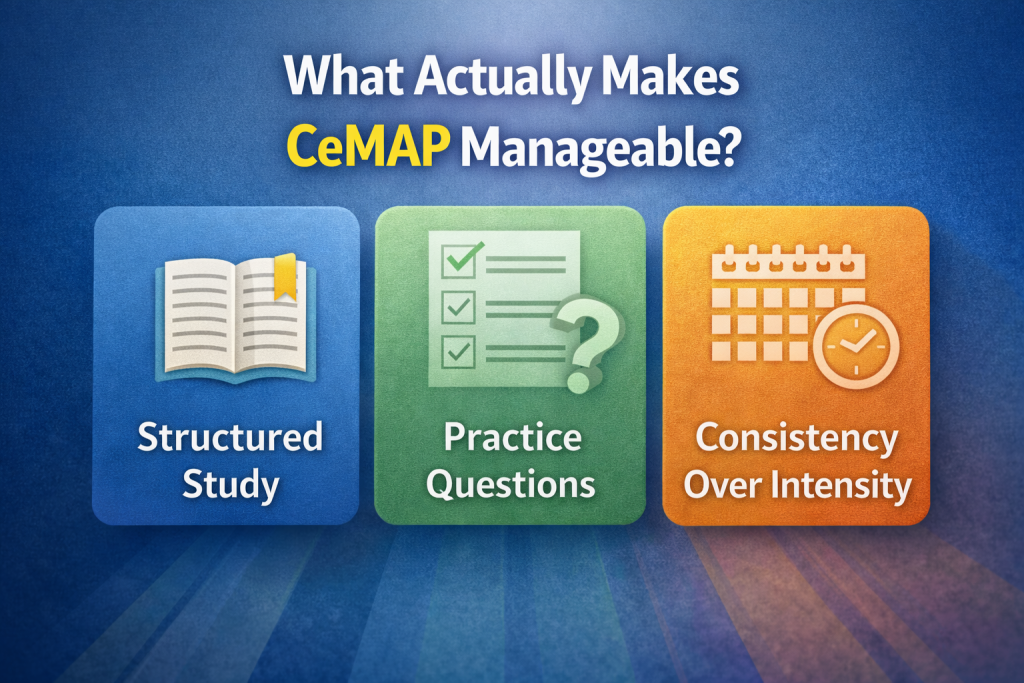
Structured Study

Breaking the syllabus into manageable sections prevents overwhelm. CeMAP content can appear large when viewed as a whole. Studied in stages, it becomes clearer.

Practice Questions

Becoming comfortable with multiple-choice questions changes how difficult the exam feels. Practice helps you recognise how questions are framed and how distractor answers are constructed.

Consistency Over Intensity

Short, regular study sessions are often more effective than occasional long sessions. The knowledge builds logically across the three modules.

What makes CeMAP manageable illustration showing structured study, practice questions and consistent revision

Does Intelligence Determine Success in CeMAP?

CeMAP does not require exceptional academic ability.

Success is usually linked to preparation, organisation, and attention to detail. Learners from a wide range of educational backgrounds complete the qualification each year.

The exams test understanding of regulation, ethics, and mortgage practice. Being methodical often matters more than being naturally academic.

Why Do Some Learners Feel Overwhelmed at the Start?

CeMAP introduces a regulated and ethically structured environment with precise terminology. That can feel unfamiliar.

Regulation and ethics require careful wording. Small differences in phrasing can change meaning. This can create early frustration, particularly in CeMAP 1.

Once learners adjust to that precision, confidence usually improves. What feels complex at first often becomes routine with repetition.

Is Exam Anxiety Making CeMAP Feel Harder?

In many cases, yes.

Anxiety can amplify perceived difficulty. Learners may know the content but doubt themselves during the exam. Multiple-choice formats can increase second-guessing.

Clear preparation and familiarity with the structure reduce this effect.

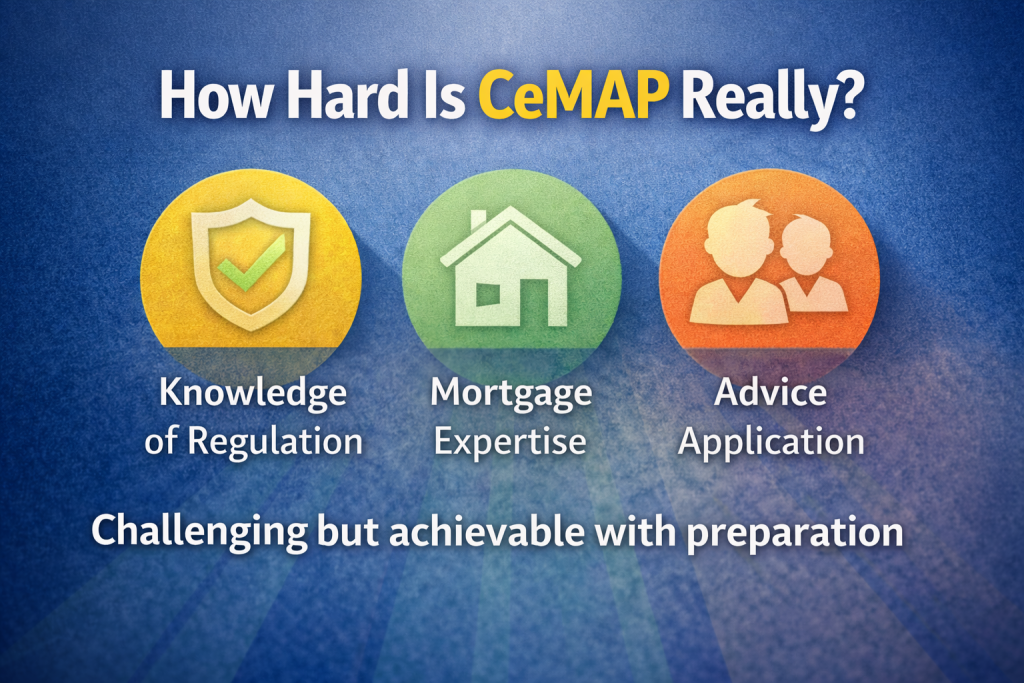
How Hard Is CeMAP Really?

CeMAP is challenging but achievable.

It is not designed to trick learners, nor is it effortless. It requires understanding financial services regulation, ethical standards, mortgage products, and the application of advice principles at a professional level.

Which module feels hardest depends on individual strengths. For most learners, CeMAP feels hardest at the beginning, when everything is new. As knowledge builds, confidence usually increases.

The key factor is not natural intelligence or prior background. It is preparation, consistency, and engagement with the material.

With realistic expectations and structured study, the CeMAP exams are demanding but manageable.

How hard is CeMAP really graphic showing regulation knowledge, mortgage expertise and advice application

Looking for training support?

We offer CeMAP training for learners working towards a career in mortgage advice. Our courses follow the London Institute of Banking & Finance syllabus and are designed to support understanding of mortgage regulation and advice requirements.

Explore our accredited CeMAP training courses

> Futuretrend Financial Training 

Choosing a CeMAP training provider: what matters and what doesn’t

Choosing a CeMAP training provider checklist showing accreditation, course quality, study support and access length

Choosing a CeMAP training provider can feel harder than it should. Many courses appear similar at first glance, and comparison often focuses on price or speed rather than substance. Yet the quality and structure of your training can have a real impact on how well you understand the syllabus and how confident you feel going into the exams.

This guide explains how to choose a CeMAP training provider sensibly. It focuses on what genuinely matters, what matters less than people think, and how to spot clear, credible training without being misled by vague or unofficial claims.

Choosing a CeMAP training provider checklist showing accreditation, course quality, study support and access length

How do I choose a CeMAP provider?

The best way to choose a CeMAP provider is to understand exactly what you are buying, how the training is recognised, and whether the support offered matches how you learn. A good provider will be transparent, properly accredited where relevant, and clear about what learners receive.

CeMAP is awarded by the London Institute of Banking & Finance. Training providers are separate organisations that support learners in studying for the qualification. Not all training providers are recognised by the awarding body, and wording around this can sometimes be unclear. Knowing what to check helps you make a confident decision.

What are you actually buying with CeMAP training?

CeMAP training is not the qualification itself. The qualification is awarded by the London Institute of Banking & Finance once you pass the required exams. A training provider supplies learning materials, structure, and support to help you prepare.

When choosing a provider, look for clear explanations of:

  • What learning materials are included
  • How the syllabus is broken down
  • What study support is available
  • How long you have access to the training

Some courses rely heavily on reading text on a screen, while others include a mix of learning formats such as explanations, examples, practice questions, and revision support. There is no single “right” format, but it should suit how you learn and be clearly explained upfront.

A reliable provider will not make you guess what you are getting. There should be no hidden limitations, unclear access periods, or vague promises of support.

CeMAP training study materials showing what learners receive, including learning resources, study support and access period

Why transparency matters in CeMAP training

Transparency is one of the strongest indicators of quality. You should be able to see, before enrolling:

  • What resources are included
  • Whether tutor or learning support is available
  • How study is expected to be paced
  • How long access lasts

Access length is often overlooked. Some providers offer reduced access periods, such as six months, while others provide longer access for the same level of study. Shorter access is not automatically a problem, but it should be clearly stated so learners can judge whether it fits their circumstances.

If details are hard to find or only explained after purchase, that is worth treating with caution.

Understanding accreditation and recognition

One of the most misunderstood areas of CeMAP training is accreditation.

CeMAP is awarded by the London Institute of Banking & Finance. Training providers are independent of the awarding body. However, a small number of providers are formally recognised as Accredited CeMAP Learning Support Providers by the LIBF

This accreditation means that the learning support offered has been reviewed and recognised as appropriate additional learning resources for students studying CeMAP. It does not mean the provider awards the qualification, and it does not guarantee exam success or career outcomes.

Accreditation is about the quality and suitability of the learning support itself.

CeMAP training accreditation and recognition explained, showing the difference between the awarding body and training providers

Why transparency matters in CeMAP training

Some training providers use phrases that sound official but do not indicate recognition by the awarding body. Terms such as “CeMAP qualified training” or “CeMAP approved course” can sound reassuring, but they do not automatically mean the provider is recognised by the LIBF.

Offering CeMAP training does not mean a provider is approved or accredited by the awarding body. Only providers formally recognised as Accredited CeMAP Learning Support Providers can describe themselves using that specific wording and use the official accreditation logo.

Clear wording protects learners. A credible provider should be precise and consistent in how they describe their status.

How to check if a provider is LIBF accredited

Learners do not need to rely on marketing claims alone. The London Institute of Banking & Finance publishes an official list of Accredited Learning Support Providers. This allows you to independently verify whether a provider is recognised.

When checking accreditation:

  • Look for the exact phrase “Accredited CeMAP Learning Support Provider”
  • Check whether the official LIBF accreditation logo is used correctly
  • Confirm the provider appears on the official LIBF accredited provider list

If a provider claims recognition but cannot be verified independently, it is reasonable to ask for clarification before enrolling.

What quality indicators really matter

Beyond accreditation, several practical indicators can help you assess training quality.

Clear structure
Good training breaks the syllabus into manageable sections and explains how learners should progress. You should not be left wondering where to start or how topics connect.

Support clarity
Support should be clearly defined. Whether this is tutor access, guidance, or structured feedback, learners should know what help is available and how to use it.

Learning suitability
Different learners need different approaches. Quality providers explain how their training works so learners can judge whether it suits their learning style.

Consistency of information
Details about access length, materials, and support should be consistent across the website and enrolment information.

Key quality indicators to look for when choosing a CeMAP training provider

What matters less than you might think

Some comparison points are often overemphasised. Price alone Being cheap or expensive does not indicate quality or accreditation. Price should be considered alongside what is included, how long access lasts, and what support is provided. Marketing language Bold claims, speed-focused promises, or vague assurances are not a substitute for clear explanations. Visual polish A modern platform can be helpful, but presentation does not equal educational quality. Substance matters more than appearance.

What matters less than you might think

Some comparison points are often overemphasised

Price alone
Being cheap or expensive does not indicate quality or accreditation. Price should be considered alongside what is included, how long access lasts, and what support is provided.

Marketing language
Bold claims, speed-focused promises, or vague assurances are not a substitute for clear explanations.

Visual polish
A modern platform can be helpful, but presentation does not equal educational quality. Substance matters more than appearance.

Questions learners should ask providers

A good provider should be comfortable answering direct questions. Useful questions include:

  • What exactly is included in the training package?
  • How long will I have access to the learning materials?
  • What support is available if I struggle with a topic?
  • How is the CeMAP syllabus structured within the course?
  • Can you explain how your training supports exam preparation?


You should also ask:

  • Can you show me where the LIBF recognises you as an Accredited CeMAP Learning Support Provider?


Clear answers to these questions signal openness and confidence in the training offered.

Checklist of questions learners should ask CeMAP training providers before choosing a course

Things learners should verify themselves

Alongside asking questions, learners can check:

  • Whether the provider appears on the official LIBF accredited provider list
  • Whether accreditation wording is precise and consistent
  • Whether access periods and support terms are clearly stated

Independent verification helps avoid confusion and ensures you know exactly what you are buying.

Keeping expectations realistic

CeMAP training supports learning, but it does not replace personal study effort. Accreditation and quality resources help learners prepare, but they do not guarantee exam results or employment outcomes.

Clear providers set realistic expectations and focus on supporting understanding rather than making promises.

Making a confident choice

Choosing a CeMAP training provider is about clarity, credibility, and suitability. Look for transparent information, precise wording around accreditation, and training that matches how you learn. Avoid being swayed by vague claims or price alone.

A well-chosen provider should make the learning process clearer, not more confusing.

Looking for training support?

We offer CeMAP training for learners working towards a career in mortgage advice. Our courses follow the London Institute of Banking & Finance syllabus and are designed to support understanding of mortgage regulation and advice requirements.

Explore our accredited CeMAP training courses

> Futuretrend Financial Training 

What is CeMAP and why it is required to give mortgage advice

CeMAP mortgage qualification concept showing a house model, certificate, calculator and keys

If you are thinking about becoming a mortgage adviser in the UK, you will quickly come across the term CeMAP. It is not optional, and it is not a company preference. CeMAP exists because mortgage advice is regulated, and advisers must meet a recognised education standard before they can give advice to the public.

This article explains, in simple terms, what CeMAP is, why it exists, who needs it, and what it does and does not allow you to do.

The content follows established UK CeMAP education and quality standards to ensure accuracy and clarity for learners.

CeMAP mortgage qualification concept showing a house model, certificate, calculator and keys

What is CeMAP?

CeMAP is the industry-standard qualification for mortgage advisers in the UK.

CeMAP stands for Certificate in Mortgage Advice and Practice. It is awarded by the London Institute of Banking & Finance (LIBF) and is designed to meet the Financial Conduct Authority’s education requirements for mortgage advice.

In simple terms, CeMAP proves that someone understands how mortgages work, how mortgage regulation operates, and how to give suitable advice to clients.

CeMAP is made up of three units that cover:

  • The UK financial services environment and regulation
  • Mortgage law, products, and repayment methods
  • Assessing clients and providing appropriate mortgage advice

A clear definition of CeMAP

CeMAP is a UK mortgage qualification awarded by the London Institute of Banking & Finance that meets the FCA’s educational requirements for giving regulated mortgage advice.

This definition is important because CeMAP is about education. It does not authorise someone to trade, and it does not make them regulated on its own.

Why is CeMAP required for mortgage advice?

Mortgage advice is regulated because it involves large financial commitments and long-term risk for consumers.

Most people borrow significant amounts of money when taking out a mortgage. Poor advice can lead to financial hardship, repossession, or unsuitable long-term commitments. For this reason, mortgage advice in the UK is regulated by the Financial Conduct Authority (FCA).

The FCA does not allow individuals to give mortgage advice unless they meet specific standards. One of those standards is holding an appropriate qualification. CeMAP is the most widely recognised qualification that meets this requirement.

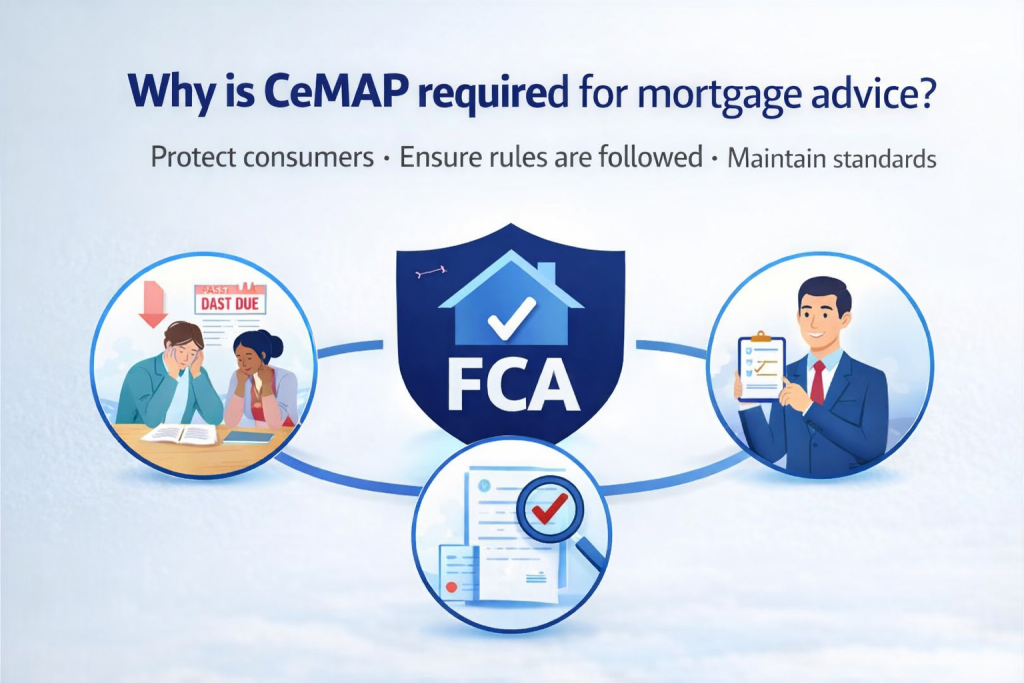
Illustration showing FCA regulation and why CeMAP is required for mortgage advice

The role of regulation

Regulation exists to:

  • Protect consumers from poor or misleading advice
  • Ensure advisers understand the rules they must follow
  • Create consistent professional standards across the industry

CeMAP supports this by ensuring advisers have a baseline level of technical knowledge and regulatory understanding before they advise clients.

Do you need CeMAP to be a mortgage adviser?

Yes, you need CeMAP, or an equivalent qualification, to give mortgage advice in the UK.

If your role involves recommending mortgage products to clients, you must hold a qualification that meets FCA education standards. CeMAP is the most common qualification used for this purpose.

Without CeMAP (or an accepted equivalent), you cannot legally give regulated mortgage advice, even if you work for an authorised firm.

This applies whether you are:

  • Employed by a mortgage brokerage
  • Self-employed
  • Working under supervision

Training alone is not enough. The qualification itself is required.

Who must hold CeMAP and who does not?

Not everyone working in a mortgage business needs CeMAP. The requirement depends on what you actually do.

Roles that must hold CeMAP

You will need CeMAP if you:

  • Give mortgage advice to clients
  • Recommend specific mortgage products
  • Assess client suitability and affordability as part of advice

These roles are classed as regulated mortgage advice activities.

Roles that do not require CeMAP

You may not need CeMAP if you:

  • Carry out purely administrative work
  • Collect information without giving advice
  • Work in marketing or customer service
  • Act as an introducer without recommending products

However, many people in non-advisory roles still choose to study CeMAP because it supports career progression and deeper understanding of the industry.

What does CeMAP qualify you to do?

CeMAP qualifies you, from an education perspective, to give mortgage advice once you are working for an authorised firm.

Specifically, CeMAP:

  • Meets the FCA’s education requirements for mortgage advisers
  • Demonstrates technical and regulatory knowledge
  • Allows a firm to consider you for an adviser role


Once you hold CeMAP and are authorised by a firm, you can:

  • Advise clients on suitable mortgage products
  • Make regulated mortgage recommendations
  • Work towards full competent adviser status under supervision


CeMAP is often described as the starting point for a mortgage advice career, not the end point.

Illustration showing what CeMAP qualifies a mortgage adviser to do under firm supervision

What does CeMAP not allow you to do?

CeMAP does not authorise you to trade or operate independently.

This is a common area of confusion, so it is important to be clear.

CeMAP does not:

  • Make you FCA authorised
  • Allow you to give advice on your own
  • Replace firm authorisation
  • Remove the need for supervision and competence sign-off

Even with CeMAP, you must work for, or be appointed by, a firm that is authorised by the FCA. The firm is responsible for oversight, compliance, and permissions.

CeMAP is an education requirement. FCA authorisation is a business and regulatory requirement. They are related, but they are not the same thing.

How CeMAP fits into the wider qualification structure

CeMAP is structured as three units, commonly referred to as CeMAP 1, CeMAP 2, and CeMAP 3.

Together, these units build from:

  • Understanding regulation and the financial services environment
  • Learning how mortgages work in practice
  • Applying knowledge to real client scenarios

Many learners study CeMAP in stages, often alongside entry-level roles in mortgage firms. After completing CeMAP, advisers usually move on to supervised practice and, later, more advanced qualifications depending on their career path.

Key points to remember

CeMAP is required because mortgage advice is regulated and consumers need protection.


It is:

  • An FCA-recognised education standard
  • Awarded by the London Institute of Banking & Finance
  • Essential for anyone giving mortgage advice


It is not:

  • FCA authorisation
  • Permission to advise independently
  • A guarantee of employment or success


Understanding this distinction early helps avoid confusion and sets realistic expectations for anyone considering a career in mortgage advice.

Looking for training support?

We offer CeMAP training for learners working towards a career in mortgage advice. Our courses follow the London Institute of Banking & Finance syllabus and are designed to support understanding of mortgage regulation and advice requirements.

Explore our accredited CeMAP training courses

> Futuretrend Financial Training 

CPD Demystified: Why Continuing Professional Development Matters for Mortgage Advisers

cpd-for-mortgage-advisers

Continuing Professional Development (CPD) is often viewed by new mortgage advisers as a box-ticking chore mandated by regulators. In reality, CPD is a powerful tool that keeps your knowledge fresh, your skills sharp, and your career trajectory on the rise.

Whether you’re striving to meet the FCA’s requirements, deepen your understanding of complex mortgage products, or simply impress clients with up-to-date expertise, a robust CPD strategy is indispensable. In this article, we’ll unpack what CPD really entails, why it matters beyond compliance, and practical steps to make it work for you.

cpd-for-mortgage-advisers

What Is CPD in the Context of Mortgage Advice?

CPD, at its core, represents the ongoing learning and development activities that professionals undertake to maintain and enhance their skills. For mortgage advisers, CPD is formalised by both the Financial Conduct Authority (FCA) and the London Institute of Banking & Finance (LIBF). The FCA’s Senior Managers & Certification Regime (SM&CR) and the Mortgage Conduct of Business (MCOB) handbook emphasise that advisers must stay competent. Meanwhile, the LIBF requires CeMAP-qualified advisers to complete a set number of CPD hours each year to retain accreditation. Understanding these frameworks ensures you’re not only compliant but also delivering the highest standard of service.

FCA Expectations for CPD

The FCA views CPD as a critical component of its broader “Treating Customers Fairly” initiative. Under SYSC (Senior Management Arrangements, Systems and Controls) rules, firms must ensure their employees are competent for their roles. This means advisers need up-to-date knowledge of regulatory changes, market developments, and ethical best practices. The FCA doesn’t prescribe exact topics, but it does expect that CPD activities are relevant, structured, and reflective. Keeping a detailed CPD log is not merely administrative—it demonstrates to both your firm and potential clients that you’re committed to excellence.

FCA Mortgage Reforms Explained for Mortgage Advisers

LIBF Requirements for CeMAP Holders

For those who have completed their CeMAP qualification through an LIBF-accredited provider, ongoing CPD is non-negotiable. The LIBF mandates a minimum of 35 hours of CPD each year, with 5 hours dedicated specifically to ethics and regulation. Activities can range from attending industry webinars and conferences to completing short online courses or even writing professional articles. Crucially, LIBF-issued CPD records are audited annually, so maintaining accurate records of your activities and reflections is vital to avoid any compliance complaints or accreditation lapses.

LIBF

Why CPD Isn’t Just a Box-Ticking Exercise

Viewing CPD as a mere compliance requirement is a missed opportunity. Each CPD activity you undertake can directly enhance your client interactions, broaden your product knowledge, and fortify your professional confidence. Imagine tackling a complex self-employed mortgage case with insights gained from a specialised lender webinar—suddenly, you’re not just compliant, you’re delivering premium service. Moreover, demonstrating a commitment to ongoing learning can set you apart in a crowded market, giving you a compelling talking point in client meetings and job interviews alike.

How to Track and Manage Your CPD

Effective CPD management starts with a simple yet consistent process. First, set clear learning objectives—whether it’s mastering the latest Buy-to-Let criteria or understanding Help-to-Buy updates. Next, choose a logging method: many advisers use spreadsheet templates, CPD-tracking apps, or even built-in modules from their training provider. After each activity, record the date, duration, learning outcomes, and personal reflections. Regular reviews—quarterly or bi-annual—help you spot gaps early and plan future CPD. Remember, a well-organised CPD log not only satisfies regulators but also offers a roadmap of your professional growth.

Best Free and Paid CPD Resources

There is an abundance of quality CPD resources, but knowing where to look can save you time and ensure relevance:

  • Free Options: Many lenders and industry bodies offer no-cost webinars on product changes and regulatory updates. The FCA website itself runs periodic workshops.
  • Accredited Providers: Futuretrend’s CPD Blogs and Podcasts cover niche topics—from green mortgages to digital compliance—packaged in short articles. LIBF-approved online courses are also available through platforms like LIBF Learn.
  • Professional Journals & Podcasts: Subscribing to publications such as Mortgage Strategy or listening to specialist podcasts can count towards your reflection hours.

Each resource type brings unique benefits—mix and match to keep your learning diverse and engaging.

Conclusion & Next Steps

CPD is far more than a regulatory hurdle; it’s the engine that drives your professional excellence and credibility. By understanding the expectations set by the FCA and LIBF, embracing a structured tracking system, and choosing the right mix of resources, you’ll not only stay compliant but also continuously elevate your advisory skills. Make CPD a strategic priority, and watch your confidence—and career prospects—soar.

Elevate Your Expertise with Futuretrend

Ready to take your CPD to the next level?

Explore more of our blogs and podcasts, designed to keep you ahead of industry changes and deliver exceptional client outcomes.

Images Designed by Freepik (www.freepik.com) and AI

Staying Focused on Your CeMAP Syllabus Amid Government Changes

Staying Focused on Your CeMAP Syllabus Amid Government Changes

Hello CeMAP learners,

I hope you’re all keeping well and staying focused on your studies. With all the chatter around the new 2025/26 tax year, the spring statement, and ongoing updates from the government, it’s easy to get side tracked by headlines and real-life changes.

However, I want to share some reassuring news: for now, all your exam preparation should be based solely on the current 2024/25 syllabus and the tax tables provided at the start of your course.

What’s Happening in the Real World?

Every spring, we see new government statements and updates that affect the wider world—be it changes to tax rates, adjustments in National Insurance contributions, or tweaks to various financial regulations. These changes are important for everyday financial life and can even impact how you advise future clients. However, it’s crucial to remember that the content of your CeMAP exams is firmly anchored in the LIBF syllabus provided when you began your studies.

Your Exams Are Based on the Current Syllabus

The LIBF has made it very clear with their official statement:

“We are aware that some of the government’s changes announced in the Spring Statement may impact on the study text and assessment materials. However, please answer questions using information from the current study materials provided.”

This means that any changes you hear about in the news will not affect the content of your exams until the syllabus is updated for the new academic year—typically around late August or early September.

Any question in your exam that relates to tax or other financial changes will specifically include the necessary information from the current 2024/25 tax table. This is designed to ensure fairness and clarity for all learners.

LIBF

Why This Matters for Your Studies

As someone who has taught CeMAP for over 10 years, I’ve seen first hand how students can become anxious when real-life changes seem to contradict what they are studying. It’s important to focus on the materials provided, as they are the foundation for your exam preparation. Here’s why sticking to the current syllabus is a smart move:

  • Consistency: The exam content won’t change mid-course. All questions will be framed with the data and rules from the 2024/25 tax year, ensuring that everyone is tested on the same material.

  • Clarity: Any necessary figures or rates that are subject to change will be provided in the exam questions themselves. This means you don’t have to worry about memorising real-time updates.

  • Reduced Stress: Focusing solely on your current study materials can help keep your mind clear and reduce the stress that often comes with trying to keep up with constant external changes.

How to Stay Focused

Here are some practical tips to help you stay focused on your CeMAP studies during this time of change:

  1. Stick to Your Study Plan: Trust the syllabus and study materials you were given. These resources are meticulously designed to prepare you for the exam.

  2. Ignore the Noise: While it’s good to be aware of changes in the financial world, don’t let them distract you. Save the in-depth discussion of real-life updates for later, once you have passed your exams.

  3. Use Official Resources: If you have any doubts about what you should be studying, always refer back to the official LIBF materials. They provide the most accurate and up-to-date guidance for your exam preparation.

  4. Join Study Groups: Discussing these points with fellow CeMAP candidates can be very reassuring. It helps reinforce that you are all on the same page—studying the same syllabus with the same content.

Looking Ahead

While the current syllabus remains unchanged, it’s good to be aware that LIBF and official training providers will update the study materials for the 2025/26 academic year around August. If you plan to take your exams after these changes come into effect, you will receive updated resources that reflect any new government regulations or tax tables.

For now, if you’re preparing for exams with the 2024/25 syllabus, your focus should remain on mastering the content as it is. Any questions on the exam that might seem to refer to changes will include the specific figures and guidelines from the current tax table, ensuring that you’re not caught off guard by any external changes.

CeMAP Study Resources

Final Thoughts

I know it can be tempting to try and keep up with every bit of news about government budgets and tax updates. However, the key to success in your CeMAP journey is to trust your study materials and the syllabus provided. The official stance from LIBF is clear: your exam content is based on the current syllabus, regardless of what’s happening in the wider financial world.

Stay focused, keep revising the content in your study materials, and remember that any real-life changes will only affect your studies once a new syllabus is released. If you have any questions or need further clarification, don’t hesitate to reach out to your training provider or fellow learners.

Happy studying, and best of luck with your exams!

Your Complete Guide to the LIBF CeMAP Exams: Structure, Duration, and How to Prepare

LIBF CeMAP Exams

If you’re planning to become a mortgage adviser in the UK, the LIBF Certificate in Mortgage Advice and Practice (CeMAP) is your key to unlocking this career path. This qualification is highly respected and FCA-recognised, giving you the knowledge and credibility to offer expert mortgage advice. In this blog, we’ll break down everything you need to know about the CeMAP exams — from the structure and duration to the different ways you can take the test and the security measures in place.

Understanding the CeMAP Qualification

The CeMAP qualification consists of three modules, each designed to test different aspects of your mortgage advice knowledge:

  • CeMAP 1: UK Financial Regulation (UKFR)

  • CeMAP 2: Mortgages

  • CeMAP 3: Assessment of Mortgage Advice Knowledge (ASSM)

Let’s dive into each module individually so you know what to expect.

LIBF CeMAP Exams

Module Breakdown

CeMAP 1: UK Financial Regulation (UKFR)

This module covers the financial services environment and the regulation of mortgage advice. If you’ve been wondering how long is CeMAP 1 exam, here’s the breakdown:

  • Exam Structure: Two units (Unit 1 and Unit 2)

  • Number of Questions: 100 multiple-choice CeMAP 1 questions (50 per unit)

  • Duration: 2 hours (1 hour per unit)

  • Pass Mark: 70%

  • Key Topics:
    • Financial services and products
    • Regulatory bodies (like FCA)
    • Key legislation and compliance requirements

CeMAP 2: Mortgages

This module dives into the intricacies of mortgage products and the application process. Many candidates search for CeMAP 2 questions to practice, as the content can be quite detailed.

Although exam is still 100 questions and 2 hours in length as in CeMAP 1, the question numbers and duration for each unit differs between units

  • Exam Structure: Four units (Unit 3 to Unit 6)

  • Number of Questions and duration:

    • Units 3 & 4: Each unit comprises 25 standalone multiple-choice questions.
      Students need to achieve at least 17/25 to pass each unit.
      Time allocation for these unit is 30 minutes each.

    • Unit 5: This unit comprises of 20 standalone multiple-choice questions.
      Students need to achieve at least 14/20 to pass this unit.
      Time allocation for this unit is 24 minutes.

    • Unit 6: This unit comprises of 30 standalone multiple-choice questions.
      Students need to achieve at least 21/30 to pass this unit.
      Time allocation for this unit is 36 minutes.

  • Pass Mark: 70%

  • Key Topics:
    • Types of mortgage products
    • Mortgage law and practice
    • Property purchase process
    • Mortgage payment methods and protection policies

CeMAP 3: Assessment of Mortgage Advice Knowledge (ASSM)

This module tests your ability to apply knowledge in real-world scenarios. When people ask how many CeMAP exams are there, this third module completes the qualification.

  • Exam Structure: One unit

  • Number of Questions: 6 case studies with 10 multiple-choice questions each (60 questions total)

  • Duration: 2 hours

  • Pass Mark: 70%

  • Key Topics:
    • Client assessment and recommendations
    • Suitability of mortgage products
    • Risk assessment

Exam Delivery Options

You can choose where to take CeMAP exams, with two main options:

Pearson VUE Test Centres

These centres provide a secure environment for your exams with in-person invigilation.

  • Booking: Flexible scheduling — how do I book my CeMAP exam? You can do it directly via Pearson VUE’s website.

  • Environment: Quiet, controlled setting

  • ID Checks: Photo ID required

  • Locations: All over UK and selected spots around Europe
Pearson VUE Exam Centre

Online Exams

If you prefer to take the exams from home, you can use Pearson VUE’s online proctoring system. This is a convenient option if you’re wondering where can I sit my CeMAP exam without traveling to a test centre.

  • Requirements:
    • A stable internet connection
    • A web camera and microphone
      Required to download specific exam software that will take control of computer during exam.
    • A quiet, private space (No interruptions)

  • Security Checks:
    • ID verification
    • 360-degree room scan
    • Continuous monitoring via webcam

Please Note: these rules are very strict, movement away from your monitor/web camera, someone entering our room while exam is live or talking to your self can and normally will result in your exam being shut down.

LIBF CeMAP Test Online

For those researching how to book a CeMAP exam, LIBF provides a straightforward process, whether you choose a test centre or the online option. Full guidelines on exams will be provided by your LIBF portal on registration.

Tips for Success

  • Time Management: Practice timed mock exams to get comfortable with the pace — crucial when tackling CeMAP questions under pressure.

  • Study Plan: Break your studies into manageable chunks, focusing on one module at a time.

  • Mock Tests: Familiarise yourself with the question format and identify areas for improvement.

  • Resources: Use LIBF materials, online courses, and study groups for comprehensive preparation.

By understanding the structure, duration, and delivery options for the CeMAP exams, you’ll be better equipped to succeed. Whether you choose to sit your exams in a Pearson VUE centre or online, careful preparation and an organised study approach will put you on the path to passing each module with confidence.

Images Designed by Freepik (www.freepik.com) and AI

Your Ultimate Guide to Getting CeMAP Qualified

Hard Copies of Made Easy Revision Guide and Official LIBF Specimen Papers

If you’re considering a career in mortgage advice or financial planning, becoming CeMAP qualified is a crucial step. This guide covers every aspect of the journey—from registering with the LIBF to selecting the right study options, whether that’s self-study or a tutor-led virtual classroom. We’ll discuss study resources, training providers, costings, and even tips on how to pass CeMAP 1 and CeMAP 2. If you’re wondering how to get CeMAP qualification or how long does CeMAP take, you’re in the right place.

Introduction to CeMAP and the LIBF

The Certificate in Mortgage Advice and Practice (CeMAP) is the industry standard for those pursuing a career in mortgage advice. Awarded by the London Institute of Banking & Finance (LIBF), the CeMAP qualification ensures that advisors meet the regulatory and ethical standards required in the UK.

Achieving your CeMAP qualification is a journey that requires discipline, commitment, and strategic planning. This article will explore in depth how to get CeMAP qualified by covering everything from initial registration to study techniques, exam preparation, and understanding the nuances of the qualification itself.

How to Build a Thriving Client Base as a New Mortgage Adviser

Starting Your CeMAP Studies

Before diving into the world of CeMAP, it’s important to get a clear understanding of what the qualification entails. You might be asking, how hard is CeMAP? The answer is that while the content is comprehensive, a structured approach makes it manageable.

Understanding the CeMAP Modules

CeMAP is divided into two primary modules:

  • CeMAP 1: Focuses on the principles and practice of mortgage advice. It covers topics such as the regulatory environment, ethical practices, and the basic structure of mortgage products.
  • CeMAP 2&3: Concentrates on applying the knowledge in practical scenarios. This includes understanding client needs, offering appropriate advice, and in-depth case studies.

Knowing the structure is key when planning your study schedule. As you begin, ask yourself, how do I study for CeMAP in a way that fits your learning style and schedule?

Setting Clear Study Goals

  1. Define Your Timeline: Map out a study schedule that allocates time for each module. Many candidates ask, how long does CeMAP take? It typically ranges from 3 to 6 months, depending on the study mode and individual pace.

  2. Determine Your Study Method: Evaluate if you prefer self-study or a more guided, tutor-led approach.

  3. Gather Resources: Ensure you have the right materials. This might include textbooks, online resources, practice questions, and mock exams.

Registering with the LIBF

Before you start your can take your exams, you must register with the London Institute of Banking & Finance (LIBF). The LIBF is the official body that oversees the CeMAP qualification process.

Steps to Register

  1. Visit the LIBF Website: Begin by reviewing the latest registration guidelines.

  2. Submit the Required Documents: Typically, you’ll need proof of identity.

  3. Pay the Registration Fee: The fee covers your entry into the exam and sometimes includes access to study materials.

  4. Confirmation: Once registered, you’ll receive a confirmation along with guidelines on your next steps.
LIBF

This process might seem daunting at first, but following the instructions carefully will ensure that you’re on track. Remember, the LIBF is there to support you through the entire qualification process.

Choosing Your Study Options

CeMAP Self-Study

Self-study is a flexible option that allows you to progress at your own pace. It is perfect for disciplined individuals who can set and adhere to a structured timetable.

Advantages of CeMAP Self-Study:

  • Flexibility: Study at your own pace and schedule your sessions around your work or personal commitments.
  • Cost-Effective: Generally, self-study options are less expensive than tutor-led courses. If you’re asking how much does CeMAP cost, self-study might be the most budget-friendly option.
  • Control Over Learning: You can focus on areas where you need the most improvement.
Hard Copies of Made Easy Revision Guide and Official LIBF Specimen Papers

Challenges:

  • Self-Discipline: Requires significant personal motivation.

  • Limited Interaction: You may miss out on peer discussion and expert clarification.

  • How to Study for CeMAP: Using a variety of study aids, such as revision guides and online forums, can help compensate for the lack of structured teaching.

CeMAP Tutor-Led

For those who prefer structured learning, a tutor-led training programme can provide a more guided approach. This method simulates a traditional classroom setting but with the convenience of studying from home.

Advantages of Tutor-Led CeMAP Classes:

  • Structured Environment: Regular sessions and set deadlines help keep you on track.

  • Expert Guidance: Tutors can provide clarity on complex topics and exam techniques.

  • Peer Interaction: Collaborating with fellow students can enhance your understanding of difficult concepts.

Challenges:

  • Higher Costs: Tutor-led courses generally cost more. When considering how much does a CeMAP course cost, factor in the additional fees for live instruction.

  • Fixed Schedule: Less flexibility in timing, which might be challenging if you have a busy work or personal schedule.

  • How Quickly Can I Pass CeMAP: While tutor-led classes may help you understand the material faster, the pace is determined by the course schedule.

Deciding between self-study and a tutor-led approach often depends on your personal learning style and time availability. Both methods have proven successful for countless candidates who have successfully passed CeMAP 1 and CeMAP 2 & 3.

LIBF Accredited Training Providers

When choosing a training provider, it is crucial to ensure they are LIBF Accredited Learning Support Provider. This accreditation ensures that the course meets the high standards set by the LIBF and will cover all necessary exam material.

Why Accreditation Matters

  1. Quality Assurance: Accredited providers have undergone rigorous checks to ensure they offer quality education.

  2. Recognised Certification: Completing a course with an accredited provider guarantees that the training meets industry requirements.

  3. Up-to-Date Curriculum: Accredited courses are frequently updated to reflect any changes in the regulatory landscape or exam format.
LIBF Accredited Learning Support Provider

Always verify the provider’s LIBF Accreditation Learning Support Provider status before enrolling. This step is vital for anyone asking, what is CeMAP training and ensures that you’re receiving an education that aligns with industry standards.

Types of Study Resources Available

A variety of study resources are available to help you prepare for the CeMAP exams. These resources can be broadly classified into printed materials, online resources, and practice exams.

Printed Materials

  • Textbooks and CeMAP Revision Guides: Most accredited providers offer comprehensive textbooks that cover both CeMAP modules.

  • Workbook Exercises: These help in reinforcing the concepts learned in each chapter.

  • Flashcards: Useful for memorising key definitions, regulatory terms, and mortgage product features.

Online Resources

  • E-Learning Platforms: Many providers offer interactive online courses that include video tutorials, quizzes, and discussion forums.

  • Webinars and Podcasts: These resources are excellent for keeping up-to-date with industry trends and deepening your understanding.

  • Downloadable PDFs and eBooks: They allow you to study on the go and provide flexibility in learning.

Practice Exams and Mock Tests

  • CeMAP Questions: Practicing past exam questions and sample tests is critical. These tests help you understand the exam pattern and the type of questions that might be asked.

  • Simulated Exams: Some providers offer full-length simulated exams to mimic the actual test environment.

  • Online Forums and Study Groups: Engaging with peers can provide insights into difficult topics and help clarify doubts.

Using a diverse range of study resources increases your chances of success and helps answer the frequent query, how to pass CeMAP.

Costing Your Training

Understanding the costs involved in getting CeMAP qualified is essential for planning your finances. The cost will vary depending on your chosen study method and provider.

Breakdown of Typical Costs

  1. Registration and exam Fees: A one-time fee payable to the LIBF.

  2. Study Materials: Books, revision guides, and online resource subscriptions.

  3. Training Provider Fees: Varies based on whether you choose self-study or tutor-led courses. For those wondering, how much does a CeMAP course cost, expect a range that fits most professional training budgets.

  4. Additional Costs: These might include costs for supplementary webinars, revision sessions, or mock exam registrations.

By comparing the different options available, you can determine which path suits your budget while still offering the quality preparation needed to answer questions such as how to get CeMAP qualified effectively.

Time Commitment: How Long Does It Take?

One of the most common questions among prospective candidates is, how long does CeMAP take to complete? The answer depends on your chosen study method, prior knowledge, and the time you can dedicate to studying.

Factors Influencing Study Duration

  • Study Mode: Self-study may offer more flexibility but could take longer if you lack discipline, whereas tutor-led classes provide a structured timeline.

  • Prior Experience: Candidates with previous experience in finance or mortgage advice might find certain topics easier to grasp.

  • Study Hours: Consistency is key. Dedicating a set number of hours each week can make a significant difference in your progress.

Typical Study Timelines

  • Self-Study: Generally, it takes around 4 to 6 months to complete the CeMAP qualification on a part time basis. This method allows you to progress at your own pace.

  • Tutor-Led Courses: These courses usually have a fixed duration, often 2 weeks of intensive study. This is ideal for those asking, how quickly can I pass CeMAP if they need to complete their qualification in a shorter time.

Planning your study schedule carefully and realistically will ensure that you can balance your other responsibilities while preparing effectively for the exams.

Common CeMAP Questions Answered

Throughout your preparation, you may have several questions. Here, we address some frequently asked queries:

How Hard is CeMAP?

While many candidates wonder, how hard is CeMAP, the answer largely depends on your commitment and prior experience. With a structured study plan, even challenging topics become manageable.

How Much Does CeMAP Cost?

As outlined in the costing section, the total expense varies. Typically, the overall cost includes registration fees, study materials, and any training provider fees. A clear budget can help you manage your finances effectively.

How Long Does the CeMAP Qualification Take?

For most candidates, how long does the CeMAP qualification take ranges between 3 to 6 months, depending on your study method and pace. This timeline answers questions like how long does it take to complete CeMAP and how long does a CeMAP course take.

What Is CeMAP Training?

When exploring what is CeMAP training, it is essentially the process of preparing for the CeMAP exams through accredited providers. Training can be tailored to individual learning styles, whether it’s self-study or a structured tutor-led environment.

Final Thoughts and Next Steps

Achieving your CeMAP qualification is a significant milestone in your professional journey. Whether you choose self-study or a tutor-led virtual classroom, the key to success is preparation, consistency, and utilising accredited resources.

Recap of Key Points:

  • Starting Your Studies: Set clear goals and gather the right study materials.
  • Registration with the LIBF: Ensure you follow the guidelines and complete the registration process accurately.
  • Study Options: Evaluate whether self-study or tutor-led classes work best for you.
  • Accredited Training: Always opt for LIB Accredited training providers to guarantee quality.
  • Resources and Costing: Use a mix of printed and online resources, and plan your finances based on the overall cost.
  • Time Management: Understand that how long does CeMAP take varies, but a realistic plan can help you succeed.
  • Exam Preparation: Focus on strategies to answer how to pass CeMAP 1 and how to pass CeMAP 2 & 3, and practice with past CeMAP questions.

As you progress, continually assess your preparation and adjust your study methods accordingly. With dedication and the right approach, you can confidently achieve your CeMAP qualification and advance your career in mortgage advice.

Images Designed by Freepik (www.freepik.com) and AI