
How the Mortgage Industry Is Evolving

Mortgage adviser using digital technology to support clients as the mortgage industry evolves through regulation and innovation

The mortgage industry is always changing, but not always in the dramatic ways headlines suggest. Rather than sudden shifts, most changes happen gradually as regulations develop, technology improves, and borrowers expect a different kind of service.

For anyone considering a career as a mortgage adviser, understanding these broad changes helps build realistic expectations. The core purpose of the profession remains the same: helping people find suitable mortgage solutions based on their circumstances. What evolves is how advisers deliver that advice, communicate with clients, and meet regulatory requirements.

If you’re wondering, “Is the mortgage industry changing?”, the answer is yes. The industry continues to adapt to new regulations, digital technology, and changing customer expectations, while maintaining its focus on delivering suitable, compliant mortgage advice.

Mortgage adviser using digital technology to support clients as the mortgage industry evolves through regulation and innovation

Why Is the Mortgage Industry Always Evolving?

The mortgage market sits at the intersection of housing, finance, regulation and consumer protection. Changes in any of these areas naturally influence how mortgage advice is delivered.

Unlike some industries that experience rapid disruption, mortgage advice evolves steadily. New technology is introduced, regulatory expectations are refined, and consumer behaviours shift over time.

For advisers, this means developing professionally throughout their careers rather than learning one fixed way of working.

The underlying principles remain consistent:

  • Understanding clients’ circumstances
  • Recommending suitable mortgage products
  • Explaining risks clearly
  • Maintaining professional standards
  • Following regulatory requirements

The methods used to achieve these goals continue to improve as the industry develops.

How Has Regulation Changed the Mortgage Advice Profession?

Regulation has become increasingly focused on ensuring good outcomes for consumers rather than simply checking whether processes have been followed.

Mortgage advisers work within rules set by the Financial Conduct Authority (FCA), which aims to protect consumers and promote confidence in financial services.

Rather than viewing regulation as an obstacle, many advisers see it as a framework that helps ensure advice remains consistent, transparent and in clients’ best interests.

In practical terms, this means advisers are expected to:

  • Gather detailed information about clients’ circumstances
  • Understand clients’ needs and objectives
  • Explain recommendations clearly
  • Keep appropriate records
  • Continue developing their professional knowledge

These responsibilities have become more structured over time, helping create greater consistency across the profession.

What Is Consumer Duty and Why Does It Matter?

One of the most significant recent developments has been the introduction of Consumer Duty by the Financial Conduct Authority (FCA).

Consumer Duty places greater emphasis on delivering good outcomes for customers throughout the entire advice process. Rather than concentrating solely on compliance checklists, firms are encouraged to consider whether clients genuinely understand the advice they receive and whether products continue to meet their needs.

For mortgage advisers, Consumer Duty reinforces practices that many already regard as good professional standards, including:

  • Using clear, understandable language
  • Ensuring recommendations are appropriate
  • Supporting informed decision-making
  • Identifying potential vulnerabilities where relevant
  • Providing suitable ongoing service where applicable

This reflects an increasing focus on the overall customer experience, not just the final mortgage recommendation.

How Is Technology Changing Mortgage Advice?

Technology has become an important tool within the mortgage industry, but it has not replaced professional advice.

Modern mortgage advisers often use digital systems to improve efficiency, reduce paperwork and manage client information securely. These tools help advisers spend more time discussing clients’ needs rather than completing administrative tasks.

Technology may assist with:

  • Researching available mortgage products
  • Comparing lending criteria
  • Collecting client information
  • Managing documentation
  • Secure communication
  • Appointment scheduling
  • Electronic identity verification

These developments make many parts of the process quicker and more convenient for both advisers and clients.

However, technology supports the advice process rather than replacing the professional judgement needed when assessing complex financial circumstances.

Mortgage adviser using digital technology and mortgage software to support clients through the mortgage advice process

Can Technology Replace Mortgage Advisers?

While technology continues to improve, mortgage advice remains a people-focused profession.

Online comparison tools and automated systems can provide useful information, but they cannot fully understand an individual’s personal circumstances, future plans or priorities in the way an experienced adviser can.

Many mortgage applications involve factors that require discussion and professional judgement, including:

  • Self-employed income
  • Changing employment
  • Complex financial situations
  • Credit history considerations
  • Protection needs
  • Long-term financial objectives

Technology helps advisers work more efficiently, but the conversations, explanations and recommendations remain central to the role.

How Are Clients' Expectations Changing?

Today’s borrowers often expect a different experience from previous generations.

Many clients are comfortable researching mortgages online before speaking to an adviser. They may arrive with questions, comparisons and a basic understanding of the market.

Rather than replacing advisers, this usually changes the nature of the conversation. Clients increasingly value advisers who can explain complex topics clearly, provide reassurance and help them understand the options available.

Modern clients also tend to expect:

  • Faster communication
  • Flexible appointment options
  • Digital document sharing
  • Clear explanations without jargon
  • Regular updates throughout the application process

Meeting these expectations helps build trust while making the mortgage journey less stressful.

Does Face-to-Face Advice Still Matter?

Yes. Although remote appointments have become much more common, face-to-face advice continues to play an important role for many clients.

Some borrowers prefer meeting in person, particularly when discussing major financial decisions or complex circumstances.

Others appreciate the convenience of video calls or telephone appointments that fit around work and family commitments.

As a result, many advisers now work flexibly, offering multiple ways for clients to communicate.

The ability to build relationships remains just as important regardless of whether meetings take place in an office, online or over the phone.

Mortgage adviser meeting a client face to face to discuss mortgage options and provide personalised financial guidance

Why Are Communication Skills Becoming More Important?

As mortgage products, regulations and client circumstances become more varied, the ability to communicate clearly becomes increasingly valuable.

Good mortgage advisers do more than understand lending criteria. They help clients make informed decisions by explaining information in straightforward language.

Strong communication includes:

  • Listening carefully
  • Asking relevant questions
  • Explaining technical terms simply
  • Checking client understanding
  • Managing expectations realistically

These skills have always been valuable, but they continue to grow in importance as clients expect a more personalised service.

How Does Ongoing Learning Support Mortgage Advisers?

The mortgage industry does not stand still, so advisers continue learning throughout their careers.

Products change, lender criteria develop, regulations are updated and technology improves. Ongoing professional development helps advisers remain knowledgeable and confident when supporting clients.

Learning may include:

  • Regulatory updates
  • Product knowledge
  • Market developments
  • Technology training
  • Communication skills
  • Specialist lending areas

Continuous professional development is part of maintaining professional standards rather than responding to dramatic industry changes.

Should Future Mortgage Advisers Be Concerned About Industry Change?

Generally, no. Change is a normal part of working in financial services.

Most developments happen gradually, giving firms and advisers time to adapt. Training providers, employers and professional development programmes help advisers stay up to date throughout their careers.

For someone entering the profession, the most important focus is building strong foundations:

  • Understanding mortgage principles
  • Learning regulatory requirements
  • Developing communication skills
  • Building confidence with clients
  • Maintaining professional knowledge

These core skills remain valuable regardless of how the wider industry evolves.

Is the Mortgage Industry Changing?

Yes, the mortgage industry is continually evolving, but its core purpose remains the same. Regulation increasingly focuses on good customer outcomes, technology helps advisers work more efficiently, and clients expect more flexible, transparent communication. Despite these developments, professional mortgage advice continues to centre on understanding individual circumstances and providing suitable recommendations.

For aspiring advisers, these changes should be viewed as part of a profession that values continuous improvement rather than constant disruption. Those who build strong technical knowledge, communicate clearly and remain committed to ongoing learning will be well placed to adapt as the industry continues to develop.
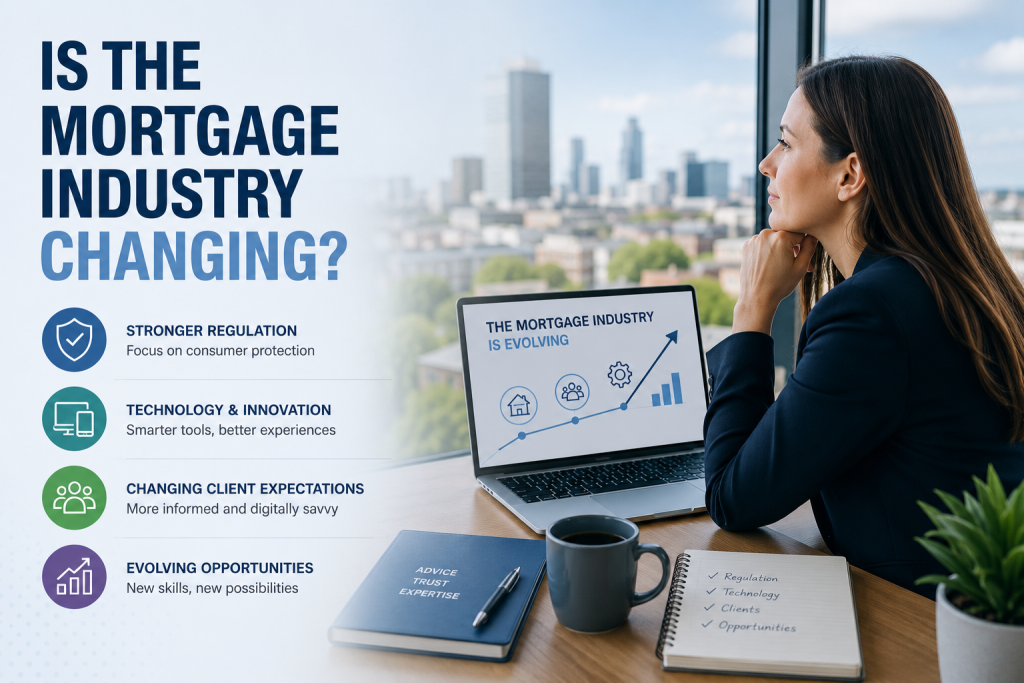
Mortgage adviser reviewing industry changes including technology, regulation and evolving client expectations

Final Thoughts

Continuing Professional Development (CPD) is the ongoing process of learning and professional improvement that takes place after an individual becomes qualified.

For mortgage advisers, CPD involves activities that help maintain and develop the knowledge, skills, and understanding needed to provide suitable advice to clients.

The mortgage market changes regularly. Lenders introduce new products, regulations evolve, technology develops, and customer circumstances become more complex. CPD helps advisers stay informed and continue delivering a professional service.

Rather than being a single course or qualification, CPD is an ongoing commitment to learning throughout a career.

Looking for training support?

We offer CeMAP training for learners working towards a career in mortgage advice. Our courses follow the London Institute of Banking & Finance syllabus and are designed to support understanding of mortgage regulation and advice requirements.

Explore our accredited CeMAP training courses

> Futuretrend Financial Training 

How to Nail Your First Job Interview in Mortgage Advice

How to Nail Your First Job Interview in Mortgage Advice

Entering your first mortgage adviser interview can feel daunting—you’ve studied hard for your CeMAP qualification, but how do you translate that knowledge into a compelling interview performance? This article will guide you through each step of the process, from understanding the role you’re applying for to mastering the questions, so you can approach your interview with confidence and clarity.

How to Nail Your First Job Interview in Mortgage Advice

Research the Role and Employer

Before you walk through the door (or log onto the video call), you need a thorough understanding of the position and organisation. Take time to explore the company’s website, recent news, and social media channels. Identify their core values, target market (e.g., first-time buyers, remortgages, buy-to-let), and any unique selling points such as digital platforms or bespoke service offerings.

Understanding the difference between an Appointed Representative (AR) role and a directly authorised adviser (DA) position is also crucial. While AR roles may offer more compliance support and established processes, DA positions often come with greater autonomy and business-building responsibilities. Tailor your research to the specific model the employer uses.

Highlight Your Qualifications and Soft Skills

Technical competence is expected—you’ve passed CeMAP modules and understand MCOB rules. What truly impresses interviewers are the personal attributes you bring to the table. Communication skills, empathy, and ethical judgement are cornerstones of successful mortgage advice.

  • CeMAP and CPD: Be ready to discuss your study approach, exam performance, and any additional CPD courses you’ve completed.

  • Active Listening: Give examples where you listened carefully to a client’s needs and adjusted your recommendations accordingly.

  • Ethical Decision-Making: Demonstrate awareness of the FCA’s Consumer Duty by describing situations where you prioritised client outcomes over sales.

Prepare for Common Interview Questions

Most mortgage adviser interviews will include a mix of technical, competency, and situational questions. Practise your responses to the following categories:

Technical Questions

  • “Can you explain the key components of a Key Facts Illustration (KFI)?”

  • “How would you assess a client’s affordability if they are self-employed?”

Competency Questions

  • “Describe a time when you had to handle a challenging client. How did you resolve the situation?”

  • “Tell me about a time you worked effectively in a team.”

Situational Questions

  • “If a client insists on a mortgage product that you believe is unsuitable, how would you respond?”

  • “How would you prioritise multiple client cases during a busy period?”

Use the STAR method (Situation, Task, Action, Result) to structure your answers clearly: describe the context, your role, the actions you took, and the outcomes achieved.

Demonstrate Your Industry Knowledge

Interviewers want to see that you stay up to date with market trends and regulatory changes. Discuss recent developments, such as the Bank of England’s latest rate decision, the impact of Consumer Duty, or the emergence of digital advice platforms.

For example, you might say:

“I’ve noticed a shift towards hybrid advice models, where clients can start the process online and finish with a personal review. I believe integrating digital fact-finding tools can enhance efficiency without compromising the personal touch.”

Backing up your insights with specific examples shows genuine interest and initiative.

Ask Insightful Questions

An interview is a two-way street. Prepare thoughtful questions that demonstrate your enthusiasm and strategic thinking, such as:

  • “How does your firm support ongoing CPD and career progression for new advisers?”

  • “What CRM or mortgage sourcing software do you use, and how does it integrate with your client experience?”

  • “How does the company measure adviser success beyond sales figures?”


These questions convey that you’re not just looking for any job—you’re looking for the right environment to grow your expertise.

Present Yourself Professionally

Your appearance, punctuality, and demeanour set the tone for the entire interview. Choose business-appropriate attire—smart but not overly formal—and arrive (or log in) at least 10 minutes early. During a video interview, ensure your background is tidy, your camera is at eye level, and your internet connection is reliable.

Maintain confident body language: make eye contact, sit upright, and smile. Active engagement—nodding, brief affirmations—can reinforce your interest and professionalism.

Conclusion

Landing your first role in mortgage advice is a significant milestone—but it’s the preparation that makes the difference. By researching the employer, refining your answers, showcasing both technical competence and soft skills, and demonstrating genuine industry awareness, you position yourself as a standout candidate.

Remember, every interview is a learning opportunity. Reflect on each experience, solicit feedback, and continuously improve your approach.

Ready to advance your mortgage expertise? Explore our CeMAP mortgage modules and gain the confidence to advise clients on tracker mortgages and beyond.

Ready for more exam-style examples?

Book our CeMAP Home Study course or visit our website for full training resources:
https://cemap123.co.uk/home-study-training/

Images Designed by Freepik (www.freepik.com)

Understanding the Certificate of Mortgage Advice and Practice (CeMAP) Qualification: Everything You Need to Know

In the world of financial services, few qualifications stand out as strongly as the Certificate of Mortgage Advice and Practice (CeMAP). If you’re considering a career in the mortgage industry or if you’re looking to enhance your financial career prospects, CeMAP is often a prerequisite. But what exactly is CeMAP, and why is it so important?

In this detailed guide, we’ll explore what CeMAP is, what it entails, how to get CeMAP qualification, and why it is worth your time and investment. Additionally, we’ll look at the career paths available once you complete the qualification and whether it’s the right choice for you.

What is CeMAP?

CeMAP is a professional qualification for individuals who want to pursue a career in mortgage advice and financial services. CeMAP helps individuals develop the skills and knowledge needed to provide expert mortgage advice to clients. This qualification is recognized and respected across the financial services sector.

CeMAP stands for “Certificate in Mortgage Advice and Practice.” It is an essential certification for anyone looking to work as a mortgage advisor in the UK. Whether you’re looking to join a bank, building society, or independent mortgage advisor firm, this qualification is often the first step.

CeMAP Qualification Details

What Level is CeMAP?

The CeMAP qualification is set at Level 3 on the Regulated Qualifications Framework (RQF). This level of qualification is equivalent to A-Level, meaning it provides you with foundational knowledge in the mortgage industry, along with practical advice and skills. While CeMAP is not the highest qualification in financial services, it is highly regarded and forms the essential base for most roles in mortgage advice.

CeMAP Structure

CeMAP is broken down into three modules:

Module 1: UK Financial Services, Regulation This module provides an overview of the UK financial services system, including the role of regulation and ethics in the industry.

Module 2: Mortgage Law and Practice In this section, you will study the legal aspects of mortgage practice, including types of mortgages, the legal processes, and the documentation involved in mortgage lending.

Module 3: Assessing Mortgage Advice The final module focuses on how to assess and recommend appropriate mortgage products based on client circumstances.

The LIBF Awarding Body

CeMAP is awarded by the London Institute of Banking & Finance (LIBF), which is a well-respected and established awarding body in the UK. LIBF offers a range of financial qualifications, and its CeMAP qualification is the most popular for mortgage advisers. LIBF is known for maintaining high standards, so obtaining your CeMAP qualification through them is a reliable and respected choice.

LIBF

Exam Details for CeMAP

How to Get CeMAP Qualification

To become CeMAP qualified, candidates must complete the three modules outlined earlier. After completing the study materials for each module, you will need to sit for exams at an accredited test centre. The exams are divided as follows:

  • Module 1: A 100-question multiple-choice exam.
  • Module 2: A 100-question multiple-choice exam.
  • Module 3: A combination of 60 multiple-choice questions and case studies, testing your ability to apply your knowledge in real-world scenarios.

Candidates must pass each module to receive their CeMAP certification. The exams are taken at designated test centres or can be taken remotely with moderator observing via your computer webcam and screen mirroring.

CeMAP Exam Costs

The cost of the CeMAP qualification can vary depending on your study provider, but typically, the full cost for all three modules will range between £1,000 and £2,000, which includes exam fees, study materials, and any other associated costs. Many providers offer flexible study options, including classroom-based learning and online self-study.

Does CeMAP Expire?

The CeMAP qualification does not expire in terms of certification, but you are required to keep up with continuing professional development (CPD) to maintain your knowledge and skills. Some employers may also require you to take refresher courses or keep up with the latest developments in mortgage advice.

Why CeMAP is Required and Career Paths on Completion

Is CeMAP Worth It?

If you are serious about pursuing a career in mortgage advice, CeMAP is worth it. It’s a highly respected qualification, and having CeMAP on your CV shows potential employers that you have the necessary knowledge to provide mortgage advice within a regulated framework. It is particularly important if you want to become a mortgage broker, adviser, or loan officer, as many financial firms require CeMAP as a minimum qualification.

What Jobs Can You Get with a CeMAP Qualification?

Upon completion of the CeMAP qualification, you will have a variety of career options in the financial services industry. Some common job roles for CeMAP-qualified professionals include:

  • Mortgage Advisor/Broker: Advising clients on the most suitable mortgage products for their needs.
  • Mortgage Underwriter: Assessing mortgage applications and determining the eligibility of borrowers.
  • Compliance Officer: Ensuring mortgage firms adhere to regulatory standards.

What is CeMAP Qualification Equivalent to?

While CeMAP is recognized as a Level 3 qualification, it is also comparable to A-levels in the UK education system. For those seeking further specialization, CeMAP is often seen as the starting point, and many professionals choose to progress to CeRER (Certificate in Regulated Equity Release) or DipFA (Diploma for Financial Advisers) for deeper expertise.

Why Get CeMAP Qualified?

In summary, CeMAP is an essential qualification for anyone interested in becoming a mortgage adviser in the UK. It equips you with the foundational knowledge needed to provide competent mortgage advice and understand the legal and regulatory aspects of the industry. By obtaining the CeMAP qualification, you open doors to a wide range of financial services roles and ensure you meet the necessary regulatory requirements for providing mortgage advice.

Whether you are starting a career in financial services or looking to enhance your skills in the mortgage industry, CeMAP is a valuable qualification that will set you apart from the competition.

Images Designed by Freepik (www.freepik.com) and AI