Many people considering a career in mortgage advice wonder whether CeMAP is suitable for learners with ADHD or autism. The simple answer is yes. People with ADHD, autism, both, or other forms of neurodivergence successfully complete CeMAP every year and go on to work in financial services.
However, studying CeMAP can present challenges that some neurodivergent learners experience more intensely than others. These may include maintaining focus, managing large amounts of information, coping with uncertainty, avoiding overwhelm, or organising study time alongside work and family commitments.
There is no single ADHD or autistic learning experience. Every learner is different. What works well for one person may not work for another. The key is not trying to force yourself into a study method that does not suit you. Instead, it is often more effective to adapt the learning process to fit how you learn best.
Is CeMAP Suitable for Learners with ADHD or Autism?
Yes, CeMAP can be suitable for learners with ADHD or autism.
The Certificate in Mortgage Advice and Practice (CeMAP) is the industry-standard qualification for mortgage advisers in the UK. Awarded by the London Institute of Banking & Finance (LIBF), it meets the educational requirements for providing regulated mortgage advice. The qualification focuses on understanding financial services, mortgage products, regulation, and advice processes.
Success in CeMAP is not determined by personality type, learning style, or whether someone is neurodivergent. Success is usually linked to understanding the material, developing effective study habits, and preparing thoroughly for the examinations.
Many aspects of CeMAP can actually suit neurodivergent learners. The syllabus is structured, the learning outcomes are clearly defined, and there is a logical progression through the modules. For some learners, having clear objectives and measurable milestones can make studying feel more manageable.
At the same time, some learners may find parts of the qualification challenging, particularly when dealing with lengthy reading materials, complex terminology, or balancing study with other responsibilities.
Why Can CeMAP Feel Challenging for Some Neurodivergent Learners?
The challenges often relate less to the subject itself and more to how information is presented and managed.
For learners with ADHD, difficulties may include:
- Maintaining concentration during long study sessions
- Staying organised
- Managing revision schedules
- Starting tasks that feel overwhelming
- Retaining information from lengthy reading materials
- Avoiding distractions
For autistic learners, challenges may sometimes include:
- Processing large volumes of unfamiliar information
- Managing changes to study plans
- Coping with uncertainty around exams
- Feeling overwhelmed by too many learning resources
- Interpreting vague or poorly structured study materials
These experiences are not universal. Some autistic learners may thrive on detail and structure, while some learners with ADHD may perform exceptionally well when engaged by a topic they find interesting.
The important point is recognising your own learning preferences rather than assuming there is a “correct” way to study.
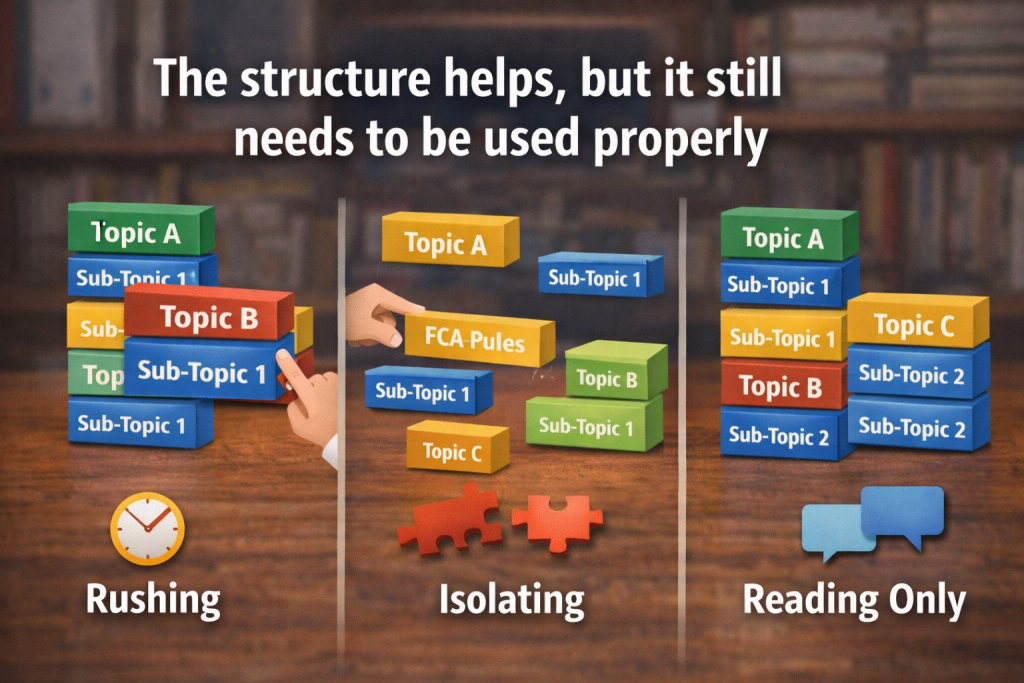
How Important Is Structure When Studying CeMAP?
Structure is often one of the most helpful tools available.
CeMAP covers a large syllabus. Looking at the qualification as a whole can sometimes feel daunting. Breaking it into smaller sections can make it much easier to manage.
Instead of focusing on completing an entire module, it may help to create smaller goals such as:
- Reading one topic area
- Completing one video lesson
- Answering twenty practice questions
- Revising a single learning outcome
- Reviewing one chapter summary
Smaller goals create clearer starting points and can reduce the feeling of being overwhelmed.
Many learners also find it useful to study at consistent times each week. A predictable routine can reduce decision-making and help study become part of everyday life rather than something that constantly needs planning.

Can Different Learning Formats Make CeMAP Easier to Understand?
For many neurodivergent learners, yes.
Relying on a single learning format is not always the most effective approach. Reading textbooks alone may work well for some people, but others understand information better when it is presented in different ways.
Common learning resources include:
Reading Materials
Written study guides provide detailed explanations and allow learners to work at their own pace.
Some learners prefer to highlight information, annotate pages, or create summaries to improve understanding and retention.
Video Lessons
Video-based learning can help break complex topics into shorter, more digestible sections.
Visual explanations may help learners understand concepts that feel difficult when encountered only through written text.
Many learners also appreciate the ability to pause, rewind, and revisit lessons whenever needed.
Practice Questions
Practice questions are often one of the most valuable learning tools available.
They help identify knowledge gaps and provide opportunities to apply information rather than simply reading it.
For some learners with ADHD, the interactive nature of question practice can feel more engaging than passive reading.
Revision Notes and Mind Maps
Visual learners may benefit from simplifying information into diagrams, flowcharts, colour-coded notes, or mind maps.
Reducing information into key themes can make revision feel more manageable and improve recall.
How Can You Reduce Feelings of Overwhelm?
Overwhelm is common among adult learners, regardless of whether they have ADHD or autism.
One effective approach is reducing the amount of information you focus on at any one time.
Rather than attempting to study an entire chapter in a single session, it may help to:
- Study one section at a time
- Use checklists
- Focus only on today’s task
- Track progress visually
- Take regular breaks
Many learners find that seeing progress helps maintain motivation.
A simple checklist showing completed topics can often feel more encouraging than constantly focusing on what remains unfinished.
It can also help to accept that not every study session needs to be perfect. Some days may be highly productive, while others may be less effective. Consistency over time is usually more important than occasional intensive revision sessions.
What Study Techniques May Help with Focus?
Focus challenges can affect many learners, particularly when studying after work or family commitments.
Some practical approaches include:
Using Short Study Sessions
Long revision sessions are not always necessary.
Many learners find that studying for 20 to 30 minutes at a time allows them to maintain concentration more effectively than attempting several uninterrupted hours.
Removing Distractions
Creating a dedicated study environment can help minimise interruptions.
This might include:
- Silencing phone notifications
- Closing unnecessary browser tabs
- Using noise-cancelling headphones
- Studying in a quiet room
- Having all required materials ready before starting
Setting Clear Objectives
Beginning a session with a specific goal can improve focus.
For example:
- Complete ten practice questions
- Learn one regulation topic
- Review one chapter summary
A clear finish point can make tasks feel more achievable.
Should You Adapt Your Study Plan?
Absolutely.
One of the biggest mistakes learners make is trying to copy someone else’s revision strategy.
A study method that works brilliantly for one person may be completely ineffective for another.
Some learners prefer:
- Detailed schedules
- Colour-coded notes
- Visual learning resources
- Audio learning
- Practice-heavy revision
Others may prefer:
- Minimal planning
- Flexible study sessions
- Reading and note-taking
- Topic-based revision
The goal is not to study like everyone else. The goal is to understand the material and prepare effectively for the exams.
Adaptability is often far more important than following a rigid system.
Are Exam Arrangements Available for Neurodivergent Learners?
Exam providers may offer reasonable adjustments for learners with recognised needs where appropriate evidence is provided.
Available arrangements depend on individual circumstances and the policies in place at the time of booking.
Because requirements and processes can change, learners should always check directly with their training provider and examination provider to understand what support may be available and what evidence might be required.
It is often worth exploring these options early rather than waiting until an exam date approaches.

What Strengths Can Neurodivergent Learners Bring to CeMAP Study?
Discussions around ADHD and autism often focus heavily on challenges, but many neurodivergent learners also bring valuable strengths to their studies.
These strengths vary significantly between individuals but may include:
- Strong attention to detail
- Deep interest in specialist subjects
- Analytical thinking
- Pattern recognition
- Persistence
- Creative problem-solving
- Strong memory for specific information
Mortgage advice requires accuracy, attention to detail, communication skills, and the ability to work through complex information. Different people bring these skills in different ways.
The objective is not to change how you naturally think. It is to build study methods that allow your strengths to support your learning.
Final Thoughts
CeMAP is suitable for learners with ADHD or autism, but there is no single approach that works for everyone.
Some learners benefit from structure and routine. Others prefer flexibility. Some learn best through reading, while others understand concepts more effectively through videos, practice questions, visual summaries, or a combination of resources.
The most successful approach is usually one that adapts to your individual learning preferences rather than expecting you to adapt to a fixed study method.
CeMAP is a challenging qualification for many people, regardless of background. Breaking learning into manageable steps, using a variety of resources, and focusing on steady progress can help make the journey more approachable.
Neurodivergent learners are not required to study in the same way as everyone else. Finding methods that suit your strengths and support your challenges can make the learning process more effective, more sustainable, and ultimately more successful.
Looking for training support?
We offer CeMAP training for learners working towards a career in mortgage advice. Our courses follow the London Institute of Banking & Finance syllabus and are designed to support understanding of mortgage regulation and advice requirements.
Explore our accredited CeMAP training courses
> Futuretrend Financial Training