What Learners Usually Find Hardest in CeMAP 1 – And Why

What is the hardest part of CeMAP 1 featured image showing regulation, ethics and compliance study themes.

Many new learners ask the same question before they begin: what is the hardest part of CeMAP 1?

The honest answer is that most people find the regulatory and legal content the most challenging. Not because it is impossible to understand, but because it feels unfamiliar, detailed and less practical than expected.

CeMAP 1 is very different from what many people imagine. It is not about mortgage calculations or sales techniques. It focuses on regulation, ethics and the legal framework that underpins financial services in the UK.

Understanding why this feels difficult can remove a lot of unnecessary anxiety.

What is the hardest part of CeMAP 1 featured image showing regulation, ethics and compliance study themes.

What Does CeMAP 1 Actually Test?

CeMAP 1 is formally known as Financial Services Regulation and Ethics (FSRE). It is the first module of the CeMAP qualification and is awarded by the London Institute of Banking & Finance.

CeMAP is the industry standard qualification for mortgage advisers in the UK. It meets the education requirements set by the Financial Conduct Authority for giving regulated mortgage advice.

CeMAP 1 focuses on:

  • The structure of financial services regulation in the UK
  • The role and powers of the Financial Conduct Authority
  • Ethical standards and professional conduct
  • Consumer protection
  • Complaints and compensation processes
  • Financial crime and anti-money laundering principles

It tests understanding of how the regulatory system works and how advisers are expected to behave within it.

It does not test how to sell mortgages. It tests whether someone understands the rules that govern the industry.

What Is the Hardest Part of CeMAP 1?

For most learners, the hardest part of CeMAP 1 is grasping the regulatory framework and remembering who is responsible for what.

This includes:

  • Understanding how regulation developed
  • Knowing the roles of different bodies
  • Distinguishing between rules, principles and guidance
  • Interpreting ethical scenarios

The difficulty usually comes from three factors:

  1. The volume of terminology
  2. The abstract nature of regulation
  3. The level of detail required

It is not usually mathematical complexity or technical mortgage knowledge that causes difficulty. It is the legal and compliance language.

Why Does Regulation-Based Learning Feel So Difficult?

Is It Because the Content Is Too Complicated?

Not necessarily. The content is logical, but it uses precise language.

Regulation is written to remove ambiguity. That means terms have specific meanings. Words such as “authorised”, “regulated activity”, and “consumer duty” are not general phrases. They carry defined legal meaning.

For learners who are new to financial services, this can feel heavy at first.

Is It Because There Is So Much to Remember?

Partly, yes.

CeMAP 1 contains structured knowledge that builds on itself. For example:

  • Understanding the regulator
  • Understanding authorised firms
  • Understanding approved persons
  • Understanding conduct standards

Each concept links to another. If the foundation feels unclear, later sections feel harder.

That can create the impression that the whole module is difficult, when in reality it is about becoming familiar with a new framework.
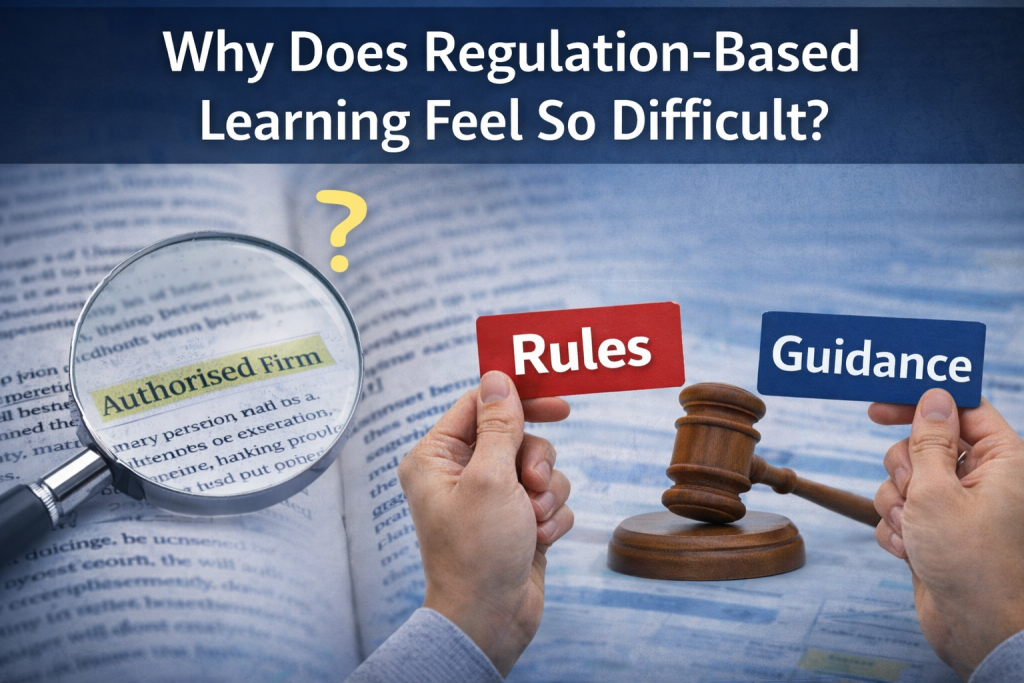
Regulation-based learning concept showing rules, guidance and authorised firm terminology in CeMAP 1 study material.

Which Areas Do Learners Most Commonly Struggle With?

Understanding the Role of the Financial Conduct Authority

Many learners initially confuse what the Financial Conduct Authority actually does.

The Financial Conduct Authority is the UK regulator responsible for overseeing financial services firms and ensuring markets function well. It sets rules, supervises firms and has enforcement powers.

Learners sometimes mix up supervision, rule-making and enforcement functions. They may also struggle to understand how the FCA’s objectives influence its approach.

Because these concepts are theoretical rather than practical, they can feel less tangible.

The Principles and Rules Framework

CeMAP 1 explains how regulation operates at different levels:

  • High-level principles
  • Detailed rules
  • Guidance

Understanding the difference between these levels can be challenging.

Principles are broad standards of behaviour. Rules are specific requirements. Guidance explains how rules may be applied.

Learners often find it harder to interpret principles because they are not checklist items. They require judgement and understanding.

Ethics and Professional Conduct

Ethics is another area that learners underestimate.

Ethics in CeMAP 1 refers to professional behaviour standards expected within regulated financial services. It includes integrity, treating customers fairly and managing conflicts of interest.

The difficulty is not the idea of being ethical. The difficulty lies in applying ethical principles to scenarios.

Questions may describe situations where more than one answer seems reasonable. That can create doubt.

Complaints and Compensation Structures

The structure of complaints handling and compensation arrangements can feel procedural.

Understanding the difference between:

  • A firm’s internal complaints process
  • The escalation route
  • The role of ombudsman services
  • Compensation schemes

requires careful reading.

Learners sometimes struggle because they try to memorise processes without fully understanding why those processes exist.

Financial Crime and Anti-Money Laundering

Financial crime topics are often detailed and rule-based.

This includes:

  • The purpose of anti-money laundering controls
  • Suspicious activity reporting
  • The responsibilities of regulated firms

The terminology can feel technical, particularly for learners without prior exposure to compliance roles.

Why Do Learners Often Expect CeMAP 1 to Be Easier?

A common misconception is that CeMAP 1 will be the “basic” module because it is first.

In reality, it lays the regulatory foundation for the rest of the qualification.

Some learners assume:

  • It will focus mainly on mortgages
  • It will be practical and scenario-based
  • It will involve simple definitions

Instead, it focuses on structure, governance and professional standards.

When expectations do not match reality, the module can feel harder than it truly is.

Is CeMAP 1 Harder Than the Other Modules?

It depends on the individual.

Some learners with legal, compliance or financial services backgrounds find CeMAP 1 straightforward.

Others who are more comfortable with practical product knowledge may find later modules more natural.

CeMAP 1 feels harder to many people because it is abstract. Later modules feel more concrete, particularly when discussing mortgage products and case-based scenarios.

Difficulty is often about familiarity rather than ability.

Does Struggling With CeMAP 1 Mean You Are Not Suited to the Industry?

No

Many capable mortgage advisers found CeMAP 1 challenging at the beginning.

Regulatory learning is a skill in itself. It requires:

  • Attention to detail
  • Comfort with structured rules
  • Careful reading

These are not innate talents. They develop with exposure.

Struggling at first does not indicate a lack of potential. It often reflects encountering a new type of subject matter.

Learner studying CeMAP 1 looking concerned, with question about suitability for the mortgage industry.

Why Standards Still Matter

While it is important to normalise difficulty, it is equally important not to minimise standards.

CeMAP 1 exists because mortgage advice is regulated.

Advisers handle large financial commitments for clients. Regulation protects consumers and ensures consistent professional conduct.

Understanding regulation is not optional. It is central to the role.

The purpose of CeMAP 1 is not to make the qualification harder. It is to ensure that anyone progressing understands the framework they will operate within.

How Should Learners View CeMAP 1?

A helpful perspective is to see CeMAP 1 as learning the rules of the road before driving.

It may not feel as exciting as discussing mortgage products. It may involve more reading than expected.

However, once the structure becomes familiar, the content becomes more logical.

Many learners report that:

  • The first exposure feels dense
  • The second reading feels clearer
  • The overall system starts to connect

The perceived difficulty often reduces as understanding grows.

Final Perspective: What Is Really the Hardest Part of CeMAP 1?

The hardest part of CeMAP 1 for most learners is adjusting to regulatory thinking.

It requires:

  • Learning precise terminology
  • Understanding a formal framework
  • Applying ethical principles

It is not about intelligence. It is about familiarity and mindset.

CeMAP 1 sets the professional foundation for mortgage advice in the UK. It introduces the regulatory environment that advisers must work within.

If it feels challenging, that is normal. It reflects the seriousness of the industry rather than a personal limitation.

With time and structured learning, what first feels abstract usually becomes clear and manageable.

The key point is perspective. Difficulty at the start is common. It does not predict the outcome.

Looking for training support?

We offer CeMAP training for learners working towards a career in mortgage advice. Our courses follow the London Institute of Banking & Finance syllabus and are designed to support understanding of mortgage regulation and advice requirements.

Explore our accredited CeMAP training courses

> Futuretrend Financial Training 

CeMAP 1, 2 and 3 explained in plain English (2025/26)

CeMAP 1, 2 and 3 explained showing FSRE, MRT1, MRT2 and ASSC modules under the 2025/26 structure

What is CeMAP 1, 2 and 3?

CeMAP is a single Level 3 qualification, not three levels.

It is formally called the Certificate in Mortgage Advice and Practice and is awarded by the London Institute of Banking & Finance (LIBF). LIBF is part of the Walbrook Group, which is why learners may see Walbrook branding when visiting the LIBF website or accessing learning platforms.

Completing CeMAP meets the education requirements set by the Financial Conduct Authority (FCA) for giving mortgage advice in the UK.

When people talk about CeMAP 1, CeMAP 2 and CeMAP 3, they are referring to modules within the same qualification, not stages or levels of qualification.

This distinction matters. A lot of confusion around CeMAP comes from the assumption that:

  • CeMAP 1 is a “lower level”
  • CeMAP 2 is a “higher level”
  • CeMAP 3 is the “final level”

That is not correct.

CeMAP has always been one qualification, made up of multiple modules. The module names and structure have been updated for 2025/26, but the underlying principle is the same.

CeMAP 1, 2 and 3 explained showing FSRE, MRT1, MRT2 and ASSC modules under the 2025/26 structure

Why do the old CeMAP 1, 2 and 3 names still exist?

The older naming still appears mainly because it is familiar shorthand.

For many years, the qualification was commonly described as:

  • CeMAP 1
  • CeMAP 2
  • CeMAP 3


LIBF has since updated the structure and module titles to better reflect what is being studied. However, the older terms still appear in:

  • online discussions
  • older learning materials
  • informal conversations in the industry

This does not mean the qualification has different versions or levels.


The important point for new learners is this:

  • You will study the current modules
  • You will sit the current exams
  • Older labels are informal references, not separate qualifications

A critical clarification: CeMAP modules are not levels

This is the misconception that causes the most confusion.

  • CeMAP 1, 2 and 3 are not levels
  • They do not represent progression through qualification levels
  • They do not grant partial adviser status

All modules combine to form one Level 3 qualification.

Completing one or two modules does not change the level of the qualification. It only means you have partially completed CeMAP.

You are only considered CeMAP qualified once all required modules are completed.

Graphic explaining that CeMAP 1, 2 and 3 are modules, not levels, showing FSRE, MRT1, MRT2 and ASSC within one qualification

What is CeMAP 1 now?

CeMAP 1 refers to the FSRE module

Under the 2025/26 structure, what people call CeMAP 1 is now the Financial Services, Regulation and Ethics (FSRE) module.

FSRE covers the regulatory and ethical foundations of financial advice. It is not mortgage-specific.

In plain terms, FSRE explains:

  • how UK financial services are regulated
  • who the regulators are and what they do
  • the role and responsibilities of advisers
  • ethical behaviour and treating customers fairly
  • how the advice process is meant to work

A note on level classification

Although the overall CeMAP qualification is Level 3, FSRE itself is classified as a Level 4 module and exam under the current structure.

This does not mean FSRE is a higher qualification. It reflects the depth and complexity of regulatory and ethical knowledge being assessed, and the fact that this content underpins multiple financial advice pathways, not just mortgages.

What FSRE does and does not allow

FSRE does not qualify someone to give mortgage advice.

However, because it focuses on regulation and ethics, some employers accept FSRE alone for:

  • administration roles
  • trainee or support positions
  • compliance or case-checking support

This is role-dependent, not adviser status.

How FSRE is assessed

FSRE is assessed by multiple-choice exams set by LIBF. There is no coursework and no practical assessment at this stage.

What is CeMAP 2 now?

CeMAP 2 refers to the mortgage modules: MRT1 and MRT2

What people traditionally call CeMAP 2 is now split into two mortgage-focused modules:

  • MRT1
  • MRT2

Together, these cover the technical knowledge required to advise on mortgages.

What MRT1 covers

MRT1 focuses on how mortgages work in practice, including:

  • mortgage structures and repayment methods
  • interest rates and lender products
  • how lenders assess applications
  • the property purchase and remortgage process
  • the adviser’s role within that process

What MRT2 covers

MRT2 builds on this knowledge and looks at:

  • more complex borrower circumstances
  • affordability and risk considerations
  • suitability and ongoing responsibilities
  • issues that can arise after completion

How MRT1 and MRT2 are assessed

Both MRT1 and MRT2 are assessed by multiple-choice exams set by LIBF.

Passing these modules means you have completed the mortgage knowledge component of CeMAP, but you are still not fully CeMAP qualified at this stage.

What is CeMAP 3 now?

CeMAP 3 refers to the ASEW module

CeMAP 3 is now called Assessment of Mortgage Advice Knowledge.

This module assesses whether you can:

  • understand a client’s circumstances
  • identify needs and objectives
  • recommend suitable mortgage solutions
  • apply regulation and ethics correctly

It focuses on application, not memorisation.

How ASSC is assessed

ASSC is assessed through a case-study-based exam using realistic customer scenarios. The assessment tests judgement and suitability rather than technical recall alone.

Is there a required order to study the modules?

There is no mandatory study order set by LIBF for FSRE, MRT1 and MRT2.

LIBF acknowledges that learners may study in different patterns, for example:

  • FRE1, then MRT1
  • returning to FRE2
  • then completing MRT2

That said, many learners find it easier to study module by module, rather than switching between regulation and mortgage content.

A common and structured approach is:

  1. Complete FSRE (FRE1 & FRE2) first
  2. Move on to MRT1 and MRT2 in order
  3. Finish with ASEW

This keeps learning styles consistent and helps learners stay focused, rather than constantly switching between regulatory and technical thinking.

The only strong recommendation is that ASEW is taken last, as it is based on knowledge from the other modules.

How all CeMAP modules fit together

CeMAP is designed to build:

  • foundations (FSRE)
  • technical knowledge (MRT1 and MRT2)
  • real-world application (ASEW)

All modules together form one qualification.

None of them represent separate qualification levels on their own.

Icons representing the three CeMAP modules: FSRE, MRT1 and MRT2, and ASSC within one qualification

Conclusion

  • CeMAP is one Level 3 qualification
  • CeMAP 1, 2 and 3 are module labels, not levels
  • FSRE is a Level 4 module within a Level 3 qualification
  • MRT and ASEW complete the qualification
  • You are only CeMAP qualified once all modules are completed

This clarity removes most of the confusion learners face when starting CeMAP.

Looking for training support?

We offer CeMAP training for learners working towards a career in mortgage advice. Our courses follow the London Institute of Banking & Finance syllabus and are designed to support understanding of mortgage regulation and advice requirements.

Explore our accredited CeMAP training courses

> Futuretrend Financial Training 

What is CeMAP and why it is required to give mortgage advice

CeMAP mortgage qualification concept showing a house model, certificate, calculator and keys

If you are thinking about becoming a mortgage adviser in the UK, you will quickly come across the term CeMAP. It is not optional, and it is not a company preference. CeMAP exists because mortgage advice is regulated, and advisers must meet a recognised education standard before they can give advice to the public.

This article explains, in simple terms, what CeMAP is, why it exists, who needs it, and what it does and does not allow you to do.

The content follows established UK CeMAP education and quality standards to ensure accuracy and clarity for learners.

CeMAP mortgage qualification concept showing a house model, certificate, calculator and keys

What is CeMAP?

CeMAP is the industry-standard qualification for mortgage advisers in the UK.

CeMAP stands for Certificate in Mortgage Advice and Practice. It is awarded by the London Institute of Banking & Finance (LIBF) and is designed to meet the Financial Conduct Authority’s education requirements for mortgage advice.

In simple terms, CeMAP proves that someone understands how mortgages work, how mortgage regulation operates, and how to give suitable advice to clients.

CeMAP is made up of three units that cover:

  • The UK financial services environment and regulation
  • Mortgage law, products, and repayment methods
  • Assessing clients and providing appropriate mortgage advice

A clear definition of CeMAP

CeMAP is a UK mortgage qualification awarded by the London Institute of Banking & Finance that meets the FCA’s educational requirements for giving regulated mortgage advice.

This definition is important because CeMAP is about education. It does not authorise someone to trade, and it does not make them regulated on its own.

Why is CeMAP required for mortgage advice?

Mortgage advice is regulated because it involves large financial commitments and long-term risk for consumers.

Most people borrow significant amounts of money when taking out a mortgage. Poor advice can lead to financial hardship, repossession, or unsuitable long-term commitments. For this reason, mortgage advice in the UK is regulated by the Financial Conduct Authority (FCA).

The FCA does not allow individuals to give mortgage advice unless they meet specific standards. One of those standards is holding an appropriate qualification. CeMAP is the most widely recognised qualification that meets this requirement.

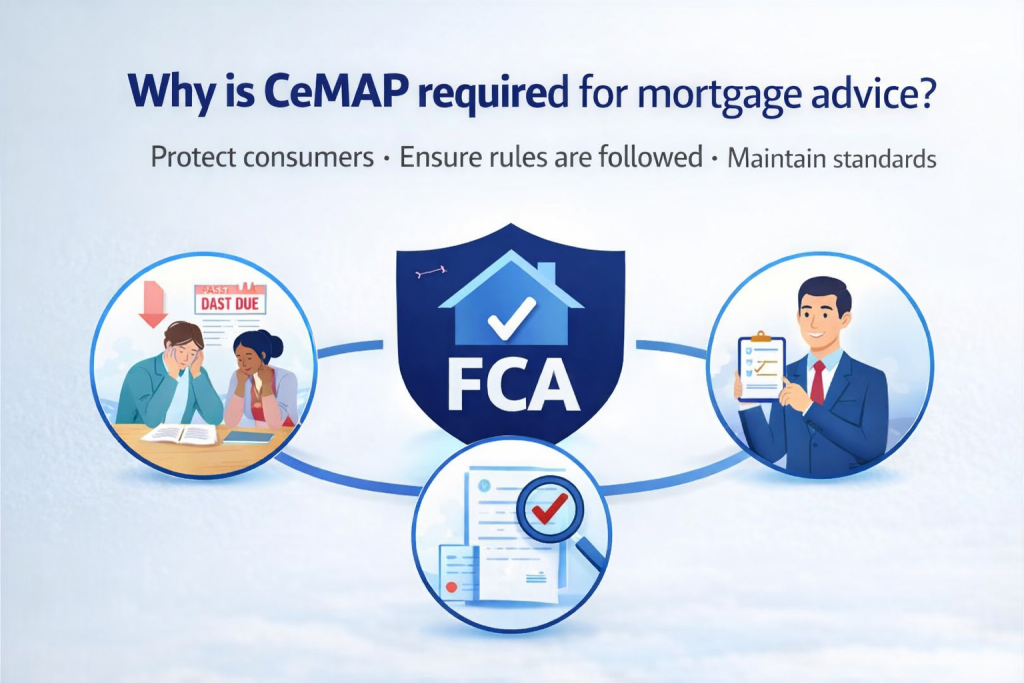
Illustration showing FCA regulation and why CeMAP is required for mortgage advice

The role of regulation

Regulation exists to:

  • Protect consumers from poor or misleading advice
  • Ensure advisers understand the rules they must follow
  • Create consistent professional standards across the industry

CeMAP supports this by ensuring advisers have a baseline level of technical knowledge and regulatory understanding before they advise clients.

Do you need CeMAP to be a mortgage adviser?

Yes, you need CeMAP, or an equivalent qualification, to give mortgage advice in the UK.

If your role involves recommending mortgage products to clients, you must hold a qualification that meets FCA education standards. CeMAP is the most common qualification used for this purpose.

Without CeMAP (or an accepted equivalent), you cannot legally give regulated mortgage advice, even if you work for an authorised firm.

This applies whether you are:

  • Employed by a mortgage brokerage
  • Self-employed
  • Working under supervision

Training alone is not enough. The qualification itself is required.

Who must hold CeMAP and who does not?

Not everyone working in a mortgage business needs CeMAP. The requirement depends on what you actually do.

Roles that must hold CeMAP

You will need CeMAP if you:

  • Give mortgage advice to clients
  • Recommend specific mortgage products
  • Assess client suitability and affordability as part of advice

These roles are classed as regulated mortgage advice activities.

Roles that do not require CeMAP

You may not need CeMAP if you:

  • Carry out purely administrative work
  • Collect information without giving advice
  • Work in marketing or customer service
  • Act as an introducer without recommending products

However, many people in non-advisory roles still choose to study CeMAP because it supports career progression and deeper understanding of the industry.

What does CeMAP qualify you to do?

CeMAP qualifies you, from an education perspective, to give mortgage advice once you are working for an authorised firm.

Specifically, CeMAP:

  • Meets the FCA’s education requirements for mortgage advisers
  • Demonstrates technical and regulatory knowledge
  • Allows a firm to consider you for an adviser role


Once you hold CeMAP and are authorised by a firm, you can:

  • Advise clients on suitable mortgage products
  • Make regulated mortgage recommendations
  • Work towards full competent adviser status under supervision


CeMAP is often described as the starting point for a mortgage advice career, not the end point.

Illustration showing what CeMAP qualifies a mortgage adviser to do under firm supervision

What does CeMAP not allow you to do?

CeMAP does not authorise you to trade or operate independently.

This is a common area of confusion, so it is important to be clear.

CeMAP does not:

  • Make you FCA authorised
  • Allow you to give advice on your own
  • Replace firm authorisation
  • Remove the need for supervision and competence sign-off

Even with CeMAP, you must work for, or be appointed by, a firm that is authorised by the FCA. The firm is responsible for oversight, compliance, and permissions.

CeMAP is an education requirement. FCA authorisation is a business and regulatory requirement. They are related, but they are not the same thing.

How CeMAP fits into the wider qualification structure

CeMAP is structured as three units, commonly referred to as CeMAP 1, CeMAP 2, and CeMAP 3.

Together, these units build from:

  • Understanding regulation and the financial services environment
  • Learning how mortgages work in practice
  • Applying knowledge to real client scenarios

Many learners study CeMAP in stages, often alongside entry-level roles in mortgage firms. After completing CeMAP, advisers usually move on to supervised practice and, later, more advanced qualifications depending on their career path.

Key points to remember

CeMAP is required because mortgage advice is regulated and consumers need protection.


It is:

  • An FCA-recognised education standard
  • Awarded by the London Institute of Banking & Finance
  • Essential for anyone giving mortgage advice


It is not:

  • FCA authorisation
  • Permission to advise independently
  • A guarantee of employment or success


Understanding this distinction early helps avoid confusion and sets realistic expectations for anyone considering a career in mortgage advice.

Looking for training support?

We offer CeMAP training for learners working towards a career in mortgage advice. Our courses follow the London Institute of Banking & Finance syllabus and are designed to support understanding of mortgage regulation and advice requirements.

Explore our accredited CeMAP training courses

> Futuretrend Financial Training