
Studying for CeMAP can feel rewarding one week and frustrating the next. Many learners experience a point where concepts that once seemed manageable suddenly become confusing. You may read the same page several times without understanding it, struggle to connect different topics, or feel as though you’ve forgotten everything you studied previously.
If this sounds familiar, you’re not alone. It does not necessarily mean you’re falling behind or that CeMAP is too difficult for you. Learning complex financial and regulatory subjects often involves periods where progress feels slower before your understanding improves.
The key is knowing how to respond when you reach one of these learning blocks rather than pushing through without changing your approach.
What If I Don't Understand CeMAP Topics?
If you don’t understand a CeMAP topic, the best approach is to pause, identify exactly where your understanding breaks down, revisit the basics, and build your knowledge back up step by step. Most learning blocks happen because an earlier concept hasn’t fully clicked, rather than because the new topic is impossible to understand.
CeMAP, awarded by the London Institute of Banking & Finance (LIBF), is designed to test your understanding of mortgage advice principles rather than your ability to memorise isolated facts. Because topics build on one another, confusion in one area can affect several later chapters.
Rather than feeling discouraged, treat confusion as a sign that it’s time to adjust your learning strategy.
Why Do CeMAP Topics Suddenly Stop Making Sense?
Many learners assume that if they understood yesterday’s study session but struggle today, something has gone wrong. In reality, this is a normal part of learning.
There are several reasons why topics can suddenly feel confusing.
Too Much New Information
CeMAP introduces many unfamiliar terms, financial concepts and regulatory requirements. Even if each section makes sense on its own, studying several chapters in one sitting can overload your memory.
Your brain needs time to organise new information before it becomes easier to recall.
Missing One Important Building Block
Sometimes one misunderstood definition causes problems later.
For example, if you’re uncertain about how different mortgage repayment methods work, later discussions about affordability, suitability or recommendations may become much harder to follow.
Rather than struggling with the advanced material, it’s often more productive to revisit the earlier topic first.
Mental Fatigue
Studying when you’re tired rarely produces your best learning.
If you’ve been concentrating for a long period, even familiar material can begin to feel confusing. Taking a proper break often improves understanding more than another hour of reading.
How Can You Reset When You're Stuck?
When a topic stops making sense, avoid repeatedly reading the same paragraph without changing your approach.
Instead, try a simple reset.
Step 1: Stop and Identify the Problem
Ask yourself exactly what you don’t understand.
Is it:
- A definition?
- A calculation?
- A regulation?
- How one topic links to another?
Being specific makes it much easier to solve the problem.
Step 2: Return to the Previous Topic
CeMAP is structured so that each section supports the next.
If today’s material feels confusing, spend fifteen or twenty minutes reviewing the previous chapter. Often you’ll discover that the missing piece was introduced earlier.
Step 3: Explain It in Your Own Words
One of the best ways to check understanding is to explain the topic without looking at your notes.
If you can’t describe it simply, you probably need another review before moving on.
You don’t need perfect wording. The goal is to understand the idea rather than memorise sentences.
Why Is Revisiting the Basics So Important?
Many learners worry that going backwards means they’re failing.
In reality, revisiting the basics is one of the fastest ways to move forwards.
Strong foundations make every later topic easier.
For example, understanding:
- mortgage terminology
- repayment methods
- interest calculations
- property types
- regulatory principles
will make many later chapters feel far more logical.
Professional learners rarely study everything once and never return to it. Revisiting earlier material helps strengthen long-term understanding rather than simply preparing for the next chapter.

Should You Keep Studying Difficult Topics?
Persistence is valuable, but repeatedly struggling without making progress is not always productive.
A useful approach is to set yourself a reasonable limit.
If you’ve genuinely tried to understand a topic for a while and still feel stuck, move on temporarily and come back later.
Sometimes learning another section provides the missing context.
Equally, taking a break for a few hours or even until the next day can make previously confusing material much clearer.
Learning is rarely completely linear.
How Can You Make Difficult Topics Easier?
Breaking larger subjects into smaller pieces makes them much more manageable.
Instead of aiming to understand an entire chapter, focus on one concept at a time.
For example:
- Learn the terminology first.
- Understand how the concept works.
- Look at practical examples.
- Answer a few practice questions.
- Review any mistakes before moving on.
This structured approach prevents information becoming overwhelming.
Small wins gradually build confidence.
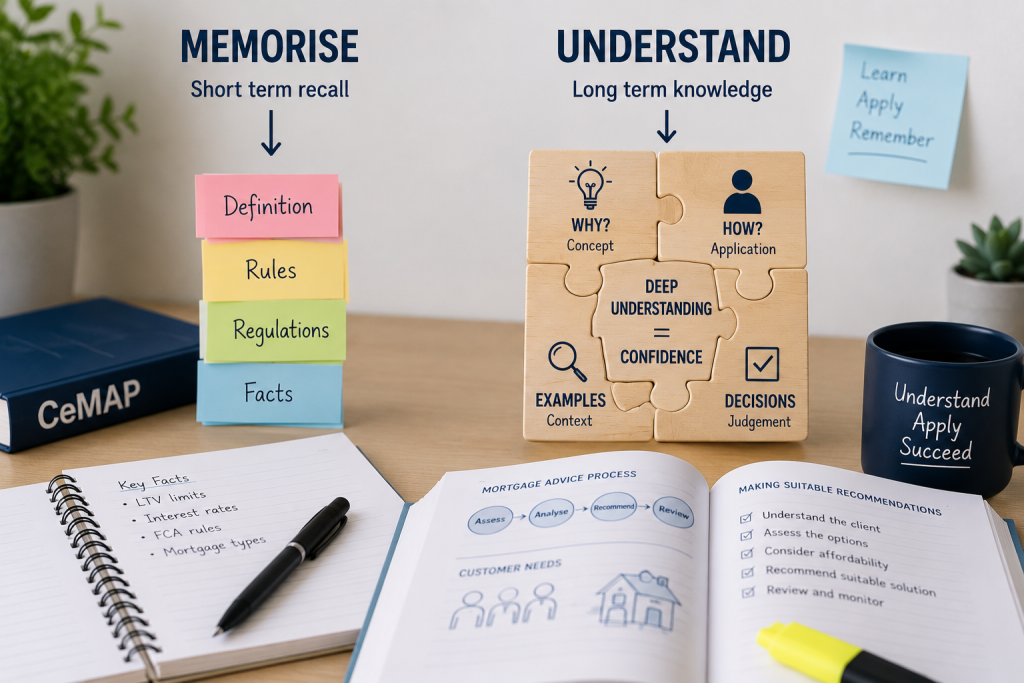
Should You Memorise or Understand?
CeMAP rewards understanding more than simple memorisation.
While some definitions and regulations naturally need remembering, many exam questions test whether you can apply your knowledge.
For that reason, ask yourself questions such as:
- Why does this rule exist?
- What problem does this mortgage solve?
- How would this apply to a customer?
- What makes this option different from another?
Thinking beyond memorised facts helps information stay with you for much longer.
When Should You Ask for Help?
Many learners wait too long before asking questions.
If you’ve reviewed the material several times and still cannot understand a topic, seeking support is usually the most efficient next step.
Support might come from:
- your course tutor
- a virtual classroom session
- a study group
- discussion with fellow learners
- additional learning resources
Often, hearing the same concept explained differently is enough for everything to click.
There’s no disadvantage in asking questions. In fact, recognising when you need clarification is a valuable professional skill.
How Can You Avoid Getting Stuck Again?
Although learning blocks can’t always be prevented, good study habits reduce how often they happen.
Try to:
- study consistently rather than cramming
- review earlier topics regularly
- complete practice questions throughout your course
- keep notes in your own words
- take regular breaks
- avoid rushing through chapters simply to finish them
Learning steadily usually produces better understanding than covering large amounts of material quickly.
Does Everyone Experience Learning Blocks?
Yes. Almost everyone studying a professional qualification encounters topics that feel more difficult than others.
Some learners struggle with regulations.
Others find calculations challenging.
Some understand technical knowledge quickly but need more time with case study questions.
This variation is completely normal.
The important point is that temporary confusion does not predict your final result.
Most successful learners experience periods where they question their progress before everything begins to come together.
Building Confidence One Topic at a Time
When CeMAP stops making sense, it’s tempting to believe you’re simply not suited to the qualification. In most cases, that’s not true.
Learning complex subjects involves periods of uncertainty. The difference between learners who continue progressing and those who lose confidence is usually how they respond to those moments.
Instead of repeatedly reading the same material, take a step back. Revisit the basics, identify the specific gap in your understanding, and use the support available to you.
Each topic you fully understand becomes another building block for the next stage of your learning.
With patience, structured study and regular review, those confusing moments become less frequent, and your confidence grows alongside your knowledge.
Looking for training support?
We offer CeMAP training for learners working towards a career in mortgage advice. Our courses follow the London Institute of Banking & Finance syllabus and are designed to support understanding of mortgage regulation and advice requirements.
Explore our accredited CeMAP training courses
> Futuretrend Financial Training