If you understand a CeMAP topic while studying but struggle to remember it a few days later, the problem may not be how much you are studying. It may be how you are reviewing and using the information.
To remember CeMAP content more effectively, focus on repeated recall rather than repeatedly reading the same material. Study a topic in manageable sections, test yourself without looking at your notes, return to it at intervals and use practice questions to check whether you can apply what you have learned.
CeMAP contains a mixture of terminology, regulation, processes, responsibilities and mortgage-related concepts. Trying to remember everything after seeing it once is unrealistic. Memory retention develops when important information is revisited and actively retrieved over time.

Why Do I Keep Forgetting CeMAP Topics?
Forgetting CeMAP topics is often caused by moving through the material without giving yourself enough opportunities to retrieve it.
Reading a chapter can create a strong sense of familiarity. You recognise the terminology and understand the explanations while they are in front of you. However, recognition is different from being able to recall information independently.
For example, you might read a section about mortgage regulation and feel comfortable with it. Two days later, if somebody asks you to explain the key points without your notes, you may find that much harder.
That does not necessarily mean you failed to learn the topic. It means the information needs further retrieval and reinforcement.
This is why effective CeMAP revision should include more than reading.
How Does Repetition Help You Remember CeMAP Content?
Repetition helps reinforce CeMAP knowledge, but it works best when you do something with the information each time you return to it.
Simply reading the same page several times can become passive. Instead, change what you do during each review.
You could:
- Read and understand the topic initially.
- Close your notes and write down the main points you remember.
- Use study cards to test key terminology or rules.
- Answer practice questions on the topic.
- Return to difficult areas a few days later.
- Explain the concept aloud in your own words.
This creates repeated contact with the material without simply repeating the same study activity.
A useful question to ask yourself is not “Have I read this?” but “Could I explain or answer a question about this without looking it up?”
That is a much better test of whether the information is becoming retrievable.
What Is Active Recall and How Can It Help With CeMAP?
Active recall means trying to retrieve information from memory before checking the answer. It can be particularly useful for CeMAP because it turns revision into a test of what you genuinely know.
Suppose you have just studied a section covering a particular mortgage concept.
Instead of immediately reading the section again, close your study material and ask yourself:
What were the main points?
Write down everything you can remember. Then reopen your notes and compare your answer with the material.
The gaps become your next revision targets.
You can use the same technique with study cards. Look at the question or prompt first and attempt the answer before turning the card over.
Even getting an answer wrong can be useful because it identifies something that needs further attention.
How Can You Use Active Learning When Studying CeMAP?
Active learning means interacting with CeMAP content rather than only reading or watching it.
There are several simple ways to do this.
You might turn a page of notes into five questions, create a short summary from memory or explain a concept as though you were teaching it to somebody else.
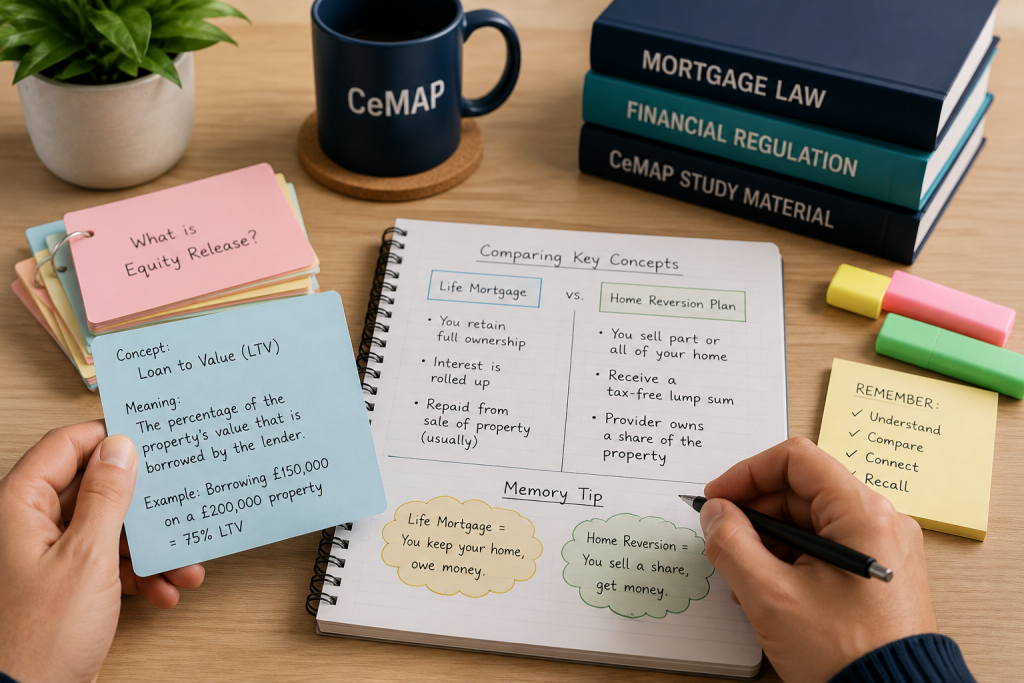
You can also compare related concepts.
For example, rather than trying to memorise two similar terms separately, create a small comparison showing:
- what each one means;
- where they differ;
- when each may apply;
- any important distinction you need to remember.
Creating the comparison requires you to think about the information rather than simply copy it.
The technique does not need to be complicated. The important part is that your brain has to retrieve, organise or apply what you have studied.

What Is Spaced Learning for CeMAP?
Spaced learning means returning to CeMAP material at intervals rather than trying to learn and revise everything in one long session.
You do not need a complicated revision system to use this approach.
For example, after studying a topic on Monday, you might briefly review it again on Wednesday, test yourself at the weekend and revisit weaker areas the following week.
The exact timings can vary depending on your study schedule and how difficult you find the material.
The principle is more important than a rigid timetable: do not leave a topic behind permanently once you have completed it.
As you progress through CeMAP, older topics should continue appearing in your revision.
This also helps prevent a common problem where learners remember the material studied most recently but struggle with topics covered several weeks earlier.
Should You Mix Old and New CeMAP Topics?
Yes. Combining new learning with short reviews of earlier CeMAP topics can help keep previous knowledge active while you continue progressing through the course.
For example, a study session might include:
New learning: 45 minutes on your current topic.
Recall: 10 minutes testing yourself on something studied earlier.
Practice: 15 minutes answering questions from a mixture of topics.
This is only an example, not a fixed study plan. Some learners will need longer sessions, while others may learn more effectively through shorter periods of study.
The important point is that progression and revision should happen alongside each other.
If all your time is spent moving forwards, earlier knowledge can gradually become harder to retrieve.
How Can Practice Questions Improve CeMAP Memory?
Practice questions help you retrieve knowledge and use it in context, making them an important part of CeMAP revision.
They can also reveal the difference between remembering a fact and knowing when that information is relevant.
When answering practice questions, avoid focusing only on your final score.
Review why you got each incorrect answer wrong.
Was it because you:
- could not remember the information;
- confused two similar concepts;
- misunderstood the question;
- missed an important word;
- knew the topic but applied it incorrectly?
These are different problems and may require different responses.
If you cannot remember the information, return to that area and revise it. If you knew the content but misread the question, repeatedly rereading the entire topic may not solve the problem.
Practice questions are therefore useful for both memory and identifying gaps in exam technique.
How Can You Remember Difficult CeMAP Terms and Concepts?
Difficult CeMAP terminology can become easier to remember when you connect it to meaning rather than trying to memorise isolated words.
Start by writing a plain-English explanation of the term.
Then connect it to something else you already understand. This could be its purpose, a related concept, a simple scenario or a comparison with something similar.
For example, if two concepts keep becoming mixed up, place them side by side and identify the one distinction that separates them.
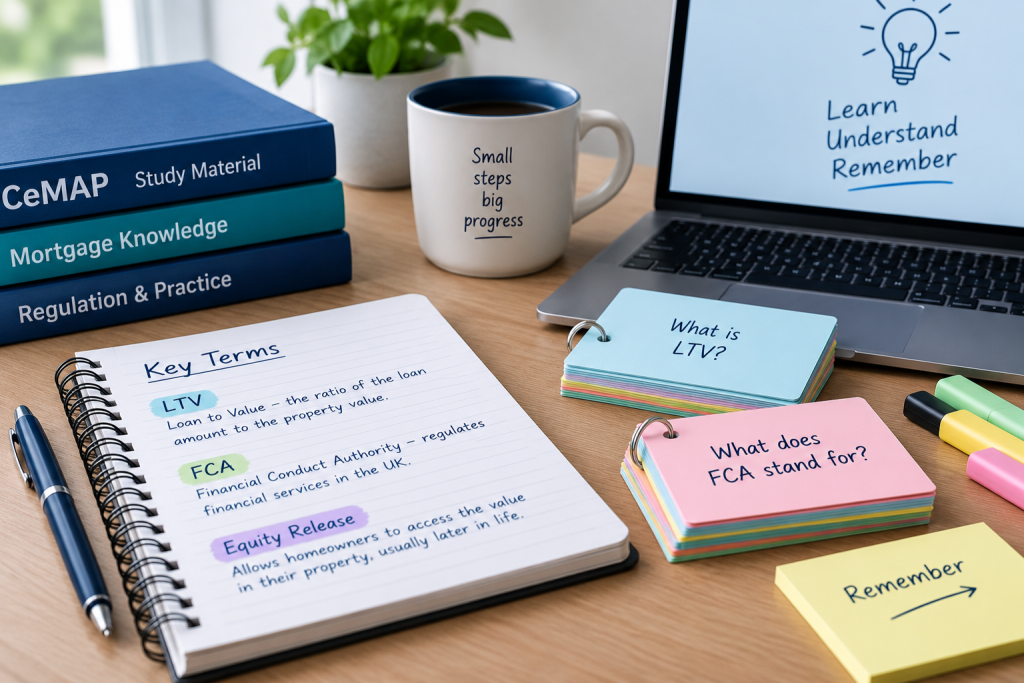
Study cards can also work well for terminology, particularly when the front contains a question rather than simply a word.
Instead of:
Term: [CeMAP term]
try:
Question: What does [CeMAP term] mean and when is it relevant?
This encourages retrieval and understanding together.
Should You Rewrite All Your CeMAP Notes?
Rewriting every CeMAP note is not automatically an effective way to improve memory.
Writing can support learning when you are selecting, summarising and reorganising information. Copying large sections word for word is much more passive.
If you use written revision, try reducing information rather than reproducing it.
Turn a detailed section into:
- a short summary;
- five key points;
- several questions;
- a comparison table;
- a simple process;
- a set of study cards.
The aim is to make yourself decide what the information means and which parts matter.
A short summary created from memory can often tell you more about your current understanding than several pages copied from study material.
What Is a Practical CeMAP Memory Routine?
A simple memory routine can be built into normal CeMAP study without dramatically increasing your study time.
After completing a section, close your material and spend a few minutes recalling the main points.
At the start of your next study session, test yourself on something from the previous session before beginning new material.
At the end of the week, return to several earlier topics and complete a mixture of recall activities and practice questions.
As you get closer to the exam, continue mixing older material with newer topics rather than concentrating exclusively on whichever section you studied last.
This creates a cycle of:
Learn → Recall → Check → Revisit → Apply
You are not trying to memorise the entire CeMAP syllabus in one go. You are gradually strengthening your ability to retrieve the information when you need it.
What Are Common CeMAP Memory and Revision Mistakes?
One of the biggest mistakes is confusing familiarity with knowledge. Seeing a page several times does not necessarily mean you could answer a question about it without the page in front of you.
Other common problems include spending too long making perfect notes, revising only favourite topics, repeatedly reviewing information you already know and avoiding practice questions because mistakes feel discouraging.
Another mistake is waiting until the end of your studies before returning to earlier material.
Regular short reviews can make revision more manageable because you are maintaining knowledge rather than trying to rebuild it shortly before the exam.
How Can You Tell Whether You Really Remember a CeMAP Topic?
The best test is whether you can retrieve and use the information without relying heavily on your notes.
Try asking yourself:
Can I explain this clearly without looking at the course material?
Can I answer questions on it when it is mixed with other topics?
Can I identify the difference between similar concepts?
Can I still remember the important points several days later?
If the answer is no, that topic probably needs another review.
This does not mean starting again from the beginning. Identify the specific gaps, revisit them and test yourself again.
How Do You Remember CeMAP Content More Effectively?
The most effective CeMAP revision is usually not about reading more. It is about retrieving more.
Use your study materials to understand each topic, but regularly put them aside and see what you can remember independently. Combine active recall, study cards, practice questions and spaced reviews so that earlier topics remain part of your learning as you progress.
Most importantly, expect to forget some information.
Forgetting something and then successfully retrieving or relearning it is part of the study process. The aim is not to remember every CeMAP topic perfectly after one study session. It is to build stronger recall through repeated, purposeful revision until you can recognise, understand and apply the knowledge when it matters.
Looking for training support?
We offer CeMAP training for learners working towards a career in mortgage advice. Our courses follow the London Institute of Banking & Finance syllabus and are designed to support understanding of mortgage regulation and advice requirements.
Explore our accredited CeMAP training courses
> Futuretrend Financial Training