What Learners Usually Find Hardest in CeMAP 1 – And Why

What is the hardest part of CeMAP 1 featured image showing regulation, ethics and compliance study themes.

Many new learners ask the same question before they begin: what is the hardest part of CeMAP 1?

The honest answer is that most people find the regulatory and legal content the most challenging. Not because it is impossible to understand, but because it feels unfamiliar, detailed and less practical than expected.

CeMAP 1 is very different from what many people imagine. It is not about mortgage calculations or sales techniques. It focuses on regulation, ethics and the legal framework that underpins financial services in the UK.

Understanding why this feels difficult can remove a lot of unnecessary anxiety.

What is the hardest part of CeMAP 1 featured image showing regulation, ethics and compliance study themes.

What Does CeMAP 1 Actually Test?

CeMAP 1 is formally known as Financial Services Regulation and Ethics (FSRE). It is the first module of the CeMAP qualification and is awarded by the London Institute of Banking & Finance.

CeMAP is the industry standard qualification for mortgage advisers in the UK. It meets the education requirements set by the Financial Conduct Authority for giving regulated mortgage advice.

CeMAP 1 focuses on:

  • The structure of financial services regulation in the UK
  • The role and powers of the Financial Conduct Authority
  • Ethical standards and professional conduct
  • Consumer protection
  • Complaints and compensation processes
  • Financial crime and anti-money laundering principles

It tests understanding of how the regulatory system works and how advisers are expected to behave within it.

It does not test how to sell mortgages. It tests whether someone understands the rules that govern the industry.

What Is the Hardest Part of CeMAP 1?

For most learners, the hardest part of CeMAP 1 is grasping the regulatory framework and remembering who is responsible for what.

This includes:

  • Understanding how regulation developed
  • Knowing the roles of different bodies
  • Distinguishing between rules, principles and guidance
  • Interpreting ethical scenarios

The difficulty usually comes from three factors:

  1. The volume of terminology
  2. The abstract nature of regulation
  3. The level of detail required

It is not usually mathematical complexity or technical mortgage knowledge that causes difficulty. It is the legal and compliance language.

Why Does Regulation-Based Learning Feel So Difficult?

Is It Because the Content Is Too Complicated?

Not necessarily. The content is logical, but it uses precise language.

Regulation is written to remove ambiguity. That means terms have specific meanings. Words such as “authorised”, “regulated activity”, and “consumer duty” are not general phrases. They carry defined legal meaning.

For learners who are new to financial services, this can feel heavy at first.

Is It Because There Is So Much to Remember?

Partly, yes.

CeMAP 1 contains structured knowledge that builds on itself. For example:

  • Understanding the regulator
  • Understanding authorised firms
  • Understanding approved persons
  • Understanding conduct standards

Each concept links to another. If the foundation feels unclear, later sections feel harder.

That can create the impression that the whole module is difficult, when in reality it is about becoming familiar with a new framework.
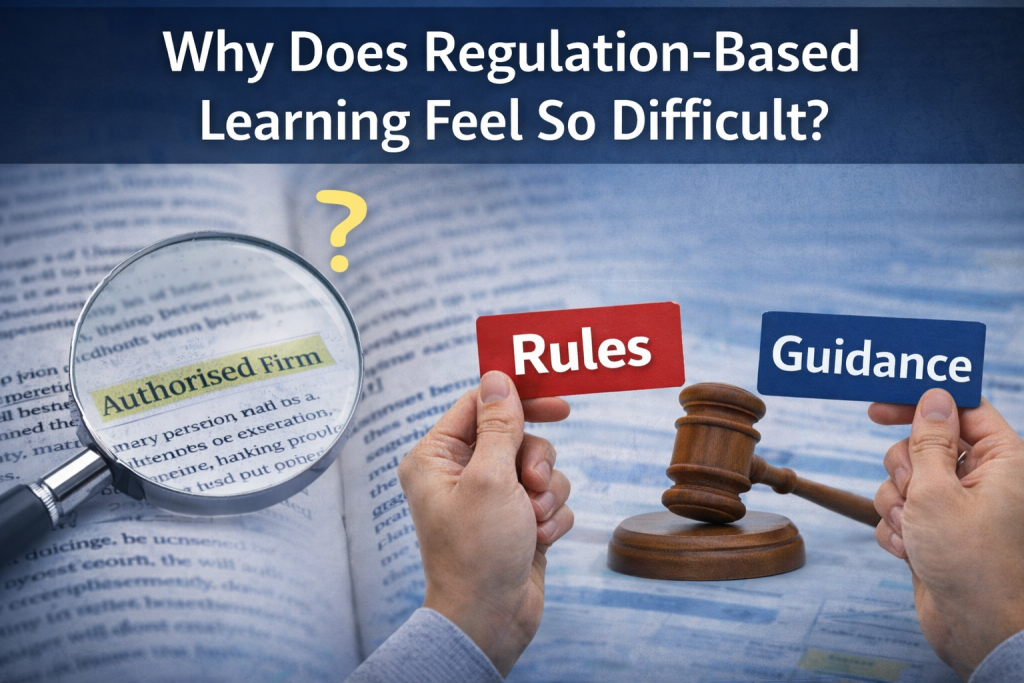
Regulation-based learning concept showing rules, guidance and authorised firm terminology in CeMAP 1 study material.

Which Areas Do Learners Most Commonly Struggle With?

Understanding the Role of the Financial Conduct Authority

Many learners initially confuse what the Financial Conduct Authority actually does.

The Financial Conduct Authority is the UK regulator responsible for overseeing financial services firms and ensuring markets function well. It sets rules, supervises firms and has enforcement powers.

Learners sometimes mix up supervision, rule-making and enforcement functions. They may also struggle to understand how the FCA’s objectives influence its approach.

Because these concepts are theoretical rather than practical, they can feel less tangible.

The Principles and Rules Framework

CeMAP 1 explains how regulation operates at different levels:

  • High-level principles
  • Detailed rules
  • Guidance

Understanding the difference between these levels can be challenging.

Principles are broad standards of behaviour. Rules are specific requirements. Guidance explains how rules may be applied.

Learners often find it harder to interpret principles because they are not checklist items. They require judgement and understanding.

Ethics and Professional Conduct

Ethics is another area that learners underestimate.

Ethics in CeMAP 1 refers to professional behaviour standards expected within regulated financial services. It includes integrity, treating customers fairly and managing conflicts of interest.

The difficulty is not the idea of being ethical. The difficulty lies in applying ethical principles to scenarios.

Questions may describe situations where more than one answer seems reasonable. That can create doubt.

Complaints and Compensation Structures

The structure of complaints handling and compensation arrangements can feel procedural.

Understanding the difference between:

  • A firm’s internal complaints process
  • The escalation route
  • The role of ombudsman services
  • Compensation schemes

requires careful reading.

Learners sometimes struggle because they try to memorise processes without fully understanding why those processes exist.

Financial Crime and Anti-Money Laundering

Financial crime topics are often detailed and rule-based.

This includes:

  • The purpose of anti-money laundering controls
  • Suspicious activity reporting
  • The responsibilities of regulated firms

The terminology can feel technical, particularly for learners without prior exposure to compliance roles.

Why Do Learners Often Expect CeMAP 1 to Be Easier?

A common misconception is that CeMAP 1 will be the “basic” module because it is first.

In reality, it lays the regulatory foundation for the rest of the qualification.

Some learners assume:

  • It will focus mainly on mortgages
  • It will be practical and scenario-based
  • It will involve simple definitions

Instead, it focuses on structure, governance and professional standards.

When expectations do not match reality, the module can feel harder than it truly is.

Is CeMAP 1 Harder Than the Other Modules?

It depends on the individual.

Some learners with legal, compliance or financial services backgrounds find CeMAP 1 straightforward.

Others who are more comfortable with practical product knowledge may find later modules more natural.

CeMAP 1 feels harder to many people because it is abstract. Later modules feel more concrete, particularly when discussing mortgage products and case-based scenarios.

Difficulty is often about familiarity rather than ability.

Does Struggling With CeMAP 1 Mean You Are Not Suited to the Industry?

No

Many capable mortgage advisers found CeMAP 1 challenging at the beginning.

Regulatory learning is a skill in itself. It requires:

  • Attention to detail
  • Comfort with structured rules
  • Careful reading

These are not innate talents. They develop with exposure.

Struggling at first does not indicate a lack of potential. It often reflects encountering a new type of subject matter.

Learner studying CeMAP 1 looking concerned, with question about suitability for the mortgage industry.

Why Standards Still Matter

While it is important to normalise difficulty, it is equally important not to minimise standards.

CeMAP 1 exists because mortgage advice is regulated.

Advisers handle large financial commitments for clients. Regulation protects consumers and ensures consistent professional conduct.

Understanding regulation is not optional. It is central to the role.

The purpose of CeMAP 1 is not to make the qualification harder. It is to ensure that anyone progressing understands the framework they will operate within.

How Should Learners View CeMAP 1?

A helpful perspective is to see CeMAP 1 as learning the rules of the road before driving.

It may not feel as exciting as discussing mortgage products. It may involve more reading than expected.

However, once the structure becomes familiar, the content becomes more logical.

Many learners report that:

  • The first exposure feels dense
  • The second reading feels clearer
  • The overall system starts to connect

The perceived difficulty often reduces as understanding grows.

Final Perspective: What Is Really the Hardest Part of CeMAP 1?

The hardest part of CeMAP 1 for most learners is adjusting to regulatory thinking.

It requires:

  • Learning precise terminology
  • Understanding a formal framework
  • Applying ethical principles

It is not about intelligence. It is about familiarity and mindset.

CeMAP 1 sets the professional foundation for mortgage advice in the UK. It introduces the regulatory environment that advisers must work within.

If it feels challenging, that is normal. It reflects the seriousness of the industry rather than a personal limitation.

With time and structured learning, what first feels abstract usually becomes clear and manageable.

The key point is perspective. Difficulty at the start is common. It does not predict the outcome.

Looking for training support?

We offer CeMAP training for learners working towards a career in mortgage advice. Our courses follow the London Institute of Banking & Finance syllabus and are designed to support understanding of mortgage regulation and advice requirements.

Explore our accredited CeMAP training courses

> Futuretrend Financial Training 
How Hard Are the CeMAP Exams Really and Which Module Feels Hardest?

How hard is CeMAP exam graphic showing regulation, mortgages and case studies modules

Many learners ask a simple question before they begin: how hard is CeMAP?

Many learners ask a simple question before they begin: how hard is CeMAP?

The honest answer is that the CeMAP exams are academically manageable for most people, but they require structured preparation and consistent study. They are not designed to catch people out, yet they do test detailed knowledge, regulation, ethics, and the ability to apply what you have learned. For some, the exams feel straightforward. For others, they feel demanding. The difference usually comes down to preparation, familiarity with financial concepts, and confidence with multiple-choice exams.

CeMAP is the industry standard qualification for mortgage advisers in the UK. It is awarded by the London Institute of Banking & Finance and meets the Financial Conduct Authority’s education requirements for giving mortgage advice. Because it leads to a regulated profession, the exams must test knowledge and ethical understanding properly. That is why they feel serious.

This article explains why difficulty is subjective, how the modules differ under the current syllabus, and why preparation matters more than natural ability.

How hard is CeMAP exam graphic showing regulation, mortgages and case studies modules

Why Does CeMAP Feel Hard for Some People?

CeMAP often feels hard because it combines new terminology, regulation, ethics, and exam pressure.

For learners who have never worked in financial services, terms relating to regulatory frameworks, conduct rules, and ethical responsibilities can feel unfamiliar. Even core mortgage concepts such as loan-to-value ratios or different repayment structures may be new. That initial learning curve can create the impression that the qualification is harder than it actually is.

Does Previous Experience Make a Difference?

Yes, but not always in the way people expect.

Someone with experience in banking or estate agency may recognise certain mortgage concepts. That familiarity can reduce learning time in CeMAP 2. However, regulatory and ethical content in CeMAP 1 still needs to be learned carefully, regardless of background.

Learners from unrelated careers often succeed because they approach the material methodically. CeMAP does not require advanced mathematics or essay writing. It requires understanding and careful recall.

Is It an Academic Exam?

CeMAP is knowledge-based rather than essay-based. You are tested through multiple-choice questions and, in the final module, case-study style assessment. You are not required to write long answers. Instead, you must recognise the correct response from several options.

For many people, this format feels manageable. For others, multiple-choice exams create uncertainty because more than one answer can appear reasonable. That is where careful reading becomes essential.

What Makes One Module Feel Harder Than Another?

CeMAP is structured in three modules. Each feels challenging for different reasons.

The modules are designed to build on each other. They do not test identical skills, so difficulty can feel different at each stage.

Under the updated 2025/26 syllabus, the modules are:

  • CeMAP 1: Financial Services Regulation and Ethics (FSRE)

  • CeMAP 2: Mortgages

  • CeMAP 3: Assessment of Mortgage Advice

The content focus has shifted slightly in CeMAP 1, and that affects how learners experience the difficulty.

CeMAP 1: Financial Services Regulation and Ethics (FSRE)

CeMAP 1 focuses on financial services regulation and ethical standards.

It covers the UK regulatory framework, the role of the Financial Conduct Authority, principles of conduct, consumer protection, and ethical responsibilities within financial services. Mortgage knowledge is still included, but the emphasis is on regulation and professional standards.

Many learners find this module challenging because of the volume of detailed definitions and the precision required in understanding regulatory language. The difficulty lies in accuracy rather than complexity.

For those new to financial services, this can feel abstract at first. Once the structure of regulation and ethical principles becomes clear, it tends to feel more logical.

CeMAP 2: Mortgages

CeMAP 2 concentrates on mortgage products and how they operate in practice.

This includes repayment methods, interest types, property considerations, underwriting factors, and different lending scenarios. The subject matter is more product-focused and practical.

Learners who prefer tangible examples sometimes find this module easier because they can visualise how mortgages work. Others find it demanding because of the range of product knowledge required.

The challenge is applying knowledge accurately rather than memorising rules alone.

CeMAP 3: Assessment of Mortgage Advice

CeMAP 3 assesses your ability to apply knowledge in realistic client situations.

It uses case-study style questions to test whether you can identify suitable advice within regulatory and ethical boundaries. It draws directly from content covered in both CeMAP 1 and CeMAP 2.

Some learners find this the hardest module because it requires judgement and careful interpretation of client information. Others find it more intuitive because it mirrors real mortgage advice scenarios.

The perception depends on whether you feel more comfortable recalling structured rules or applying them in context.

Is There a “Hardest” CeMAP Module?

There is no single hardest CeMAP module for everyone.

Some learners say CeMAP 1 feels hardest because of the regulatory and ethical detail. Others say CeMAP 3 feels hardest because of the case-study format. The perception usually reflects personal strengths and learning style.

If you prefer structured theory and definitions, CeMAP 1 may feel manageable.

If you prefer product knowledge, CeMAP 2 may feel more straightforward.

If you prefer applied scenarios, CeMAP 3 may feel more natural.

The qualification is designed to test competence across regulation, ethics, product knowledge, and advice skills. It is not structured so that one module is deliberately more difficult than another.

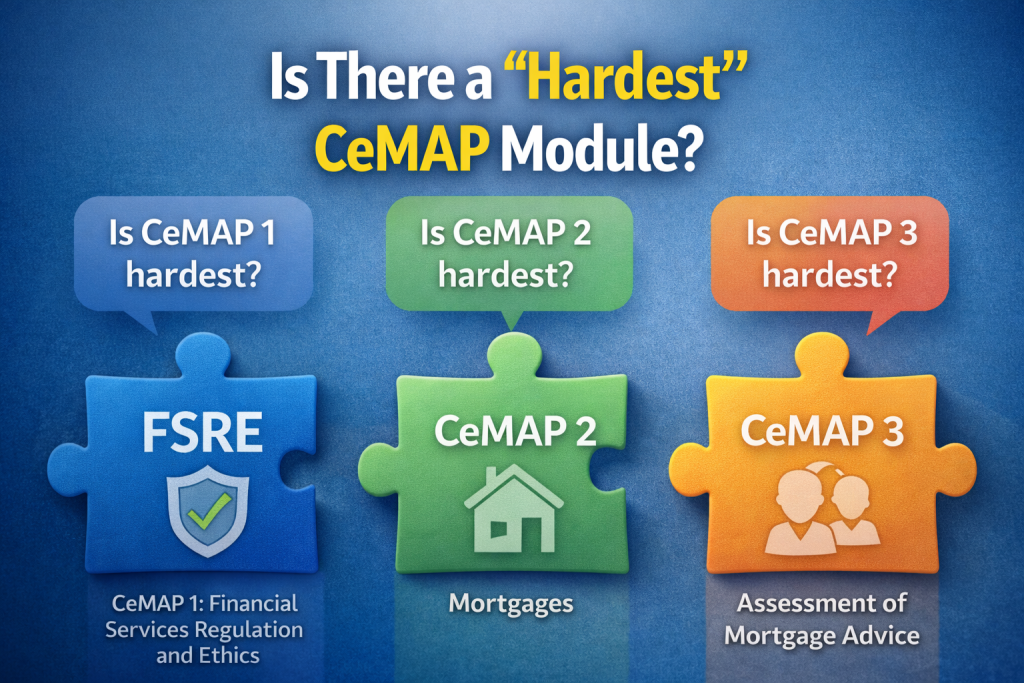
Is there a hardest CeMAP module graphic showing CeMAP 1 FSRE, CeMAP 2 Mortgages and CeMAP 3 Assessment of Mortgage Advice

How Hard Is CeMAP Compared to Other Qualifications?

CeMAP sits at Level 3 on the Regulated Qualifications Framework. This is broadly comparable to A-level standard in terms of academic level.

Most learners taking CeMAP are adults balancing work and other commitments. Time management and consistent study usually matter more than academic background.

CeMAP does not require advanced mathematics. Calculations are limited and practical. The main requirement is understanding regulation, ethics, and mortgage structures clearly.

Does the Pass Mark Mean It Is Difficult?

The pass mark reflects the standard required to meet regulatory expectations, not an attempt to make the exam difficult.

Because mortgage advice is a regulated activity, the Financial Conduct Authority expects advisers to demonstrate knowledge and ethical awareness before giving advice to clients. The exams are structured to confirm that standard.

They are not designed to reduce pass numbers. They are designed to confirm competence.

What Actually Makes CeMAP Manageable?

Preparation makes CeMAP manageable.

Most learners who initially feel that CeMAP is hard change their view once they understand the structure and style of questioning.

Structured Study

Breaking the syllabus into manageable sections prevents overwhelm. CeMAP content can appear large when viewed as a whole. Studied in stages, it becomes clearer.

Practice Questions

Becoming comfortable with multiple-choice questions changes how difficult the exam feels. Practice helps you recognise how questions are framed and how distractor answers are constructed.

Consistency Over Intensity

Short, regular study sessions are often more effective than occasional long sessions. The knowledge builds logically across the three modules.

What makes CeMAP manageable illustration showing structured study, practice questions and consistent revision

Does Intelligence Determine Success in CeMAP?

CeMAP does not require exceptional academic ability.

Success is usually linked to preparation, organisation, and attention to detail. Learners from a wide range of educational backgrounds complete the qualification each year.

The exams test understanding of regulation, ethics, and mortgage practice. Being methodical often matters more than being naturally academic.

Why Do Some Learners Feel Overwhelmed at the Start?

CeMAP introduces a regulated and ethically structured environment with precise terminology. That can feel unfamiliar.

Regulation and ethics require careful wording. Small differences in phrasing can change meaning. This can create early frustration, particularly in CeMAP 1.

Once learners adjust to that precision, confidence usually improves. What feels complex at first often becomes routine with repetition.

Is Exam Anxiety Making CeMAP Feel Harder?

In many cases, yes.

Anxiety can amplify perceived difficulty. Learners may know the content but doubt themselves during the exam. Multiple-choice formats can increase second-guessing.

Clear preparation and familiarity with the structure reduce this effect.

How Hard Is CeMAP Really?

CeMAP is challenging but achievable.

It is not designed to trick learners, nor is it effortless. It requires understanding financial services regulation, ethical standards, mortgage products, and the application of advice principles at a professional level.

Which module feels hardest depends on individual strengths. For most learners, CeMAP feels hardest at the beginning, when everything is new. As knowledge builds, confidence usually increases.

The key factor is not natural intelligence or prior background. It is preparation, consistency, and engagement with the material.

With realistic expectations and structured study, the CeMAP exams are demanding but manageable.

How hard is CeMAP really graphic showing regulation knowledge, mortgage expertise and advice application

Looking for training support?

We offer CeMAP training for learners working towards a career in mortgage advice. Our courses follow the London Institute of Banking & Finance syllabus and are designed to support understanding of mortgage regulation and advice requirements.

Explore our accredited CeMAP training courses

> Futuretrend Financial Training 
What you study in CeMAP 1 (FSRE) and why it matters

CeMAP 1 FSRE explained showing financial services, regulation and ethics icons

Many people starting CeMAP are surprised by how much regulation is covered before they reach mortgages. This often leads learners to question why CeMAP 1 exists at all.

CeMAP 1 is not about mortgage products. It is about the rules, responsibilities, and ethical standards that apply to anyone giving regulated mortgage advice in the UK. Without this foundation, mortgage advice cannot be given safely or compliantly.

This article explains exactly what you study in CeMAP 1, what Financial Services, Regulation and Ethics (FSRE) means, how FRE1 and FRE2 are structured and assessed, and why this content matters in real mortgage advice.

CeMAP 1 FSRE explained showing financial services, regulation and ethics icons

What do you study in CeMAP 1?

CeMAP 1 is the first module of the Certificate in Mortgage Advice and Practice. It focuses on financial services regulation, professional conduct, and ethics.

CeMAP 1 does not teach mortgage lending rules or product knowledge. Instead, it explains the regulatory environment in which mortgage advice takes place and the standards advisers are expected to meet.


The module covers Financial Services, Regulation and Ethics (FSRE) and is split into two units:

  • FRE1: Regulation, legislation and key parties
  • FRE2: Skills, principles and ethical behaviours


Together, these units provide the regulatory and ethical foundation required before progressing to mortgage-specific study.

What is FSRE in CeMAP?

Financial Services, Regulation and Ethics (FSRE) describes the subject content covered in CeMAP 1.

FSRE focuses on how the UK financial services industry operates, how it is regulated, and how advisers are expected to behave when dealing with clients.

CeMAP is awarded by the London Institute of Banking & Finance, which forms part of the Walbrook Group, and meets the Financial Conduct Authority education requirements for giving mortgage advice in the UK.

FSRE exists to ensure advisers understand not just what they can advise on, but how they must operate when dealing with consumers.

What is FSRE in CeMAP showing financial services, regulation and ethics icons

What does FRE1 cover in CeMAP 1?

FRE1 focuses on the structure, regulation, and legal framework of the UK financial services industry.

It explains who regulates financial services, why regulation exists, and how different parts of the system interact.

Regulation of financial services in the UK

FRE1 covers:

  • The purpose of financial regulation
  • How regulation has developed over time
  • The role of statutory regulation in protecting consumers

You study the responsibilities of the Financial Conduct Authority and the Prudential Regulation Authority, including how their roles differ.

This matters for mortgage advisers because all mortgage advice falls under FCA regulation, even when advisers are employed by a firm with its own compliance structure.

Key legislation and legal principles

FRE1 introduces the legal framework that underpins financial advice, including:

  • How financial services law is created and enforced
  • The difference between legislation, regulation, and guidance
  • Legal responsibilities of firms and individuals

This content explains why regulatory rules are enforceable and why breaches can lead to sanctions, complaints, or loss of permissions.

The financial services industry and markets

FRE1 also covers:

  • The structure of the UK financial services industry
  • Types of financial institutions and their roles
  • How money flows through financial markets
  • The relationship between risk and reward


Although this content is broader than mortgages, it provides context for how mortgage lending fits into the wider financial system.

What does FRE2 cover in CeMAP 1?

FRE2 focuses on adviser behaviour, ethical standards, and the advice process.

While FRE1 explains the system, FRE2 explains how advisers are expected to operate within it.

The advice process and suitability

FRE2 covers the stages of giving regulated advice, including:

  • Establishing client circumstances and objectives
  • Assessing suitability
  • Making appropriate recommendations
  • Reviewing and maintaining advice

These principles apply directly to mortgage advice, even though the examples are not mortgage-specific.

Ethics and professional standards

A significant part of FRE2 is understanding ethical behaviour in practice.

This includes:

  • Acting in the client’s best interests
  • Treating customers fairly
  • Managing conflicts of interest
  • Maintaining integrity and professionalism

These principles underpin FCA conduct rules and are central to how adviser behaviour is judged.

Consumer protection and complaints

FRE2 also explains:

  • Consumer rights and protections
  • How complaints are handled
  • The role of redress mechanisms such as the Financial Ombudsman Service

Mortgage advisers must understand these processes because complaints often focus on conduct rather than technical product errors.

How are the FRE1 and FRE2 exams structured?

Both FRE1 and FRE2 exams are structured in exactly the same way. The syllabus content differs, but the assessment format does not.

Each unit is assessed by a one-hour computer-based multiple-choice exam consisting of 40 questions.

Exam question breakdown

Each exam is split into two parts.

Part 1: Case study questions

  • 3 short case studies
  • Each case study has 5 multiple-choice questions
  • Total case study questions: 15

These questions test how well learners can apply regulatory and ethical principles to realistic advisory situations.


Part 2: Standalone multiple-choice questions

  • 25 standard multiple-choice questions
  • These assess knowledge and understanding of the syllabus content

Pass mark and requirements

  • Pass mark: 70%
  • Minimum score to pass: 28 out of 40
  • Exams are taken online via the LIBF assessment platform
  • FRE1 and FRE2 must both be passed to complete CeMAP 1

The use of case studies reflects how regulation operates in real advisory work, rather than treating it as abstract theory.

Why does FSRE matter in real mortgage advice?

FSRE matters because mortgage advice carries legal and ethical responsibility.

In practice, FSRE knowledge helps advisers:

  • Understand why certain client information must be collected
  • Assess suitability correctly
  • Communicate risks clearly
  • Avoid inappropriate or misleading advice
  • Act within regulatory permissions

Most regulatory breaches and complaints relate to conduct and process, not interest rates or product mechanics. FSRE addresses exactly those areas.

Why FSRE matters in real mortgage advice showing consumer protection, regulation and ethics

Common misconceptions about CeMAP 1 FSRE

“FSRE is just irrelevant law”

FSRE explains the rules that govern every client interaction. These rules exist to protect consumers and advisers alike. Ignoring them does not remove responsibility.


“You don’t use this in real life”

FSRE shapes how advisers assess clients, document advice, and justify recommendations. It influences daily decisions, even when advisers are not consciously thinking about regulation.


“CeMAP 1 has nothing to do with mortgages”

CeMAP 1 provides the regulatory foundation that allows mortgage advice to take place. Without it, advisers would not meet the required professional standards.

What CeMAP 1 does and does not do

CeMAP 1 does:

  • Explain the regulatory environment for mortgage advice
  • Set expectations for adviser behaviour
  • Establish ethical and professional standards


CeMAP 1 does not:

  • Authorise individuals to give advice
  • Replace firm-level training or supervision
  • Teach mortgage products or lending criteria


Passing CeMAP 1 meets education requirements, but advisers must still operate under a regulated firm.

Why CeMAP 1 exists

CeMAP 1 exists because mortgage advice involves risk, responsibility, and consumer protection.

FSRE ensures advisers understand:

  • The rules they operate under
  • The standards they are judged against
  • Their obligations to clients and the wider market

For learners questioning its value, CeMAP 1 is not an academic barrier. It is the foundation of competent, compliant mortgage advice.

Why CeMAP 1 exists showing FCA requirements, training standards and mortgage adviser qualification

CeMAP 1 (FSRE) Frequently Asked Questions

What is CeMAP 1?

CeMAP 1 is the first module of the Certificate in Mortgage Advice and Practice. It covers Financial Services, Regulation and Ethics (FSRE) and explains how the UK financial services industry is regulated and how advisers are expected to behave.

What does FSRE stand for in CeMAP?

FSRE stands for Financial Services, Regulation and Ethics. It describes the subject content covered in CeMAP 1 rather than being a separate qualification.

Is CeMAP 1 about mortgages?

CeMAP 1 is not about mortgage products or lending criteria. It focuses on regulation, ethics, and adviser conduct. Mortgage-specific knowledge is covered later in CeMAP 2.

What is the difference between FRE1 and FRE2?

FRE1 focuses on the structure and regulation of the UK financial services industry, including regulators, legislation, and key parties.
FRE2 focuses on adviser behaviour, ethics, the advice process, and consumer protection.

How many exams are there in CeMAP 1?

There are two exams in CeMAP 1: one for FRE1 and one for FRE2. Both exams must be passed to complete the module.

How are the FRE1 and FRE2 exams structured?

Each exam is one hour long and contains 40 multiple-choice questions. This includes 15 case study questions and 25 standalone multiple-choice questions. The pass mark is 70 percent.

Why does regulation matter for mortgage advisers?

Mortgage advisers give regulated financial advice. Regulation exists to protect consumers and ensure advice is suitable, fair, and ethical. Most complaints and regulatory action relate to conduct, not product choice.

Does passing CeMAP 1 allow you to give mortgage advice?

No. Passing CeMAP 1 meets part of the education requirement, but advisers must also complete CeMAP 2 and 3 and operate under a regulated firm authorised by the Financial Conduct Authority.

Who awards CeMAP 1?

CeMAP is awarded by the London Institute of Banking & Finance, which forms part of the Walbrook Group.

Is CeMAP 1 difficult?

CeMAP 1 is detailed rather than technical. Many learners find it challenging because it covers unfamiliar regulatory content, but it reflects the real responsibilities of working in regulated mortgage advice.

Looking for training support?

We offer CeMAP training for learners working towards a career in mortgage advice. Our courses follow the London Institute of Banking & Finance syllabus and are designed to support understanding of mortgage regulation and advice requirements.

Explore our accredited CeMAP training courses

> Futuretrend Financial Training 

Explaining the FCA: Your Guide to CeMAP 1 Regulation

FCA regulatory role

Struggling to understand the FCA for your CeMAP exam? You’re not alone. The Financial Conduct Authority (FCA) plays a critical role in the mortgage advice process—and understanding that role is essential for passing your CeMAP 1 exam and becoming a competent, compliant adviser.

At Futuretrend, we’ve guided thousands through CeMAP 1—this is just a taste of our full virtual and home‑study courses. With over 25 years of offering training and career guidance as a respected LIBF-accredited training provider, we’re here to break down the regulatory tangle for you.

Ready to tackle one of the most important regulators in UK financial services? Let’s dive in.

FCA regulatory role

What Is the FCA?

The Financial Conduct Authority (FCA) is the main regulator for financial services in the UK. Its core aim is to protect consumers, maintain market integrity and promote competition. For anyone studying CeMAP Unit 1, understanding the FCA role in CeMAP is fundamental.

The FCA was formed in 2013 after the Financial Services Authority (FSA) was disbanded. It now operates independently of the UK government but is accountable to the Treasury and Parliament.

Tutor Tip: You’ll need to remember that while the FCA is responsible for conduct regulation, prudential regulation for large firms is handled by the Prudential Regulation Authority (PRA).

As a CeMAP 1 regulator, the FCA is a cornerstone of the content you’ll face in your assessment. But what exactly does it do?

Key FCA Responsibilities

Authorisation and Supervision

Every mortgage adviser must be authorised or work for a firm that is. The FCA checks that firms and individuals are “fit and proper” to carry out regulated activities.

If you’re aiming to become a mortgage adviser, this is non-negotiable. The FCA responsibilities mortgage adviser candidates need to know include:

  • Meeting training and competency standards
  • Maintaining up-to-date knowledge
  • Adhering to ethical conduct

Tutor Tip: Expect questions on the FCA’s authorisation process and the significance of its approval in CeMAP 1 exams.

Enforcement and Compliance

The FCA holds the power to investigate and penalise firms or individuals who break the rules. This might include fines, suspensions, or even bans.

Mortgage advisers must be especially aware of:

  • Mis-selling practices
  • Poor record-keeping
  • Inadequate suitability assessments

This aligns with learning outcomes around CeMAP financial conduct authority rules on treating customers fairly.

Setting Standards: The FCA Handbook

A key publication is the FCA Handbook, which outlines the rules and guidance for firms. For CeMAP students, you should pay attention to the Conduct of Business Sourcebook (COBS), which governs how advisers interact with clients.

Tutor Tip: Expect scenario-based questions in CeMAP 1 using principles from the Handbook—especially around disclosure and advice standards.

Protecting Consumers

The FCA aims to protect clients from bad advice, financial harm, and unfair treatment. This links directly to its principles of good conduct, such as:

  • Treating customers fairly (TCF)
  • Transparency in product information
  • Fair complaint handling

The FCA also enforces financial promotions rules—ensuring advertising and communications are clear, fair and not misleading.

Preventing Financial Crime

The FCA plays a key role in anti-money laundering (AML) regulation. Mortgage advisers must be trained to spot suspicious activity.

If this area seems fuzzy, then best to look over Money Laundering covered in Topic 23 of CeMAP 1.

Why FCA Knowledge Is Crucial for CeMAP

Mastering the FCA role in CeMAP isn’t just about passing your exam. It’s about building the foundation of your career in financial services. You’ll need to understand:

  • How regulation affects day-to-day client interactions
  • The compliance responsibilities of your role
  • What legal and ethical standards apply in real-world scenarios

In short: If you’re offering mortgage advice, the FCA’s rules are your rulebook.

Test Yourself: Real-World Example

Scenario:
A mortgage adviser promotes a new low-interest product in an email to clients but fails to mention a high arrangement fee.

Question:
Which FCA principle has been breached?


➡️ Drag your mouse over box below to reveal answer

Answer:
The principle of “clear, fair and not misleading” communication.

FAQs About Becoming a Mortgage Adviser in the UK

This kind of practical application is what CeMAP 1 is all about.

Tutor Tip Recap

✅ Know the FCA’s three key objectives: protect consumers, ensure integrity, and promote competition.

✅ Familiarise yourself with the structure of the FCA Handbook.

✅ Be ready to identify how FCA rules apply to real-life adviser behaviour.

✅ Understand how the FCA fits into the broader financial regulatory framework alongside the PRA and HM Treasury.

Ready to Go Deeper?

View and Download our resources free sample  and get a taste of Futuretrend’s CeMAP training. It’s packed with practical examples, memory tricks, and tutor-guided walk-throughs.

👉 Download Free CeMAP Resources

Final Thoughts

Understanding the FCA role in CeMAP is not just a box to tick—it’s the backbone of mortgage advice. From authorisation to client care, the FCA sets the tone for how you’ll operate in the industry.

And remember: you don’t have to tackle CeMAP alone. With 25 years in training services and career guidance, Futuretrend is your expert guide through every regulation, revision session, and exam day.

👉 View of CeMAP study options for training support

Images Designed by Freepik (www.freepik.com) and AI

Guide to the CeMAP 1 Qualification

Guide to the CeMAP 1 Qualification

This module, officially known as UK Financial Regulation (UKFR), serves as the foundation for your journey into the world of mortgage advice.

In CeMAP 1, you’ll be introduced to the Financial Services Environment and the various financial products that play a crucial role in this sector. It’s not just about mortgages – you’ll gain insight into a range of financial services that are integral to the industry.

Now, let’s break it down further. CeMAP 1 consists of two units, each designed to help you develop the specialist knowledge required in this field.

Unit 1: Introduction to Financial Services Environment and Products

In this unit, you’ll explore the Financial Services Environment, gaining a comprehensive understanding of the landscape you’re stepping into. You’ll also get acquainted with a variety of financial products. This unit lays the groundwork for your journey, providing a solid foundation for the more specialized knowledge you’ll acquire as you progress through the qualification.

Unit 2: UK Financial Services and Regulations

Moving on to the second unit, you’ll delve into the rules and regulations that govern the UK Financial Services sector. Understanding the regulatory landscape is crucial for any Mortgage Adviser. This unit equips you with the knowledge needed to navigate the legal aspects of providing financial advice.

The LIBF state that your CeMAP studies on whole will cover things like 

  • the process and structure of the UK financial services industry 
  • the financial conduct authority’s main aims and activities 
  • the rules and regulations and the FCA’s approach to regulating firms and individuals 
  • the main areas of financial advice asset classes and financial services products 
  • the impact of socio-economic factors on personal financial plans 

More specifically your studies for CeMAP 1 will include the

  • UK financial services industry structure 
  • financial asset classes
  • financial services products 
  • financial advice and regular reviews 
  • basic legal concepts
  • UK taxation the benefit system
  • inflation
  • interest rate volatility 
  • non-tax laws
  • regulation 
  • conduct of business rules
  • anti-money laundering rules 
  • complaints and compensation
  • the EU general data protection regulation and
  • European directives 

As you can see, CeMAP 1 is all about building a strong foundation. Whether you’re new to the financial services sector or looking to enhance your existing knowledge, these units are tailored to provide you with the insights necessary to excel in your role as a Mortgage Adviser

The entire CeMAP qualification typically spans 6 to 12 months, providing you with a comprehensive learning journey. When it comes specifically to CeMAP 1, if you’re pursuing it through self-study, you can expect to invest around two to four months to complete this module.

However, we understand that time is of the essence for many aspiring Mortgage Advisers. That’s where Fast Track training options come into play. There are programs, such as the Futuretrend 5-day CeMAP 1 Live Virtual Classroom, designed to accelerate your learning process. These intensive courses aim to support you in completing the first module within just a few weeks.


CeMAP 1 Exam

Now that we’ve covered what CeMAP 1 involves, let’s talk about the moment that many of you are gearing up for – the exam.

To start, you’ll need to register with the awarding body, The London Institute of Banking and Finance, also known as LIBF.

Each module, including CeMAP 1, currently costs £215. This fee covers your registration, a hard copy of the syllabus, and a single exam sitting for that module.

The CeMAP 1 exam is a crucial step in your journey toward becoming a qualified Mortgage Adviser. Here are some key details you need to know.


Exam Format:

The CeMAP 1 module is assessed through a 2-hour exam comprising 100 multiple-choice questions. This exam is split into the two units we discussed earlier.


Time and Questions Allocation:

For each unit, you have 1 hour to answer 50 questions. That’s 2 minutes per question, so time management is key.


Pass Mark:

The pass mark for each unit is 70%, meaning you need to correctly answer 35 out of 50 questions in each section to pass.


Module Grading:

Each module is graded separately. If, for any reason, you don’t pass a unit, you only need to retake that specific unit, not the entire exam.


Results:

After completing the exam, you won’t have to wait long for the results. You’ll receive them on the same day via your LIBF Portal.

Preparing for the CeMAP 1 exam can be challenging, but with the right resources and study approach, you’ll be well-equipped to succeed.

Next Steps / What Comes Next

Once you have successfully navigated through CeMAP 1, and passed the exam, what comes next?

To complete your CeMAP qualification, your journey continues with the CeMAP 2&3 course.

CeMAP 2 focuses on mortgages, giving learners a thorough grounding in the mortgage application process, including the different products available and the issues borrowers may face after completion.

Look out for future post where we’ll cover the CeMAP 2 Module in detail. We’ll explore the syllabus, study options, and insights to help you excel in this next phase of your CeMAP journey.


To conclude, CeMAP 1 is not just a module; it’s the foundational step toward achieving your full CeMAP qualification. Making a solid start here sets you on a path for success throughout your entire qualification journey.

If you have any questions or uncertainties regarding CeMAP 1, feel free to drop them in the comment section below. We’re here to help, and we’ll get back to you with the information you need.

For more in-depth information or to book your CeMAP training course online, visit our CeMAP course pages on our website. If you prefer a chat, don’t hesitate to call our friendly learning and development team on 020 8443 2888. They’re here to discuss any queries you may have or to assist you in booking your course over the phone.

Images Designed by Freepik (www.freepik.com) and AI