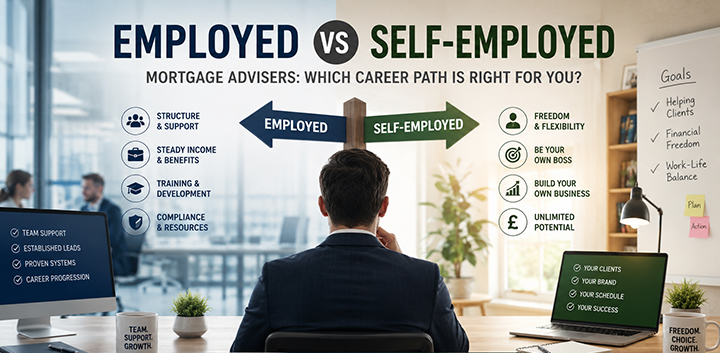
If you are thinking about becoming a mortgage adviser, one of the biggest career decisions you will eventually face is whether to work as an employed adviser or as a self-employed adviser.
Both routes can lead to a successful and rewarding career. Neither is inherently better than the other. The right choice depends on how much structure, support and responsibility you want in your working life.
This guide explains how each model works, what the main differences are, and which type of role may suit your personality and career goals best.
What Is the Difference Between Employed and Self-Employed Mortgage Advisers?
An employed mortgage adviser works for a company and receives a salary or basic income, often with bonuses linked to performance.
A self-employed mortgage adviser runs their own business or operates as an independent contractor, taking responsibility for finding clients, managing costs and organising their own work.
Both types of advisers must hold an appropriate qualification, such as London Institute of Banking & Finance’s CeMAP, and must be authorised to give advice through a firm regulated by the Financial Conduct Authority. CeMAP is the industry standard qualification for UK mortgage advisers and meets the FCA’s educational requirements for giving mortgage advice.
The main difference is how you are paid, how much support you receive, and how much responsibility you take on yourself.
What Does an Employed Mortgage Adviser Do?
An employed mortgage adviser usually works for a business such as:
- A mortgage brokerage
- An estate agency
- A bank or building society
- A financial services firm
In this arrangement, the company provides much of the infrastructure needed to do the job.
This often includes:
- Leads and client enquiries
- Compliance support
- Software and systems
- Administration assistance
- Ongoing training
- Management support
Your focus is mainly on advising clients and progressing mortgage applications.
What Does a Self-Employed Mortgage Adviser Do?
A self-employed adviser performs the same core role but is responsible for running the business side as well.
This may include:
- Generating leads
- Managing marketing
- Paying business costs
- Organising administration
- Handling invoicing
- Managing your own schedule
Many self-employed advisers work as appointed representatives of a network or larger firm. This gives them access to compliance oversight and lender relationships while still operating independently.
In practice, self-employment offers more freedom but also more responsibility.
What Support Does an Employed Adviser Receive?
One of the biggest advantages of employed roles is built-in support.
When you are new to the industry, this can make the learning curve much easier.
Typical support includes:
- Regular coaching
- Structured onboarding
- Technical help
- Compliance guidance
- Team collaboration
- Steady flow of clients
For many newly qualified advisers, this structure provides confidence while they build experience.
What Support Does a Self-Employed Adviser Receive?
Self-employed advisers can still receive support, especially when working under a network or principal firm.
However, support is often less hands-on than in a traditional employed role.
Depending on the arrangement, you may have access to:
- Compliance oversight
- Technology platforms
- Training resources
- Product sourcing tools
- Marketing guidance
The key difference is that you are usually expected to take more initiative and manage your own business decisions.
What Are the Main Risks of Being Self-Employed?
Self-employment introduces additional business responsibilities.
These can include:
- Irregular income
- Marketing costs
- Business overheads
- Administrative workload
- Greater accountability
If you do not generate enough client enquiries, your workload and earnings can be affected.
This does not mean self-employment is unsuitable. It simply requires a different mindset and a willingness to take ownership.
What Are the Main Risks of Being Employed?
Employed roles tend to offer more stability, but they can come with less flexibility.
Possible drawbacks include:
- Set working hours
- Performance targets
- Less control over business decisions
- Restricted choice over processes and systems
Some advisers prefer having a structured environment, while others eventually want more independence.
Which Route Is Better for Newly Qualified Advisers?
For many new advisers, employment is the most straightforward starting point.
The reasons are practical:
- You gain experience in a supported setting.
- You learn compliance processes.
- You develop client skills.
- You build confidence before managing everything yourself.
That said, some people are naturally entrepreneurial and may be comfortable entering self-employment earlier if they have a strong support network and realistic expectations.

Should Mortgage Advisers Be Self-Employed?
Mortgage advisers do not need to be self-employed.
Many advisers build long and successful careers as employees, while others eventually choose self-employment for greater independence.
Whether you should become self-employed depends on your appetite for responsibility, your confidence in generating business and the type of working life you want.
If you prefer structure and support, employed roles are often a better fit.
If you value autonomy and are comfortable managing your own business, self-employment may suit you well.
How Does Day-to-Day Work Differ?
The client-facing advice process is largely the same in both roles.
The difference lies in what happens around the advice.
Employed Adviser Day-to-Day
An employed adviser may spend most of their time:
- Speaking to clients
- Researching mortgage options
- Preparing recommendations
- Liaising with lenders
- Working with administrators
Lead generation, marketing and compliance systems are often handled by the employer.
Self-Employed Adviser Day-to-Day
A self-employed adviser may also need to spend time:
- Networking
- Following up referrals
- Managing marketing
- Reviewing business costs
- Planning workflow
This broader responsibility appeals to some people and feels overwhelming to others.
Which Personality Suits an Employed Role?
Employed roles often suit people who:
- Prefer structure
- Enjoy teamwork
- Value consistent support
- Want to focus mainly on advising
- Feel more comfortable with clear expectations
If you like having established systems and guidance, employment can be an excellent fit.
Which Personality Suits Self-Employment?
Self-employment may suit people who:
- Are self-motivated
- Enjoy independence
- Are comfortable making decisions
- Like building a business
- Can cope with uncertainty
You do not need to be highly extroverted or naturally sales-driven, but you do need to be proactive and organised.
Can You Move from Employed to Self-Employed Later?
Yes, and this is a very common progression.
Many advisers begin in employed roles to gain experience and then move into self-employment once they have:
- Built confidence
- Developed a client base
- Established referral relationships
- Understood the regulatory environment
This route allows you to learn the profession before taking on the added responsibilities of running your own business.

Can You Move Back into Employment?
Absolutely.
Career paths are rarely fixed.
Some advisers try self-employment and later decide they prefer the structure and predictability of employed work.
Others remain employed for their entire careers and are perfectly happy doing so.
Changing direction is normal.
How Do Networks Fit into Self-Employment?
Many self-employed advisers operate through a mortgage network.
A network provides regulatory oversight, compliance systems and access to lenders, while the adviser remains responsible for running their own business.
This arrangement can provide a balance between independence and support.
However, advisers still need to manage the commercial side of their work.
What Matters More Than Employment Status?
Your long-term success is influenced less by your employment model and more by your ability to:
- Build trust with clients
- Understand mortgage products
- Follow compliance rules
- Communicate clearly
- Stay organised
- Continue learning
Both employed and self-employed advisers need these core skills.
How CeMAP Fits into Both Career Paths
Regardless of which route you choose, the starting point is the same.
CeMAP provides the knowledge required to understand:
- Mortgage regulation
- Property law
- Financial products
- The advice process
It is the recognised qualification most employers and networks expect when recruiting new advisers.
Your choice between employed and self-employed usually comes after qualification, not before.

Final Thoughts
The employed and self-employed routes both offer genuine opportunities for mortgage advisers.
Employment provides structure, support and a more predictable environment.
Self-employment offers independence, flexibility and greater personal responsibility.
Neither option is universally better.
If you are just starting out, an employed role can provide valuable experience and confidence.
If you enjoy autonomy and are comfortable running a business, self-employment may become an attractive option later on.
The best choice is the one that fits your personality, goals and preferred way of working.
A mortgage advice career is not defined by how you are engaged. It is defined by the quality of advice you provide and the trust you build with clients.
Looking for training support?
We offer CeMAP training for learners working towards a career in mortgage advice. Our courses follow the London Institute of Banking & Finance syllabus and are designed to support understanding of mortgage regulation and advice requirements.
Explore our accredited CeMAP training courses
> Futuretrend Financial Training