
Choosing a career in mortgage advice is not just about passing exams or gaining a qualification. It is about how you work with people, how you handle responsibility, and how you make decisions that affect real financial outcomes.
A mortgage adviser is someone who helps clients understand their borrowing options and make informed choices. In the UK, this typically involves meeting the qualification requirements set by the Financial Conduct Authority, often through qualifications like CeMAP awarded by the London Institute of Banking & Finance.
But qualifications alone do not define whether someone will feel comfortable or effective in the role. The day-to-day work relies heavily on practical skills and personal traits that develop over time.
This article looks at the key skills and traits that support success in mortgage advice, with a focus on development rather than natural ability.
Do you need strong communication skills to be a mortgage adviser?
Yes. Communication is one of the most important skills in mortgage advice, but it is not about being a confident speaker or a “natural salesperson”.
It is about clarity.
Mortgage advisers deal with complex information, including interest rates, lending criteria, affordability assessments, and legal processes. Clients often come in with limited understanding or with assumptions that are not quite right. Your role is to explain things in a way that makes sense to them.
What good communication looks like in practice
Clear communication in this role usually means:
- Explaining financial concepts in plain language
- Checking understanding rather than assuming it
- Listening carefully before offering solutions
- Adjusting how you explain things depending on the client
For example, one client may want a detailed breakdown of options, while another may feel overwhelmed and prefer a simple comparison.
Listening matters as much as explaining
A common misconception is that communication is mostly about talking. In reality, listening is often more important.
Clients may not always explain their situation clearly at first. They might leave out key details or focus on the wrong concerns. Being able to pick up on what is not being said, and ask the right follow-up questions, is a skill that improves with experience.
This is especially important when discussing sensitive topics such as income, debt, or financial difficulties.
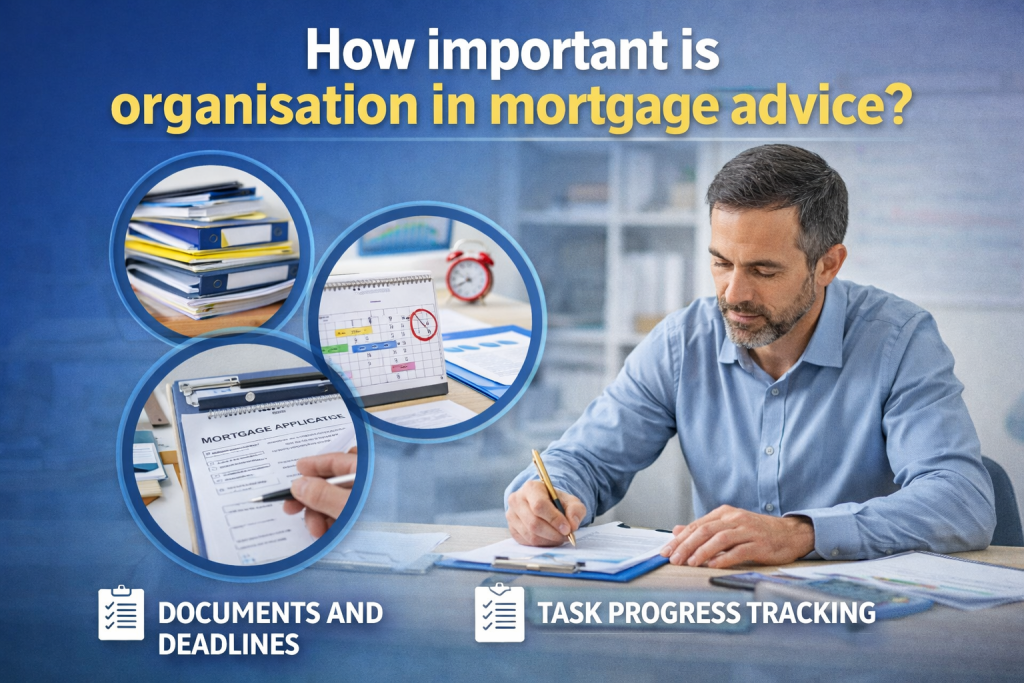
How important is organisation in mortgage advice?
Organisation is essential because mortgage advice involves managing multiple moving parts at once.
You are not just having conversations. You are also:
- Handling documents and evidence
- Tracking application progress
- Meeting lender requirements
- Managing deadlines and client expectations
Without a structured approach, it becomes easy to miss details or create delays.
Why organisation affects client experience
From a client’s perspective, the mortgage process can already feel stressful. Delays, missing paperwork, or unclear updates can make that worse.
An organised adviser helps by:
- Keeping processes moving smoothly
- Providing timely updates
- Reducing uncertainty
This does not mean you need to be naturally “ultra-organised”. Many advisers develop systems over time, using checklists, workflows, and CRM tools to stay on track.
Small habits make a big difference
Organisation in this role often comes down to consistent habits, such as:
- Recording information accurately after meetings
- Following up when you say you will
- Keeping clear notes on each case
These are learnable behaviours rather than fixed traits.
What kind of judgement do mortgage advisers need?
Mortgage advisers regularly make judgement calls, even within structured rules and regulations.
This includes:
- Assessing which mortgage products may suit a client’s situation
- Deciding how to present options clearly
- Identifying potential risks or complications
While lenders provide criteria, real client situations are not always straightforward.
Judgement is about applying knowledge, not guessing
Good judgement does not mean relying on instinct alone. It comes from:
- Understanding how different lenders operate
- Recognising patterns in client situations
- Knowing when something needs further clarification
Over time, advisers build a sense of what is likely to work and what may cause issues later in the process.
Knowing when to slow down
An important part of judgement is recognising when not to rush.
If something does not seem clear or complete, taking time to check details can prevent larger problems later. This might mean going back to the client for more information or double-checking lender criteria.
Why does empathy matter in mortgage advice?
Empathy plays a central role because mortgages are not just financial transactions. They are tied to major life events.
Clients may be:
- Buying their first home
- Moving due to family changes
- Dealing with financial pressure
- Unsure about long-term commitments
Understanding how someone feels about their situation helps you communicate more effectively and provide appropriate support.

Empathy is about awareness, not emotion
You do not need to be overly emotional to be empathetic. It is more about recognising:
- When a client feels uncertain or anxious
- When they need reassurance or clarity
- When to slow down and explain things more carefully
A calm and respectful approach often matters more than trying to be overly reassuring.
Building trust through understanding
Clients are more likely to trust advice when they feel understood. This trust is important because they are relying on you to guide them through decisions that may affect them for years.
Empathy supports that trust, but it develops naturally through experience and exposure to different client situations.
What does professionalism mean in this role?
Professionalism in mortgage advice is about consistency, responsibility, and clear boundaries.
It includes:
- Being accurate and careful with information
- Following regulatory requirements
- Communicating clearly and honestly
- Managing expectations appropriately
Why professionalism is critical
Mortgage advisers operate within a regulated environment. The standards set by the Financial Conduct Authority are there to protect clients.
This means professionalism is not optional. It is part of the role.
For example, this includes:
- Avoiding misleading statements
- Ensuring advice is suitable for the client
- Keeping records of recommendations
Professional behaviour builds long-term credibility
Clients may not always understand the technical side of what you do, but they do notice how you behave.
Reliability, honesty, and clarity contribute to a professional reputation over time.
Can these skills be developed, or do you need them already?
These skills can be developed. They are not fixed traits that you either have or do not have.
This is an important point, especially for people considering whether mortgage advice is the right fit.
Development happens through experience
Most advisers improve their skills through:
- Training and structured learning
- Practical experience with real clients
- Feedback from managers or mentors
For example:
- Communication improves through repeated client conversations
- Organisation improves through building systems and routines
- Judgement improves through exposure to different cases
Confidence often follows competence
Many people assume they need confidence before starting. In reality, confidence tends to grow as skills improve.
Early on, it is normal to feel unsure or cautious. Over time, as processes become familiar, confidence develops naturally.
What skills do mortgage advisers need overall?
Mortgage advisers need a combination of communication, organisation, judgement, empathy, and professionalism.
No single skill defines success. Instead, it is how these areas work together.
In simple terms:
- Communication helps clients understand
- Organisation keeps the process on track
- Judgement supports decision-making
- Empathy builds trust
- Professionalism ensures standards are met
These are practical, developable skills rather than fixed personality traits.

Final thoughts
Mortgage advice is a people-focused role built on clear thinking and responsible communication.
It does not require a specific personality type or a perfect starting point. What matters more is a willingness to learn, adapt, and improve over time.
If you are assessing whether the role suits you, it is worth focusing less on whether you already have these skills and more on whether you are open to developing them.
That mindset tends to matter far more in the long run.
Looking for training support?
We offer CeMAP training for learners working towards a career in mortgage advice. Our courses follow the London Institute of Banking & Finance syllabus and are designed to support understanding of mortgage regulation and advice requirements.
Explore our accredited CeMAP training courses
> Futuretrend Financial Training